The Gordie Howe Bridge Is a Development Story, Not Just a Traffic Story
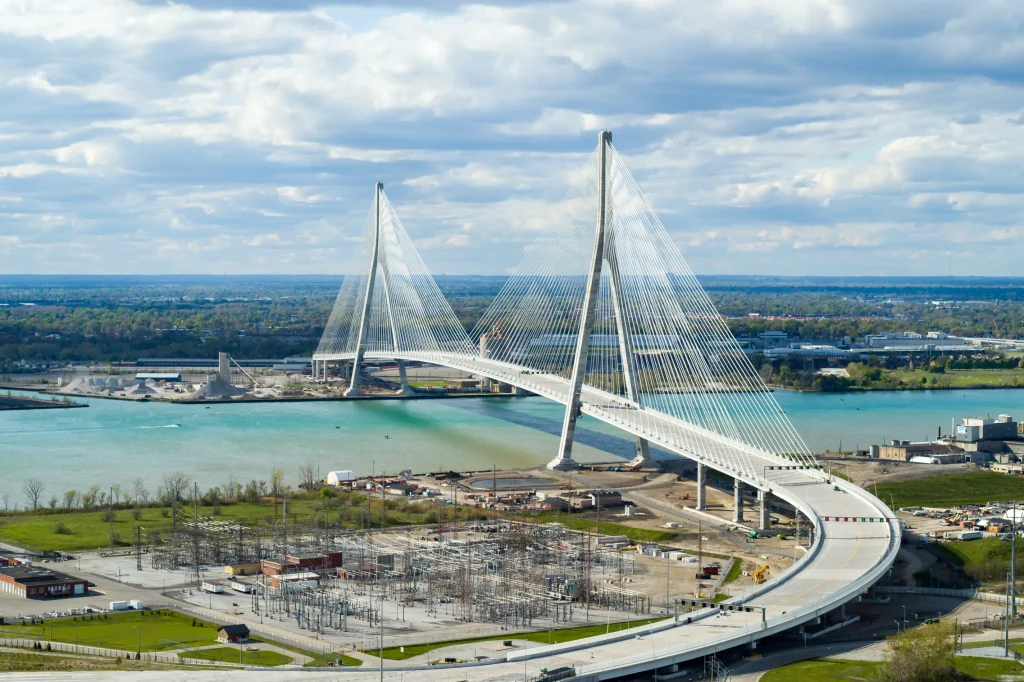
Most coverage of the Gordie Howe International Bridge will treat it as a transportation milestone. I see it as something bigger: a generational reset of land value, logistics capacity, and growth potential along one of the busiest borders in the world. When a six-lane cable-stayed crossing opens between Detroit and Windsor after years of planning and roughly CA$6.4 billion in investment, that is not just infrastructure news. That is a signal to every developer, planner, and investor watching the Detroit River corridor.
The bridge stretches about 2.5 kilometers across the river, with an 853-meter main span connecting Interstate 75 directly to Ontario Highway 401. That direct freeway-to-freeway link matters more than its length. Roughly a quarter of all truck trade between the United States and Canada moves through this corridor, and a faster, higher-capacity alternative to the aging Ambassador Bridge changes the calculus for where warehousing, manufacturing, and logistics parks make sense on both sides of the water.
Land near new border infrastructure tends to move in predictable stages. First comes the freight and industrial demand, as companies reposition distribution facilities closer to the improved crossing. Then comes the housing pressure, as workers and suppliers follow the jobs. Windsor and the surrounding Essex County market has spent years anticipating this shift, and now that vehicles are actually moving across the span, the feasibility conversations around adjacent commercial and residential parcels get a lot more concrete. Detroit’s side of the river, long overshadowed by downtown redevelopment narratives, gains a fresh argument for renewed attention as well.
Strong projects are built from understanding timing, access, infrastructure, policy, and demand together, not in isolation.
It is worth being honest about the friction here too. The opening was clouded by tariff disputes and revenue-sharing disagreements serious enough that the two countries could not manage a joint ribbon cutting. Canadian officials, including Ontario Premier Doug Ford, framed the bridge as a long-term investment in trade and regional prosperity, while U.S. officials sat out the ceremony entirely. That kind of political friction is normal around major cross-border infrastructure, and it rarely slows the underlying economic gravity for long. Toll pricing was also set with commercial volume in mind, with passenger vehicles paying US$5.75 and commercial trucks charged per axle, a structure designed to keep freight moving rather than to maximize short-term revenue.
For anyone tracking land value and development strategy in the Great Lakes region, the real story is not the ribbon cutting, it is the decade that follows. New customs facilities, expanded freeway connections, and a dedicated pedestrian and cycling path all point to a corridor being built for sustained growth rather than a single traffic bottleneck fix. Cities do not transform on opening day. They transform on the decisions made in the years after the cameras leave, and this crossing has just handed both Windsor and Detroit a much stronger hand to play.
Source: parametric-architecture.com