



Artificial intelligence is changing the way homes are valued, but not in the simplistic way many headlines suggest. The most important shift is not that machines are suddenly replacing appraisers or making human judgment obsolete. The real change is operational. AI is helping lenders, appraisers, buyers, sellers, and investors process more information faster, apply more consistent valuation logic, and make pricing decisions with better visibility into risk. In a market where timing, accuracy, and trust matter, that is a meaningful upgrade.
Table Of Content
- Why Property Valuation Was Ready for Reinvention
- What AI Looks Like in Property Valuation Today
- The Practical Benefits: Speed, Cost, and Scale
- Case Study 1: Mortgage Lending and the Rise of Appraisal Alternatives
- Case Study 2: Property Data Collection as the New Valuation Infrastructure
- Case Study 3: Desktop and Hybrid Appraisals in Real Workflows
- Case Study 4: Canada and the North American Shift Toward Flexible Valuation
- Where AI Works Best and Where It Still Struggles
- Why Data Quality Matters More Than Model Hype
- The Regulatory Turning Point: AI Needs Guardrails
- The Emerging Importance of Confidence Scores and Explainability
- Common Misconceptions About AI in Property Valuation
- What This Means for Buyers, Sellers, Investors, and Appraisers
- The Future of Real Estate Pricing Will Be Hybrid
- Final Thoughts
Property valuation has always been part science and part judgment. A home is not just a set of numbers, yet pricing decisions depend on measurable factors such as comparable sales, neighborhood trends, condition, square footage, lot size, school access, and mortgage market conditions. Traditional appraisal workflows can capture many of these variables well, but they can also be slow, expensive, and uneven when data is fragmented. AI steps into that gap by strengthening the intelligence layer behind valuation. It organizes signals that humans struggle to process at scale and surfaces insights that support faster decision-making.
Across North America, this shift is already visible in automated valuation models, desktop appraisals, hybrid appraisals, appraisal waivers, and property data collection tools. Major institutions are not framing this as a fully automated future for every property. Instead, they are building a valuation spectrum. At one end are data, model, and technology-driven processes that work well for lower-risk, data-rich properties. At the other are traditional appraisal-driven methods that remain necessary for complex homes and harder-to-model markets. This blended approach is where AI is making its biggest practical impact.
There is also a financial story behind the technology. Fannie Mae says its appraisal alternatives have supported 5.34 million loans sold and generated $3 billion in borrower savings since 2018. That number matters because it translates AI-enabled valuation from theory into direct market efficiency. Faster closings, lower friction, and reduced costs are not abstract benefits. They change how real transactions move through the housing system.
This article explores how AI is transforming property valuation in practice. It looks at where the technology is already working, where it still needs human support, and why regulation, data quality, and fairness now matter as much as algorithmic speed. The future of real estate pricing is not a black box. It is a more supervised, data-driven, and increasingly hybrid system that uses AI to make valuation more scalable without losing accountability.
Why Property Valuation Was Ready for Reinvention
Real estate valuation has long faced a structural challenge. Every property is local, but the lending and investment systems around property are industrial in scale. Mortgage lenders need reliable collateral estimates quickly. Investors need current values across large portfolios. Borrowers want affordable transactions. Appraisers need time and credible data to deliver quality reports. When those needs collide, the result is pressure on cost, speed, and consistency.
Traditional appraisals remain essential, especially for unusual or high-risk properties, but the process can be slow when demand spikes. A field inspection has to be scheduled, the appraiser gathers comparable sales, verifies physical condition, analyzes market context, and prepares a report. That process is rigorous, but it is also labor-intensive. In active markets, delays can ripple through loan pipelines and create frustration for both borrowers and lenders.
AI enters this environment as a scaling tool. It can sort through massive transaction datasets, identify patterns in comparable sales, flag inconsistencies in property records, and estimate value ranges in seconds rather than days. It can also help standardize inputs so that valuation decisions depend less on fragmented records and more on structured, comparable data. This makes the overall workflow more efficient, especially when the property is relatively standard and market data is deep.
The timing makes sense. Housing data has become richer, cloud systems have matured, geospatial tools are stronger, and lenders increasingly operate through digital mortgage pipelines. In that context, AI is not disrupting a static process. It is connecting pieces that were already moving toward digitization. The valuation function simply happens to be one of the highest-impact places to apply those tools.
What AI Looks Like in Property Valuation Today
When people hear the phrase AI property valuation, they often imagine a single algorithm spitting out a price. In reality, the ecosystem is broader and more practical. AI appears in several layers of the workflow, from data collection and image analysis to model-based estimates, confidence scoring, quality control, and review support. It is less about one model taking over and more about many tools improving how value is estimated and verified.
The best known application is the automated valuation model, or AVM. An AVM uses data such as prior sales, tax assessments, location signals, listing history, and nearby comparable transactions to generate a computer-based estimate of value. AVMs can be extremely useful for lower-risk lending scenarios, prequalification, refinancing screens, portfolio monitoring, and early-stage underwriting decisions. They are fast and scalable, which makes them attractive in modern mortgage operations.
Another major use case is the desktop appraisal. Fannie Mae explicitly ties desktop appraisal processes to advanced analytics and technology, allowing qualified appraisals to be completed without a physical in-person property inspection in certain scenarios. Instead of visiting the property, the appraiser reviews digital records, standardized property data, photos, floor plans, maps, and market evidence. AI helps by organizing those inputs, surfacing comparables, and highlighting anomalies that merit closer review.
Then there are hybrid appraisal workflows, where data collection is performed separately and the appraisal analysis is completed by a licensed appraiser. In these models, AI often supports the intake, validation, and consistency checking of property data. This approach matters because it preserves human judgment while reducing repetitive workflow burdens. It also creates a more structured bridge between full appraisal and fully model-driven estimates.
Finally, AI is increasingly used in quality control. Lenders and secondary market participants use model outputs and review systems to test whether an appraisal appears consistent with local market evidence, whether comparable sales are reasonable, and whether there are indications of missing or unreliable information. In that sense, AI does not only produce values. It also helps evaluate the credibility of the valuation process itself.
The Practical Benefits: Speed, Cost, and Scale
The most immediate advantage of AI-driven valuation is speed. Traditional valuation steps that once took days can now be initiated or partially completed within minutes. Comparable sales can be surfaced automatically. Geospatial factors can be layered into the analysis quickly. Property records can be cross-checked across multiple databases. For borrowers, this often means fewer delays between application and underwriting decision. For lenders, it means less operational drag and better throughput.
Cost is the second major benefit. Fannie Mae reports that its appraisal alternatives have supported 5.34 million loans sold and $3 billion in borrower savings since 2018. That is one of the clearest real-world indicators that technology-enabled valuation is not simply a back-office convenience. It has measurable consumer impact. Lower valuation-related costs can improve affordability at the transaction level, especially in refinance scenarios or lower-risk originations where a full traditional appraisal may not always be necessary.
Scale is the third advantage, and it is often underestimated. Large lenders and investors do not just value one property at a time. They manage pipelines, servicing portfolios, securitized assets, and loss mitigation decisions across thousands or millions of homes. AI allows them to update valuation views more frequently and at lower cost than a fully manual process would permit. That matters in shifting rate environments or volatile local markets where stale values create risk.
There is also a consistency benefit. Humans are capable of excellent judgment, but manual workflows are vulnerable to variation in process and documentation. Structured data collection, model-driven checks, and AI-assisted review can reduce random inconsistency. That does not guarantee correctness, but it improves standardization, which is a critical feature in mortgage and collateral systems.
AI is changing valuation most effectively where the property is ordinary, the data is rich, and the workflow needs to move quickly without losing control.
Case Study 1: Mortgage Lending and the Rise of Appraisal Alternatives
The clearest real-world case study comes from the mortgage market. In lending, valuation is not an academic exercise. It directly affects loan approval, collateral risk, pricing, and salability. Because of that, lenders have strong incentives to improve valuation efficiency without weakening safeguards. This is exactly where AI-assisted valuation has gained traction.
Fannie Mae’s current framework illustrates the shift well. It separates valuation methods along a spectrum, with data, model, and technology-driven value acceptance on one side and appraisal-driven value determination on the other. That framing is important because it acknowledges that not every loan requires the same valuation treatment. Some transactions are lower risk, backed by strong data, and suitable for streamlined processes. Others still need traditional appraisal analysis.
In practical terms, lenders may use appraisal waivers, desktop appraisals, or property data collection-supported workflows when the property and transaction profile fit program criteria. AI helps in these settings by validating available records, estimating value ranges, screening for inconsistencies, and flagging cases where confidence is too low for a streamlined path. Instead of forcing every file into the same expensive process, technology helps match the valuation method to the risk profile.
The savings figures underscore how meaningful this has become. When millions of loans can move through alternatives that save time and money while maintaining oversight, the market starts to change structurally. Borrowers experience less friction. Lenders improve cycle times. Appraisers can focus more of their effort on the assignments that genuinely require deeper professional judgment. This is a strong example of AI improving workflow allocation rather than simply replacing labor.
Case Study 2: Property Data Collection as the New Valuation Infrastructure
One of the most underappreciated changes in valuation is the growing importance of standardized property data collection. Fannie Mae describes property data collection as a foundational input not only for appraisals, but also for AVMs, market analysis, investment decisions, regulatory compliance, and quality control. That statement captures a key truth about AI in real estate: models are only as useful as the information feeding them.
Historically, property details could be inconsistent across listing systems, county records, appraisal files, and lender databases. Small discrepancies in living area, renovation quality, condition, room count, or lot features could materially affect valuation outcomes. AI can help identify these inconsistencies, but it cannot fix missing reality on its own. That is why structured field data collection has become so important. Better data does not just improve one appraisal. It strengthens the entire valuation ecosystem.
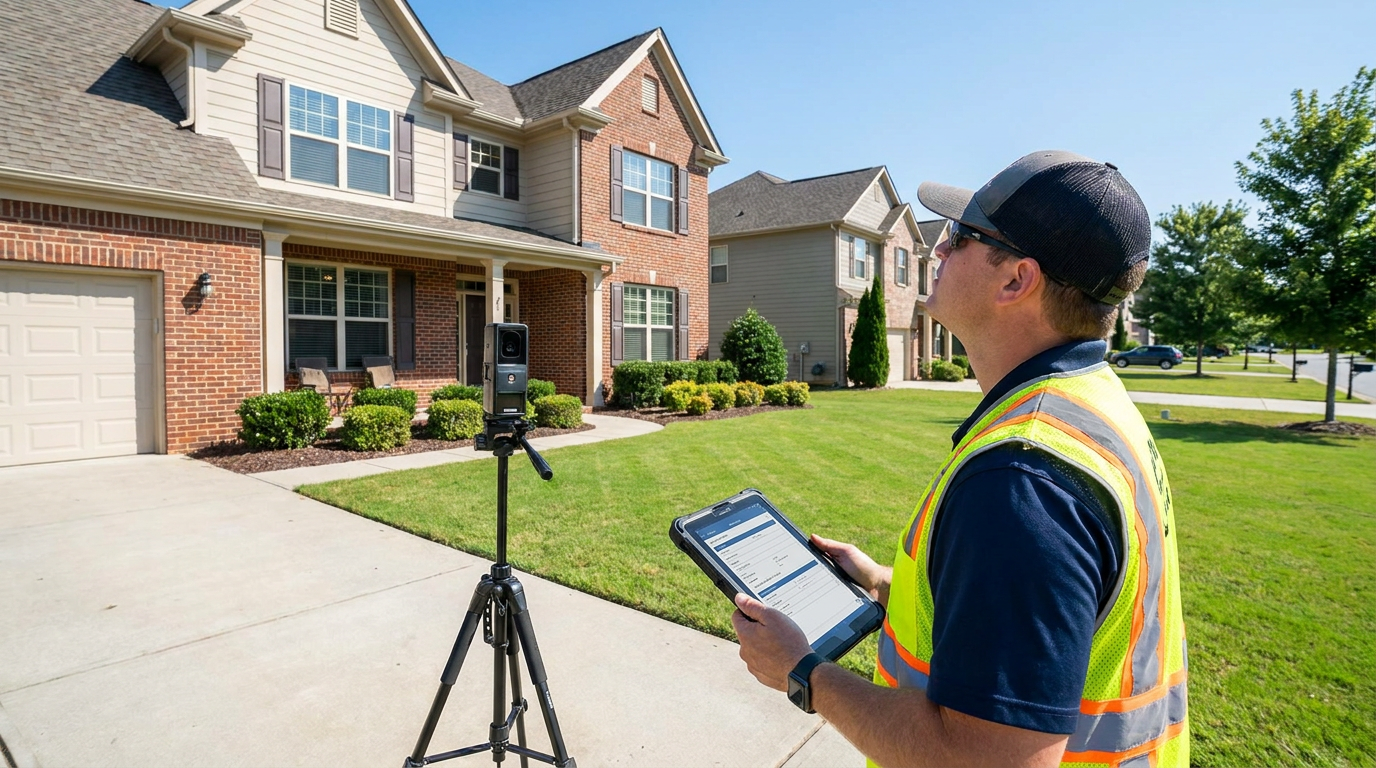
In a practical workflow, a trained collector may capture photos, condition notes, exterior details, and key property attributes using a standardized digital process. AI systems can then check that data for completeness, compare it to existing records, and feed it into valuation models or appraisal review tools. This creates a cleaner chain from property observation to value conclusion. It also supports more defensible desktop and hybrid valuations.
For investors and servicers, the value goes even further. Standardized property data improves portfolio analytics, loss mitigation decisions, and quality control reviews. A lender managing distressed assets or monitoring geographic risk exposure benefits from having valuation-relevant data that is comparable across properties. In that sense, AI-powered valuation begins with disciplined data architecture, not only with predictive modeling.

Case Study 3: Desktop and Hybrid Appraisals in Real Workflows
Desktop and hybrid appraisals are some of the most practical examples of AI reshaping valuation without removing the appraiser from the process. In a desktop appraisal, the licensed appraiser may never inspect the property in person. Instead, the appraiser relies on high-quality digital inputs, including standardized property data, photographs, maps, floor plans, public records, and recent comparable sales. AI helps organize these inputs and prioritize what deserves attention.
This matters because a large share of appraisal work is not inherently about being physically present at every property. Much of it is analytical. It involves interpreting market evidence, adjusting comparables, testing consistency, and reconciling value indications. If the property data is reliable, some of that work can be completed effectively from a desk. AI accelerates this by surfacing relevant comps faster, identifying outliers, and supporting appraisal review logic.
Hybrid models go one step further by splitting the physical observation and analytical interpretation into linked stages. A third-party professional may collect on-site property data, while the appraiser performs the valuation analysis remotely. This design allows appraisers to spend more time on judgment-intensive work and less time on travel and repetitive documentation. It also gives lenders a more scalable operating model when transaction volume rises.
These workflows are not universal solutions. Their effectiveness depends on the property type, available market data, and confidence in the collected information. Still, for many standard suburban homes in active markets, desktop and hybrid methods can deliver strong results with lower friction. This is where the practical value of AI is clearest: it reallocates effort toward interpretation instead of clerical or logistical bottlenecks.
Case Study 4: Canada and the North American Shift Toward Flexible Valuation
Although much of the public discussion comes from the United States, the valuation shift is broader than one country. In Canada, CMHC underwriting materials reference third-party valuation products including AVMs and low-ratio valuation products. That suggests a regional pattern rather than an isolated experiment. Institutions across North America are moving toward more flexible valuation options where the risk profile and data environment support them.
This does not mean every market is equally digitized or that regulatory frameworks are identical. What it does mean is that the logic behind AI-assisted valuation is becoming widely accepted. Lenders want faster and more standardized workflows. Borrowers want a smoother process. Investors want better reporting and more timely value updates. AI and standardized data products help meet those demands in both U.S. and Canadian contexts.
There is also a strategic reason for this shift. Housing markets across North America vary dramatically by region, price band, property type, and liquidity. A flexible valuation framework allows institutions to use lighter-touch methods where appropriate while preserving full appraisal rigor for more complex cases. That is a more efficient use of both technology and professional expertise.
For readers tracking the bigger market story, this is the key point: AI valuation is not a niche proptech add-on anymore. It is becoming part of the mainstream mortgage and collateral infrastructure, shaped by large institutions, underwriting rules, and shared data standards.
Where AI Works Best and Where It Still Struggles
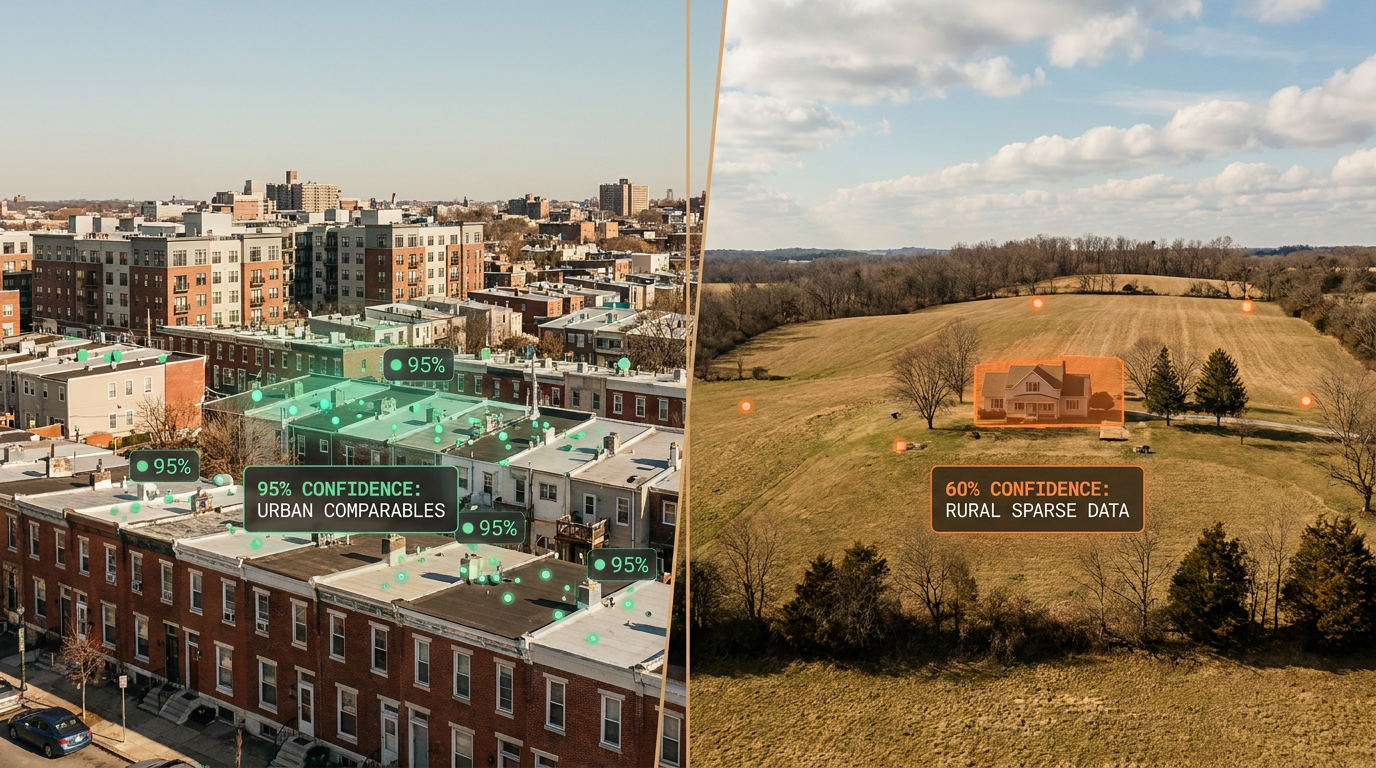
AI valuation performs best when three conditions are present. The first is strong data availability. The second is a relatively standard property that looks similar to many nearby homes. The third is a market with enough recent transactions to provide reliable comparables. In these settings, models tend to have more stable inputs and can estimate value with greater confidence.
Urban and suburban neighborhoods with homogeneous housing stock are often good examples. If dozens of similar homes have sold recently within a small radius, an AVM has a robust evidence base. Desktop or hybrid workflows also become more practical because digital records and comparable sales are easier to validate. Lenders can feel more comfortable using streamlined methods when the market gives the model enough signal.
AI struggles more in thin-data environments. Rural areas are a well-known challenge, and FHFA research has specifically examined AVM accuracy issues in these markets. When sales are sparse, homes are spread apart, and properties vary widely in features or land characteristics, comparable analysis becomes harder for both humans and machines. Models may produce outputs with lower reliability because there is simply less evidence to work with.
Unique or luxury homes present another challenge. A custom-built property with unusual architecture, significant acreage, rare amenities, or atypical market appeal may not fit neatly into model logic. Even if the algorithm processes extensive data, it may still fail to capture the qualitative factors that affect what a buyer would actually pay. In these cases, experienced appraiser judgment remains indispensable.
Why Data Quality Matters More Than Model Hype
One of the most important truths in AI valuation is also the least glamorous: data quality determines credibility. Appraisal Institute commentary has stressed that no valuation model can be reliable if it is fed flawed information. That principle applies whether the model is created by an AVM vendor, an appraiser, or a lender’s internal analytics team. Bad inputs do not become good outputs because the software is advanced.
Property data can fail in multiple ways. Records may be outdated. Renovations may be missing. Finished basements may be coded inconsistently. Square footage may differ across sources. Prior listing descriptions may exaggerate condition or amenities. Local data standards may vary. If these issues are not detected, the valuation process inherits hidden error. AI can sometimes spot anomalies across sources, but it still needs a trustworthy baseline.
This is why the market is investing so heavily in standardized property data, confidence scoring, and quality-control frameworks. The goal is not simply to make models faster. It is to make them auditable and dependable. A quick value estimate is only useful if users can understand how much trust to place in it. That is where confidence metrics and validation procedures become crucial.
For buyers and sellers, the lesson is simple. A digital estimate may be informative, but it should not be treated as equally authoritative in every context. For lenders and institutional users, the lesson is stricter. Model governance, input controls, exception handling, and periodic testing are no longer optional features. They are core infrastructure.
The Regulatory Turning Point: AI Needs Guardrails
As AI becomes more embedded in valuation, regulators are moving from observation to formal oversight. In 2024, U.S. federal regulators finalized quality control standards for AVMs, with the rule taking effect on October 1, 2025. The agencies involved include the FHFA-related federal banking framework participants and key financial regulators. This is a significant milestone because it confirms that AI-assisted valuation has become important enough to require explicit risk controls.
The rule requires institutions that use AVMs in certain mortgage credit or securitization decisions to maintain policies and procedures designed to support confidence in the estimates, protect against data manipulation, avoid conflicts of interest, use random sample testing and reviews, and comply with nondiscrimination laws. That is a broad governance framework, and it addresses many of the exact risks critics have raised about algorithmic valuation.
The CFPB has made a similar point from a consumer protection perspective. Algorithmic appraisal tools can provide useful insight, but they can also produce inaccurate or discriminatory outcomes if model design and underlying data are flawed. That warning matters because AI is often misunderstood as inherently objective. In practice, models reflect the structure of the data they learn from and the assumptions built into them. Bias does not disappear automatically when a decision is digitized.
This regulatory environment should be read as a sign of maturation, not rejection. The market is not stepping away from AI valuation. It is institutionalizing rules around accountability. That is what happens when a technology moves from experimentation into critical infrastructure. Real estate pricing is too consequential to leave unmanaged.
The Emerging Importance of Confidence Scores and Explainability
A raw value estimate is not enough, especially in professional settings. Users also need to know how reliable that estimate appears to be. This is why confidence scoring is becoming a central topic in valuation technology. Industry discussion around MISMO’s AVM Common Confidence Score reflects an effort to make reliability signals more comparable across vendors. That may sound technical, but it solves a very practical problem.
If two AVM providers estimate the same home differently, a lender needs a way to interpret not only the values but also the strength of the supporting evidence. A standardized confidence framework helps users compare outputs more intelligently. It can also support workflow routing. A high-confidence result may proceed through a streamlined path, while a low-confidence result may trigger a desktop review or full appraisal.
Explainability is closely related. Users want to understand what drove a valuation result. Which comparables mattered most? Were there missing data issues? Did the model detect market volatility, sparse sales, or conflicting records? Explainability does not always mean exposing every technical detail of a proprietary model. It means giving decision-makers enough context to use the output responsibly.
In the long term, confidence scoring and explainability may become as important as the estimate itself. They are what turn AI valuation from a mysterious calculation into a usable professional tool. The future is not just automation. It is interpretable automation with workflow logic built around trust levels.
Common Misconceptions About AI in Property Valuation
One of the biggest misconceptions is that AI valuation means a fully automated process with no human involvement. In reality, most real-world deployments are hybrid. Human review, standardized data collection, appraisal expertise, and risk controls remain integral parts of the system. AI is changing who does what, but it is not eliminating the need for professional oversight.
Another misconception is that AVMs and appraisals are interchangeable. They are not. An AVM is a computer-generated estimate based on data and model logic. An appraisal is a professional opinion of value produced within a defined appraisal framework and often supported by inspection and judgment. The two can complement each other, but they serve different roles and carry different implications.
A third misconception is that more data automatically means better valuation. More data only helps when it is accurate, relevant, and consistent. Poorly structured or biased data can degrade model performance rather than improve it. This is why disciplined property data collection and quality control matter so much in the AI era.
The final misconception is that AI naturally removes bias. Regulators have already made clear that algorithmic systems can amplify discrimination if they are not properly governed. Fair-lending compliance, random testing, conflict controls, and nondiscrimination requirements are not side issues. They are central to responsible valuation technology.
What This Means for Buyers, Sellers, Investors, and Appraisers
For buyers, AI-assisted valuation can mean a faster mortgage experience and, in some cases, lower transaction costs. It can also mean more pricing transparency early in the process. But buyers should understand that digital estimates are context-dependent. A number generated quickly is useful, yet it should be interpreted alongside market realities and loan-specific requirements.
For sellers, AI changes how pricing expectations are formed. Listing strategies increasingly draw from automated estimates, neighborhood trend dashboards, and comparative analytics tools. That can improve initial pricing discipline, though sellers of unusual homes may still find that model outputs fail to capture important nuances. Human interpretation remains critical where the property does not fit the statistical norm.
For investors, the benefits are especially strong. AI enables more frequent portfolio revaluation, sharper market surveillance, and better scenario testing. Funds, lenders, and institutional owners can monitor risk across many assets without relying solely on periodic manual reviews. This creates a more responsive asset management environment, particularly when rates or local conditions shift.
For appraisers, the long-term implication is not irrelevance but role evolution. Repetitive tasks, basic screening, and some lower-risk assignments may continue to be streamlined. At the same time, appraisers become even more valuable in complex properties, disputed values, exception cases, and markets where data is weak. The profession’s comparative advantage moves further toward analysis, judgment, and credibility rather than routine data gathering alone.
The Future of Real Estate Pricing Will Be Hybrid
The strongest takeaway from today’s market is that the future of property valuation is not purely automated and not purely traditional. It is hybrid. Data-rich, lower-risk properties will increasingly move through AI-supported valuation paths that reduce friction and cost. Complex, unusual, or thin-data properties will continue to require appraiser-led analysis. Between those ends of the spectrum, a growing set of desktop, hybrid, and review workflows will connect model outputs with human expertise.
This hybrid future is more than a compromise. It is a better design for the realities of housing. Real estate is too diverse for one valuation method to fit every situation. AI performs best when it is used as a system for triage, standardization, pattern detection, and support. Human professionals perform best when judgment, local context, and nuance matter most. A modern valuation framework uses both accordingly.
Over the next few years, the most important developments will likely center on data governance, standardized confidence measures, explainability, and regulatory compliance. As these layers improve, trust in AI valuation will grow. Not because the technology becomes magical, but because the market becomes better at supervising it. That is the real path to scale.
In practical terms, AI is already revolutionizing property valuation by making the pricing process faster, more efficient, and more data-aware. Its greatest success is not that it can produce a number quickly. It is that it can help the real estate industry decide when that number is strong enough to act on, when it needs review, and when a human expert should take the lead. That is a far more useful revolution than automation alone.
Final Thoughts
Property valuation is entering a more intelligent era. AI is not removing uncertainty from real estate, but it is changing how uncertainty is measured, managed, and communicated. That shift matters for everyone involved in housing, from first-time buyers and homeowners to lenders, appraisers, and large investors.
The most credible vision of the future is one grounded in evidence rather than hype. We already know that AI-assisted valuation can reduce borrower costs, speed up lending workflows, and improve standardization in suitable cases. We also know that data quality, fairness, and human oversight remain non-negotiable. The institutions shaping this market are not abandoning appraisal discipline. They are rebuilding valuation around a more scalable intelligence layer.
If real estate pricing used to depend on scattered records and slower interpretation, the next phase will depend on cleaner data, stronger models, and clearer confidence signals. That does not make valuation simple. It makes it more structured. And in a market where one number can influence a purchase, a refinance, an investment decision, or a family’s financial future, better structure is exactly what progress should look like.



No Comment! Be the first one.