M City’s Next Phase: How Mississauga’s Tallest Towers Signal a Master-Planned Community Coming Into Focus
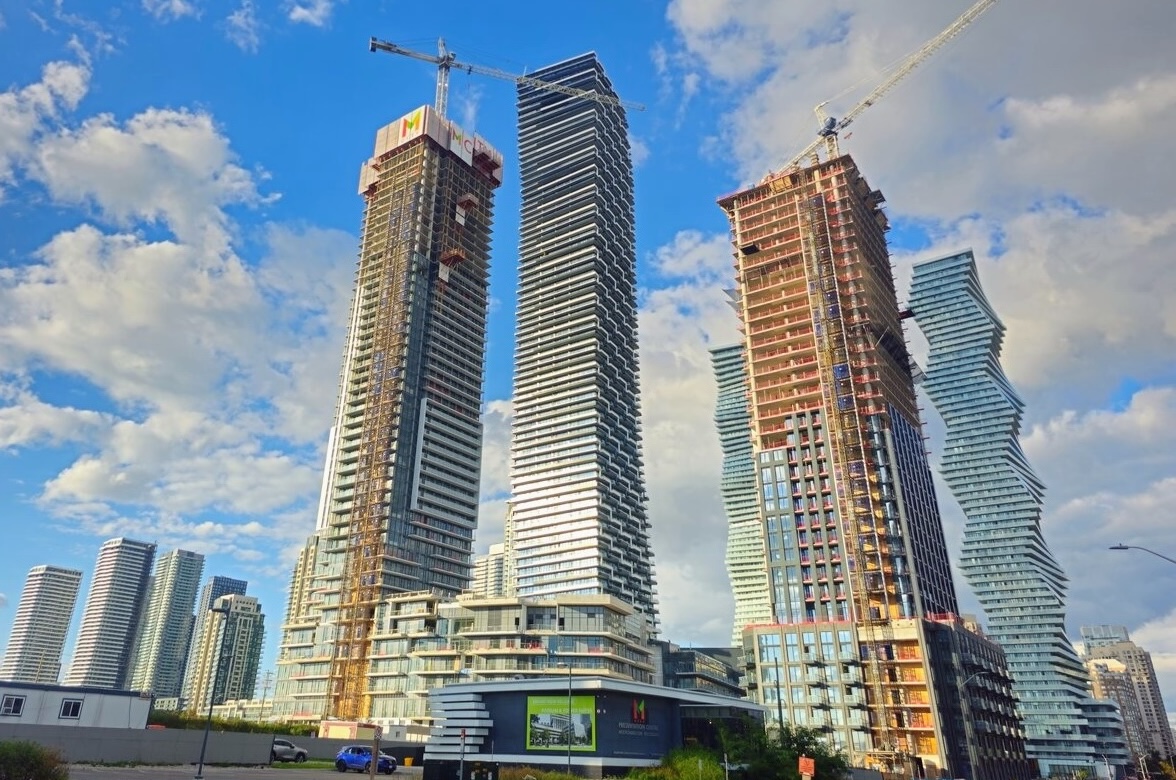
Mississauga City Centre is in the middle of one of the most consequential build-outs in the Greater Golden Horseshoe, and the latest construction milestones at M City make the scale of that ambition impossible to ignore. M3, now Mississauga’s tallest building at 260.29 metres across 77 storeys, has topped off and had its crane dismantled. Beside it, M4 is climbing past the 50-storey mark toward an eventual 215.6 metres, and M5 is approaching its own topping off at 35 storeys. This is not a single tower story. It is a master-planned community asserting itself floor by floor.
What makes M City worth watching from a development strategy lens is not just the height of any one tower but the sequencing. Rogers Real Estate Development and Urban Capital Property Group are not delivering a single asset and moving on. They are stacking phases, with M3, M4, and M5 together bringing 2,333 condominium units to market, while cleared land nearby is already earmarked for M6, M7, and M8, adding a further 57, 45, and 50 storeys to the skyline in future phases. That is the hallmark of disciplined land strategy: securing a large assembled site, phasing delivery to match absorption and financing capacity, and letting each completed tower build market confidence for the next.
There is also an infrastructure story embedded in the engineering choices here. M3’s crown houses a three-storey chamber for a 705-tonne tuned mass damper, a serious structural investment that reflects the realities of building supertall towers in a secondary downtown rather than a traditional financial core. Decisions like that are not incidental. They are the kind of long-horizon planning that determines whether a tall building remains viable and comfortable decades from now, and they tell us something about how seriously this site is being treated as a permanent fixture of Mississauga’s skyline rather than a one-off trophy project.
Strong projects are built from a wider understanding of timing, access, infrastructure, policy, demand, and the future identity of a community.
For anyone tracking housing supply in the 905 region, M City is a useful case study in what concentrated vertical growth around transit-adjacent city centres can look like when a developer commits to a multi-decade site rather than a single building. Nearly 2,400 homes from just three towers, with three more phases already queued on adjacent land, is the kind of density that reshapes a municipality’s housing trajectory and its tax base at once. Mississauga City Centre has spent years positioning itself as a second downtown for the region, and M City’s progress this fall is tangible proof that the plan is advancing on schedule, tower by tower.
Source: UrbanToronto, “M3 Topped Off While M4 and M5 Are Climbing at M City in Mississauga”