


Why RealPage’s Purchase of Cherre Signals the Next Phase of Real Estate Intelligence
Every housing decision, whether it is a single lease renewal or a billion dollar portfolio reallocation, is only as good as the data underneath it. That is the quiet truth behind RealPage’s completed acquisition of Cherre, a real estate data intelligence company whose technology now becomes part of RealPage’s AI-enabled software platform. Financial terms were not disclosed, but the strategic logic is easy to read: connected data, not just more data, is what actually moves institutional decision-making forward.
Cherre’s core contribution is not flashy. It resolves fragmented real estate records, pulled from leasing systems, asset management platforms, and investment tools, into standardized, governed datasets. That governance layer matters more than it sounds. Before any AI model can be trusted with a portfolio decision, it needs a consistent definition of what a property even is across every system that touches it. Cherre reportedly resolves more than four billion real estate entities representing roughly four trillion dollars in assets, which gives a sense of the scale institutional owners are working with when their records do not line up.
“AI can transform real estate only if it understands real estate,” said Dirk Wakeham, president and chief executive officer of RealPage. That framing gets at something I see constantly in property intelligence work: the algorithm is rarely the bottleneck. The bottleneck is dirty, disconnected, or duplicated data feeding it. RealPage already serves more than 42,000 customers managing approximately 24 million housing units worldwide, so layering Cherre’s identity resolution and governance underneath that base is less about adding a feature and more about reinforcing the foundation everything else sits on.
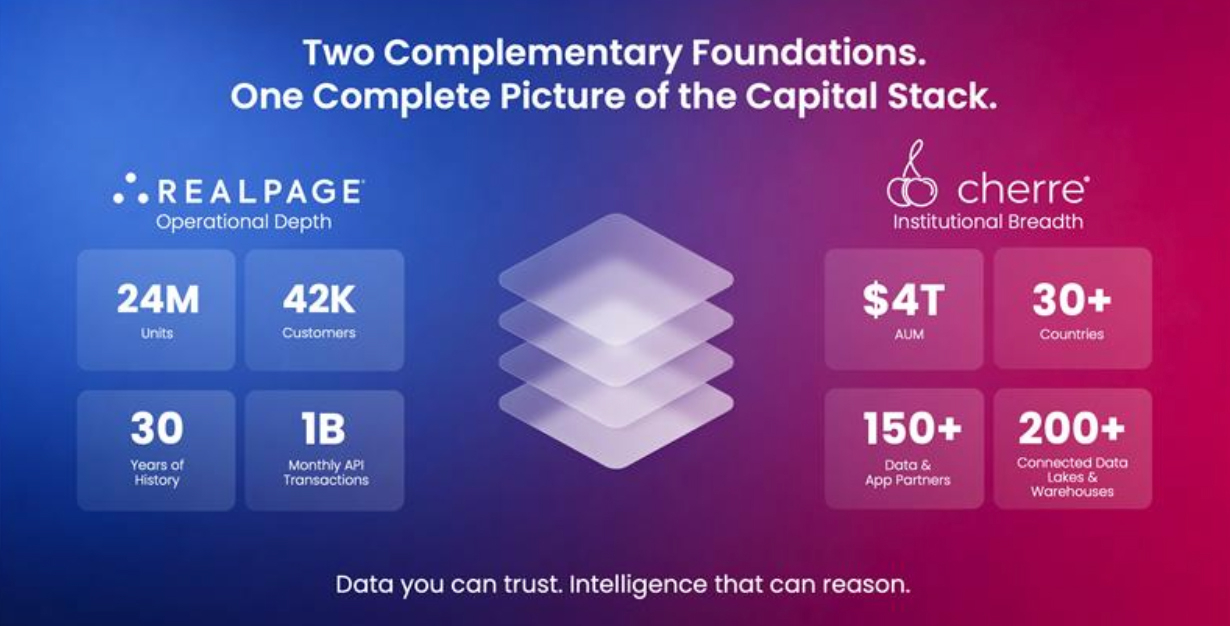
What stands out from an analytics perspective is the deliberate link RealPage is drawing between property-level operations and portfolio- and fund-level decision-making. Those two layers have historically lived in separate systems, with separate vocabularies, which is exactly why so many organizations struggle to move from a single building’s performance metrics to a coherent view of an entire fund. Cherre co-founder and chief executive L.D. Salmanson put the intent plainly: “We’ve always believed real estate organizations can’t make confident decisions on data alone. They need a trusted, connected meaning behind it.”
Connected meaning, not raw volume, is what turns a spreadsheet into a decision.
For readers tracking where property technology is heading, this deal reflects a broader pattern across commercial real estate: capital is flowing toward platforms that can reliably feed AI systems, not just toward AI itself. Owners and managers want automation, but automation built on inconsistent data produces confident sounding, wrong answers. RealPage says Cherre will keep operating as an open platform, continuing to integrate with third-party systems and serve existing clients through the same consulting teams, while gaining access to a larger engineering organization and expanded delivery capacity. That continuity matters for adoption. Institutional users are cautious about disruption to tools they already trust.
Backed by Thoma Bravo and employing more than 8,500 people globally, RealPage is clearly positioning itself as the connective layer between property operations and capital allocation. The real signal here is not the size of the deal, which was not disclosed, but the direction it points. As portfolios grow more complex and AI tools become standard in underwriting and asset management, the organizations with governed, resolved, trustworthy data will be the ones whose models actually hold up. Everyone else will just be automating their guesswork faster.
Source: citybiz.co