
A Danforth East Listing Is a Warning Sign for Anyone Still Pricing to 2021
Five years is normally enough time for a well-maintained property to build equity, especially after a renovation. But a two-bedroom house on Queensdale Avenue in Toronto’s Danforth East is testing that assumption in public. It just hit the market at $698,000, undercutting its own 2021 sale price of $753,000 by $55,000, and it’s done so with a fresh kitchen, a renovated bathroom, a finished basement, and a restored second bedroom. On paper, the property is objectively better than it was five years ago. On price, it’s worse.
For investors, this is the kind of data point that matters more than the headline. In May 2021, the house listed at $550,000 and closed at $753,000, a premium of roughly 37 per cent over asking, the kind of bidding-war math that defined that entire cycle. That premium was never really about the house. It was about scarcity, cheap borrowing, and buyer psychology at a specific moment. None of those conditions have held, and this listing is the receipt.
It’s also worth noting this isn’t the property’s first attempt at repricing reality. It briefly returned to market in February 2026 asking $820,000, and that listing was pulled about a month later without a sale. The current $698,000 ask, arriving only months afterward, tells you something sharper than a slow market. It tells you the seller, or whoever is now marketing this asset, recalibrated fast once the $820,000 number failed to move buyers, and chose to re-enter using the same strategy that worked back in 2021: an aggressive underlist designed to generate multiple offers rather than reflect true expected value.
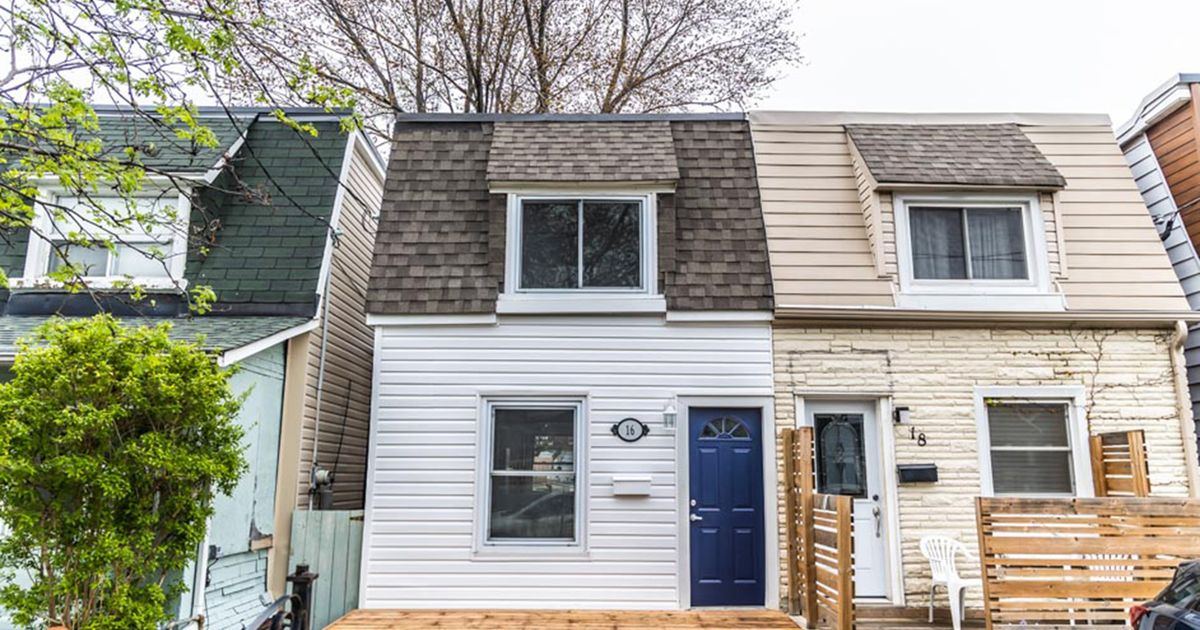
That strategy still has teeth in this pocket of Toronto. The article notes the cheapest semi-detached house to sell recently in the area still fetched around $850,000, which means the sub-$700,000 ask on this fully renovated, freehold two-bedroom is priced well below the neighbourhood’s recent floor. Investors and end users should read that gap correctly: this is very likely a deliberate underpricing tactic, not a genuine market valuation, and the eventual sale price should be expected to land meaningfully higher.
The listing price is not the story. The gap between the 2021 peak and today’s ask is the story, and it’s a live signal about where buyer conviction actually sits in this market right now.
What this case really illustrates for KG Invest readers is the difference between renovation value and market timing. The seller here did the right things on paper: new flooring, new cabinetry, new appliances, a restored second bedroom, and updated bathrooms. Renovation typically supports resale value and shortens time on market. But it cannot override a broader repricing of what Toronto buyers were once willing to pay at the top of a speculative cycle. If a renovated, better-configured asset is still asking below its 2021 sale price, that is a market-wide signal, not a property-specific one.
For buyers watching the Danforth East corridor, this listing is worth tracking closely regardless of whether it fits your own search. Its final sale price, whatever it turns out to be, will function as a fresh comparable for a neighbourhood where the previous ceiling was set during conditions unlikely to return soon. For sellers holding similar properties bought near the 2021 peak, the lesson is blunter: equity built purely on cycle timing can erode, and renovation, while valuable, is a floor raiser, not a guaranteed path back to your purchase price.
Source: blogTO, “Renovated Toronto house asking less than it sold for five years ago”