Etobicoke’s West Square Shows How Patient Capital and Policy Can Unlock Affordable Supply
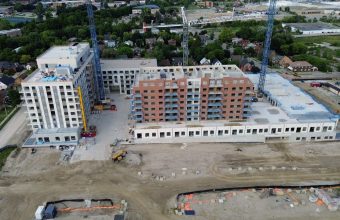
Every so often a project comes along that reads less like a single building opening and more like a case study in how large scale housing actually gets delivered. West Square, the 494-home first phase of a mixed-use rental community at The East Mall and Bloor Street West in Etobicoke, is one of those projects. With 217 of those homes now open as affordable rentals, the development is a useful marker for anyone trying to understand how land, capital, and policy come together to move the needle on housing supply in a city that badly needs it.
What stands out to me is not the ribbon cutting itself, but the structure underneath it. This is a formerly stalled site, once known as Valhalla Village, reimagined by KingSett Capital and designed by BDP Quadrangle into two towers of 11 and 30 storeys. Nearly half the homes in Phase 1 are designated affordable, secured for at least 40 years. That kind of long horizon commitment does not happen by accident. It happens when a developer’s timeline lines up with a municipal incentive program and a federal financing tool at the same moment.
The numbers behind that alignment are worth sitting with. Toronto is providing roughly $11.9 million in incentives through its Rental Housing Supply Program, largely in fee, charge, and property tax exemptions, while the federal government backed the project with a $235.9 million low-interest loan. That is the financing architecture that makes below-market rents pencil out for a private developer without simply asking them to absorb the loss. It is a model worth watching as more municipalities look for ways to unlock stalled or underbuilt sites.

Phase 2 is already under construction immediately to the west, designed by Zeidler Architecture, adding 641 more rental homes across a 21 and a 38-storey tower. Once both phases are complete, the community will total 1,135 homes, with 347 affordable rentals sitting alongside 788 market-rate units. That phasing strategy matters from a development standpoint. It allows a developer to stage capital deployment, manage construction risk, and keep leasing momentum going on one phase while building the next, all while the surrounding public realm, a new park and shared amenity space, matures alongside it.
Strong projects are built from a wider understanding of timing, access, infrastructure, policy, and demand, and West Square is a working example of all four moving in the same direction.
Toronto counts West Square among roughly 50 affordable housing projects currently under construction citywide, part of a pipeline expected to deliver more than 14,000 homes, including over 4,200 affordable rentals, under the HousingTO 2020-2030 Action Plan. That scale matters more than any single opening. It suggests a repeatable playbook, transit-adjacent land, blended affordability, layered public and private financing, that other developers and municipalities can study and adapt rather than treat as a one-off.
For readers tracking where large scale housing strategy is headed, West Square is worth watching not for its towers but for its financing logic. Land value, policy incentives, and patient capital rarely align this cleanly, and when they do, the results are homes that actually get built and actually stay affordable.
Source: UrbanToronto, “West Square Opens With 217 Affordable Rental Homes in Etobicoke”