



Strategic market positioning in land development has become one of the defining disciplines of modern city building. In an earlier era, a well-located parcel in a growing region could often carry a project on its own. Today, that is no longer enough. The market is more segmented, policy frameworks are more influential, infrastructure constraints are more visible, and communities are more engaged in shaping what gets built and where. The result is that successful development depends less on simple land ownership and more on the quality of the development thesis behind it.
Table Of Content
- Why Market Positioning Matters More Than Ever
- The Demand Side of the Equation: Reading Growth Correctly
- Demand Is Local, Even When Growth Is National
- The Supply Side Reality: Constraints Shape Positioning
- Community Needs Are Now Central to Value Creation
- Housing Diversity as a Strategic Advantage
- Product, Density, and Form: Matching the Site to the Market
- Phasing as a Core Strategic Tool
- Scenario Planning and Optionality
- The Role of Policy, Infrastructure, and Entitlement Strategy
- Moving Beyond the Biggest Project Mentality
- A Strategic Framework for Market Positioning in Land Development
- The Long View: Land as an Urban Growth Asset
- Conclusion
That thesis must connect macro trends to local conditions in a disciplined way. Population growth, migration patterns, household formation, transit investment, affordability stress, municipal planning priorities, and capital market volatility all shape what the right project looks like. The strongest developers are not simply reacting to these variables. They are integrating them into a coherent strategy that defines product type, price point, tenure, density, timing, and public value from the outset.
In Canada, the need for this level of precision is especially clear. Statistics Canada reported that the country’s 41 census metropolitan areas grew by 3.5% from July 1, 2023 to July 1, 2024, confirming that growth remains heavily concentrated in large urban regions. At the same time, CMHC reported that housing starts in Canada’s six largest cities reached 68,639 units in the first half of 2024, the second-highest level since 1990. Yet even that strong headline number still lagged demographic demand when adjusted for population. In other words, more construction activity has not automatically translated into market balance.
This is the central challenge of market positioning today. Developers are operating in an environment where the demand for housing is real and persistent, but where not all supply is equal. A project can add units and still miss the market if it delivers the wrong product, in the wrong location, at the wrong time, or without the infrastructure and community amenities needed to support long term acceptance and value. Market positioning, therefore, is not a branding exercise. It is a strategic discipline that links demand analysis, land economics, public policy, urban design, and execution capability into one operating framework.
For professionals in land development, urban planning, and project strategy, this shift carries a clear message. The future belongs to teams that understand growth not as a volume game, but as a fit problem. The objective is not simply to build more. It is to build the right form of supply where market trends, community needs, and delivery capacity genuinely intersect.
Market positioning in land development is not about selling a project after it is conceived. It is about shaping the project correctly before capital is committed.
Why Market Positioning Matters More Than Ever
The phrase market positioning is often misunderstood in development circles. Many people associate it with branding, leasing strategy, or sales language. Those elements matter, but they come later. In land development, market positioning begins much earlier. It starts with defining the role a site can realistically play within a regional housing system, a local planning framework, and a specific economic cycle.
That broader perspective matters because the housing challenge in Canada and across North America is no longer just a matter of output. It is a matter of alignment. CMHC has estimated Canada’s national housing supply gap at roughly 3.5 million additional units by 2030. That figure is significant not just because of its scale, but because it illustrates the depth of the opportunity and the policy problem. The market does not need generic units alone. It needs deliverable, financeable, and community-supported housing in forms that reflect changing household needs.
Large metropolitan regions make this especially apparent. The Toronto census metropolitan area has now passed 7 million people in recent Statistics Canada estimates, reinforcing how concentrated demand has become in major urban regions. Similar pressures exist in Vancouver, Montreal, Calgary, and Ottawa, and the dynamic is not uniquely Canadian. In the United States, Harvard’s Joint Center for Housing Studies continues to document a severe and persistent housing shortage. Across North America, urban growth is colliding with affordability constraints, infrastructure limitations, and policy friction.
For developers, this means that location by itself no longer guarantees performance. Two sites within the same metropolitan area can have very different market outcomes depending on transit connectivity, municipal support, servicing readiness, household demographics, school capacity, and competing pipeline supply. A strategic position is created when a project responds to these realities better than alternatives in the market. That position can be built around attainable rental, family-friendly ownership, transit-oriented intensification, missing middle housing, adaptive reuse, or phased mixed-use growth. What matters is not the label, but the fit.

The Demand Side of the Equation: Reading Growth Correctly
Strategic positioning begins with a clear reading of demand, but demand itself has become more complex. Population growth is still the headline driver, yet the composition of that growth matters just as much as the total number. Household formation patterns, immigration, interprovincial migration, age distribution, household size, and income segmentation all shape what type of housing a market can absorb.
Urban centres continue to capture most of the growth. That concentration increases the pressure on land values, infrastructure, and approvals in metropolitan areas, but it also creates opportunity for projects that can deliver well-located housing efficiently. The crucial question is not simply whether a region is growing. It is whether a specific submarket is undersupplied in a way that a given project can credibly address. A downtown rental tower, a suburban transit node, a mid-rise corridor site, and an established neighborhood suited for infill all operate under different demand profiles.
Affordability stress has made this even more important. Households may want certain forms of housing but be priced out of them, creating a gap between aspirational demand and effective demand. Developers who ignore that distinction risk positioning projects into narrow demand bands. By contrast, teams that understand attainable price points, rental thresholds, family-size needs, and tenure preferences can shape product more intelligently. In many urban markets, the most durable demand lies in housing that balances livability with attainability rather than pursuing only the highest nominal values.
Recent CMHC reporting reinforces this point. Apartment development remains a dominant source of new supply, yet growth in family-sized ownership housing remains limited. That suggests a mismatch between what the market is delivering and what many households still need. A development strategy that addresses this gap through a more balanced unit mix, stacked townhouses, larger rental formats, or flexible layouts may be better positioned than a conventional one-size-fits-all program.
Demand Is Local, Even When Growth Is National
One of the most common strategic mistakes in land development is treating national or regional growth data as if it applies evenly across local markets. It does not. Broad demand can coexist with weak absorption in a specific node if too much similar product is arriving at once, if infrastructure is lagging, or if the project is mismatched to the dominant household profile. This is why local segmentation remains essential.
Market positioning should answer a sequence of practical questions. Who is the likely resident or buyer? What is their budget range? What alternatives do they have nearby? What compromises are they currently making due to affordability or supply scarcity? What does the site offer that materially improves their trade-off between cost, access, space, and convenience? A project that can answer those questions clearly has the foundation for strong market fit.
It is also important to understand unmet demand that may not be obvious in standard comps. Many households remain in housing that is too small, too far from work, or poorly aligned with life stage because alternatives are limited. That suppressed mobility can create hidden demand for projects that offer the right combination of location, design, and affordability. Developers who look only at recent sales or rental performance without investigating these structural gaps risk underestimating opportunity.
The Supply Side Reality: Constraints Shape Positioning
Strong demand does not automatically create a viable development opportunity. Supply-side constraints can materially change what is feasible, financeable, and ultimately profitable. Statistics Canada and CMHC both identify land costs, construction costs, labour shortages, development fees, and regulatory conditions as major constraints on housing supply. These factors do more than compress margins. They influence what kind of project can be delivered at all.
In practical terms, this means market positioning must be grounded in execution economics. A product type may appear attractive from a demand standpoint, but if entitlement timelines are too long, servicing upgrades too expensive, construction labour too scarce, or development fees too high, the strategic thesis weakens quickly. The best-positioned project is not the one with the most theoretical demand. It is the one where demand, approvals, capital, and buildability align well enough to produce a successful outcome.
CMHC has also noted that Canada’s land-use and regulatory environment is tighter than in the United States, which can slow the speed of new housing supply. That observation is important because it reveals why supply shortages can persist even when market signals are strong. It also explains why positioning around certainty and readiness has grown in value. Sites with clear entitlement paths, infrastructure access, and policy alignment often outperform more speculative alternatives because time itself has become a major development cost.
This is where discipline matters. Market positioning should never be separated from feasibility analysis. A compelling concept that cannot move through approvals, cannot be serviced economically, or cannot secure financing in a volatile rate environment is not strategically positioned. It is simply aspirational. Strong development teams understand that strategic fit and feasibility fit are inseparable.
Community Needs Are Now Central to Value Creation
Another major shift in land development is the elevation of community need from a secondary concern to a primary market factor. In many urban regions, community acceptance influences entitlement timelines, design outcomes, and political support. More importantly, developments that genuinely serve community needs often create stronger long term value through better absorption, more resilient pricing, lower reputational risk, and improved place quality.
Community-serving development does not mean abandoning commercial discipline. It means understanding that housing demand is inseparable from the systems that support everyday life. Families need schools, parks, open space, safe streets, and suitable unit sizes. Workers need mobility options and access to employment nodes. Older adults may need walkable services and adaptable housing forms. Young renters often prioritize transit, convenience, and social infrastructure. Positioning land successfully means translating these needs into product and place.
This is one reason why mixed-use and transit-oriented development have gained such strategic relevance. As housing costs rise, households place greater value on reducing transportation burdens and gaining access to daily amenities without long commutes. Walkable, transit-served neighborhoods can therefore outperform auto-dependent locations even when unit sizes are more compact. The value proposition is broader than the home itself. It includes time, mobility, convenience, and lifestyle efficiency.
There is also an important political lesson here. A common misconception is that urban densification is always opposed by communities. In reality, many projects gain support when they clearly improve public realm quality, add needed housing choices, strengthen local retail, deliver parks or community space, and connect growth to transit. Opposition often emerges when people believe density is being pursued without corresponding investment in livability or infrastructure. Positioning is stronger when the project can articulate a community benefit narrative that is credible, specific, and visible in the plan.

Housing Diversity as a Strategic Advantage
One of the clearest signals in today’s market is the need for a wider range of unit types and tenures. In many major metros, the system has leaned heavily on small apartment formats while underdelivering family-sized ownership and rental choices. This is not just a social issue. It is a market-positioning issue. Communities are more stable and complete when they can accommodate people across life stages, income bands, and household structures.
Developers that incorporate housing diversity into their land strategy may create advantages on multiple fronts. They can broaden demand capture, improve political support, reduce exposure to a single product segment, and support stronger long term place value. Diversity can take many forms, including mixed tenure, a range of bedroom counts, secondary suites, stacked townhouses, purpose-built rental, senior-friendly units, and adaptive building forms that allow future conversion.
In established urban areas, gentle densification, conversions, and infill development have become increasingly important ways to expand supply. CMHC’s recent reporting highlights this trend, and for good reason. Established neighborhoods often contain the infrastructure, transit access, and amenity base that households want, but they may lack pathways to add housing incrementally. Projects that unlock these sites thoughtfully can occupy a powerful market position because they respond to both scarcity and livability.
Product, Density, and Form: Matching the Site to the Market
Once demand, supply constraints, and community context are understood, the next strategic question is product. What should actually be built on the site, in what density, and in what form? This is where many development strategies either sharpen or unravel. Positioning is strongest when the product is directly calibrated to market depth, policy support, and buildability.
There is no universal answer. In some locations, high-rise rental near rapid transit is the most logical and defensible response. In others, mid-rise mixed-use with family-oriented units may provide better risk-adjusted performance. In lower-scale urban neighborhoods, a combination of multiplexes, laneway suites, townhouse infill, and small apartment formats may align best with demand and planning context. The key is to avoid forcing a template onto a site simply because it has worked elsewhere.
Density should also be understood strategically rather than ideologically. More density is not always better if it creates entitlement friction, infrastructure costs, or absorption pressure that undermines viability. Likewise, underbuilding a strategically located site can waste rare urban land and miss long term value. The right density is the one that balances policy opportunity, servicing capacity, market depth, financing conditions, and community support. In many cases, that density can evolve over phases rather than appearing all at once.
Product form also affects resilience. A mixed-product development can adapt more effectively to changing conditions than a single-format project. If ownership demand softens but rental remains strong, a flexible program can pivot. If financing costs alter achievable price points, a site with multiple building typologies may preserve optionality. Strategic positioning today therefore includes designing for future decision-making, not just present conditions.
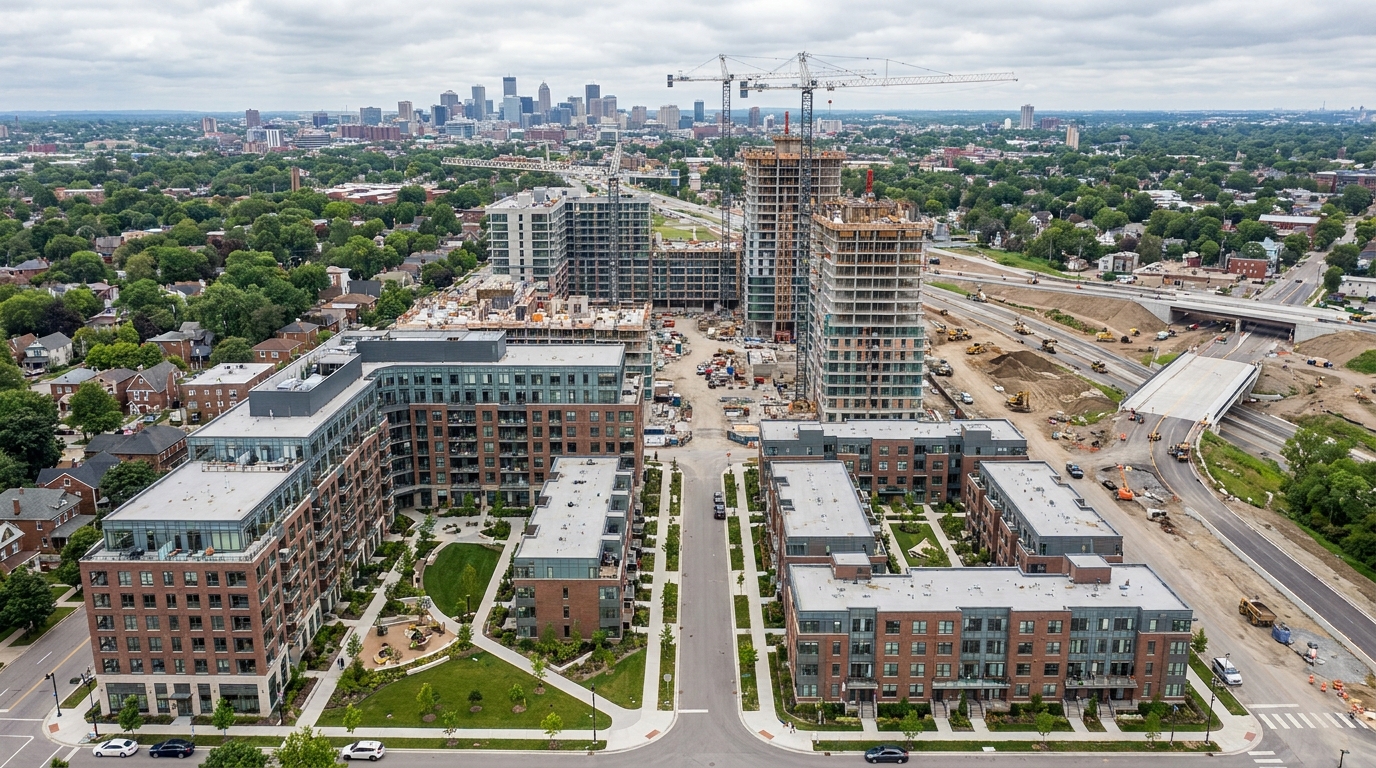
Phasing as a Core Strategic Tool
Large-scale land development is not won at the moment of acquisition. It is won through the disciplined sequencing of approvals, infrastructure, capital deployment, and product release. In an environment of macroeconomic uncertainty and uneven absorption, phasing has become one of the most important tools in strategic market positioning.
Recent CMHC reporting notes that weaker demand in some segments has been tied to slower population growth and macroeconomic uncertainty, while supply is still entering the market in waves. That creates a familiar risk in many submarkets. If too much similar product arrives too quickly, pricing softens, incentives rise, and project economics weaken. A phased strategy helps avoid flooding the local market while preserving the long term value of the land.
Phasing also allows infrastructure delivery and entitlement complexity to be managed more realistically. Roads, utilities, stormwater systems, parks, schools, and transit integration often cannot be delivered at the same pace as vertical construction alone. A strong phased plan aligns market absorption with infrastructure readiness so that each stage enhances the next rather than creating operational strain. This is where urban strategy and project management truly converge.
Importantly, phasing is not only defensive. It can also be value-accretive. Early phases can establish the identity of a place, prove market demand, and attract stronger financing terms for later stages. They can create the amenity base that makes subsequent density more supportable. They can also build credibility with municipalities and communities if commitments around public realm and infrastructure are delivered visibly and on schedule.
Scenario Planning and Optionality
Because financing costs, municipal requirements, and absorption conditions can change quickly, strategic positioning should be supported by scenario planning. This means evaluating how the project performs under different assumptions around interest rates, rent growth, sales pace, construction costs, infrastructure timing, and policy obligations. It also means building structural flexibility into the plan wherever possible.
A site that can shift between for-sale, rental, and build-to-rent models has more resilience than one locked into a single outcome. A plan that allows block-by-block delivery can respond more intelligently to market signals than one dependent on full-scale launch. A master plan that can recalibrate unit mix over time is stronger than one tied rigidly to assumptions made years earlier. In a volatile environment, optionality is not indecision. It is strategic preparedness.
The Role of Policy, Infrastructure, and Entitlement Strategy
Policy and infrastructure increasingly shape where growth is both feasible and politically supportable. Infill, intensification, transit-oriented development, zoning reform, resilience planning, and affordability initiatives are all influencing land value and project timing. As a result, entitlement strategy has moved to the centre of market positioning.
Developers who understand municipal priorities can position projects more effectively from the beginning. If a city is prioritizing growth around transit corridors, then land near stations may carry a premium not only because of location but because policy support improves the path to density. If a municipality is focused on family housing or missing middle formats, then a project that responds directly to that agenda may secure smoother approvals than one optimized solely for immediate revenue. The strategic objective is to align private value creation with public planning direction wherever possible.
Infrastructure capacity is equally important. A site may appear attractive in land terms but still be strategically weak if water, wastewater, transportation, schools, or community facilities are already constrained. Conversely, a site with near-term infrastructure readiness can outperform because it shortens the timeline between concept and delivery. In high-growth regions, infrastructure is not a background variable. It is often the decisive one.
This is why the best development organizations treat infrastructure planning, public engagement, entitlement management, and market analysis as interconnected functions. A project that is sound in one dimension but misaligned in another can stall. A strategically positioned project integrates all four early enough to shape land strategy before assumptions become fixed.
Moving Beyond the Biggest Project Mentality
Another misconception worth addressing is the belief that the highest-growth markets should always be pursued with the largest possible project. Scale can be powerful, but scale alone is not strategy. In many cases, oversized programs create exposure to entitlement battles, infrastructure burdens, capital concentration risk, and local absorption limits. They may also reduce a team’s ability to adapt as conditions change.
The more strategic approach is to think in terms of the most appropriate project, not the largest one. That may still mean a major master-planned community or a dense mixed-use district. But it may also mean a sequence of mid-rise phases, a network of infill sites, or a hybrid approach that combines steady near-term housing delivery with longer-term intensification potential. The goal is to match ambition with the capacity of the market and the city to absorb growth well.
This principle is particularly relevant when per-capita supply remains inadequate despite elevated construction levels. The first half of 2024 saw Canada’s largest cities post high housing starts, but per-capita activity remained near historical averages rather than moving decisively above them. Headline volume can therefore conceal deeper shortfalls. The answer is not automatically to build bigger in every location. It is to improve the quality, speed, mix, and geographic fit of supply.
A Strategic Framework for Market Positioning in Land Development
For professionals seeking a practical framework, effective market positioning in land development can be organized around several integrated tests. These are not isolated checkboxes. They should reinforce one another and reveal whether a site can support a compelling long term development thesis.
- Demand fit: Is there clear unmet or underserved demand for the intended product in this submarket, at achievable price points or rents, and among identifiable household segments?
- Policy fit: Does the project align with municipal growth objectives, zoning direction, transit plans, affordability priorities, and community planning expectations?
- Infrastructure fit: Can the site be supported by existing or planned servicing, transportation networks, schools, parks, and public facilities without undermining viability or public acceptance?
- Feasibility fit: Do land cost, construction cost, development fees, labour conditions, financing assumptions, and timing support execution under realistic scenarios?
- Product fit: Does the proposed density, tenure, unit mix, and built form match both market depth and the local urban context?
- Phasing fit: Can the project be staged in a way that protects absorption, manages infrastructure delivery, and preserves flexibility as market conditions evolve?
- Community fit: Does the project add visible value through public realm, housing diversity, mobility, amenities, and place quality in a way that strengthens support and long term performance?
When these dimensions align, market positioning becomes more than a concept. It becomes an executable strategy with defensible logic. When they do not align, even a well-located site can struggle. This is why the best developers increasingly think like urban strategists. They understand that land value is created not only by scarcity, but by the quality of the plan attached to it.
The Long View: Land as an Urban Growth Asset
The broader trend across North America is clear. Land development is becoming more data-driven, more policy-sensitive, and more infrastructure-dependent. Affordability concerns, zoning reform, resilience standards, transit investment, and changing household needs are all reshaping where growth can happen and what form it should take. The industry is moving away from a short-term commodity view of land and toward a more strategic understanding of land as an urban growth asset.
This perspective matters because the cities that perform best over time are not simply the ones that grow fastest. They are the ones that convert growth into durable value through better coordination of housing, infrastructure, mobility, and public realm. Developers play a central role in that process. When market positioning is done well, private investment can help solve real urban problems while also producing strong financial outcomes. When it is done poorly, projects can add friction to already strained systems.
That is why visionary thinking in land development must remain grounded in execution. Vision without feasibility is speculation. Feasibility without vision can produce generic outcomes that underperform socially and economically. Strategic market positioning bridges the two. It asks where demand is heading, what communities need, what policy is enabling, what infrastructure can support, and what the development team can actually deliver with discipline.
In today’s environment, that integrated mindset is not optional. It is the basis of competitiveness. Whether the opportunity lies in transit-oriented nodes, master-planned suburban growth, mixed-use corridors, adaptive reuse, or gentle urban intensification, the same principle applies. The strongest projects are those that align with the future before the future fully arrives.
Conclusion
Strategic market positioning in land development is fundamentally about fit. It is the fit between housing demand and product design, between land economics and entitlement reality, between community expectations and urban growth, and between near-term execution and long-term value creation. In a market defined by concentrated population growth, persistent housing shortages, affordability pressure, and policy complexity, this level of alignment is what separates resilient projects from fragile ones.
The evidence from Canada is instructive. Major metropolitan areas continue to grow rapidly. Housing starts have risen in key cities, yet supply still falls short relative to demographic demand. Costs, regulation, and labour constraints remain significant barriers. Product mix mismatches persist, especially for family-oriented and attainable housing. All of these conditions point to the same conclusion. Development success will not come from volume alone. It will come from sharper strategic positioning.
For developers, planners, and urban decision-makers, the path forward is clear. Study growth carefully. Understand households, not just headlines. Treat infrastructure and policy as core market variables. Build flexibility into product and phasing. Create places that communities can support because they meet real needs. Most importantly, approach land not as a static commodity to be traded, but as a platform for shaping the next generation of urban life.
That is the real promise of market positioning in modern land development. It allows us to move beyond reactive project making and toward intentional city building. And in an era when both opportunity and housing need are immense, that shift is not only strategic. It is essential.


No Comment! Be the first one.