



Sustainability compliance in urban development refers to the combined set of climate, energy, resilience, and municipal planning requirements a project must satisfy to secure approvals, financing, and long-term value — well beyond what building codes alone require. In recent years, this discipline has moved from the margins of project planning to the center of decision making. For developers, it is no longer enough to deliver a project that meets basic zoning and building code requirements. Today, major housing and mixed use developments are shaped by a wider system of climate policy, energy performance rules, municipal planning standards, resilience expectations, infrastructure conditions, and investor scrutiny. In practical terms, sustainability compliance now influences what gets approved, what gets financed, what gets built, and what performs well over time.
Table Of Content
- Why sustainability compliance has become a core development issue
- Understanding the compliance landscape: federal, provincial, and municipal layers
- Federal frameworks and funding related expectations
- Provincial codes and technical compliance
- Municipal planning standards and site specific obligations
- Common misconceptions that create project risk
- A strategic framework for managing sustainability compliance
- 1. Start with due diligence, not post design correction
- 2. Build a compliance matrix that maps every obligation
- 3. Integrate sustainability into core design decisions
- 4. Use recognized frameworks strategically
- 5. Treat resilience as part of compliance, not a separate conversation
- 6. Plan procurement and construction around performance commitments
- 7. Verify in operation, not just on paper
- Best practices for large scale housing projects
- The Toronto model and what it signals for the market
- Implementation challenges and how to overcome them
- The business case: compliance as long term urban strategy
- Conclusion
- Key takeaways for developers
This shift matters because cities are growing under pressure. Housing demand remains intense, infrastructure systems are stretched, and communities are increasingly exposed to heat, flooding, air quality concerns, and rising operating costs. In that environment, sustainability compliance is not simply an environmental exercise. It is a governance framework that connects land use, building performance, transportation, water systems, public health, construction risk, and long term asset value. Developers who understand that connection are better positioned to move projects forward with fewer surprises and stronger outcomes.
Across Canada and North America, the compliance challenge is multilayered. Federal frameworks influence funding conditions and climate reporting. Provincial codes define technical standards for energy efficient design and construction. Municipal planning approvals increasingly carry project specific sustainability obligations related to emissions, stormwater, mobility, urban ecology, waste, and livability. A project can therefore be fully code compliant and still fall short of municipal sustainability expectations or funding program requirements. That is where many development teams get into trouble, not because the rules are hidden, but because they are treated too late in the process.
The strategic opportunity is clear. Developers who integrate sustainability compliance early can reduce redesign cycles, manage approval risk, improve access to incentives or green finance, and create buildings that are more efficient, resilient, and attractive in the market. Just as important, those projects contribute to healthier communities through better air quality, lower heat exposure, reduced flood risk, and stronger connections to transit and green infrastructure. Compliance, in other words, is not just about getting a permit. It is about building places that remain viable in the next phase of urban growth.
This article provides a practical framework for navigating sustainability compliance in urban development projects. It draws on the current Canadian regulatory context, including the Federal Sustainable Development Strategy, the Climate Lens used for eligible infrastructure programs, the National Energy Code of Canada for Buildings, and municipal standards such as the Toronto Green Standard. The goal is not to present compliance as a static checklist, but as a lifecycle strategy that begins in due diligence and continues through design, construction, verification, and operations.

Why sustainability compliance has become a core development issue
For many years, sustainability was often framed as a value add, a branding device, or a voluntary certification path pursued by projects with a particular market positioning. That view no longer reflects reality. Today, sustainability compliance sits alongside entitlements, servicing, financing, and construction costs as a central development risk category. The reason is straightforward. Governments at every level are trying to align development activity with climate goals, infrastructure resilience, public health objectives, and long term fiscal responsibility.
At the federal level, Canada’s 2022 to 2026 Federal Sustainable Development Strategy signals the broader policy direction that is shaping public investment and climate expectations. For some federally funded infrastructure, climate related tools such as the Climate Lens are used to assess both greenhouse gas impacts and resilience implications. These federal frameworks do not replace local approvals, but they influence project design logic, documentation requirements, and access to funding. If a project depends on public infrastructure partnerships or climate aligned capital, those federal expectations become highly relevant very early in the process.
At the building scale, energy and emissions performance is increasingly anchored in technical standards. The National Energy Code of Canada for Buildings, commonly referred to as NECB 2020, sets requirements for energy efficient design and construction of new buildings and additions. The published edition also includes revisions and errata released in February 2025, which is a reminder that compliance standards evolve. Developers cannot treat code knowledge as static because technical requirements, interpretations, and pathways to compliance continue to change in response to policy and market pressure.
The most visible pressure point, however, is often the municipal approval process. Cities are using planning tools to secure sustainability outcomes at the site and neighbourhood level. Toronto’s Green Standard is one of the clearest examples. Version 4 applies to new planning applications received on or after May 1, 2022, and Tier 1 is mandatory through the planning approval process. Higher tiers may unlock incentives such as Development Charge refunds. That structure shows how municipalities are moving beyond voluntary encouragement and embedding sustainability directly into development approvals.
This is why sustainability compliance should be seen as a business discipline. It affects schedule certainty, consultant coordination, design choices, cost forecasting, procurement strategy, legal conditions, investor reporting, and operational performance. It also affects reputation. Developers who consistently deliver projects that align with evolving city building goals are more likely to build productive relationships with municipalities, communities, lenders, and institutional partners. In an era of constrained land and rising complexity, that credibility matters.
Understanding the compliance landscape: federal, provincial, and municipal layers
One of the most common mistakes in urban development is assuming that sustainability compliance is captured by the building code alone. In reality, developers face a layered governance structure, and each layer serves a different purpose. Understanding how those layers interact is essential for project feasibility and risk management. Without that understanding, teams tend to discover obligations in a fragmented way, often after major design decisions have already been made.
Federal frameworks and funding related expectations
Federal sustainability policy often enters a project through infrastructure, financing, or reporting mechanisms rather than direct local approvals. The Federal Sustainable Development Strategy provides a broad policy framework that influences how public institutions assess progress on climate and sustainability outcomes. On projects connected to federal infrastructure programs or other forms of public support, climate related assessment tools may also apply. The Climate Lens is particularly important because it evaluates both emissions implications and climate resilience. That means projects may need to demonstrate not only reduced carbon intensity, but also preparedness for future climate conditions.
For developers, the practical takeaway is that sustainability narratives must be evidence based. It is not enough to say a project is green or future oriented. Teams increasingly need energy models, resilience assessments, water management strategies, mobility planning, and documentation that shows how a project aligns with funding criteria or public policy objectives. When those materials are assembled late, they tend to reveal design conflicts that are expensive to resolve. When they are built into due diligence, they become tools for decision quality.
Provincial codes and technical compliance
Provincial and national codes shape the technical baseline for building performance. NECB 2020 is a major reference point in Canada for energy efficient design and construction. Depending on jurisdiction and project type, developers may also encounter related requirements around envelope performance, ventilation, electrification pathways, and emissions intensity. These standards matter not just because they define minimums, but because they influence the cost and constructability of future upgrades. A building designed only to today’s minimum standard may become less competitive or more exposed to retrofitting pressure within a relatively short period.
This is where a strategic developer looks beyond strict compliance and asks a broader question. Does the project have a credible pathway to lower operational carbon, resilience under future climate conditions, and compatibility with investor and municipal expectations? If the answer is no, code compliance may still leave the project vulnerable. High performing buildings increasingly need integrated energy systems, efficient envelopes, electrification readiness, commissioning discipline, and operating strategies that align with long term urban decarbonization goals.
Municipal planning standards and site specific obligations
Municipal requirements are often where sustainability compliance becomes most concrete. Cities use official plans, secondary plans, zoning, urban design guidelines, green standards, transportation requirements, and servicing conditions to shape development outcomes. The United States Environmental Protection Agency’s smart growth guidance underscores the importance of local codes and ordinances because they govern land uses, density, setbacks, street widths, and parking. Those rules directly influence sustainability outcomes. A project’s emissions profile, walkability, stormwater performance, and heat island impact are all shaped by local planning decisions.
Toronto’s Green Standard demonstrates how comprehensive these requirements can become. The standard addresses air quality, water quality, greenhouse gas reductions, waste management, and urban ecology. In effect, it translates broad climate and livability goals into project level performance measures. This approach is becoming more common across municipalities. Developers should expect cities to continue using planning approvals as a compliance lever, especially where local governments are under pressure to meet climate targets while accommodating new housing supply.
Strategic insight: The most successful development teams do not ask whether sustainability compliance applies. They ask which compliance layers apply, when they apply, who owns them, and how they affect feasibility.
Common misconceptions that create project risk
Several misconceptions continue to undermine otherwise capable development teams. The first is the belief that code compliance is the same as sustainability compliance. It is not. A project may satisfy technical code minimums and still fail municipal sustainability expectations, climate assessment criteria, or conditions tied to incentives and approvals. This gap is especially common in stormwater design, transportation demand management, biodiversity measures, and urban heat mitigation.
The second misconception is that sustainability is mainly an environmental or communications issue. In practice, it is deeply connected to financing, schedule risk, consultant coordination, procurement strategy, and long term operating costs. Lenders, equity partners, institutional buyers, and public agencies increasingly want evidence that a project can perform in a lower carbon and more climate exposed future. A team that treats sustainability as a late stage reporting exercise often discovers that market expectations have already moved beyond the original design basis.
A third misconception is that third party certifications are the same as government compliance. Certifications such as LEED, Zero Carbon Building standards, and Passive House related approaches can be highly useful. They often help organize design decisions, clarify performance targets, and support market positioning. They may even align well with municipal standards. But they do not replace statutory compliance unless a jurisdiction explicitly recognizes them within its approval framework. Developers need to understand where certification helps and where direct regulatory obligations still govern.
Another common misunderstanding involves language around net zero and zero carbon. These terms are often used loosely in marketing and early concept discussions. In reality, teams must distinguish between operational carbon, embodied carbon, and offset based claims. A project can be efficient in operation but carry a heavy embodied carbon burden through materials and construction. Likewise, a building may perform well on paper but fail to deliver in practice without proper commissioning and operational accountability. Precision matters because regulators, funders, and sophisticated buyers are becoming more exacting.
A strategic framework for managing sustainability compliance
Developers need a framework that is both disciplined and adaptable. Sustainability compliance is not a one time review. It is a continuous management process that starts before land is acquired and continues after occupancy. The strongest approach is to organize compliance across the full project lifecycle, with clear ownership and documented decision points. That is how teams avoid the trap of treating sustainability as an isolated consultant package.
1. Start with due diligence, not post design correction
The most important principle is early integration. Before massing is fixed or applications are submitted, the development team should identify all sustainability obligations that may affect the project. That includes federal funding related expectations, provincial code requirements, municipal green standards, transportation and servicing conditions, climate resilience concerns, and potential incentive program criteria. This review should be tied directly to site selection and feasibility modeling, not parked as a later technical exercise.
At this stage, developers should ask whether the site supports transit oriented growth, low impact stormwater strategies, district energy compatibility, electrification readiness, biodiversity improvements, and climate resilience. A site may be attractive on land cost and density potential but weak on servicing, heat exposure, or flood vulnerability. Those weaknesses can materially affect both compliance cost and approval timing. Strategic due diligence therefore links sustainability to land value, not just design quality.
2. Build a compliance matrix that maps every obligation
Complex projects need a live compliance matrix. This document should identify each requirement, its source, the responsible consultant or team lead, the project stage at which it applies, the evidence needed, and the risk if it is missed. In large scale housing projects, this matrix becomes a management tool that keeps planning, legal, architecture, engineering, sustainability, and construction functions aligned. It also helps senior decision makers understand where design choices may trigger downstream consequences.
A useful compliance matrix does more than list rules. It maps dependencies. For example, a municipal green standard may affect massing, glazing ratios, mechanical strategy, roof design, landscape programming, and stormwater infrastructure all at once. If those links are not visible, teams will underestimate the scope of change required. A transparent matrix supports better sequencing and fewer reactive redesigns.
3. Integrate sustainability into core design decisions
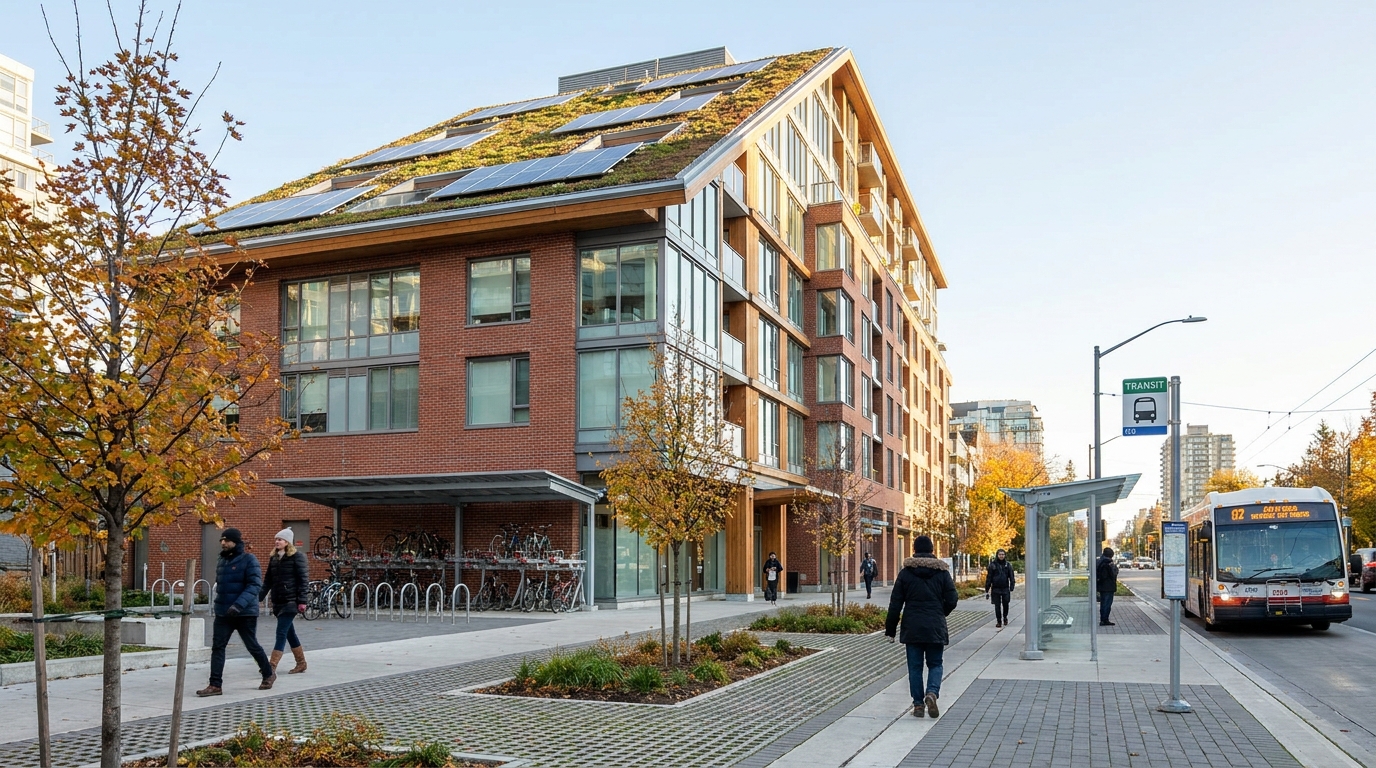
Compliance succeeds when it informs the fundamentals of the project. That means sustainability must be integrated into massing, orientation, facade design, parking strategy, loading, mobility planning, landscape systems, servicing, and amenity programming. Too often, a project is designed for density and yield first, and then adjusted for sustainability later. That approach usually creates tension because climate and resilience objectives affect form as much as systems.
Developers should aim for design teams that can translate policy requirements into development logic. If a municipality is emphasizing reduced greenhouse gas emissions, improved water quality, waste reduction, and urban ecology, those goals should shape site planning from the beginning. If a project is likely to pursue higher municipal tiers or zero carbon alignment, the building envelope, mechanical concept, and roof utilization strategy need to reflect that ambition at concept stage.
4. Use recognized frameworks strategically
Third party frameworks can be powerful if used intelligently. The Canada Green Building Council’s Zero Carbon Building Standards, including the Design Standard v4 launched in 2024, provide a made in Canada framework for low carbon design and operational performance. Passive building standards and other high performance approaches can also help organize technical decisions and provide a language that lenders, public agencies, and sophisticated buyers understand. Toronto’s Green Standard crosswalks with LEED v4.1 BD&C, CAGBC Zero Carbon Building Standard, and Passive House type frameworks show that these systems are increasingly converging around shared performance goals.
The strategic point is not to collect certifications for their own sake. It is to use proven frameworks to improve project discipline, demonstrate credibility, and align market expectations with approval requirements. Developers should be careful, however, to distinguish between voluntary frameworks and mandatory obligations. The value of third party standards is strongest when they simplify decision making and verification rather than complicate it.
5. Treat resilience as part of compliance, not a separate conversation
Resilience is now inseparable from sustainability compliance. A building that reduces operational energy use but remains vulnerable to heat stress, flooding, smoke events, or utility disruptions is not well positioned for long term urban performance. Federal climate guidance and municipal planning standards increasingly reinforce this point. Projects are expected to think about future conditions, not just present day averages.
For housing developments, resilience has direct implications for resident safety and public health. Backup power strategies, passive survivability, durable envelopes, cooling capacity, stormwater management, shaded outdoor areas, and water system protection all matter. The strongest projects treat resilience as an asset quality issue. That perspective helps teams justify investments that might otherwise look optional in a narrow first cost analysis.
6. Plan procurement and construction around performance commitments
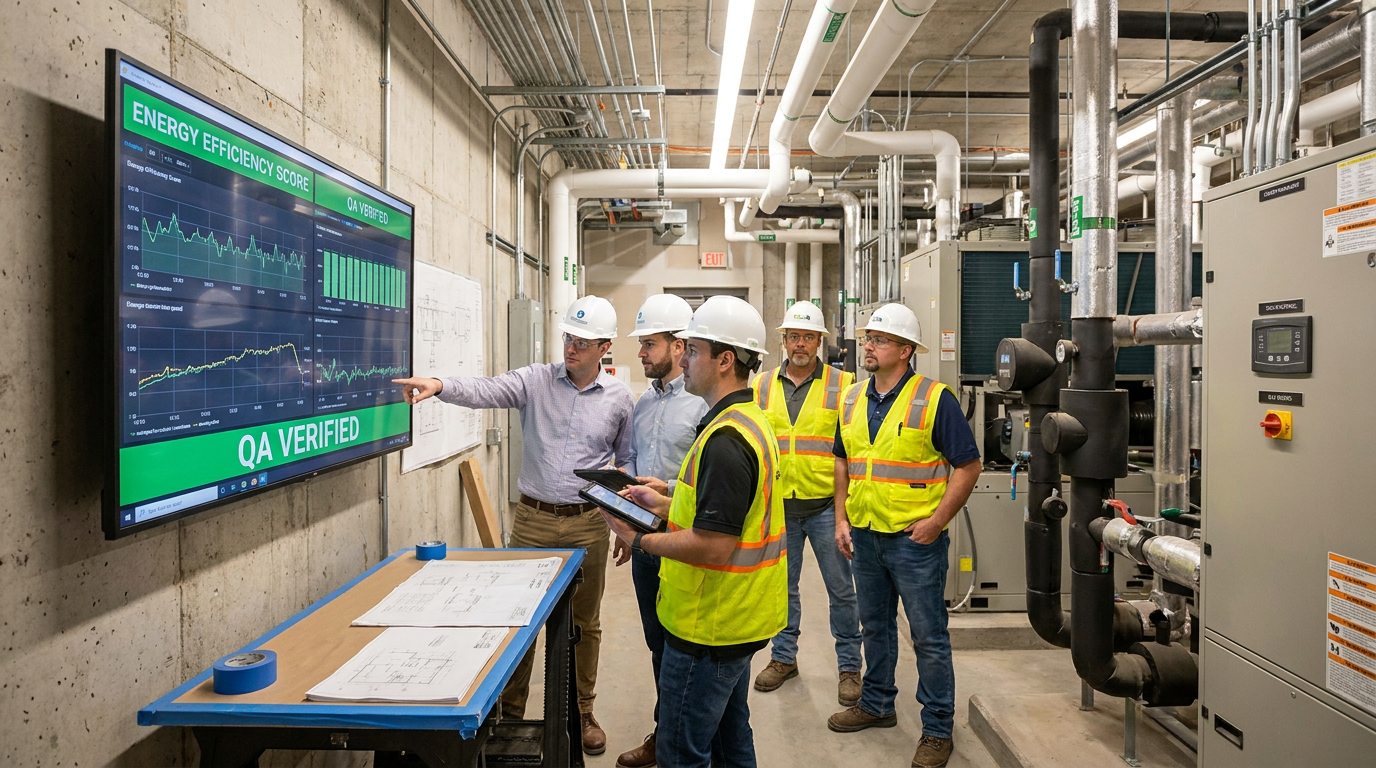
Many compliance failures do not occur in concept or approvals. They occur during procurement and construction, when substitutions, sequencing changes, budget pressure, or incomplete coordination erode the performance assumptions made earlier. A development team that promises high efficiency, lower carbon materials, enhanced stormwater measures, or specific waste diversion outcomes must ensure those commitments survive into contracts, scopes, shop drawings, and site supervision.
This is why developers need procurement language and quality assurance processes that reinforce sustainability obligations. Performance targets should not disappear once a permit is issued. Material specifications, commissioning requirements, testing protocols, and closeout documentation all need to support the original compliance pathway. If they do not, the project may face delayed occupancy, failed certifications, missed incentives, or operational underperformance.
7. Verify in operation, not just on paper
True compliance extends beyond design intent. Buildings need commissioning, performance verification, operating manuals, and post occupancy review to ensure that energy, water, ventilation, and comfort outcomes are actually delivered. This is increasingly important as cities, investors, and owners focus on real operational results rather than modeled promises alone. A project that performs poorly after handover can quickly undermine the financial and reputational value of all the earlier compliance work.
Developers who hold assets long term have a particularly strong reason to prioritize this step. Efficient operations reduce costs, improve tenant comfort, and protect asset value. Even merchant builders benefit because verified performance supports market confidence and reduces the chance of disputes tied to building systems or environmental claims. Compliance that ends at permit sign off is incomplete compliance.
Best practices for large scale housing projects
Large housing developments have unique sustainability compliance challenges because they combine building level performance with neighbourhood level effects. Density, mobility, public realm design, social infrastructure, servicing capacity, construction logistics, and phasing all shape the sustainability profile of the project. That means compliance should be structured at both the building and master planning scales.
One best practice is to tie sustainability objectives to phasing strategy. In multi building developments, early phases often establish the infrastructure and design language that later phases inherit. If district energy compatibility, stormwater systems, mobility networks, or biodiversity features are not planned coherently from the outset, later phases may become constrained or more expensive to bring into compliance. A strategic phasing plan therefore protects long term performance, not just short term approvals.
Another best practice is to connect sustainability with mobility and land use efficiency. Projects near transit can reduce parking dependency, improve walkability, and lower transportation related emissions if the site design supports those outcomes. EPA smart growth guidance is relevant here because zoning and development codes influence density, setbacks, street widths, and parking. Developers who understand those relationships can often produce more efficient and more compliant urban form at the same time.
Housing projects also need a strong community health lens. Better air quality, reduced heat risk, safer active transportation routes, and improved green infrastructure are not abstract public policy goals. They are resident outcomes. Municipal standards increasingly recognize this by linking sustainability to urban ecology, water quality, and livability. Developers who frame compliance in terms of health and comfort often make better decisions because they connect technical requirements to real human experience.
The Toronto model and what it signals for the market
Toronto offers a useful model because it shows how sustainability compliance is becoming embedded in mainstream development approvals. The Toronto Green Standard has applied since 2010, and Version 4 took effect for new planning applications on May 1, 2022. Tier 1 is mandatory, while higher tiers can provide incentives such as Development Charge refunds. The city also states that new City owned developments are designed and constructed to applicable Toronto Green Standard Version 4 and achieve zero carbon emissions beginning in 2022. These policies signal a strong municipal direction of travel.
For developers, the lesson is not just about Toronto. It is about what Toronto represents. Large cities are increasingly using planning approvals to drive reductions in greenhouse gas emissions, better water and stormwater performance, improved waste management, healthier landscapes, and stronger urban ecology outcomes. As these standards mature, they shape consultant practice, lender expectations, buyer awareness, and construction capability across the broader market.
The result is a form of policy convergence. Municipal requirements, investor standards, and third party frameworks are beginning to align around common themes such as electrification readiness, operational carbon reduction, embodied carbon scrutiny, resilience, and post occupancy verification. This does not mean every jurisdiction moves at the same pace. It means the general direction is clear. Development teams that build capability now will be better positioned as expectations continue to rise.
Implementation challenges and how to overcome them
Even well intentioned projects face implementation barriers. The most common challenge is fragmented accountability. When planning consultants handle municipal submissions, engineers handle technical compliance, contractors manage substitutions, and asset managers inherit operations, sustainability can fall between organizational boundaries. The solution is executive level ownership supported by clear internal governance. Someone needs authority to track obligations across the project lifecycle and escalate conflicts before they become delays.
Another challenge is cost perception. Sustainability measures are often evaluated through a narrow first cost lens, even when they reduce operating expenses, support incentives, improve financing conditions, or avoid future retrofit risk. Developers need decision frameworks that account for lifecycle value. In many cases, the real cost is not the sustainability measure itself, but the delay, redesign, or underperformance that results from ignoring it until late in the process.
Documentation can also become a bottleneck. Compliance increasingly requires evidence, not broad statements of intent. Energy models, material disclosures, commissioning records, resilience assessments, and as built verification all take time and coordination. Teams that treat documentation as a parallel workstream, rather than an afterthought, are much more likely to meet approval conditions and preserve credibility with regulators and partners.
The business case: compliance as long term urban strategy
The strongest reason to take sustainability compliance seriously is that it supports long term urban viability. Efficient, resilient, low carbon, and well integrated projects are better positioned for the future economics of cities. They tend to face lower operating costs, stronger tenant comfort, better adaptation to changing regulations, and greater appeal to institutions that care about performance and Environmental, Social, and Governance reporting. In a market where capital is becoming more selective, that matters.
There is also a direct city building benefit. Better compliance planning contributes to lower emissions, improved water management, reduced flooding exposure, healthier public spaces, and stronger transit integration. These are not secondary outcomes. They are part of what makes urban growth functional and socially durable. When development adds housing supply in a way that also strengthens infrastructure efficiency and community health, it supports both private value and public value.
From a strategic perspective, developers should think of sustainability compliance as part of land development intelligence. It helps answer a larger question about whether a project belongs in the future city that governments, communities, and capital markets are trying to shape. Projects that can answer yes with evidence will move through the system more effectively. Projects that cannot may still get built, but they will carry more friction, more risk, and less long term resilience.
Conclusion
Navigating sustainability compliance in urban development projects requires more than technical familiarity. It requires a strategic mindset that sees compliance as a lifecycle discipline and a core part of project feasibility. Federal climate frameworks, code based energy requirements, and municipal planning standards are converging to create a more demanding but also more coherent development environment. The implication for developers is clear: sustainability is no longer a separate agenda. It is embedded in how cities approve growth, finance infrastructure, and define long term value.
The practical path forward is to integrate sustainability at the beginning, map obligations clearly, align design with performance targets, use recognized frameworks wisely, protect commitments through procurement and construction, and verify outcomes in operation. That approach reduces approval risk and creates stronger buildings and communities. It also positions developers to respond to the next wave of regulation, investor expectations, and urban climate realities with confidence rather than improvisation.
In the end, sustainability compliance is about more than checking boxes. It is about building housing and urban places that can endure. Cities will continue to expand, intensify, and adapt under pressure. The projects that succeed will be those that understand compliance not as a burden on growth, but as a discipline that makes growth more resilient, more credible, and more valuable over time.
Key takeaways for developers
- Compliance is multilayered. Federal, provincial, and municipal sustainability requirements can all affect one project at the same time.
- Code minimums are not the whole picture. Planning approvals, funding criteria, and municipal green standards often create separate obligations.
- Early integration is essential. Sustainability should shape due diligence, site planning, design, procurement, and commissioning from the beginning.
- Third party frameworks are useful tools. Standards such as CAGBC Zero Carbon Building can help organize performance, but they do not automatically replace government compliance.
- Resilience matters alongside carbon. Heat, flooding, utility reliability, and passive survivability are increasingly part of compliance strategy.
- Verification protects value. Design intent must carry through construction, commissioning, and operations to deliver real performance.
For developers operating in a fast changing urban environment, that is the real message. Sustainability compliance is not just a regulatory hurdle. It is a framework for delivering projects that can succeed in the city of the future.



No Comment! Be the first one.