



Every memorable interior has a certain atmosphere that lingers in the mind long after the visit ends. Sometimes it is the quiet glow of a lamp against plaster walls, sometimes it is the theatrical focus on a painting, and sometimes it is the soft evening warmth that makes a room feel instantly protective and intimate. What we often describe as beauty, comfort, or elegance is very often a response to light. Lighting is not simply a technical layer added at the end of design. It is one of the clearest ways a home expresses its personality.
Table Of Content
- Why Lighting Is a Core Part of Visual Identity in Design
- The Three Essential Layers of Light
- Ambient Lighting Creates the Room’s Baseline Mood
- Task Lighting Brings Precision and Ease
- Accent Lighting Adds Character and Drama
- Color Temperature and the Emotional Tone of a Room
- The Quiet Importance of Color Rendering
- Lighting and Wellness: The New Dimension of Home Atmosphere
- How to Build a Distinct Lighting Identity in Each Room
- Living Rooms: Layered Warmth and Social Flexibility
- Kitchens: Clarity with Character
- Bedrooms: Softness, Privacy, and Evening Calm
- Bathrooms: Flattering Precision
- Home Offices and Reading Areas: Focus Without Fatigue
- Daylight as the First Layer of Identity
- Glare, Shadow, and the Importance of Restraint
- Smart Controls, Dimmers, and the Rise of Flexible Atmosphere
- LEDs, Efficiency, and the Beauty of Responsible Choices
- Common Misconceptions That Dull a Home’s Lighting Identity
- A Practical Framework for Experimenting at Home
- Conclusion: Let Light Become Part of Your Home’s Signature
Lighting identity refers to the way illumination shapes how a room is seen, felt, and remembered. It alters scale, draws the eye, deepens texture, flatters materials, and subtly guides emotion, turning light into one of the clearest expressions of a home’s personality. A room lit only for utility may be usable, yet it rarely feels complete; a room lit with sensitivity becomes expressive. Depending on how light is composed within it, a space can feel editorial, calm, gallery-like, dramatic, restorative, or quietly luxurious. In short, lighting identity is not simply the presence of light, but the deliberate composition of ambient, task, and accent sources working together to give a room its own recognizable emotional signature.
Research supports what designers have long understood intuitively. The U.S. Department of Energy explains that a successful home lighting plan blends ambient, task, and accent lighting, rather than relying on a single source of brightness. Natural Resources Canada also notes that lighting remains an important part of household energy choices, with residential lighting accounting for 3.5% of energy use in the average Canadian home. In other words, the lighting decisions we make affect both atmosphere and performance, beauty and efficiency.
Today, the conversation goes even further. Light is now understood as a wellness issue as well as a design one. Studies on evening light exposure show that homes are often brighter at night than many people realize, with nearly half of observed homes in one field study showing levels high enough to suppress melatonin by 50%. This gives lighting identity a distinctly modern tension. The most beautiful light is not always the brightest, and the most efficient light is not automatically the most soothing. Good lighting design now asks us to choreograph style, function, and biological rhythm together.
This is what makes the subject so compelling. Lighting allows us to compose a home the way a photographer composes an image or a filmmaker shapes a scene. It is an artistic medium, but also an everyday tool. With the right understanding of layers, color temperature, controls, glare, and timing, anyone can transform a room without changing a single wall. Illumination becomes the language through which a space tells its story.
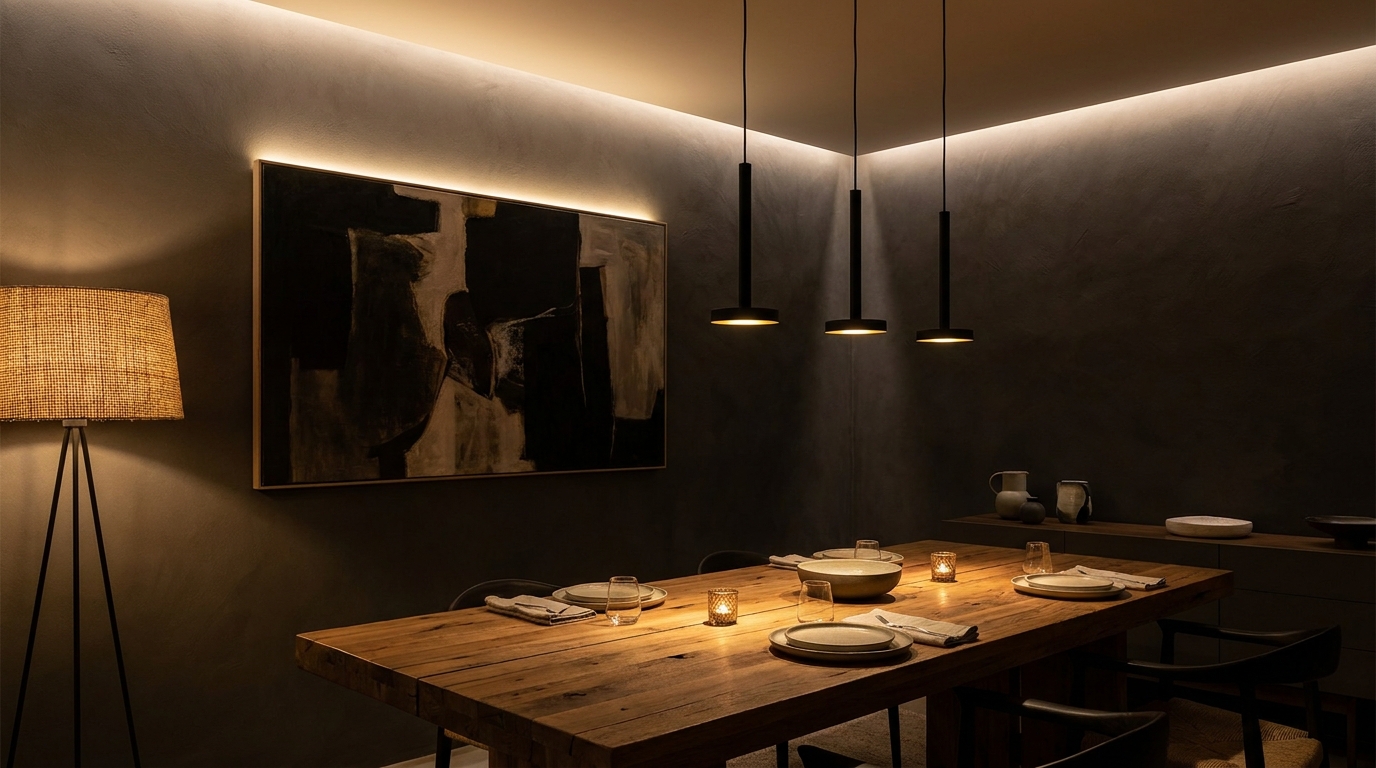
Why Lighting Is a Core Part of Visual Identity in Design
When we think about visual identity in interiors, we often think first of color palettes, furniture silhouettes, materials, and styling. Yet none of those elements can fully express themselves without light. Lighting reveals oak grain, softens linen, sharpens marble veining, and determines whether brass reads as mellow and rich or stark and brassy. It frames perception. A room with beautiful finishes can feel flat under poor lighting, while a modest room can feel elevated when illuminated with care.
This is why lighting should be understood as a design language rather than a background utility. Just as typography gives a brand a recognizable voice, lighting gives a home a recognizable emotional tone. A minimalist apartment may use concealed lines of light and disciplined pools of illumination to feel crisp and architectural. A traditional interior may lean on shaded lamps and warm layers to create intimacy and depth. A collector’s home may use accent lighting almost like a gallery to turn objects into focal points. The identity of the space emerges not only from what is in the room, but from how the room is lit.
The Department of Energy emphasizes that more light is not necessarily better. This point is essential because brightness alone does not create atmosphere. In fact, excessive brightness can flatten a room, expose every surface too harshly, and create visual fatigue. Identity comes from variation, contrast, rhythm, and intention. It comes from knowing where light should recede and where it should gather attention.
Lighting also shapes how people move through a home. Accent lighting can guide circulation toward an entry console, staircase, or reading corner. Soft pools of light create invitation. Darker perimeters can feel cocooning when balanced properly. A well-lit kitchen island signals activity and sociability, while a dimmed living area nearby encourages retreat. In this sense, lighting is spatial storytelling. It tells occupants how to inhabit a room and what emotional register that room is meant to hold.
Lighting identity is the difference between a room that is merely visible and a room that feels composed.
The Three Essential Layers of Light
The foundation of effective lighting identity begins with layered lighting. The Department of Energy defines three primary categories that work together in residential settings: ambient lighting for general illumination, task lighting for specific activities, and accent lighting to highlight features and enhance aesthetics. These three layers are not competing systems. They are complementary voices within a single composition.
Ambient Lighting Creates the Room’s Baseline Mood
Ambient lighting is the general glow that allows a room to function comfortably. It can come from ceiling fixtures, recessed lights, wall lights, cove lighting, or daylight. Too often, homeowners stop at this layer, which is why many interiors feel overlit yet emotionally unresolved. Ambient lighting should make a room navigable and welcoming, but it should not erase all shadow or nuance.
Cove lighting can become architecture in its own right: in the domed foyer at 216 Duncan Rd, hidden LED strips trace each plaster rib up to a central skylight.
In aesthetic terms, ambient lighting establishes the room’s first impression. A warm, diffused ambient layer suggests calm and softness. A cooler, brighter ambient field can feel focused, fresh, and active. The ideal approach is to create enough background light for comfort while preserving room for other layers to add depth. Think of ambient light as the atmosphere in which everything else will live.
Task Lighting Brings Precision and Ease
Task lighting supports specific actions such as chopping, reading, grooming, writing, sewing, or working at a desk. It is practical by nature, but that does not mean it should feel intrusive. The most successful task lighting solves a need quietly and elegantly. Under-cabinet lighting in a kitchen, a reading lamp beside a chair, vanity lighting that flatters the face, or a directional desk lamp are all examples of task lighting used well.
Task lighting is especially important because identity must never come at the expense of usability. A beautifully dim room can be enchanting until someone tries to prepare dinner or review paperwork. The art lies in giving activity areas the clarity they require without forcing the entire space into a uniformly bright condition. This is one of the great benefits of layering. One room can support multiple moods at once.
Accent Lighting Adds Character and Drama
Accent lighting is often the layer that transforms a home from ordinary to memorable. According to the Department of Energy, accent lighting draws attention to special features and enhances the aesthetic qualities of a space. This might include highlighting art, grazing a textured wall, illuminating open shelving, washing curtains with soft light, or giving a sculptural chair its own moment of presence. Accent light directs the eye and gives hierarchy to the room.
Many people assume accent lighting is optional decoration, but it performs a deeper role. It shapes spatial identity by deciding what matters visually. Without it, a room can feel visually democratic in the least interesting way, where everything is equally bright and nothing feels intentional. With accent lighting, the room gains rhythm. It acquires focal points, pauses, and visual punctuation.
Color Temperature and the Emotional Tone of a Room
Among the most powerful tools in lighting design is color temperature, measured in Kelvin. Natural Resources Canada notes that most residential LED bulbs fall roughly between 2000K and 6500K, giving homeowners a wide range of expressive control. This range matters because color temperature influences not just how a room looks, but how it feels physically and emotionally.
Warmer light, often in the lower Kelvin range, tends to feel gentle, intimate, and flattering. It is associated with candlelight, hospitality, and evening comfort. It softens skin tones and can make living rooms, bedrooms, and dining areas feel more inviting. Cooler or more neutral light can feel clearer, crisper, and more alert. It is often useful in kitchens, bathrooms, home offices, and utility spaces where accuracy and concentration matter more.
The mistake is to assume one temperature is universally superior. Warm light is not automatically best in every room, just as cool light is not automatically harsh. Identity comes from selecting a temperature that suits both the function and the emotional purpose of the space. A breakfast nook may benefit from a fresher tone in the morning, while a formal dining room may come alive under warmer evening light. A home office may need visual clarity by day and softer ambience after hours.
Color-tunable LEDs have made this flexibility more accessible than ever. The Department of Energy notes that tunable products can simulate daylight or candlelight to match mood, finishes, and even support human circadian rhythms. This turns lighting into a responsive medium. Instead of installing a fixed atmosphere, homeowners can shape different scenes across the day, allowing one room to evolve from focused and bright to soft and restorative.
The Quiet Importance of Color Rendering
If color temperature influences emotional tone, color rendering influences visual truth. Color Rendering Index, often referred to as CRI, measures how faithfully a light source reveals colors compared with a natural reference. The Department of Energy states that a CRI of 80 or higher is acceptable for most indoor residential applications. This may sound technical, yet it has an immediate effect on daily life.
Under poor color rendering, paint can feel lifeless, textiles can lose richness, and food can appear less appetizing. Skin tones may look tired or gray, and artwork may lose subtlety. In a home that values beauty, this matters profoundly. Luxury is often experienced through nuance. The complexity of walnut, the depth of terracotta, the softness of cream bouclé, or the true balance of a gallery wall all depend on the quality of light that reveals them.
When choosing bulbs and fixtures, it helps to think beyond wattage and lumens. Ask whether the light will honor the surfaces you have chosen. A room full of carefully considered materials deserves illumination that can reveal its full range. Lighting identity is not only about style, but about fidelity. It is about allowing your home to appear as beautifully as it was intended to be seen.
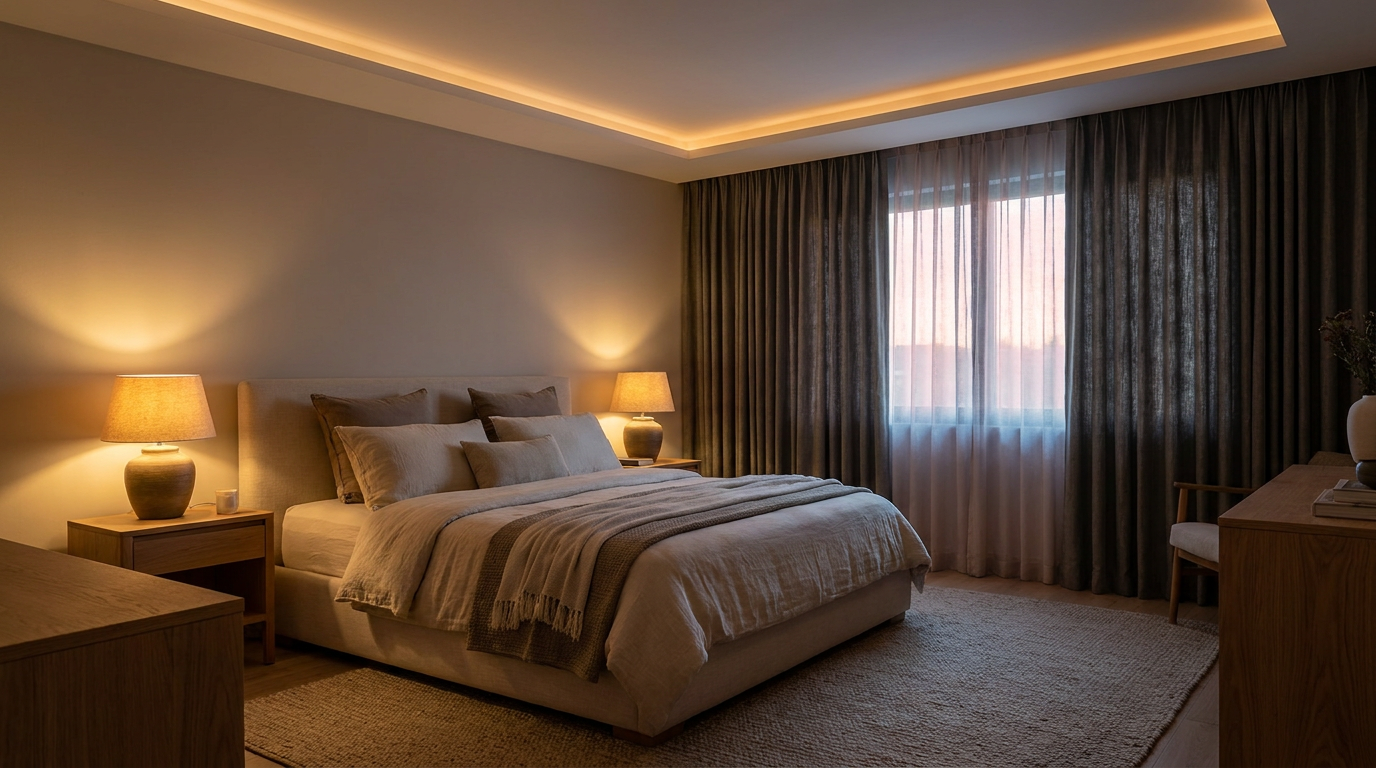
Lighting and Wellness: The New Dimension of Home Atmosphere
One of the most significant shifts in contemporary lighting design is the recognition that illumination affects the body as much as the eye. Evening light exposure can influence circadian timing, suppress melatonin, and alter sleep quality. Research highlighted in the earlier summary found that nearly half of homes in one field study had evening light levels bright enough to suppress melatonin by 50%. Another study reported that homes with energy-efficient lights had nearly double the melanopic illuminance of homes with incandescent lighting. These findings remind us that a stylish room can still be biologically disruptive if the light is too bright or too cool late at night.
This does not mean homeowners must fear modern lighting. It means timing and control matter. Bright, cool, energizing light can be beneficial in the morning or during work hours, especially in spaces where focus is needed. But as evening approaches, a home often benefits from a gentler lighting profile. Dimming levels, shifting toward warmer tones, and reducing overhead brightness can help create an environment that feels naturally aligned with rest.
Bedrooms and living rooms deserve particular attention here. These are often the spaces where people wind down, read, talk, or transition out of the day. Instead of relying on a single bright ceiling fixture, use lower-level lamps, warm bedside lights, and dimmable ambient layers. Let the room darken gradually. This creates psychological softness while also respecting the body’s need for reduced stimulation.
The larger lesson is beautiful in itself: lighting identity should not be static. A healthy home has different luminous needs at 8 a.m. and 10 p.m. To design with light today is to design for time. Atmosphere is not merely a look. It is a rhythm.
How to Build a Distinct Lighting Identity in Each Room
Although principles apply across the home, each room asks for a slightly different composition of light. The goal is not sameness, but coherence. A home feels sophisticated when its lighting vocabulary is consistent in spirit while still responsive to each space’s purpose. This is where design identity becomes truly personal.
Living Rooms: Layered Warmth and Social Flexibility
The living room is often the emotional center of the home, which makes it an ideal place to explore lighting identity fully. Rather than relying on one overhead fixture, combine ambient glow from concealed or ceiling sources with table lamps, floor lamps, and selective accent lighting on shelves, artwork, or architectural details. This layered arrangement allows the room to shift between conversation, reading, entertaining, and quiet evening retreat.
Warmth is often desirable here because it flatters people and encourages relaxation. Dimmers are especially valuable in living areas because they allow the room to adapt to the hour and occasion. A brighter setting may suit afternoon gatherings, while a lower scene with highlighted focal points creates intimacy after dark. When done well, the room feels less lit and more composed.
Kitchens: Clarity with Character
Kitchens require strong task lighting, but they do not need to feel clinical. Under-cabinet illumination can brighten countertops beautifully without forcing the entire space into excessive overhead glare. Pendants above an island can provide focus and rhythm while also contributing to the room’s visual identity. If the kitchen opens into dining or living areas, layered lighting becomes even more important because the atmosphere must transition gracefully between work and social life.
Neutral to slightly cooler light often supports food preparation and accuracy, but balance is key. If every surface is uniformly bright, the room can feel exposed rather than inviting. Accent lighting inside glass cabinetry or along open shelving can soften the composition and make the kitchen feel integrated with the rest of the home’s aesthetic language.
Bedrooms: Softness, Privacy, and Evening Calm
Bedrooms benefit from lighting that feels deeply considered. This is the room where circadian awareness and atmosphere naturally meet. Bedside lamps, wall-mounted reading lights, gentle cove lighting, and dimmable controls can create an environment that supports both function and rest. Warm tones usually work best in the evening, helping the room feel serene and protective.
Overhead light should be used thoughtfully here. If present, it should ideally be dimmable and not the sole source of illumination. The best bedroom lighting allows the room to hold shadow gracefully. It avoids harsh brightness and instead invites a sense of quiet enclosure. This is where lighting becomes almost emotional architecture.
Bathrooms: Flattering Precision
Bathroom lighting must balance clarity with comfort. Vanity lighting should minimize harsh shadows on the face, which is why side lighting or carefully positioned front lighting is often more flattering than a single overhead source. Neutral light can be useful here for grooming, skincare, and makeup, but excessive coolness can feel sterile.
For nighttime use, consider a softer secondary layer such as a dimmed sconce or low-level guide light. This makes the bathroom more adaptable and reduces the shock of sudden brightness during evening hours. Even practical rooms deserve an atmosphere that feels considered and humane.
Home Offices and Reading Areas: Focus Without Fatigue
Spaces dedicated to concentration need sufficient illumination for visual comfort, but they also benefit from depth and softness. A desk lamp with controlled direction can reduce eye strain and support specific tasks, while ambient light prevents harsh contrast between the work surface and surrounding room. If possible, daylight should play a role, though glare on screens must be managed carefully.
These rooms often look best with a more disciplined palette of light. Clear, neutral task lighting paired with subtle accent illumination on shelving or artwork can make a workspace feel intelligent and calm rather than cold. The aim is not to flood the room, but to balance focus and ease.
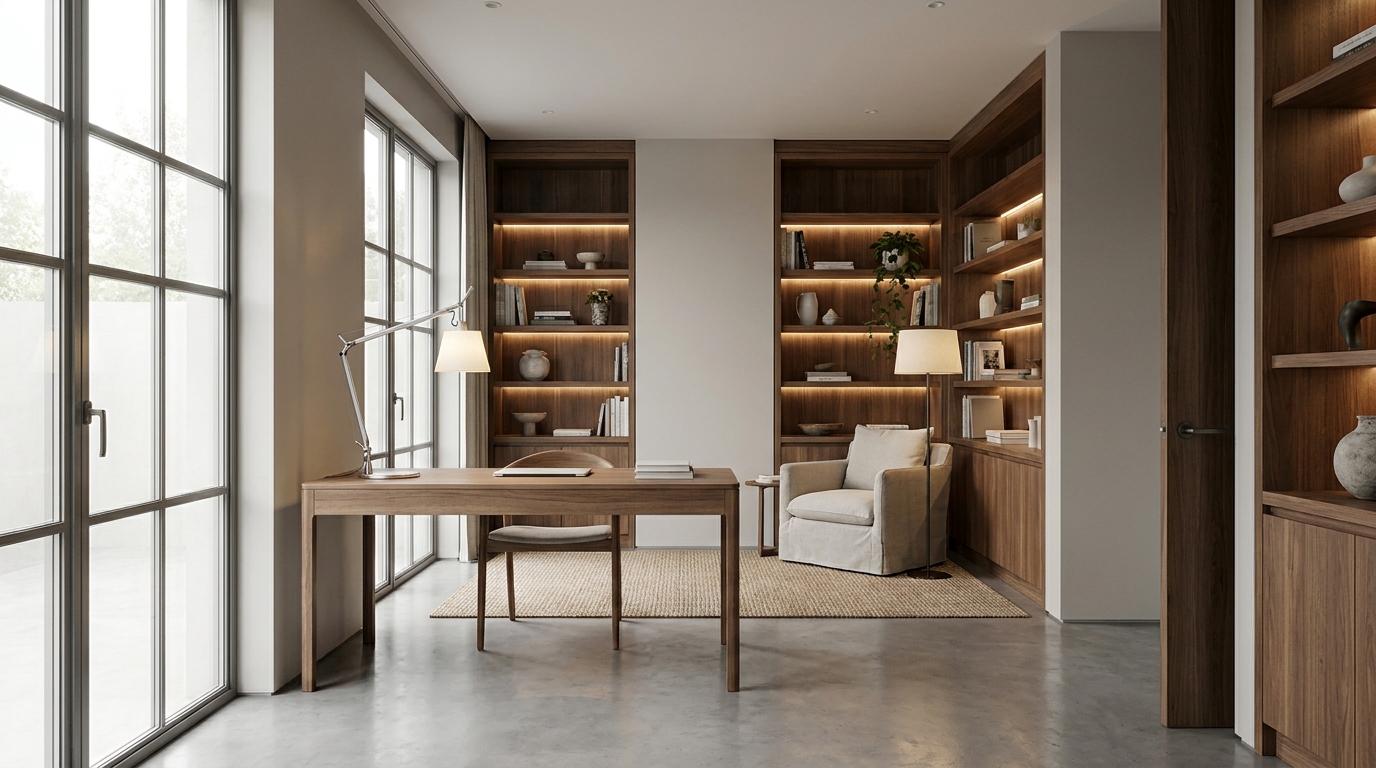
Daylight as the First Layer of Identity
Before artificial lighting enters the conversation, daylight deserves careful attention. It is the most dynamic and emotionally expressive light source in the home. Morning light can feel fresh and clarifying, afternoon light can be generous and uplifting, and filtered evening light can lend even the simplest room a cinematic tenderness. Designing with daylight means observing how the home changes throughout the day and allowing that movement to inform the artificial layers added later.
Window treatments, reflective surfaces, wall colors, and furniture placement all influence how daylight behaves. A sheer curtain can diffuse harsh direct sun into a gentle wash, while a darker matte wall can absorb brightness and increase intimacy. Mirrors can extend light deeper into a room, though they should be positioned thoughtfully to avoid glare. Daylighting is not only about maximizing brightness. It is about shaping quality.
The most sophisticated homes often feel connected to natural light rhythms even after sunset. Their artificial lighting seems to continue the logic of the day rather than erase it. This continuity makes the home feel grounded and elegant. It also reduces dependence on excessive electric light during daytime hours, supporting energy-conscious design.
Glare, Shadow, and the Importance of Restraint
One of the least discussed but most influential aspects of lighting identity is glare control. A beautiful room can lose all refinement if the eye is constantly struck by exposed bulbs, shiny reflections, or poorly aimed brightness. Glare creates discomfort and visual stress. It interrupts the softness that many people seek at home and can make even expensive interiors feel unresolved.
Restraint is often the answer. Concealed sources, shaded fixtures, diffused glass, indirect lighting, and careful aiming all help maintain comfort. It is also wise to avoid placing lights where they will reflect aggressively off glossy stone, polished screens, or mirrors. The goal is to illuminate surfaces and activities, not to make the source itself dominate unless it is intentionally decorative.
Shadow deserves equal respect. A room with no shadow often feels flat, while a room with controlled shadow feels dimensional and calm. Designers understand that darkness is not the enemy of good lighting. It is part of the composition. When certain corners remain quieter and some surfaces recede, the illuminated areas become more meaningful. Identity emerges through contrast as much as through brightness.
Smart Controls, Dimmers, and the Rise of Flexible Atmosphere
Lighting controls are among the most useful tools for shaping identity over time. The Department of Energy notes that dimmers, timers, occupancy sensors, and photosensors can reduce energy use while also creating flexible atmospheres. This is an important point because controls are often treated as merely practical additions, when in truth they are central to the emotional life of a home.
Dimmers are perhaps the simplest and most transformative option. They allow a dining room to move from daytime utility to evening intimacy in seconds. They let a bedroom soften toward rest and a living room settle into a quieter register after sunset. They also correct one of the most common mistakes in residential lighting, which is installing fixtures at an intensity that feels acceptable only when partially reduced.
Smart and color-tunable systems offer even more nuance. They can shift temperature and brightness by schedule, activity, or season. A morning scene might support alertness with brighter, more neutral light, while an evening scene might transition to a lower, warmer profile. Far from being just a technology trend, this is an evolution in how homes can express themselves. It makes lighting identity living and adaptive.
LEDs, Efficiency, and the Beauty of Responsible Choices
Energy efficiency and aesthetic quality are no longer opposing goals. In Canada, Natural Resources Canada notes that ENERGY STAR certified lighting products can help homeowners save money, while properly designed and used white-light LED products can last at least 25,000 hours. This longevity changes how we think about residential lighting. We are no longer choosing simply for immediate brightness, but for lasting performance and consistent atmosphere.
LED technology has also expanded the design vocabulary available to homeowners. The broad temperature range, compatibility with dimming in many products, and compact formats suitable for discreet architectural applications make LEDs particularly versatile. They can serve minimal interiors that rely on invisible sources, as well as decorative interiors where luminous layering matters deeply.
Still, efficiency alone is not enough. An efficient bulb that is too cool, too bright, or poor in color rendering may save energy while compromising comfort. The most responsible choice is a holistic one that considers consumption, lifespan, mood, visual fidelity, and timing together. Sustainable design is not only about reduction. It is about making choices that support better daily life.
Common Misconceptions That Dull a Home’s Lighting Identity
Several misconceptions continue to limit how people use lighting at home. The first is the belief that more light is always better. In reality, overwhelming brightness often removes the very atmosphere people want. Quality, placement, and direction matter as much as quantity. Another common misunderstanding is that warm light is best everywhere. While warmth can be beautiful, task-heavy areas often need more neutral light for clarity and accurate color perception.
There is also a tendency to think of accent lighting as purely decorative. Yet accent lighting is one of the strongest tools for defining visual hierarchy, guiding movement, and creating personality. Similarly, some assume smart lighting is just a gadget category. In practice, it can be one of the most elegant design tools available, especially when used to support layered scenes and healthier evening transitions.
Finally, many people assume that because LEDs are efficient, they are automatically benign in all contexts. But efficient LEDs can still be too bright or too blue at night. The lesson here is subtle but important. Good lighting is never about a single metric or trend. It is about relationships between light, room, body, and time.
A Practical Framework for Experimenting at Home
If you want to refine your home’s lighting identity, begin by observing rather than buying. Spend a few evenings noticing where the room feels flat, where glare occurs, and which areas naturally draw comfort. Consider what each room should feel like at different times of day. Should it energize, calm, flatter, focus, or invite conversation? These emotional intentions provide a better starting point than fixture shopping alone.
From there, work through a simple sequence.
- Assess daylight first and notice how the room changes across morning, afternoon, and evening.
- Establish ambient lighting that provides comfort without excess brightness.
- Add task lighting exactly where activities need clarity.
- Introduce accent lighting to create focal points and reveal texture.
- Choose color temperature intentionally based on room function and mood.
- Check CRI so materials, skin tones, and finishes appear natural and rich.
- Install dimmers or controls to let the atmosphere evolve throughout the day.
- Test at night and adjust for comfort, glare, and sleep-friendly softness.
This process does not require a complete renovation. Often, a room changes dramatically with the addition of one lamp, one dimmer, or one better-positioned accent source. The transformation lies in intention rather than excess. Lighting identity is less about buying more and more about seeing more clearly what the room wants to become.
Conclusion: Let Light Become Part of Your Home’s Signature
The most beautiful homes are not necessarily the brightest or the most elaborate. They are the ones that understand mood, rhythm, and perception. They know how to flatter materials, support daily life, and shift gently with the hour. They use light not as a final layer of utility, but as an essential expression of identity.
In practical terms, this means layering ambient, task, and accent light with care. It means choosing color temperature and CRI with as much thought as you would give to paint or stone. It means using LEDs and controls wisely, embracing daylight, reducing glare, and allowing evening spaces to soften into rest. It also means accepting that great lighting is rarely accidental. It is composed.
There is something deeply empowering in this. Illumination is one of the most accessible ways to transform a home because it changes not only what we see, but how we feel inside what we see. A room can become more intimate, more sculptural, more peaceful, or more alive without moving a wall or replacing a sofa. Light has that power. When handled with artistry and restraint, it becomes the signature that makes your home unmistakably your own.



No Comment! Be the first one.