



Coastal infrastructure sits at one of the most important intersections in modern city building. It protects land, supports transportation, enables trade, carries utilities, and increasingly determines whether housing growth can proceed safely in places under pressure from climate change. That matters because many of the regions attracting the most investment are also the regions facing rising exposure to sea level rise, storm surge, erosion, nuisance flooding, and complex drainage failures. In practical terms, the future of coastal development is no longer just about the edge of the water. It is about whether entire urban systems can remain functional as environmental conditions shift.
Table Of Content
- Why Coastal Infrastructure Has Become a Growth Issue, Not Just a Protection Issue
- The Climate Risks Are Escalating Faster Than Traditional Planning Assumptions
- From Hard Defenses to Layered and Adaptive Systems
- Housing Delivery Depends on Infrastructure That Can Withstand Future Conditions
- Governance and Regional Coordination Will Determine Success
- What Smart Coastal Infrastructure Planning Looks Like in Practice
- Core Principles for Future Ready Coastal Development
- Correcting the Misconceptions Holding Projects Back
- The Investment Case for Resilience Is Becoming Stronger
- The Future of Coastal Infrastructure Development
Across Canada and North America, waterfronts, estuaries, ports, and Great Lakes shorelines continue to attract large scale redevelopment. These areas often offer proximity to downtowns, transit corridors, industrial land conversion opportunities, and significant economic value. At the same time, they contain aging infrastructure that was not designed for today’s climate realities, let alone future ones. Natural Resources Canada and the National Research Council have both underscored that coastal infrastructure is under strain from deferred maintenance, rising hazard exposure, urbanization, and changing weather patterns. That combination creates both a risk and a strategic imperative.
The key shift underway is conceptual as much as technical. Resilience is no longer being defined as building a higher wall and hoping it holds. It is increasingly being understood as an integrated system of risk management that aligns land use, infrastructure finance, housing policy, environmental planning, emergency access, and long range design assumptions. For developers, municipalities, and policymakers, that is a major change in thinking. It means coastal infrastructure development has become central to broader conversations about housing supply, urban growth, and long term public safety.
This is particularly relevant in Canada, where the need to expand housing supply remains urgent. Major urban growth areas often overlap with waterfronts, river mouths, former industrial lands, and infrastructure rich precincts that are attractive for redevelopment but exposed to flooding and erosion. If those places are not planned with future conditions in mind, housing delivery may become more expensive, less insurable, more vulnerable to disruption, and in some cases fundamentally unviable. If they are planned well, they can become a model for how climate adaptation and urban expansion can reinforce one another rather than compete.
That is the real opportunity. Climate resilient coastal infrastructure should not be treated as a narrow environmental concern or as a compliance burden. It is a development enabler. It creates the conditions for stable investment, long term asset performance, and safer communities. The cities that understand this first will be better positioned to absorb growth, protect public value, and avoid the cycle of building in hazard prone places only to spend far more later on emergency retrofits and recovery.
Why Coastal Infrastructure Has Become a Growth Issue, Not Just a Protection Issue
Historically, coastal infrastructure was often discussed in defensive terms. Seawalls, dikes, breakwaters, wharves, marinas, and small craft harbours were seen as stand alone assets that protected shorelines, enabled marine activity, or maintained local access. That view is no longer sufficient. Today, the performance of these assets affects transportation reliability, utility service delivery, port operations, emergency response, insurance risk, and the feasibility of adjacent real estate. In dense urban regions, a single weak link can have cascading effects across an entire district.
That systems perspective is increasingly reflected in Canadian policy and research. Federal guidance now treats coastal resilience as a regional planning challenge rather than an asset by asset engineering exercise. This is a critical change because flood risk does not respect property lines or municipal boundaries. A protective intervention in one location can redirect water, sediment, or erosion pressures elsewhere. In the same way, a new housing project may appear sound on site but still depend on roads, substations, wastewater systems, and emergency routes that are exposed just beyond its limits.
For growing cities, this is where coastal infrastructure becomes directly linked to housing. Canada’s housing expansion agenda has increased pressure to use land efficiently, intensify existing urban areas, and unlock sites that can support meaningful scale. Many of those sites are on or near waterfronts because that is where infrastructure capacity, transit connections, redevelopment potential, and land value often converge. Yet these same places can carry significant climate risk. The implication is straightforward. Housing growth and coastal resilience can no longer be planned in separate silos.
In strategic terms, resilient infrastructure lowers uncertainty. It helps municipalities make more credible land use decisions, gives developers a more reliable basis for underwriting projects, and provides communities with greater confidence that growth will not come at the cost of greater hazard exposure. Without that confidence, approvals slow, costs rise, political opposition hardens, and long term maintenance obligations become harder to manage. With it, the development process becomes more disciplined and more durable.
The broader lesson is that infrastructure resilience is part of city making. It is not only about surviving a storm. It is about enabling a waterfront district, port precinct, estuary community, or Great Lakes shoreline settlement to function economically and socially over decades of changing conditions. That is a very different standard from the one many existing assets were designed to meet.
The Climate Risks Are Escalating Faster Than Traditional Planning Assumptions
One of the most persistent misconceptions in coastal development is that flood risk is static. In reality, coastal hazards are dynamic and compounding. Sea level rise increases baseline water levels. Storm surge adds episodic peaks. Erosion reshapes shorelines over time. Urbanization changes runoff volumes and drainage behavior. In some places, declining sea ice removes a natural buffer that once reduced wave energy. In others, land subsidence or constrained stormwater systems amplify the impacts of even relatively modest water level increases.
The significance of this is often underestimated because the physical change can seem incremental while the operational consequences are not. NOAA’s comparative guidance from the United States is useful here. It shows that coastal infrastructure can become vulnerable at approximately 0.5 metres, 0.8 metres, and 1.2 metres above mean higher high water for minor, moderate, and major flooding thresholds. The lesson is not about one country’s exact metrics. It is that relatively small water level changes can trigger outsized disruption, especially in systems that rely on narrow tolerances and uninterrupted access.
This matters enormously for urban development. Roads can become impassable before buildings themselves flood. Pumping stations can fail before a protective barrier is overtopped. Utility vaults, transit corridors, and low lying intersections can create weak points that compromise an entire neighborhood. A project that appears compliant under historical flood data may still be misaligned with future service conditions. In that sense, the real challenge is not just defending structures from water. It is preserving urban functionality under evolving risk scenarios.
That is why modern coastal planning is moving away from backward looking assumptions. Historical averages are no longer enough. Scenario based mapping, sea level rise projections, and future flood allowances are becoming essential tools in both public planning and private feasibility analysis. This shift may initially appear conservative, but in reality it is economically rational. Building to outdated assumptions only creates hidden liabilities that surface later through retrofits, service failures, litigation, and value impairment.
Coastal resilience is not about predicting one exact future. It is about designing infrastructure and communities that can perform acceptably across a range of plausible futures.
That framing is especially important for cities balancing urgent housing demand with finite land availability. If climate risk is not integrated early, development can lock in exposure for generations. If it is integrated intelligently, cities can still grow while reducing long term vulnerability and improving infrastructure performance.
From Hard Defenses to Layered and Adaptive Systems
Another common misconception is that seawalls and dikes alone can solve coastal risk. Hard infrastructure remains essential in many settings, particularly where dense urban assets, ports, industrial operations, or critical public infrastructure leave little room for retreat. But the most effective contemporary strategies recognize that no single intervention can manage the full complexity of coastal systems. A wall may reduce direct overtopping at one location while increasing reflection, erosion, or drainage problems elsewhere. It may protect current conditions while becoming undersized under future scenarios. It may defend property while disconnecting a community from the shoreline and degrading ecological function.
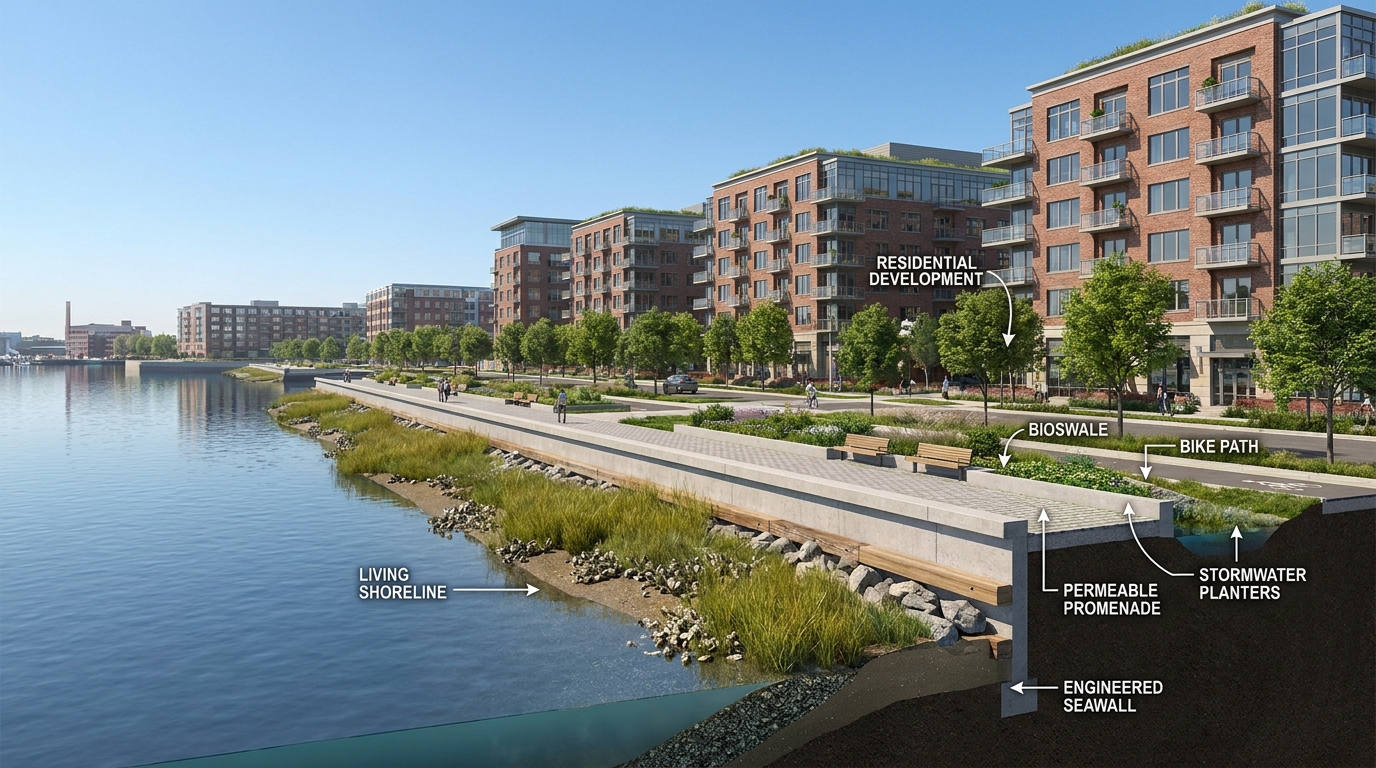
As a result, the future of coastal infrastructure development lies in layered protection. This means combining engineered structures with nature based systems, floodplain design, stormwater management, elevated site planning, and operational preparedness. A resilient waterfront district might include raised grades, deployable barriers at key access points, restored marsh edges, enhanced pumping capacity, flood compatible public spaces, protected utility corridors, and buildings designed with resilient ground floors. The value of this approach is not aesthetic alone. It creates redundancy, distributes risk management across multiple systems, and improves the ability to adapt over time.
Natural Resources Canada’s flood guidance has reinforced this direction through a stronger emphasis on risk based analysis and vertical allowances. In simple terms, vertical allowances are elevation adjustments that help maintain acceptable flood risk under future sea level scenarios. This is a strategic concept because it allows designers and decision makers to move beyond fixed historical benchmarks. Instead of asking whether an asset meets yesterday’s conditions, they can ask whether it is positioned to remain functional through tomorrow’s.
Hybrid infrastructure is particularly promising because it bridges engineering performance and environmental stewardship. Living shorelines, restored wetlands, dune systems, and floodplain reconnection can absorb wave energy, reduce erosion, store water, and improve habitat. When integrated with conventional protection, these features can produce more flexible and multifunctional outcomes. They may not replace hard defenses in every context, especially in intensely urbanized areas, but they can reduce pressure on those defenses and provide co benefits that purely grey infrastructure cannot.
For development strategy, this has a clear implication. The question is no longer whether a site has a wall. The question is whether the district has a coherent resilience system that can evolve over time. That distinction is critical for investors, regulators, and communities because long term value depends on system performance, not just on isolated structures.
Housing Delivery Depends on Infrastructure That Can Withstand Future Conditions
In many major cities, the most realistic opportunities for adding significant housing are tied to areas already shaped by infrastructure. These include waterfront regeneration zones, former port lands, transit connected industrial districts, and estuarine urban edges where large parcels can be assembled or repurposed. Such areas often make sense from a growth perspective. They are close to jobs, connected to transportation, and capable of supporting density. Yet their viability increasingly depends on whether supporting infrastructure can be renewed and climate proofed at the same time.
This is where resilience and housing should be understood as mutually reinforcing rather than competing priorities. Resilient infrastructure can help unlock land for safer development by clarifying servicing capacity, defining flood thresholds, protecting critical access routes, and giving markets confidence in long term asset performance. Conversely, large scale housing projects can help justify and finance major infrastructure upgrades when planned at the district level. A well structured growth strategy can therefore align public adaptation objectives with private development economics.
The opposite approach is much more costly. If municipalities approve housing without resolving underlying exposure in surrounding infrastructure networks, they may create neighborhoods that are technically built but operationally fragile. Residents may face recurrent access issues, rising insurance costs, service interruptions, and eventual calls for expensive public intervention. What looks like accelerated housing delivery in the short term can become deferred infrastructure liability in the long term.
That is why resilience screening should be integrated into feasibility analysis from the outset. Developers and public agencies need to evaluate not just parcel specific hazards, but also dependency risks tied to roads, water systems, wastewater facilities, power supply, transit links, shoreline protection, and emergency services. This broader lens often changes site planning, phasing, and cost allocation. It may also influence density assumptions, land value, and infrastructure contribution frameworks. None of this slows good development. It makes it more credible.
There is a larger strategic point here as well. Housing policy cannot succeed in isolation from infrastructure policy. In coastal and waterfront contexts, the two are inseparable. If Canada and other North American jurisdictions are serious about increasing supply, they must also be serious about renewing the infrastructure systems that make urban housing safe, reliable, and durable under future climate conditions.
Governance and Regional Coordination Will Determine Success
Engineering matters, but governance often decides whether resilient projects actually happen. Coastal systems cross municipal boundaries, involve multiple infrastructure owners, and affect overlapping public interests. Ports, conservation authorities, utilities, transportation agencies, Indigenous governments, municipalities, provincial bodies, and private landowners may all have a stake in the same shoreline. Without coordination, projects can stall, conflict, or simply transfer risk from one jurisdiction to another.
This is one reason newer Canadian resilience programs have placed strong emphasis on collaboration. Natural Resources Canada’s Climate Resilient Coastal Communities Program, backed by $41 million over 2023 to 2028, reflects a more implementation oriented phase of adaptation policy. It supports pilot projects across Canada’s three marine coasts and the Great Lakes and St. Lawrence region, with direct relevance to estuaries, ports, municipal services, and planning processes. The importance of that funding is not just its size. It signals that resilience is now being operationalized through partnerships and place based action.
Regional planning is especially valuable because isolated asset upgrades can produce maladaptation. A municipality may strengthen one section of shoreline while increasing scour elsewhere. A developer may elevate a site while adjacent roads remain exposed. A port authority may invest in operational resilience while neighboring residential communities still face access failures during flood events. Coordinated planning helps avoid these fragmented outcomes by assessing exposure, dependencies, and trade offs across a wider geography.
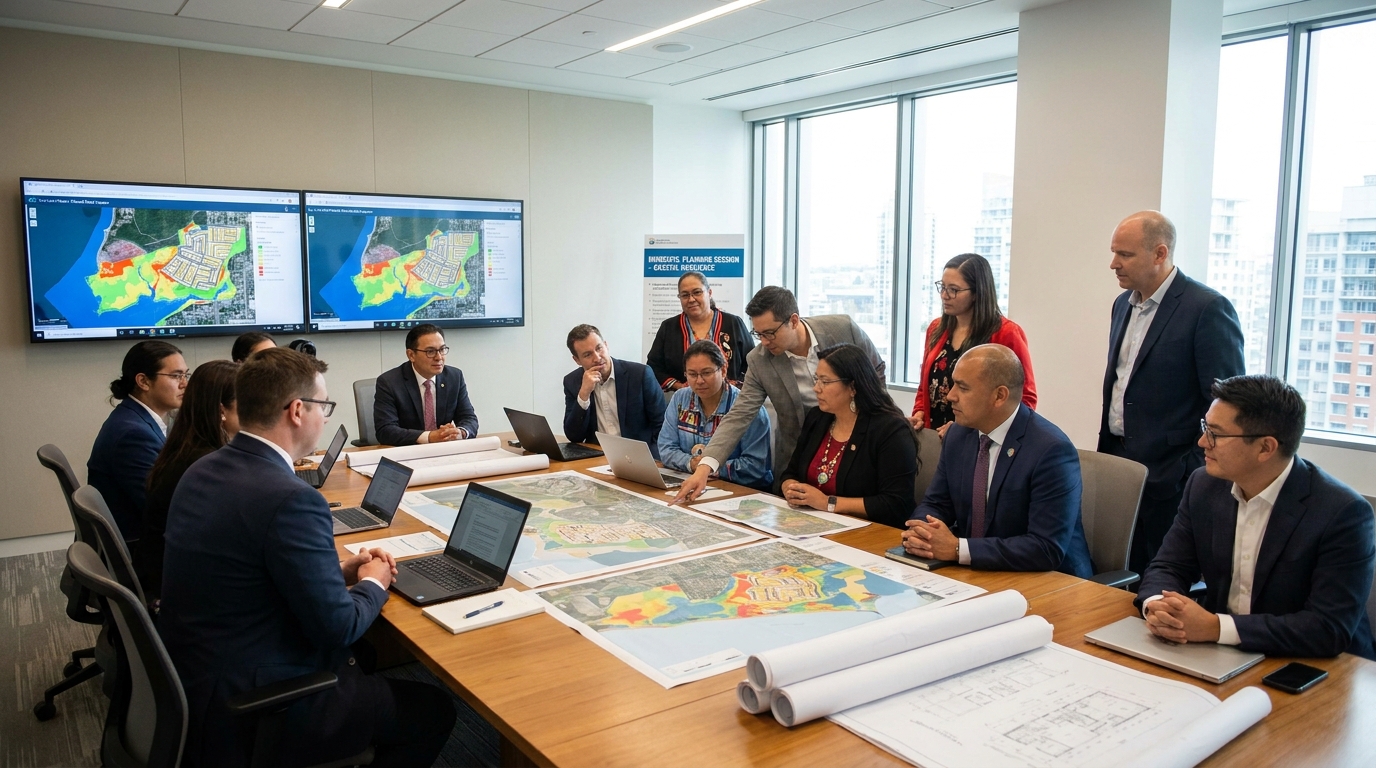
Indigenous leadership is also central to the future of coastal infrastructure development. Many coastal decisions affect cultural landscapes, harvesting areas, ecological systems, and long standing relationships to land and water. Indigenous communities are not simply stakeholders in adaptation. In many cases they are rights holders, knowledge holders, and leaders in place based resilience planning. Stronger coastal governance therefore requires engagement structures that move beyond consultation toward meaningful partnership and shared decision making.
Community engagement more broadly plays a practical role as well as an ethical one. Residents often understand where flooding occurs first, which routes fail during storms, how drainage behaves, and what infrastructure gaps are felt most acutely. Public trust also matters because resilience measures can affect access, views, public space, taxation, and development intensity. Projects that explain trade offs clearly and show how adaptation supports safety, livability, and future growth are far more likely to earn durable support.
What Smart Coastal Infrastructure Planning Looks Like in Practice
Smart planning begins with accepting that resilience is a portfolio, not a single project. The strongest coastal strategies combine hazard mapping, engineering assessment, land use controls, ecological design, infrastructure phasing, emergency planning, and long term asset management. They identify what must be protected, what can be adapted incrementally, where natural systems can do more work, and where some uses may need to shift over time. This approach is more complex than a stand alone wall, but it is also more realistic.
A useful planning sequence often starts with risk characterization. That means understanding current and future flood exposure, erosion trajectories, drainage patterns, service dependencies, and social vulnerability. From there, decision makers can define performance objectives. Which roads must remain passable during certain flood events. Which utilities require uninterrupted service. Which housing areas can tolerate temporary disruption and which cannot. Which public spaces can be designed to flood safely. These are strategic questions because they shape cost, design standards, and land use outcomes.
Next comes spatial alignment. Infrastructure upgrades need to be coordinated with growth areas, transit investments, and public realm improvements so that resilience spending creates broader urban value. A raised waterfront corridor, for example, may also support new transit, active mobility, utility renewal, and stormwater upgrades. A restored wetland edge may reduce erosion while improving habitat and creating public open space. The more functions a project serves, the stronger the long term return on public and private investment.
Adaptive phasing is equally important. Not every intervention has to be built at once, but the overall system should be designed so future upgrades remain possible and cost effective. This might include reserving corridors, protecting expansion zones, setting grade relationships that can be increased later, or designing structures to accommodate future barrier extensions. In development terms, adaptability protects optionality. It reduces the risk of premature obsolescence and helps cities respond to changing science, funding, and growth patterns.
Asset management must also be part of the conversation. Much of Canada’s coastal infrastructure is aging, and resilience cannot be separated from renewal. Deferred maintenance creates vulnerability even before climate change is considered. Replacing or rehabilitating marine structures, protective works, and related municipal systems should therefore be seen as a chance to redesign for future performance rather than simply restore past function. That is one of the clearest ways to move from reactive spending to strategic investment.
Core Principles for Future Ready Coastal Development
-
Plan at the district and regional scale. Flood risk, access, utilities, and shoreline dynamics operate across boundaries. Projects should be evaluated as part of wider systems.
-
Design for future conditions, not historical averages. Sea level rise allowances, scenario mapping, and changing storm patterns must inform elevation, drainage, and servicing decisions.
-
Use layered defenses. Hard protection, nature based systems, resilient public realm design, and emergency planning work best in combination.
-
Align resilience with housing and economic development. Infrastructure investments should help unlock safe growth and protect the long term value of urban districts.
-
Build governance capacity. Strong outcomes depend on coordination among municipalities, Indigenous communities, infrastructure owners, regulators, and private sector partners.
Correcting the Misconceptions Holding Projects Back
Several misconceptions continue to distort public debate around coastal infrastructure. The first is that resilience is mainly an environmental agenda that slows development. In reality, resilience is increasingly a precondition for development. It reduces uncertainty, supports underwriting, improves public confidence, and lowers the probability of future disruption. In many locations, the fastest way to make housing and infrastructure approvals more defensible is to deal with climate exposure up front rather than leave it unresolved.
The second misconception is that nature based solutions are too small to matter. This understates both their technical role and their strategic value. Wetlands, living shorelines, dunes, and restored floodplains may not replace engineered barriers in dense port or downtown settings, but they can reduce wave energy, create storage, slow erosion, and provide ecological and social benefits that improve overall project performance. The most mature resilience portfolios now treat them as serious infrastructure components rather than optional landscape features.
The third misconception is that only oceanfront cities need to care. Coastal risk extends through estuaries, river mouths, Great Lakes shorelines, industrial corridors, and utility networks that support inland populations. Flood exposure can travel through connected systems even when a community is not directly on the open coast. This broader geography matters because infrastructure planning often remains too narrow while risk itself remains highly interconnected.
The fourth misconception is that if an area has not flooded badly in recent memory, the threat is limited. That assumption fails to account for changing baselines, development pressure, and infrastructure aging. A location that performed acceptably under past conditions may become far more vulnerable when sea levels rise slightly, drainage is constrained, or adjacent land use intensifies. This is why updated mapping and forward looking allowances are indispensable.
Correcting these misconceptions is not just a communications exercise. It changes investment decisions. It influences how cities prioritize renewal, how developers structure feasibility, and how communities understand the relationship between growth and safety. In that sense, better public literacy around coastal resilience can directly improve development outcomes.
The Investment Case for Resilience Is Becoming Stronger
For years, adaptation was often framed as a cost center. That framing is weakening because the financial consequences of inaction are becoming harder to ignore. Flood damage, operational downtime, insurance challenges, emergency repairs, asset impairment, and reputational risk all have real costs. In housing markets already facing affordability pressure, avoidable infrastructure failure only pushes costs higher. Resilience spending, by contrast, can stabilize long term value when it is targeted well and integrated with growth planning.
There is also a timing advantage to acting during redevelopment cycles. When districts are already being rezoned, serviced, or rebuilt, infrastructure interventions can be coordinated more efficiently with grading, utilities, transportation, and public realm investment. Retrofitting later is almost always more expensive and more disruptive. This is particularly true in coastal urban areas where underground systems, access constraints, and multiple stakeholders complicate after the fact adaptation.
From a public finance perspective, resilient infrastructure can also improve the durability of tax base expansion. Municipalities depend on development to support future revenues, but that growth is only as sound as the systems beneath it. If a waterfront district generates significant assessment value while relying on fragile flood exposed infrastructure, the fiscal upside may prove unstable. If that same district is supported by resilient, well planned infrastructure, the municipality is far better positioned to sustain service delivery and defend public investment over time.
Private capital is beginning to respond to this logic as well. Institutional investors, lenders, and insurers increasingly recognize climate exposure as a material factor in long term asset performance. Coastal resilience therefore influences not only physical planning but also financing conditions. Projects that can demonstrate robust adaptation planning may enjoy stronger market confidence than those that treat flood risk as a secondary issue. Over time, that differentiation is likely to become more pronounced.
The Future of Coastal Infrastructure Development
The future will belong to places that treat resilience as part of mainstream growth strategy. This does not mean every shoreline can or should be defended in the same way. Some locations will require robust engineered protection. Others will benefit from hybrid systems. Some uses may be redesigned to tolerate periodic flooding, while in a limited number of areas, retreat or relocation may become the most responsible long term choice. What matters is that these decisions are made deliberately, transparently, and with a realistic understanding of future conditions.
Canada is moving in that direction. Federal funding programs, evolving hazard guidance, and a stronger focus on collaborative adaptation planning show that the policy landscape is maturing. The challenge now is to translate that momentum into local delivery, district level implementation, and more disciplined integration with housing and infrastructure decisions. That is where the next generation of coastal leadership will be defined.
For city builders, the message is clear. Coastal infrastructure can no longer be viewed as a background utility or a specialized engineering concern. It is central to land value, project feasibility, public safety, and regional economic continuity. It affects where growth can occur, how much it costs, and whether communities will remain functional under environmental stress. In an era of rising climate risk and urgent housing demand, that makes it one of the most strategic infrastructure questions on the urban agenda.
The most resilient coastal projects will not be the ones that simply resist water most aggressively. They will be the ones that understand systems, anticipate change, coordinate across jurisdictions, and create room for adaptation over time. They will protect critical assets while supporting new housing, better public spaces, healthier ecosystems, and more reliable infrastructure networks. In other words, they will do what good city building has always aimed to do. They will create places that are not only valuable today, but viable tomorrow.
That is the future of coastal infrastructure development. Not a retreat from growth, but a smarter foundation for it. Not a narrow line of defense, but a coordinated strategy for living, building, and investing responsibly at the water’s edge.

No Comment! Be the first one.