



Cities are entering a new phase of development. For decades, urban governments have relied on planning policy, infrastructure investment, and public administration to manage growth. Today, artificial intelligence is adding a new layer to that work. It is not replacing the fundamentals of city building, but it is changing how municipalities understand patterns, allocate resources, and respond to pressure in real time. In practical terms, AI-driven cities represent the next evolution of the smart city, where data and machine intelligence help leaders make better decisions in transportation, housing, utilities, climate resilience, and service delivery.
Table Of Content
- Why AI Matters More as Cities Grow
- From Smart City to AI-Driven City
- How AI Improves Urban Planning
- Better Scenario Testing for Long-Term Growth
- Mobility, Transit, and the Daily Experience of the City
- Public Services That Become More Responsive
- Infrastructure, Energy, and the Value of Predictive Maintenance
- Climate Adaptation and Urban Resilience
- The Governance Challenge Behind the Technology
- What Strong Urban AI Governance Looks Like
- Misconceptions That Distort the Conversation
- What AI-Driven Cities Mean for the Future of Urban Living
- A Strategic Path Forward
This shift matters because urban complexity is rising faster than traditional systems can comfortably manage. The United Nations reports that more than half of the global population already lives in urban areas, and that share is expected to keep climbing toward roughly two-thirds by 2050. In Canada, this is especially relevant because population growth continues to concentrate in large metropolitan regions. Statistics Canada identifies 41 census metropolitan areas in the 2025 subprovincial population estimates, while Toronto remains the country’s largest CMA with 6,202,225 residents in the 2021 Census. Ottawa-Gatineau reached 1,488,307 residents and grew 8.5 percent between 2016 and 2021. These numbers underline a simple reality. As cities get larger and more interconnected, urban management becomes more demanding.
The most useful way to understand AI in cities is to remove the hype. AI-driven cities are not science fiction environments where algorithms govern urban life without public oversight. They are cities that use artificial intelligence, machine learning, and real-time data to improve how decisions are made and how services are delivered. The OECD has framed AI as a tool that can help cities anticipate needs and strengthen urban planning and management. That framing is important because it puts AI in its proper place. It is a capability within governance, not a substitute for governance itself.
What makes this moment significant is scale. According to an OECD issues note published in 2025, a survey of 250 cities across 78 countries found that 56 percent were already actively using AI and another 35 percent were piloting or planning to use it. That tells us the conversation has moved well beyond experimentation. AI is becoming an operational layer in city administration, particularly in mobility, public services, and infrastructure management. The next question is no longer whether cities will use AI. It is how they will use it responsibly, effectively, and in ways that create long-term public value.
For urbanists, developers, policymakers, and residents, the strategic implications are substantial. AI can help cities reduce congestion, improve transit reliability, anticipate infrastructure failures, lower energy waste, and respond more quickly to emergencies. It can also support more targeted planning by revealing where growth pressures are intensifying and where investment can have the greatest effect. Yet none of these benefits happen automatically. The long-term success of AI-driven cities depends on data governance, institutional capacity, procurement discipline, ethical safeguards, and public trust. In the end, the future of urban living will be shaped as much by civic readiness as by technical sophistication.
The future city will not be defined by how much technology it deploys, but by how intelligently it aligns that technology with public purpose.
Why AI Matters More as Cities Grow
Urban growth increases demand on every major system at once. More residents require more housing, more water capacity, more transit frequency, more waste collection, more emergency response coordination, and more resilient public infrastructure. In a smaller or slower-growing municipality, these pressures may be manageable through conventional forecasting and departmental workflows. In large metropolitan areas, however, the margin for error narrows. Delays in traffic management can ripple across entire regional networks. Deferred maintenance on one utility corridor can create system-wide costs. Misaligned service planning can deepen inequities between neighborhoods.
This is where AI has practical value. Artificial intelligence can process large volumes of data from sensors, service records, geospatial systems, traffic feeds, weather models, and utility networks faster than traditional manual methods. It can identify patterns that are difficult for human teams to see in isolation. It can estimate where demand will surge, where assets are likely to fail, and where interventions may have the greatest impact. That does not eliminate the need for planning judgment. It strengthens the ability of decision-makers to work with better evidence.
For North American cities, this capability is especially relevant because urban form is often fragmented. Many metropolitan regions operate across municipal boundaries, multiple transit agencies, and layered utility jurisdictions. Growth is rarely contained within one administrative unit. AI, when paired with strong data-sharing structures, can help create a more integrated view of how the broader urban system is functioning. This can support regional planning, infrastructure coordination, and more coherent investment strategies over time.
There is also a fiscal argument. Cities are expected to do more with constrained budgets, aging infrastructure, and rising climate risk. OECD research on smart-city data governance notes that digital technologies such as AI, IoT, and big data can generate real-time data that improves operational efficiency and public-service delivery. In a period where municipalities face both growth pressure and funding limitations, better use of data can become a form of financial resilience. A city that can anticipate maintenance, optimize staffing, and reduce waste is better positioned to protect service quality without simply absorbing ever-rising costs.
From Smart City to AI-Driven City
The term smart city has been used so broadly that it often loses precision. In its most useful sense, a smart city uses digital tools to improve urban outcomes. AI-driven cities build on that foundation, but add a stronger predictive and adaptive capability. Instead of only gathering data, they use machine intelligence to interpret it, model scenarios, and recommend or automate responses. The distinction matters because many cities already have sensors, software platforms, and digital records. The opportunity now is to connect those systems in ways that support decisions rather than simply reporting conditions.
This evolution can be understood through a simple progression. First, cities digitized information. Then they started integrating systems and building dashboards. Now they are layering AI into that environment to forecast needs and optimize operations. A traffic system that simply displays congestion is useful. A traffic system that predicts bottlenecks and dynamically adjusts signal timing is more valuable. A maintenance database that logs asset conditions is helpful. A predictive model that estimates which assets are likely to fail before visible deterioration appears can transform capital planning.
The OECD has consistently emphasized that AI in cities should be viewed as a means to improve planning and management. That is an important corrective to the misconception that AI-driven urbanism is mainly about autonomous vehicles, robots, or widespread surveillance. In reality, many of the most credible use cases are administrative and infrastructural. They involve reducing delays, prioritizing repairs, improving service coordination, and enhancing resilience. These are not glamorous outcomes, but they are foundational to urban quality of life.
The strategic lesson is clear. The future of AI-driven cities will be won not by cities chasing novelty, but by those building interoperable systems, trusted governance frameworks, and durable public-sector capabilities. Technology can unlock value, but only if it is deployed within institutions capable of using it wisely.
How AI Improves Urban Planning
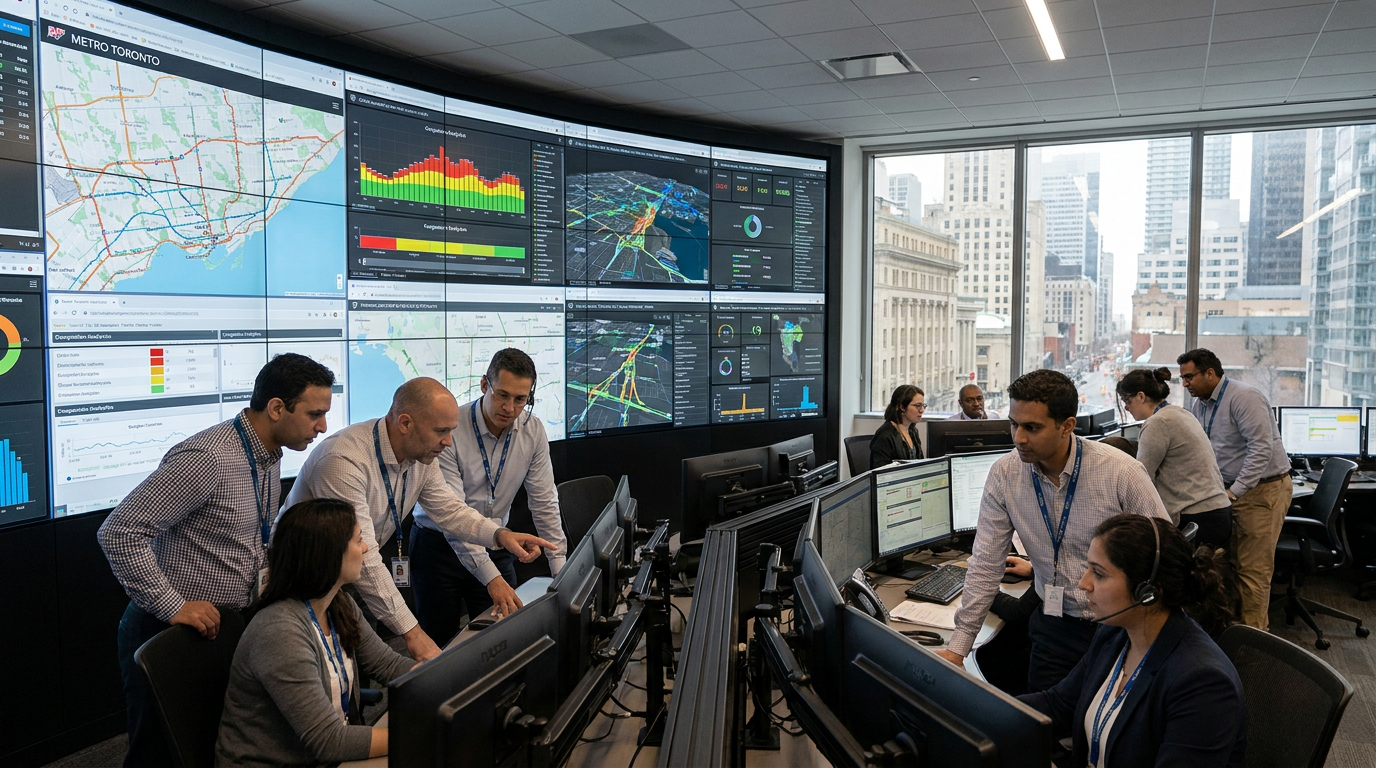
Urban planning has always been an exercise in forecasting. Planners estimate where population will grow, how land will be used, what transportation patterns will emerge, and where infrastructure must expand. AI does not remove uncertainty from that work, but it can improve the quality, speed, and granularity of analysis. By combining historical data with real-time information, AI can help cities understand development trends earlier and test policy scenarios more rigorously.
One of the strongest emerging tools in this space is the digital twin. A digital twin is a dynamic virtual representation of a physical urban environment that can integrate land use, transportation, infrastructure, environmental data, and building information. With AI layered into these models, cities can simulate the effects of zoning changes, transit investments, heat events, stormwater interventions, or population shifts before making costly commitments. This changes planning from a largely static process into a more responsive and iterative one.
For a city facing housing pressure, this is particularly valuable. AI can help identify where underused land, infrastructure capacity, and transit access align in ways that support more housing supply. It can also reveal where bottlenecks in approvals, servicing, or utility capacity are slowing otherwise viable growth areas. In strategic terms, this can help municipalities move from reactive planning toward a more coordinated growth model. Better insight into land, infrastructure, and service interactions can improve project feasibility and align public investment with long-term housing outcomes.
AI can also make planning more inclusive if used correctly. Traditional planning often relies on periodic studies that can quickly become outdated. AI-enabled urban analytics can detect changing conditions at the neighborhood level and help cities identify service gaps, accessibility issues, and areas vulnerable to climate or economic stress. The key, however, is that the data must be interpreted through a public-interest lens. A model may show where market demand is strongest, but planning still has to ask whether that demand aligns with affordability, equity, environmental performance, and infrastructure capacity.
Better Scenario Testing for Long-Term Growth
One of the most valuable planning functions of AI is scenario testing. Cities can ask more strategic questions. What happens to commute times if a major employment cluster grows without parallel transit investment. Which neighborhoods face the highest flood exposure under different climate projections. Where will school, water, and road capacity become constrained if intensification exceeds current forecasts. AI can accelerate that analysis and make it more precise.
For growing urban regions like Toronto, Montréal, Vancouver, Calgary, or Ottawa-Gatineau, these questions are not abstract. They are tied directly to land value, housing supply, and economic competitiveness. Cities that can model growth more effectively can stage infrastructure more efficiently, reduce uncertainty for developers, and make stronger cases for senior-government funding. Over time, this can lead to a more stable and investable urban environment.
Mobility, Transit, and the Daily Experience of the City
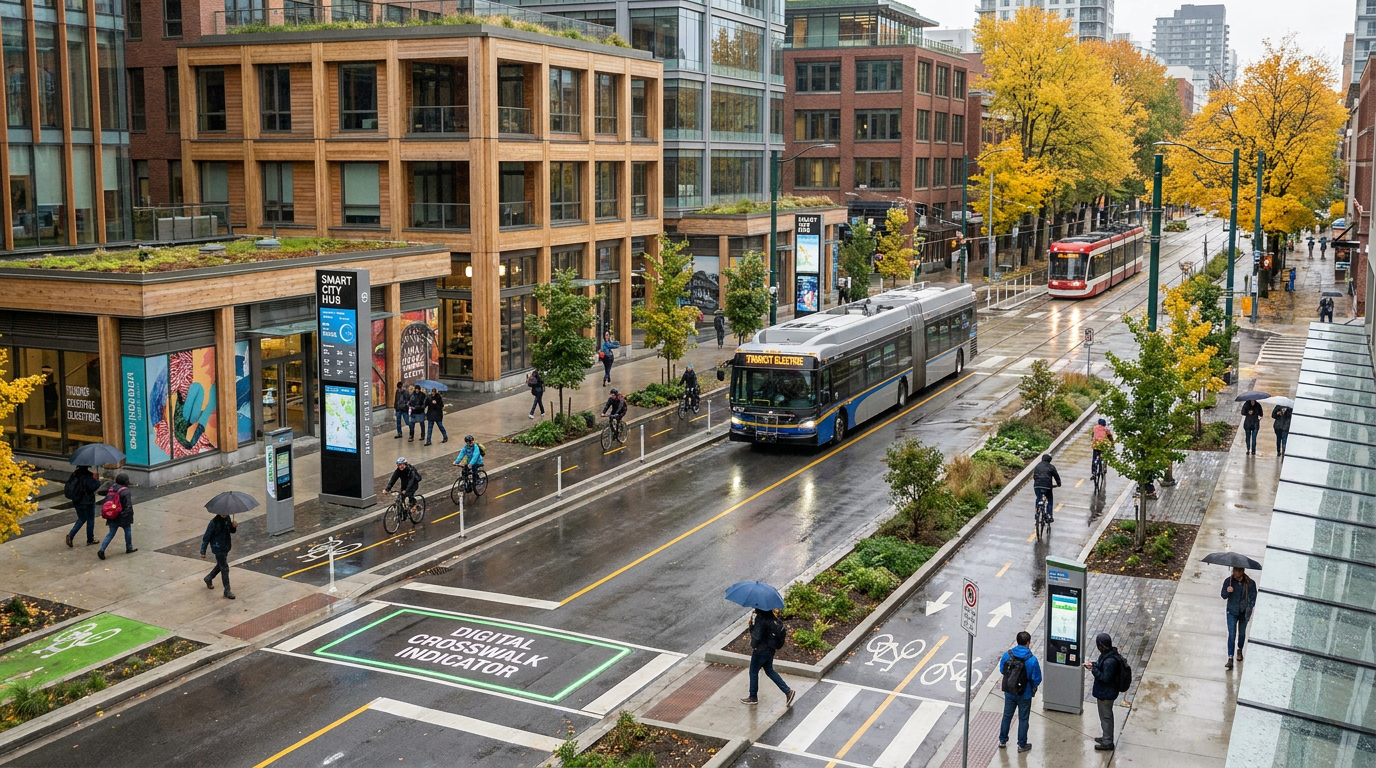
If residents notice AI anywhere in urban life, mobility is where they will feel it first. Transportation systems generate constant streams of data from transit vehicles, fare networks, road sensors, mobile devices, parking systems, and logistics flows. AI can use this data to optimize signal timing, improve bus dispatching, predict crowding, manage incident response, and support more reliable multimodal travel. The result is not just technical efficiency. It is a better daily experience for people trying to move through the city.
Congestion is expensive in every sense. It wastes time, raises emissions, reduces productivity, and undermines quality of life. AI-enabled traffic management can help mitigate these costs by identifying patterns in congestion before they intensify and adjusting operations in response. Transit agencies can also use AI to forecast ridership surges, improve scheduling, and allocate vehicles more effectively. In fast-growing urban areas, even incremental improvements in reliability can have significant cumulative value.
There is also a broader planning advantage. Mobility data can reveal where the urban form is supporting efficient movement and where it is not. Cities can use AI-driven analytics to understand first-mile and last-mile gaps, evaluate curb usage, and better integrate transit, cycling, walking, and shared mobility. This supports a more human-centered approach to street design and transportation planning, one that balances movement with accessibility, safety, and place quality.
The point is not that AI will solve every transportation challenge. Land use patterns, infrastructure investment, and political choices still shape the system. But AI gives city leaders and agencies stronger tools to operate what they have, identify where intervention is most urgent, and design more adaptive mobility networks as urban density rises.
Public Services That Become More Responsive
AI-driven cities are not only about infrastructure and mobility. They are also about the quality and responsiveness of public services. Municipal governments manage large volumes of routine interactions, from permit requests and service complaints to benefits administration and emergency communications. AI can help automate repetitive tasks, improve triage, and speed up service responses. This can make the public sector more accessible and efficient, especially when demand is high.
In public administration, AI can support document processing, language translation, chat-based resident support, and workload prioritization. These may seem like modest innovations compared with large infrastructure systems, but they matter because they affect how residents experience government. Faster permit intake, clearer information, and better issue routing can reduce frustration while freeing staff to focus on complex cases that require human judgment. In strategic terms, AI can make city hall function more effectively without diminishing accountability.
Emergency response is another high-value use case. AI can analyze weather patterns, traffic conditions, historical incident data, and infrastructure vulnerabilities to support dispatching and preparedness. During extreme heat, flooding, or winter storms, this can help municipalities coordinate resources more quickly and target support to vulnerable populations. As climate risk intensifies, the ability to anticipate rather than simply react will become increasingly important for urban resilience.
There is also a social inclusion dimension. If designed well, AI-enabled services can improve access for people who face language barriers, mobility constraints, or difficulty navigating bureaucratic systems. However, that promise depends on careful implementation. If systems are poorly trained, inaccessible, or built without consideration for digitally excluded populations, they can reinforce the very inequities they are meant to reduce. Human-centered design remains essential.
Infrastructure, Energy, and the Value of Predictive Maintenance
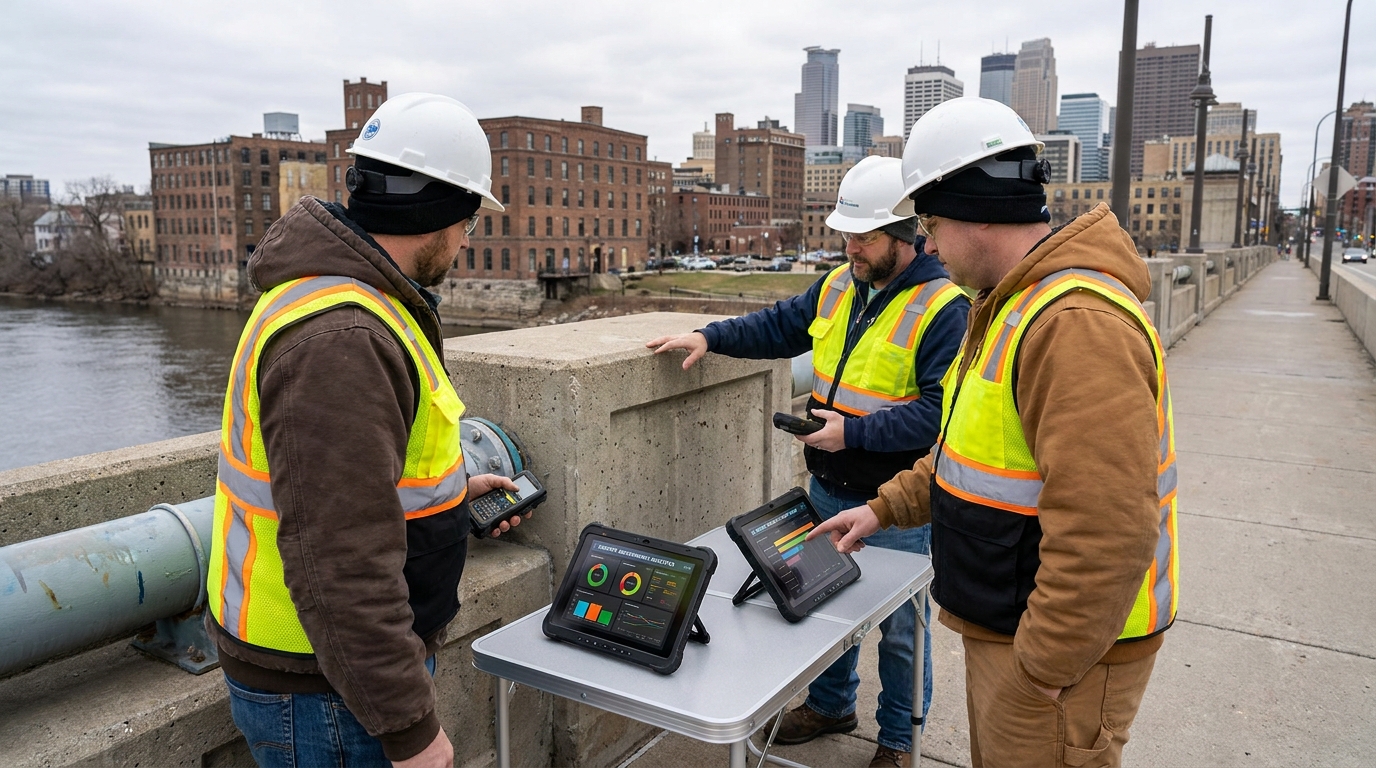
One of the most financially compelling applications of AI in cities is predictive maintenance. Municipal infrastructure is costly to build, costly to replace, and often difficult to monitor at the level needed for proactive intervention. Roads, bridges, water mains, transit assets, street lighting, and public buildings all deteriorate over time. Traditionally, many cities have relied on periodic inspections, reactive repairs, or coarse replacement schedules. AI allows for a more targeted approach.
By combining inspection records, sensor data, weather conditions, operational loads, and historical failure patterns, AI can estimate which assets are most at risk and when intervention is most cost-effective. This helps cities move from emergency repairs toward planned maintenance. The savings can be substantial because preventive action is usually cheaper than failure response, and because service disruptions often carry hidden economic and social costs beyond the repair itself.
Energy management offers similar potential. AI can optimize building systems, forecast peak demand, improve street lighting efficiency, and help coordinate distributed energy resources. In a city trying to reduce emissions while maintaining reliability, these capabilities matter. They can support climate goals without relying solely on large capital projects. Smaller operational gains, repeated across a wide asset base, can create meaningful long-term impact.
For growing urban regions, these systems also influence development capacity. Infrastructure that is monitored and managed intelligently can perform more reliably under stress. That has implications for housing delivery, employment growth, and investor confidence. In development terms, well-run infrastructure reduces uncertainty. It signals that a city is serious about maintaining the systems that support urban growth.
Climate Adaptation and Urban Resilience
The long-term value of AI in cities may be most evident in resilience. Climate change is increasing the frequency and intensity of heat waves, flooding, storms, and infrastructure stress. Cities need better ways to monitor conditions, model risk, and coordinate response. AI can support all three. It can process environmental data in real time, identify vulnerable assets or populations, and help decision-makers allocate resources before events escalate.
Flood management is a useful example. AI can integrate rainfall forecasts, watershed conditions, stormwater system performance, and land-cover data to predict where flooding is most likely to occur. That can improve emergency planning, infrastructure prioritization, and even future land-use decisions. The same logic applies to urban heat. AI can help cities identify neighborhoods with lower tree canopy, higher surface temperatures, and greater concentrations of vulnerable residents, informing both short-term interventions and long-term capital planning.
Resilience is not only about response. It is also about recovery and adaptation. Cities can use AI to assess post-event damage, coordinate public communications, and evaluate which systems performed well or poorly. Over time, this builds institutional learning. The more effectively a city can analyze disruptions, the better it can design future infrastructure and policy to absorb shocks.
This is where AI intersects directly with strategic city building. A resilient city is not one that simply survives stress. It is one that adapts and improves. AI can be a powerful tool in that process, but only when linked to capital planning, land-use policy, utility management, and social service coordination. Resilience is always multi-system. The technology must be as integrated as the risk.
The Governance Challenge Behind the Technology
For all the opportunity AI presents, the largest barriers to successful deployment are often institutional rather than technical. OECD work on smart-city data governance points to familiar constraints including limited financial resources, fragmented data systems, and weak governance. These issues explain why many promising pilots struggle to scale. A city may have a useful AI application in one department, but if systems do not interoperate, if procurement is rigid, or if data standards are inconsistent, citywide value remains limited.
Governance is the real backbone of an AI-driven city. Municipal leaders need clear frameworks for data privacy, cybersecurity, accountability, and procurement. They need to know who owns data, how it is shared, how decisions are audited, and how residents can challenge harmful or inaccurate outcomes. They also need internal capacity. Buying software is not the same as building capability. Public institutions need staff who can evaluate models, manage vendors, interpret outputs, and align technical tools with policy goals.
Algorithmic bias is another serious issue. AI systems learn from data, and if that data reflects existing inequalities or historical distortions, the system can reproduce them. This is especially important in public services, enforcement, housing, and infrastructure prioritization. Ethical deployment requires regular testing, transparency, and human oversight. It also requires a basic humility about what models can and cannot do.
Cybersecurity cannot be treated as an afterthought either. As cities connect more infrastructure, digitize more services, and rely on more real-time systems, they increase the importance of digital resilience. A compromised network can affect transportation, utilities, communications, and public trust all at once. An AI-driven city must therefore be secure by design, not merely efficient by ambition.
What Strong Urban AI Governance Looks Like
Cities that succeed with AI tend to build around a few strategic principles. They establish clear public objectives before procuring technology. They create common data standards across departments. They invest in interoperability rather than allowing isolated systems to proliferate. They maintain human accountability for consequential decisions. They communicate openly with the public about what data is used and why.
In practice, this means governance should include several elements:
- A citywide data strategy that defines standards, ownership, privacy protocols, and sharing rules.
- Ethical review processes for high-impact AI applications affecting access, safety, or equity.
- Procurement discipline that avoids vendor lock-in and prioritizes interoperable, scalable platforms.
- Cybersecurity safeguards embedded into infrastructure, applications, and operational workflows.
- Workforce development so public servants can manage AI tools with competence and confidence.
- Resident transparency that builds legitimacy and trust over time.
These are not side issues. They are the conditions that determine whether AI becomes a productive civic asset or an expensive, fragmented experiment.
Misconceptions That Distort the Conversation
Public discussion about AI-driven cities often gets pulled toward extremes. On one side is a utopian belief that technology will automatically make cities efficient, sustainable, and equitable. On the other is a fear that AI in urban systems is merely a surveillance project in new packaging. Both positions miss the operational reality.
First, AI will not replace city planners, engineers, or public servants. In most credible use cases, AI functions as a decision-support system. It helps identify patterns, automate repetitive tasks, and optimize operations. Human judgment remains essential because city decisions are not purely technical. They involve trade-offs, political accountability, legal frameworks, and public values.
Second, smart or AI-driven cities are not defined solely by surveillance technologies. Privacy risks are real and deserve strong safeguards, but many legitimate deployments focus on traffic management, energy optimization, predictive maintenance, accessibility, and service delivery. The quality of governance determines whether a system serves the public or undermines it.
Third, AI does not automatically make a city sustainable. Better outcomes depend on policy choices, data quality, institutional coordination, and implementation discipline. A poorly governed system can waste money, reinforce bias, or increase vulnerability. Technology is an enabler, not a guarantee.
Finally, AI is not only for megacities. Smaller and mid-sized municipalities can benefit from predictive maintenance, resource planning, permitting tools, and shared-service platforms. In some cases, they may be able to move faster than larger cities because they face fewer institutional silos. The right approach depends less on size than on clarity of purpose and organizational readiness.
What AI-Driven Cities Mean for the Future of Urban Living
If implemented well, AI-driven cities will feel less like a technological spectacle and more like a place that simply works better. Commutes become more reliable. Public services become easier to access. Infrastructure failures become less frequent. Energy systems become more efficient. Emergency response becomes more targeted. Planning becomes more evidence-based. Residents may not always see the algorithms behind these improvements, but they will feel the difference in daily life.
For city leaders, the larger opportunity is strategic. AI can help municipalities move from reactive management to anticipatory governance. That means fewer decisions made under crisis conditions and more decisions informed by patterns, scenarios, and real-time insight. In a period defined by urban growth, fiscal pressure, and climate uncertainty, that shift has major implications for city competitiveness and livability.
For the development industry, AI-driven governance can improve predictability. Better infrastructure management, stronger growth analytics, and clearer service planning all support a healthier development environment. When cities understand capacity constraints earlier and coordinate investment more effectively, they reduce friction in the growth process. Over time, this can support housing supply, commercial investment, and more coherent urban expansion.
For residents, the promise is not a fully automated city. The promise is a city that uses intelligence to become more responsive, inclusive, and resilient. That distinction matters. The best future cities will not be the most technologically saturated. They will be the ones that combine advanced tools with public trust, good planning, and a strong institutional culture of accountability.
A Strategic Path Forward
The rise of AI-driven cities should be viewed as a public-sector transformation, not a gadget cycle. The cities that benefit most will be those that start with clear urban priorities and then deploy AI in service of those goals. If congestion is the challenge, use AI to improve mobility operations and planning. If aging infrastructure is the challenge, prioritize predictive maintenance and asset intelligence. If climate vulnerability is rising, integrate AI into resilience planning and emergency coordination. Strategy must come before software.
This also means city governments should resist the temptation to scale technology faster than they can govern it. Institutional readiness is as important as innovation. A city with modest AI capability and strong governance may outperform a city with more advanced tools but weaker coordination, poorer data quality, and low public trust. The future belongs to places that can combine technical adoption with civic competence.
The broader urban story is one of adaptation. Cities have always evolved in response to new pressures and new capabilities, from transit systems and sewer networks to electricity and telecommunications. AI is part of that lineage. It is another layer of urban infrastructure, though less visible than roads or pipes, that can shape how the city functions. The question is whether we build that layer thoughtfully.
As major urban centers continue to grow, the demand for better planning, better service delivery, and better infrastructure performance will only intensify. AI offers a powerful set of tools to meet that demand. But the real measure of success will not be how advanced a city appears on paper. It will be whether people experience it as more livable, more reliable, more sustainable, and more fair. That is the true strategic promise of the AI-driven city, and it is where the future of urban living will ultimately be decided.



No Comment! Be the first one.