



Modern interiors are being asked to do more than ever before. A single room may need to function as a place to work in the morning, gather in the afternoon, entertain in the evening, and restore the body at night. At the same time, people are becoming more attentive to wellness, climate comfort, accessibility, and the emotional atmosphere of the spaces they inhabit. This shift has given rise to one of the most compelling movements in contemporary design: responsive interiors.
Table Of Content
- What Responsive Interiors Really Mean
- Why Responsive Design Is Rising Now
- The French Design Lens: Elegance With Discipline
- The Functional Beauty of Flexible Planning
- Furniture That Moves With Life
- Environmental Responsiveness and the Science of Comfort
- Biophilic Design and the Emotional Power of Nature
- Accessibility, Aging in Place, and Future-Ready Homes
- Smart Technology as a Quiet Layer, Not the Main Character
- How to Create a Responsive Interior With Lasting Beauty
- Common Misconceptions About Responsive Interiors
- The Future of Responsive Interiors
- Conclusion: Beauty That Responds
Responsive interiors are not simply fashionable rooms filled with gadgets. They are environments carefully designed to adapt to changing human needs, routines, and environmental conditions through thoughtful planning, movable elements, smart controls, and material intelligence. The beauty of this approach is that it brings function and elegance into the same conversation. A responsive home does not need to feel mechanical or impersonal. In its most graceful form, it feels intuitive, calm, and almost effortless.
There is something particularly persuasive about viewing this movement through the lens of French design. French interiors have long been admired for their balance, symmetry, proportion, and refinement. Historically shaped by traditions spanning Louis XIV, Régence, Rococo, and Neoclassical aesthetics, they offer a visual language of order and softness that sits surprisingly well beside innovation. Responsive design, when expressed with this discipline, becomes less about visible technology and more about beautifully orchestrated living.
For readers in Canada and across North America, the relevance is immediate. Housing affordability, compact urban footprints, remote work, multigenerational households, and a growing interest in aging in place are all pressuring homes to become more flexible. Responsive interiors answer these conditions with intelligence and grace. They suggest that good design is no longer only about how a room looks, but about how elegantly it responds over time.
This is why responsive interiors matter now. They represent the next evolution of interior design, one in which beauty is not sacrificed for practicality, and functionality is elevated by composition, texture, and atmosphere. In a world where most people spend the vast majority of their time indoors, the spaces we inhabit should not remain static if our lives are anything but.
What Responsive Interiors Really Mean
The term responsive interiors can sound highly technical at first, yet its core idea is profoundly human. A responsive interior is a space that adapts to shifts in activity, comfort, preference, age, occupancy, and environmental conditions. Sometimes that adaptation is powered by digital systems such as sensor-based lighting or automated shading. Just as often, it is achieved with low-tech solutions such as sliding panels, reconfigurable furniture, hidden storage, or rooms designed to support more than one purpose.
One of the most important misconceptions to correct is that responsive interiors are not synonymous with smart-home automation. Technology may play a supporting role, but it is not the entire concept. A room can be highly responsive because its layout allows for privacy when needed and openness when desired. A home can be responsive because its storage systems absorb everyday clutter, its furniture shifts with changing routines, and its circulation allows for future accessibility without major renovation.
This broader view is what makes the idea so useful. It allows responsive interiors to apply not only to luxury penthouses or experimental showrooms, but also to family homes, condominiums, rental apartments, and aging-in-place renovations. The concept is flexible because life is flexible. Design, in turn, becomes less rigid and more attuned to lived experience.
At its most successful, responsiveness disappears into the rhythm of the home. The user does not feel overwhelmed by controls or visual complexity. Instead, the room simply behaves well. It offers light where needed, privacy when desired, comfort when conditions change, and beauty throughout. That quiet intelligence is what sets responsive interiors apart from decorative trends that may look impressive but do little to support daily life.
Responsive interiors are best understood not as futuristic spectacle, but as rooms that listen. They respond to light, movement, routine, age, and emotion while preserving a sense of order and grace.
Why Responsive Design Is Rising Now
The rise of responsive interiors is not accidental. It is being shaped by social realities, environmental concerns, and a more nuanced understanding of what interior spaces should provide. Across Canada and North America, homes are under pressure to perform in new ways. Floor plans are becoming more compact in urban settings, while family structures are becoming more layered. One household may include children, remote workers, aging parents, and hybrid schedules, all competing for comfort and privacy within the same footprint.
This is why multifunctional design has moved from novelty to necessity. The home office that disappears into millwork, the dining room that doubles as a study area, and the guest suite that supports future mobility needs are no longer indulgent ideas. They are practical answers to the realities of contemporary living. Responsive interiors do not merely save space. They make space feel more generous because every surface and volume has been considered with intention.
Policy and standards are also pushing this movement forward. In Canada, Accessibility Standards Canada published CAN/ASC-2.8:2025 Accessible-Ready Housing in May 2025, offering a formal framework for homes designed to accommodate future accessibility needs with minimal alterations. This is significant because it reframes adaptability as a built-in quality rather than an afterthought. It aligns with broader conversations around aging in place, long-term affordability, and reducing the disruption and cost of later renovations.
There is also a growing awareness that interiors profoundly shape wellbeing. Research on indoor environmental quality consistently shows that thermal comfort, noise, privacy, lighting, air quality, and layout affect satisfaction and performance. A 2024 study comparing occupant surveys found higher perceived indoor environmental quality in WELL-certified buildings than in LEED-certified buildings across most parameters. These findings suggest that people notice when their surroundings support them, and responsive interiors are uniquely positioned to deliver that support.
At the same time, design culture itself is changing. There is a move away from interiors that are either rigidly formal or aggressively minimal, and toward spaces that feel timeless yet flexible. This sensibility harmonizes beautifully with French design principles. The room remains composed, elegant, and visually calm, but beneath that elegance lies a deeper intelligence.
The French Design Lens: Elegance With Discipline
French design offers a remarkably sophisticated framework for responsive interiors because it has always been concerned with proportion, atmosphere, and the arrangement of beauty. Traditional French rooms often rely on symmetry, balanced sightlines, graceful ornament, layered textures, and an understanding that luxury is felt as much through restraint as through display. These principles can guide highly adaptable spaces without forcing them into a cold or utilitarian aesthetic.
In practice, this means a room can contain transformable elements while still feeling serene. A movable partition can be integrated into architectural paneling. Concealed storage can sit behind beautifully detailed joinery. Adjustable lighting can be layered through sconces, pendants, and discreet controls rather than announced as a technical feature. The result is a home that behaves dynamically without losing visual poise.
French-inspired responsiveness also resists the false choice between ornament and function. Soft drapery can improve acoustics while framing daylight with elegance. Upholstered seating can define flexible conversational zones while adding comfort and tactility. Carefully selected finishes can support durability and maintenance while preserving a refined palette. These are not separate concerns. They are parts of one coherent composition.
Perhaps most importantly, French design reminds us that a responsive interior should still feel emotionally resonant. It should not only solve spatial problems but also cultivate atmosphere. A home must adapt, yes, but it should also seduce the senses with light, texture, proportion, and rhythm. This is where responsive design becomes truly aspirational. It moves beyond efficiency and enters the realm of lived beauty.
The Functional Beauty of Flexible Planning
Flexible planning is one of the foundational strategies behind responsive interiors. It begins with the understanding that rooms do not need to have only one fixed identity. A living area can support quiet reading, children’s play, remote work, and evening entertaining if the circulation, storage, furniture placement, and lighting have been planned with nuance. The key is not to make a room do everything at once, but to allow it to transition smoothly between uses.
This approach is especially valuable in smaller homes where every square foot must justify itself. Yet it also benefits larger homes, where families increasingly seek spaces that feel relevant throughout the day rather than formally preserved and rarely used. Flexible planning asks designers to think in scenarios rather than categories. Instead of labeling a room in static terms, they consider how it will live over time.
Several design moves support this responsiveness. Rooms can be organized around generous clearances that permit furniture to shift without awkwardness. Built-in storage can hold the equipment that allows a room to change functions quickly. Lighting can be layered so that task, ambient, and accent needs are all addressed. Visual continuity between zones can preserve calm even when activities differ.
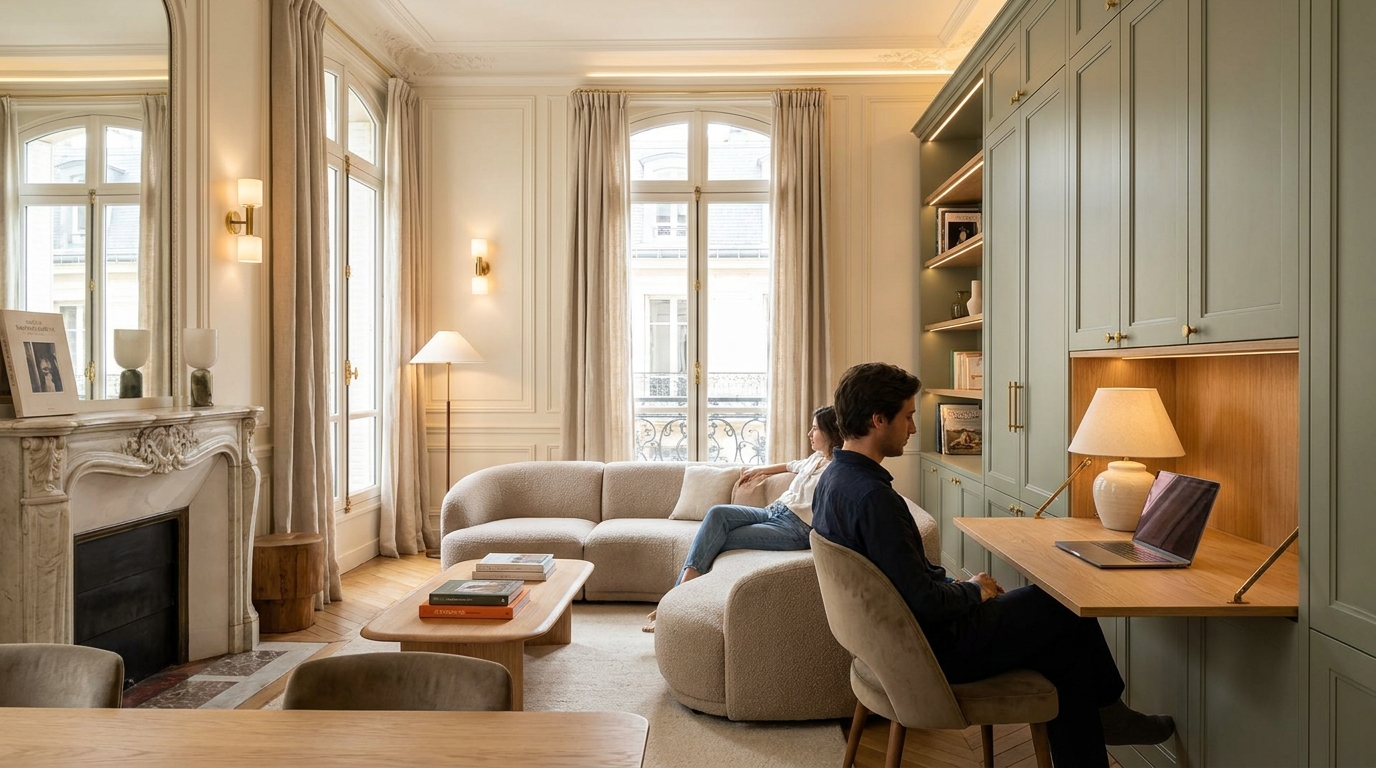
A responsive plan also depends on what might be called spatial diplomacy. It balances openness with retreat. Open concept living remains appealing, but many people now realize that complete openness can create acoustic stress and visual fatigue. Responsive interiors answer this by introducing subtle thresholds, sliding panels, glazing, curtains, millwork dividers, or furniture compositions that create privacy without sacrificing light. It is an elegant compromise between freedom and enclosure.
French design principles elevate these strategies by giving them compositional clarity. Symmetry can stabilize a multifunctional room. Repeated materials can unify distinct zones. A disciplined palette can prevent visual confusion even when a space serves several purposes. Flexibility, in other words, need not look improvised. It can look exquisitely composed.
Furniture That Moves With Life
Furniture plays a pivotal role in making interiors responsive because it is often the most immediate and accessible layer of adaptation. Unlike architecture, furniture can be reconfigured, folded, expanded, nested, or concealed with relative ease. In a truly responsive home, furniture is not selected only for style. It is chosen for its capacity to support changing rituals without disturbing the visual identity of the room.
Convertible and multifunctional pieces have evolved far beyond crude sofa beds and collapsible tables. Today’s best examples are elegant, tactile, and discreet. A banquette may include hidden storage beneath linen upholstery. A console may unfold into a dining table. An ottoman may become extra seating during gatherings and a soft resting surface on ordinary days. Modular sofas can shift from formal arrangement to lounge composition depending on how the room is being used.
The French influence here is especially compelling because it tempers utility with grace. Rather than introducing visibly mechanical furniture that dominates the space, a French-inspired responsive interior favors pieces with sculptural lines, beautiful joinery, and noble materials. The transformation should feel seamless, not theatrical. When a desk folds into cabinetry or a partition glides within paneled walls, the room retains its elegance even as its purpose changes.
This layer of design also has social significance. In multigenerational households, adaptable furniture can help rooms welcome diverse bodies, ages, and routines. In compact apartments, it can preserve dignity and order. In family homes, it can absorb seasonal change, school rhythms, and visiting guests. Furniture becomes less about fixed ownership of a single function and more about service to a changing life.
Environmental Responsiveness and the Science of Comfort
A beautiful room can still fail if it is too hot, too cold, too noisy, too dim, or too glaring to occupy comfortably. This is why environmental responsiveness is central to modern interior design. Research on indoor environmental quality has consistently shown that thermal comfort, air quality, light, privacy, acoustics, and layout significantly affect satisfaction and wellbeing. Because people spend most of their lives indoors in North America, the quality of interior conditions is not a minor issue. It is a daily determinant of health and mood.
One of the most useful findings in this area comes from ASHRAE Standard 55 guidance, which notes that increasing personal control over the thermal environment improves thermal comfort. This is a subtle but powerful idea. It suggests that comfort is not only about achieving the perfect average temperature. It is also about giving people the ability to adjust their surroundings to suit their own bodies and preferences.
Responsive interiors can support this through zoning, operable shading, layered ventilation strategies, adjustable textiles, and smart but intuitive climate controls. In practical terms, this may mean window treatments that reduce glare during the brightest hours, ceiling fans that supplement airflow, heated flooring in colder regions, or seating layouts that take advantage of natural light without exposing occupants to discomfort. These solutions are most successful when they feel integrated rather than imposed.
Acoustics deserve equal attention. As homes absorb more work, study, and caregiving functions, sound control becomes essential. Upholstered surfaces, rugs, drapery, acoustic wall treatments, and strategic room separation can all improve comfort. Again, French-inspired design offers a generous toolkit because softness, fabric, and layered materiality are already part of its visual language. Acoustic performance does not need to appear technical when it can be woven into the room’s aesthetic character.
Lighting is perhaps the most poetic form of responsiveness. It shapes not only visibility but emotion. A well-designed interior offers more than a single overhead source. It layers ambient, task, and accent lighting so the atmosphere can shift with time of day and activity. Sensor-based or programmable systems may support this transition, but the goal remains human: to allow the room to move from morning clarity to evening warmth with ease.
Biophilic Design and the Emotional Power of Nature
Responsive interiors are not only about mechanics and planning. They are also about emotional restoration, and this is where biophilic design becomes essential. Research increasingly supports what intuition has long suggested: people respond positively to nature. A meta-analysis of 49 studies with 3,201 participants found that exposure to natural environments produced medium-to-large improvements in positive affect and reductions in negative affect. While results always depend on context and design quality, the broader message is clear. Nature matters indoors.
In responsive interiors, biophilic design is not a decorative afterthought. It is part of the environment’s adaptive intelligence. Daylight should be welcomed and modulated rather than blocked indiscriminately. Natural materials such as wood, stone, linen, wool, and clay can add tactility and visual calm. Indoor planting can soften hard lines, improve atmosphere, and strengthen a sense of care. Views, breezes, and changing light can all become active participants in how a room performs across the day.
French-inspired interiors are especially adept at this because they often favor filtered light, nuanced texture, and an appreciation of patina. A responsive room might pair elegant sheer curtains with heavier drapery for seasonal adjustment, use pale oak to reflect daylight softly, or introduce sculptural greenery as part of the room’s composition. The effect is neither rustic nor overly engineered. It is cultivated, fresh, and deeply humane.
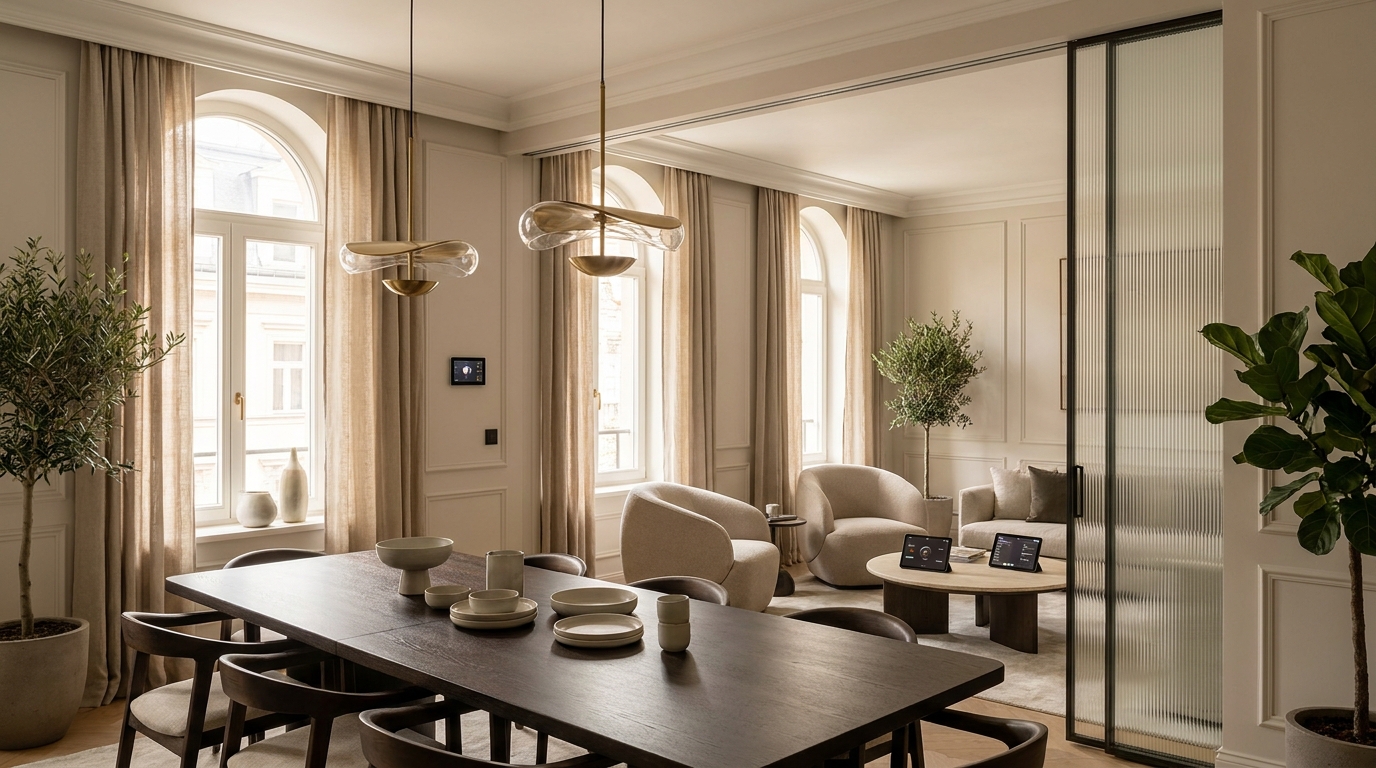
Biophilic responsiveness also supports seasonal living. In colder climates, warmer materials, richer textiles, and light-maximizing strategies can create comfort without visual heaviness. In summer, lighter fabrics, improved airflow, and shading can preserve freshness. The room does not remain fixed against the seasons. It responds to them, and in doing so it feels more alive.
Accessibility, Aging in Place, and Future-Ready Homes
One of the most meaningful dimensions of responsive interiors is their role in creating homes that can age gracefully with their inhabitants. Adaptability is not just a design preference. It is increasingly recognized as a social and economic necessity. Canadian housing policy and standards now frame adaptability as a way to support aging in place and reduce costly later renovations, making responsive interiors relevant to far more than trend-conscious homeowners.
The publication of CAN/ASC-2.8:2025 Accessible-Ready Housing signals an important shift in thinking. Rather than waiting for a crisis, injury, or life transition to force modifications, accessible-ready design encourages homes to be planned in ways that allow future adaptation with minimal alterations. This includes flexible layouts, thoughtful clearances, and documentation that can guide later changes. In other words, responsiveness is built into the logic of the home from the beginning.
This does not mean sacrificing aesthetic quality. On the contrary, some of the finest responsive interiors are those in which accessibility features are integrated so discreetly that they enhance comfort for everyone. Wide circulation paths improve ease of movement and visual calm. Bathrooms with strong spatial logic feel more luxurious as well as safer. Lever hardware, adaptable storage heights, layered lighting, and well-considered seating all contribute to a more inclusive environment.
French design can be unexpectedly instructive here because it values order and proportion. A room with good proportion naturally supports clearer movement and better spatial legibility. A layout that avoids unnecessary clutter feels more elegant while also being more usable. Responsive interiors, viewed through this lens, become not only future-ready but deeply civilized. They prepare for change without announcing fear of it.
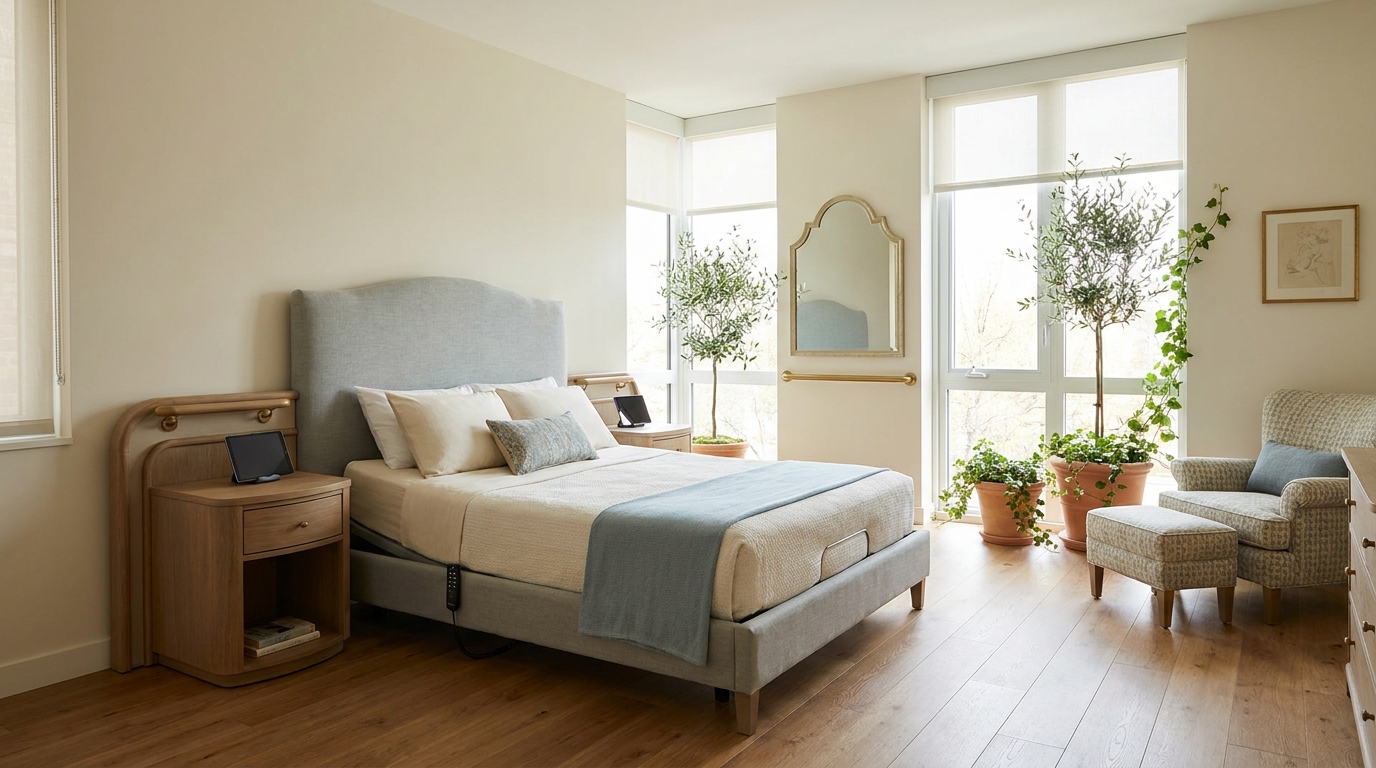
This is particularly important for multigenerational living. Homes that welcome grandparents, adult children, or temporary caregivers need a greater range of comfort, privacy, and mobility conditions. Responsive interiors can provide this through suites that flex in purpose, bathrooms prepared for future upgrades, and furniture arrangements that support both conversation and circulation. The result is a home that feels generous not because it is large, but because it is intelligently prepared.
Smart Technology as a Quiet Layer, Not the Main Character
Smart technology has a place in responsive interiors, but it is most elegant when it behaves like a discreet servant rather than a showpiece. The goal is not to turn the home into a dashboard. It is to make daily life smoother, more comfortable, and more intuitive. Sensor-based lighting, automated shading, climate zoning, connected surfaces, and programmable scenes can all contribute meaningfully when they are implemented with restraint.
Recent industry developments in 2025 show growing interest in smart materials, connected surfaces, and multifunctional interiors. Yet the lesson for designers and homeowners is not that every room needs more screens or more controls. Instead, technology should support a broader design vision rooted in adaptability and wellbeing. A responsive interior uses digital systems where they genuinely improve comfort, efficiency, or accessibility, and relies on passive design and flexible planning everywhere else.
For example, a living room may use occupancy-sensitive lighting to reduce energy use, while still depending on excellent lamp placement and layered fixtures for atmosphere. A bedroom may include automated blackout shading, yet also rely on beautiful textiles and a serene palette to support rest. A kitchen may incorporate connected appliances, but its responsiveness may owe just as much to clear workflows, adaptable storage, and resilient materials.
This distinction matters because people often confuse responsive interiors with technological complexity. In reality, some of the most effective responsive solutions are almost invisible. A pocket door that creates acoustic separation, a built-in bench that hides equipment, a mirror that improves light distribution, or a switchable lamp scene that supports evening calm can transform experience without overwhelming it. The best innovation often feels simple because it has been thoughtfully integrated.
How to Create a Responsive Interior With Lasting Beauty
Designing a responsive interior requires a layered mindset. It is not enough to add modular furniture at the end of a project or install a few smart devices after construction. The most successful results emerge when responsiveness is considered from the earliest stages, through planning, circulation, storage, material selection, lighting, and long-term use. It is a design philosophy as much as a collection of products.
For homeowners and designers looking to embrace this approach, several principles are especially useful:
- Start with routines: Study how the household lives across morning, afternoon, evening, weekday, weekend, and season. A responsive interior answers patterns, not abstractions.
- Design for more than one life stage: Consider future mobility, changing family size, work habits, and caregiving needs. Adaptability is often more elegant and affordable when planned early.
- Layer flexibility into architecture: Use sliding panels, concealed storage, adaptable lighting, and furniture with more than one role so rooms can evolve without visual disorder.
- Prioritize indoor environmental quality: Address daylight, acoustics, thermal comfort, privacy, and air quality with as much care as style, since comfort is inseparable from beauty.
- Use technology selectively: Choose smart systems that genuinely improve ease and wellness, and let them remain secondary to spatial clarity and tactile richness.
- Maintain compositional discipline: A restrained palette, balanced proportions, and coherent materials keep multifunctional spaces feeling calm and timeless.
These principles are especially powerful when translated through French-inspired restraint. Instead of overdesigning, one edits carefully. Instead of filling every corner, one allows breathing room. Instead of chasing novelty, one invests in proportion, craftsmanship, and systems that support daily grace. The result is an interior that can change function without losing identity.
Common Misconceptions About Responsive Interiors
Because the concept is still emerging in mainstream design conversations, responsive interiors are often misunderstood. One common assumption is that they must look futuristic or minimalist. In reality, adaptability can live within richly textured, classical, or layered spaces. A home with paneling, antiques, linen drapery, and sculptural lighting can be every bit as responsive as a sleek contemporary loft if it has been thoughtfully planned.
Another misconception is that responsive design is only for luxury projects. While high-end homes may showcase advanced solutions beautifully, the core principles are profoundly relevant to everyday housing. In fact, smaller homes often benefit the most because every design decision carries greater weight. Accessible-ready planning, multifunctional furniture, and improved environmental comfort can be transformative in modest settings.
There is also a tendency to overestimate the role of automation. Not every responsive interior is fully programmable, and not every smart home is well designed. Some of the most meaningful strategies are low-tech: movable partitions, hidden desks, adaptable shelving, layered curtains, durable finishes, and rooms planned with future flexibility in mind. These interventions are accessible, practical, and often more timeless than rapidly changing tech products.
Finally, biophilic elements are sometimes dismissed as decorative styling. Research suggests otherwise. While outcomes vary by context, the evidence linking natural-environment exposure with improved affect supports interior strategies that bring nature, light, and tactile authenticity into daily life. A well-placed tree, a room oriented toward daylight, or a material palette grounded in natural texture is not merely aesthetic indulgence. It is part of a healthier and more responsive environment.
The Future of Responsive Interiors
The future of interior design will likely belong to spaces that can do several things at once: support wellbeing, conserve resources, adapt over time, and remain visually compelling. Responsive interiors sit at this intersection. They are becoming mainstream not because they are novel, but because they solve multiple pressures at once. They answer smaller homes, remote work, accessibility needs, climate consciousness, and the growing expectation that beauty should also be practical.
We can expect further convergence between smart materials, sustainable systems, accessibility-ready planning, and elegant modular design. Yet the most enduring projects will not be those that accumulate the most features. They will be those that understand how people want to feel inside a home. Calm, capable, comforted, and free. That emotional intelligence is what transforms responsive interiors from a technical category into a meaningful cultural shift.
French design principles will remain highly relevant in this future because they offer a language of timelessness. Symmetry, proportion, refined detailing, and softness of atmosphere can absorb innovation without being overtaken by it. As a result, homes can become more flexible without becoming visually restless. They can change with life while remaining composed in spirit.
Ultimately, responsive interiors invite us to think of design as a living art. A room is not a frozen image for admiration alone. It is a setting for movement, adaptation, care, and memory. When thoughtfully conceived, it can respond to the body, the season, the hour, and the evolving story of the people who inhabit it. That is not merely modern convenience. It is a beautiful form of intelligence.
Conclusion: Beauty That Responds
Responsive interiors represent a profound refinement in the way we think about home. They move beyond decoration and beyond pure efficiency, bringing together flexibility, wellness, accessibility, and atmosphere. In these spaces, design does not impose a single rigid way of living. It supports change with quiet confidence, allowing rooms to remain useful, elegant, and emotionally resonant over time.
What makes this movement especially exciting is that it does not ask us to abandon beauty in favor of practicality. Quite the opposite. Through the disciplined grace of French-inspired design, responsive interiors reveal that adaptability can be soft, luxurious, and timeless. Concealed storage can feel artisanal. Flexible rooms can remain symmetrical and serene. Smart systems can dissolve into the background while light, texture, and proportion lead the experience.
As homes continue to absorb more complexity, the most desirable interiors will be those that feel prepared without appearing overworked. They will honor everyday routines while leaving space for future change. They will support comfort and wellbeing while still offering visual poetry. And perhaps most importantly, they will remind us that the finest design is not static. It listens, responds, and evolves with grace.


No Comment! Be the first one.