



Mega-region planning has moved from a specialized planning concept into a practical necessity for countries and metropolitan economies trying to manage growth at the scale where growth actually happens. In many cases, people live in one municipality, work in another, study in a third, and depend on infrastructure systems that stretch across an entire corridor of urbanized places. Businesses make location decisions based on labor markets, transportation access, energy supply, and housing availability that extend well beyond a single city boundary. When the economy operates regionally but planning remains fragmented, the result is often avoidable congestion, housing shortages, infrastructure inefficiency, and social tension.
Table Of Content
- Why Mega-Region Planning Matters Now
- The Core Strategic Question: How Should Growth Be Organized?
- Governance Fragmentation Is the Central Constraint
- Housing Supply and Affordability Must Be Central, Not Peripheral
- Transportation Is About Access, Not Just Movement
- Environmental Protection and Climate Resilience Define Long Term Viability
- Energy and Grid Capacity Are Now Planning Issues
- Community Concerns Are Not Obstacles to Planning. They Are Part of Good Planning.
- What Meaningful Community Integration Looks Like
- Canadian Examples Show Both Opportunity and Complexity
- From Vision to Execution: What Effective Mega-Region Planning Requires
- A Strategic Framework for the Next Generation of Mega-Regions
- Conclusion: Planning at the Scale of Reality
That reality is especially clear in North America, where metropolitan areas in the United States, Canada, and Mexico contain 77 percent of the combined population and generate 86 percent of combined GDP. Those numbers underline a simple but powerful point. Economic performance is increasingly tied to regional coordination rather than isolated local decision making. If growth is now shaped by linked metros, freight corridors, commuter patterns, and shared utility systems, then planning must also evolve to match that scale.
For a general audience, the term mega-region can sound abstract, but the underlying idea is straightforward. A mega-region is not just a very large city; it is a network of adjacent metropolitan areas and urban systems that function together through economic exchange, commuting flows, infrastructure dependence, environmental systems, and development pressure. In Canada, examples include the Greater Toronto and Hamilton Area, the broader Greater Golden Horseshoe, Metro Vancouver, and the National Capital Region, each showing a different version of this reality. Mega-region planning is the practice of coordinating that network deliberately: aligning land use, transportation, housing, utilities, environmental protection, and governance across jurisdictions so that regional growth produces broad public value instead of fragmented costs, congestion, and missed opportunity. That distinction is why mega-region planning has become a practical necessity rather than an academic exercise.
The strategic challenge is not simply how to accommodate more people. It is how to do so in a way that supports housing affordability, protects environmental assets, improves mobility, strengthens competitiveness, and preserves public trust. That is the real discipline behind sustainable mega-region planning: aligning growth with capacity, rather than simply drawing bigger maps.
This is where the future of planning becomes both more demanding and more consequential. The best mega-region strategies are grounded in evidence, realistic about implementation, and attentive to community concerns. They recognize that long term growth must be managed, not merely anticipated. They also recognize that legitimacy matters. If people believe a regional strategy is being imposed on them without regard for affordability, neighborhood stability, or environmental justice, opposition is inevitable.

At its best, mega-region planning provides a framework for making better decisions before pressures become crises. It can help identify where new housing should go, where transit investment will be most effective, which infrastructure gaps threaten growth, which landscapes must be protected, and how local priorities can fit within a regional strategy. At its worst, it can become a vague slogan or a top down exercise that prioritizes flagship projects over day to day livability. The difference lies in strategic discipline, institutional coordination, and a genuine commitment to inclusive outcomes.
This article explores the core considerations that should shape mega-region planning in the years ahead. The goal is not only to explain why this form of planning matters, but to show how it can support sustainable growth while addressing the concerns that communities rightly bring to the table. As development pressure rises and infrastructure systems age, the question is no longer whether regions need coordinated planning. The real question is whether they can build the governance, trust, and strategic clarity to make it work.
Why Mega-Region Planning Matters Now
The urgency around mega-region planning comes from a convergence of pressures that no single municipality can solve alone. Population growth continues to concentrate in large urban corridors. Housing supply remains constrained in many high demand regions. Transportation systems are strained by longer trips and dispersed travel patterns. Climate change is exposing vulnerabilities in water systems, energy infrastructure, floodplains, and heat-prone urban areas. At the same time, firms and workers are making choices based on regional conditions, not municipal branding.
Brookings has described megaregions as networks of linked metropolitan areas rather than single cities. That distinction matters because it changes how we understand growth. The true unit of analysis is no longer just the downtown core or the suburban municipality. It is the wider system of labor markets, goods movement, environmental assets, utility networks, and development corridors that bind multiple places together. Once that system becomes visible, fragmented planning begins to look increasingly inadequate.
In practical terms, a family looking for attainable housing may move farther from the employment centers that sustain them. A logistics operator may depend on highways, rail, ports, and industrial land spread across multiple jurisdictions. A major transit investment may require supportive zoning and service coordination in several municipalities to deliver its full value. An environmental asset like a watershed or agricultural belt may cross boundaries that have little relevance to ecological function. These are all mega-region issues, even if they first appear as local disputes.
The Canadian context illustrates why this matters. Ontario’s planning for the Greater Golden Horseshoe is one of the clearest examples of mega-region logic in action. It attempts to coordinate development, density, and infrastructure across a wide and economically powerful regional footprint. Federal Metro-Region Agreements are also pushing in this direction by requiring integrated regional plans that cover transit, transportation infrastructure, housing, and land use, supported by organizations that can implement and enforce those plans. That shift from theory to implementation is significant because it acknowledges that disconnected policies cannot deliver coherent growth outcomes.
The Core Strategic Question: How Should Growth Be Organized?
Mega-region planning is fundamentally about organizing growth in a way that improves long term outcomes. That requires planners, governments, and development stakeholders to move beyond a reactive mindset. Instead of asking where pressure is appearing today, they need to ask where growth can be most productively and sustainably absorbed over decades. That includes choices about urban form, infrastructure sequencing, public investment, environmental conservation, and economic geography.
A strong strategy begins with a clear spatial vision. Not every part of a mega-region should grow in the same way. Some areas are suited to high density housing and employment because they are transit rich and infrastructure ready. Some are better suited to logistics, industry, or institutional uses. Others contain farmland, ecological systems, or natural hazard areas that should be protected from urbanization. The purpose of strategic planning is to match growth to place rather than letting uncoordinated market pressure dictate the regional pattern.
This is where the concept of polycentric growth becomes useful. A healthy mega-region often functions best when growth is distributed across multiple strong urban centers rather than concentrated in one dominant core or dispersed endlessly outward. Polycentric regions can support shorter commutes, more resilient labor markets, and better use of infrastructure if supported by reliable transit, clear land-use priorities, and coordinated public investment. Without that structure, growth can drift into low efficiency patterns that intensify congestion and raise service costs.
Strategic regional planning also forces a more honest conversation about tradeoffs. Every region wants growth, affordability, environmental protection, and economic competitiveness. The challenge is sequencing and alignment. If housing approvals are accelerated without transit, schools, and utilities, communities feel overwhelmed. If infrastructure is expanded without land-use discipline, sprawl follows. If environmental protection is treated as an afterthought, the long term costs can exceed the short term gains. Good mega-region planning does not eliminate tradeoffs, but it makes them explicit and manageable.
Governance Fragmentation Is the Central Constraint
The most difficult issue in mega-region planning is rarely the technical analysis. It is governance. Growth crosses boundaries far more easily than authority does. Municipal councils, provincial agencies, transit bodies, infrastructure operators, conservation authorities, and federal institutions often hold pieces of the same problem without a unified mechanism for making integrated decisions. This fragmentation can slow delivery, produce contradictory priorities, and deepen public frustration.
Brookings has argued that fragmented governance can undermine inclusive growth, mobility, and environmental justice. That is not simply a procedural concern. It shapes real outcomes on the ground. A region may approve transit without enough housing around stations. It may permit logistics growth without protecting industrial land. It may expand suburban development without coordinating energy capacity or water servicing. Each actor can claim to be advancing progress, yet the collective result can still be inefficient and inequitable.
The strategic response is not necessarily to create a single super government over every mega-region. In many cases that is politically unrealistic and institutionally unnecessary. The more practical goal is to build decision making structures that align plans, funding, accountability, and implementation across jurisdictions. Federal Metro-Region Agreements reflect this principle by requiring integrated planning and organizations with real authority. The essential lesson is that coordination must be institutionalized, not improvised.
Implementation authority matters because regional visions often fail at the delivery stage. A plan may set targets for transit oriented housing, freight mobility, emissions reduction, or greenbelt protection, but if no agency can enforce consistency across local decisions, the strategy weakens over time. Strategic planning must therefore include governance design. Who decides, who pays, who delivers, who monitors, and who is accountable are not side questions. They are the planning challenge.
Regional growth succeeds when institutions are designed to match the scale of the market, the infrastructure network, and the environmental system they are trying to manage.
Housing Supply and Affordability Must Be Central, Not Peripheral
No mega-region strategy is credible today if it treats housing as a secondary issue. Housing supply, affordability, tenure mix, and location efficiency are at the heart of regional performance. When households cannot find suitable housing near jobs, schools, or transit, the region pays in longer commutes, labor shortages, higher emissions, and reduced social mobility. Housing dysfunction is not only a social issue. It is an economic and infrastructure issue as well.
This is why integrated planning matters so much. Infrastructure expansion alone does not solve growth challenges. Land use, housing policy, and transit investment must be aligned. A rail corridor without housing intensity near stations underperforms. A large greenfield expansion without a long term transit strategy locks in auto dependence. A region that restricts new housing in high opportunity locations shifts pressure outward, increasing travel distances and burdening communities at the edge.
At the mega-region scale, housing strategy should answer several questions. Where can the largest share of net new housing be delivered with the least environmental and infrastructure cost. Which centers can absorb more population while supporting jobs and services. What types of housing are missing across the region. How can approvals, servicing, and public investment be coordinated to improve both pace and quality. These are not abstract policy matters. They determine whether growth improves regional resilience or worsens exclusion.
Affordability also requires attention to displacement. Growth can create value, but if that value is captured narrowly, long standing communities may experience rising rents, land speculation, or cultural displacement. Mega-region planning should therefore include clear affordability goals, tenant protections where appropriate, and public benefit frameworks tied to major investments. Communities are more likely to support growth when they can see who it serves and how benefits will be shared.
Transportation Is About Access, Not Just Movement
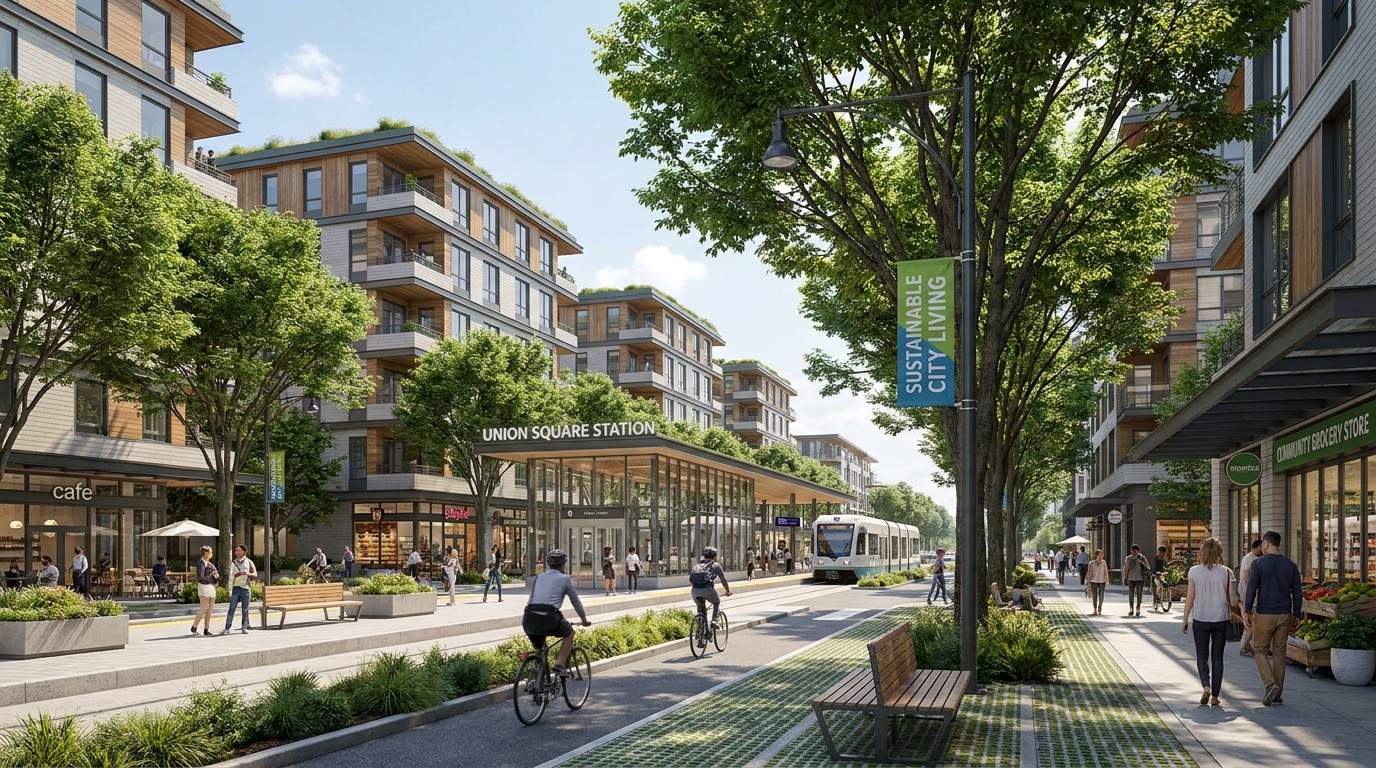
Transportation is often the most visible component of mega-region planning, but it should not be reduced to moving people and goods faster. The deeper objective is access. A successful regional transportation strategy connects people to jobs, housing, education, health care, and daily needs in ways that are efficient, reliable, and equitable. It also supports the economic circulation of goods while reducing unnecessary environmental and social costs.
One of the most promising lessons in Canada comes from TransLink’s Area Transport Planning approach, which is designed to reflect local context while advancing region wide transportation priorities. That model is valuable because it shows that mega-region planning does not have to erase local differences. A strong regional framework can set long term investment direction while allowing sub-regional plans to respond to community conditions, land-use patterns, and mobility needs on the ground.
This balance is crucial. Regions that overemphasize centralization may lose local legitimacy. Regions that overemphasize local autonomy may never achieve coherence. Transportation planning works best when local knowledge informs regional objectives and regional discipline supports local delivery. That means integrating rapid transit, commuter rail, bus networks, active transportation, station area planning, road management, and freight corridors within one strategic system.
Freight and passenger mobility must also be planned together. Mega-regions are economic systems, not only residential landscapes. Industrial land, ports, airports, warehousing, and intermodal logistics are essential to competitiveness and employment. If these systems are neglected in favor of a narrow commuter lens, regions can lose economic function even as they grow. The strategic task is to protect key goods movement corridors while reducing conflict with housing, neighborhoods, and environmental systems.
Environmental Protection and Climate Resilience Define Long Term Viability
A region can grow quickly and still fail strategically if it erodes the natural systems that support long term livability. Mega-region planning must therefore place environmental protection and climate resilience at the center of decision making. Farmland, watersheds, forests, wetlands, river valleys, coastlines, and habitat systems are not leftover spaces between development zones. They are foundational assets that support food systems, flood management, biodiversity, air quality, and public health.
One of the strongest arguments for planning at the mega-region scale is that environmental systems do not follow municipal boundaries. The same is true of climate risks. Flood exposure upstream can affect downstream communities in another jurisdiction. Heat vulnerability is shaped by land cover, urban design, and infrastructure performance across a broad territory. Wildfire risk, water scarcity, and severe weather events require coordinated adaptation strategies that cannot be solved city by city.
Common mega-region planning goals therefore include reducing sprawl, preserving farmland and habitat, and redirecting infrastructure investment toward lower emission patterns of growth. That is not anti-development. It is disciplined development. Every hectare of land converted at the urban edge carries long term infrastructure, transportation, and ecological implications. Regions that fail to manage that edge often discover too late that dispersed growth is expensive to service and difficult to decarbonize.
Climate resilience also changes the economics of infrastructure itself. Roads, bridges, stormwater systems, transit assets, and power networks must be designed for a more volatile future. If capital planning is based on outdated assumptions, regions may lock in liabilities that are costly to retrofit. Strategic planning at the mega-region level can identify where resilience investments are most urgent and how they should be coordinated with growth areas, housing targets, and environmental protection frameworks.

Energy and Grid Capacity Are Now Planning Issues
One of the most important shifts in regional strategy is the growing recognition that energy availability and grid capacity are not just utility sector concerns. They are development concerns. Fast growing metropolitan economies depend on reliable, affordable, and increasingly clean power to support housing, transit electrification, advanced industry, digital infrastructure, and climate goals. When energy planning is disconnected from land-use and growth planning, regions can face delays, cost escalation, and weakened competitiveness.
Recent Brookings work has emphasized that energy and growth strategy are becoming inseparable. That observation is highly relevant to mega-regions. New housing communities, industrial districts, data-intensive uses, and major transit investments all place demands on the grid. Electrification of buildings and transportation will increase those demands further. Regions that do not proactively plan transmission, generation, and distribution capacity may find that growth approvals outpace energy readiness.
The strategic implication is clear. Mega-region planning should include energy infrastructure in the same conversation as transportation, housing, and economic development. Growth areas should be tested not only for zoning compatibility and transit access, but also for power capacity and resilience. Industrial policy and land strategy should reflect where utility readiness exists or can be efficiently expanded. Clean growth depends on these alignments.
This issue also shapes equity. If energy investments flow mainly to premium employment zones or politically visible projects, communities with aging infrastructure can be left behind. Regional plans should therefore consider who benefits from new grid investment, how costs are distributed, and how resilience can be improved across the full geography of the region. A modern mega-region cannot be strategically planned without understanding its energy geography.
Community Concerns Are Not Obstacles to Planning. They Are Part of Good Planning.
One of the greatest risks in mega-region planning is the perception that it exists to advance large scale growth regardless of local consequences. That perception can emerge when plans are overly technocratic, when public engagement is superficial, or when visible benefits do not reach the communities being asked to absorb change. Strategic planning fails when it treats community concerns as resistance to be managed rather than intelligence to be incorporated.
Recent lessons from fast moving development sectors, including data-center growth debates highlighted by Brookings, reinforce a broader principle. When permits, power, and land decisions are rushed, community benefits are too often treated as an afterthought. That can trigger backlash, delay, and a breakdown of trust. The same lesson applies to mega-regions. Scale does not excuse weak public process. In fact, larger scale planning requires greater legitimacy because the consequences are broader and longer lasting.
Community concerns usually center on understandable questions. Will housing become more or less affordable. Will transit improvements actually arrive. Will new development overwhelm schools, roads, and public services. Will environmental assets be protected. Will existing residents be displaced. Will decisions reflect local knowledge. These are not anti-growth questions. They are tests of whether growth has been properly planned.
Strong mega-region strategies answer these questions through transparency and measurable commitments. They explain where growth is going, why those locations were chosen, what infrastructure will support it, how affordability will be addressed, what environmental safeguards are in place, and how progress will be tracked over time. Public trust grows when regional planning is specific enough to be evaluated and flexible enough to adapt as conditions change.
What Meaningful Community Integration Looks Like
Meaningful participation is more than a public meeting after major decisions are already framed. It begins earlier with shared problem definition and extends into implementation and monitoring. Regions that do this well tend to combine technical analysis with clear communication, local consultation, and structured opportunities for communities to influence priorities. This is particularly important in places facing historic exclusion, rapid redevelopment pressure, or environmental risk.
Indigenous consultation and co-governance deserve specific attention in the Canadian context. Mega-region planning often touches land, infrastructure corridors, watersheds, and ecological systems that intersect with Indigenous rights, stewardship responsibilities, and long term relationships to place. Treating this solely as a compliance exercise is both inadequate and strategically short sighted. Durable regional planning depends on broader legitimacy, and that legitimacy requires more serious partnership models.
Canadian Examples Show Both Opportunity and Complexity
Canada offers several useful reference points for understanding how mega-region planning works in practice. The Greater Golden Horseshoe is perhaps the most visible case because it combines intense population growth, a large economic footprint, protected greenbelt lands, freight corridors, and a mix of urban and suburban centers. It demonstrates both the necessity and difficulty of coordinating development, density, and infrastructure across a vast and diverse regional territory.
Metro Vancouver offers another important lesson through its transportation and regional planning structures. Its use of sub-regional area transport plans shows how local context can be reflected within a wider strategic framework. This matters because mega-regions are rarely uniform. The needs of a central urban municipality differ from those of a suburban growth node or a municipality with industrial, port, or ecological priorities. Planning systems need enough structure to maintain coherence and enough flexibility to respond to place.
The National Capital Region highlights a different kind of complexity. It spans an interprovincial context with crossings, greenbelt management, sustainable transportation, and long range land-use coordination. It demonstrates that mega-region style planning often involves legal and political boundaries that do not align neatly with how people actually move and how infrastructure actually functions. That is why long term coordination is not optional. It is the only way to manage shared systems responsibly.
What these examples share is not a single institutional model. What they share is the recognition that strategic growth management requires coordination at a scale larger than the local municipality. They also show that implementation depends on authority, funding, and continuity. A regional strategy cannot succeed if it resets every electoral cycle or if participating agencies lack the capacity to carry it through.
From Vision to Execution: What Effective Mega-Region Planning Requires
The success of mega-region planning ultimately depends on execution. Good intentions, elegant maps, and ambitious targets are not enough. The region needs a disciplined framework that ties together land-use decisions, infrastructure funding, governance roles, delivery timelines, and public accountability. Without that structure, plans become aspirational documents rather than strategic tools.
Several practical requirements stand out. First, the region needs a shared evidence base. Data on population growth, commuting patterns, housing demand, infrastructure condition, environmental constraints, and energy capacity should be aligned across agencies so that decisions are not being made from conflicting assumptions. Second, it needs clear spatial priorities. Not every community can or should absorb the same kind of growth. Third, it needs implementation mechanisms that link funding to conformity with regional objectives.
Fourth, regions need performance metrics that go beyond units approved or kilometers built. The real measures of success include housing delivered near jobs and transit, emissions reduced, travel times improved, freight reliability maintained, farmland protected, resilience strengthened, and affordability outcomes tracked over time. Fifth, plans need adaptive capacity. Economic cycles, migration patterns, technology, and climate risks will change. A strategic plan must be stable enough to guide investment and flexible enough to respond to new realities.
For readers thinking about the future of urban development, the key insight is this. Mega-region planning is not simply about scale. It is about integration. It is about making sure housing policy speaks to transportation policy, transportation policy speaks to land-use policy, land-use policy speaks to environmental stewardship, and all of it speaks to economic and community outcomes. The regions that master that integration will be better positioned to grow with confidence.
A Strategic Framework for the Next Generation of Mega-Regions
If there is a single principle that should guide mega-region planning, it is that growth must be organized around public value. That means planning for more than expansion. It means planning for access, affordability, resilience, productivity, and legitimacy at the same time. It means recognizing that infrastructure decisions shape land value, that land-use decisions shape mobility, and that both shape social outcomes across generations.
In strategic terms, the next generation of mega-region planning should rest on a few reinforcing ideas.
- Plan growth where infrastructure and access can support it, rather than allowing expansion to outrun public systems.
- Protect environmental assets and agricultural land as essential components of regional resilience and quality of life.
- Integrate housing, transportation, and energy planning so that development patterns are economically viable and climate aligned.
- Build governance structures with real authority to coordinate across jurisdictions and maintain long term consistency.
- Treat communities as stakeholders in value creation, not just recipients of top down decisions.
These principles are not ideological. They are practical. Regions that ignore them tend to produce a familiar pattern of high housing costs, congested networks, strained infrastructure, fragmented growth, and mounting public frustration. Regions that embrace them are more likely to create places that work not only for investors and institutions, but for households trying to build stable lives within a changing urban system.
Conclusion: Planning at the Scale of Reality
The future of urban growth will not be decided by municipal boundaries alone. It will be shaped by the larger systems through which people, capital, infrastructure, goods, and environmental pressures move. Mega-region planning is therefore best understood as planning at the scale of reality. It recognizes that modern urban economies are interconnected, that local decisions carry regional consequences, and that long term prosperity depends on strategic coordination.
For Canada and other North American jurisdictions, the path forward is increasingly clear. Integrated regional plans that combine transit, housing, land use, infrastructure, energy, and environmental protection are no longer optional frameworks for ideal conditions. They are essential tools for managing present day pressures. The stakes are high because the consequences of poor coordination are cumulative. Every disconnected approval, delayed investment, and fragmented policy choice adds cost to the future.
Yet there is also reason for optimism. Canadian metro-region agreements, transportation planning reforms, and broader interest in interjurisdictional infrastructure all suggest that the policy landscape is moving toward greater regional coherence. The challenge now is to ensure that this coherence is not limited to growth promotion alone. It must also include affordability, community participation, environmental stewardship, and implementation discipline.
Mega-region planning is ultimately a leadership exercise. It asks whether governments, institutions, and communities can think beyond short term silos and act in the long term interest of the broader region. The answer will shape not only how our urban areas grow, but whether they remain livable, productive, and resilient in the decades ahead.
- Author: Michael Moreno
- Category: Global Development Vision
- Topic: Mega-region planning


No Comment! Be the first one.