



European luxury in interior design has long captivated the imagination, yet its true power lies beyond glittering chandeliers and ornate ceilings. At its finest, it is a language of restraint, craftsmanship, memory, and proportion. A European inspired interior does not need to announce itself loudly to feel exceptional. Instead, it creates a sense of ease that comes from thoughtful composition, beautiful materials, and details that reveal themselves slowly over time.
Table Of Content
- The Philosophy Behind European Luxury
- History as a Foundation, Not a Costume
- Craftsmanship as the Heart of Luxury
- Material Honesty and the Beauty of Patina
- The Many Faces of European Style
- French Classicism
- Italian Modernism
- British Heritage
- Scandinavian Restraint
- Proportion, Symmetry, and the Architecture of Calm
- Layered Lighting and the Mood of Refinement
- Modern European Luxury and the Rise of Softness
- How to Bring European Luxury into a North American Home
- Room by Room Ideas for Accessible Elegance
- Living Room
- Dining Room
- Bedroom
- Kitchen and Bath
- Common Misconceptions About European Luxury
- The Lasting Appeal of Quiet Luxury
- Conclusion: Making the Ordinary Feel Exceptional
- Key Takeaways for Designing with European Luxury in Mind
For many homeowners today, especially in Canada and across North America, this idea feels particularly relevant. There is a growing desire for homes that feel elevated without becoming theatrical, polished without turning cold, and timeless without looking frozen in the past. According to Grand View Research, the global interior design market is estimated at USD 185.7 billion in 2025, with North America holding 35.1% of global revenue. That scale reflects a strong regional appetite for design led spaces and premium interiors, but it also suggests a larger cultural shift toward homes that carry emotional and aesthetic depth.
The essence of European luxury is best understood as quiet confidence. It is luxury expressed through quality rather than quantity. It is visible in a perfectly joined cabinet, a linen curtain that falls with graceful weight, a marble surface that ages with dignity, or a room where symmetry and softness exist in balance. These spaces often feel complete not because they are filled with expensive things, but because each element has been chosen with intention.
This article explores what truly defines European luxury in interiors, from its historical roots and regional interpretations to the materials, techniques, and planning principles that give it life. It also looks at how these ideas can be translated for modern homes at different budgets. The beauty of this design philosophy is that it is not reserved for palaces or grand apartments. With the right understanding, its principles can transform even the most ordinary room into something deeply refined.
The Philosophy Behind European Luxury
To understand European luxury, it helps to step away from the common misconception that luxury means abundance. In many of the most admired European interiors, luxury appears as discipline. There is editing, there is order, and there is a visible respect for space itself. Rooms are allowed to breathe. Furnishings are selected not only for style, but for scale, comfort, and longevity. Decorative gestures are present, yet they rarely overwhelm the architecture.
This approach is rooted in centuries of design culture. Across Europe, interiors evolved through a long dialogue between architecture, decorative arts, social rituals, and local materials. The result is not one singular style, but a family of attitudes. A Parisian apartment, a Milanese villa, a London townhouse, and a Copenhagen residence may look very different from one another, yet all can express luxury through coherence, craftsmanship, and confidence in restraint.
The philosophy also places high value on continuity. European luxury interiors often feel layered because they acknowledge the passage of time. A contemporary chair may sit beside an antique mirror. Modern art may hang above historic paneling. Honed stone, aged brass, and hand finished timber all contribute to an atmosphere where perfection is less important than character. This is one reason such spaces feel emotionally resonant. They are not trying to erase history. They are inviting it into the present.
There is also a human dimension to this philosophy. European interiors are designed for living, receiving, reading, dining, and resting. The most beautiful rooms are not only visually elegant, but also calibrated to daily rituals. Light matters in the morning and again in the evening. Chairs are chosen for the way they hold the body. Tables are shaped by conversation. In this sense, luxury becomes not a spectacle, but a form of care.
True European luxury is rarely about displaying wealth. It is about creating rooms where craftsmanship, comfort, and cultural memory meet in perfect balance.
History as a Foundation, Not a Costume
Much of what we now recognize as European luxury has been shaped by historical design movements that still influence contemporary interiors. The Arts and Crafts movement, as documented by the Victoria and Albert Museum, emphasized simplicity, quality, and beauty in everyday objects. Its legacy remains highly relevant because it championed the idea that honest making and restrained aesthetics are deeply valuable. In today’s interiors, that spirit lives on in bespoke millwork, hand finished furniture, artisanal ceramics, and rooms that privilege substance over decoration.
Art Nouveau brought another layer to European design culture through organic lines, fluid forms, and the union of art and craft. Although its visual language can be more expressive, its deeper influence can still be seen in the way modern luxury interiors embrace curvature, botanical motifs, and the sensual use of materials. This softer, more human geometry has returned in recent years as homeowners move away from harsh minimalism and toward interiors that feel warmer and more embodied.
Art Deco added a distinctly modern glamour to the European design story. The Victoria and Albert Museum notes that Art Deco borrowed from historic European movements and avant garde influences, translating traditional craftsmanship into a contemporary luxury language. That translation remains instructive today. Modern European luxury often works in the same way, taking heritage principles and adapting them to current life. A fluted console, a geometric bronze light fitting, or a marble and walnut composition can all nod to Deco without feeling literal.
What matters is that history in European interiors should not become costume. The goal is not to recreate a museum room. The goal is to absorb the intelligence behind earlier styles and reinterpret it with sensitivity. That is why the most successful contemporary European inspired homes feel timeless rather than themed. They borrow the principles of the past, then allow present day comfort and clarity to shape the final result.
Craftsmanship as the Heart of Luxury
If there is one idea that most clearly separates genuine luxury from decorative imitation, it is craftsmanship. European interiors are often admired because so much of their beauty comes from the hand and eye of skilled makers. Joinery, stone cutting, upholstery, plasterwork, metal finishing, tile setting, and cabinetmaking all contribute to the final atmosphere of a room. The value of these elements is not only visual. It is tactile, structural, and lasting.
UNESCO’s language around heritage crafts is especially useful here, defining traditional craftsmanship through manual dexterity, traditional materials, and design techniques. This framework explains why a hand finished oak cabinet or a tailored upholstered banquette feels luxurious in a way that a mass produced alternative often does not. Luxury is embedded in the process. It lives in the precision of the details, the knowledge of the maker, and the relationship between material and method.
The Victoria and Albert Museum’s collections and archives, which include furniture, textiles, tiles, interior architecture, and decorative arts, further reinforce the idea that luxury is not created by a single purchase. It emerges from a network of disciplines working in harmony. A room becomes extraordinary when its parts speak to one another. The brass of a wall light echoes the tone of a table base. The drapery repeats the softness of an upholstered chair. The edge profile of a mantel complements the moldings nearby. This is cross disciplinary beauty.
For a homeowner, this does not mean commissioning every piece by hand. It means learning to recognize where craftsmanship matters most. A beautifully made dining table can anchor a room for decades. Well designed kitchen cabinetry can transform the entire experience of daily life. A custom headboard can bring architectural presence to an otherwise simple bedroom. Investing in one or two crafted pieces often has greater impact than filling a room with many expensive objects that lack cohesion.
Material Honesty and the Beauty of Patina
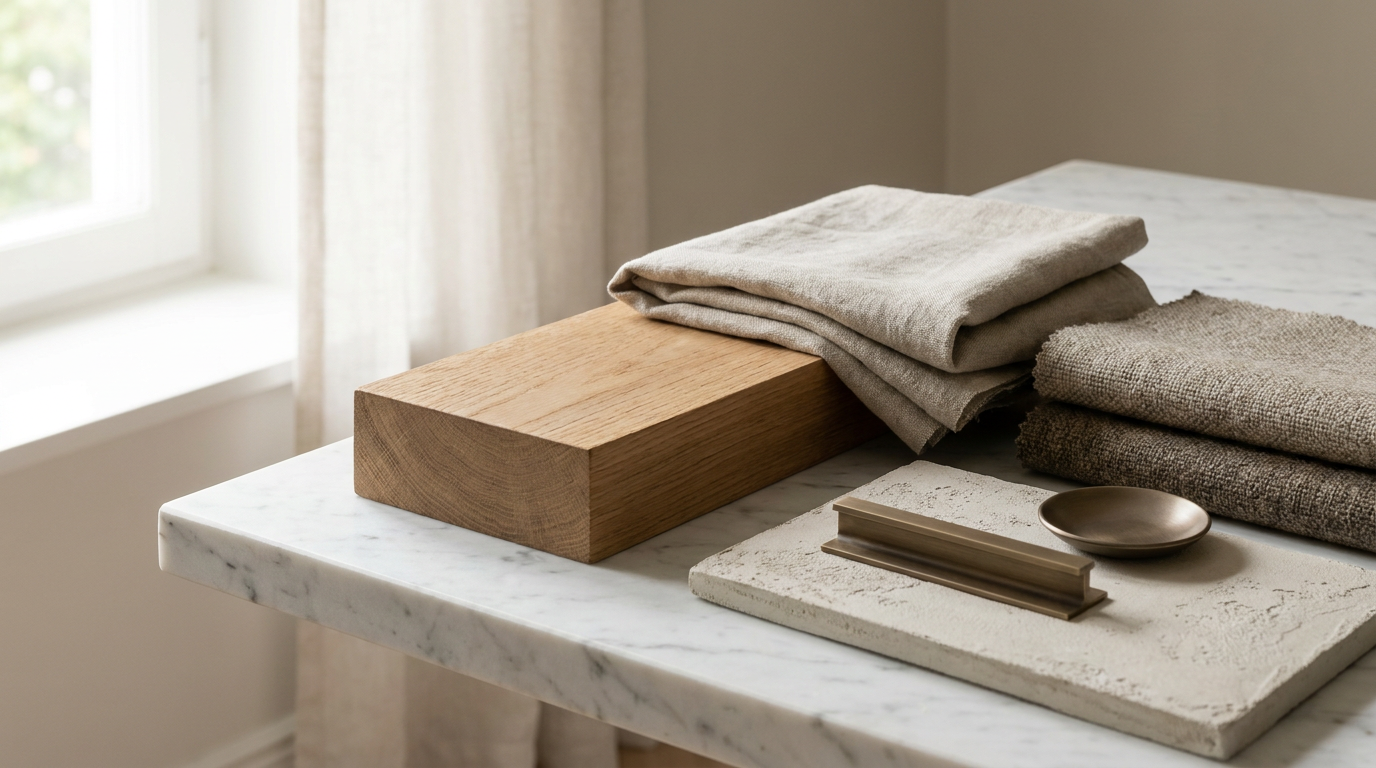
One of the most distinctive traits of European luxury interiors is their devotion to materials that age well. Marble, limestone, hardwoods, bronze, linen, wool, silk, plaster, and ceramics all appear frequently because they offer more than surface beauty. They possess depth, variation, and the ability to develop character through use. In a European inspired space, materials are chosen not simply for their initial impact, but for the way they will look and feel five or ten years later.
This idea can be described as material honesty. Stone should read as stone, with natural veining and subtle irregularity. Timber should reveal grain rather than being hidden under artificial gloss. Linen should crease softly. Brass should mellow. Plaster should catch light with quiet movement. These qualities give interiors an emotional richness that synthetic perfection often lacks. They also support the philosophy of quiet luxury because they do not need constant embellishment to feel significant.
The history of European decorative arts shows how even functional materials were elevated through technique and finish. From Delftware tiles to polished woods and sculpted metals, artisans turned utility into beauty. For the modern homeowner, this history offers a practical lesson. Rather than trying to make every surface look luxurious, choose one or two authentic feeling materials and use them consistently. A room with oak, linen, and stone will generally feel more sophisticated than one crowded with many competing finishes.
Patina is equally important. In contemporary culture, there is often pressure for everything to remain pristine. European luxury proposes a different ideal. A slightly worn leather chair, a marble counter that has softened with time, or an antique brass fitting with tonal variation can all add soul. These surfaces tell a story. They remind us that beauty can deepen through living, and that elegance is often more compelling when it is touched by time.
The Many Faces of European Style
Another important truth is that European luxury is not one style. It spans multiple traditions, each with its own proportions, materials, and emotional atmosphere. Understanding these variations allows homeowners to borrow with greater intelligence. It also prevents the common mistake of flattening European design into a generic old world look. In reality, the continent’s design culture is richly diverse.
French Classicism
French classic interiors are often associated with symmetry, paneling, fireplaces, elegant moldings, and a sense of poise. Their luxury comes from proportion and grace rather than clutter. Even when decorative, they remain composed. In a modern home, French influence might appear through wall paneling, a sculptural chandelier, antique inspired mirrors, or soft neutral upholstery balanced by one more dramatic gesture such as veined marble or a dark wood table.
Kingsgate Luxury Homes applied this French classical vocabulary at 216 Duncan Rd in Richmond Hill, pairing symmetrical limestone architecture and full-height wall panelling with a cascading sculptural chandelier and black marble accents in the foyer.
Italian Modernism
Italian luxury tends to bring sensuality and modern confidence. It values impeccable furniture, sculptural forms, polished stone, and a refined play between glamour and restraint. Italian modern interiors often feel slightly bolder than French classic rooms, yet they are still deeply edited. Curved seating, lacquered surfaces used sparingly, statement lighting, and rich yet controlled material contrasts are all hallmarks that translate beautifully into contemporary apartments and open plan homes.
British Heritage
British interiors often excel at layering, comfort, and lived in sophistication. They embrace books, textiles, antiques, and rooms that feel personally collected rather than perfectly staged. Luxury here is intimate and intellectual. A British inspired room might include tailored upholstery, patterned drapery, dark painted millwork, or vintage wood furniture softened by generous lamp light and natural fibers. The effect is cultivated rather than precious.
Scandinavian Restraint
Scandinavian luxury is often the quietest of all, yet also one of the most influential today. It favors pale woods, clean lines, warm minimalism, and a strong connection to light and wellbeing. Its sophistication lies in subtle texture, excellent craftsmanship, and an uncluttered visual rhythm. For North American homes, Scandinavian ideas offer a powerful reminder that luxury can feel calm, humane, and entirely practical.
Continental eclecticism, particularly in homes that blend several European references, may combine all of these attitudes in measured doses. The key is not to imitate every detail, but to identify the emotional quality you want. Do you want your space to feel poised, sculptural, enveloping, or serene? Once that is clear, the design language becomes easier to shape.
Proportion, Symmetry, and the Architecture of Calm
One reason European interiors feel so resolved is that they often begin with architecture. Even a modest room can feel luxurious when the underlying proportions are strong. Ceiling height, door placement, sight lines, and the relationship between furniture and walls all influence the experience of a space. European design traditions tend to respect these frameworks, allowing decoration to support architecture rather than compete with it.
Symmetry plays an important role, though it should not be understood too rigidly. A pair of sconces flanking a mirror, matching bedside tables, or two armchairs facing a fireplace all create visual order. This order is calming. It makes a room feel deliberate and grounded. Yet symmetry works best when softened by variation, such as a vintage object on one side, a stack of books on the other, or artwork that introduces movement and individuality.
Scale is equally crucial. Oversized furniture in a small room can feel oppressive, while undersized pieces in a large room appear uncertain. European luxury often succeeds because pieces are selected with care for both room volume and circulation. There is space to move comfortably. Conversation areas feel intimate but not cramped. Decorative elements are given room to breathe. In practical terms, this means measuring carefully and resisting the urge to over furnish.
Architectural trim can also elevate a room dramatically. Simple panel molding, a ceiling medallion, a stone surround, or a well detailed baseboard can create a sense of permanence that instantly shifts the mood. These interventions need not be extravagant. Their power lies in giving ordinary walls a framework. Once that framework exists, even contemporary furnishings can feel more grounded and more luxurious.
Layered Lighting and the Mood of Refinement
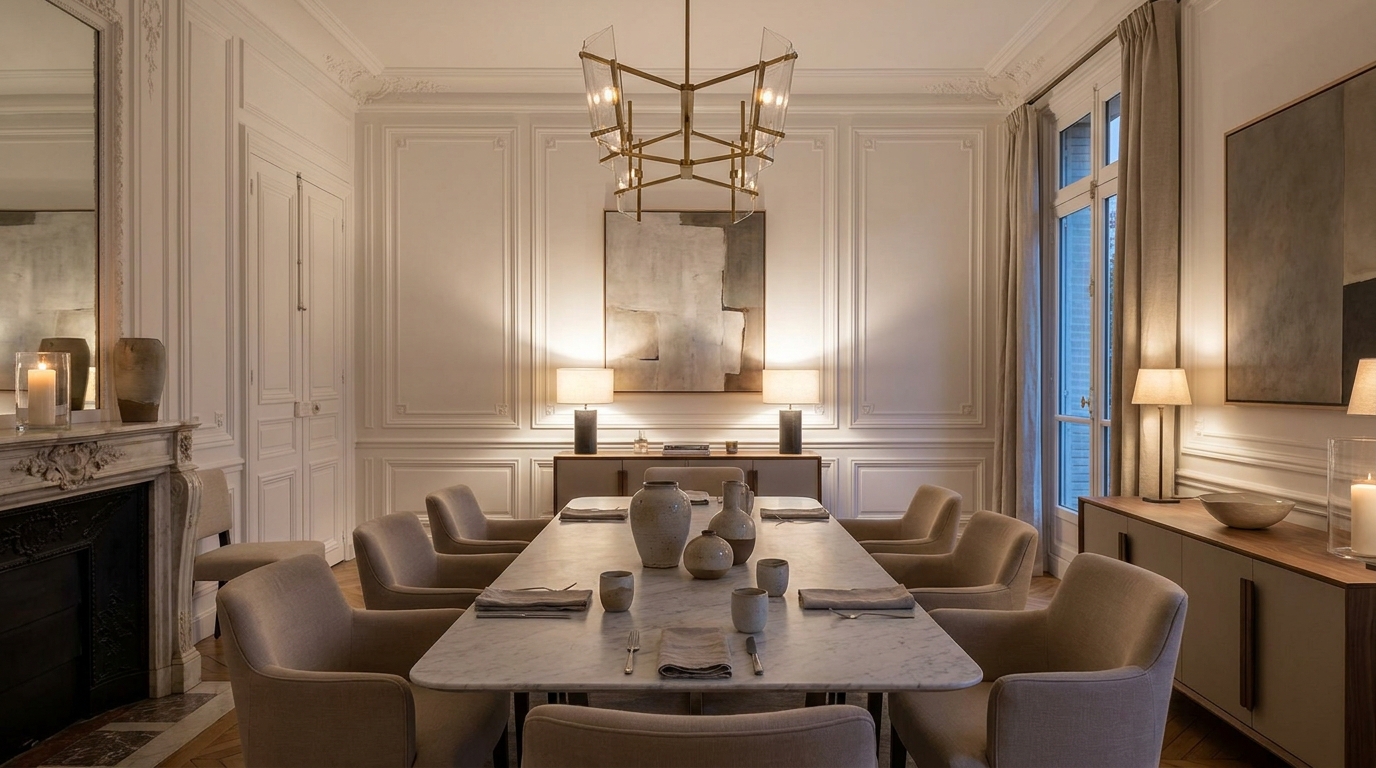
Luxury is not only seen. It is also felt through atmosphere, and nothing shapes atmosphere more powerfully than lighting. In many European interiors, light is layered carefully so that a room remains beautiful at every hour. Daylight is valued and often filtered through linen drapery or sheer panels that soften glare while preserving glow. In the evening, lighting becomes more intimate and sculptural.
A refined lighting plan usually includes ambient, task, and accent lighting. Overhead fixtures provide general illumination, but they are rarely expected to do all the work. Wall sconces create warmth and rhythm. Table lamps bring pools of light to conversation areas and reading corners. Picture lights, shelf lighting, or subtle floor lamps add depth. The result is a room that feels dimensional rather than flat.
European luxury also understands the decorative role of lighting objects themselves. A bronze sconce, a Murano glass pendant, or a pleated lampshade can act as jewelry within the room. Yet as with everything else, restraint matters. A space does not need many statement fixtures if one or two are beautifully chosen and well placed. It is often the layering of low, warm light that creates the greatest sense of sophistication.
For homeowners seeking this mood, a practical rule is to avoid relying solely on ceiling lights. Add lamps at eye level and below. Choose warmer bulbs. Introduce dimmers whenever possible. Evening light should feel flattering to people and materials alike. When stone, wood, textile, and plaster are lit softly, their textures become richer, and the room begins to hold that unmistakable quality of quiet elegance.
Modern European Luxury and the Rise of Softness
Recent design directions suggest that luxury is becoming softer, more organic, and more connected to wellbeing. WGSN’s interiors trend coverage has highlighted a move toward future facing creativity, warm palettes, collectible design, and lifestyle driven spaces rather than rigid formalism. This aligns beautifully with the evolution of European interiors, which are increasingly less about grandeur alone and more about emotional experience.
Warm minimalism is one expression of this shift. Instead of stark white spaces with severe edges, many luxury interiors now feature rounded forms, textured neutrals, earthy tones, and tactile surfaces. Curved sofas, limewash walls, brushed metals, and handmade ceramics all contribute to a gentler visual language. These rooms still feel elevated, but they do so through softness and serenity rather than intensity.
Wellness is another important thread. Bedrooms are being designed as sanctuaries. Bathrooms are becoming more spa like, with stone surfaces, muted light, and sensory calm. Living spaces increasingly include natural materials, greenery, and arrangements that support conversation and rest. In this context, European luxury becomes not simply an aesthetic ideal, but a framework for living well. Beauty is inseparable from comfort and emotional ease.
Sustainability also influences modern interpretations. Durable materials, fewer but better purchases, vintage sourcing, and respect for craft all align naturally with a more responsible design mindset. A room built from lasting materials and furnished thoughtfully will outlive many trend driven alternatives. This makes European luxury especially appealing today because its timelessness is not only beautiful, but also practical and conscientious.
How to Bring European Luxury into a North American Home
One of the most encouraging aspects of this design philosophy is its adaptability. You do not need a historic apartment in Paris or a villa in Tuscany to capture its essence. What matters more is the intelligent use of composition, texture, and quality cues. Even in a suburban house, urban condo, or newly built home, these principles can create rooms that feel elevated and enduring.
Start with the envelope of the room. Paint colors should feel nuanced rather than flat. Soft whites, stone beiges, muted taupes, mossy greens, and smoky blues all work well because they allow materials and light to take center stage. If possible, add trim, panel molding, or a more refined ceiling detail. These architectural moves instantly create a sense of heritage, even in contemporary spaces.
Then focus on one standout crafted element. This could be a custom vanity, a beautifully upholstered headboard, a stone topped console, or a dining table in solid oak or walnut. The presence of one strong piece often lifts everything around it. From there, build with natural materials. Linen curtains, wool rugs, ceramic lamps, and mixed metal accents will create the layered tactility associated with European interiors.
Editing is equally important. Avoid filling every wall and surface. Leave negative space where the eye can rest. Curate objects rather than scatter them. A small collection of books, one sculptural vase, a pair of candlesticks, and a framed artwork can feel far more luxurious than a crowded arrangement. European rooms often feel composed because they trust simplicity.
North American layouts also benefit from zoning. Open plan living can sometimes feel visually diffuse, so use rugs, lighting, and furniture placement to define intimate areas within larger rooms. A reading chair by a lamp, a conversation grouping around a coffee table, or a bench beneath a window all create moments of purpose. These small acts of planning make a home feel more intentional, which is one of the clearest signals of luxury.
Room by Room Ideas for Accessible Elegance
Living Room
In the living room, begin with a sofa that prioritizes form and comfort equally. The research notes that the U.S. led the North America sofa market in 2025 with 83.2 percent of regional revenue, reflecting strong demand for design forward furniture. This is useful because the sofa is often the emotional and visual anchor of the room. Choose a silhouette with clean lines or subtle curvature, then layer it with linen, velvet, or wool cushions in tonal shades.
Add a coffee table in stone or wood, then bring in softer textures through a rug, drapery, and lamp shades. If the architecture is simple, a fireplace surround or built in shelving can create a stronger focal point. Finish with a few curated objects that feel personal rather than generic. The goal is not to make the room busy, but to make it rich in texture and calm in composition.
Dining Room
The dining room is an ideal place to express European elegance through symmetry and mood. A central chandelier, a substantial table, and upholstered chairs immediately create ritual and presence. Consider a stone, wood, or plaster finished table surface, then soften it with fabric seating and a restrained centerpiece. Wall moldings, framed art, or a large mirror can add architecture without overwhelming the room.
Table settings matter as well. Fine ceramics, linen napkins, and candlesticks evoke the European understanding that everyday rituals deserve beauty. This does not need to feel formal. It simply means honoring the dining room as a place of gathering rather than an afterthought. Even in a compact space, lighting and materiality can create a remarkable sense of occasion.
Bedroom
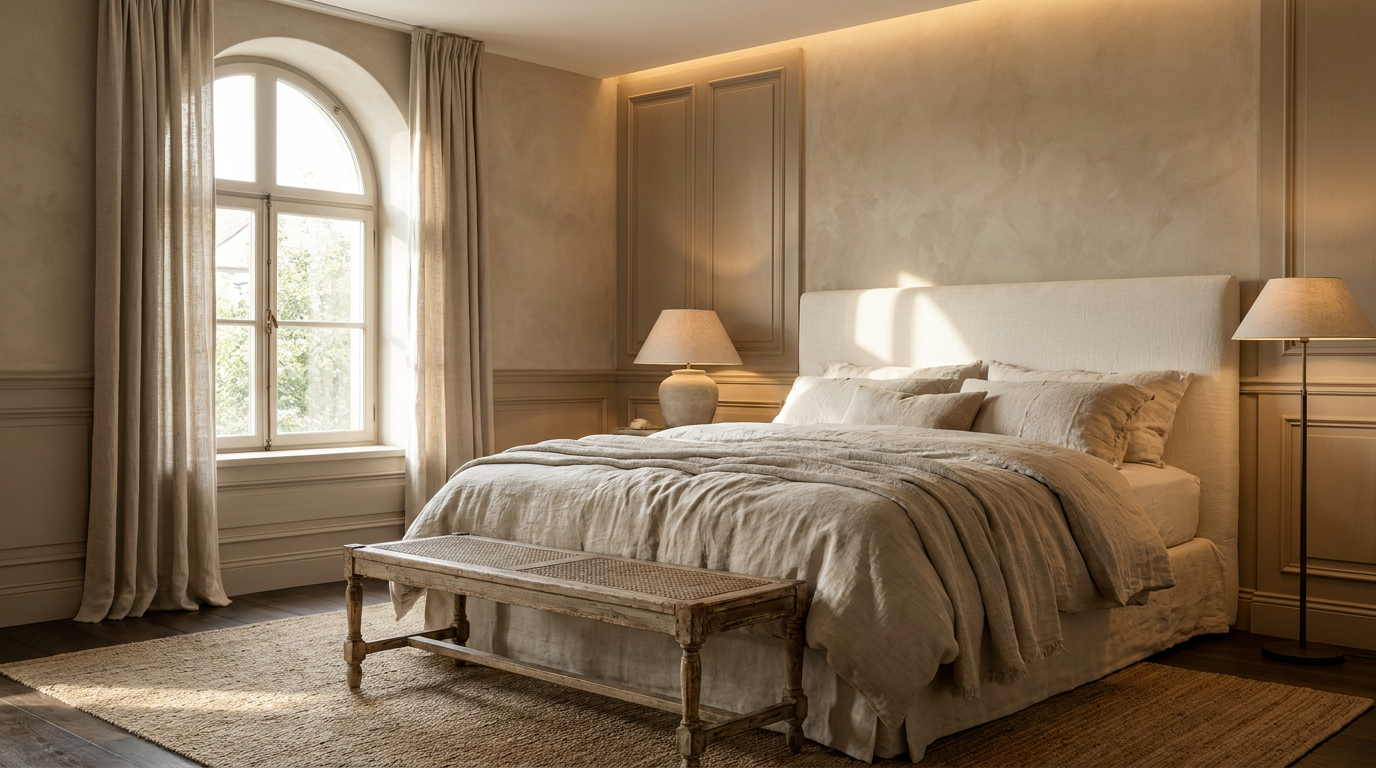
The bedroom should embody the quieter side of luxury. Prioritize an upholstered or paneled headboard, high quality bedding in linen or cotton, and layered light with bedside lamps and perhaps a wall sconce. Keep the palette soft and cohesive. A bench at the foot of the bed, an antique chest, or a textured rug can add depth without clutter. Bedrooms feel most luxurious when they are soothing to both eye and body.
Kitchen and Bath
Kitchens and bathrooms often reveal the clearest difference between decorative luxury and genuine refinement. In these rooms, quality of finish matters immensely. Cabinetry should feel thoughtful and well proportioned. Stone should be chosen for depth rather than trend. Hardware should feel weighty in the hand. In bathrooms, plaster walls, marble or limestone accents, and warm metal fixtures create a serene spa like atmosphere that feels both timeless and deeply practical.
Common Misconceptions About European Luxury
One of the most persistent misconceptions is that European luxury requires maximal ornament. In fact, many of the most elegant interiors are remarkably restrained. They rely on line, material, and craftsmanship rather than accumulation. Another misconception is that luxury must be expensive in every detail. The truth is that coherence often matters more than cost. A room with a limited palette, one excellent piece of furniture, and thoughtful lighting can feel more luxurious than a room filled with costly but disconnected items.
It is also wrong to assume that European interiors are inherently old fashioned. Many current luxury looks are modern reinterpretations of historical principles. Clean lined furniture can sit beautifully within classic architecture. Abstract art can enrich a traditionally detailed room. Organic contemporary forms can coexist with antique woods and brass accents. This ability to blend past and present is one of the most sophisticated aspects of European design.
Another misunderstanding is that brand names alone create status. While quality manufacturers certainly matter, authentic luxury often resides in custom joinery, finish quality, and design coherence. A bespoke bookshelf made by a local craftsperson may contribute more to the character of a room than a logo driven accessory. European luxury values the integrity of making, and that value remains deeply relevant today.
The Lasting Appeal of Quiet Luxury
The current popularity of quiet luxury in fashion and interiors is not accidental. It reflects a broader cultural fatigue with excess and spectacle. People increasingly want homes that restore rather than stimulate, that endure rather than chase novelty, and that reflect discernment rather than display. European interior traditions answer this desire beautifully because they are built on principles that do not age quickly.
Quiet luxury also invites a more personal relationship with design. Instead of buying into a rigid formula, homeowners can shape spaces gradually, adding pieces with meaning and quality over time. A room can evolve. It can inherit. It can blend memory and modernity. This makes the home feel not only elegant, but also alive. The best European inspired interiors always carry this sense of continuity.
For designers and homeowners alike, the lesson is simple. Luxury is not a style to copy mechanically. It is a sensibility to cultivate. It asks for patience, discernment, and a willingness to prioritize what will matter in daily life and in years to come. A well placed lamp, a beautifully made chair, a linen curtain, a wall with graceful molding, a stone surface that catches morning light, these are small decisions, yet together they create extraordinary rooms.
Conclusion: Making the Ordinary Feel Exceptional
European luxury in interior design is ultimately a celebration of what is well made, well proportioned, and deeply felt. It draws from history without becoming trapped in it. It honors craftsmanship, embraces material honesty, and understands that elegance is often most powerful when it whispers. In a world of fast trends and visual noise, this sensibility offers something profoundly refreshing.
Its greatest beauty may be its accessibility. While grand residences have long embodied these ideals, the philosophy itself can be adapted almost anywhere. A carefully chosen material palette, layered lighting, architectural trim, one bespoke element, and a commitment to editing can transform a home at any scale. The result is not imitation grandeur, but a more intimate form of sophistication that feels personal and lasting.
To explore the essence of European luxury is to discover that refinement is not about excess at all. It is about care. It is about the meeting of heritage and modern life, of beauty and usefulness, of atmosphere and structure. And when these elements are brought together with intelligence, even the simplest room can become an extraordinary haven.
Key Takeaways for Designing with European Luxury in Mind
-
Prioritize craftsmanship by investing in a few pieces or finishes that reveal care, skill, and longevity.
-
Choose natural materials such as wood, stone, linen, wool, plaster, and bronze for depth, tactility, and graceful aging.
-
Respect proportion and architecture through balanced layouts, thoughtful scale, and simple trim or paneling where possible.
-
Layer light carefully using lamps, sconces, and dimmable fixtures to create warmth and mood.
-
Embrace restraint by editing accessories and allowing key pieces and materials to stand out.
-
Blend history with the present so that classic references feel relevant, livable, and personal rather than staged.
-
Design for rituals by shaping rooms around comfort, conversation, rest, and daily life.



No Comment! Be the first one.