



Harnessing Wind Energy: A Beginner’s Guide for Homeowners
Wind energy has a powerful reputation. For many people, it brings to mind long rows of turbines turning across prairie landscapes or offshore coastlines, quietly producing electricity on a massive scale. What often gets overlooked is that wind can also play a role much closer to home. For the right property and the right household, a small wind system can become part of a practical, lower carbon energy strategy that supports resilience, reduces reliance on grid electricity, and makes renewable energy feel more personal.
Table Of Content
- What Home Wind Energy Actually Means
- Why Some Homeowners Are Looking at Wind Again
- Who Is the Best Fit for a Residential Wind Turbine?
- A Step by Step Way to Decide if Wind Is Viable at Your Home
- Step 1: Understand Your Energy Use First
- Step 2: Assess the Wind Resource
- Step 3: Confirm Space, Setbacks, and Tower Height
- Step 4: Check Local Zoning and Permits
- Step 5: Explore Utility Interconnection and Net Metering
- Step 6: Review Economics Honestly
- Real Life Scenarios: When Home Wind Makes Sense and When It Does Not
- Choosing Equipment Without Falling for Marketing Hype
- Common Misconceptions About Residential Wind
- Why Energy Efficiency Should Come Before the Turbine
- The Rise of Hybrid Home Energy Systems
- Questions to Ask Before You Move Forward
- Final Thoughts: Wind as a Practical, Site Specific Home Energy Choice
That said, home wind energy is not a universal solution, and it helps to say that clearly from the beginning. A residential wind turbine is not like swapping out a light fixture or adding a smart thermostat. Its success depends on wind resource, land conditions, local regulations, utility rules, and realistic expectations about what the system can and cannot do. The good news is that once you understand those factors, the decision becomes far less mysterious and much more manageable.
This guide is designed to make wind energy approachable without oversimplifying it. We will look at how small wind systems work, who they are best suited for, how much power they can realistically produce, and how to evaluate your property step by step. Along the way, we will also cover common misconceptions, equipment quality, costs, and the growing trend toward hybrid systems that combine wind, solar, batteries, and energy efficiency upgrades. The goal is not to convince every homeowner to install a turbine. The goal is to help you make a smart, grounded decision.
In North America, the most relevant category for homeowners is known as distributed wind or small wind. In U.S. federal terminology, small wind turbines are typically under 100 kilowatts, with residential systems often in the 5 to 15 kilowatt range. These systems are used to offset electricity use at homes, farms, and small businesses. In many cases, they work best in rural or semi-rural locations where there is space for a properly sited tower and a steady, unobstructed wind resource.
Practical takeaway: Wind energy for homes is attainable, but it is highly site dependent. A good property can make a modest turbine surprisingly effective. A poor site can make even an expensive system disappointing.
Across Canada, wind energy already plays a meaningful role in the broader electricity mix. Natural Resources Canada reports that wind generated 36 terawatt-hours of electricity in 2022, or about 5.7 percent of the country’s total electricity generation, enough to power roughly 3 million typical Canadian homes. That national success is encouraging, but it does not automatically translate into viability at the individual household level. Home wind is about micro-siting, tower height, turbulence, zoning, and local average wind speeds, not just national potential.
For homeowners who are curious, that distinction matters. Utility scale wind farms are carefully located and professionally engineered around strong, consistent wind resources. A residential system has to work within the conditions of your own property, your municipality, and your utility. That is why the best starting point is not excitement about the turbine itself. It is a calm assessment of whether your home is actually a good candidate.
What Home Wind Energy Actually Means
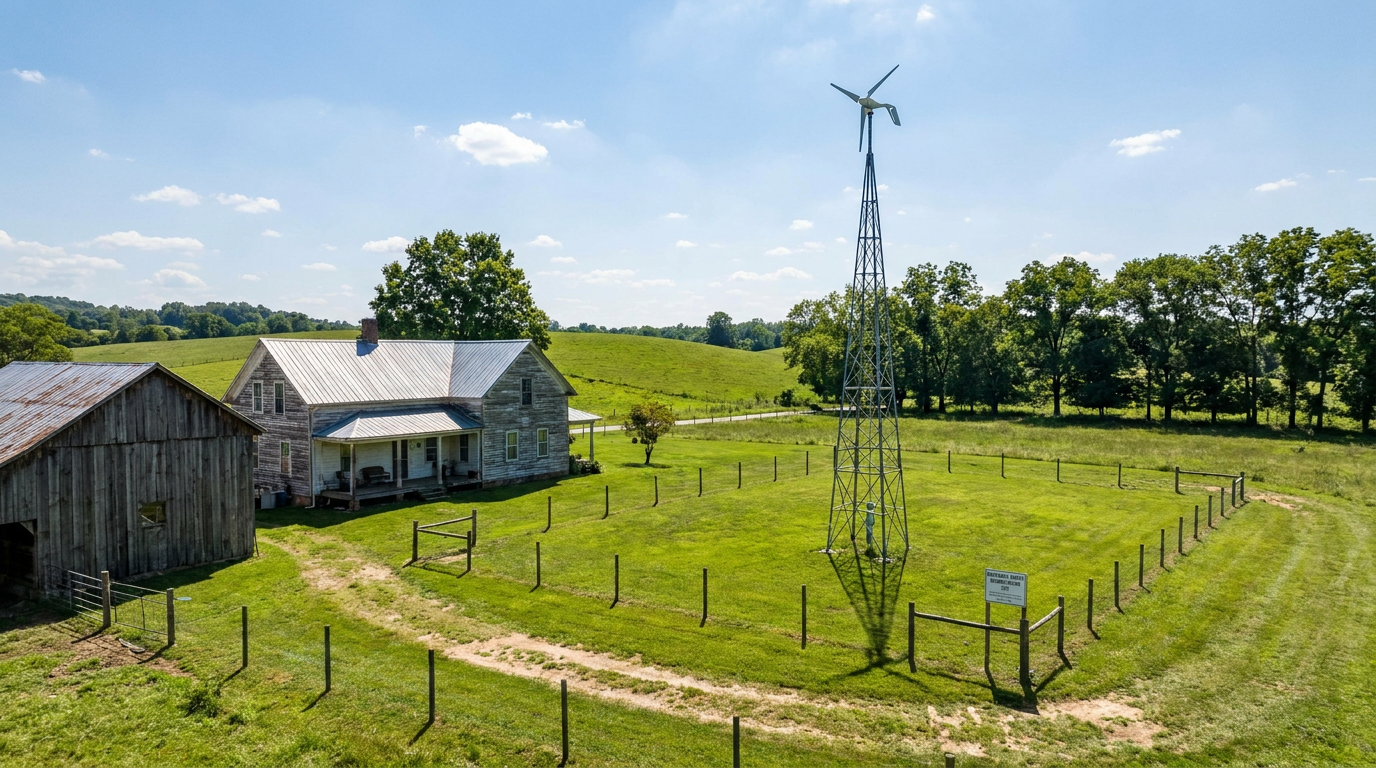
Home wind energy is the use of a small turbine, usually mounted on a tower, to convert the kinetic energy of moving air into electricity for a house, farm, or small business. In North America this category is known as distributed or small wind: turbines generally under 100 kilowatts, with most residential systems sized between 5 and 15 kilowatts. That electricity can power part of a home’s demand directly, reduce how much energy is purchased from the grid, charge batteries in some setups, or feed surplus power back to the utility where net metering or similar arrangements are available. The exact configuration depends on whether the property is grid connected, partially independent, or fully off grid. Output is never constant, since it depends heavily on real-time wind speed, tower height, and how the turbine is sited relative to trees, buildings, and terrain.
A common misunderstanding is that any small turbine can power an entire house around the clock. In reality, output varies significantly with wind speed, siting, tower height, and system losses. The U.S. Department of Energy notes that a typical U.S. home uses about 10,649 kilowatt-hours per year. By comparison, a 1.5 kilowatt turbine may cover only a relatively small load, around 300 kilowatt-hours per month, and only in a strong wind location with an average wind speed of about 14 miles per hour. That is useful context because it shows why turbine size alone tells only part of the story.
The turbine’s rated power is best understood as a reference point, not a promise of constant production. Wind is variable, and turbines produce more energy at higher wind speeds. Because of this, two homes with the same model turbine can see very different annual results. A property with open exposure and stronger average winds may achieve meaningful savings, while a sheltered property near trees or buildings may see disappointing output from the same equipment.
This is one reason federal guidance generally does not recommend rooftop mounting for most residential wind systems. Roofs and nearby structures tend to create turbulence, which reduces efficiency and places stress on equipment. A tower in open, unobstructed wind usually performs better and more reliably. While rooftop turbines can look compact and convenient in marketing images, real world performance often falls short compared with properly tower-mounted systems.
Why Some Homeowners Are Looking at Wind Again
Interest in distributed energy has grown steadily, and wind remains part of that conversation for a few very practical reasons. First, many homeowners are looking for ways to reduce their carbon footprint without waiting for broader infrastructure changes. Second, resilience has become more important as people think about outages, rural grid reliability, and long term energy costs. Third, some households simply want a more independent relationship with energy, particularly on farms, acreages, and remote properties.
For those households, wind can be appealing because it often complements other renewable sources. Solar panels are productive during daylight hours and often strongest in summer. Wind patterns can be more active at night, during storms, or in colder seasons, depending on location. That means a hybrid system of solar and wind may create a more balanced energy profile than either technology alone. Add battery storage and careful load management, and a home can become significantly more flexible in how it uses and stores power.
There is also a quieter trend reshaping the market. Wind resource assessment tools are improving, including lower cost desktop and virtual assessment methods that can help screen a property before anyone commits to equipment. This matters because one of the biggest risks in home wind has always been investing too early, before confirming whether the site is truly viable. Better assessment tools reduce guesswork and make the early decision phase more grounded.
At the same time, there is more emphasis today on reliable certification and independently verified performance data. The small wind market has historically included products sold with inconsistent or overly optimistic claims. That is changing as buyers, installers, and regulators place more value on certification for safety, performance, and reliability. For homeowners, this is a very healthy shift. Better data leads to better decisions.
Who Is the Best Fit for a Residential Wind Turbine?
Home wind tends to work best for a fairly specific user profile. The strongest candidates are often homeowners with larger rural or semi-rural properties, open wind exposure, room for tower setbacks, and a genuine interest in long term energy planning. Farms, homesteads, acreages, and off-grid cabins are often more promising than suburban neighborhoods or dense urban blocks. Space and airflow matter, and both are usually easier to find away from heavy development.
A homeowner in a windy coastal area, on the southern Prairies, or in parts of Atlantic Canada may have stronger baseline conditions than someone in a sheltered inland subdivision. Even then, local obstacles such as tree lines, hills, neighboring buildings, and zoning restrictions can change the picture dramatically. A promising region is not enough on its own. The property itself has to support the system.
The other strong fit is a homeowner who is already thinking holistically about energy use. The Department of Energy consistently points consumers toward reducing demand before generating more power. That means the ideal wind customer is not only interested in a turbine. They are also willing to improve insulation, upgrade appliances, manage heating and cooling loads, and size a renewable system around realistic consumption. Wind works best as part of a thoughtful energy plan, not as a shortcut around efficiency.
It is also helpful if the homeowner has patience for permitting, utility conversations, and due diligence. A small wind system is a technical home improvement with structural, electrical, and regulatory dimensions. It can be very worthwhile, but it is rarely an impulsive purchase. People who approach it with the same care they would bring to a major renovation usually have a better experience.
A Step by Step Way to Decide if Wind Is Viable at Your Home
The easiest way to evaluate home wind is to follow a simple sequence of questions. This approach mirrors the practical guidance used in official small wind resources and helps keep the process grounded. Before comparing turbine brands or imagining energy savings, begin with the property itself. The key question is whether your site has enough wind to justify the investment.
Step 1: Understand Your Energy Use First
Start by reviewing at least one year of electricity bills. Look at your annual kilowatt-hour consumption and note any seasonal spikes related to heating, cooling, irrigation, or workshop equipment. This gives you a baseline for what you are trying to offset. It also reveals whether your home is already efficient or whether there are easy upgrades that may reduce the size of the renewable system you actually need.
This step is important because many renewable energy projects become more affordable after efficiency improvements. Air sealing, insulation, efficient water heating, lighting upgrades, and better appliances often cost less per unit of saved energy than generation equipment. If you cut demand first, the turbine you eventually choose can be smaller, less expensive, and better matched to your remaining load.
Step 2: Assess the Wind Resource
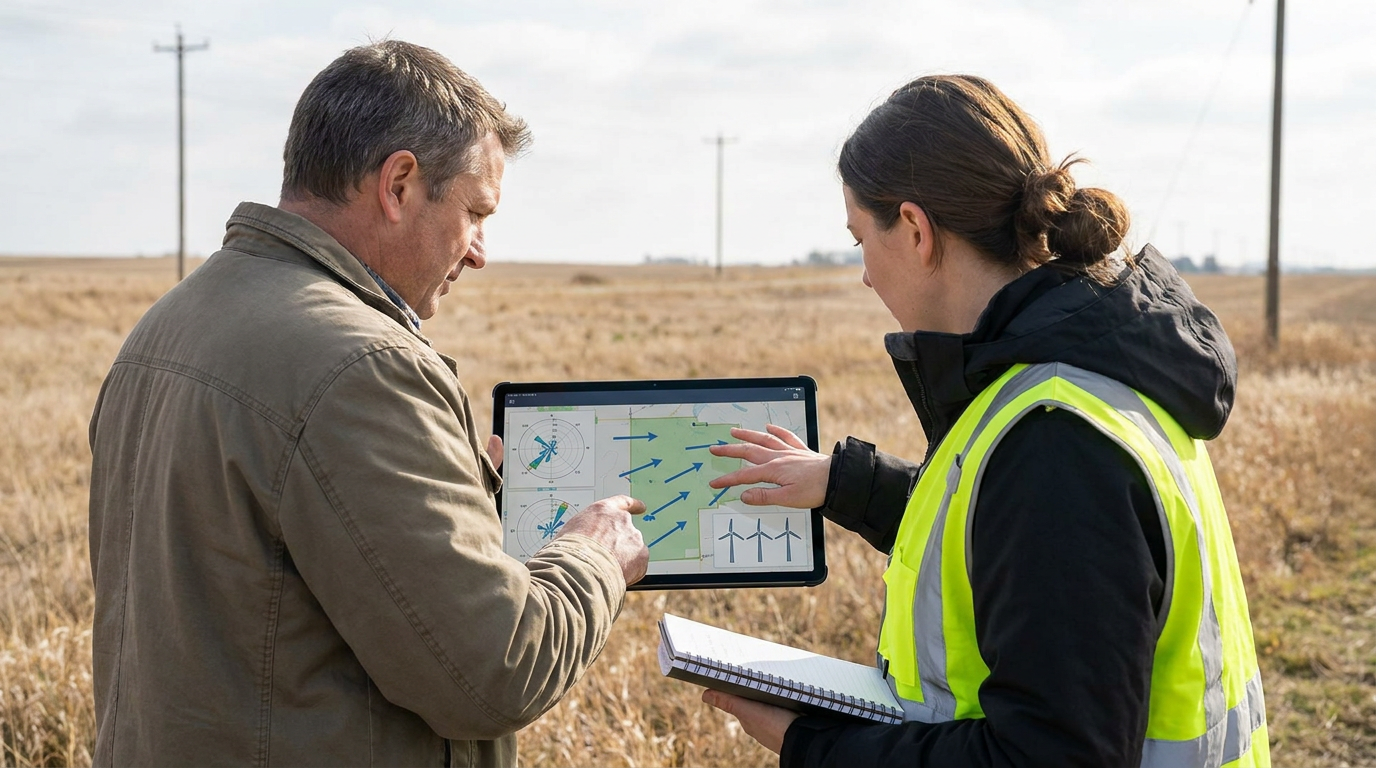
Next, evaluate the wind conditions at your site. Regional wind maps, desktop assessment tools, local meteorological data, and installer experience can all help. Newer virtual assessment methods are improving this early stage and can reduce the cost of deciding whether your property is worth pursuing further. Still, desktop data should be treated as a screening tool, not the final word.
What matters most is the annual average wind speed at the height where the turbine will actually operate. Wind speed increases with height, which is why taller towers usually produce more energy. Local surface roughness also matters. Open ground, smooth terrain, and distance from obstructions help maintain stronger, cleaner airflow. Trees, buildings, ridges, and uneven terrain can create turbulence that lowers output and increases wear.
A property that feels breezy at ground level is not necessarily a strong wind site in engineering terms. Likewise, a windy season or memorable storm is not enough evidence for annual performance. This is one area where restraint pays off. A careful assessment now is much cheaper than installing a system that never meets expectations.
Step 3: Confirm Space, Setbacks, and Tower Height
Once the wind resource looks promising, consider whether the site has enough physical space for a proper tower installation. Small wind systems need clearance and setbacks for safety, maintenance access, and better airflow. A turbine placed too close to trees or structures is much more likely to encounter turbulent wind, which reduces power production and can shorten equipment life.
Tower height is not a cosmetic choice. It is one of the strongest drivers of performance. Because wind speed generally rises with elevation, a taller tower can significantly improve annual energy output. The challenge is that taller towers may trigger zoning limits, visual concerns, setback requirements, or additional permitting steps. A site may have enough wind in theory but fail in practice if the necessary tower height is not allowed.
This is why rooftop wind is usually discouraged. Roof level is often exactly where turbulence is strongest, especially in built environments. A tower in open exposure is almost always the more effective solution. If your property cannot support a tower, that may be a sign that wind is not the best technology for your home.
Step 4: Check Local Zoning and Permits
Before moving too far, contact your municipality or county to understand zoning, height limits, noise rules, and permitting requirements. Some communities have clear pathways for distributed wind, while others treat small turbines more cautiously. Ask about allowable structure height, setback distances, electrical permits, and whether any environmental or aviation reviews may apply.
This step may feel procedural, but it has real influence on project success. A site that is technically strong can become impractical if local rules cap tower height too low or make approvals unpredictable. Conversely, a supportive local framework can make a project much smoother. Understanding these conditions early helps you spend time and money wisely.
Step 5: Explore Utility Interconnection and Net Metering
If your home is connected to the grid, ask your utility how a small wind system can interconnect and whether net metering or a comparable arrangement is available. The Department of Energy notes that small wind systems can offset on-site electricity use and may use net metering where available. Those policies can materially affect project economics because they determine how surplus electricity is credited and what equipment or approvals are required.
Interconnection rules vary by utility and jurisdiction. Some require specific disconnects, metering arrangements, engineering reviews, or certified equipment. Others may limit system size relative to your historical usage. The point is not to assume complexity, but not to assume simplicity either. Utility compatibility is one of the core practical questions that should be answered before purchase.
Step 6: Review Economics Honestly
Finally, look at the economics with clear eyes. Consider equipment cost, tower cost, permitting, electrical work, installation, maintenance, and any battery or inverter components. Compare the projected annual production against your current electricity rates, local incentives if any, and the value of exported energy under your utility policy. A good installer should be able to model estimated performance using your actual site conditions rather than generic marketing assumptions.
In some cases, the economics will be attractive, especially on strong wind sites with high electricity costs, good interconnection rules, or remote conditions where delivered fuel and backup generation are expensive. In other cases, the payback will be long and the carbon case may be stronger than the purely financial one. Neither result is a failure. The goal is to know where your project stands before you commit.
Real Life Scenarios: When Home Wind Makes Sense and When It Does Not
Consider a farmhouse on open land in the Prairies with consistent wind, room for a tower, and a household that already upgraded insulation and equipment. In that scenario, a small wind turbine may offset a meaningful share of annual electricity use, especially if paired with net metering and solar panels. The system may not carry every load at every hour, but it could become a durable part of the home’s energy mix.
Now imagine a suburban home on a compact lot, surrounded by mature trees and nearby houses. The homeowner is interested in sustainability and has seen attractive rooftop turbine products online. In this case, wind is much less likely to perform well. Turbulence, height restrictions, and limited space all work against the project. The better choice may be rooftop solar, battery storage, and aggressive efficiency improvements.
A third example is an off-grid cabin or rural retreat with seasonal use. Here, wind can be very valuable if the site has good exposure and the owner wants winter or overnight generation to complement solar. Because remote properties often need more resilient self-supply, a modest turbine can add stability when designed into a larger off-grid system with batteries and backup controls. In these settings, wind is often less about maximizing return on investment and more about improving reliability and reducing generator dependence.
Good wind projects are usually boring in the best way. They are carefully sited, realistically sized, properly permitted, and chosen for a property that genuinely supports them.
Choosing Equipment Without Falling for Marketing Hype
Once you have a promising site, equipment quality becomes the next priority. This is an area where homeowners should move carefully. Small wind has seen products enter the market without clear, independently verified data on performance, reliability, noise, and safety. That makes third-party certification especially important. The Department of Energy recommends consumers buy turbines certified to nationally recognized standards for safety, performance, and reliability.
Ask for certification details, power curves, acoustic information, warranty terms, maintenance schedules, and real production data from comparable installations. Be cautious about broad claims that seem detached from site conditions. A turbine that sounds impressive in a sales brochure may not be the right choice for your wind regime, tower height, or utility setup. Verified performance is far more valuable than optimistic language.
It is also wise to ask how service will be handled after installation. Who performs maintenance? How easy is it to source replacement parts? What happens if a component fails several years into operation? Long term support matters because a turbine is not just a product. It is a working mechanical and electrical system exposed to weather over many seasons.
For Canadian homeowners, it is helpful to look for compliance with recognized standards and to work with professionals familiar with local code requirements. A quality installation should feel well engineered, not improvised. That means proper foundations, electrical integration, grounding, and shutdown protections, not just an appealing machine at the top of a pole.
Common Misconceptions About Residential Wind
One of the biggest misconceptions is that a residential wind turbine can power any home if it is large enough. In reality, success depends first on wind resource, tower height, and clear exposure. A larger turbine on a poor site is still a poor project. Another common myth is that rated kilowatts equal real world output at all times. Actual production depends on the wind itself, which is variable and site specific.
There is also a persistent belief that rooftop turbines are a simple, urban-friendly alternative to tower-mounted systems. Federal guidance generally points in the opposite direction. Rooflines and nearby obstacles create turbulence, and turbulence is the enemy of efficient, reliable small wind. If a project depends on a rooftop turbine because there is no room for a proper tower, that usually suggests the property is not ideal for wind.
Some people assume wind is only relevant at utility scale. That overlooks the role of distributed wind in homes, farms, and small businesses. Small wind absolutely exists as a practical category. It is simply more selective than some other home energy technologies. Its niche is real, but it is a niche.
Finally, not all small turbines are equally reliable. Certification, engineering quality, and independently verified performance matter. If there is one place to be conservative, it is here. Homeowners do not need the flashiest system. They need one that performs as promised over time.
Why Energy Efficiency Should Come Before the Turbine
There is something appealing about generating your own electricity. It feels tangible and empowering. But from both a financial and environmental perspective, the most effective first step is often reducing demand. Better insulation, more efficient heating and cooling, smart controls, and efficient appliances shrink the load your renewable system has to serve. This tends to improve project economics and can make the final setup more elegant.
Think of it this way: every kilowatt-hour you avoid using is one you do not have to generate, store, or buy. That principle is especially important with wind because output is variable and site dependent. A home that wastes less energy gives any renewable system a better chance to succeed. It also reduces the pressure to oversize equipment in pursuit of unrealistic self-sufficiency.
For many homeowners, the most resilient path is a layered one. Start with efficiency. Add solar if the roof and sun exposure are favorable. Explore wind if the property has the right conditions. Integrate battery storage if outage resilience or load shifting matters. This kind of sequencing tends to produce better outcomes than jumping straight to generation hardware.
The Rise of Hybrid Home Energy Systems
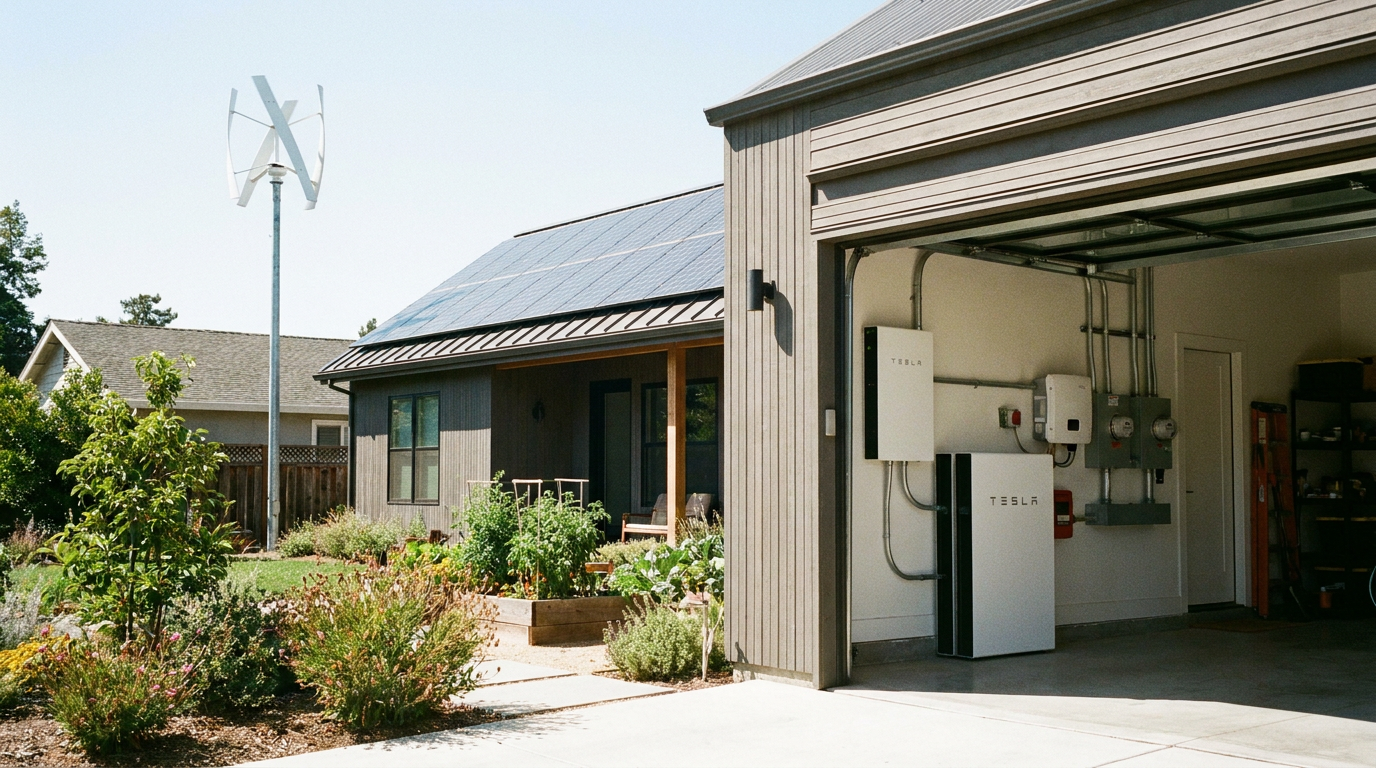
One of the most promising trends in home energy is the hybrid system. Instead of asking one technology to do everything, homeowners are combining complementary tools. A small wind turbine may work alongside rooftop or ground-mounted solar, battery storage, smart inverters, and load management systems. Each component supports the others, and the result is often more resilient than any single technology on its own.
Wind is particularly interesting in a hybrid context because its production profile can differ from solar. In some places, wind is stronger at night or in winter, when solar is less productive. That can help smooth seasonal and daily variation. Batteries then add another layer by storing surplus power and making it available when loads peak or the grid goes down.
For homeowners, this does not mean complexity for its own sake. It means better matching technology to the rhythms of real life. If your household uses more electricity in the evening, values backup capability, or lives in a place with variable renewable conditions, a hybrid approach may be more practical than trying to force one technology into every role.
Questions to Ask Before You Move Forward
If you are seriously considering a residential wind system, it helps to gather answers to a short set of practical questions. These should include your annual electricity use, your site’s estimated average wind speed at tower height, whether local zoning permits the necessary structure, how the system would interconnect with the utility, and whether the model you are considering has independent certification. You should also ask who will install and maintain the system, what annual production is realistically expected, and how those estimates were developed.
It can be useful to request a written feasibility review or proposal that shows assumptions clearly. That means wind resource inputs, tower height, expected annual output, maintenance expectations, and how utility credits are treated. A trustworthy proposal should feel specific to your property. If everything looks generic, it probably is.
Most importantly, give yourself permission to walk away if the fit is weak. Choosing not to install wind after a careful review is still a successful outcome. It means you made a disciplined decision and can redirect your effort toward solutions that suit your home better.
Final Thoughts: Wind as a Practical, Site Specific Home Energy Choice
Wind energy has an understandable romance to it. It is visible, kinetic, and quietly expressive of a home working more closely with natural systems. But the best reason to consider wind is not romance. It is practicality. On the right site, for the right homeowner, a small wind system can be a credible, durable way to offset electricity use, support cleaner living, and build a more resilient home energy plan.
The key is to approach it with the right expectations. Home wind is not for every roof, every lot, or every budget. It asks for wind, space, height, permitting, and patience. It performs best when paired with energy efficiency and, in many cases, other renewable technologies. It rewards careful assessment more than enthusiasm alone.
If you live on a property with open exposure, room for a tower, and a genuine interest in long term energy planning, wind may be worth a closer look. Start with your energy use. Investigate your site. Ask about zoning and utility interconnection. Seek certified equipment and realistic production data. From there, the path becomes much clearer.
In the end, sustainable housing choices do not have to be dramatic to be meaningful. Sometimes they simply need to be well matched to place. Wind energy is exactly that kind of choice: elegant when it fits, responsible when it is well planned, and most effective when it is grounded in the realities of home.


No Comment! Be the first one.