



Artificial intelligence has a way of attracting big claims. In construction and architecture, the phrase AI-generated buildings can sound like a future where software designs a house, sends plans to a factory, and delivers a finished structure with little human involvement. That is not how the industry works today. The reality is more grounded, and in many ways more useful. AI is becoming part of the design and construction workflow as a tool that helps people explore options, sort information, reduce repetitive work, and make better decisions earlier.
Table Of Content
- What AI-generated buildings actually mean today
- Why AI matters now in construction and housing
- How homeowners may benefit from AI-assisted building design
- The limits homeowners need to understand
- What AI changes for architects, engineers, and builders
- AI and standardized building systems
- The code, permitting, and liability reality
- Trust, governance, and safety are the real test
- Ethical questions the industry cannot ignore
- Common misconceptions about AI-generated architecture
- Where the next few years are likely headed
- What homeowners and professionals should do now
- Conclusion
That matters because building has become harder to deliver efficiently. In Canada, pressure on housing supply is well documented. CMHC reports that housing construction increased 6% year over year in 2025 to 259,000 units, with record rental construction and growth in missing-middle housing. Even with that increase, CMHC has also stated that Canada needs to roughly double housing starts over the next decade to address affordability pressure. The issue is not only how much we build, but how productively we build it.
Productivity is where the conversation gets practical. Statistics Canada reported that labour productivity in Canada’s residential construction industry fell cumulatively by 37.3% from 2001 to 2023. CMHC estimated that lost productivity from 2019 to 2024 added $6 to $8 billion to housing construction costs in Canada, accounting for up to 20% of the increase in new home prices. When you look at those numbers, AI stops sounding like a design trend and starts looking like one possible tool for reducing friction in an industry that needs more throughput and less waste.
For homeowners, this technology is worth watching because it may change how homes are planned, priced, customized, and delivered. For architects, engineers, developers, and contractors, the question is less about whether AI will replace them and more about where it can save time without introducing risk. The most balanced view is this: AI-generated buildings are not a finished product category. They are an emerging set of methods that can improve concept design, feasibility, coordination, scheduling, standardization, and project decision-making when used with skilled human oversight.
AI in construction is strongest today when it reduces repetitive effort, exposes design conflicts early, and gives experienced professionals better information before work starts on site.
This article looks at what AI-generated buildings really mean in practice, where the value is today, what homeowners should be excited about, what construction professionals should be cautious about, and why code, liability, and trust still matter more than software promises.
What AI-generated buildings actually mean today
The term AI-generated buildings can be misleading because it suggests a complete building appears from an algorithm. In practice, AI is usually involved in a narrower and more manageable part of the process. It may generate floor plan options, test massing concepts, optimize room relationships, estimate quantities, compare site constraints, or improve coordination between digital models. The output is often a starting point or decision support tool, not a permit-ready building.
That distinction matters because construction is not a pure design exercise. A building has to satisfy structural requirements, fire separation, accessibility rules, energy codes, local zoning, site servicing, environmental conditions, procurement realities, and budget limits. It also has to be buildable by real crews using available materials under a real schedule. AI can assist with many of those variables, but it does not remove them.
Recent industry use points toward workflow-embedded AI rather than flashy concept art. Software platforms are increasingly adding generative tools inside design environments, which lets teams explore options without leaving their normal workflow. Researchers are also working on geometry-aware systems such as neural CAD models that move beyond image generation toward editable 2D and 3D design outputs. That is a more useful direction for construction because editable geometry can be measured, coordinated, priced, and checked.
For a homeowner, the practical version of AI-generated design might be a renovation platform that can quickly test kitchen layouts, daylighting changes, or addition options against a rough budget. For a builder, it might be software that compares several framing layouts, identifies likely material overruns, or flags scheduling conflicts before subcontractors are booked. For a developer, it might mean exploring how many unit mixes can fit on a site while staying within zoning constraints. None of this is science fiction. It is incremental improvement, which is usually how real change arrives in construction.

Why AI matters now in construction and housing
Construction has always had a productivity problem that gets worse when projects become more customized, regulations become more layered, and labor markets tighten. Canada is feeling all three pressures at once. Housing demand remains high, affordability is strained, and the industry needs to increase output without simply assuming there will be unlimited skilled labor available to do it. That makes tools that reduce rework and speed up early decision-making especially important.
AI is relevant here because many project delays do not begin on site. They begin in the planning stage when teams are still sorting through incomplete information, unclear constraints, cost uncertainty, conflicting priorities, and manual coordination work. If software can help teams compare options faster and catch obvious issues earlier, the project has a better chance of entering construction with fewer surprises. That does not solve every problem, but in building, fewer surprises often means better outcomes.
There is also a broader business backdrop. Statistics Canada reported that 12.2% of Canadian firms used AI to produce goods or deliver services in 2025, up from the prior year, and 14.5% planned to adopt AI within 12 months. Adoption in construction is still uneven, but that unevenness is normal. Larger firms and software-integrated teams tend to move first because they already have structured data, digital workflows, and staff who can test new tools. Smaller firms often adopt later, once the value is clearer and the software is easier to use.
What makes this different from past software cycles is the pressure from housing supply and cost. If AI can support more standardized housing systems, digitally coordinated prefabrication, better quantity takeoffs, or faster feasibility studies, it could contribute to better output at scale. It will not solve affordability by itself, but it could become one part of a larger productivity strategy.
How homeowners may benefit from AI-assisted building design
For most homeowners, the near-term benefit of AI is not a fully automated dream house. It is a faster, more informed planning process. Many residential projects get stuck at the point where owners are trying to understand what is possible on their lot, what changes fit their budget, and how one design choice affects another. AI-assisted tools can help narrow those unknowns early by generating options, identifying tradeoffs, and putting rough performance information in front of the client sooner.
One benefit is speed in concept development. A homeowner considering a custom home or major renovation can work through more variations in less time. Instead of waiting through several rounds of manual drafting just to compare broad layout ideas, a design team may be able to evaluate circulation, room placement, window orientation, and basic massing much faster. That does not replace proper design work, but it makes the first stages of the project less slow and less opaque.
Another likely benefit is better space efficiency. AI tools can test how layouts perform within a fixed building envelope, which may help identify wasted circulation, awkward room relationships, or underused square footage. In expensive markets, every square foot matters. If a family can get a better functioning plan from the same footprint, that is a practical win. In multifamily and missing-middle housing, this kind of optimization can also improve viability for builders and developers.
Energy performance is another area where AI may become useful to ordinary clients. NIST’s AI for Building Systems Innovation program notes that buildings account for 37% of U.S. energy use and that more than 80% of a building’s life-cycle energy use is operational rather than construction-related. That means better orientation, envelope decisions, glazing strategies, and system planning can matter more over time than many people realize at the start of a project. AI-assisted analysis can help teams compare options earlier, before expensive decisions are locked in.
There is also the possibility of lower soft costs over time. If design teams can reduce repetitive drafting, produce clearer early estimates, and coordinate information more efficiently, some of those savings may eventually show up in project pricing or at least in reduced design churn. Homeowners should not expect dramatic immediate discounts, but they should expect gradual improvements in how quickly teams can test ideas and move toward a workable plan.
The limits homeowners need to understand
The upside is real, but so are the limits. Homeowners should be careful not to confuse a polished AI-generated concept with a buildable design. A design image may look convincing while missing local climate considerations, structural logic, site grading realities, or code requirements. If the software has not been trained or configured around local conditions, it can generate ideas that are attractive on screen and impractical in the field.
Transparency is another issue. If a platform produces a plan recommendation, the client should know what assumptions shaped it. Was the design optimized for cost, daylight, rentable area, energy use, or speed of assembly. Those goals can conflict. A house that is efficient to build may not be the best fit for privacy, views, or neighborhood character. Homeowners need professionals who can explain not only what the software suggests, but why.
There is also a quality question. Good houses are not only efficient arrangements of rooms. They are responses to site, climate, use patterns, and human comfort. AI can help generate options, but it does not automatically create architecture with judgment, restraint, or long-term livability. In residential work, those qualities still depend heavily on the skill of the architect, designer, and builder interpreting the brief and the place.
What AI changes for architects, engineers, and builders
For construction professionals, AI has value across the project lifecycle, but its strongest near-term role is in preconstruction. That is where many of the repetitive tasks live, and where early mistakes multiply if they are not caught. Design teams can use generative tools to compare massing options, test floor plans, estimate embodied carbon, and structure information inside BIM models earlier. Contractors can use AI to assist with quantity takeoffs, scheduling, risk detection, and progress tracking based on site imagery.
These are practical uses because they support decisions that already need to happen. An estimator still reviews quantities. A project manager still decides how to sequence trades. An engineer still signs off on structural requirements. AI simply helps reduce the time spent collecting and organizing information. In an industry where experienced staff are often spread thin, that can be significant.
For architects, one of the biggest gains may be option generation without manual repetition. Early concept work often involves testing many arrangements that are not dramatically different but still take time to draw and evaluate. If AI can generate viable variants based on the actual constraints of the project, the design team has more time to evaluate quality and communicate with clients. That is a much better use of professional expertise than redrawing similar versions by hand.
For engineers, especially those working in integrated digital workflows, AI may help identify coordination issues earlier or compare system alternatives faster. If geometry, structure, envelope, and services are tied together in shared models, even modest automation can reduce clashes and rework. The real value is not the novelty of AI. It is fewer downstream surprises when construction documents meet site conditions.
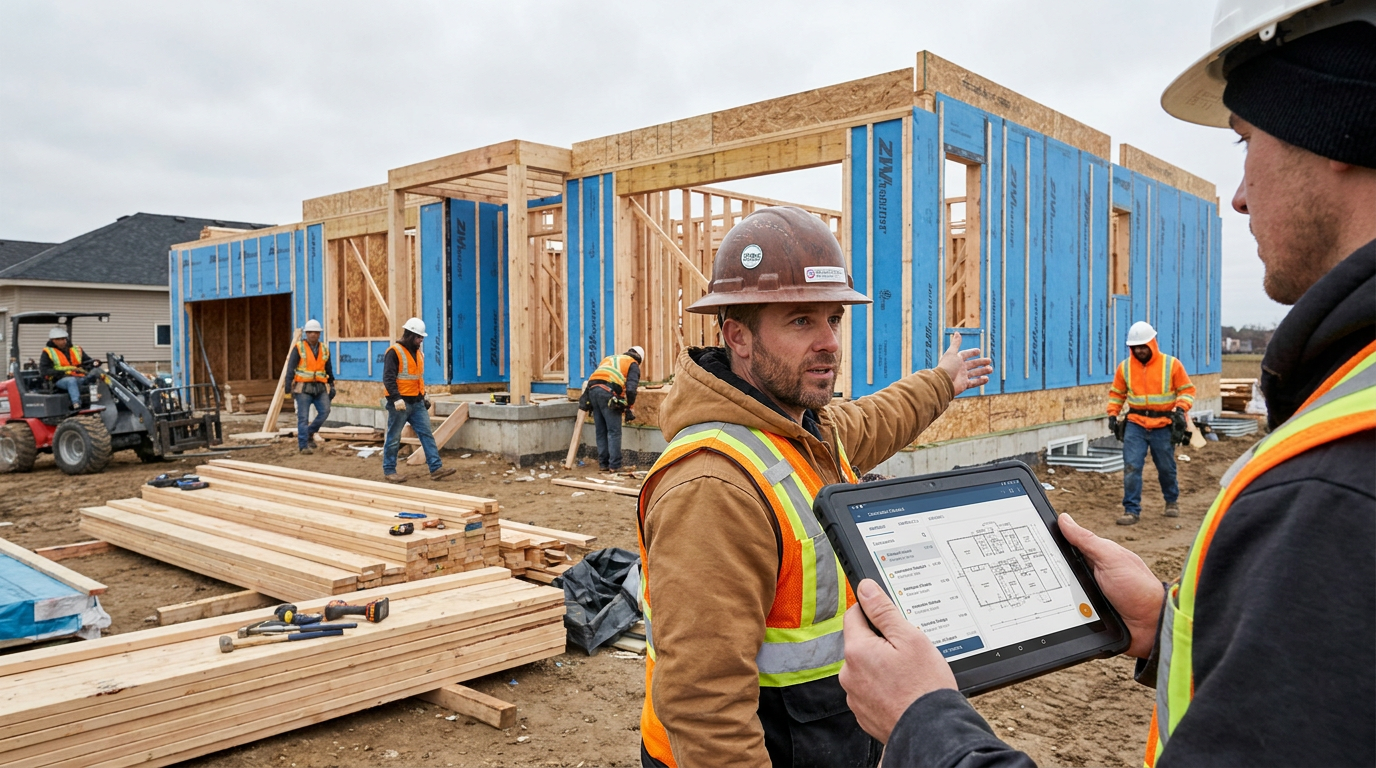
For contractors, AI is especially useful when it supports planning and field awareness. Image-based progress tracking, predictive scheduling, and automated takeoff tools can save time, but only if they fit the existing workflow. Builders do not need another dashboard that produces generic insights. They need tools that help them understand what is late, what is missing, what is out of sequence, and what should be corrected before it affects cost and schedule.
AI and standardized building systems
One of the most important practical connections is between AI and standardized or modular construction. Many people imagine AI-generated buildings as ultra-custom or futuristic forms. In reality, some of the biggest gains may come from the opposite direction. Repeatable, standardized systems are easier to optimize, coordinate, fabricate, and cost accurately. AI is well suited to environments where design rules and component libraries are clearly defined.
That is why off-site construction and prefabrication matter in this conversation. If a housing provider uses a kit-of-parts approach, AI can help configure unit layouts, structural modules, facade options, and service runs within a controlled system. This does not make the building generic by default. It simply improves the relationship between design choice and manufacturing logic. In a housing market under pressure, that could become a very practical model.
For Canada in particular, standardized housing and digital manufacturing may become increasingly relevant if they support scalability and better productivity. The industry needs ways to build more homes with fewer coordination failures. AI can help if it is tied to repeatable systems, reliable data, and clear approval pathways. That is far more promising than expecting software to invent perfect buildings from scratch.
The code, permitting, and liability reality
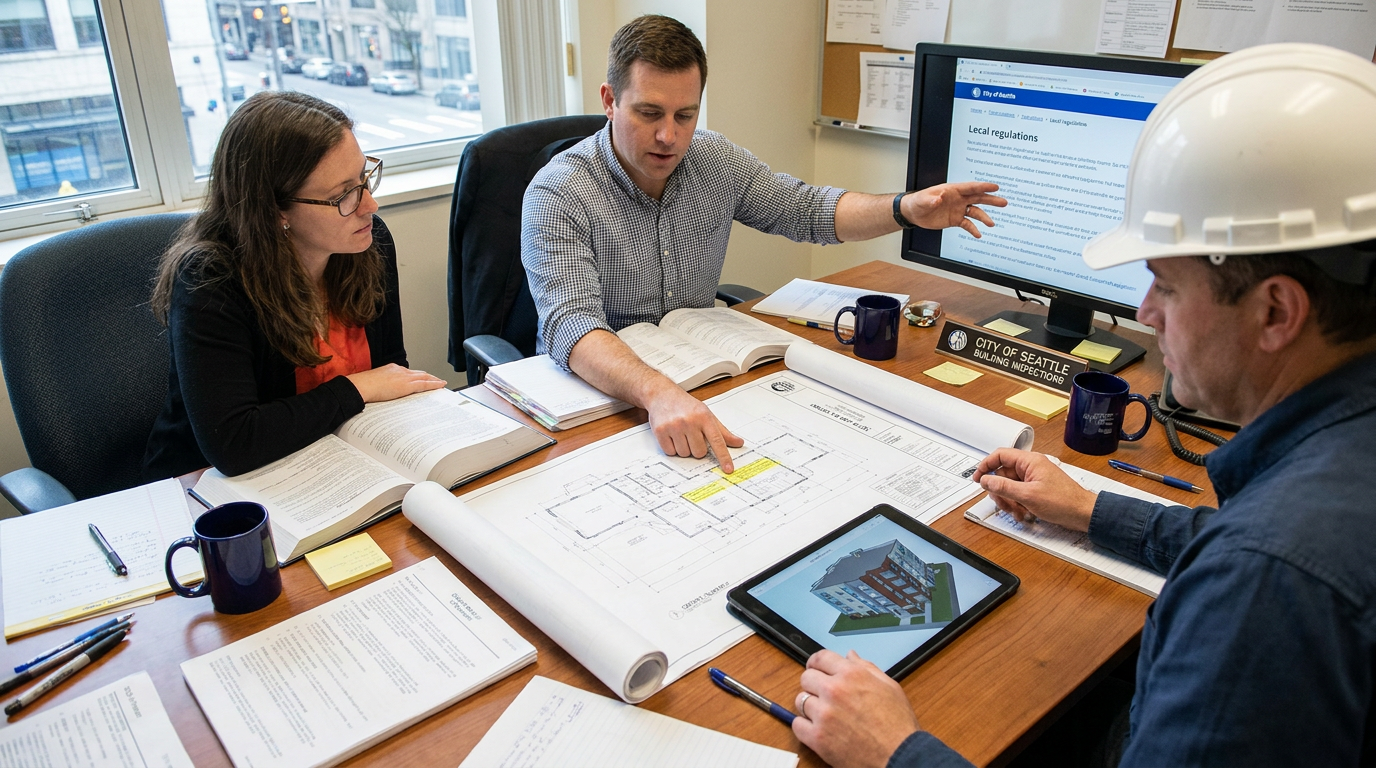
Every serious discussion about AI-generated buildings has to come back to regulation and responsibility. Buildings are governed by codes for a reason. They must meet legal minimum requirements related to life safety, structural performance, accessibility, energy use, fire protection, and more. NIST states that building codes are legal minimum requirements enforced mainly by state and local governments in the U.S., which means AI-generated designs still require jurisdiction-specific code review. The same practical principle applies elsewhere. Local rules matter, and they are not optional.
This is where the hype often breaks down. AI can produce a layout or suggest an arrangement, but it does not carry the legal responsibility for compliance. Licensed professionals and code officials remain responsible for final decisions and approvals. That means any AI-generated output has to be checked against local zoning, permit requirements, assembly details, structural loads, and the realities of construction in that jurisdiction.
Permitting is especially resistant to simple automation because local processes vary so much. A design that looks acceptable in one municipality may face setbacks, height limits, parking requirements, heritage restrictions, snow load considerations, or energy targets in another. Software can assist by organizing information and flagging likely compliance issues, but it cannot be assumed to know every local interpretation without careful configuration and review.
Liability is the other side of the same issue. If an AI-assisted model leads to a coordination error, who owns that mistake. If a client relies on a generated concept that later proves unbuildable within budget, who is accountable for the misalignment. These are not theoretical questions. They affect contracts, insurance, scopes of service, and how firms communicate with clients. The practical answer is that professionals need to define where AI is being used, how outputs are verified, and what remains subject to independent review.
Trust, governance, and safety are the real test
If there is one theme that separates useful AI from risky AI in construction, it is governance. A building is not a marketing asset. It is a physical product that people live in, work in, and depend on for safety. NIST’s AI Risk Management Framework is helpful because it treats AI as a system that must be evaluated for reliability, transparency, and accountability. In construction, those are not abstract values. They affect safety, compliance, privacy, cybersecurity, and the quality of project decisions.
Reliability starts with data. If an AI system is trained on incomplete, outdated, or low-quality project information, the output may look precise without being trustworthy. In building work, false confidence is dangerous. A neat plan or a clear quantity estimate can still be wrong if assumptions were flawed at the start. This is why experienced teams do not simply accept the output. They test it against known constraints and field reality.
Transparency matters because professionals and clients need to understand how recommendations are being made. A black-box result is harder to defend when code compliance, budget, or safety is involved. If the software proposes a layout change that improves floor efficiency but increases egress complexity or service coordination risk, the team needs to know that tradeoff. Good decision-making depends on seeing the reasoning, not just the recommendation.
Cybersecurity and privacy also become more important as building workflows become more digital. AI tools may rely on cloud-hosted models, shared project files, image capture, procurement data, and even occupant-related information in some cases. Firms need to know where data is going, who can access it, and how it is being protected. Construction has historically lagged in digital security maturity, so this is an area where rapid adoption without process discipline can create unnecessary exposure.
There is also a misconception worth clearing up. AI does not automatically make buildings safer. It can help identify risks sooner, but it can also introduce new errors if teams trust it too quickly or use it without proper controls. Safety comes from good design practice, competent review, disciplined execution, and clear accountability. AI can support that system, but it does not replace it.
Ethical questions the industry cannot ignore
Ethics in AI-generated buildings is not only about abstract fears of machines replacing designers. The more immediate questions are about bias, access, authorship, and decision quality. If training data overrepresents certain housing types, regions, cost assumptions, or design norms, the output may consistently favor solutions that are less suitable for other communities. That can show up in everything from unit layouts to facade assumptions to energy strategies.
There is also an access issue. Larger firms are more likely to benefit first because they already have BIM systems, structured datasets, and integrated software ecosystems. Smaller design studios, independent builders, and local developers may not have the same ability to test or validate these tools. That could widen capability gaps within the industry unless software becomes more usable, more affordable, and better aligned with real project delivery needs.
Authorship is another complicated area. If an architect uses AI to generate a concept, how should that be represented to the client. If several options are derived from previous datasets, what constitutes original work, and who owns the result. These questions are still evolving, but the practical principle is simple. Firms should be honest with clients about how tools are being used and where professional judgment enters the process.
The final ethical issue is one of professional responsibility. AI can encourage speed, but construction often requires patience. It is tempting to take a promising output and move too quickly because the software made the process feel efficient. Good professionals know when to slow down, ask questions, and test assumptions. In that sense, AI raises the value of judgment rather than reducing it.
Common misconceptions about AI-generated architecture
The public discussion around AI-generated buildings often drifts toward easy extremes. On one side, AI is presented as a near-magical solution to housing shortages, cost overruns, and design inefficiency. On the other side, it is dismissed as image-making software with no serious construction value. Neither view is accurate. The truth sits in the middle and is more practical than dramatic.
- AI will fully design and permit buildings on its own. In reality, AI mainly assists human teams and still requires licensed review, code compliance checks, and jurisdiction-specific approvals.
- AI-generated architecture is only about visuals. Some of the most useful applications are in feasibility analysis, floor plan optimization, quantity takeoffs, scheduling support, and model coordination.
- AI automatically improves safety. Safety depends on data quality, verification, competent design, and strong governance. AI can help, but it can also mislead if used carelessly.
- AI means every building becomes highly bespoke. In many cases, the biggest practical gains come from standardized, modular, and repeatable systems that software can optimize well.
- Adoption is happening evenly across the industry. It is not. Firms with stronger digital infrastructure are likely to benefit first, while others adopt more slowly.
Where the next few years are likely headed
The most likely future is not a construction industry dominated by autonomous design engines. It is a more integrated environment where AI becomes a normal feature inside the tools professionals already use. That means design platforms with built-in option generation, BIM workflows with smarter coordination, estimating software with better pattern recognition, and project controls that can surface risk earlier.
This matters because the construction industry usually changes through workflow adoption, not through complete reinvention. Builders trust tools that save time without disrupting the chain of responsibility. Architects trust systems that produce editable outputs they can refine. Owners trust processes that are transparent, priced clearly, and reviewable by real professionals. AI will grow where it fits those conditions.
In housing, AI may become especially relevant where it supports standardized design libraries, off-site manufacturing, and repeatable approvals. If the same family of building types can be adapted efficiently to multiple sites, there is a better chance of reducing friction without sacrificing quality. This could be useful in missing-middle housing, purpose-built rentals, and other categories where scale and repeatability matter.
There is also a sustainability angle. Since most of a building’s life-cycle energy use is operational, earlier analysis of orientation, envelope performance, and system planning could improve long-term performance if teams use it well. AI is not a substitute for good building science, but it can help bring building science into design decisions sooner.
What homeowners and professionals should do now
For homeowners, the practical takeaway is to ask better questions, not to chase a futuristic promise. If you are working with a design or construction team that uses AI-assisted tools, ask how those tools affect scope, cost confidence, design options, and code review. Ask what is being automated and what still depends on manual review. A good team should be able to explain the workflow in plain terms and show where professional judgment remains central.
For architects and builders, this is a good time to focus on targeted use cases rather than broad claims. The firms seeing value are usually the ones applying AI to repetitive, measurable tasks where output can be checked against known standards. Preconstruction planning, option comparison, takeoffs, scheduling support, and model coordination are all sensible places to start. Trying to automate too much too quickly usually creates more confusion than efficiency.
It also makes sense to invest in the basics that make AI more useful. Clean project data, disciplined BIM practices, clear file standards, documented review processes, and realistic staff training will matter more than adopting the latest tool. In construction, software does not create discipline. It amplifies the discipline or disorder that already exists in the workflow.
Firms should also prepare for client communication and risk management. Contracts, scopes of work, and internal review procedures may need to evolve as AI becomes more common. Clients will want to know what is being used and what it changes. Teams that can explain that clearly will be in a stronger position than teams that treat AI as a black-box selling point.
Conclusion
AI-generated buildings are not the arrival of machine-made architecture in the way headlines sometimes suggest. They are the early result of AI being folded into the real work of planning, designing, coordinating, and delivering buildings. Used well, these tools can help teams explore more options, reduce repetitive effort, improve early-stage decision-making, and support better productivity in an industry that badly needs it. Used poorly, they can create false confidence, shallow design decisions, compliance risks, and misplaced trust.
That balanced view is the one worth keeping. For homeowners, the near-term benefit is not a house designed entirely by software. It is a planning process that may become faster, clearer, and better informed. For construction professionals, the value lies in augmentation, not replacement. Skilled people still need to interpret site conditions, code requirements, budget limits, and client needs. The software can assist, but it cannot carry the responsibility.
In the years ahead, the winners will likely be the teams that use AI as a practical construction tool rather than a branding exercise. They will tie it to BIM, prefabrication, standardization, project controls, and disciplined review. They will understand that trust, governance, and safety are not barriers to innovation. They are the conditions that make innovation worth using in the first place.



No Comment! Be the first one.