



Cities across the world are confronting the same strategic question through very different planning traditions: how can urban growth continue without driving up infrastructure costs, worsening housing affordability, and deepening climate risk? The answer is no longer found in a single doctrine of density or in a simplistic preference for expansion at the urban edge. Sustainable urban growth is increasingly understood as a coordinated system of land use, housing, transport, public investment, and governance. When those pieces align, cities become more accessible, more resilient, and more economically productive. When they do not, even well intentioned growth can result in congestion, high emissions, and persistent affordability pressure.
Table Of Content
- Why International Development Models Matter Now
- Model One: Transit-Oriented Development as an Integrated Growth Strategy
- What Canada Can Learn from TOD
- Model Two: The Compact City and the Logic of Densification
- Why Density Alone Is Not Enough
- Model Three: Polycentric Metropolitan Development
- The Governance Demands of Polycentric Regions
- Financing Urban Growth: Why the Best Models Still Fail Without Fiscal Alignment
- Climate Resilience as a Core Design Requirement
- How Canada and North America Can Adapt Global Models
- A Practical Framework for Evaluating Development Models
- The Strategic Direction Ahead
International development models matter because they allow policymakers and planners to move beyond local habits and compare what actually works. Some nations have built successful transit-oriented urban regions. Others have protected land through compact city frameworks, while some have organized growth through multiple employment and housing hubs across a metropolitan area. The strategic value of these models is not that they offer templates to be copied wholesale. Their value lies in showing how city form, infrastructure finance, and public institutions can work together to shape outcomes over decades rather than election cycles.
That perspective is especially important in Canada and across North America. The primary challenge is not urbanization itself. It is the spatial pattern of growth. Low density expansion, fragmented municipal decision making, auto dependence, and delayed infrastructure coordination have made it more difficult to deliver housing supply efficiently while meeting climate and mobility objectives. According to OECD analysis, North American cities have an average density of about 1,700 inhabitants per square kilometre, far below many other global regions. Canada has densified gradually, with cities increasing from about 1,900 inhabitants per square kilometre to around 2,500 by 2015, but that shift has been evolutionary rather than transformative.
Urban growth in Canada remains highly concentrated. Statistics Canada’s 2021 Census shows that large urban population centres of 100,000 or more accounted for 22,640,314 people, or 61.2 percent of the national population, up from 59.6 percent in 2016. Statistics Canada defines a population centre as an area with at least 1,000 people and a density of at least 400 persons per square kilometre. Those numbers matter because they highlight a central reality of modern development strategy: most growth pressure is metropolitan, and metropolitan pressure demands metropolitan solutions. Local zoning changes on their own are not enough if regional transit, municipal finance, and housing delivery remain misaligned.
This article compares the most influential international development models now shaping the debate on sustainable urban growth. It focuses on transit-oriented development, compact city planning, and polycentric metropolitan development, while also examining the financing and governance frameworks that make these models succeed or fail. The core argument is straightforward. Development models should be judged less by ideology and more by measurable outcomes. The real test is whether they reduce land consumption, improve access to jobs and services, support housing affordability, lower emissions, and strengthen climate resilience.
Sustainable urban growth is not simply about adding density. It is about connecting density to accessibility, affordability, public realm quality, infrastructure capacity, and long term governance discipline.
Why International Development Models Matter Now
The timing of this conversation is critical. Urban development is no longer assessed only through the lens of growth management or transportation efficiency. Climate adaptation, heat risk, flood exposure, housing supply, energy transition, and social inclusion have moved to the center of planning. UN-Habitat’s World Cities Report 2024 warns that more than 2 billion city dwellers could face an additional temperature increase of at least 0.5 degrees Celsius by 2040. That is not an abstract environmental concern. It directly affects where housing should be built, how streets and buildings should be designed, and how public infrastructure should be financed and maintained.
At the same time, public investment capacity is increasingly local. The OECD notes that in its member countries, local governments account for about 55 percent of public investment. That means municipalities and metropolitan institutions are not passive implementers of national policy. They are central actors in the urban transition. If city regions are expected to deliver housing, rapid transit, resilience infrastructure, and better public spaces, they need development models that are fiscally realistic as well as spatially coherent.
Global institutions have also sharpened their focus on urban systems. The World Bank says it invests an average of about 5 billion dollars annually in urban development, resilience, and land related projects. That scale of involvement reflects a broad consensus that the way cities grow has consequences for economic opportunity, emissions, fiscal health, and social stability. Sustainable urban growth has become a development issue, not just a planning issue. For Canadian policymakers and urban planners, this means international comparisons are no longer academic. They are practical tools for identifying what can be transferred, what must be adapted, and what should be avoided.
Model One: Transit-Oriented Development as an Integrated Growth Strategy
Transit-oriented development, often described as TOD, has become one of the most influential international models because it links mobility and land use in a direct and measurable way. The World Bank describes TOD as compact, mixed use, pedestrian and bicycle friendly development integrated with mass transit. That definition is important because it corrects a common misunderstanding. TOD is not simply high density construction near a station. It is a sequencing strategy in which transport investment, land regulation, urban design, and development rights are structured together to create access rather than car dependence.
In parts of East Asia, TOD has been implemented at a scale that reshaped entire metropolitan regions. Rail systems and station areas were planned as integrated development corridors, often with a mix of residential, office, retail, civic, and public space functions. The result was not just efficient movement of people. It was the creation of highly accessible urban districts where land value could rise in response to public investment. This is one reason TOD has attracted so much international attention. It offers a way to align housing growth with major infrastructure instead of treating infrastructure as a delayed response to outward expansion.
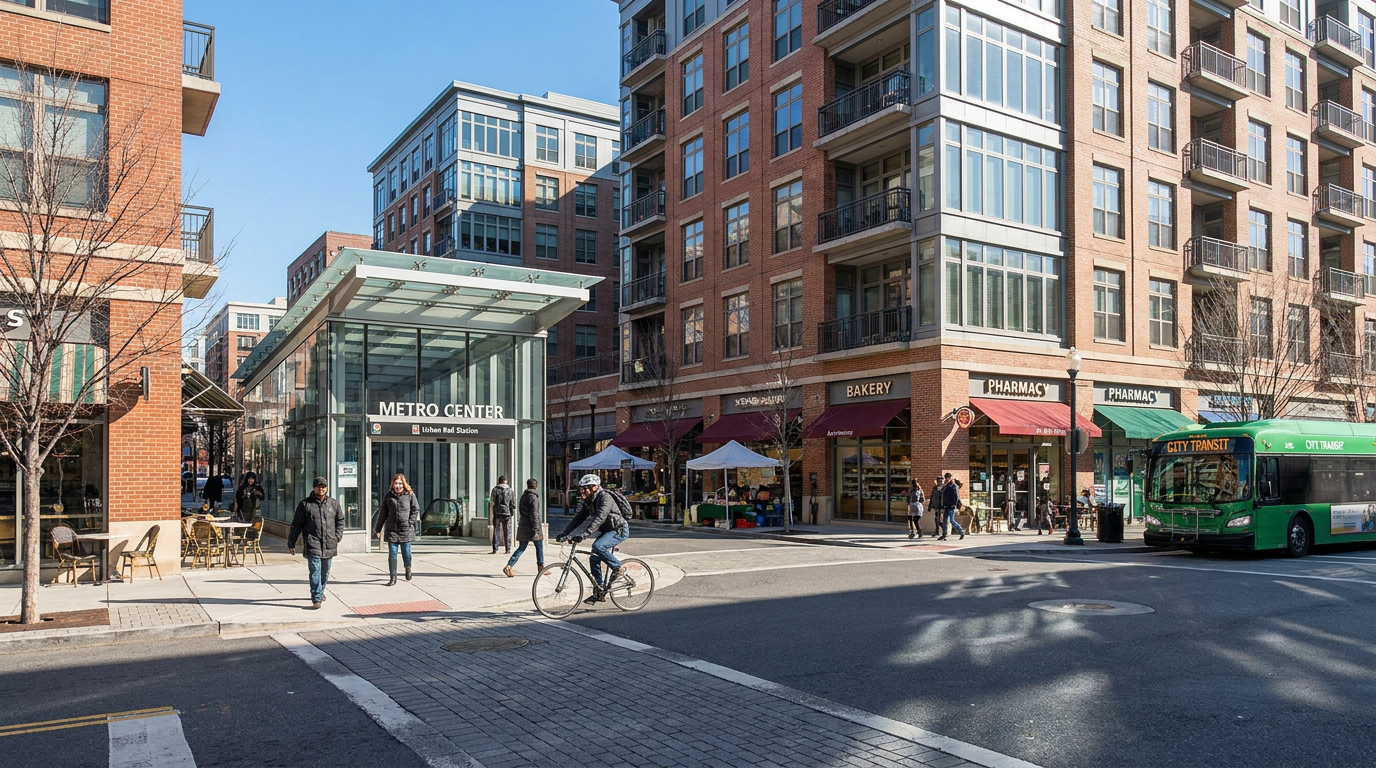
The strengths of TOD are strategic and cumulative. It can increase housing supply in high access locations, reduce household transportation costs, support transit ridership, lower per capita emissions, and improve the economics of infrastructure provision. When daily destinations are clustered around rapid transit and designed for walking and cycling, the city becomes more efficient at both the household and regional scale. Travel times become more predictable, land consumption slows, and more public investment can be concentrated where it produces the greatest accessibility gains.
Yet the transferability of TOD into North American conditions depends on several institutional realities. Successful TOD requires predictable transit investment, zoning that permits sufficient intensity around stations, strong public realm standards, and in many cases some capacity for land assembly or coordinated site planning. Without these ingredients, a station area can become a patchwork of isolated projects rather than a coherent district. In that scenario, density is added, but the essential benefits of mixed use, walkability, and seamless transit integration are not fully realized.
One of the most important policy tools associated with TOD is land value capture. Public infrastructure, especially rapid transit, often increases nearby land values. Land value capture mechanisms aim to recover a portion of that uplift to help finance the infrastructure itself or the services required to support growth. This may include special assessments, development charges linked to accessibility gains, joint development partnerships, or structured agreements on development rights. For Canadian metropolitan areas, this approach is highly relevant because it addresses a persistent challenge: public investment creates private land value, but municipal finance systems often capture only a fraction of that increase.
Still, TOD should not be romanticized. It can intensify affordability pressure if station areas become premium enclaves without adequate housing variety. It can also underperform if transit service is too infrequent, if surrounding land uses remain segregated, or if walking routes are weak. The lesson from international examples is not that TOD automatically works. It is that TOD works when transport, housing, urban design, and finance are treated as one development system rather than separate files managed in isolation.
What Canada Can Learn from TOD
For Canadian cities, the TOD lesson is not merely to build taller near stations. The deeper lesson is to structure growth around access. This means planning station areas as complete urban districts with housing diversity, community services, employment potential, and high quality public space. It also means ensuring that major transit investments are not followed by years of zoning uncertainty, fragmented approvals, and local resistance that suppresses supply precisely where demand and accessibility are highest.
Canada’s federal sustainable development strategy already links sustainable cities with public transit, active transportation, affordable housing, air quality, and net zero transition goals. TOD can help connect these objectives, but only if it is treated as a delivery framework rather than a slogan. The strategic opportunity is significant. Done well, TOD can become the meeting point of housing policy, infrastructure policy, and climate policy.
Model Two: The Compact City and the Logic of Densification
The compact city model is strongly associated with European planning traditions, where containment of sprawl, protection of agricultural land, support for walking and cycling, and efficient infrastructure use have long shaped urban policy. Compact city planning does not always mean very high rise development. More often, it means a deliberate commitment to denser settlement patterns, mixed land use, shorter travel distances, and a public realm designed around proximity rather than long commutes. The model is less about skyline height than about urban form and daily accessibility.
The policy rationale is compelling. If cities consume less land per resident, preserve more greenfield space, and support more trips by walking, cycling, and transit, they can reduce transport emissions and lower infrastructure costs over time. OECD work consistently links density, land use mix, street connectivity, and transport supply. These elements reinforce one another. A denser district without transit remains car dependent. A transit corridor without mixed use remains underutilized. A walkable neighborhood without enough housing supply can become exclusive and unaffordable. The compact city works only as a system.
For North American regions, this model is often implemented incrementally. Existing urban form, especially in postwar suburbs, cannot simply be erased and rebuilt. As a result, compact growth in Canada usually takes the form of corridor intensification, missing middle housing, infill projects, redevelopment of aging commercial sites, and brownfield conversion. This is not a weakness. In fact, incremental densification can be more fiscally practical and politically durable than dramatic redesign. The key is to ensure that incremental change accumulates into a coherent urban pattern rather than isolated projects.
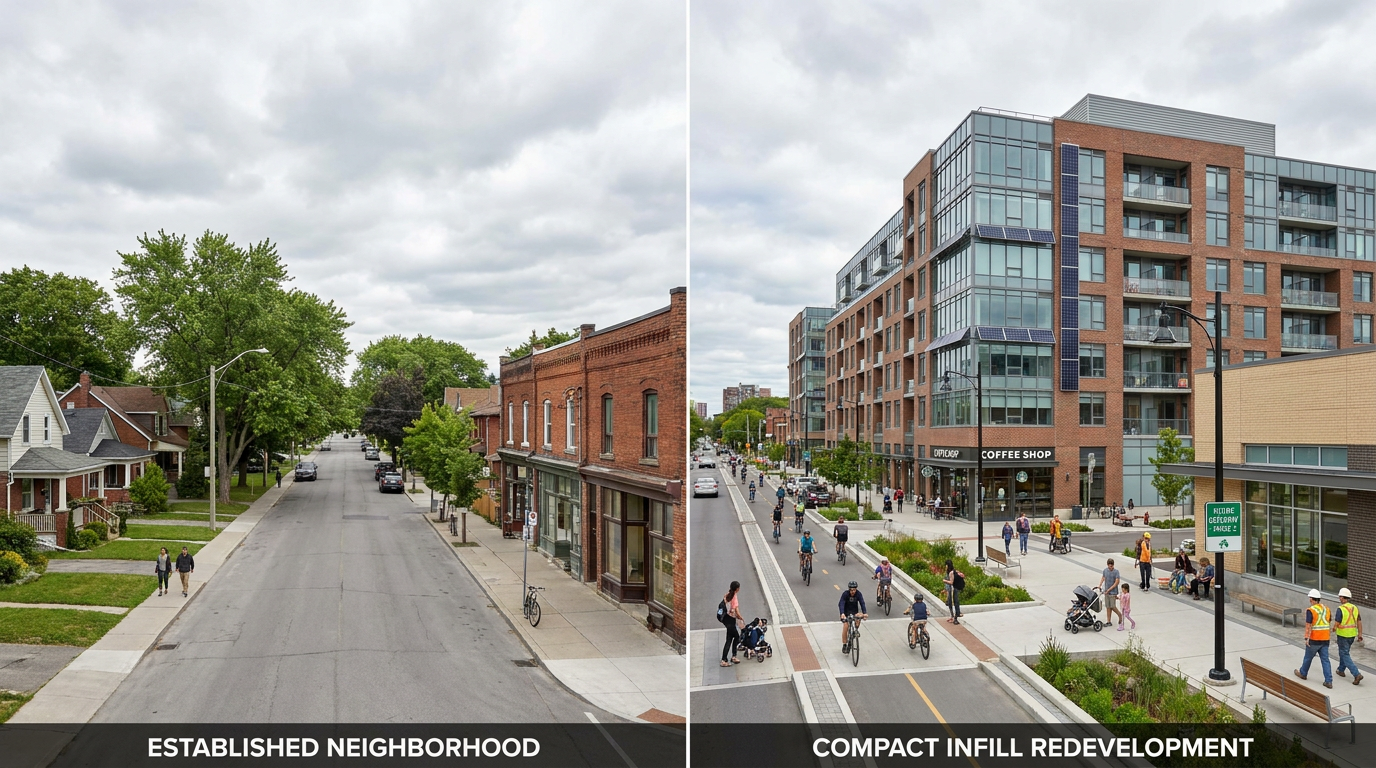
The compact city model also intersects directly with housing supply. In many high demand urban regions, scarcity is not simply a land problem. It is a permissions problem, a servicing problem, and a coordination problem. Compact growth strategies can increase supply in established areas, but only if regulations permit enough housing variety and enough project certainty to make development feasible. This includes townhouses, multiplexes, low rise apartments, mid rise corridor housing, and adaptive reuse of underutilized sites. If densification is limited to a narrow set of sites or subject to highly unpredictable approvals, then the compact city can become more rhetorical than real.
Critics sometimes argue that compact city planning raises costs by constraining outward expansion. That can happen if the model is applied without corresponding changes to housing approvals, infrastructure timing, and tenure diversity. However, the stronger interpretation is that compact growth changes where and how supply should occur, not whether supply should occur at all. In other words, a successful compact city is one that combines land restraint with robust urban capacity. It protects greenfield land while making room for substantial new housing and employment in serviced, connected locations.
Why Density Alone Is Not Enough
One of the most persistent misconceptions in urban policy is that higher density automatically produces sustainability. It does not. Density can reduce land consumption and support transit, but without affordability, public amenities, schools, parks, healthcare access, and quality design, it can generate resistance rather than resilience. Sustainable density must be livable density. That means family suitable housing, comfortable public spaces, urban tree canopy, and services that allow daily life to function close to home.
This is where the compact city model has evolved. Increasingly, it overlaps with ideas such as proximity planning and the 15 minute city. The principle is simple: people should be able to reach many of their daily needs within a short, safe, and comfortable trip. The strategic value of this approach is not branding. It is the recognition that accessibility, not just density, drives sustainable outcomes. A moderately dense district with excellent daily access can outperform a denser area that remains poorly connected or unaffordable.
Model Three: Polycentric Metropolitan Development
Polycentric development offers a different answer to the growth challenge. Rather than concentrating jobs, services, and cultural life overwhelmingly in a single downtown core, this model supports multiple urban centers across a metropolitan region. Each center becomes a node of housing, employment, education, retail, and public life, linked to other nodes through strong transport infrastructure. In large regions, this approach can improve regional resilience, distribute opportunity more evenly, and reduce pressure on a single core that can no longer absorb unlimited growth efficiently.
This model is especially relevant for metropolitan regions such as Toronto, Montréal, Vancouver, and Calgary, where the geography of growth already extends well beyond one historic downtown. It is also relevant to many fast growing regions in the United States, where decentralized employment patterns are already a fact, even if the land use framework is weak. The strategic question is whether decentralization can be shaped into polycentric urbanism or whether it will remain dispersed auto oriented sprawl. That distinction is crucial.
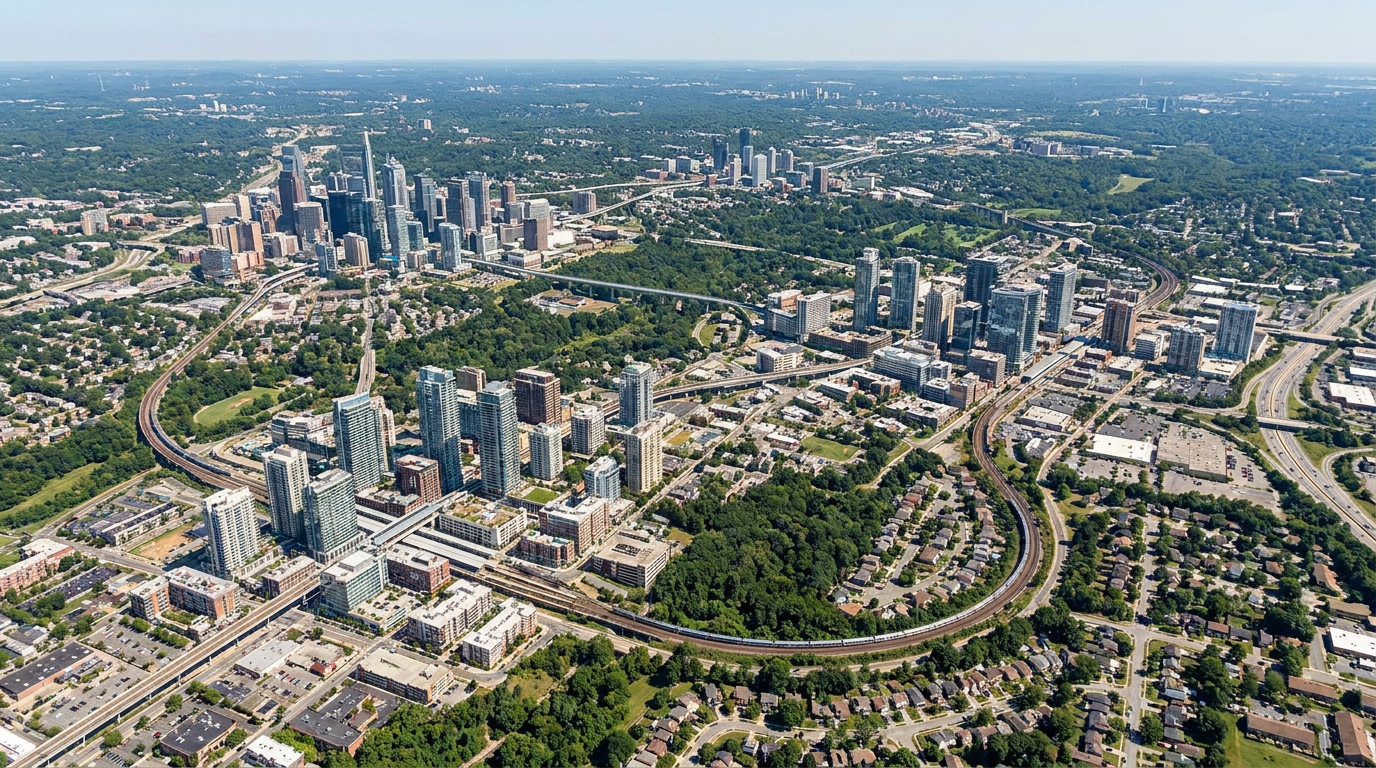
At its best, polycentric planning can shorten commutes, support local employment clusters, diversify housing options, and improve regional shock absorption. If one node weakens economically, the region does not depend entirely on a single core. If housing can be built near several high access centers, pressure may be distributed more effectively. This can also create a better alignment between labor markets and household location choices. Not every trip has to move toward one central destination if metropolitan structure itself is more balanced.
But polycentric growth is often misunderstood. Multiple centers do not automatically create sustainability. Without strong transit links, each node can simply become another isolated, car dependent district. Without coordinated land use rules, employment may disperse while housing remains restricted, or housing may expand without enough jobs and services. In that case, the region appears polycentric on paper but functions as fragmented sprawl. The difference lies in planning discipline and infrastructure coordination.
The Governance Demands of Polycentric Regions
Polycentric development is heavily dependent on metropolitan governance. Individual municipalities often compete for tax base, restrict housing, or pursue land use decisions that make sense locally but undermine regional efficiency. A true polycentric strategy requires shared objectives across municipal boundaries. Transit must connect centers reliably. Zoning must permit sufficient intensity around those centers. Infrastructure sequencing must support both employment and residential growth. Fiscal tools must discourage leapfrog development while supporting serviced, transit linked nodes.
This is why metropolitan governance has become such a prominent topic in global urban policy. Functional urban areas rarely match municipal borders. People live in one jurisdiction, work in another, and use infrastructure across the entire region. If governance remains fragmented, development models lose coherence. The region then pays more for roads, pipes, and transit while producing lower accessibility and weaker housing outcomes.
Financing Urban Growth: Why the Best Models Still Fail Without Fiscal Alignment
Urban development models are often discussed in spatial terms, but the financing dimension is equally decisive. A city can adopt excellent principles on paper and still fail in practice if infrastructure funding, municipal revenue tools, and land value recovery mechanisms are weak. Sustainable growth requires front end investment in transit, water, wastewater, streets, parks, schools, and climate adaptation measures. If these costs are not planned transparently, growth can either stall or shift toward locations where infrastructure appears cheaper in the short term but proves more expensive over the full life cycle.
Land value capture has become increasingly important because it addresses a long standing imbalance. Public action, such as a new transit line, rezoning decision, or major streetscape upgrade, often creates substantial private land value. Capturing a portion of that uplift is not anti development. It is a way of recycling growth benefits into the infrastructure and public realm that make growth workable. Internationally, this has been used to support station area investment, transit expansion, and local amenities. In Canada, the challenge is to build tools that are predictable enough for the market and robust enough for the public sector.
Another fiscal issue is the long term cost of low density expansion. Greenfield development can appear financially attractive because land is cheaper and approvals may be simpler. Yet the ongoing cost of maintaining dispersed roads, utilities, transit service, and emergency access is often far higher per resident. Sustainable urban growth models force a more honest accounting of infrastructure liabilities over time. They ask not only where development can occur, but where it can be serviced efficiently for decades.
Climate Resilience as a Core Design Requirement
No serious comparison of international development models can ignore climate resilience. The question is no longer whether cities should grow sustainably. It is whether they can remain functional and safe as temperatures rise and weather extremes intensify. Heat, flood risk, wildfire smoke, and infrastructure stress are redefining the performance standards for urban development. This pushes planning beyond conventional growth management into the realm of adaptation.
Nature based solutions and green infrastructure have become central to this shift. Urban tree canopy, permeable surfaces, stormwater landscapes, shaded public spaces, and cooler street design all affect how urban density performs under climate stress. A dense district without shade, ventilation, or green space can become increasingly difficult to inhabit during extreme heat. A low density area spread across flood prone land can impose major future liabilities. Resilient growth is therefore not separate from compact or transit oriented growth. It must be woven into them.
The most effective international models now treat resilience as a baseline requirement rather than a policy add on. Zoning, building codes, public realm standards, and infrastructure planning all play a role. This is one of the clearest lessons from recent global policy debates. Sustainable urban growth means growth that can withstand future conditions, not just growth that looks efficient under present assumptions.
How Canada and North America Can Adapt Global Models
The most useful lesson from international comparisons is that adaptation matters more than imitation. Canada cannot simply import European compact city policy, East Asian TOD delivery systems, or any single metropolitan governance model in a literal form. Provincial authority, municipal finance, land markets, baseline densities, and political culture differ substantially. Yet that does not reduce the relevance of international models. It sharpens it. The goal is to identify transferable mechanisms rather than symbolic features.
For Canada and much of North America, the strongest path forward is a hybrid strategy. TOD should organize major growth around rapid transit corridors and station areas. Compact infill should add substantial housing in established neighborhoods and redevelopment zones. Selective polycentric growth should strengthen regional centers beyond the main downtown, especially where transit can support jobs and housing at scale. Land value tools should help finance the infrastructure and public amenities that make these patterns viable. Most importantly, metropolitan governance should coordinate these elements so that local land use decisions serve regional outcomes.
This is also where common misconceptions need to be set aside. Sprawl is not only a U.S. issue. It is a planning and financing pattern that can emerge anywhere growth outpaces coordination. TOD is not just building beside a station. Density alone is not sustainability. Polycentric growth is not automatically anti sprawl. Each of these ideas becomes effective only when institutions, regulations, and public investment are aligned around measurable results.
A Practical Framework for Evaluating Development Models
For policymakers and planners, the most constructive way to assess international development models is through outcomes rather than ideology. A model should be judged by how well it performs against the actual pressures facing urban regions. Those pressures include housing supply, infrastructure cost, emissions, accessibility, climate resilience, and fiscal sustainability. If a model looks elegant in theory but cannot deliver approvals, funding, or public support, it will not scale.
A useful evaluation framework should ask several direct questions:
- Does the model reduce land consumption per resident while preserving room for growth?
- Does it improve access to jobs, schools, healthcare, and daily services?
- Does it support a meaningful increase in housing supply and housing diversity?
- Does it lower transport emissions and reduce auto dependence?
- Does it strengthen resilience to heat, flooding, and other climate risks?
- Does the governance structure support implementation across municipal boundaries?
- Does the financing model recover enough value to sustain infrastructure quality over time?
These criteria are deliberately practical. They move the conversation away from symbolic debates over height, density labels, or planning rhetoric. Cities need models that can survive real world constraints and still produce better outcomes. That is the standard sustainable urban growth demands.
The Strategic Direction Ahead
The global conversation on urban development has matured. The debate is no longer between growth and no growth, or between density and sprawl in their simplest forms. The real issue is whether city regions can build enough housing, enough transit access, enough resilience, and enough institutional coordination to absorb growth productively. International development models provide a valuable comparative lens because they reveal how those objectives can reinforce one another when treated as a single urban system.
For Canada, the path forward is clear in broad terms even if implementation will remain contested. Urban growth should be directed toward places where infrastructure, accessibility, and public investment can support it efficiently. Housing policy should be integrated with land use and transit planning rather than managed separately. Municipal and regional governance should be strengthened so that metropolitan outcomes are not undermined by fragmented local decisions. Public investment should be paired with value capture and long term cost discipline. Climate adaptation should shape development from the beginning, not after the fact.
None of this requires blind faith in one international model. In fact, the opposite is true. The most successful strategy is likely to be a composed one, drawing from the best global examples while respecting local conditions. That means TOD where transit capacity exists or is planned, compact infill where serviced land is already urbanized, polycentric planning where multiple regional nodes can be supported, and climate conscious infrastructure everywhere. The objective is not to mimic another country’s skyline or planning vocabulary. It is to build metropolitan systems that are more affordable, more connected, more resilient, and more fiscally sound.
Ultimately, sustainable urban growth is a governance challenge expressed through land. It depends on whether institutions can coordinate decisions about housing, transport, infrastructure, and public space with enough consistency to shape long term outcomes. The strongest international lesson is not about density alone or transit alone. It is about integration. Cities that align land use, infrastructure, finance, and resilience strategy are the ones most likely to grow without losing livability. That is the standard modern urban development should aim to meet.

No Comment! Be the first one.