



By 2026, the conversation about cities has become far more practical, urgent, and local. For years, urban development was often framed in broad terms such as growth, density, competitiveness, and sustainability. Those ideas still matter, but they no longer tell the full story. Today, the real test for cities is whether they can translate vision into delivery, particularly in housing, infrastructure, and climate readiness. That shift is changing how governments, planners, developers, and communities think about land use, investment, and long-term growth.
Table Of Content
- Why 2026 Marks a Strategic Shift in Urban Development
- Trend 1: Localization Is Replacing One-Size-Fits-All Growth Planning
- What Localization Means in Practice
- Trend 2: Housing Strategy Is Becoming More Community-Driven and Type-Specific
- Trend 3: Climate Resilience Is Moving Into the Core of Housing and Infrastructure Planning
- From Green Branding to System Resilience
- Trend 4: People-Centered Technology Is Replacing the Old Smart City Narrative
- Trend 5: Demographic Change Is Forcing More Adaptable Housing and Infrastructure Strategy
- How These Five Trends Are Converging
- What City Leaders, Developers, and Communities Should Watch Next
- Conclusion: The Future of Cities Will Be Built Locally
The numbers behind this moment are impossible to ignore. UN-Habitat’s World Cities Report 2026 states that up to 3.4 billion people globally lack access to secure, safe, and adequate housing, while more than 1 billion people live in informal settlements and slums. In Canada, the challenge looks different in form but not in seriousness. Canada Mortgage and Housing Corporation has said the country may need roughly 430,000 to 480,000 new homes per year by 2035 to address housing needs, and urban housing starts reached 241,171 units in 2025, up from 227,697 in 2024. The scale of need makes one point very clear: city development in 2026 is no longer about abstract future building. It is about execution at local scale.
This is why the most important emerging city trends are converging around a common principle. Cities are moving away from one-size-fits-all expansion and toward localization, meaning strategies that are grounded in specific places, infrastructure realities, demographics, and community priorities. A growing city, a shrinking city, a climate-vulnerable city, and a high-cost global metro may all face housing pressure, but their solutions will not look the same. The era ahead belongs to places that can align policy, land, infrastructure, and community trust.
Across North America and globally, five trends are increasingly shaping this new development logic. They are localization of housing and land-use strategy, community-driven and type-specific housing delivery, climate resilience, people-centered technology, and demographic change. These are not isolated themes. They are overlapping forces that are redefining how urban strategy works in practice. The cities that understand their relationship will be better positioned to deliver homes, maintain infrastructure, build public confidence, and remain economically resilient.
In this article, I look at the top 5 emerging city trends shaping global development in 2026 and explain why they matter for housing and infrastructure strategy. The larger takeaway is not just that cities are changing. It is that successful urban development is becoming more place-based, community-driven, and operationally disciplined. That is where the next generation of city building will be won.
Why 2026 Marks a Strategic Shift in Urban Development
There are certain years when existing pressures intensify enough to change the planning framework itself. 2026 is one of those years. Housing affordability has moved from a social issue to a defining economic constraint. Climate shocks are no longer intermittent concerns but recurring costs. Infrastructure systems built for a different era are under strain. Technology is maturing, but public tolerance for poorly governed digital systems is falling. At the same time, population patterns are becoming more uneven, with some regions softening while others continue to absorb strong demand.
What makes this period especially important is that institutions are beginning to respond in a more integrated way. Canadian federal housing and infrastructure materials in 2026 place stronger emphasis on community-driven housing, climate resilience standards, nature-based solutions, and low-carbon infrastructure. Internationally, the OECD and UN-Habitat continue to reinforce the idea that the city is where housing, equity, infrastructure, labor markets, and climate policy now intersect most directly. In other words, cities are no longer just the setting for these challenges. They are the delivery platform.
That matters for public and private decision-makers alike. For developers, land strategy now requires deeper understanding of approvals, servicing, local politics, and infrastructure timing. For municipalities, housing policy can no longer sit apart from transit planning, utility upgrades, or social infrastructure. For residents, development is becoming less about whether change is coming and more about what kind of change will be delivered, who it serves, and how it improves daily life.
The defining urban question of 2026 is not whether cities should grow. It is whether they can grow in a way that is affordable, resilient, locally credible, and operationally deliverable.
With that in mind, the top trends below should not be read as separate headlines. They form a single strategic framework. Each trend shapes the others, and together they are creating a more grounded model of global development.
Trend 1: Localization Is Replacing One-Size-Fits-All Growth Planning
The first and perhaps most important shift in 2026 is the move from broad growth targets to localized, place-based development. For a long time, city strategy relied heavily on macro ideas such as intensification, greenfield expansion, downtown revitalization, or regional growth corridors. Those tools remain relevant, but they are now being filtered through a more specific question: what can actually be delivered in this neighborhood, on this site, with this infrastructure capacity, under this governance structure?
This is a major evolution in urban planning because it recognizes that city challenges vary significantly by size, demographics, geography, and economic specialization. The OECD has consistently emphasized that urban conditions are not uniform, and the evidence increasingly supports that conclusion. In 2026, two cities may both need more housing, but one may require transit-oriented family rentals near employment clusters, while another may need aging-in-place housing, adaptive reuse, and utility upgrades before any large expansion can occur. The strategy has to fit the place.
Localization also changes the way land is understood. Under a place-based model, land is not simply a unit of potential density. It is part of a broader ecosystem that includes servicing, transportation access, community facilities, local employment, environmental conditions, and social acceptance. This is why local land activation is receiving more attention. In Canada, federal announcements tied to site activation and community partnerships, including projects such as Naawi-Oodena and Ottawa site activation, signal that housing strategy is becoming more directly linked to local delivery structures and partnerships.
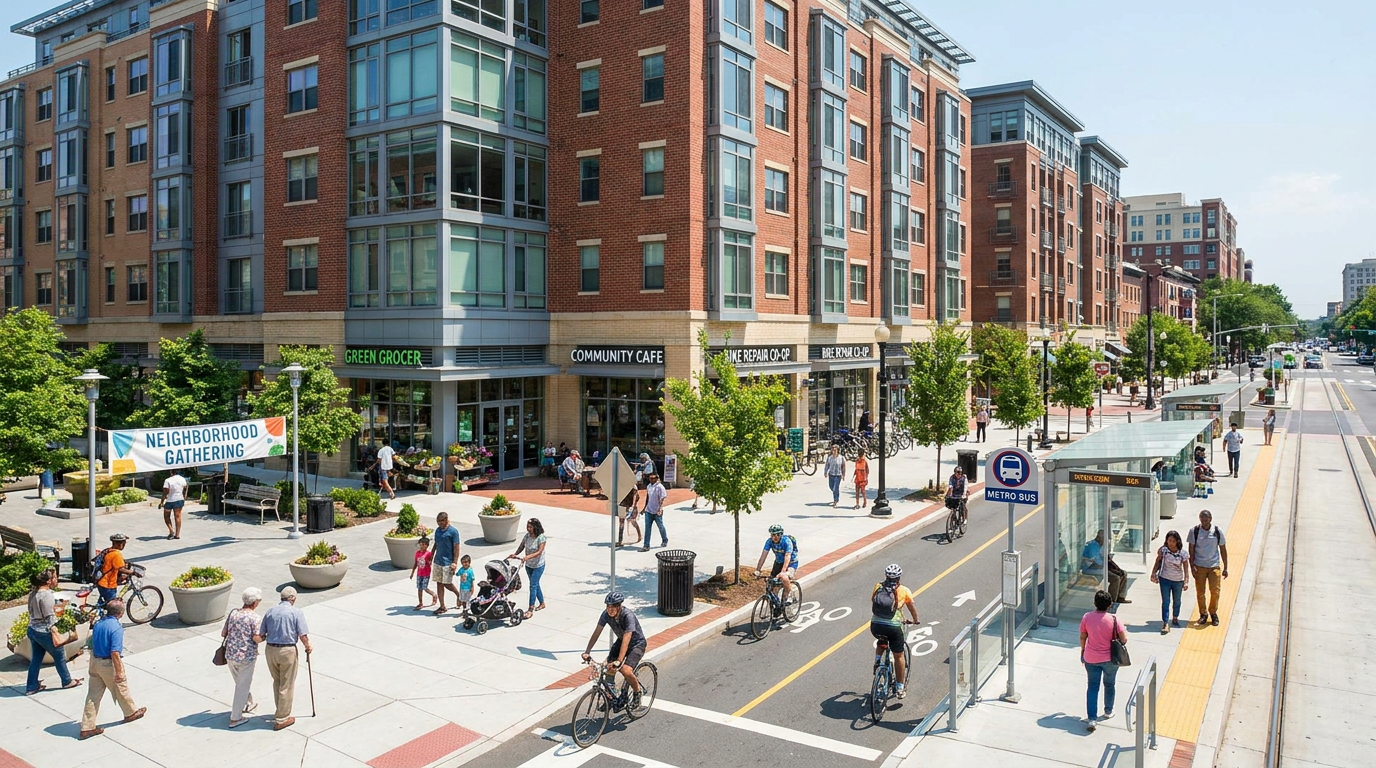
Another important aspect of localization is that it elevates community-driven and Indigenous-led development models. These approaches are not just symbolic improvements to consultation. They can materially improve project outcomes because they align development with local knowledge, cultural priorities, and long-term stewardship. In practical terms, that means more mixed-income neighborhoods, more neighborhood-scale redevelopment, and more partnerships that produce lasting local legitimacy.
For housing and infrastructure strategy, this trend has several implications. It favors sites with clear servicing pathways, strong municipal alignment, and access to daily amenities. It also places more value on infill, adaptive reuse, and transit-connected growth than on remote expansion without supporting infrastructure. Most of all, it rewards execution. In 2026, the best development strategies are not the most ambitious on paper. They are the ones that can move from policy intent to delivered homes and functioning public systems.
What Localization Means in Practice
Place-based planning can sound abstract, but in practice it is highly operational. It changes how projects are sequenced, who is involved, and what success looks like. Instead of treating neighborhoods as passive recipients of top-down growth, cities are increasingly approaching them as active development environments with specific strengths and constraints.
- Housing plans are being tied more closely to neighborhood infrastructure capacity.
- Mixed-income and transit-oriented projects are receiving stronger policy support.
- Municipal and Indigenous partnerships are becoming more central to land activation.
- Community-led housing models are gaining attention as realistic delivery tools.
- Approvals strategy is increasingly shaped by local context rather than generic density targets.
This trend is strategic because it improves the fit between urban policy and local reality. Over time, that can reduce conflict, improve delivery speed, and produce more durable communities.
Trend 2: Housing Strategy Is Becoming More Community-Driven and Type-Specific
If there is one issue defining urban development in 2026, it is housing. Yet the housing conversation itself is changing. For years, the debate was framed around supply versus regulation, density versus neighborhood resistance, and ownership versus rental. Those distinctions still matter, but they are too narrow for the present moment. The central housing challenge now is not just how many units can be built. It is whether cities can deliver the right mix of housing types in the right locations with the right supporting infrastructure.
That shift matters because housing pressure is no longer uniform. In Canada, 2026 housing outlooks show that rental markets are easing in some large cities as population growth slows and new supply comes online, especially in parts of Toronto and Vancouver. But easing conditions in select markets do not mean the affordability crisis is over. Instead, they reveal a more nuanced reality in which regional divergence is increasing. Some cities face softening rents, others remain undersupplied, and many still lack family-sized units, accessible housing, and forms of housing that match local incomes.
This is why community-driven housing and incremental development are gaining policy attention. These models recognize that local housing delivery often depends on smaller-scale, flexible, and partnership-based approaches. A city may need purpose-built rental near transit, missing-middle forms in established neighborhoods, supportive housing near services, and adaptive reuse in older commercial areas. No single product solves all these needs. What works is a portfolio approach grounded in local demand patterns and delivery capacity.
The misconception that housing shortages are solved by supply alone is becoming harder to defend. Supply matters enormously, but so do unit type, approval timelines, land assembly conditions, infrastructure constraints, construction costs, and affordability mechanisms. A city can add units and still fail households if those units are misaligned with income levels or daily needs. In 2026, better housing policy is becoming more surgical.
This trend also reinforces the value of mixed-income and transit-oriented development. Housing near jobs, schools, healthcare, and transit can improve affordability in practical terms by reducing transportation burden and supporting household resilience. It also tends to make better use of public infrastructure investments. In the long run, that integration matters more than headline unit counts alone because it shapes whether growth produces stable communities or simply shifts pressure from one system to another.
For developers and policymakers, the lesson is straightforward. Market analysis must go deeper than absorption forecasts. It must ask who the future residents are, how households are changing, what services they need, and what local barriers stand between approved units and occupied homes. The quality of urban growth increasingly depends on these details.
Trend 3: Climate Resilience Is Moving Into the Core of Housing and Infrastructure Planning
The third major trend shaping cities in 2026 is the elevation of climate resilience from a specialized policy area to a central urban development function. This is one of the most important planning shifts underway. For many years, climate policy in cities focused heavily on mitigation, especially building efficiency, emissions reduction, and transit mode shift. Those priorities remain essential, but adaptation has become equally urgent. Cities are now confronting the immediate costs of flood risk, extreme heat, infrastructure failures, wildfire smoke, and utility stress.
UN-Habitat has warned that over 2 billion city dwellers could face an additional temperature increase of at least 0.5 degrees Celsius by 2040. That projection underscores a critical truth. Climate resilience is not separate from housing policy. It is now embedded in it. Where homes are built, how streets manage water, whether transit remains reliable during heat events, and how neighborhoods access shade and cooling are all part of the same urban system.
In Canada, 2026 housing and infrastructure materials emphasize climate resilience standards, low-carbon resilience, and nature-based solutions. This is a meaningful policy shift because it moves resilience from aspiration into standards and delivery frameworks. For urban strategy, that means new attention to flood protection, stormwater systems, heat mitigation, district energy, utility hardening, and the use of blue-green infrastructure as everyday development components rather than optional enhancements.
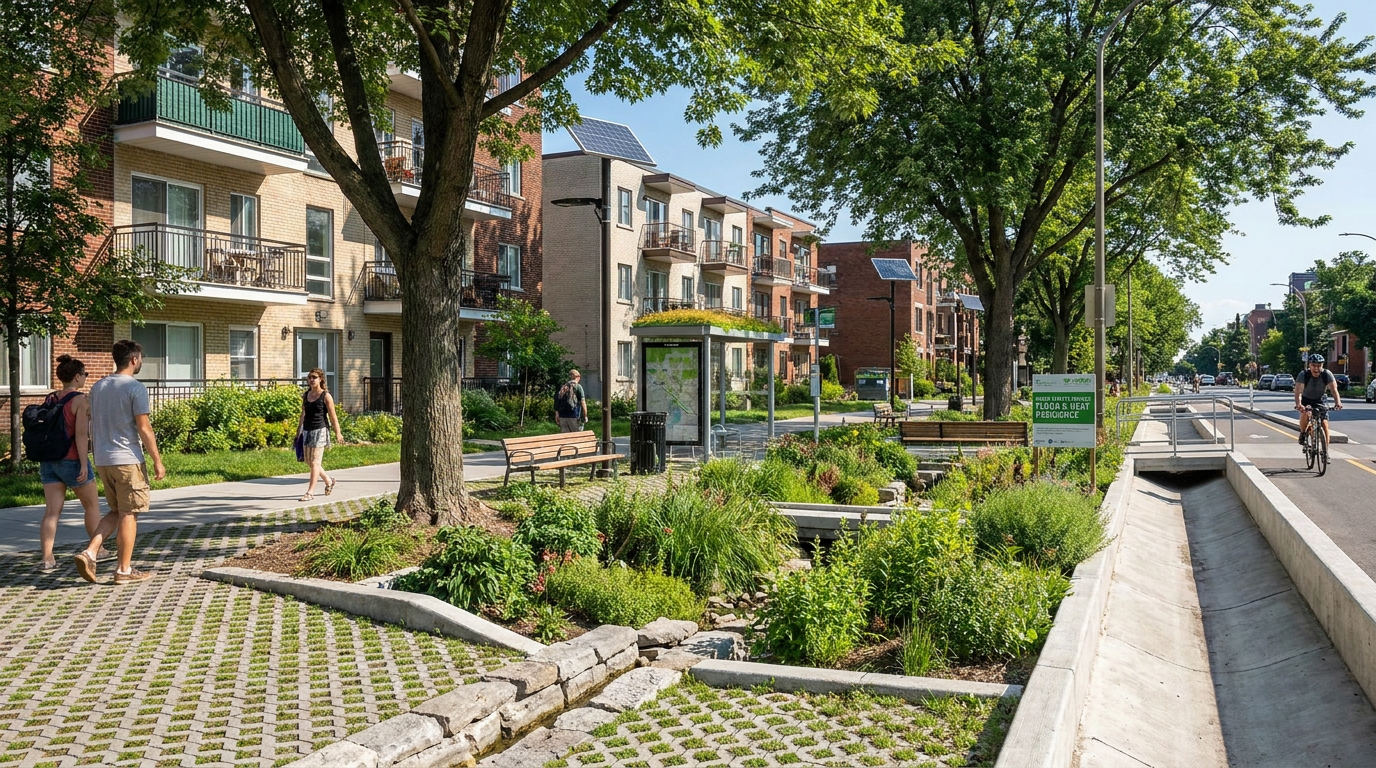
This trend also changes how resilience is measured. A sustainable city is not simply one with efficient buildings. It is one that can keep essential systems functioning under stress while protecting vulnerable populations. That includes reliable transit, protected utilities, safe public space, and housing that is not repeatedly exposed to unmitigated environmental risk. Resilience therefore becomes an issue of equity as much as engineering.
Community-led upgrading is also becoming more prominent in global development discussions. In many parts of the world, the resilience challenge is not just about future building standards but about improving existing neighborhoods where risks are already concentrated. This reflects a broader justice-based adaptation framework that prioritizes the people most exposed to climate impacts. For cities, that means resilience investments need to be targeted, not generic.
For practitioners, the strategic implication is significant. The value of land and infrastructure is increasingly connected to climate performance. Sites with manageable environmental risk, strong servicing, and room for nature-based design may command greater long-term strategic importance. Conversely, projects that ignore heat, water, and utility exposure may face rising insurance, maintenance, and operational costs. In 2026, climate resilience is becoming part of development feasibility itself.
From Green Branding to System Resilience
One of the biggest misconceptions in urban sustainability is that it starts and ends with green buildings. Building performance matters, but cities operate as interconnected systems. A highly efficient tower in a flood-vulnerable district with weak transit redundancy and overheated public space is not a fully resilient urban outcome.
- Land use decisions now need to consider long-term climate exposure.
- Housing delivery must account for cooling, drainage, and utility reliability.
- Public infrastructure has to be upgraded for more volatile environmental conditions.
- Nature-based solutions are becoming practical tools for risk reduction.
- Equity matters because lower-income communities often face the greatest climate burden.
This is why resilience is now central to city building. It affects where investment should go, how infrastructure should be designed, and how communities can remain functional during disruption.
Trend 4: People-Centered Technology Is Replacing the Old Smart City Narrative
The fourth trend shaping global development in 2026 is the evolution of urban technology. A decade ago, the term smart city often implied a technology-first future driven by sensors, platforms, automation, and data dashboards. In many places, that language created excitement, but it also generated skepticism. Residents began to question privacy, surveillance, accountability, and whether technology was actually improving life on the ground. In response, the urban tech agenda is becoming more mature.
UN-Habitat’s World Smart Cities Outlook 2024 reflects this shift by emphasizing inclusion, oversight, human rights, and reducing the digital divide. That framing is important because it changes the purpose of city technology. The goal is no longer to make cities seem futuristic. The goal is to make governance and services more effective, equitable, and accessible. This is a more grounded direction, and it aligns well with the broader move toward localized urban strategy.
In practical terms, people-centered technology can improve development outcomes in several ways. It can streamline permitting and approvals, helping reduce delays that undermine housing delivery. It can support infrastructure monitoring, making it easier to identify service vulnerabilities before they become expensive failures. It can improve public engagement by giving residents better access to planning information and consultation tools. It can also support mobility through more responsive transit systems and integrated service platforms.
What distinguishes this trend from the old smart city model is governance. Technology is being judged less by novelty and more by trustworthiness. Does it protect privacy? Does it work for residents with different levels of digital access? Does it improve accountability rather than obscure it? Does it help communities understand and influence development decisions? In 2026, these questions are central.
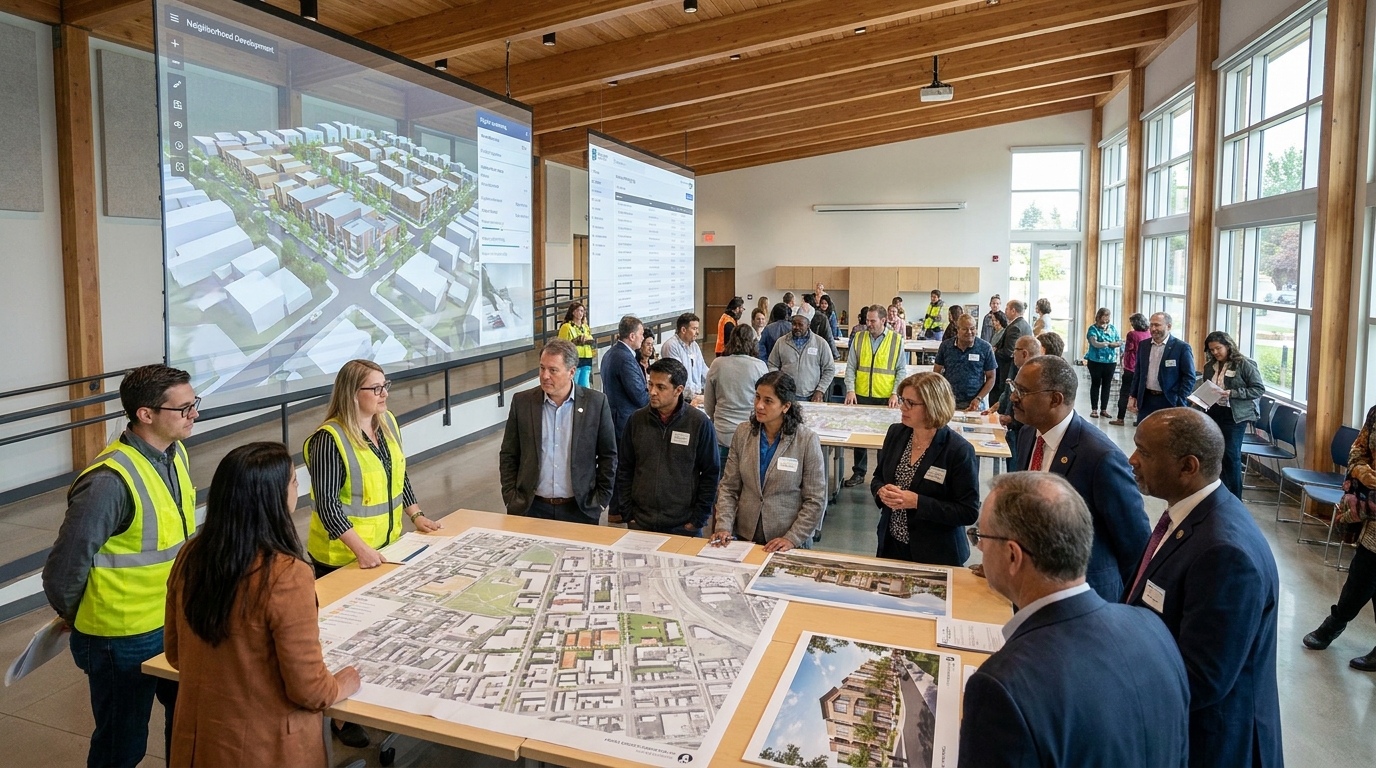
This trend is especially relevant to housing and infrastructure because so much urban friction occurs in the space between policy and delivery. Permitting backlogs, fragmented infrastructure data, poor interdepartmental coordination, and weak communication with residents all slow progress. If technology can improve those systems without undermining rights and inclusion, it becomes a practical development tool rather than a branding exercise.
There is also a strategic localization angle here. Digital platforms can help cities tailor services and planning responses to neighborhood conditions, but only if they are designed for accessibility and participation. A city that invests in digital permitting but ignores community engagement may improve speed while worsening trust. A city that builds elaborate data systems but leaves vulnerable residents offline may deepen inequality. The best urban technology in 2026 is not the most complex. It is the most useful and broadly accessible.
For city leaders, this requires discipline. Technology should be evaluated the same way any infrastructure investment is evaluated, through outcomes, governance, reliability, and public value. The future of urban tech will belong to cities that use it to support human-centered development rather than institutional spectacle.
Trend 5: Demographic Change Is Forcing More Adaptable Housing and Infrastructure Strategy
The fifth major trend shaping cities in 2026 is demographic change. This may sound familiar, but the current moment is different because demographic shifts are no longer moving in a single direction. In many cities, growth remains strong over the long term, driven by household formation, migration, and ongoing urban concentration. Yet in the shorter term, some major markets are seeing slower population growth, easing rental conditions, or changes in demand composition. This creates a more fragmented planning environment.
Canada offers a useful example. Recent housing outlooks and population data suggest that rental pressure is easing in some of the largest urban markets as new supply enters the system and population growth moderates. But this easing is highly uneven, and it does not erase broader affordability strain. More importantly, demographic change is not just about the number of people arriving. It is about the kinds of households they form and the kinds of housing and infrastructure they need.
Aging populations require accessible design, proximity to healthcare, and housing forms that support aging in place. Younger households and newcomers may need rental flexibility, smaller units, or transit-connected affordability. Families need larger homes near schools, parks, and services. Regions with changing labor markets may need to align housing with new employment nodes rather than old commuting patterns. This makes the relationship between housing type and local demand more important than ever.
That is why adaptable housing is becoming a stronger planning priority. The emerging model is not simply dense or low density, rental or ownership, urban or suburban. It is adaptable, mixed, and responsive. Cities are increasingly looking for housing systems that can evolve with demographic patterns rather than locking neighborhoods into a single form. This supports the rise of mixed-income neighborhoods, transit-oriented infill, and missing-middle typologies that add flexibility to the urban fabric.
Demographic divergence also reinforces the need for regional strategy. A single national or continental development model does not fit all cities, and that misconception is becoming more visible in 2026. Some regions need rapid rental expansion. Others need selective intensification around existing infrastructure. Others need adaptive reuse or targeted affordability measures. Smart urban strategy begins by understanding these differences rather than smoothing them over.
For long-term planners and investors, this trend points to a key principle. Resilient cities are built on optionality. They preserve the capacity to respond to shifting household structures, economic cycles, and migration flows. That requires more flexible zoning, better infrastructure coordination, and a stronger connection between demographic analysis and land use planning. In a volatile era, adaptability becomes a core form of urban strength.
How These Five Trends Are Converging
Each of these trends is powerful on its own, but their real significance lies in how they combine. Localization changes the scale at which planning decisions are made. Community-driven housing changes the way supply is delivered. Climate resilience changes the performance standards expected of neighborhoods and infrastructure. People-centered technology changes how decisions are managed and communicated. Demographic change changes what kinds of homes and services are actually needed. Together, they form a new urban operating model.
This convergence is also changing the relationship between public and private actors. Governments are under pressure to create clearer approvals pathways, invest in enabling infrastructure, and support local partnerships. Developers are expected to understand policy, climate risk, community context, and housing need more deeply than before. Community organizations and Indigenous partners are increasingly important not just as stakeholders but as delivery participants. This is a more complex system, but it is also a more realistic one.
Importantly, these trends push cities beyond symbolic planning. They encourage action that is measurable and local. Can a site be serviced? Can approvals be coordinated faster? Can housing near transit reduce cost burdens? Can flood and heat risks be managed through design? Can technology improve access without compromising rights? These are execution questions, and execution is where 2026 differs from previous cycles of urban optimism.
From a strategic perspective, this convergence also suggests that the most competitive cities of the next decade may not be the ones with the boldest branding. They may be the ones that can consistently align housing, infrastructure, and governance at neighborhood scale. In a world of fiscal pressure, climate uncertainty, and uneven demographic change, that capability will matter more than abstract claims of innovation.
What City Leaders, Developers, and Communities Should Watch Next
Looking ahead, there are several signals worth watching as these trends continue to shape urban development. The first is whether cities can move from policy ambition to implementation speed. Housing need is immediate, and infrastructure renewal cannot wait for perfect conditions. Places that build stronger delivery systems, especially around approvals, land activation, and infrastructure sequencing, will create a major advantage for themselves.
The second is whether resilience investment becomes mainstream budgeting rather than project-by-project experimentation. Climate adaptation will be more effective when it is embedded in routine capital planning, street design, utility upgrades, and housing policy. The same is true for digital governance. The question is not whether cities will use technology, but whether they will use it in a way that deepens trust and broadens access.
The third is whether housing strategy becomes more sophisticated in matching supply to actual demand. A city that adds units but neglects families, seniors, accessibility, or transit connectivity may still reproduce instability. Better outcomes depend on pairing quantity with fit. This is especially important as demographic patterns become more varied across regions.
Finally, city leaders should watch the growing importance of local legitimacy. In 2026, development that is seen as imposed, disconnected, or operationally weak faces a harder path. By contrast, projects rooted in partnership, local infrastructure readiness, and visible public benefit are more likely to endure. This is not just a political point. It is a strategic one. Trust is becoming an increasingly valuable form of development capacity.
Conclusion: The Future of Cities Will Be Built Locally
The top 5 emerging city trends shaping global development in 2026 all point toward the same conclusion. The future of urban growth will be determined less by grand theory and more by local execution. Housing affordability pressure, climate resilience, infrastructure renewal, people-centered technology, and demographic change are forcing cities to become more precise, more adaptive, and more community-driven in how they plan and build.
This is a welcome shift. It replaces simplistic narratives with a more serious understanding of how cities actually work. Housing does not exist apart from transit, utilities, public space, or local governance. Climate adaptation does not sit outside infrastructure planning. Technology does not justify itself through innovation alone. And growth cannot be managed effectively through a single template applied across very different places.
The strongest urban strategies in 2026 are the ones that recognize this complexity without becoming paralyzed by it. They focus on delivery, local partnerships, resilient systems, and the practical needs of households. They understand that the city is not just a market or a map. It is a living system where land decisions affect people, opportunity, infrastructure, and long-term social stability.
That is why localization matters so much now. The next era of city building will not be won by the places that simply promise more growth. It will be won by the places that can deliver better growth, in the right locations, with the right housing, supported by the right infrastructure, and guided by communities that can see themselves in the future being built around them.


No Comment! Be the first one.