



Large-scale housing projects are never defined by construction alone. They are shaped by land strategy, municipal approvals, infrastructure timing, financing discipline, labour availability, procurement execution, and the long-term resilience of the community being built. In Canada and across North America, the pressure to deliver more housing has intensified, but the path from concept to occupancy remains long, capital-intensive, and exposed to multiple points of failure. That is why risk mitigation in housing development is not a secondary exercise. It is a core project strategy.
Table Of Content
- Why risk mitigation must start before the site is active
- The core risk categories in large-scale housing development
- Strategy 1: Build an integrated approvals, servicing, and financing schedule
- What an integrated schedule should include
- Strategy 2: De-risk land assembly and entitlement before maximizing density
- Strategy 3: Use phased master planning to control complexity
- Strategy 4: Strengthen construction delivery through standardization and procurement discipline
- Construction mitigation practices that consistently improve outcomes
- Strategy 5: Treat financing risk as an operating condition, not a one-time event
- Strategy 6: Embed climate resilience into feasibility, design, and long-term operations
- Strategy 7: Build governance that can make decisions under uncertainty
- Case study pattern 1: The project that de-risked early and moved steadily
- Case study pattern 2: The project that lost control of late-stage risk
- How public programs and partnerships can reduce project risk
- A practical risk mitigation framework for project leaders
- The long view: risk mitigation as city-building discipline
The most effective risk mitigation strategies for large-scale housing projects share a common structure: they treat land assembly, municipal approvals, infrastructure servicing, financing, construction procurement, climate resilience, and governance as one interdependent system rather than separate workstreams. In practice, that means building an integrated approvals-servicing-financing schedule before committing major capital, de-risking land assembly and entitlement before maximizing density, using phased master planning to match project pace to real market and labour capacity, standardizing construction and procurement to reduce execution risk, treating financing risk as an ongoing condition rather than a one-time closing event, embedding climate resilience into feasibility and design from the outset, and building governance structures that can make fast, accountable decisions under uncertainty. Applied together, these strategies reduce the compounding effect where one unresolved risk in a housing project delays or derails several others.
For project leaders, the practical challenge is that risks rarely arrive one at a time. A delay in rezoning can affect financing. A servicing issue can trigger redesign. Labour shortages can push schedule compression and increase costs. Climate exposure can alter insurance assumptions and long-term operating performance. When these issues are managed in silos, large housing projects become vulnerable to compounding setbacks that erode feasibility and, in some cases, stop delivery altogether.
Current housing data reinforces the urgency. CMHC reported that actual housing starts in centres with populations of 10,000 or more reached 15,886 units in February 2026, up 10 percent year over year, while the national standalone seasonally adjusted annualized rate was 238,049 units for that month. CMHC also stated that housing starts reached about 259,000 units in 2025, up 6 percent year over year. Those numbers show momentum, but they also highlight the scale of the gap. Demand is persistent, timelines are lengthy, and the delivery system remains constrained by approvals, infrastructure, trades capacity, and execution complexity.
The deeper strategic point is that housing supply is not a short-cycle system. CMHC has said that from project design to full housing market impact can take 25 to 30 years. That single fact changes how responsible developers, landowners, lenders, municipalities, and delivery partners should think about risk. If the life cycle of impact spans decades, then mitigation has to begin early, be structured, and continue well beyond groundbreaking.

This article focuses on practical risk mitigation strategies for large-scale housing projects, with an emphasis on what project leaders can do before problems become expensive. It also draws on the broader lessons emerging from Canadian housing policy and delivery trends, including integrated approval planning, infrastructure coordination, phased master planning, modular construction, public-private alignment, and climate resilience. The goal is not simply to avoid failure. The goal is to build a more durable path to project success.
Why risk mitigation must start before the site is active
One of the most common misconceptions in housing development is that risk mitigation is mostly about construction safety and on-site execution. Those issues matter, but in large-scale housing projects the most consequential risks often emerge well before excavation begins. Entitlement uncertainty, land assembly gaps, infrastructure servicing assumptions, and financing exposure can all undermine a project while it is still on paper. By the time these issues show up in the schedule, they have usually become more expensive to solve.
Federal housing agencies and policy documents consistently identify approvals, zoning, subdivision, and municipal permitting as major bottlenecks. These are not minor administrative frictions. They directly affect carrying costs, pricing assumptions, lender confidence, and the timing of revenue. A project that spends another year in approvals can absorb higher interest costs, face revised construction pricing, lose a contractor window, and be forced into a redesigned product mix. In volatile markets, even a short delay can shift a feasible project into a marginal one.
That reality is why sophisticated risk management starts with a broad project map rather than a narrow construction checklist. Leaders need visibility on every critical dependency, from land control and entitlement sequencing to utility commitments and capital structure. The best teams do not treat planning, servicing, financing, and procurement as separate streams to be coordinated later. They treat them as one interdependent system.
Strategic principle: In large-scale housing, the earlier a risk is identified, the more options exist to solve it at a lower cost and with less disruption to feasibility.
The core risk categories in large-scale housing development
Before selecting mitigation tactics, it helps to define the main risk categories that shape major housing projects. Although every site is different, most projects face a combination of the following pressures.
- Land and entitlement risk, including title issues, assembly complexity, zoning uncertainty, political sensitivity, and incomplete approval pathways.
- Infrastructure and servicing risk, including water, wastewater, stormwater, roads, power, transit access, and off-site upgrades that may depend on public agencies.
- Financing and market risk, including interest-rate volatility, refinancing exposure, absorption risk, product-market fit, and shifts in lender appetite.
- Construction execution risk, including labour shortages, design coordination problems, contractor capacity, material-price volatility, and schedule slippage.
- Climate and resilience risk, including flood exposure, wildfire interface, drainage performance, extreme heat, utility disruptions, and future insurance costs.
- Governance and stakeholder risk, including weak decision-making structures, partner misalignment, community opposition, and poor change control.
- Operational and long-term performance risk, including maintenance burden, energy performance, asset durability, and resident experience after occupancy.
These categories overlap. A project with weak servicing certainty may struggle to secure financing on acceptable terms. A project exposed to climate hazards may face higher insurance costs or stricter lender review. A project with late-stage design changes can trigger procurement problems and labour disruption. The practical lesson is that risk should be understood as a system, not a list.
Strategy 1: Build an integrated approvals, servicing, and financing schedule
If there is one strategy that consistently improves risk management in large-scale housing, it is the integration of approvals, servicing, and financing into one coordinated schedule. Too many projects still advance these items in parallel without fully accounting for their dependencies. This creates blind spots that show up late and often under deadline pressure.
A better model is to create a complete entitlement and infrastructure map before major capital is committed. That map should identify every municipal and agency approval required, the sequence in which those approvals must occur, the studies and drawings needed to support them, and the expected review periods. It should also clarify which utility and transportation commitments are needed to unlock each project phase and what assumptions lenders are making about those milestones.
For project leaders, this means asking hard questions early. Is the zoning path straightforward or discretionary. Are subdivision approvals required. Are there utility capacity constraints that could affect density or timing. Does off-site infrastructure depend on municipal budgets or regional agency work programs. Are there transit commitments or road improvements assumed in the pro forma but not yet secured. If those answers are vague at acquisition, then the project is carrying hidden exposure.
The federal policy environment supports this integrated approach. Programs aimed at accelerating housing supply and reducing approval friction reflect the same basic lesson: delays in regulation, permitting, and servicing are delivery risks, not just process inconveniences. In practice, project teams can reduce this risk by establishing decision gates before land acquisition, before full design advancement, and before major procurement commitments. At each gate, the team should confirm that the entitlement path, servicing assumptions, and financing structure remain aligned.
What an integrated schedule should include
An effective integrated schedule is both strategic and detailed. It should include not only the approval milestones everyone expects, but also the external decisions that frequently derail progress when they are omitted. That includes utility design reviews, school board coordination where relevant, environmental permits, transportation studies, and agency comments that can affect site layout or phasing.
- Approval pathway by phase, with critical dependencies clearly marked
- Municipal and agency submission calendar tied to consultant deliverables
- Servicing and off-site infrastructure milestones
- Financing milestones linked to entitlement certainty and construction start assumptions
- Decision gates for land release, design advancement, and tender strategy
- Escalation triggers if review periods exceed planned durations
When this schedule becomes the backbone of the project, teams are less likely to make premature commitments based on optimistic assumptions. It creates discipline, strengthens lender conversations, and allows leadership to identify risk concentrations before they become schedule failures.
Strategy 2: De-risk land assembly and entitlement before maximizing density
Ambition can create value, but it can also introduce fragility. In large housing projects, there is often a temptation to pursue maximum density immediately, even when the land assembly is incomplete or the entitlement path is politically or technically uncertain. That approach may create an attractive top-line vision, but it can also magnify timing risk and weaken execution confidence.
Experienced developers often take a more disciplined route. They separate the ideal end-state plan from the practical first approvals strategy. That means securing clean land control, confirming title and access conditions, resolving easements and encumbrances, and building a realistic entitlement case before finalizing the highest-yield concept. In some situations, a phased density strategy can outperform a fully loaded plan because it gets a portion of the project moving while preserving optionality for later intensification.
Land assembly risk is especially important in urban infill and transit-oriented development. Small gaps in ownership, relocation requirements, or unresolved access arrangements can delay an otherwise sound project. The key mitigation is to define what must be controlled now, what can be deferred, and what rights must be contractually protected in advance. The project should never rely on informal assumptions where a legal right is required.
Value creation in housing development is not just about achieving the highest unit count on paper. It is about converting land into deliverable, financeable, serviceable, and durable housing. A slightly more modest first phase with stronger entitlement certainty often creates more real value than an aggressive concept that cannot move through approvals on schedule.
Strategy 3: Use phased master planning to control complexity
Phased development is one of the most effective risk mitigation tools available in large-scale housing. It reduces capital concentration, aligns infrastructure spending with absorption, and allows teams to learn from each delivery stage before scaling the next one. In periods of market volatility, phasing also preserves flexibility. Product mix, tenure, building typology, and amenity timing can all be adjusted in response to changing conditions.
That does not mean phasing should be improvised. Strong phased master planning begins with a clear long-term framework for roads, utilities, parks, drainage, transit integration, and future blocks. The first phase should be designed to stand on its own operationally while supporting, rather than constraining, future growth. Too often, early phases are optimized for short-term speed but later create expensive retrofits because the original servicing, circulation, or public realm strategy was too narrow.
Phasing is particularly useful where labour capacity is constrained. CMHC reporting has emphasized labour shortages and competition for specialized trades as ongoing delivery risks. If a project attempts to launch too much volume at once, it can overwhelm local trade availability and expose itself to schedule slips and premium pricing. A phased strategy allows the team to match project pace to real market and construction capacity.
There is also a financing advantage. Investors and lenders generally prefer a project with visible de-risking milestones. When each phase has defined approvals, service readiness, procurement strategy, and market objectives, capital can be structured more rationally. This can improve confidence and reduce the chance that one unresolved issue jeopardizes the entire master plan.
Strategy 4: Strengthen construction delivery through standardization and procurement discipline
Construction risk in large-scale housing is no longer just a field management issue. It is a productivity issue, a labour issue, and a supply-chain issue. Canada had roughly 650,000 construction workers building homes in 2023, yet CMHC estimated housing production of 240,267 units was below the potential capacity of more than 400,000 homes per year. That gap points to a system under strain, where output is limited not only by demand but by execution capacity and coordination.
One practical response is to reduce unnecessary complexity in the design and procurement model. Standardized unit layouts, repeatable structural grids, rationalized building systems, and coordinated specifications can all lower construction risk. Standardization is not about eliminating quality or place-making. It is about using repetition intelligently so that projects can be priced more reliably, built more predictably, and staffed more efficiently.
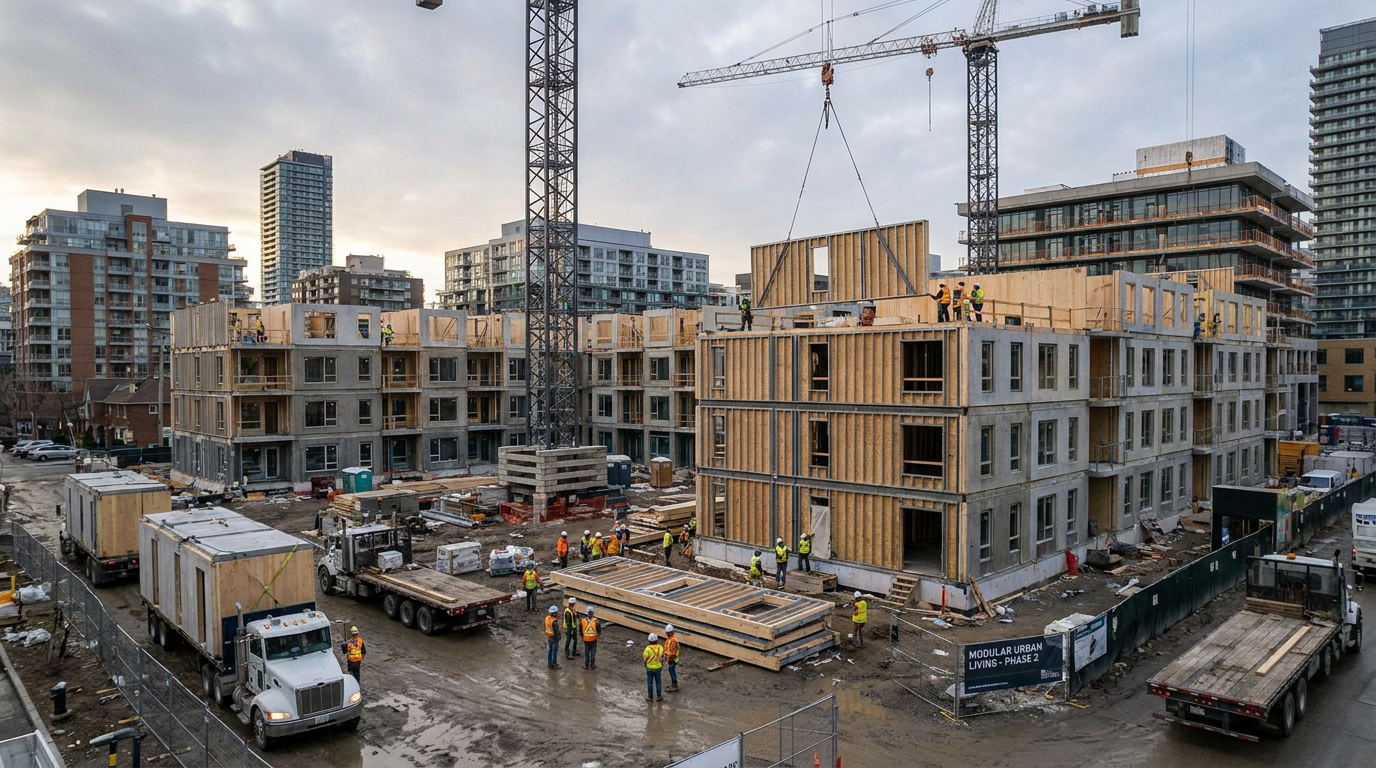
Modular and off-site construction can also help, especially where labour constraints or schedule pressure are severe. However, one of the major misconceptions is that modular delivery eliminates project risk. It does not. It shifts some risks and reduces others. Modular construction still depends on design freeze discipline, manufacturer capacity, transport logistics, crane planning, site readiness, and tolerance coordination. If those elements are weak, the project can still suffer costly disruption.
The most effective mitigation is a procurement strategy that identifies critical materials and trades early, pre-negotiates where appropriate, and creates backup options for vulnerable packages. Mechanical, electrical, facade, and elevator scopes often deserve special attention because delays or pricing shocks in these areas can have outsized schedule impacts. The earlier a team knows where supply-chain exposure is concentrated, the more effectively it can hedge procurement risk.
Construction mitigation practices that consistently improve outcomes
- Use repeatable building elements and standardized unit families where feasible
- Prequalify contractors and key trades based on actual capacity, not just price
- Lock critical long-lead items earlier than the standard tender cycle
- Maintain market-based contingencies for labour and material escalation
- Coordinate design changes through strict governance to prevent field disruption
- Evaluate modular or panelized systems when they fit site conditions and schedule goals
At an executive level, the objective is simple: remove avoidable uncertainty from the delivery process. Construction teams perform best when project scope is coherent, decisions are timely, and supply-chain risks are acknowledged rather than assumed away.
Strategy 5: Treat financing risk as an operating condition, not a one-time event
Large-scale housing projects are highly sensitive to capital conditions. Interest-rate shifts, lender retrenchment, appraisal changes, and slower absorption can all affect the cost and availability of money. In a long development cycle, financing risk should never be viewed as something solved at closing. It is a condition that must be monitored, updated, and actively managed throughout the project.
A strong mitigation framework begins with realistic underwriting. That means resisting optimistic assumptions about approval timing, construction duration, rent growth, sale velocity, or refinancing conditions. It also means stress testing the pro forma against higher rates, slower occupancy, cost escalation, and delayed starts. If a project only works under best-case assumptions, it is not truly de-risked.
Phased financing structures can improve resilience, particularly when tied to phased approvals and site servicing. So can diversified capital stacks, public financing tools, and partnerships that reduce exposure to a single source of debt or equity pressure. The recent strength of rental construction in Canada demonstrates how policy support and financing tools can materially influence what gets built. Project leaders should therefore monitor not just market debt conditions, but also public programs that can reduce delivery friction or improve project economics.
Another practical strategy is to align financing milestones with decision gates. If the project has not achieved specific entitlement, infrastructure, or procurement benchmarks, capital deployment should be reviewed before advancing to the next commitment level. This governance discipline protects the balance sheet and prevents teams from chasing sunk costs deeper into unresolved risk.
Strategy 6: Embed climate resilience into feasibility, design, and long-term operations
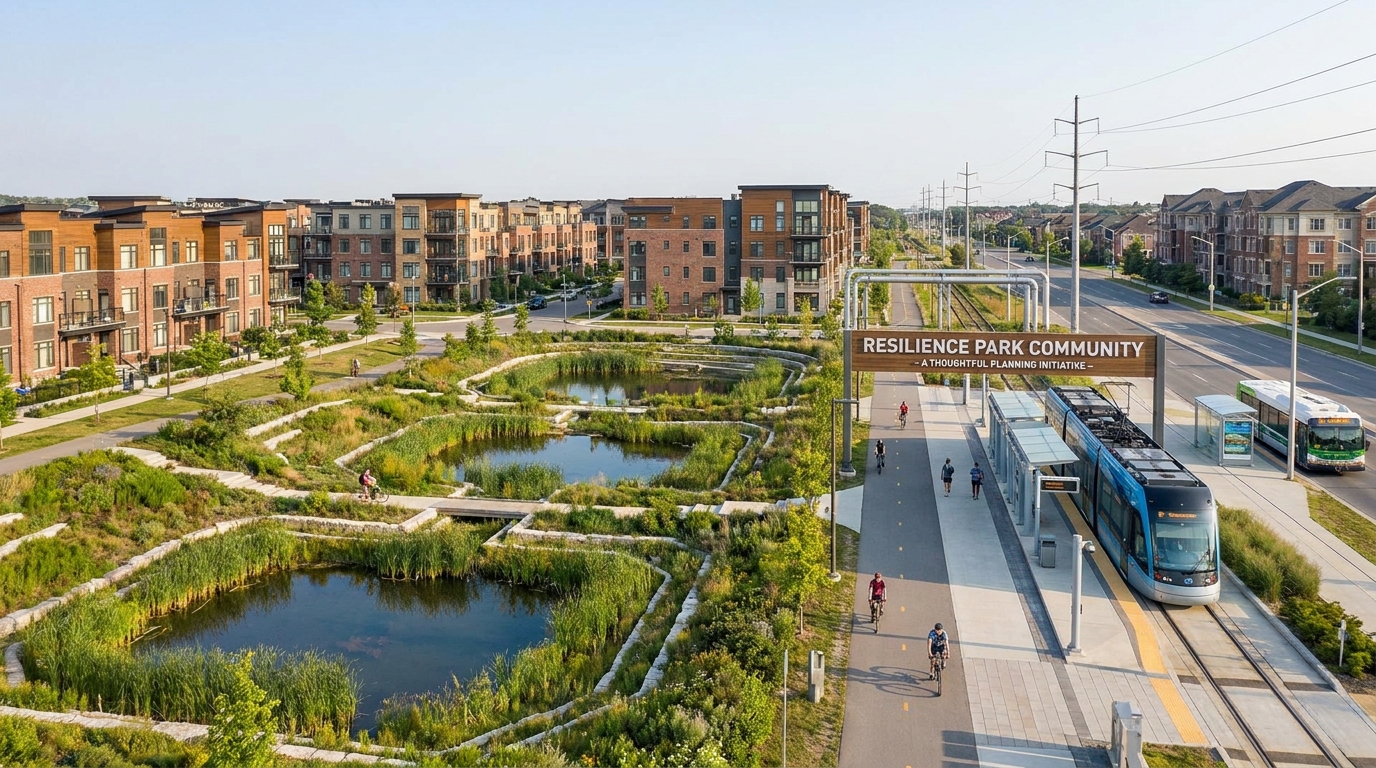
Climate resilience is no longer an optional overlay in housing development. It is now part of basic project viability. A site that appears attractive on conventional metrics can carry significant long-term risk if it is exposed to flooding, wildfire interface pressures, extreme heat, drainage failure, or recurring utility disruptions. These are not only environmental concerns. They are financial, operational, insurance, and reputational concerns.
The mitigation strategy starts at site selection and due diligence. Floodplain screening, geotechnical review, stormwater capacity analysis, and hazard mapping should be performed early enough to influence land strategy and design assumptions. If a site requires major resilience investments to function properly over time, those costs need to be reflected in the original feasibility model rather than discovered later during technical review.
At the design stage, climate resilience should be translated into clear criteria. That can include stronger drainage systems, backup utility planning, durable landscape strategies, heat mitigation, passive survivability measures, and life-cycle asset management planning. The point is not to overdesign indiscriminately. The point is to ensure that what is approved and built can perform under the conditions that are increasingly shaping cities across North America.
There is also a market dimension. Residents, insurers, municipalities, and institutional capital providers are paying closer attention to resilience. A project that is technically buildable but visibly vulnerable can face weaker long-term value, harder insurance conversations, and greater operational strain after occupancy. In that sense, resilience is not just protection against downside. It is part of long-term asset quality.
Strategy 7: Build governance that can make decisions under uncertainty
Even well-designed projects can fail when governance is weak. Risk mitigation depends on timely decisions, disciplined escalation, and clear accountability. In large-scale housing developments involving landowners, developers, consultants, lenders, public agencies, and construction partners, uncertainty is inevitable. What matters is whether the project has a structure for responding to it.
Strong governance begins with defining who owns each major risk category and what triggers executive review. If a servicing milestone slips, who leads the response. If a key trade package comes in above estimate, what options are evaluated and how quickly. If market conditions shift, who has authority to adjust phasing, tenure mix, or amenity timing. Without clarity, teams often drift, hoping a problem will resolve itself while costs continue to accumulate.
Contingency governance is especially important. Budget contingency alone is not enough. Projects need schedule buffers, scenario plans, substitution pathways, and change-control rules that prevent reactive redesign. A disciplined governance process should distinguish between value engineering that improves feasibility and late-stage cost cutting that undermines product integrity or creates downstream maintenance burdens.
Community and stakeholder engagement also belongs here. Public opposition, political shifts, and neighbour concerns can affect timelines and design outcomes. Early engagement does not eliminate disagreement, but it does reduce the likelihood of late-stage surprises. Projects that communicate clearly, show infrastructure readiness, and demonstrate how they fit into broader city-building goals are often better positioned to move through scrutiny.
Case study pattern 1: The project that de-risked early and moved steadily
Consider the profile of a successful large-scale housing project in a transit-served growth area. The development team acquires land only after confirming the entitlement path, mapping all approval requirements, and identifying utility capacity constraints. Rather than assuming future infrastructure expansion will arrive on time, the team works with municipal and agency partners early to understand sequencing and cost responsibilities. The first phase is sized to align with both market demand and available servicing.
The master plan includes a clear long-term vision, but the first approvals package focuses on what can be delivered with high confidence. Standardized building components are used where practical, key trade packages are planned early, and financing milestones are tied to defined approval and servicing conditions. Climate screening influences grading, drainage, and public realm design before drawings are locked.
This type of project does not avoid every challenge. Review periods still fluctuate, procurement markets still tighten, and revisions still occur. But because the major risks were surfaced and managed early, the project remains adaptable. Costs are more visible, decisions are faster, and lenders and public partners have greater confidence in delivery. The result is not speed alone. It is steadiness, which is often more valuable than optimism in major housing development.
Case study pattern 2: The project that lost control of late-stage risk
Now consider a contrasting pattern. A large site is acquired based on an aggressive density assumption and a broad expectation that approvals will follow because housing demand is strong. Servicing details are left for later. Land control over a critical access point is incomplete, but the issue is treated as manageable. The design advances quickly, procurement discussions begin, and financing is structured around an optimistic schedule.
Months later, the project encounters more resistance in approvals than expected. Utility upgrades require external coordination and capital that had not been fully reflected in the pro forma. Design changes ripple through the building layouts, procurement timing slips, and labour pricing moves upward. Because capital was committed too early, the team is forced to preserve momentum under weakened conditions instead of stepping back at a decision gate and resetting the strategy.
This pattern is familiar across many markets. The lesson is not that ambition should be avoided. It is that ambition without sequencing discipline creates fragility. When land, approvals, servicing, financing, and design are not aligned from the start, late-stage adjustments become expensive and often erode both affordability and project quality.
How public programs and partnerships can reduce project risk
Housing delivery increasingly depends on alignment between development strategy and public policy. The National Housing Strategy represents more than $82 billion in planned support, and current policy direction increasingly links housing outcomes to infrastructure, transit-oriented communities, and climate resilience. For project leaders, this matters because risk mitigation is not only about internal execution. It is also about understanding where public tools can reduce friction.
Programs that support faster approvals, stronger municipal capacity, and infrastructure linked to housing can materially improve project viability. The same is true of financing mechanisms that better support rental delivery, affordable housing, or mixed-income communities. A large project that aligns with municipal growth goals and infrastructure priorities may be better positioned to secure support, move through review, and maintain political momentum.
Public-private partnerships can be particularly effective when they are built around clear risk allocation. Public land, infrastructure commitments, or streamlined processes can help de-risk early phases, while private partners bring capital discipline and delivery expertise. The key is transparency. If responsibilities for servicing, timing, affordability outcomes, or public realm delivery are vague, partnership risk can grow instead of shrink.
A practical risk mitigation framework for project leaders
For executives and project managers overseeing large-scale housing, the most useful approach is often a repeatable framework that can be applied from acquisition through occupancy. The framework should be simple enough to use in real decision-making and robust enough to capture evolving risks.
- Define the project thesis by clarifying location strategy, target tenure, density ambition, and the infrastructure assumptions on which value depends.
- Map every critical dependency across land control, approvals, utilities, transportation, environmental review, financing, procurement, and phasing.
- Stress test feasibility against slower approvals, higher rates, trade scarcity, material escalation, and revised servicing costs.
- Create decision gates before acquisition, before design lock, before construction start, and before each major phase commitment.
- Assign ownership for each risk category with clear escalation thresholds and reporting cadence.
- Build contingency in multiple forms including budget, schedule, procurement alternatives, and design options.
- Review and refresh monthly because project risk changes as the market, approvals, and construction conditions evolve.
- Carry risk into operations by planning for long-term resilience, maintenance, energy performance, and resident outcomes.
This framework helps teams move from reactive problem solving to proactive control. It also supports better conversations with lenders, municipalities, and partners because the project can demonstrate that uncertainty is being managed in a structured way.
The long view: risk mitigation as city-building discipline
Large-scale housing projects do more than deliver units. They shape infrastructure demand, transportation patterns, affordability outcomes, neighbourhood identity, and long-term public trust in growth. That is why risk mitigation should be understood as part of city-building discipline rather than a narrow project management function. When major projects fail, the damage is not confined to a balance sheet. It affects housing supply, public confidence, and the capacity of communities to grow well.
Canada’s housing challenge is structural and long-term. More starts matter, but starts alone do not solve delivery fragility. Projects succeed when they convert land into housing through a process that is realistic, coordinated, and resilient. That means confronting entitlement risk early, aligning infrastructure with approvals, matching construction ambition to labour reality, building financing structures that can absorb volatility, and embedding climate resilience before it becomes a late-stage cost.
The most effective leaders in this environment are not simply those who move fastest. They are the ones who can see the full life cycle of development, understand how one unresolved issue can ripple through every part of a project, and create decision systems that keep complexity under control. In a market where housing delivery can take decades from concept to full impact, that strategic discipline is not optional. It is the foundation of feasibility.
Risk mitigation in large-scale housing is ultimately about confidence. Confidence that the land can be entitled, that the site can be serviced, that capital can stay aligned, that labour and materials can be secured, that the buildings will perform over time, and that the community created will remain valuable and resilient. When project teams build that confidence deliberately, they do more than reduce risk. They increase the probability that housing actually gets delivered where it is needed most.



No Comment! Be the first one.