



Global capital flows refer to the movement of investment capital across borders through channels such as foreign direct investment, institutional portfolio allocations, private credit, and bank funding, and they directly shape real estate pricing, development activity, and investor returns. Real estate investors often focus on rents, vacancy, supply, and interest rates within their local market, and those variables remain essential. But they sit inside a wider system shaped by capital that moves globally in response to corporate expansion decisions, monetary policy, and risk appetite. When those flows shift, the effects reach property pricing, development pipelines, refinancing conditions, and buyer competition in ways that can materially alter expected returns for investors who ignore the connection.
Table Of Content
- Why Global Capital Flows Matter in Real Estate
- The Main Types of Capital Flows Investors Should Watch
- Foreign Direct Investment
- Portfolio Capital Flows
- Private Capital and Alternative Funding
- Bank Funding and Credit Conditions
- Canada as a Case Study in Capital Flow Dynamics
- Why Greenfield Investment Matters More Than Many Investors Realize
- Sector by Sector Impact of Global Capital Flows
- Multifamily and Purpose Built Rental
- Industrial and Logistics
- Office
- Retail
- Exchange Rates, Hedging Costs, and Cross Border Purchasing Power
- Why Bond Yields and Credit Spreads Deserve a Place in Every Property Investor’s Dashboard
- Actionable Framework: How Investors Can Use Capital Flow Trends
- Where the Strongest Opportunities May Be in Canada and North America
- Common Investor Mistakes When Reading Capital Flow Trends
- Risk Management in a World of Mobile Capital
- Conclusion: Turning Global Capital Insight Into Better Property Decisions
For Canadian and North American investors, the conversation should move beyond the narrow idea of foreign homebuyers. The more useful framework is broader and more strategic. Capital enters economies through business investment, mergers and acquisitions, project finance, and debt markets, then influences how much real estate can be built, bought, refinanced, or repositioned. In that sense, global capital does not simply push up prices. It changes which sectors attract liquidity, which cities gain momentum, and which strategies deserve capital.
Recent data make this especially relevant. Canada’s stock of foreign direct investment reached C$1,600.5 billion at the end of 2025, up C$103.0 billion from 2024. Foreign direct investment into Canada totaled C$96.8 billion in 2025, the highest level since 2007. Those are meaningful figures because they indicate a market still able to attract external capital even as financing conditions, policy uncertainty, and geopolitical risks remain elevated.
At the same time, investors should avoid simplistic conclusions. Global foreign direct investment flows rose in 2025 according to OECD reporting, yet greenfield investment stalled. That distinction matters. A financial transaction can transfer ownership of an asset, but greenfield investment is more likely to create new jobs, expand supply chains, and increase future demand for office, industrial, logistics, housing, and retail space. The implication is straightforward. Capital inflows are important, but not every inflow supports local real estate fundamentals in the same way.
This article examines how global capital flows interact with real estate sectors, why the Canadian market requires a sector by sector lens, and how investors can use these trends to make sharper allocation decisions. The goal is not just to explain macroeconomics. It is to translate global financial movement into actionable, property level investment thinking.
Key investor takeaway: Global capital flows matter most when they align with durable local demand such as population growth, constrained supply, infrastructure spending, and employment expansion. Capital can accelerate a trend, but it rarely replaces fundamentals.
Why Global Capital Flows Matter in Real Estate
Real estate is capital intensive. Every acquisition, development, renovation, or refinance depends on the availability and cost of money. When global investors allocate more capital to a country or region, the local property market can benefit from deeper liquidity, greater competition for assets, and improved access to funding. When capital pulls back, the opposite can happen. Transactions slow, pricing becomes more selective, and highly leveraged owners face more pressure.
The mechanics are practical rather than abstract. If pension funds, sovereign investors, private equity firms, or multinational corporations increase exposure to Canada or North America, they may buy real estate directly, fund developers, acquire operating companies, or expand business operations that require space. That can support apartment construction, logistics demand, office leasing, retail absorption, and land values. If bond yields rise, hedging costs increase, or central bank policy turns restrictive, some of that capital can retreat or demand materially higher returns.
For investors, this means global capital affects both sides of the equation. It influences income growth potential through employment and business activity, and it influences valuation through capitalization rates, debt pricing, and buyer competition. That dual impact is why capital flow analysis belongs alongside market rent analysis and operating fundamentals.
The concept also helps investors avoid common misconceptions. Foreign direct investment is not the same as an overseas individual buying a condo. It includes business investment, cross border mergers, expansions, and project development. Likewise, a rise in capital inflows does not automatically signal a healthy market. Sometimes it reflects a chase for perceived safety or yield compression, which can reduce future returns even while prices move higher.
The Main Types of Capital Flows Investors Should Watch
Not all capital entering a market produces the same result in real estate. Investors need to understand which type of capital is moving, where it is going, and how durable its impact may be. A disciplined framework usually begins with four broad categories: foreign direct investment, portfolio flows, private capital and credit, and bank funding conditions.
Foreign Direct Investment
Foreign direct investment, or FDI, usually involves a lasting ownership stake or business commitment in the target country. In real estate terms, that can include direct property acquisition, development, infrastructure investment, or corporate expansion that creates property demand indirectly. The significance of Canada’s C$96.8 billion FDI inflow in 2025 is that it signals international willingness to commit capital into the Canadian economy despite a challenging global backdrop.
FDI tends to matter most when it generates new economic activity. A multinational manufacturing expansion can support industrial and logistics space. A technology or service sector investment can create office demand. A population and employment boost can support multifamily absorption and neighborhood retail. This is why investors should look beyond the headline amount and ask where the capital is landing.
Portfolio Capital Flows
Portfolio flows are more liquid and often more sensitive to changes in interest rates, risk sentiment, and macro policy. These flows affect equities, bonds, listed real estate vehicles, and broader financial conditions. Even when portfolio capital does not buy physical real estate directly, it influences debt markets, yield expectations, and market confidence. A country attracting portfolio flows into its bond market may experience lower borrowing costs and improved financing conditions for property investors.
The risk, however, is reversibility. Portfolio capital can move quickly when inflation surprises, central banks tighten policy, or geopolitical risk rises. That is one reason why valuation expansions driven primarily by abundant financial liquidity deserve more caution than those supported by durable leasing demand and supply constraints.
Private Capital and Alternative Funding
Private equity, private credit, family offices, and institutional joint ventures are increasingly important in real estate. These sources often step in where traditional financing becomes restrictive. In periods of bank caution, private capital can fund acquisitions, recapitalizations, bridge loans, preferred equity structures, and value add repositionings. For investors, this creates both opportunity and competition. Properties with operational upside may still attract funding even when conventional debt is tight.
Private capital is also highly selective. It tends to favor sectors with clear demand visibility and sponsors with execution credibility. That dynamic supports the broader trend of capital rotating toward multifamily, logistics, and specialized urban opportunities rather than indiscriminate exposure across all property types.
Bank Funding and Credit Conditions
Bank funding is the transmission line between macro capital markets and local real estate activity. When banks face higher funding costs, tighter regulations, or more conservative risk frameworks, property lending becomes more expensive or less available. This can suppress land values, reduce development starts, and create refinancing stress for weaker assets. Conversely, improving credit conditions can unlock transaction volume and support development in sectors where fundamentals justify new supply.
In practical terms, investors should monitor government bond yields, credit spreads, lender appetite, and refinancing trends as closely as they monitor sale comparables. These variables shape who can buy, what they can pay, and whether a development pipeline remains economically viable.

Canada as a Case Study in Capital Flow Dynamics
Canada offers an instructive example because it attracts meaningful international capital while remaining heavily influenced by domestic fundamentals. The scale of foreign direct investment is substantial, with total foreign direct investment stock reaching C$1,600.5 billion at the end of 2025. That level of international participation supports liquidity, development potential, and broad investor interest in the market.
Yet Canada has not moved in lockstep with global residential pricing. The Bank for International Settlements reported that real global house prices fell 0.6% year over year at the end of 2025, while Canada’s real house prices remained below pre pandemic levels. The signal here is important. Global capital alone has not been enough to erase the effects of affordability constraints, mortgage rates, regulation, and supply imbalances in the Canadian market.
That divergence reinforces a core investment lesson. Real estate outcomes are local, even when funding is global. Capital can intensify existing patterns, but domestic borrowing costs, income growth, household formation, construction economics, and policy settings still determine whether asset values are justified. Investors who assume international inflows will override weak affordability or overbuilt conditions are usually relying on a weak thesis.
Canada’s housing investment mix also points to where capital sees stronger long term demand. Statistics Canada reported that investment in Canadian apartments increased 8.3% in 2025, while investment in row and single detached houses declined for a third consecutive year. This is more than a construction trend. It reflects affordability pressure, urban demand concentration, and financing logic that favors rental housing in many markets.
Why Greenfield Investment Matters More Than Many Investors Realize
One of the most overlooked distinctions in capital flow analysis is the difference between financial ownership and new productive investment. OECD reporting showed global FDI flows rose in 2025, but greenfield investment stalled. For real estate investors, this matters because greenfield activity tends to be a stronger leading indicator of future space demand than a pure ownership transfer.
If an international buyer acquires an existing company or property portfolio, the transaction may be significant financially without creating much additional local demand for buildings. By contrast, a new manufacturing plant, distribution network, technology campus, or infrastructure linked project can generate construction activity, employment, household formation, and long term leasing demand across several sectors.
This distinction is especially valuable when underwriting office and industrial markets. Industrial corridors tied to reshoring, nearshoring, transportation investment, and warehousing expansion often benefit more from greenfield momentum than from financial flows alone. Office markets also need genuine business expansion to support occupancy. Capital that merely changes ownership may support valuations in the short run, but it does not necessarily improve fundamentals.
For investors, a sensible question is not simply whether foreign investment is rising. The better question is whether the incoming capital is creating real local economic activity. Markets that can answer yes to that question tend to offer better long term compounding potential.
Sector by Sector Impact of Global Capital Flows
Real estate does not respond as a single asset class. Global capital flows affect office, multifamily, industrial, and retail in different ways because each sector has distinct demand drivers, lease structures, and sensitivity to economic cycles. A strategic investor must interpret capital movement through a sector specific lens.
Multifamily and Purpose Built Rental
Multifamily is one of the clearest beneficiaries of durable capital interest in Canada and many North American markets. Population growth, affordability constraints in homeownership, immigration, and urban labor demand all support rental housing. The rise in apartment investment in Canada during 2025 reflects this alignment. Investors are responding to a segment where end user demand is visible and where rental housing can serve as both an income asset and an inflation linked store of value.
Global capital often favors multifamily because cash flow tends to be more diversified across tenants and demand is less dependent on a single corporate leasing cycle. In periods of uncertainty, institutions often prefer assets where occupancy can remain resilient even if economic growth slows. This does not remove risk. Regulatory policy, development costs, and local rent controls still matter. But relative to other sectors, multifamily often offers a stronger link between capital availability and durable occupancy demand.
Industrial and Logistics
Industrial and logistics have remained among the most resilient sectors due to e commerce, supply chain reconfiguration, and nearshoring trends. Capital seeks visibility, and this segment has generally offered it. Distribution nodes, last mile facilities, and select manufacturing linked corridors benefit when companies rework supply chains for resilience rather than pure cost minimization.
Cross border investment can accelerate this trend by funding acquisitions, development, and infrastructure related projects. However, investors still need discipline. The best opportunities are usually in locations with transportation access, labor availability, and limited competing supply. Capital can compress yields quickly in premium industrial markets, so entry price matters as much as the sector narrative.
Office
Office remains the most uneven sector in the current cycle. Canadian office market commentary in 2025 continued to show structural weakness in some segments, even as certain cities benefited from office to residential conversion activity. This is a useful reminder that capital is not abandoning cities altogether. It is becoming more selective about how urban assets are used.
Traditional office demand still depends on employment growth and workplace strategy, but not all buildings are positioned to win. Capital tends to favor best in class assets with modern specifications or properties that can be repositioned at an attractive basis. Older office inventory in weaker submarkets faces a tougher path because refinancing and leasing risk can combine at the same time. In this sector, global capital does not remove structural issues. It separates assets with adaptive potential from assets trapped by obsolete design.
Retail
Retail is no longer a uniform story. Necessity based retail, grocery anchored centers, and urban service retail can remain stable where population growth supports spending. Tourism and affluent urban demand can also help select high street assets. But discretionary retail remains exposed to consumer confidence and changing spending patterns. Capital tends to approach retail with precision, targeting locations and formats that serve a clearly defined daily need.
For investors, retail can still work when tied to demographic growth and strong tenant quality. The lesson is not that global capital ignores retail. It is that the market now rewards specificity over broad thematic exposure.

Exchange Rates, Hedging Costs, and Cross Border Purchasing Power
Foreign exchange is one of the most practical links between global capital flows and property investment returns. A favorable currency can make Canadian assets more attractive to foreign buyers by lowering their effective entry cost. A stronger local currency can have the opposite effect. But the equation is more nuanced than a simple price discount. Investors also need to consider hedging costs, borrowing currency, and income translation risk.
When interest rate differentials widen, currency hedging can become more expensive. That can reduce the appeal of otherwise attractive real estate investments for foreign institutions. In some cases, buyers may still pursue acquisitions because they view the market as strategically important or relatively stable. In other cases, hedging costs can erode expected returns enough to delay deployment.
Domestic investors should care because foreign exchange conditions influence competitive intensity. If international buyers become more aggressive due to favorable currency dynamics, pricing may firm for high quality assets. If hedging costs rise sharply, competition may cool, creating better entry opportunities for local buyers with balance sheet flexibility.
In short, exchange rates affect not only purchasing power but also bidding behavior and required yields. They are an underappreciated component of real estate timing.
Why Bond Yields and Credit Spreads Deserve a Place in Every Property Investor’s Dashboard
Real estate is often priced relative to fixed income alternatives. When government bond yields rise, investors usually demand higher property yields to maintain an adequate risk premium. When credit spreads widen, financing costs increase and leveraged returns can compress. These shifts influence valuations even before local rents change materially.
BIS research on the Americas has emphasized that economic and policy uncertainty can affect capital flows, exchange rates, and asset prices. For real estate investors, that translates into a clear operational discipline. It is not enough to watch cap rates and vacancy data. Investors should also monitor central bank communication, sovereign yields, bank lending standards, and capital market stress indicators.
This broader dashboard helps explain why some seemingly solid property markets struggle to transact. If the cost of debt rises faster than rental growth, buyers cannot justify yesterday’s prices. Conversely, when financing conditions ease and sector fundamentals are still healthy, transaction activity can recover quickly. Timing matters because real estate values are shaped by both asset performance and capital market conditions.
A useful rule is to separate operational strength from pricing risk. A great property in a healthy submarket can still be a poor investment if acquired at too aggressive a yield during a period of unstable funding conditions. Global capital flow analysis helps investors make that distinction more clearly.
Actionable Framework: How Investors Can Use Capital Flow Trends
Investors do not need to forecast every global macro variable perfectly to benefit from capital flow analysis. They need a disciplined process that connects global trends to local opportunity. The most effective approach is to focus on alignment. Markets tend to outperform when external capital interest reinforces already strong local fundamentals rather than trying to rescue weak ones.
A practical framework starts by ranking target markets and property types across several dimensions. Investors can evaluate the durability of demand, the depth of local supply constraints, the degree of infrastructure support, the health of employment growth, and the likelihood that incoming capital will fund genuine economic activity rather than simply reprice existing assets. This allows for more selective deployment.
The following checklist can help translate a macro narrative into an investment thesis:
- Identify the source of capital. Determine whether flows are coming from FDI, portfolio capital, private credit, or bank lending expansion. Each type has a different durability profile.
- Assess where the capital is landing. Capital supporting productive business growth is more constructive than capital focused purely on financial ownership transfers.
- Match the flow to the right sector. Industrial, multifamily, office, and retail respond differently to the same macro environment.
- Check domestic fundamentals. Review affordability, job growth, supply pipeline, policy conditions, and rent sustainability.
- Monitor pricing discipline. Rising capital inflows can improve liquidity, but they can also compress returns beyond a sensible risk premium.
- Stress test reversals. Underwrite scenarios where rates stay higher, hedging costs rise, or geopolitical risk disrupts cross border activity.
This process reduces the temptation to chase headlines. Instead of assuming that any foreign money entering the country is bullish for every property type, investors can focus on areas where capital flow trends improve the odds of durable cash flow growth.
Where the Strongest Opportunities May Be in Canada and North America
Based on recent market evidence, the strongest opportunities are often where global capital inflows intersect with long term local demand. In Canada, that frequently points to purpose built rental housing, select industrial and logistics corridors, and conversion friendly urban assets. These sectors benefit from structural demand drivers rather than relying solely on cyclical optimism.
Purpose built rental remains compelling in markets with population growth, limited affordable ownership options, and disciplined supply. Investors should still be selective about local regulation, operating costs, and rent growth assumptions, but the demand base is tangible. In an environment where apartment investment is increasing while lower density housing investment remains under pressure, rental housing appears to be absorbing a larger share of both capital and end user demand.
Industrial and logistics opportunities are strongest in corridors supported by transportation infrastructure, trade access, and supply chain realignment. Here, capital flow analysis should include manufacturing plans, import export trends, labor access, and the probability of new business formation rather than relying on warehouse narratives alone. The most durable opportunities usually sit where logistics is embedded in broader economic activity.
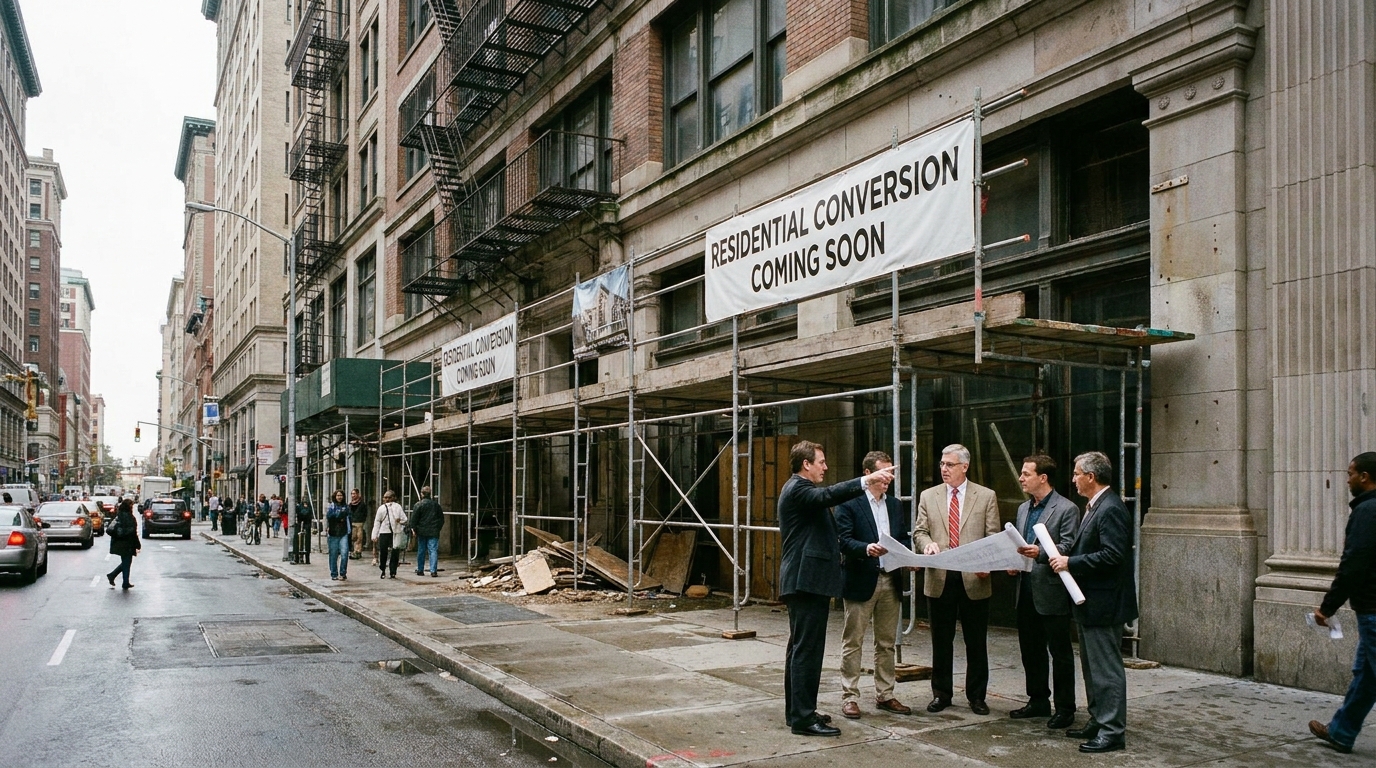
Urban repositioning and office to residential conversion also deserve attention. While office weakness creates obvious risk, it can also create basis driven opportunity for well located buildings that can be adapted economically. The success of these strategies depends on municipal policy, conversion feasibility, floorplate design, and local residential demand. But in selected cities, this is one of the clearest examples of how capital can shift from a challenged use into a stronger one.
Common Investor Mistakes When Reading Capital Flow Trends
One frequent mistake is assuming that more capital always means better fundamentals. In reality, heavy inflows can produce overpricing and reduce future returns, especially when investors compete aggressively for a limited set of assets. Liquidity is helpful, but return on entry price still matters. Capital can validate a market’s attractiveness while simultaneously making it less attractive for new buyers.
Another error is treating foreign direct investment as identical to foreign homebuyer demand. These are separate concepts. FDI includes business investment, mergers, and development activity, all of which can affect real estate indirectly through employment and space demand. Investors who fail to distinguish these channels may misunderstand where demand is truly coming from.
A third mistake is extrapolating global housing trends directly into Canada or other local markets. The BIS data show that real global house prices and Canadian real house prices are not moving in a simple synchronized way. Domestic mortgage rates, policy decisions, taxation, land use regulation, and local supply still matter deeply. Investors should use global data as context, not as a substitute for local underwriting.
Finally, many investors underestimate reversal risk. The same capital inflow that boosts values can retreat when rate expectations change, exchange rates move sharply, or geopolitical tensions rise. Strong strategies are built to survive that scenario, not just to benefit from the optimistic one.
Risk Management in a World of Mobile Capital
Because capital can move quickly, risk management has become more important than broad market enthusiasm. Investors should favor assets and structures that remain resilient under multiple funding conditions. That means moderate leverage, realistic refinancing assumptions, and asset selection grounded in occupier demand rather than narrative alone.
It also means recognizing that financial stability matters at the property level. If a market depends heavily on cheap debt or highly cyclical international capital, valuations may be more fragile than they appear. By contrast, assets supported by essential housing demand, strategic logistics relevance, or adaptive urban reuse often have a stronger cushion against capital market volatility.
In practical terms, prudent investors should ask several questions before deploying capital. Can the property maintain occupancy if economic growth slows. Is the debt structure sustainable if rates remain elevated. Would demand still exist if a major cross border capital source temporarily withdrew. Can the asset be repositioned if its current use weakens. These questions often reveal more than headline market momentum.
Real estate is a long duration asset class. That is precisely why short term capital conditions can create long term opportunity for disciplined buyers. Investors who preserve flexibility during volatile periods are often best positioned to acquire quality assets when the market reprices risk.
Conclusion: Turning Global Capital Insight Into Better Property Decisions
Global capital flows are not a side issue in real estate. They are one of the core forces shaping financing conditions, transaction activity, sector leadership, and valuation pressure. In Canada and North America, the most effective lens is broader than the standard foreign buyer narrative. Investors should focus on foreign direct investment, portfolio movements, private capital, bank funding, and the extent to which these flows support real economic activity.
The current environment rewards nuance. Canada’s foreign direct investment base remains substantial, yet local residential prices still reflect domestic affordability and rate pressures. Global FDI has improved, but greenfield investment has stalled, making it risky to assume all inflows will create future space demand. Sector rotation continues, with multifamily and industrial generally showing stronger resilience than much of the office market. Those differences matter because capital is increasingly selective.
For actionable investing, the strongest strategy is to look for places where global capital aligns with local fundamentals rather than fighting them. Markets with population growth, supply constraints, infrastructure support, and employment expansion tend to convert capital inflows into lasting property performance more effectively. In today’s market, that often means focusing on purpose built rental, select logistics corridors, and urban conversion opportunities with clear execution logic.
The best investors do not chase capital. They understand what it is financing, why it is moving, and whether the local market can turn that flow into durable cash flow growth. That is where global real estate insight becomes real investment advantage.

No Comment! Be the first one.