



Illuminate the Future: Innovative DIY Lighting Projects for a Modern Home
Lighting has always done more than brighten a room. It shapes mood, reveals texture, creates rhythm, and gives architecture its emotional register. In a modern home, light is no longer merely practical. It is part of the way we live, entertain, unwind, and move through space. The most compelling homes today understand that lighting should feel intelligent, graceful, and deeply integrated with everyday life.
Table Of Content
- Why Future Lighting Begins with Timeless Design Principles
- How to Think Like a Designer Before Starting Any DIY Lighting Project
- Project One: Create a Floating Glow with Concealed LED Shelf Lighting
- Design notes for shelf lighting
- Project Two: Install Smart Dimmable Plug In Pendants for Architectural Drama
- Project Three: Build a Motion Lit Hallway or Stair Path with Low Level LEDs
- Project Four: Retrofit Recessed Downlights for Better Quality and Efficiency
- What to check before retrofitting downlights
- Project Five: Design a Tunable White Reading Corner or Work Niche
- Project Six: Create an Outdoor Solar LED Moment with Architectural Restraint
- Understanding the Technical Details That Make DIY Lighting Successful
- Sustainability Beyond Energy Savings
- Common DIY Lighting Mistakes to Avoid
- A Sample Future Ready Lighting Plan for the Modern Home
- Conclusion: The Most Beautiful Light Is Intelligent, Sustainable, and Human
The future of lighting is especially exciting because it does not ask us to choose between beauty and performance. New technology allows homeowners to embrace energy efficiency, flexible controls, and longer lasting materials while still preserving the softness and elegance that make a room feel inviting. In fact, the most sophisticated lighting schemes often rely on classic design principles such as layering, focal points, balance, and proportion, then refine them through modern tools like LEDs, dimmers, sensors, and tunable white settings.
For anyone interested in DIY lighting projects, this moment offers rare creative freedom. You can update a room without a major renovation, introduce architectural drama with modest means, and reduce energy use while making your interiors feel more curated. Natural Resources Canada notes that lighting accounts for 3.6% of energy used in the average Canadian home, which may sound small, yet it is meaningful enough to make lighting upgrades one of the most approachable ways to improve home efficiency. Older reference material has also placed lighting at roughly 10% of home electricity use, which reminds us how worthwhile a thoughtful retrofit can be.
This article explores elegant, sustainable, and innovative DIY lighting ideas for the modern home. Each project is rooted in design logic and informed by practical research. You will find inspiration, guidance, and technical details that help ensure the result is not only visually compelling but safe, efficient, and enduring.
The finest lighting does not announce technology. It simply makes a room feel more beautiful, more intuitive, and more alive.
Why Future Lighting Begins with Timeless Design Principles
Before discussing products and projects, it is worth returning to the foundation of good lighting design. The rooms that feel most comfortable are rarely lit by a single overhead fixture. Instead, they rely on layers of light that respond to different needs and moments. Natural Resources Canada encourages this exact approach through a mix of ambient, accent, decorative, and task lighting, ideally operated separately for flexibility and comfort.
Ambient lighting provides the overall glow of a room. Task lighting supports specific activities such as reading, cooking, grooming, or working. Accent lighting draws the eye to art, shelves, alcoves, and architectural details. Decorative lighting contributes sculptural presence and atmosphere. When these layers are composed thoughtfully, a room acquires visual depth. It feels designed rather than simply illuminated.
This layered approach is essential to future focused DIY lighting because it prevents technology from becoming sterile. A connected downlight system can be useful, but on its own it may still leave a room flat. A warm under shelf glow, a dimmable pendant over a dining table, or a low level hallway guide light can transform that same space into something more nuanced and refined. Good lighting, whether classic or contemporary, is always about composition.
The beauty of modern LED technology is that it allows us to achieve this composition more efficiently than before. NRCan notes that a 9 watt LED can deliver roughly the same brightness as a 60 watt incandescent bulb at around 800 lumens. ENERGY STAR goes even further, stating that LED lighting products can produce light up to 90% more efficiently than incandescent bulbs. In practical terms, this means homeowners can layer light more generously without the same energy penalty older systems once carried.
How to Think Like a Designer Before Starting Any DIY Lighting Project
The temptation in DIY lighting is to begin with the fixture. A more refined method is to begin with the experience you want to create. Ask yourself what the room should feel like in the morning, in the afternoon, during dinner, and late in the evening. Consider which surfaces deserve emphasis, where shadow should remain, and how brightness should shift from one zone to another.
Designers often evaluate lighting through four practical questions. What activities happen here. Where should the eye naturally travel. Which materials deserve illumination. How can the room feel softer after dark. These questions guide better decisions than simply choosing the brightest bulb available. They also help prevent one of the most common misconceptions in home lighting, which is that more wattage means better light. In reality, brightness is better understood through lumens, while quality depends on factors such as color temperature and Color Rendering Index, often called CRI.
If you want a home to feel warm and residential rather than clinical, pay close attention to color temperature. Lower Kelvin values tend to create a softer, more intimate atmosphere. Higher values feel cooler and more energetic, which may work in some task driven areas but can make living rooms and bedrooms feel too severe. Many of the most promising future lighting options now offer tunable white or warm dim behavior, allowing one fixture to support both focused daytime activity and quieter evening ambiance.
It is also wise to map your control strategy before installation. Separate switches, smart scenes, dimmers, and motion based automation all influence how successful a project will feel in daily life. Smart lighting is not automatically efficient if it is configured poorly or left brighter than necessary. The most elegant systems are intentional. They respond to the rhythm of the home rather than overwhelming it.
Project One: Create a Floating Glow with Concealed LED Shelf Lighting
One of the most graceful ways to introduce future ready lighting is with a shelf or ledge that appears to emit light from within. This project is ideal for living rooms, dining areas, home offices, or bedrooms where you want a sophisticated ambient layer without adding visual clutter. Concealed LED strip lighting can turn an ordinary shelf into a luminous architectural feature, especially when used to illuminate textured plaster, stone, wood grain, ceramics, or framed objects.
The concept is simple. Install a floating shelf or retrofit an existing one, then place an LED strip in a concealed channel along the back or underside so the light washes gently across the wall or downward onto objects below. The effect is subtle, luxurious, and highly adaptable. It works beautifully in minimalist interiors because the source of light remains hidden. It is equally effective in more classic rooms where the glow adds atmosphere without competing with decorative elements.
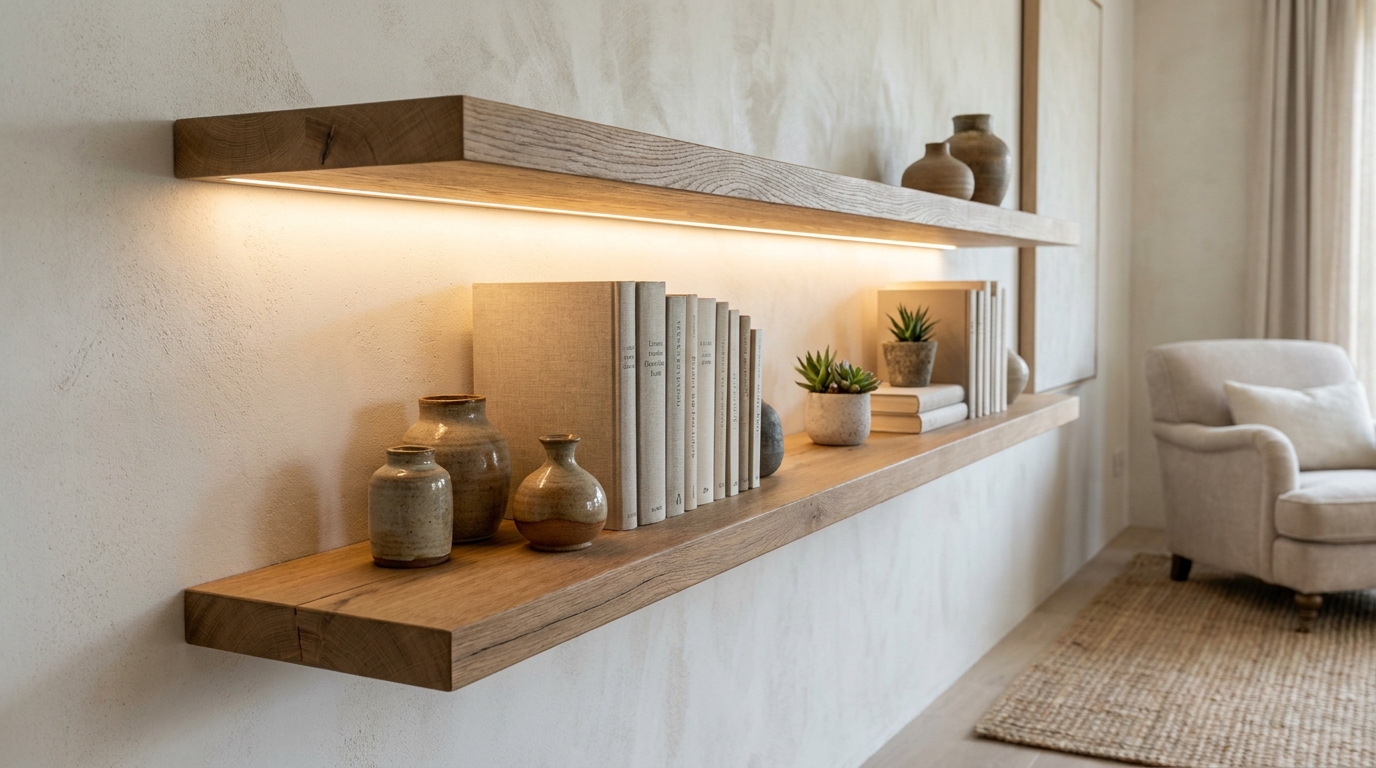
For the most polished result, choose a high quality LED strip with a pleasing warm white temperature and strong color rendering. High CRI matters because it helps books, artwork, fabrics, and natural materials appear richer and more accurate. A simple diffuser channel can soften the output and prevent visible diode dots, which makes the light appear more integrated and architectural.
This is also an excellent sustainability move. LEDs use far less energy than incandescent sources and typically last much longer, reducing both operating costs and replacement frequency. Since the fixture itself can often be built from reclaimed wood, leftover stone, or repurposed millwork, the project can express sustainability through both technology and material choice. If your shelf is in a reading nook or workspace, consider pairing the strip with a dimmer so the same installation can shift from ambient evening glow to brighter functional lighting.
When planning the project, think carefully about wire management and power supply placement. A concealed adapter, an accessible outlet, and a clean routing path will make the result feel bespoke rather than improvised. If you are connecting the strip to a smart plug or app based controller, create scenes that correspond to time of day. A brighter daytime setting and a softer evening setting can completely transform how the room is experienced.
Design notes for shelf lighting
- Use the wall as a reflective surface rather than aiming the strip directly into the room.
- Choose a diffuser channel for a smoother and more finished look.
- Look for high CRI LED strips so books, art, and natural materials appear true to life.
- Consider reclaimed wood or offcut stone for the shelf itself to add material sustainability.
Project Two: Install Smart Dimmable Plug In Pendants for Architectural Drama
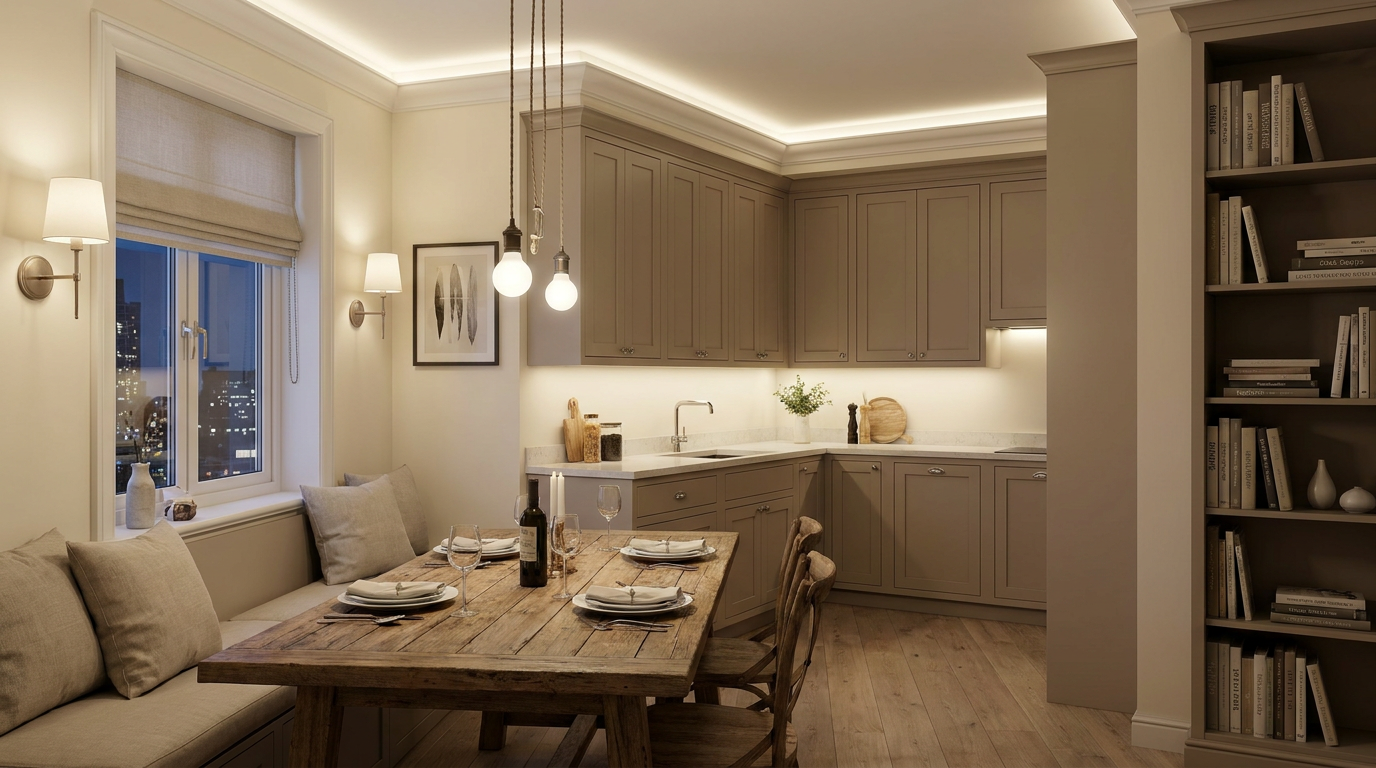
Pendants have a unique ability to define a zone. They create intimacy above a dining table, elegance beside a bed, and sculptural focus in an unused corner. Yet many homeowners assume pendants require extensive rewiring. In reality, a beautifully chosen plug in pendant can offer a remarkably accessible DIY solution, especially when combined with a smart dimmable LED bulb.
This project is perfect for renters, apartment dwellers, or anyone who wants strong visual impact without opening walls. The idea is to install a ceiling hook or decorative mounting point, route a fabric covered cord with care, and pair the fixture with an LED bulb that supports dimming or tunable white controls. The result can feel every bit as elevated as a hardwired installation when the proportions are right and the cord is integrated intentionally into the composition of the room.
Classic design principles matter deeply here. Pendant lighting should feel centered, balanced, and scaled appropriately to the furniture below. Over a dining table, the fixture should anchor the table visually without overwhelming it. In a bedroom, a pair of pendants can replace conventional bedside lamps and free up surface space while creating a serene hotel like atmosphere. In a reading corner, a single pendant can provide both mood and practical illumination when paired with the correct bulb.
The technological dimension is where this project becomes especially future focused. Smart bulbs now allow app based dimming, scheduling, and color temperature adjustment, which means one pendant can serve multiple emotional roles throughout the day. In the morning, it can emit a brighter neutral white for clarity. At dinner, it can shift warmer and lower. Late at night, it can become a delicate amber toned presence rather than a harsh overhead glare.
As with any dimmable setup, compatibility matters. ENERGY STAR notes that not every LED works with every dimmer switch, so always verify compatibility before purchase if you plan to use a physical dimmer. This is one of the most common reasons DIY lighting upgrades disappoint. Flicker, buzzing, and uneven dimming usually reflect a control mismatch rather than a flaw in the overall concept.
If you wish to make the project feel more custom, consider crafting your own shade from linen, perforated metal, ribbed glass, or a carefully refinished vintage frame. The future of DIY lighting is not just electronic. It is also tactile. Materials still matter. A warm LED becomes more beautiful when filtered through a shade that introduces depth, softness, and a sense of character.
Project Three: Build a Motion Lit Hallway or Stair Path with Low Level LEDs
Some of the most memorable lighting in a home is also the quietest. Hallways, stairs, and circulation spaces are ideal for low level path lighting that responds gently as someone moves through the house. This project combines sustainability, safety, and a distinctly modern elegance. Rather than turning on a bright overhead light at night, motion activated LEDs near the floor can guide movement with a subtle glow.
The installation can take several forms. You might place slim LED fixtures along the baseboard, integrate small puck lights under a floating console, or use low profile step lights for a stair run. The key is to keep the illumination soft and directional. A warm amber or warm white tone tends to be kinder to tired eyes and far more atmospheric than a cool bright source. This is one of those projects where restraint creates luxury.
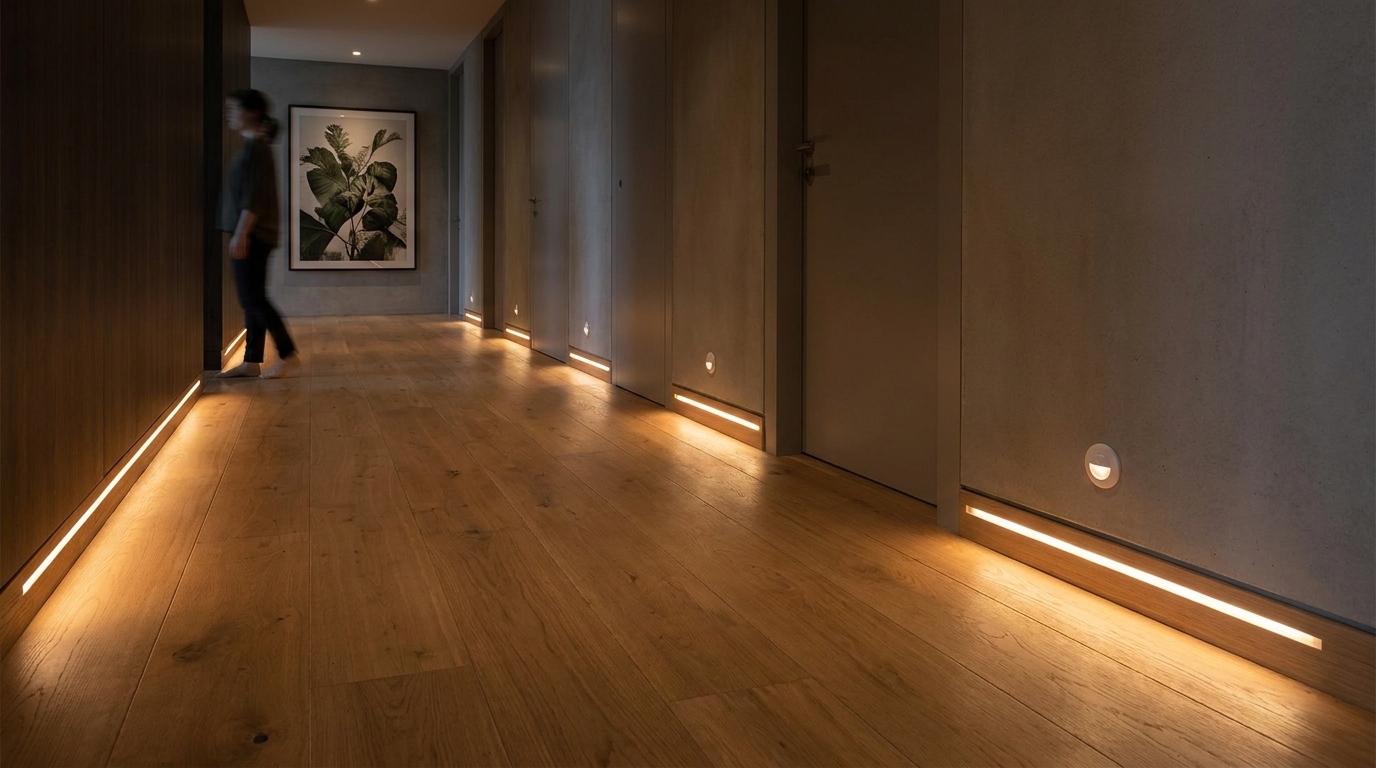
NRCan highlights motion detectors and photocells as practical tools for convenience and savings, and this is an ideal application. Because the lights activate only when needed, the system reduces unnecessary energy use while improving nighttime safety. For families with children, older adults, or guests unfamiliar with the house, the effect is particularly valuable. It feels intuitive and considerate.
From a design perspective, path lighting introduces another important lesson. Not every area of the home should be equally bright. In fact, lower contrast and selective illumination often create a more sophisticated environment. By allowing the floor plane or wall base to carry the light, you preserve shadow in the upper portion of the hallway, which can make the architecture feel calmer and more expansive.
This project also demonstrates how future lighting can blend seamlessly with classic interiors. Even a traditional home can benefit from discreet sensor based illumination if the fixtures are understated and the color temperature is warm. The technology remains almost invisible, yet the experience of the home becomes more fluid and refined.
Project Four: Retrofit Recessed Downlights for Better Quality and Efficiency
Recessed lighting often suffers from a poor reputation, usually because older installations produced flat, glaring, or overly cold light. Yet modern recessed retrofit kits have improved dramatically. Today, high quality LED downlights can be dimmable, high CRI, tunable white, and exceptionally efficient, making them a smart choice for kitchens, hallways, bathrooms, and living spaces that need clean architectural lighting without visual clutter.
ENERGY STAR notes that certified recessed downlights can use up to 90% less energy than traditional incandescent models. Recent products available in Canada and the United States also include continuously dimmable, tunable white options with long lifetimes that may reach 54,000 hours. This is important because it means efficiency no longer demands aesthetic compromise. You can have crisp, visually accurate illumination and still maintain a soft evening mood.
If you are planning a retrofit, safety and compatibility deserve close attention. Recessed lights are not all interchangeable. ENERGY STAR recommends type IC models when insulation may come into contact with the fixture and type AT models for airtight performance below unconditioned attics. These specifications are especially relevant in older homes and colder climates where air sealing and insulation continuity affect comfort as well as energy use.
For a more designerly result, think beyond a simple grid of identical brightness. Use recessed downlights to support a layered scheme rather than dominate it. In a kitchen, for example, downlights can provide ambient clarity while under cabinet strips handle task work and a pendant over an island offers decorative focus. In a living room, downlights may illuminate circulation zones while accent lamps and concealed LEDs create warmth at eye level. The future of recessed lighting lies in better integration, not overuse.
What to check before retrofitting downlights
- Confirm the housing size and retrofit kit compatibility.
- Check whether the location requires IC rated or airtight performance.
- Verify dimmer compatibility if the fixture will be dimmed.
- Choose the right color temperature and aim for high CRI where visual quality matters.
- Plan the lighting as one layer among several rather than the sole source of illumination.
Project Five: Design a Tunable White Reading Corner or Work Niche
Modern homes increasingly ask rooms to perform multiple roles. A dining nook may become a workstation. A bedroom corner may become a reading retreat. A small landing may become a study area. Tunable white lighting is especially effective in these transitional spaces because it adapts to changing needs with remarkable elegance.
This project can be as simple as combining a refined floor lamp or wall mounted swing arm with a tunable white LED bulb or smart fixture. During focused work, a cooler and brighter setting can improve visual clarity. In the evening, the same lamp can shift to a warmer and dimmer glow suited to reading or relaxation. The fixture footprint stays the same, but the character of the space changes with the light.
What makes this a meaningful DIY project is the opportunity to shape an intimate zone with very little intervention. You might refresh an existing chair with new upholstery, add a side table in natural stone or stained oak, and then anchor the vignette with lighting that responds to your habits. This is where technology feels humane. It supports comfort rather than spectacle.
For readers who care about circadian friendly environments, tunable white lighting offers practical promise, especially when used thoughtfully and not excessively. Brighter, cooler light may support daytime alertness, while warmer evening scenes can help the home feel calmer after sunset. Although lighting alone does not determine wellness, it certainly contributes to how a space aligns with the rhythm of the day.
Project Six: Create an Outdoor Solar LED Moment with Architectural Restraint
The future of lighting does not stop at the front door. Outdoor spaces benefit enormously from carefully placed, low energy illumination that improves safety while preserving atmosphere. NRCan specifically highlights solar powered LED path lights as practical tools, making them an ideal DIY entry point for patios, garden walks, entry paths, and balconies.
The mistake many homeowners make outdoors is overlighting. Bright, scattered fixtures can flatten a garden and disrupt the quiet beauty of evening. A more refined approach is to light edges, thresholds, and key textures. A row of understated solar LED path lights along a stone walk can feel elegant if the spacing is deliberate and the beam remains soft. A concealed solar accent near a planter can gently reveal foliage rather than blasting it.
For modern homes, outdoor lighting should read as an extension of the architecture. Use warm tones that relate to interior light, and think about what the house looks like from inside when viewed at night. The aim is continuity. A softly lit path, a glimmer on textured masonry, or a small pool of light near the entrance can make the exterior feel composed and inviting.
Because solar technology and LED performance have improved, these solutions are more viable than they once were. They also reinforce sustainability by reducing dependence on wired electricity for modest landscape illumination. As always, quality matters. Choose weather appropriate fixtures with a finish that complements the house rather than drawing attention to itself.
Understanding the Technical Details That Make DIY Lighting Successful
Elegant lighting is often the result of invisible discipline. A room may look effortlessly beautiful, yet behind that effect are dozens of practical decisions about brightness, color, controls, placement, and safety. When homeowners understand a few core technical ideas, they make far better choices and avoid disappointment.
Start with lumens, which measure the amount of light produced. This is more useful than wattage when comparing modern bulbs. Since LEDs use less power, a low watt bulb can still produce substantial brightness. NRCan’s comparison of a 9 watt LED and a 60 watt incandescent is a useful benchmark for understanding how much efficiency has advanced.
Then consider color temperature, measured in Kelvin. Warm light often creates intimacy and softness, while cooler light feels brisker and more task oriented. In homes, lower Kelvin values are generally preferred for living rooms, bedrooms, and dining areas, while somewhat brighter and more neutral settings may suit kitchens or work zones. Tunable white technology simply allows this relationship to become more fluid.
Next is CRI, or Color Rendering Index. High CRI lighting renders colors more faithfully, which matters enormously if you care about textiles, wood tones, artwork, skin tones, or food presentation. A room can be bright and still look disappointing if the light source renders materials poorly. Future lighting is not just about efficiency. It is also about visual fidelity.
Finally, think about controls. Dimmers, occupancy sensors, motion detectors, photocells, and smart scenes all shape how lighting behaves. They should feel intuitive. A beautifully designed room loses some of its grace if every evening requires a complicated sequence of app commands. Simplicity is part of luxury.
Sustainability Beyond Energy Savings
Sustainable lighting is often discussed only in terms of electricity use, yet the subject is broader and more interesting than that. Longevity matters. Material choice matters. Recycling and disposal matter. Policy shifts also matter because they influence what kinds of products are available and encouraged in the market.
Canada’s Energy Efficiency Regulations continue to reinforce a movement away from inefficient lamps, and a 2024 government report on lamps containing mercury highlights LED replacements as mercury free, longer lasting, and more energy efficient. This is a meaningful evolution. Choosing LEDs can reduce operating costs, but it can also support a cleaner and more responsible transition away from older lamp technologies that carry additional environmental concerns.
For DIY homeowners, sustainable thinking can extend into every stage of a project. You might preserve an existing fixture body and simply retrofit it with a better lamp. You might choose reclaimed timber or leftover stone for a custom sconce backing or floating shelf. You might plan ahead for how older bulbs and components will be recycled. Sustainability becomes much more elegant when it is understood as stewardship rather than deprivation.
There is also a quiet aesthetic advantage to sustainability. Long lasting products invite more permanence and fewer disposable decisions. A well made light, chosen carefully and used intelligently, tends to look better over time. It becomes part of the architecture of the home rather than a temporary accessory.
Common DIY Lighting Mistakes to Avoid
The most polished lighting projects are often distinguished by what they avoid. One frequent mistake is relying on a single overhead fixture for an entire room. This tends to flatten textures, overexpose some areas, and leave others curiously underconsidered. Layering is almost always more graceful.
Another common error is assuming every LED is interchangeable. As the research makes clear, not all LEDs are plug and play. Dimmer compatibility remains a real issue, and fixture ratings still matter. If a retrofit behaves poorly, flickers, or buzzes, the problem may stem from a mismatch in controls rather than from the LED itself.
Homeowners also sometimes prioritize brightness over quality. A higher lumen output can be useful in work areas, but too much brightness in living spaces can erase intimacy. Likewise, a cheap low quality bulb may illuminate the room while making finishes look lifeless. It is worth investing in visual quality where daily experience matters most.
Finally, do not ignore ratings and safety details in recessed or enclosed installations. IC rated and airtight requirements exist for important reasons, especially in insulated ceilings and attic conditions. Beautiful design loses all value if the installation is unsafe or inefficient.
A Sample Future Ready Lighting Plan for the Modern Home
To bring these ideas together, imagine a modest but well considered lighting plan for a modern home. The living room begins with dimmable ambient downlights used sparingly, then adds a concealed LED shelf wash for warmth and texture. A sculptural plug in pendant marks a reading corner, while smart scenes shift the room from daytime clarity to evening softness.
The kitchen pairs recessed LEDs with under cabinet task lighting and a tunable pendant over the breakfast table. The hallway uses motion activated low level path lights for nighttime comfort. The bedroom replaces traditional table lamps with pendants or swing arm sconces that free the nightstands and add serenity. Outside, discreet solar LED markers illuminate the entrance walk without disrupting the night.
None of these gestures is extravagant alone. Yet together they produce what great interiors always seek to achieve, which is coherence. The house feels intentional. It supports function, respects energy, and remains visually calm. Technology serves the atmosphere rather than dominating it.
Conclusion: The Most Beautiful Light Is Intelligent, Sustainable, and Human
The future of home lighting is not cold, mechanical, or impersonal. At its best, it is remarkably intimate. It understands how we move, what we notice, what comforts us after dark, and how space can become more expressive through subtle shifts in glow and shadow. It also reflects a more thoughtful relationship with energy and materials, proving that sustainability can be deeply elegant.
For homeowners ready to begin, DIY lighting projects offer one of the most satisfying ways to transform a space. A concealed LED shelf, a smart dimmable pendant, a motion lit hallway, a carefully retrofitted downlight, or a tunable reading corner can each elevate the home in distinct but harmonious ways. These upgrades may appear modest, yet their emotional effect is often profound.
If there is one guiding principle to remember, it is this: let lighting be layered, deliberate, and responsive. Use modern tools, but do so with a classic eye. The result will not merely brighten your rooms. It will reveal them more beautifully, and carry your home gracefully into the future.


No Comment! Be the first one.