



The Art of Reflecting Elegance: How to Install Mirrors in Your Kitchen and Bathroom with Style
There are few design elements as quietly transformative as a mirror. In the kitchen and bathroom, where function often takes priority, a mirror introduces something rarer: a sense of atmosphere. It catches the morning light, doubles the glow of a sconce, expands a narrow wall, and lends a room the composed grace of a carefully considered interior. What seems like a simple addition can shift the emotional tone of a space from purely practical to undeniably elegant.
Table Of Content
- Why Mirrors Matter in Kitchens and Bathrooms
- The French Design Perspective: Elegance with Restraint
- Choosing the Right Mirror for the Room
- Shape and Proportion
- Frame and Finish
- Standard Mirror, Heavy Mirror, or Medicine Cabinet
- Where to Place a Mirror for Maximum Beauty and Function
- Before You Install: What to Check First
- Tools and Materials You May Need
- Step by Step: Installing a Standard Wall Mounted Mirror
- Step 1: Measure the Wall and Mark the Ideal Placement
- Step 2: Locate Studs and Assess the Wall
- Step 3: Install Mounting Hardware
- Step 4: Hang the Mirror and Check Alignment
- Step 5: Finish and Protect the Installation
- Special Considerations for Bathrooms
- Special Considerations for Kitchens
- Common Mistakes to Avoid
- When to Call a Professional
- Styling the Finished Space
- A Final Reflection
- Quick Reference Checklist Before You Hang Your Mirror
This is especially true in rooms that work hard every day. Kitchens and bathrooms are filled with utility, movement, moisture, and routine, yet they are also the spaces where good design is deeply felt. A mirror can make a compact powder room feel luminous, or allow a kitchen with limited windows to breathe more generously. In French inspired interiors, mirrors are not merely accessories. They are instruments of balance, refinement, and light.
The beauty of mirror installation is that it offers both immediate visual reward and meaningful function. It is a project approachable enough for many homeowners, yet nuanced enough to deserve careful planning. The right proportions, the correct hardware, and thoughtful placement all matter. So do practical concerns such as humidity, wall type, fastening method, and local code requirements.
This guide is designed to help you approach mirror installation with both confidence and discernment. We will look at how mirrors enhance kitchens and bathrooms aesthetically, how to choose a shape and style that suits your home, how to prepare for installation, and how to mount a mirror properly and safely. Along the way, we will consider the particular poetry of French design, where elegance is rarely loud and beauty is often found in proportion, patina, and restraint.
A well placed mirror does more than reflect a room. It reveals its light, improves its rhythm, and gives ordinary daily rituals a more graceful setting.
Why Mirrors Matter in Kitchens and Bathrooms
Mirrors are often underestimated because they are so familiar. Yet in interior design, familiarity should not be mistaken for simplicity. In kitchens and bathrooms, a mirror can alter spatial perception more effectively than many larger renovations. It increases perceived brightness by reflecting available light, and this quality is especially valuable in narrow bathrooms, powder rooms, and kitchens where windows are limited or positioned only on one side.
There is also the question of visual architecture. Rooms are made not only of walls, floors, and fittings, but also of sightlines. A mirror extends those sightlines. It can draw the eye toward a chandelier, a window frame, a beautiful faucet finish, or a line of cabinetry, giving the room a stronger sense of composition. In spaces filled with hard surfaces and straight edges, a curved mirror can soften the arrangement and introduce relief.
Current design reporting continues to show strong interest in layered bathrooms, organic modern materials, warm metal finishes, and French country character. Mirrors fit naturally into all of these directions. A wood framed mirror can bring warmth to a painted vanity. An aged brass edge can connect with sconces and plumbing fixtures. An arched form can bridge modern minimalism and traditional softness with remarkable ease.
In a practical sense, mirrors also support usability. They assist grooming, of course, but they can also improve the room’s functionality by increasing ambient light and helping a small room feel less compressed. This is why mirror placement should never be treated as an afterthought. A mirror is decorative, but it is not decorative only.
The French Design Perspective: Elegance with Restraint
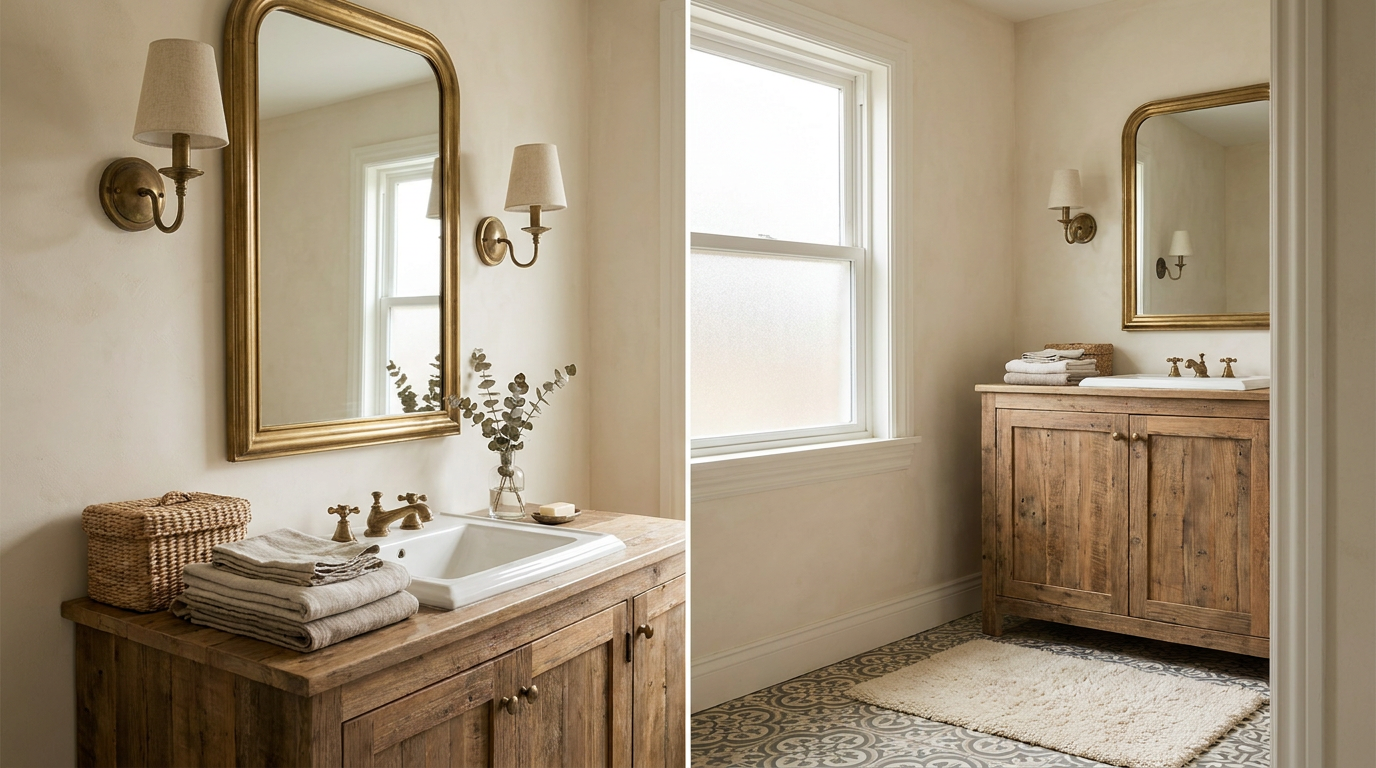
French interiors have long understood how to make utility feel beautiful. In a Paris apartment, a mirror may reflect a mantel, a sconce, or a tall window, contributing to the room’s gentle luminosity. In a French country home, a mirror often sits comfortably among limewashed finishes, aged wood, ceramic basins, and warm metal details. It participates in the room’s atmosphere without insisting on attention.
This distinction matters when choosing a mirror for a kitchen or bathroom. A mirror in a French inspired scheme is rarely oversized without reason, and rarely chosen in isolation. It relates to the vanity, the wall color, the tile tone, the faucet finish, and the surrounding light. It may be antique in feeling, softly curved, or subtly framed, but it remains practical. The result is elegance that feels lived in rather than staged.
French design also favors balance over perfection. A mirror does not need to be flamboyant to be memorable. The right edge detail, a delicate bevel, a muted wood frame, or a gently arched top can be enough to change the room’s character. In a modern kitchen, this softness can temper sleek cabinetry. In a bathroom, it can counter the severity of tile grids and stone surfaces.
If your aim is to create a kitchen or bathroom that feels elevated rather than merely updated, this perspective is useful. It suggests that the mirror should not just fill a wall. It should participate in the room’s harmony. That may mean reflecting a pendant, framing a beautiful backsplash, or introducing shape where too many lines have become rigid.
Choosing the Right Mirror for the Room
Shape and Proportion
The first decision is shape, and shape has more influence than many people expect. Rectangular mirrors remain the most common because they are practical and easy to align with vanities, backsplashes, and cabinets. However, round and arched mirrors are especially effective in kitchens and bathrooms because they soften the geometry of tile, stone, drawers, and appliances. In rooms that feel too angular, a curved top can introduce a welcome sense of ease.
Proportion is equally important. A mirror should feel connected to the furniture or architectural feature beneath it. Above a bathroom vanity, a mirror that is slightly narrower than the vanity often creates a balanced, tailored effect. In a kitchen, a decorative mirror above a sideboard, a beverage station, or a narrow wall section should feel scaled to the surrounding cabinetry rather than floating without relation.
One common misconception is that bigger is always better. Large mirrors often improve brightness and openness, but they can also overwhelm a room or reflect views you would rather conceal. If a mirror captures countertop clutter, exposed storage, or awkward adjacent walls, its size may work against the room. Measure thoughtfully, and think about what the mirror will reflect at eye level and from the room’s main entry point.
Frame and Finish
The frame determines much of the mirror’s personality. A slim black or bronze frame leans modern and architectural. A pale oak or walnut frame supports organic modern styling and pairs beautifully with natural stone and plaster tones. Brass or antique gold can evoke Parisian charm, especially when used with restraint and echoed in lighting or hardware.
In bathrooms inspired by French country style, wood framed mirrors and softly aged finishes feel especially at home. They bring warmth to white tile and painted cabinetry, and they can make a new space feel less generic. In more contemporary rooms, a beveled frameless mirror may offer a refined clarity while still reflecting light elegantly.
Edge treatment deserves attention too. Polished or beveled edges contribute to a more finished appearance, while raw or exposed edges can look abrupt unless the design intentionally calls for that simplicity. Since mirrors in kitchens and bathrooms are close to splashes and cleaning, edge quality also affects durability and ease of maintenance.
Standard Mirror, Heavy Mirror, or Medicine Cabinet
Not every mirror installation is equally simple. A standard decorative wall mirror is often the most straightforward project for a homeowner. Once the location is planned and the wall substrate understood, installation can be very manageable. A very large mirror, an extra heavy framed mirror, or a recessed or surface mounted medicine cabinet requires more planning and sometimes professional help.
Many homeowners assume that bathroom mirrors must be medicine cabinets, but that is no longer the defining rule of a functional bathroom. Decorative mirrors paired with efficient vanity storage can feel lighter, more decorative, and more current. If storage is limited, a medicine cabinet may still be the right answer, but it should be considered as one option among several, not an automatic default.
Where to Place a Mirror for Maximum Beauty and Function
Placement is where mirror installation becomes an art. In bathrooms, the mirror usually belongs above the vanity, but its exact position should respond to the sink width, faucet height, backsplash depth, and light fittings. A mirror centered only on the wall may look oddly disconnected if the vanity itself is offset or if sconces are installed asymmetrically. The mirror should relate first to the vanity composition, then to the room as a whole.
In accessible bathroom contexts, placement can also be shaped by code related guidelines. In the United States, the International Plumbing Code includes a mirror placement rule in certain accessible situations, noting that a mirror in the room may satisfy the requirement if its bottom edge is mounted no more than 35 inches above the floor. This does not govern every residential mirror project, but it illustrates an important principle: installation should account for intended users and local requirements, not just visual preference.
In Canada, code adoption varies by province and territory, and homeowners should confirm which locally adopted code edition applies before beginning work. Codes Canada materials emphasize safety, health, accessibility, energy efficiency, and building protection. If your project intersects with a renovation permit, plumbing modifications, accessibility requirements, or any glazed assembly concerns, local confirmation is essential. Product instructions and installer guidance also matter, especially if they are needed to demonstrate compliance.
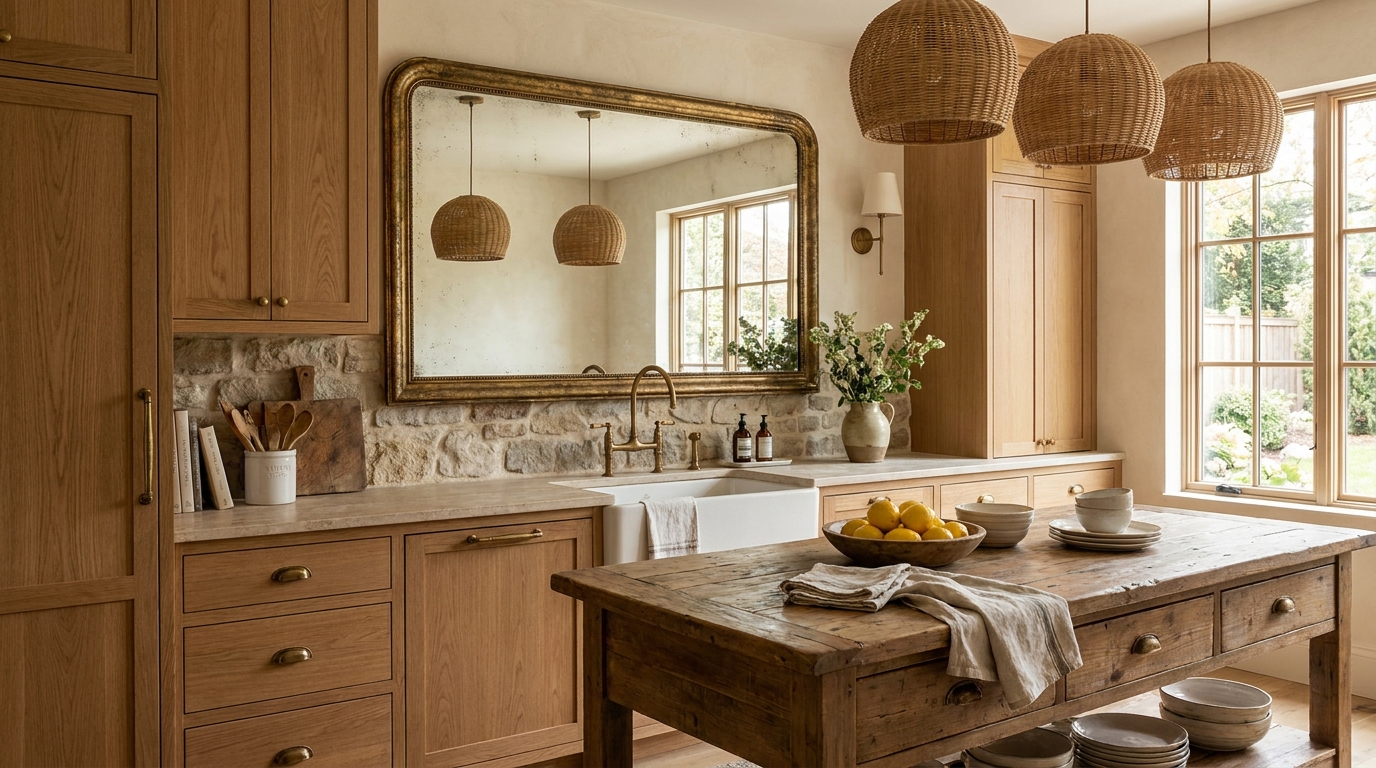
In kitchens, mirror placement is often more decorative than mandatory, which allows greater creativity. A mirror can brighten a breakfast corner, enlarge a pantry passage, or animate a coffee station. It can be placed on a wall opposite a window or adjacent to pendant lighting so that the room seems more luminous in the morning and more atmospheric at night. It should, however, avoid direct splash zones, high grease areas near the cooktop, and heat exposure that can affect longevity.
Before You Install: What to Check First
Preparation determines whether mirror installation feels smooth or stressful. Begin by studying the wall itself. Is it drywall, tile, plaster, or a combination of materials with a backsplash below? A fastening method that works beautifully on painted drywall may be wrong for tile or unsafe for a heavy framed mirror. The wall substrate tells you what anchors, screws, drill bits, and adhesive types are appropriate.
Weight is the second major consideration. Every mirror has a mounting requirement based on its size, construction, and frame. Never assume that decorative appearance means lightweight construction. A mirror with a substantial wood or metal frame may weigh far more than it looks. Use the manufacturer’s guidance if available, and choose mounting hardware rated well above the mirror’s actual weight for added security.
Bathrooms demand special attention to moisture. Humidity, steam, and repeated temperature shifts can weaken inappropriate adhesive, promote corrosion on low quality fasteners, and shorten the life of the installation. Choose corrosion resistant hardware and bathroom appropriate materials. In kitchens, grease and heat become the greater concerns, so mirror placement and cleaning access matter more than one might initially think.
It is also wise to think about reflection before drilling any holes. Stand where you usually enter the room, where you sit in the bath if applicable, and where you use the vanity or countertop. What will the mirror show? A beautiful window, pendant light, and stone wall can make a mirror sing. A cluttered shelf, exposed cords, or an awkward ceiling vent can undermine the effect.
Tools and Materials You May Need
The precise list depends on your wall type and mirror style, but most standard installations call for a measuring tape, painter’s tape, pencil, stud finder, level, drill, suitable drill bits, wall anchors, screws or specialized mirror hardware, and safety gear such as gloves and eye protection. Some installations also use mirror adhesive, though not every mirror should rely on adhesive alone. Always check the mirror manufacturer’s instructions before choosing a mounting method.
If you are drilling through tile, use the correct bit and proceed slowly to avoid cracking the surface. If you are working above a backsplash, account carefully for the change in depth so the mirror sits correctly and level. If the mirror includes a cleat system or D rings, follow that hardware logic rather than improvising your own system unless you are fully confident in load capacity and compatibility.
Step by Step: Installing a Standard Wall Mounted Mirror
Step 1: Measure the Wall and Mark the Ideal Placement
Start by measuring the width of the vanity, console, or wall area that will anchor the mirror visually. Mark the center line with painter’s tape or a light pencil mark. Then mark the desired top and bottom edges of the mirror. In a bathroom, leave enough clearance above the faucet and backsplash so the mirror feels intentional and easy to clean around. In a kitchen, consider nearby shelves, sconces, outlet locations, and cabinet doors.
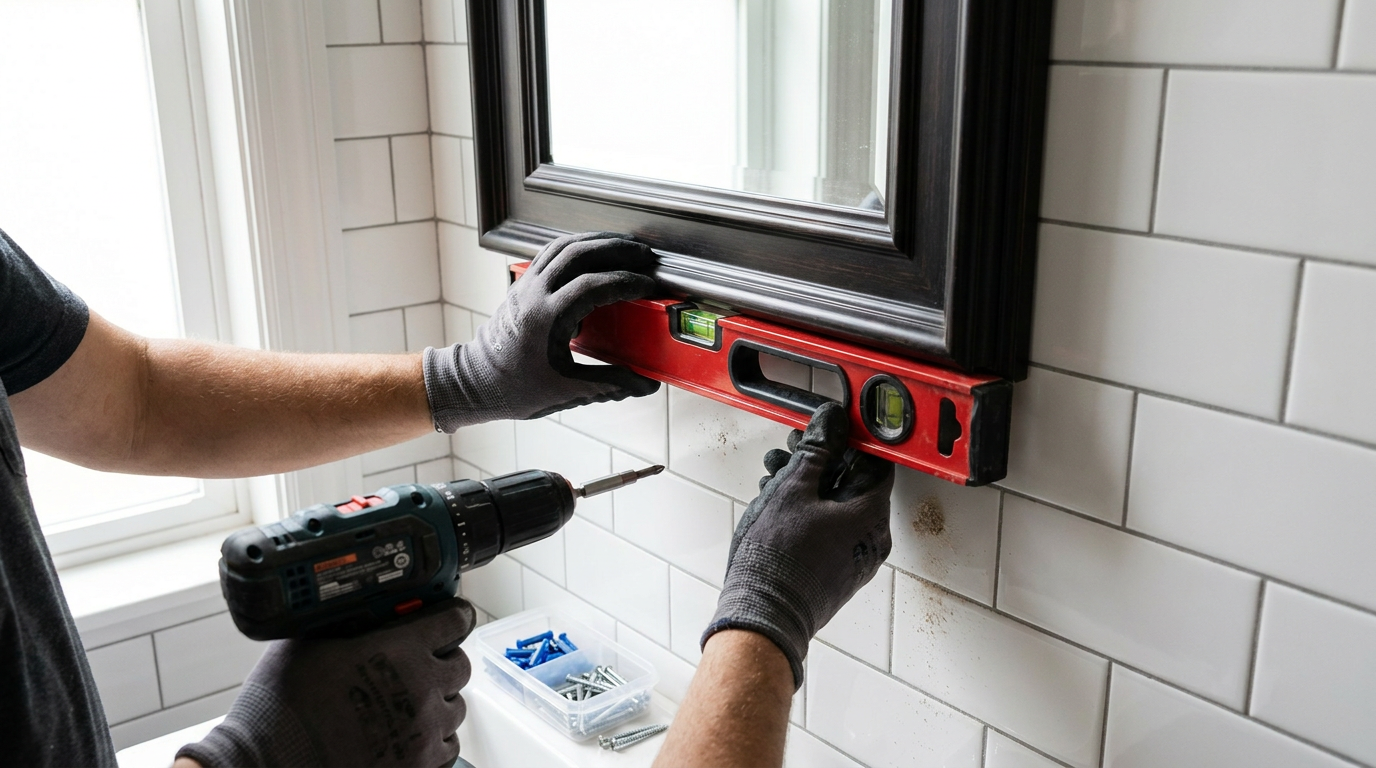
Use a level to draw or tape temporary guidelines. This stage may seem modest, but it is what preserves elegance in the final result. A mirror that is even slightly off center or uneven can make the room feel unsettled. In a space shaped by symmetry, such as a French inspired bathroom with paired sconces, precise alignment is especially important.
Step 2: Locate Studs and Assess the Wall
Use a stud finder to identify framing where possible. Mounting into studs is the most secure option for heavier mirrors. If the mounting points do not align with studs, select anchors designed for the mirror’s full weight and suitable for the specific wall type. Drywall anchors vary widely in capacity, and tile installations may require a different assembly entirely.
This is also the time to look for practical conflicts. In bathrooms and kitchens, walls may contain plumbing lines, wiring, or vent paths. If you are unsure what lies behind the wall, especially in renovated older homes, proceed cautiously. Heavy mirrors or complex placements near fixtures justify extra diligence and, in some cases, a professional consultation.
Step 3: Install Mounting Hardware
Once your marks are confirmed, drill pilot holes where needed and install the chosen anchors or hardware. If the mirror uses a cleat, mount the wall portion first and verify that it is perfectly level. If it hangs from D rings or keyhole brackets, measure the distance between hanging points carefully so the installed screws correspond exactly. Small measuring errors become very visible once the mirror is in place.
For installations that include mirror adhesive, remember an important truth: not every adhesive is appropriate. This is one of the most common misconceptions in mirror projects. Use only adhesive approved for mirrors and suitable for the wall substrate and room conditions. Some products can damage mirror backing, while others may not perform well in humidity. Adhesive also does not replace proper mechanical support when the manufacturer requires hardware.
Step 4: Hang the Mirror and Check Alignment
Lift the mirror into place carefully, ideally with a second person if the mirror is medium to heavy. Set it onto the hardware and let it rest fully before releasing your grip. Step back immediately and check level, centering, and sightlines. This is the moment to make slight adjustments before considering the work complete.
In bathrooms, check the relationship between the mirror and lighting. If sconces flank the mirror, the spacing should feel balanced and the reflected light should be flattering rather than harsh. In kitchens, look at how the mirror reflects windows, cabinetry, and countertops. The right mirror placement should make the room feel calmer and brighter, not busier.
Step 5: Finish and Protect the Installation
Once the mirror is secure, inspect edges, hardware visibility, and surrounding wall surfaces. Clean the glass with a non abrasive cleaner and a soft cloth. If the installation method or manufacturer instructions call for edge sealing or specific spacing from wet areas, complete that detail carefully. Good finishing is often what distinguishes a merely completed project from one that feels professionally executed.
Then allow the room to settle. View the mirror in daylight, evening light, and task lighting. A successful installation should enhance the room at all hours. The mirror should feel integrated, not imposed. If it catches a window, doubles candlelight, or softens a hard corner, it is doing more than hanging on the wall. It is contributing to the room’s character.
Special Considerations for Bathrooms
Bathrooms combine moisture, daily use, and close range visibility, which means details matter more here than in many other rooms. Corrosion resistant fasteners are essential, especially near showers, tubs, and sinks. Proper ventilation helps preserve both the mirror and the wall behind it. If your bathroom suffers from frequent condensation, address the ventilation issue as part of the upgrade rather than asking the mirror to endure an unhealthy environment.
Local code can also be relevant in less obvious ways. If your project involves a medicine cabinet, changes around plumbing fixtures, or glass near hazardous locations, safety rules may apply. In North America, the International Building Code and related state rules can require safety glazing and identification in certain hazardous locations. While a standard decorative wall mirror is not automatically governed in the same way as a glazed door assembly, the principle remains important when a mirror is integrated into more complex construction or installed where breakage risk is a concern.
Height is not only a visual matter. It affects usability for everyone who shares the room. In family bathrooms and future proofed homes, positioning the mirror with accessibility in mind is simply gracious design. A room that is elegant and easy to use has a kind of quiet luxury all its own.
Special Considerations for Kitchens
Kitchen mirrors are less conventional than bathroom mirrors, which is precisely why they can be so interesting. They bring an unexpected layer of depth to hardworking spaces and can make compact layouts feel far more generous. Yet the kitchen asks for selectivity. Avoid placing a mirror where it will catch persistent grease, direct stove heat, or constant sink splash. A beautiful mirror is less compelling if it becomes difficult to maintain.
The most successful kitchen mirror placements usually reflect something lovely and stable. A window, pendant lights, open shelving with restrained styling, or a stone backsplash can all benefit from repetition in reflection. In a French inspired kitchen, a mirror above a sideboard or beverage station can feel especially natural, as if it has always belonged there. It adds depth without competing with the cabinetry.
If the kitchen already has many glossy surfaces, such as lacquer cabinetry or highly polished stone, consider a framed mirror that brings texture and visual grounding. If the room is matte and tonal, a beveled or lightly antiqued mirror can add subtle sparkle. The key is balance. A mirror should enrich the room’s rhythm, not create visual noise.
Common Mistakes to Avoid
Many mirror problems begin with assumptions. Homeowners often assume the mirror should be centered on the wall without considering the vanity or cabinetry beneath it. Others assume any adhesive will do, or that mounting into drywall is sufficient for every weight category. These shortcuts are risky because mirrors are not weightless decorations. They are glass objects that need secure, environment appropriate support.
Another frequent mistake is choosing a mirror based only on shape trends without studying the room’s practical needs. Circular and arched mirrors remain popular for good reason, but they must still suit the wall height, vanity width, and lighting plan. A beautiful mirror that leaves too little room for sconces or reflects clutter constantly will not feel elegant for long.
There is also the temptation to oversize for drama. Large mirrors can be marvelous, especially in small spaces, but scale should remain in dialogue with everything around it. In French design, beauty often comes from proportion rather than sheer size. A modestly scaled mirror with the right frame and positioning can feel much more luxurious than one that dominates the room carelessly.
When to Call a Professional
There is no loss of style in knowing when a project exceeds the boundaries of easy DIY. If the mirror is unusually heavy, if the wall is tiled in a way that makes drilling risky, if the installation involves electrical or plumbing adjustments nearby, or if code compliance is uncertain, professional help is the wise choice. This is particularly true for recessed medicine cabinets, custom wall to wall mirrors, or installations in older homes where wall conditions may be unpredictable.
Professional installers also bring confidence to challenging materials such as stone, porcelain slab, and uneven plaster walls. In some cases, their fee protects the mirror, the wall finish, and your peace of mind. Elegance is not only about appearance. It is also about durability and calm. A beautifully installed mirror should feel secure for years, not merely acceptable on the day it is hung.
Styling the Finished Space
Once the mirror is installed, the room around it can be edited to make the reflection work in your favor. In bathrooms, this may mean reducing countertop clutter, adding a pair of refined sconces, or introducing a small vase of branches that the mirror can echo. In kitchens, it may mean simplifying open shelves or choosing a pendant that looks especially beautiful when seen twice, once directly and once in reflection.
French inspired styling works best when it feels composed but not rigid. Pair a warm wood mirror frame with creamy walls, unlacquered brass, a stone tray, or linen hand towels. Let there be texture and patina. If the mirror is more formal, soften the room with organic shapes and muted materials. If the mirror is simple, give it context with layered lighting and tactile finishes.
What you are shaping, in the end, is not just a room but an experience. The first light in the morning, the warm reflection of evening sconces, the sense of depth in a once narrow bathroom, the quiet glamour of a kitchen corner that suddenly feels intentional. These are subtle shifts, but they are the shifts that make a home feel cared for.
A Final Reflection
Installing a mirror in the kitchen or bathroom may begin as a practical project, but it often ends as a lesson in design clarity. It asks you to consider proportion, reflection, light, hardware, moisture, and daily habit all at once. That combination of utility and beauty is precisely what makes the project so satisfying. With good planning, the right materials, and a sensitivity to the room’s character, even a simple mirror can transform the space around it.
For homeowners drawn to French inspired interiors, mirrors offer a particularly graceful opportunity. They embody elegance without excess. They support function while enriching atmosphere. They soften, brighten, and enlarge while remaining quietly useful. In rooms devoted to routine, they make daily life feel more composed.
Before you begin, confirm local code considerations where relevant, especially if your project is complex or tied to broader renovation work. Respect the wall type, choose hardware and adhesive carefully, and never treat installation details as secondary. A mirror deserves the same thoughtfulness as any other architectural finish. When it is placed well and mounted properly, it does not simply reflect elegance. It creates it.
Quick Reference Checklist Before You Hang Your Mirror
- Confirm the purpose of the mirror so the size, shape, and placement suit both function and style.
- Measure the wall and surrounding features including vanity width, backsplash height, sconces, shelves, and clearances.
- Study what the mirror will reflect because the reflected view is part of the design.
- Check the wall substrate whether drywall, tile, plaster, or stone, and match hardware accordingly.
- Verify the mirror’s weight and manufacturer instructions before selecting anchors, screws, or adhesive.
- Use corrosion resistant and room appropriate materials especially in humid bathrooms.
- Review local code requirements if applicable particularly for accessibility, plumbing related renovations, or glazing safety concerns.
- Install with precision using a level, secure fastening, and assistance for heavier mirrors.
- Finish thoughtfully by cleaning the glass, inspecting alignment, and editing the room around the reflection.
With these steps in place, your kitchen or bathroom mirror can become more than a useful object. It can become one of the room’s most eloquent features, catching light, extending space, and lending your home the kind of polished ease that never goes out of style.


No Comment! Be the first one.