



Transform Your Space With Stylish Open Shelving in Kitchens and Bathrooms
Open shelving has a way of changing the mood of a room almost instantly. A wall that once felt heavy with upper cabinets or visually empty above a counter can become lighter, more gracious, and far more personal with a few beautifully placed shelves. In kitchens and bathrooms especially, open shelving introduces a sense of rhythm and calm. It invites your most useful objects into view and turns everyday routines into something a little more deliberate, a little more beautiful.
Table Of Content
- Why Open Shelving Still Feels So Fresh
- The Balance Between Functionality and Beauty
- Where Open Shelving Works Best in the Kitchen
- Best Kitchen Items for Open Shelves
- Where Open Shelving Works Best in the Bathroom
- French Elegant Style Cues for Open Shelving
- How to Decide If Open Shelving Is Right for Your Home
- Step by Step DIY Guide to Building Elegant Open Shelving
- Step 1: Choose the Right Location
- Step 2: Select Moisture Conscious Materials
- Step 3: Find the Studs and Plan for Load
- Step 4: Measure and Cut the Shelves
- Step 5: Install the Brackets Level and Secure
- Step 6: Attach the Shelf Boards
- Step 7: Style With Restraint
- Simple Styling Formulas That Always Work
- Maintenance Matters More Than Most People Expect
- Common Mistakes to Avoid
- How Open Shelving Changes the Feeling of a Room
- Final Thoughts
There is, however, a difference between shelves that merely look charming in a photograph and shelves that truly work in daily life. The most successful open shelving is never only decorative, and it is never only practical. It lives in the balance between the two. A stack of everyday plates becomes part of the room’s composition. Fresh towels folded in simple symmetry become both storage and texture. A small row of spice jars or apothecary bottles becomes an act of visual order as much as convenience.
Recent renovation coverage continues to show that open shelving remains relevant in contemporary kitchens, especially when paired with other forms of hidden storage. Houzz has reported open shelving as a common feature in kitchen remodels and a frequent choice in butler’s pantries, which tells us something important about how homeowners are really using it. They are not replacing every cabinet with exposed storage. They are choosing open shelves selectively, using them where easy access, styling, and architectural lightness matter most.
That is the heart of this guide. Rather than treating open shelving as an all or nothing design move, we will approach it as a refined and highly livable solution for kitchens and bathrooms. Inspired by French elegance, informed by practical renovation wisdom, and grounded in moisture conscious design, this article will help you decide where open shelving belongs, how to build it well, and how to style it so it remains graceful long after the renovation dust settles.
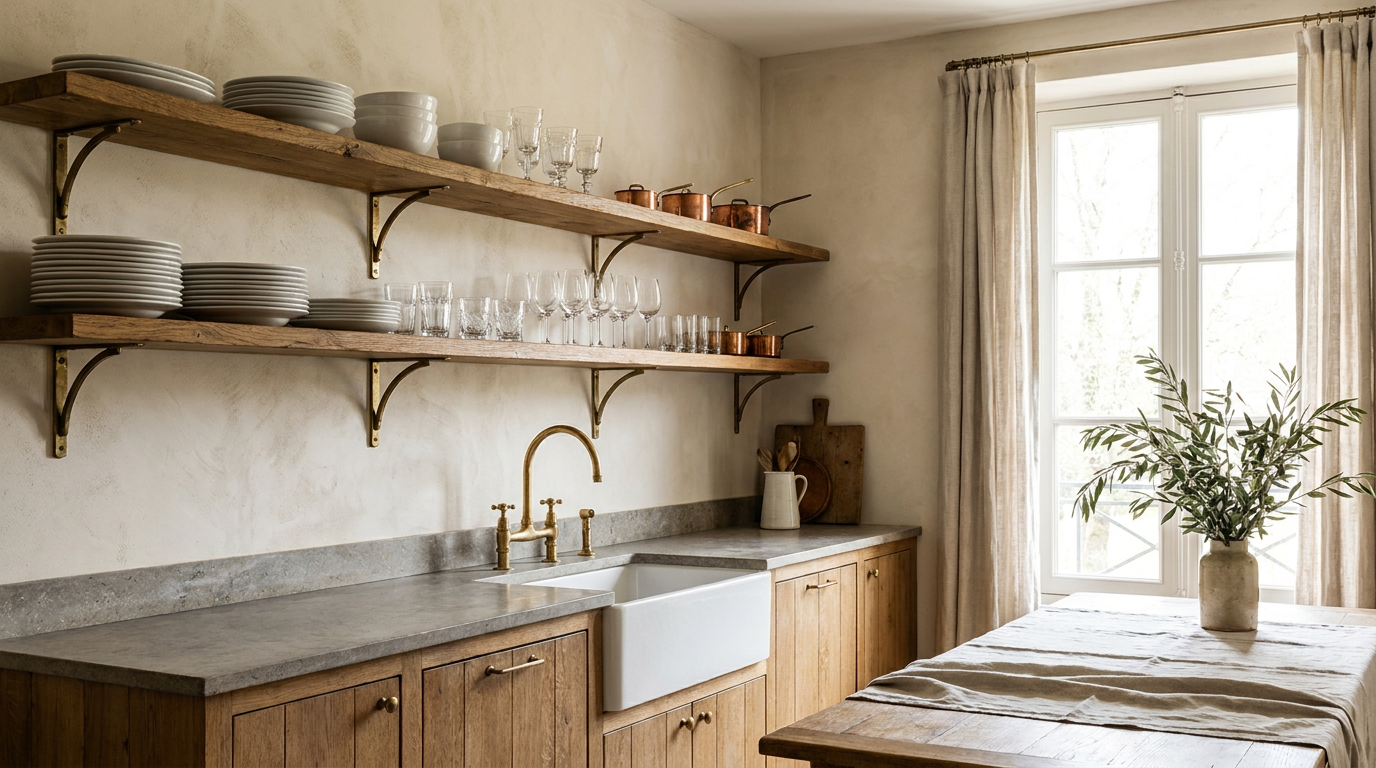
Why Open Shelving Still Feels So Fresh
Although open shelving has been discussed for years, its appeal endures because it answers several needs at once. It can make a compact room feel visually larger by reducing the blocky mass of closed cabinetry. It can also soften a highly fitted kitchen or bathroom by introducing a more relaxed, lived in quality. Most importantly, it allows the objects you use every day to participate in the room’s design rather than disappearing behind doors.
There is also a cultural shift behind its popularity. Today’s interiors are increasingly curated rather than overfilled. People want homes that feel edited, calm, and intentional. Open shelving supports that desire beautifully because it asks for restraint. You do not place everything on display. You choose what deserves visibility, what benefits from quick access, and what contributes to a sense of order.
French inspired interiors have long understood this principle. In a classic French country kitchen, shelves often carry ceramic pitchers, stacked earthenware, glass canisters, and a handful of vintage pieces that suggest history without clutter. Architectural design coverage of French country kitchens often highlights honed stone, aged hardware, furniture like cabinetry, and open shelves holding useful yet charming objects. The effect is not showroom perfection. It is quiet beauty shaped by use.
Bathrooms can benefit from the same philosophy. A carefully placed shelf with folded towels, a soap dish, a stone jar for cotton rounds, and a small basket can feel more serene than a crowded vanity top or overstuffed cabinet. Open shelving, when it is not overloaded, makes daily rituals easier. It also creates visual breathing room, which is often exactly what smaller bathrooms lack.
The Balance Between Functionality and Beauty
If there is one misconception worth releasing, it is that open shelving is only decorative. It can be deeply functional when used in the right places and for the right items. In the kitchen, shelves can hold the dishes and glasses you reach for every day, keeping them close at hand and reducing the need to open and close doors constantly. In the bathroom, shelves can keep frequently used hand towels, skincare essentials, and baskets within easy reach.
At the same time, open shelving should not be asked to do what closed storage does best. Bulk packages, visual clutter, cleaning products, and moisture sensitive extras are usually better hidden away. The most elegant and realistic approach is hybrid storage. Let open shelves carry the beautiful and frequently used pieces. Let cabinets and drawers hold the practical overflow, the unattractive packaging, and the objects that tend to create disorder.
This balance is also what keeps the room feeling sophisticated rather than busy. When every inch of shelf depth is packed tightly with mixed objects, the visual effect can become restless. When the shelves are lightly styled and sensibly used, they feel effortless. Think of them as edited vignettes with a purpose. A shelf should serve you first, but it should also leave room for the wall behind it, whether that wall is tiled, paneled, painted, or finished in plaster.
The most beautiful open shelving is not about showing everything. It is about revealing the right things in the right place, with enough restraint that the room still feels calm.
Where Open Shelving Works Best in the Kitchen
In kitchens, placement matters more than almost anything else. A shelf can be visually perfect and still become inconvenient if it is installed in the wrong zone. Open shelving tends to work best where the items stored are naturally used nearby. For example, shelves near a prep zone can hold mixing bowls, oils, spices, or favorite dishes. Shelves near a coffee station can hold mugs, cups, and small jars. Shelves near a dining area may beautifully support glassware and serving pieces.
It is wise, however, to be selective near high grease and splash areas. Open shelves beside a stove usually need more frequent wiping because grease and dust settle faster there. Shelves immediately beside a sink can collect water spots and soap residue. This does not mean these locations are impossible, only that they ask more of you in maintenance. If you adore the look in those zones, keep the shelf contents simple and easy to clean.
Another important principle is accessibility. Frequently used items should live on lower or middle shelves where they can be reached comfortably. Less often used pieces can occupy higher shelves, but anything heavy should remain at a height that feels secure. A kitchen shelf should support your rhythm, not interrupt it. The elegance of a room always suffers when beauty requires awkward movement.
Open shelving is especially effective in kitchens that already have adequate lower cabinets or pantry storage. In those settings, it becomes a graceful complement rather than a desperate storage solution. That is one reason it appears so often in butler’s pantries and curated renovation projects. There is enough hidden storage elsewhere to allow the open shelves to breathe.
Best Kitchen Items for Open Shelves
Certain objects lend themselves naturally to open shelving because they are both useful and visually pleasing. Everyday plates, bowls, mugs, stemless glasses, and neutral serving pieces create an orderly and attractive display. Small jars of dry goods or spices can work beautifully if they are decanted into coordinated containers. A ceramic pitcher, a vintage cutting board, or a small framed artwork can add warmth without overwhelming the function of the shelf.
Consistency helps. If your dishes vary wildly in color, size, or style, the shelf may feel chaotic. A restrained palette of whites, creams, soft grays, warm taupes, or muted greens often works well in French inspired interiors. Materials matter too. Ceramics, stoneware, glass, and wood all carry texture and age gracefully.
Where Open Shelving Works Best in the Bathroom
Bathrooms ask for a slightly different mindset because moisture is such an important factor. Health and building guidance consistently emphasize that humidity, condensation, and poor ventilation create favorable conditions for mold. CMHC advises adequate bathroom ventilation that vents condensation, moisture, and odors directly outside. Sources connected to NIEHS and WHO likewise stress that moisture control and proper ventilation are essential for preventing mold growth indoors.
This means the first rule of bathroom shelving is to place it in a drier zone whenever possible. A wall above the toilet, an open area beside the vanity, or a section of wall opposite the shower is often more suitable than a shelf directly beside a tub or in the path of spray. Even beautiful materials can suffer when they are repeatedly exposed to water and steam without enough air movement.
The second rule is to store the right things. Bathroom open shelves are ideal for folded towels, lidded jars, soap, daily skincare in attractive containers, woven baskets, and perhaps a candle or small vase. They are less ideal for overstock items in disposable packaging, medications, or anything you would rather keep dust free and private. Again, open shelving does best when it is part of a broader storage plan, not the entire system.
A bathroom shelf can also make a modest room feel more layered and architectural. In many homes, bathrooms are composed of hard surfaces and utilitarian fixtures. Shelves introduce warmth through wood, stone, metal, and textiles. A simple wooden plank on elegant brackets can soften a tiled wall and make the whole room feel more considered.
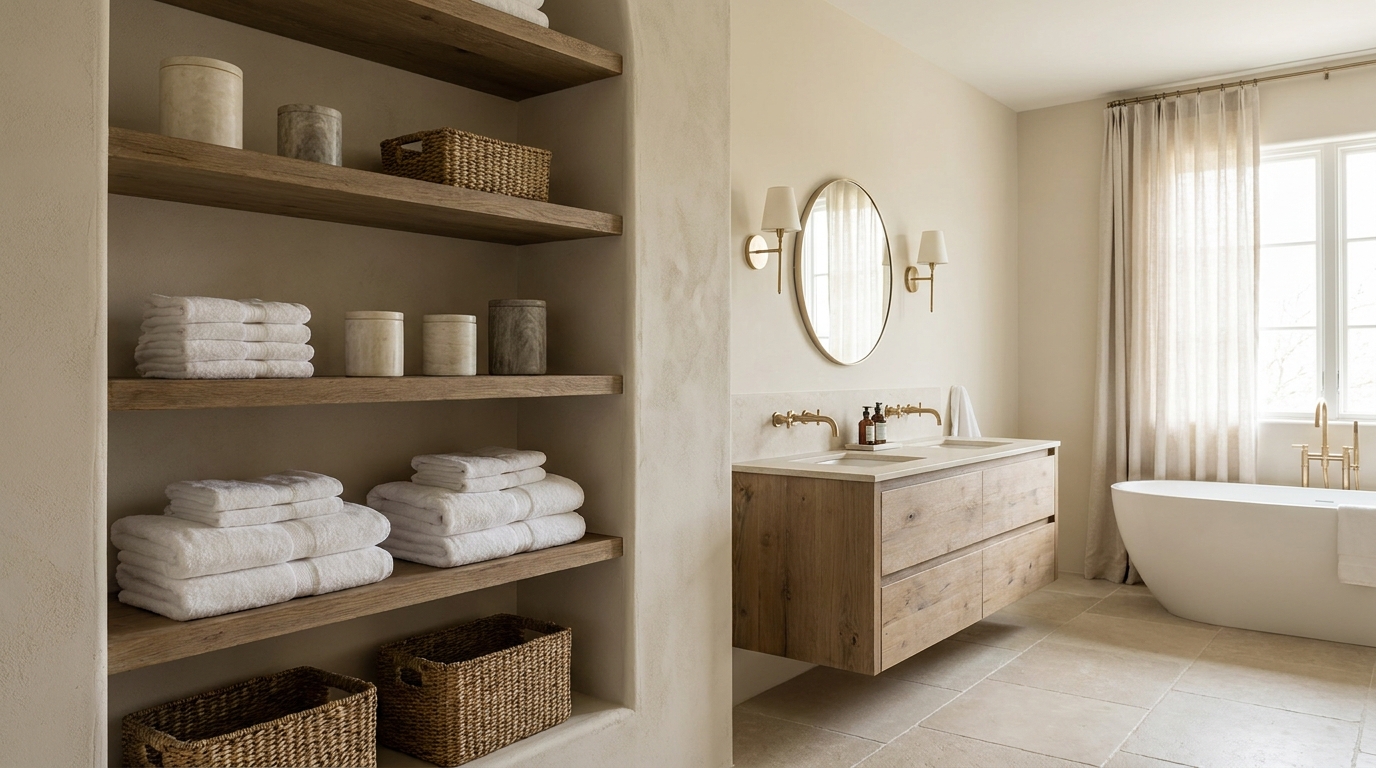
French Elegant Style Cues for Open Shelving
To give open shelving a refined French character, begin with the materials. Warm woods are especially effective because they lend softness and a sense of age. Oak, ash, walnut toned finishes, or pine with a subtle matte stain can all work beautifully depending on your home. The goal is not a glossy or overly modern plank, but a shelf with tactile warmth and believable presence.
Metal hardware should feel timeless rather than trendy. Aged brass, antique bronze, soft black iron, or brushed nickel can all suit a French leaning scheme if the shape is graceful and not overly industrial. Brackets can become part of the composition. Slim, curved, or classically simple supports often feel more elegant than chunky utilitarian ones, though strength should never be sacrificed for appearance.
Then turn to the objects themselves. French inspired styling often includes ceramics with slight irregularity, stacked white dishes, glass carafes, stone jars, linen textiles, and a few vintage or antique inspired accessories. Think of the shelf as a still life that happens to be useful. One of the loveliest qualities of French influenced rooms is that nothing seems placed only to impress. Beauty emerges from everyday objects chosen well and arranged lightly.
Color palette plays a quiet but decisive role. Cream, parchment, soft mushroom, dusty sage, pale gray, and chalky white all create a calm envelope for shelving. Against these tones, natural wood and muted ceramics become more expressive. If you have a backsplash of handmade tile, stone, or lime washed plaster, open shelving allows more of that surface to remain visible, which adds depth and architectural character.
How to Decide If Open Shelving Is Right for Your Home
Before you begin measuring walls or shopping for brackets, pause to assess your habits honestly. Do you appreciate visible order, or do you prefer everything hidden away? Are you willing to wipe shelves regularly, especially in a kitchen? Does your bathroom have good ventilation, and do you use the exhaust fan consistently? The success of open shelving depends as much on lifestyle as style.
It also helps to evaluate what you truly need to store. If your kitchen is already overflowing with small appliances, bulk pantry goods, and mismatched dishware, replacing too many cabinets with open shelves may feel frustrating. If your bathroom lacks drawer storage entirely, open shelves alone may not solve the room’s needs. But if you have enough concealed storage elsewhere, then open shelving can be a wonderful finishing layer.
One useful exercise is to gather the items you imagine placing on the shelves and look at them together. Do they share a palette or material story? Are they actually used often? Would they look more composed if a few were stored elsewhere? This simple test can reveal whether your vision is practical or whether you are asking the shelf to solve too many problems at once.
Step by Step DIY Guide to Building Elegant Open Shelving
Once you have chosen the right wall and clarified your storage plan, you can move into the building phase. While open shelving is among the more approachable DIY projects, it still deserves care. In kitchens and bathrooms especially, sturdiness, anchoring, and material durability matter more than decorative details alone. A beautiful shelf that sags, rusts, or loosens over time quickly loses its charm.
Step 1: Choose the Right Location
Stand in the room and study how you move through it. In the kitchen, identify a wall where shelves will be convenient but not exposed to excessive grease or constant splashing. In the bathroom, choose a wall in a drier area with decent airflow. Make sure the shelf will not interfere with doors, mirrors, faucets, or lighting.
Mark out a rough width and height with painter’s tape. This helps you visualize the scale and spacing before making any holes. A taped outline often reveals proportions more clearly than measurements on paper. It can also help you confirm that the shelf feels balanced relative to nearby cabinetry, tile lines, or architectural features.
Step 2: Select Moisture Conscious Materials
Use shelf boards that can tolerate the conditions of the room. Solid wood can be beautiful, but it should be sealed with a wipeable finish suited to kitchens or bathrooms. Plywood with a high quality veneer can also perform well if the edges are properly finished. In very humid bathrooms, moisture resistant materials and well sealed surfaces are especially important.
Choose corrosion resistant brackets and screws, particularly in bathrooms. Hardware in brass, stainless steel, powder coated metal, or finishes designed for damp environments will generally age better than low quality untreated metal. Even in elegant spaces, practicality must lead the specification.
Step 3: Find the Studs and Plan for Load
Use a stud finder to locate framing behind the wall. Mark the studs clearly with pencil. Anchoring into studs is one of the most important parts of a safe shelf installation, especially if the shelf will hold dishes, jars, or stacked towels. Decorative floating systems can be lovely, but they still need proper structural support appropriate to the load.
Think carefully about what the shelf will hold and choose brackets and spacing accordingly. Heavier items need stronger support and often more frequent brackets. There is no elegance in a shelf that bows. It is always better to overbuild than to rely on appearance alone.
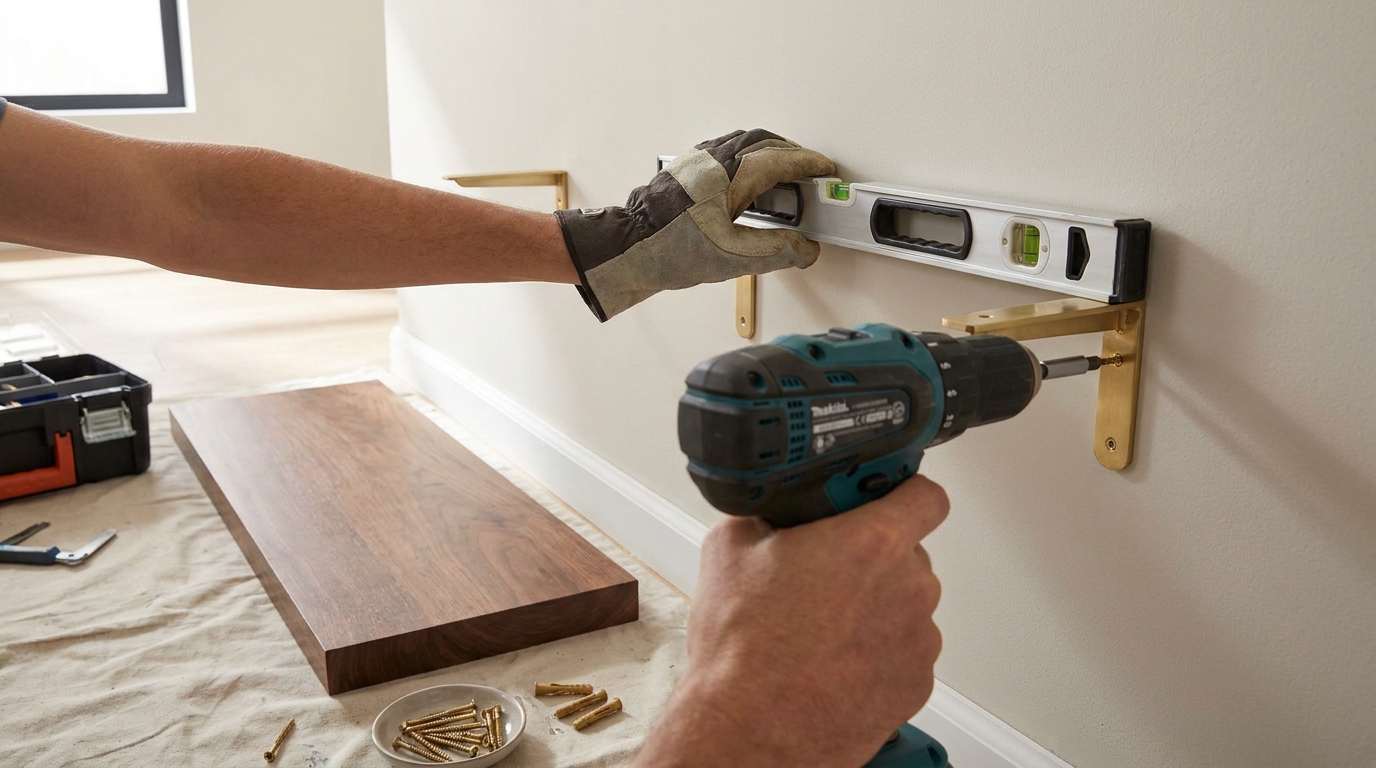
Step 4: Measure and Cut the Shelves
Measure your shelf length carefully, then cut the boards to size or have them cut at the supplier. Sand all surfaces and edges until smooth. If you want a refined, furniture like look, soften the corners slightly rather than leaving them sharp. This small detail can make the shelf feel more bespoke and less utilitarian.
Apply your chosen finish before installation when possible. A matte or satin protective coat tends to suit French inspired interiors better than a high gloss finish. Let the boards cure fully according to product instructions so they are durable and not tacky once installed.
Step 5: Install the Brackets Level and Secure
Using a level, mark the line where the shelf will sit. Pre drill as needed, then mount the brackets securely into studs or appropriate heavy duty anchors if stud placement is limited. Check the level again before tightening fully. Precision here matters because even a slight tilt becomes visible once objects are placed on the shelf.
Bracket spacing should feel balanced and structurally sound. In many designs, two brackets are sufficient for shorter spans, while longer shelves may require three or more. Follow the hardware manufacturer’s load guidance whenever available, and never assume a decorative bracket can carry substantial weight without verification.
Step 6: Attach the Shelf Boards
Set the shelf board onto the brackets and confirm the fit. If your bracket design includes screws from below or hidden fasteners, secure the board accordingly. Give the shelf a gentle but firm test before styling it. It should feel stable, with no wobble or movement.
Take a final moment to wipe the shelf clean and inspect the finish. In elegant interiors, craftsmanship is often revealed in the quiet details. Smooth edges, straight lines, and a thoughtful finish will make even a simple DIY shelf feel sophisticated.
Step 7: Style With Restraint
Now comes the part most people look forward to, though it is often where the room succeeds or fails visually. Begin by placing the most functional items first. In a kitchen, that may be stacks of plates, bowls, and glasses. In a bathroom, it may be folded towels and a couple of everyday jars. Once the essentials are in place, add only a few decorative touches.
Leave negative space between groupings so the shelf can breathe. Vary heights gently but avoid too many competing forms. Repetition creates serenity. Three stacks of similar plates will often look better than one shelf crowded with unrelated objects. Let the wall remain visible, and let each piece have room to contribute.
Simple Styling Formulas That Always Work
If styling feels intimidating, a few timeless formulas can help. In the kitchen, try a combination of stacked dishes, clear glassware, one ceramic vessel, and one small board or framed piece at the back. In the bathroom, try folded towels, one lidded container, one woven basket, and one discreet decorative object such as a small vase or candle.
Texture is often more important than color. Matte ceramics, soft linen, aged wood, and brushed metal create visual richness without noise. This is one reason French inspired rooms feel so inviting. They rely on tactile harmony rather than strong contrast. Even a modest shelf can feel luxurious when the materials speak gently to one another.
It is also wise to edit seasonally. Remove what is not being used, wipe everything down, and restyle lightly. Open shelving is not static. It benefits from attention, but not constant reinvention. A little curation now and then is enough to keep it feeling fresh.
Maintenance Matters More Than Most People Expect
One of the clearest truths about open shelving is that it rewards good habits. Kitchen shelves collect grease, dust, and splatters more quickly than closed cabinets, particularly near cooking areas. That is why many design and lifestyle sources recommend using them for frequently used items that are naturally rotated and washed often. If you place an object on an open shelf and never touch it, expect it to gather residue.
Bathroom shelves require a different kind of attention. The greater concern is moisture. If your bathroom tends to stay humid after showers, use the exhaust fan consistently and allow the room to dry out properly. Moisture control is not just a matter of protecting aesthetics. It supports healthier indoor air quality and helps reduce the conditions that encourage mold growth.
A simple maintenance rhythm is usually enough. In the kitchen, wipe shelves weekly or every other week depending on placement. In the bathroom, dry any visible condensation promptly and clean surfaces regularly with appropriate products. Check brackets and fasteners occasionally to ensure they remain tight and secure. A shelf should age gracefully, not invisibly loosen over time.
Common Mistakes to Avoid
-
Using open shelves to replace all upper storage. Most homes function better with a mix of open and closed storage. Open shelves are best when used intentionally, not excessively.
-
Placing shelves in the wettest or greasiest possible zones. Shelves too close to shower spray, stove splatter, or constant sink splash demand much more upkeep and may age poorly.
-
Ignoring wall structure. Beautiful brackets are not enough. Proper stud anchoring, suitable hardware, and realistic load planning are essential.
-
Overstyling. Too many small accessories can make the shelf feel cluttered and can also create more surfaces to clean. Elegance almost always comes from restraint.
-
Choosing the wrong finish. Unsealed wood or low quality metal may struggle in kitchens and bathrooms. Durable, wipeable, moisture aware finishes are always worth the effort.
How Open Shelving Changes the Feeling of a Room
What makes open shelving so enduring is not merely that it stores objects. It changes the architecture of daily life. A kitchen becomes more open, more breathable, more sociable. A bathroom feels less clinical and more composed. Shelves draw the eye upward and outward, encouraging the room to feel curated rather than purely utilitarian.
There is something emotionally generous about being able to see the things you use and love. A favorite set of bowls, a row of glasses that catch morning light, linen towels folded with care, a ceramic vessel collected on a journey. These are ordinary things, and yet when displayed thoughtfully, they bring character into the room. They remind us that function and beauty need never be separate ambitions.
French elegance has always understood this union. It does not rely on excess. It relies on atmosphere, proportion, and the quiet dignity of materials used well. Open shelving can embody that spirit perfectly when it is built with integrity and styled with a light hand. It turns storage into composition and daily routine into a small visual pleasure.
Final Thoughts
If you are considering a kitchen or bathroom refresh, open shelving can be one of the most transformative additions you make. It is approachable enough for a confident DIY project and expressive enough to reshape the whole mood of a space. The key is to think beyond trend and focus on placement, moisture awareness, material quality, and editing. When those elements come together, the result feels timeless.
Let your shelves hold what is useful, beautiful, and genuinely part of your life. Let closed storage handle the clutter. Choose warm woods, graceful hardware, and a palette that gives the room softness. Keep ventilation and cleaning in mind, especially in bathrooms and near active kitchen zones. In that balance of practicality and poetry, open shelving becomes not just a storage solution, but a design gesture with enduring charm.
And perhaps that is its greatest gift. It teaches us to live with a little more intention. To keep only what serves and delights. To make room for light, texture, and air. To let the everyday become, in its quiet way, exquisite.


No Comment! Be the first one.