



Industrialized construction is one of those terms that sounds more complicated than it needs to be. At its core, it means moving a larger share of building work away from the open jobsite and into a controlled factory or plant environment. Instead of framing, assembling, and finishing everything piece by piece in the weather, teams manufacture panels, components, or full volumetric modules under controlled conditions and then transport them to the site for installation. It is still construction, but the delivery method is different, and that difference matters.
Table Of Content
- What Industrialized Construction Means in Real Terms
- Why the Industry Is Paying More Attention Now
- The Main Types of Industrialized Construction
- How the Process Works from Design to Installation
- Where Industrialized Construction Works Best
- The Schedule Advantage and Why It Matters
- The Cost Question: Better Economics, but Not Automatically Lower Prices
- Quality Control and Build Performance
- Why Sustainability Is a Real Part of the Conversation
- Common Misconceptions That Need Clearing Up
- The Real Challenges and Limitations
- How Owners and Project Teams Can Use It Well
- What the Future Likely Looks Like
- Final Takeaway
For owners, developers, builders, and even everyday readers trying to understand where the industry is headed, industrialized construction is worth paying attention to because it addresses several long-standing problems at once. It can shorten schedules, reduce waste, improve consistency, and make better use of labor. It also fits the current pressures facing the building sector in Canada and the United States, where housing demand is high, productivity growth has been weak, and skilled labor is hard to find in many markets. Those realities are pushing builders to look for methods that are more repeatable and less vulnerable to the usual jobsite disruptions.
That said, industrialized construction should not be treated like a miracle cure. It is not a universal replacement for conventional construction, and it does not make every project cheaper or easier. The projects that benefit most tend to have repeatable layouts, enough scale to support manufacturing, solid early planning, and a team that understands how to design for off-site production and on-site assembly. When those conditions are in place, industrialized construction can be a practical and powerful delivery system. When they are not, the promised advantages can disappear quickly.
This article takes a grounded look at what industrialized construction actually includes, how it works in practice, where it performs best, and what owners and project teams need to understand before choosing it. The goal is not to sell the method as an ideology. The goal is to explain, in plain terms, how buildings can be delivered more efficiently and with better control when more of the work is treated like manufacturing and less like improvisation on an exposed site.
What Industrialized Construction Means in Real Terms
Industrialized construction is an umbrella term, not a single product or one fixed system. It includes modular construction, prefabrication, panelized systems, volumetric units, and other forms of off-site manufacturing. The common idea behind all of them is that more labor, fabrication, and quality control happen in a plant instead of happening entirely on the site. That shift changes the workflow, the sequencing, and often the economics of the project.
In a traditional build, many trades wait on each other and weather interrupts progress all the time. Materials arrive in batches, crews adjust to field conditions, and variability is normal. Industrialized construction tries to reduce that variability by standardizing more of the work. Factory settings allow teams to use jigs, controlled storage, repeatable processes, digital templates, and inspection checkpoints that are harder to maintain consistently on an open site.
That does not mean the finished building is somehow less real or less durable than a site-built structure. In most cases, factory-built systems are designed to meet the same codes, structural standards, and performance requirements as conventional buildings. The difference is in the process, not in whether the building counts as legitimate construction. This point matters because one of the biggest misconceptions in the market is that prefab means temporary or low quality. In practice, quality depends on design, engineering, materials, and execution, just as it does in conventional work.
A useful way to think about industrialized construction is to see it as a delivery strategy. It is a way of organizing design, procurement, fabrication, logistics, and installation so the project can be built with more precision and less field uncertainty. Some projects may use only prefabricated wall panels or bathroom pods. Others may use complete modular units. Many sit somewhere in between.
Why the Industry Is Paying More Attention Now
The renewed interest in industrialized construction is not happening by accident. It is a response to real pressure in the market. In Canada, housing affordability and supply have become central policy issues, and faster delivery methods are getting serious attention from public agencies and private developers alike. At the same time, conventional construction has struggled with productivity gains for years, especially in fragmented markets where small firms dominate.
Statistics Canada’s 2026 analysis found that firms with fewer than 20 workers accounted for 66.1 percent of employment in Canadian residential construction in 2023. That matters because a highly fragmented industry can be harder to standardize and harder to scale. Small firms can do excellent work, but fragmentation often limits the industry’s ability to invest in production systems, digital coordination, and repeatable processes that improve output over time. Industrialized construction is one way to address that by concentrating more work in organized manufacturing environments.
There is also a labor issue that cannot be ignored. Skilled trades remain in short supply in many regions, and the workforce is aging. McKinsey has reported that modular approaches can reduce manpower requirements by up to 40 percent, which makes these methods especially relevant when labor is constrained. That does not mean factories eliminate the need for skilled workers. It means labor can be used differently, with more tasks performed in parallel and in more controlled conditions.
Public policy is pushing in the same direction. Canadian housing agencies, including CMHC, increasingly frame modular and factory-built construction as part of the housing solution set, especially in rural, northern, and weather-sensitive regions where conventional methods face serious delays. Recent policy discussions also connect industrialized construction with faster housing delivery, better energy performance, and lower-carbon building strategies. In other words, this is no longer a niche conversation inside the prefab sector. It is becoming part of the mainstream discussion about how to build enough housing and infrastructure with the labor, time, and climate constraints the market actually has.
The Main Types of Industrialized Construction
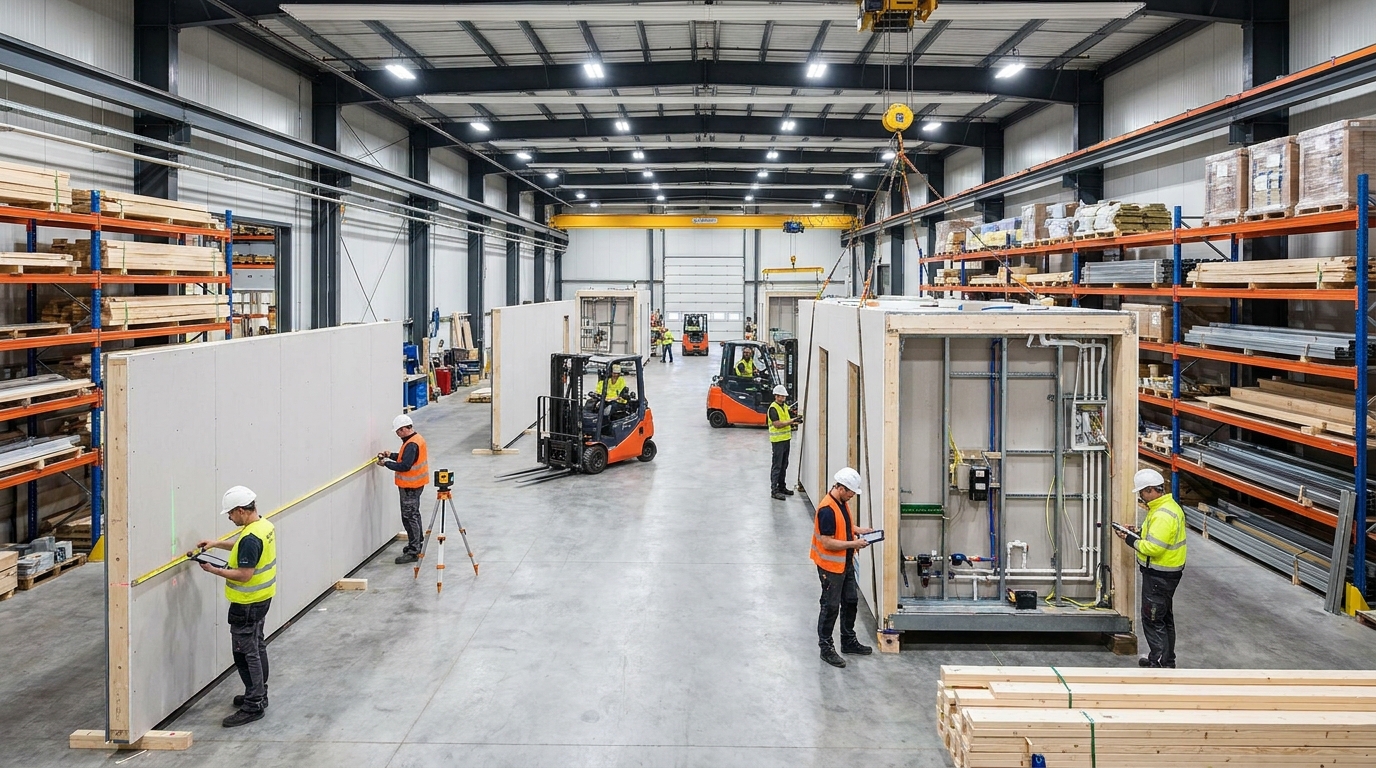
Because the term covers several methods, it helps to separate the main categories. The first is component prefabrication, where specific building elements such as trusses, mechanical racks, stairs, facade sections, or bathroom pods are manufactured off site and delivered for installation. This is often the easiest entry point because it does not require the whole project to be rethought. Teams can adopt prefabrication selectively where it adds value.
The second is panelized construction, where wall panels, floor panels, or roof panels are manufactured in a plant and then assembled on site. This method is common in residential and light commercial applications because it offers a good balance between factory efficiency and site flexibility. Panels can be highly engineered, and they help crews get enclosed faster, which reduces exposure to rain, snow, and temperature swings.
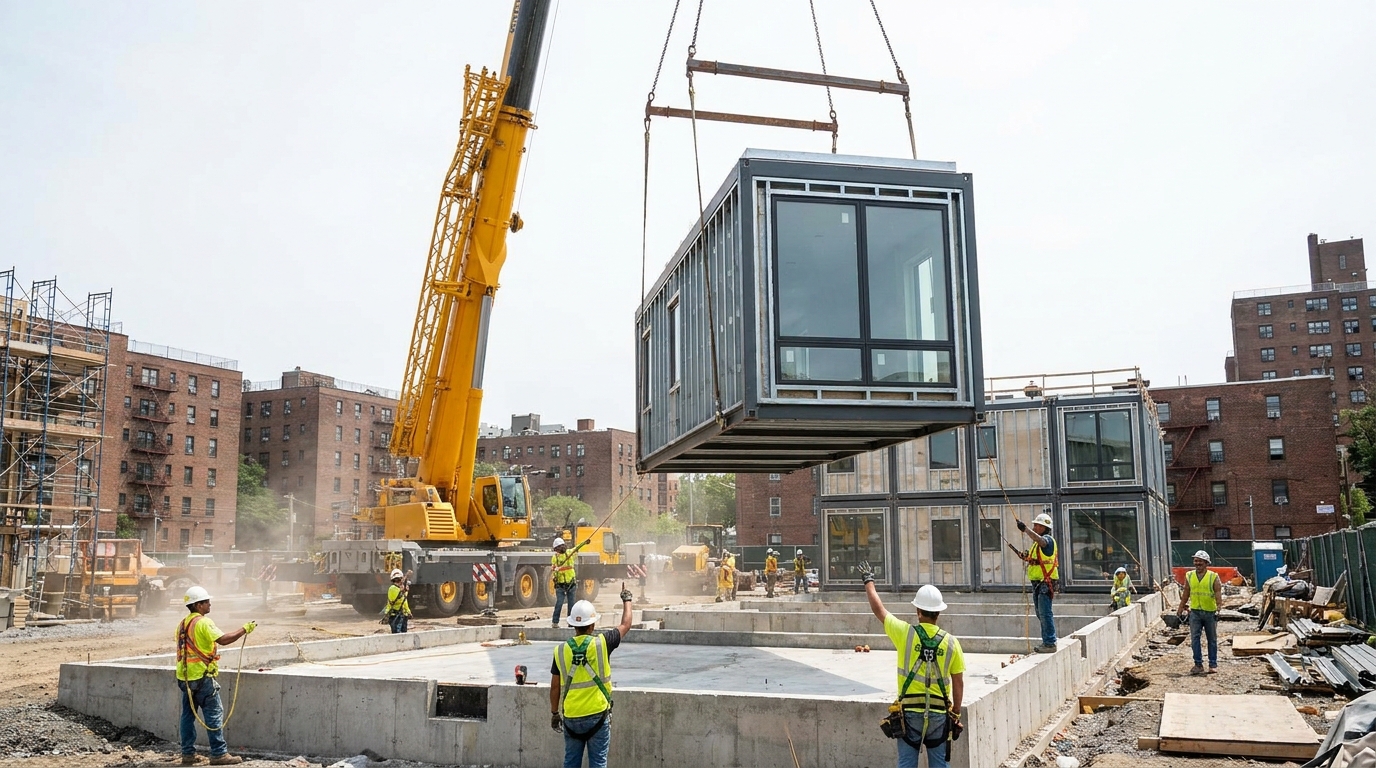
The third is modular or volumetric construction. In this system, three-dimensional units are built in the factory with a high level of completion before they are shipped to the site. Depending on the project, modules may include structure, insulation, interior finishes, fixtures, mechanical rough-ins, and even appliances. On site, the focus shifts to foundation work, craning, connections, weather sealing, and final commissioning.
A related idea is DfMA, or design for manufacture and assembly. This is less a building type and more a discipline. It means the project is designed from the start to suit manufacturing efficiency and site assembly. DfMA forces decisions earlier, which can feel restrictive at first, but it also removes a lot of field confusion later. The best industrialized projects usually have DfMA thinking built in from the beginning rather than added after design is mostly finished.
How the Process Works from Design to Installation
One of the biggest practical differences in industrialized construction is that planning happens earlier and in more detail. In a conventional project, some coordination issues get pushed into the field. Crews adapt, details are revised, and the site becomes the place where problems get solved. That flexibility can be useful, but it also creates rework, delays, and inconsistent results. In industrialized construction, the process works better when major decisions are locked in sooner because fabrication relies on certainty.
The design stage usually involves tighter digital coordination, often through BIM and other model-based workflows. Structural, architectural, and mechanical systems need to line up before fabrication starts because factory production is not forgiving when dimensions conflict. Openings, penetrations, connection points, lifting points, transport limits, and finish tolerances all need to be resolved in advance. The work is still complex, but the complexity is pulled forward rather than being left for the field.
Once design and engineering are sufficiently coordinated, manufacturing begins while site work proceeds in parallel. That parallel sequencing is one of the biggest schedule advantages. Foundations, utilities, and site access can move ahead while modules or panels are being fabricated indoors. If the team manages the handoff properly, the project can compress the overall timeline because two critical paths are running at the same time instead of one after the other.
Transport and logistics then become a major part of the project. Modules are not abstract design objects. They are large physical assemblies that must be loaded, protected, moved legally, and delivered in the right order. Roads, bridge clearances, escort requirements, weather windows, and crane access all matter. Once on site, assembly is often fast compared to conventional framing, but only if the groundwork, staging, and connections have been planned correctly. Industrialized construction replaces some jobsite uncertainty with logistics discipline.
Where Industrialized Construction Works Best
Industrialized construction is most effective where the building program supports repetition. Multifamily housing is a strong fit because unit layouts repeat floor after floor. Student housing, hotels, senior living, workforce housing, and certain healthcare support facilities also perform well because they often contain standardized room types and stacked service zones. Repetition allows manufacturers to refine production, reduce waste, and spread setup costs across many identical or similar units.
Commercial and industrial applications can also benefit, especially when there are repeated office modules, washroom cores, utility corridors, or service buildings. Even when a full building is not modular, partial prefabrication can improve speed and quality. Mechanical skids, electrical assemblies, facade panels, and prefabricated structural elements are now common on many sophisticated projects because they reduce site congestion and improve installation accuracy.
Remote and northern projects are another strong use case. CMHC has highlighted modular construction as especially useful in hard-to-build regions where weather, short building seasons, and logistics make conventional construction difficult. If a building shell can be assembled quickly after factory production, communities with narrow construction windows can gain time that would otherwise be lost to seasonal constraints. That does not solve every remote challenge, but it can reduce the amount of exposed field work in difficult climates.
Industrialized construction is generally less compelling for highly customized one-off projects with little repetition and difficult access unless there are specific components that clearly benefit from prefabrication. Signature architecture, unusual geometry, or frequent late design changes can work against factory efficiency. In those cases, conventional construction or a hybrid approach may be the more practical choice. The method selection should follow project conditions, not trend language.
The Schedule Advantage and Why It Matters
The most widely discussed benefit of industrialized construction is speed, and in the right circumstances that reputation is deserved. McKinsey estimates that modular methods can reduce end-to-end project timelines by 20 percent to 50 percent when implemented under suitable conditions. The reason is not magic. It comes from overlap, standardization, and fewer weather interruptions. Manufacturing and site preparation can proceed at the same time, and less work is left exposed to field delays.
A strong real-world example comes from Canada. CMHC reported that the 155-unit UTILE Rimouski student housing project was completed in 10 months from start to finish, with prefabricated modular construction identified as the reason for that compressed schedule. That kind of result gets attention because speed has direct consequences for financing, occupancy, and community impact. A building that opens sooner starts generating value sooner.
Schedule compression is especially important in housing, where demand is high and supply remains tight. A CMHC and Canadian housing policy discussion indicated that restoring housing affordability may require roughly 430,000 to 480,000 new housing units annually for the next decade. No single building method will solve a supply problem of that scale, but faster delivery systems clearly have a role to play. If a method reliably reduces project duration in the right situations, it becomes relevant well beyond the technical conversation about construction systems.
Still, timeline gains should be treated carefully. They depend on early decisions, timely approvals, factory capacity, and clean logistics. If the project is not coordinated well, delays can simply move from the field into design, transport, or manufacturing queues. Industrialized construction can make projects faster, but only when the whole system is managed around that objective.
The Cost Question: Better Economics, but Not Automatically Lower Prices
Cost is where many conversations about industrialized construction go off track. People often assume factory-built means cheaper by default. That is not how it works. McKinsey estimates cost reductions of up to 20 percent in the right conditions, but the phrase in the right conditions is doing a lot of work. Savings are highly dependent on project type, manufacturing scale, design repeatability, logistics, financing, and procurement strategy.
A factory has its own overhead and needs enough annual volume to justify investment. If a manufacturer does not have stable demand, the economics become difficult. Standardized repeat demand is often what makes the model work, which is why housing, hospitality, and institutional uses with repeated unit types are such common targets. One-off projects with limited production runs may struggle to unlock real cost advantages even if the method shortens the schedule.
There are also cost categories that industrialized construction does not eliminate. Site work is still needed. Foundations still have to be designed and built. Utilities still need coordination. Modules still have to be shipped, protected, craned, set, connected, and commissioned. If transport distances are long or access is difficult, those costs can become significant. In some regions, code approval pathways and financing structures may also be less familiar with modular delivery, which can add friction.
Where industrialized construction often shows its value is not only in direct cost reduction but in cost predictability. Better quality control, less weather exposure, more accurate material usage, and fewer field surprises can reduce rework and contingency use. That matters to owners because a predictable project is often more valuable than a supposedly cheap project that drifts off schedule and burns through allowances. Practical decision-makers usually care about total delivery performance, not just the line item cost of a wall section.
Quality Control and Build Performance
One of the strongest arguments for industrialized construction is quality control. Factory environments allow teams to measure, inspect, and document work in a way that is harder to maintain consistently on scattered job sites. Materials can be stored dry, assemblies can be built with tighter tolerances, and repeated tasks allow crews to improve through repetition. That does not guarantee quality, but it creates better conditions for it.
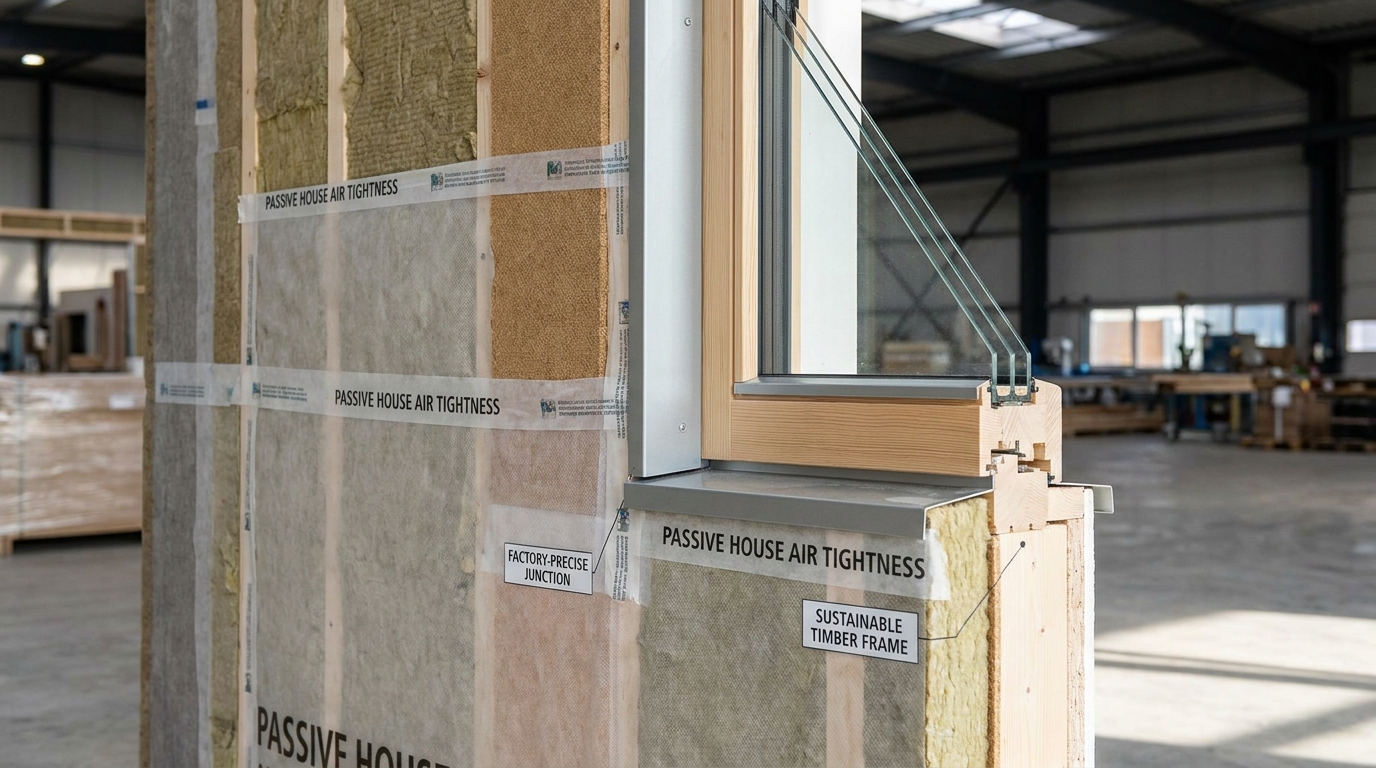
Building envelope performance is a good example. Airtightness, insulation continuity, and moisture management are easier to control when wall assemblies are produced indoors rather than exposed to rain and site variability. Factory production can support more consistent sealing, more reliable sheathing installation, and cleaner integration of windows and barriers. In climate-sensitive regions, those details have a direct impact on durability and energy use.
Industrialized methods can also reduce damage during construction. Traditional sites often leave materials exposed for days or weeks while sequences catch up. Wet framing, delayed enclosure, and rough handling all affect final performance. When more of the work is completed and protected before arriving at the site, the chance of hidden moisture or avoidable damage can be reduced. That is a practical gain, not just a marketing claim.
Quality, however, still depends on execution across the entire chain. A well-built module can still suffer if shipping protection is poor, if storage on site is careless, or if final connections are rushed. Industrialized construction improves quality assurance opportunities, but it does not replace the need for disciplined inspection, supervision, and commissioning. Good systems still need good management.
Why Sustainability Is a Real Part of the Conversation
Sustainability is often discussed in broad terms, but industrialized construction has some specific environmental advantages that are worth separating from general green-building claims. First, factory production can improve material efficiency. Standardized cutting, better inventory control, and more organized workflows can reduce waste compared with traditional site practices. In a market where disposal costs and material prices remain significant, waste reduction is both an environmental and financial benefit.
Second, controlled fabrication can support better envelope quality and lower operational energy use. More consistent insulation installation and improved airtightness are not flashy benefits, but they matter over the life of the building. CMHC has described modular construction as an innovative way to build energy-efficient and affordable housing quickly, especially in rural, northern, and hard-to-build contexts where weather and short seasons create extra difficulty. When buildings go together with fewer moisture problems and stronger enclosure performance, long-term durability also improves.
Third, industrialized construction increasingly connects with lower-carbon material strategies. Canadian research and government messaging have tied these methods to lower embodied carbon pathways, better material efficiency, and safer working conditions because more work is completed in controlled environments. This becomes especially relevant when industrialized systems are paired with mass timber prefabrication, optimized structural design, or more efficient mechanical assemblies.
None of that means every factory-built project is automatically sustainable. Transport emissions, material choices, and manufacturing energy sources all count. The right conclusion is more practical than that: industrialized construction gives teams better tools to achieve sustainability targets consistently, but they still have to choose the right design, materials, and logistics to make those gains real.
Common Misconceptions That Need Clearing Up
Several misconceptions still hold back wider adoption. The first is the idea that industrialized construction is the same as low-grade temporary housing. That view is outdated. Many modular and prefabricated buildings meet the same code requirements and performance targets as site-built projects, and in some cases they outperform conventional builds because tolerances and moisture control are handled better.
The second misconception is that prefab automatically means cheap. Sometimes it does reduce cost, but only when scale, repeatability, logistics, and project coordination support factory economics. If a project is highly customized, changes late in design, or requires difficult transport, cost savings can narrow or disappear. The method should be evaluated honestly, not sold through blanket promises.
The third misconception is that industrialized construction is mainly for single-family housing. In reality, some of the strongest applications are multifamily housing, hotels, student housing, senior living, healthcare support spaces, and repeatable commercial uses. North American adoption is growing, though it remains a minority share overall. The Modular Building Institute cited modular construction starts increasing from 2.14 percent of all construction starts in 2018 to 6.0 percent in 2022, which suggests meaningful momentum even if the sector is still far from dominant.
A final misconception is that factory-built construction removes the need for traditional site expertise. It does not. Site work remains critical. Foundations, utilities, transport planning, craning, weather protection, final assembly, fire stopping, testing, and commissioning all require skill and experience. Industrialized construction changes where work happens and how it is sequenced, but it does not eliminate the craft of building.
The Real Challenges and Limitations
Balanced discussion matters here because industrialized construction has real constraints. Up-front capital is one of them. Factories, equipment, digital workflows, and supply chain integration require investment. Manufacturers need enough throughput to stay efficient, and developers need confidence that the pipeline will support the model. Without reliable volume, the business case can weaken quickly.
Design rigidity is another issue. Industrialized systems tend to reward early decisions and repeated layouts, which can feel limiting to architects or owners who are used to adjusting details later. Late changes are usually more disruptive because fabrication relies on locked dimensions and production schedules. This does not mean good design is impossible. It means the project team needs a mindset that values early coordination over late improvisation.
Transportation and storage also create risk. Modules and panels must be protected from moisture during shipping and while awaiting installation. Routes need to be checked carefully for size restrictions, and the site must be prepared to receive components in the right sequence. A good factory can still be undermined by poor logistics planning. In practical terms, industrialized construction moves risk around rather than making it disappear.
Procurement and code alignment can be barriers as well. Some lenders, insurers, and permitting authorities are fully familiar with modular systems, while others are less so. Fragmented procurement, unclear scopes, or delayed approvals can erode the advantages that factory production is supposed to provide. The method works best when everyone involved understands the delivery model from the start.
How Owners and Project Teams Can Use It Well
For owners and developers, the first practical step is to decide whether the project genuinely fits the method. Repetition, scale, schedule pressure, labor constraints, and site difficulty all point toward industrialized solutions. If those factors are weak, a hybrid strategy may make more sense than full modular delivery. The right question is not whether industrialized construction is fashionable. The right question is whether it serves the project better than the alternatives.
Early team selection matters a great deal. Architects, engineers, manufacturers, general contractors, and logistics planners should be engaged early enough to shape the design around manufacturing and assembly realities. Trying to convert a fully conventional design into a factory-built one late in the process usually creates frustration. The gains come when the project is conceived with production and installation in mind from day one.
Owners should also pay attention to factory capacity, quality systems, and experience with similar building types. A manufacturer that performs well with hospitality modules may not be the best fit for a healthcare or educational project. Site logistics should be studied just as carefully as the factory itself. Good access, crane planning, weather windows, storage, and connection detailing are all part of making the system work.
Finally, teams need to judge success across several metrics at once. Cost matters, but so do schedule certainty, quality, energy performance, labor efficiency, and long-term durability. Industrialized construction often delivers value through the combination of those outcomes rather than through a single dramatic number. That broader view usually leads to better decisions.
What the Future Likely Looks Like
Industrialized construction is unlikely to replace conventional construction across the board, and it does not need to. The more realistic future is a market where off-site manufacturing becomes a larger share of how buildings are delivered, especially in sectors that benefit from repeatability and speed. That shift is already visible in policy support, digital design integration, and the growing use of prefabricated components across many project types.
As BIM, manufacturing software, and supply chain coordination improve, the line between traditional and industrialized methods may become less rigid. More projects will likely adopt hybrid approaches that combine conventional structure with prefabricated facades, modular bathrooms, mechanical racks, or panelized envelopes. That is a practical direction because it lets teams use factory precision where it pays off most without forcing every part of the building into one system.
Housing pressure will keep the conversation moving. When governments and industry groups are looking for ways to deliver more units faster, methods that reduce schedule and manpower demands will continue to draw interest. Climate goals will reinforce that trend because better envelope control, material efficiency, and lower-carbon assemblies are easier to scale when production is more standardized. The industry is still early in this transition, but the direction is becoming clearer.
The important point is that industrialized construction should be treated as a serious building method, not a passing trend and not a cure-all. It is most valuable when the project, team, and market conditions line up with what the system does well. Used that way, it offers something the construction industry badly needs: a more predictable, more controlled way to build quality buildings under real-world time, labor, and cost pressure.
Final Takeaway
Industrialized construction is best understood as a practical response to modern building challenges. It shifts more work into factory settings, where standardized processes and better quality control can reduce waste, cut rework, and improve schedule reliability. In the right conditions, it can support faster delivery, stronger performance, safer workflows, and better use of limited labor.
It is not automatically cheaper, it is not ideal for every design, and it does not remove the need for strong site execution. But for residential and commercial projects with repeatable layouts, demanding schedules, difficult climates, or labor constraints, it can be a very effective option. The key is to choose it for the right reasons and to manage it with the same discipline that good construction always requires.
Practical bottom line: Industrialized construction is not about replacing craftsmanship. It is about organizing craftsmanship more efficiently, with more control, earlier coordination, and fewer variables working against the project.
For builders, owners, and communities trying to deliver more housing and better buildings with fewer delays, that is a modern approach worth understanding clearly.

No Comment! Be the first one.