



Environmental monitoring can sound like something reserved for laboratories, government agencies, or large industrial sites. In reality, the basic idea is much simpler and far more useful for everyday life. Environmental monitoring is the practice of paying attention to measurable environmental conditions such as energy use, water consumption, waste generation, air quality, and emissions, so that decisions are based on evidence rather than guesswork. For people who want to live more sustainably, that shift can be surprisingly empowering because it replaces vague guilt with practical feedback.
Table Of Content
- What Does Environmental Monitoring Actually Mean?
- Why Does Environmental Monitoring Matter for Everyday Sustainability?
- What Are the Most Useful Things to Monitor at Home?
- Energy Use
- Water Consumption
- Waste and Consumption
- Transportation and Mobility
- Indoor and Outdoor Air Quality
- What Environmental Monitoring Is Not
- How Public Data Makes Monitoring More Accessible
- Citizen Science and Community Monitoring
- A Simple Framework for Tracking Your Eco Footprint
- Step 1: Choose a Small Set of Indicators
- Step 2: Gather a Baseline
- Step 3: Use Simple Tools
- Step 4: Look for Patterns Rather Than Perfect Numbers
- Step 5: Make One Change at a Time
- Step 6: Review and Reset
- Examples of Practical Monitoring in Daily Life
- The Role of Water and Ecosystem Monitoring Beyond the Home
- How Clean Technology Fits In
- Keeping the Process Calm and Sustainable
- Final Thoughts: Measure What Helps You Move Forward
- Quick Reference: A Practical Household Monitoring Checklist
When sustainability feels abstract, it is easy to assume that personal actions do not matter very much. Monitoring changes that feeling because it turns broad environmental concerns into specific patterns you can see and respond to. If your electricity use rises every winter, if your household waste spikes during busy weeks, or if poor outdoor air quality affects how you commute, those details can help you make better choices without overhauling your entire life. The goal is not perfection. The goal is to understand your eco footprint well enough to improve it thoughtfully.
Across Canada and beyond, environmental monitoring already shapes public life in ways many people do not notice. Canada publishes an annual national greenhouse gas inventory and submits it to the UN Framework Convention on Climate Change, creating a long term picture of how emissions change over time. The 2024 National Inventory Report shows that Canada tracked emissions from seven greenhouse gases from 1990 through 2022, and that total emissions in 2022 were 708 Mt CO2e, down from 761 Mt CO2e in 2005 even as the population grew. That is environmental monitoring at national scale, and it demonstrates a principle that also works at home: once something is measured consistently, it becomes easier to understand where progress is happening and where more work is needed.
This guide approaches environmental monitoring as an accessible tool for everyday green living. You do not need advanced training, expensive equipment, or a perfectly optimized home to begin. You need a few meaningful indicators, a simple routine, and a willingness to learn from what the numbers are telling you. Once those pieces are in place, monitoring becomes less about pressure and more about clarity.
What Does Environmental Monitoring Actually Mean?
At its core, environmental monitoring is the systematic tracking of environmental conditions over time. The phrase may include highly technical systems that measure atmospheric pollutants or industrial discharges, but the same logic applies to everyday living. You measure something, interpret what it means, and then make adjustments based on the pattern you see. This is why environmental monitoring is best understood as a feedback loop rather than a one time snapshot.
For households, that feedback loop often includes energy, water, transportation, waste, and indoor environmental quality. For communities, it may also include local air quality, urban heat, stormwater conditions, biodiversity, and pollutant exposure. On a larger scale, governments use monitoring to track greenhouse gas emissions, pollutant releases, and ecosystem health. These layers are connected. When you look at your home electricity use, you are seeing one small piece of a larger system that includes buildings, infrastructure, energy supply, and public policy.
That connection matters because environmental monitoring is not only about individual responsibility. It also helps people interpret the world around them more clearly. Canada’s greenhouse gas inventory, for example, shows that in 2022 the largest emitting sectors included oil and gas at 31 percent, transport at 22 percent, and buildings at 13 percent. That does not mean household actions are irrelevant. It means personal choices are most useful when they are informed by a realistic understanding of where impacts come from and how they accumulate.
Monitoring also extends beyond climate. Canada’s National Pollutant Release Inventory reported more than 2.68 million tonnes of air emissions across 164 substances in 2024, showing that environmental tracking includes toxic releases and air pollution, not just greenhouse gases. This broader view is important because a healthy environment is not defined by one number alone. A household could reduce electricity use while still overlooking waste, water leaks, or poor indoor air. Good monitoring keeps the picture balanced.
Why Does Environmental Monitoring Matter for Everyday Sustainability?
Many people try to live sustainably by making occasional upgrades or adopting a few greener habits. Those choices can help, but without some kind of monitoring it is difficult to know what is truly making a difference. An energy efficient appliance, a reusable shopping routine, or a shorter commute may all sound positive, but real impact becomes clearer when you compare before and after results. Monitoring gives sustainability a practical structure.
It also helps prevent overwhelm. One of the biggest barriers to greener living is the feeling that everything matters equally and must be fixed at once. In practice, most households benefit more from focusing on a few high impact areas first. Tracking allows you to see whether heating is your main energy issue, whether food waste is more significant than packaging waste, or whether driving patterns outweigh changes in lighting and electronics. Once you know your biggest patterns, sustainable action becomes more proportionate and less emotional.
There is also a strong public health dimension. Health Canada and Environment and Climate Change Canada use monitoring and public outreach to reduce risks from indoor and outdoor air pollution, and the Air Quality Health Index helps people make daily exposure decisions. That is a useful reminder that environmental monitoring is not only about long term climate goals. It also influences day to day wellbeing, especially for children, older adults, and anyone with respiratory or cardiovascular sensitivities.
Environmental monitoring does not ask you to become a full time analyst. It simply gives you enough information to choose more wisely, more calmly, and more consistently.
Perhaps most importantly, monitoring builds credibility. It is easier to talk with family members, neighbors, landlords, building managers, or local officials when concerns are backed by actual observations. If you can show rising summer indoor temperatures, unusually high water usage, or repeated days of poor local air quality, the conversation becomes more constructive. Data does not solve every problem, but it often makes collaboration easier.
What Are the Most Useful Things to Monitor at Home?
If you are new to environmental monitoring, it helps to start with indicators that are both meaningful and manageable. A practical household approach usually combines a few categories rather than relying on a single metric. That is because your eco footprint reflects multiple systems working together. Electricity use matters, but so do transport choices, heating fuel, water habits, material consumption, and waste patterns.
Energy Use
Energy is often the easiest place to begin because households already receive monthly utility data. Electricity bills, natural gas statements, and smart meter portals can show how usage changes by season, occupancy, and daily routine. If your region offers more detailed interval data, you may be able to see exactly when peaks occur. This can reveal simple opportunities such as reducing standby loads, adjusting thermostat schedules, sealing drafts, or replacing one inefficient appliance rather than many smaller items.
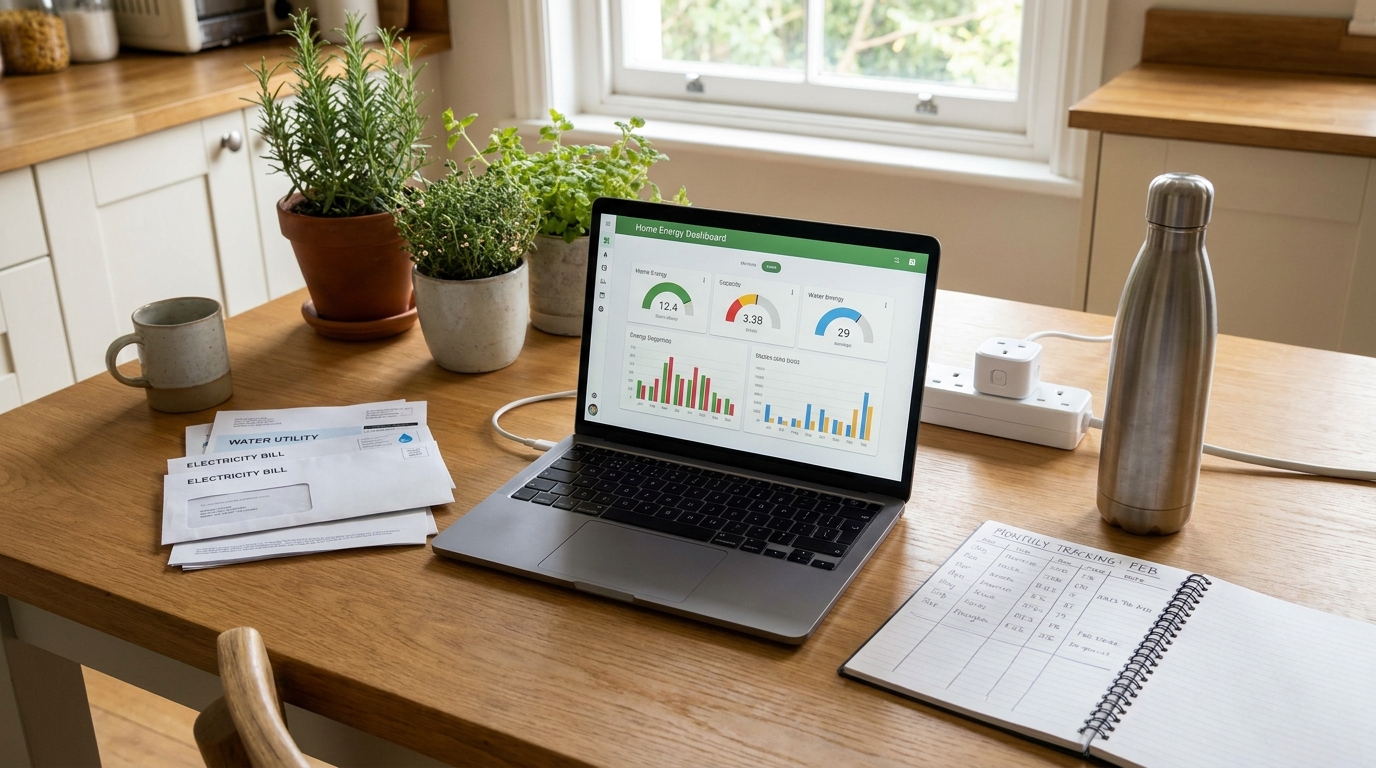
For people interested in clean technology, smart plugs, energy monitors, and home energy apps can add useful detail without becoming intrusive. These tools can help identify which devices draw power continuously and which habits drive spikes. The value is not only in precision. It is in making energy visible enough that your actions begin to feel connected to outcomes.
Water Consumption
Water monitoring is equally practical, especially in homes where leaks or irrigation habits can quietly increase environmental impact and utility costs. A monthly water bill can reveal broader trends, while a simple meter check before and after a quiet overnight period may help detect hidden leakage. In homes with gardens, rain barrels, drought aware planting, and timing irrigation for cooler hours can all become easier to evaluate when water use is being tracked consistently.
Water monitoring also encourages a wider understanding of sustainability. It draws attention to the relationship between household routines and local watersheds, infrastructure, and treatment systems. Even if you are not testing water quality directly, tracking how much water you use is a meaningful form of environmental awareness that often leads to practical efficiency improvements.
Waste and Consumption
Waste is one of the most revealing indicators because it reflects purchasing choices, food planning, material use, and disposal habits all at once. A household does not need a complicated audit to learn something useful. Simply noticing how many garbage bags, recycling bins, and compost containers are filled each week can highlight patterns that would otherwise be missed. If landfill waste rises after periods of convenience shopping or takeout meals, you have a clear place to adjust.
Monitoring waste also helps correct a common misconception. Recycling alone does not define a low impact lifestyle. Reduction, reuse, repair, and better buying decisions often matter more. When households track what they throw away, they usually begin to see which purchases create clutter, packaging, or food waste before those items ever reach the bin.
Transportation and Mobility
For many households, transportation is a major part of the overall footprint. Monitoring can be as simple as recording weekly driving distance, fuel purchases, transit use, cycling trips, or remote work days. Over time, that record helps you understand whether the biggest opportunity lies in consolidating errands, improving route planning, shifting one regular trip to active transportation, or preparing for a lower emission vehicle in the future.
Transportation monitoring is especially useful because it connects personal choice with broader emissions data. Since transport is one of Canada’s largest emitting sectors, household travel patterns are not trivial. Even modest changes become more meaningful when repeated regularly and tracked over time.
Indoor and Outdoor Air Quality
Air quality is another category that can directly affect daily decisions. Outdoor air conditions may influence whether you walk, exercise, ventilate your home, or adjust activity levels for children and older family members. Canada’s AQHI tools are valuable because they translate technical measurements into a clearer health based guide. Rather than asking people to interpret raw pollutant data, they offer a practical signal for decision making.
Indoor air quality can also be monitored in simple ways. Households may track humidity, ventilation, carbon dioxide in shared spaces, and signs of persistent dust, mold, or combustion byproducts. While low cost indoor sensors can be useful, context matters. They are not always equivalent to reference grade instruments, so readings should be interpreted carefully and, when necessary, supported by professional assessment.

What Environmental Monitoring Is Not
Part of making environmental monitoring feel accessible is clearing up a few common misconceptions. The first is the idea that monitoring is only for scientists, regulators, or large institutions. Professional monitoring absolutely matters, especially where health, compliance, and public safety are involved, but households and communities can still monitor meaningful indicators using basic tools and public datasets. The scale is different, not the underlying logic.
Another misconception is that measuring something automatically improves it. Monitoring is helpful because it identifies patterns, priorities, and risks, but it does not replace action. If a household tracks electricity use and never changes settings, habits, or equipment, the data remains informational rather than transformative. In that sense, monitoring is best treated as a guide rather than a solution in itself.
It is also important not to rely on one number as a stand in for your whole footprint. Household electricity may be relatively low while car dependency remains high. Waste might be well managed while heating losses remain significant. A balanced approach usually combines multiple indicators, even if each one is tracked simply.
One more distinction matters for readers who follow air pollution issues. Air quality monitoring and emissions monitoring are not the same thing. Air quality monitoring measures pollutant concentrations in the air people breathe. Emissions monitoring measures pollutant releases from a source such as a facility, vehicle, or process. Both matter, but they answer different questions.
How Public Data Makes Monitoring More Accessible
One of the most encouraging trends in environmental monitoring is the growth of public facing dashboards, open data, and map based tools. You no longer need to wait for a technical report to understand many environmental conditions around you. In many places, people can check local air quality, weather related heat risk, water conditions, neighborhood tree coverage, transportation emissions information, and utility usage through digital platforms designed for non specialists.
Canada offers especially useful examples. The national greenhouse gas inventory shows how the country’s emissions profile changes over time, while the National Pollutant Release Inventory provides information about pollutant releases and disposals. For an everyday reader, these systems may seem distant at first. Yet they help answer practical questions such as where emissions are concentrated, what types of pollutants are being tracked, and how environmental accountability works beyond the household level.
Public data also helps connect local action with systemic context. If you reduce your home energy use, it is helpful to know how buildings fit into national emissions patterns. If you are concerned about local industrial activity or regional air pollution, pollutant reporting systems can provide a clearer starting point for questions and advocacy. Monitoring becomes more empowering when private habits and public information reinforce each other.
For communities, open data can support better planning and resilience. Neighborhood groups, schools, and local organizations may use public information to identify heat vulnerable areas, traffic related air quality concerns, or watershed issues that deserve attention. This is one reason environmental monitoring increasingly overlaps with environmental justice and community wellbeing. Good data can illuminate where burdens are unequally distributed and where support is most needed.
Citizen Science and Community Monitoring
Another reason environmental monitoring is becoming more accessible is the growth of citizen science. The United States Environmental Protection Agency describes citizen science as public participation in meaningful data collection and analysis, and notes that volunteer monitoring can support environmental protection. That framing is useful because it validates something many communities already understand intuitively. Local observation matters, especially when people are documenting conditions that affect daily life.
Citizen science can take many forms. Residents may help track neighborhood tree health, map heat islands, count birds and pollinators, monitor litter near waterways, or log unusual odor and smoke events. In schools, environmental monitoring can become a practical way to teach science, civic engagement, and systems thinking all at once. Community groups may also use low cost sensors or shared observation protocols to build local awareness and strengthen advocacy.
That said, it is worth being realistic about tools and limitations. Low cost sensors can reveal useful patterns, but they are not always equivalent to regulated reference grade instruments. Calibration, placement, maintenance, and interpretation all matter. A community monitor might show that one street appears consistently hotter or smokier than another, which is valuable information, but formal regulatory decisions may still require higher grade validation.
The strength of citizen science is not that it replaces professional monitoring. Its strength is that it expands participation, fills observational gaps, and helps communities ask better questions. When handled thoughtfully, it can make environmental data feel less remote and more democratic.

A Simple Framework for Tracking Your Eco Footprint
If you would like to start monitoring your own environmental footprint, the process does not need to be elaborate. A calm and sustainable approach is usually more effective than an ambitious system that quickly becomes tiring. The most useful framework is to choose a few indicators, establish a baseline, review changes monthly, and make one or two adjustments at a time. This keeps monitoring practical and turns it into a long term habit rather than a short burst of enthusiasm.
Step 1: Choose a Small Set of Indicators
Begin with the areas most relevant to your household. For many people, a good starting set includes electricity, heating fuel, water use, transportation, and landfill waste. If you have specific concerns, you might also add indoor humidity, air quality alerts, or food waste. The point is not to capture every variable. It is to create a balanced enough picture that your main patterns become visible.
Step 2: Gather a Baseline
Use the last three to twelve months of bills, receipts, or records to understand your normal range. Seasonal changes matter, so context is important. A winter heating spike may be expected, while a sudden summer increase in water use could indicate irrigation changes or a leak. Baselines help you distinguish ordinary variation from meaningful shifts.
Step 3: Use Simple Tools
You do not need a fully automated smart home to monitor effectively. A spreadsheet, notebook, utility portal, transit app, phone note, or shared family dashboard can be enough. If technology makes the process easier, use it. If it makes the process feel burdensome, simplify. Monitoring works best when the method fits your actual life.
Step 4: Look for Patterns Rather Than Perfect Numbers
Household data is rarely flawless. There may be missing receipts, unusual travel months, guests staying over, or weather extremes that complicate comparison. That is fine. Your aim is not laboratory precision. Your aim is to notice trends such as whether weekday commuting drives most fuel use, whether one room is consistently too humid, or whether electricity spikes after adding a second freezer.
Step 5: Make One Change at a Time
Once you notice a pattern, test a response. You might lower water heater temperature slightly, add weatherstripping, plan meals more deliberately, set power saving schedules, or shift one recurring errand trip. By changing one thing at a time, it becomes easier to see whether the adjustment had any measurable effect. This keeps learning grounded and avoids the confusion that comes from changing everything at once.
Step 6: Review and Reset
At the end of each month or season, revisit the data and ask a few simple questions. What improved, what stayed the same, and what still feels hard to influence? Sustainability is rarely linear. Some months will look better than others. The value of monitoring is not in proving constant progress. It is in creating a reliable rhythm of observation and response.
Examples of Practical Monitoring in Daily Life
Consider a family in a detached home that feels drafty every winter. Instead of immediately investing in multiple upgrades, they review their gas and electricity data, compare it with outdoor temperatures, and notice that heating demand rises sharply during cold snaps even when the thermostat setting remains moderate. A home energy assessment later confirms air leakage around windows and attic access points. Because they monitored first, their spending becomes more targeted and effective.
Or imagine an apartment resident who wants to reduce waste but feels that recycling is already being handled reasonably well. After tracking landfill disposal for a few weeks, they realize the larger issue is food spoilage from inconsistent meal planning and overbuying produce. With that insight, they focus less on packaging guilt and more on shopping rhythm, freezer use, and cooking portions. The result is less waste and lower grocery spending, all driven by one simple monitoring habit.
In another example, a neighborhood group notices that children are avoiding outdoor play on certain summer afternoons because the heat feels unusually intense. Residents use public weather data, tree canopy maps, and a small citizen science effort to compare shaded and unshaded areas. The findings support a request for more street trees and cooler public space design. Here, monitoring becomes a bridge between personal experience and community action.
The Role of Water and Ecosystem Monitoring Beyond the Home
Environmental monitoring becomes even more meaningful when people understand how it supports public systems. The United States Geological Survey notes that national water quality monitoring data are used by agencies to protect drinking water, recreation, irrigation, energy, and ecosystems. That is a reminder that routine measurement is not bureaucracy for its own sake. It helps communities protect resources that many people rely on every day.
For households, this broader perspective can deepen motivation without creating pressure. Tracking your own water use is valuable, but it also helps to appreciate the larger network of rivers, treatment facilities, stormwater systems, and ecological conditions connected to that use. Monitoring is one of the ways societies maintain that connection responsibly. It turns environmental stewardship from an abstract ideal into a set of visible relationships.
The same principle applies to biodiversity and landscape health. While not every household will formally monitor species or habitat conditions, people can still pay attention to signs that matter locally such as pollinator presence, tree canopy changes, soil dryness, or recurring flooding after heavy rain. These observations are especially useful when combined with municipal data and local conservation efforts. In many places, resilience begins with noticing patterns early enough to respond well.
How Clean Technology Fits In
Because this topic sits within clean technology, it is worth looking at how digital tools and smart devices are changing environmental monitoring. The most visible examples include smart thermostats, energy dashboards, connected plugs, leak detectors, occupancy sensors, indoor air monitors, and building management systems. These tools can make data collection easier and more continuous, reducing the effort required from residents.
Still, technology is most useful when it clarifies decisions rather than multiplying distractions. A smart device that sends too many alerts or requires constant attention may not support long term behavior change. By contrast, a well designed dashboard that quietly shows monthly energy trends or warns you about a leak can be genuinely helpful. The best clean technology often works in the background while giving people just enough information to act at the right time.
There is also a growing trend toward hyperlocal monitoring, especially for air quality, heat, and indoor environments. Lower cost sensors and open data platforms are making neighborhood level conditions more visible than before. This can support resilience and equity by revealing where environmental burdens are concentrated. At the same time, it reinforces the importance of calibration, interpretation, and context. More data is not always better unless people know what the signals actually mean.
Keeping the Process Calm and Sustainable
One of the quiet strengths of environmental monitoring is that it can make sustainability feel steadier. Instead of trying to do everything at once, you start by observing reality. That creates room for proportion, patience, and better timing. It also makes it easier to celebrate practical progress such as a lower winter heating bill, fewer bags of trash, or more days when active transport replaces a car trip.
There is no need to monitor every detail of your life. In fact, overtracking can create the same fatigue that pushes people away from sustainability in the first place. The better approach is to choose a few metrics that genuinely influence decisions and revisit them consistently. If the system supports your life, you are more likely to keep using it. If it turns into a source of stress, it probably needs simplifying.
This is especially important for families, renters, and busy households working within real constraints. Not everyone can retrofit a home, change buildings, or access the same technologies. Monitoring is still useful because it helps identify the changes that are realistic now while also building a case for future improvements. Even a small amount of good information can lead to smarter choices.
Final Thoughts: Measure What Helps You Move Forward
Environmental monitoring is often presented as a technical discipline, but for everyday green living it is better understood as a practical habit of attention. You measure conditions, learn what they are telling you, and respond in ways that fit your home, budget, and priorities. This process does not eliminate complexity, but it does make sustainability more concrete and less overwhelming.
Canada’s national inventories, pollutant reporting systems, and public air quality tools show what monitoring can achieve at scale. They also offer a useful lesson for individuals and communities. Progress becomes easier to understand when it is tracked honestly and revisited consistently. Whether you are monitoring a utility bill, checking the AQHI before a bike ride, or participating in a local citizen science effort, you are taking part in that same larger logic of accountability and care.
The most effective eco choices are often not the most dramatic ones. They are the ones supported by clear patterns, repeated over time, and grounded in what actually matters where you live. Environmental monitoring helps you find those choices. It replaces uncertainty with insight and turns sustainability into something more achievable, more elegant, and more lasting.
Quick Reference: A Practical Household Monitoring Checklist
- Pick three to five indicators that match your home and lifestyle, such as electricity, heating, water, driving, and landfill waste.
- Collect a baseline from recent bills or records so you know what normal looks like across seasons.
- Review data monthly rather than daily unless a real time issue, such as a leak or indoor air concern, needs closer attention.
- Use public tools like local air quality dashboards, climate data, and municipal environmental maps for context.
- Test one change at a time so you can see what actually improves results.
- Keep notes brief and practical, focusing on patterns, comfort, cost, and impact.
- Reassess every season because heating, cooling, travel, and water use often change throughout the year.
In the end, environmental monitoring is not about becoming obsessed with numbers. It is about using the right amount of information to live with more awareness and less waste. That is a sustainable practice in the fullest sense of the word.



No Comment! Be the first one.