



Urban mobility systems are entering a new era. For decades, cities often treated transportation as a technical function, focused on moving commuters into downtowns and expanding road capacity where congestion appeared. That model no longer fits the realities of modern urban growth. Housing shortages, climate obligations, changing work patterns, rising infrastructure costs, and public demand for healthier communities have all elevated mobility into something much larger. It is now a strategic platform that shapes where homes can be built, how employment areas perform, how public services are accessed, and whether a city can grow without undermining its own quality of life.
Table Of Content
- Why Urban Mobility Systems Have Become Core City Infrastructure
- The Evolution from Commuter Transit to All-Day Urban Mobility
- Transit-Oriented Development Is Becoming a Growth Strategy, Not a Design Trend
- What Effective TOD Requires
- Zero-Emission Transit and the Decarbonization Imperative
- Why Bus Priority and Network Redesign Deserve More Attention
- Micromobility and the First-Mile, Last-Mile Opportunity
- Mobility, Housing Supply, and the Economics of Land
- Key Principles for Linking Mobility and Housing
- Designing Multimodal Corridors for Long-Term Urban Growth
- Governance, Data, and the Need for Better Decision Frameworks
- Common Misconceptions That Still Hold Cities Back
- A Strategic Agenda for the Next Generation of Sustainable City Transit
- Conclusion: Mobility as the Framework for Better Urban Living
Across Canada and in many comparable urban regions, this transition is visible in both the data and the policy response. Urban public transit delivered about 1.6 billion passenger trips in 2024, up from 1.5 billion in 2023, yet still only 84.2 percent of the 2019 total. In December 2024, ridership reached 131.7 million trips, 7.7 percent higher year over year and 85.9 percent of the pre-pandemic December 2019 level. Those numbers tell a nuanced story. Transit demand has rebounded meaningfully, but not uniformly, and cities are still adapting to travel patterns that are less dominated by five day commuting and more influenced by all day trips related to childcare, healthcare, education, shopping, and hybrid work.
This is why the future of urban mobility systems cannot be reduced to a debate about trains versus buses or roads versus transit. The real question is how to build integrated systems that support sustainable city growth at scale. A strong mobility network does more than reduce travel time. It unlocks land value in the right places, supports higher housing supply near infrastructure, improves economic access, reduces emissions, and creates stronger neighborhood connections. It allows cities to intensify with purpose rather than simply densify by default.
From a development and planning perspective, mobility is increasingly the operating system of the city. When it is fragmented, growth becomes expensive, inequitable, and environmentally damaging. When it is coordinated with housing, land use, and infrastructure investment, it can become one of the most powerful tools available for creating livable and resilient urban regions. The future of urban mobility systems, then, is not just about transportation innovation. It is about building a city that works better for more people over the long term.
Mobility infrastructure is no longer a secondary service layered onto growth. In successful cities, it is a primary framework that determines how growth can happen well.
Why Urban Mobility Systems Have Become Core City Infrastructure
There was a time when transit planning was often viewed as a downstream function of urban expansion. New subdivisions were approved, roads were widened, and transit agencies were asked to serve what had already been built. That sequence produced predictable results. Communities became more car dependent, infrastructure costs rose, congestion spread across entire regions, and transit struggled to compete because land use patterns did not support frequent service. Today, that logic is increasingly being reversed. Mobility is being considered early because governments recognize that growth without transportation integration creates long term liabilities.
This shift is especially important in the Canadian context, where housing affordability and supply have become defining policy issues. Federal housing policy now links some transit funding to housing supply actions, requiring communities seeking transit funding to take steps that directly unlock housing where it is needed most. This is a major signal. It reflects the understanding that transit investment should not simply move people more efficiently through a constrained housing market. It should help reshape the market by enabling more homes in connected, serviced, and economically productive locations.
Transportation policy is also central to climate strategy. Transportation remains one of Canada’s largest sources of greenhouse gas emissions, which means mobility decarbonization is not a niche environmental issue but a structural requirement for sustainable development. Federal support for zero-emission transit planning and fleet transition reinforces this point. But while electrification is essential, it is not enough on its own. Sustainable mobility depends not only on cleaner vehicles but also on mode shift, better urban form, and reduced dependence on long car trips for basic daily needs.
The strategic implication is straightforward. Urban mobility systems now have to serve growth goals, housing goals, climate goals, and equity goals at the same time. That is a more complex mandate than transit agencies faced in the past, but it is also a more useful one. It places mobility where it belongs, at the center of city building rather than at its edge.
The Evolution from Commuter Transit to All-Day Urban Mobility
One of the most important changes in recent years is the move away from a narrow commuter model. Traditional transit planning often focused on peak hour demand, especially trips from outer neighborhoods into a central business district. That pattern still matters, but it is no longer the sole organizing principle. Cities now need systems that work for shift workers, students, caregivers, seniors, service employees, and residents making multiple short trips across the day. In practical terms, this means mobility systems must become more frequent, more connected, and more flexible.
This evolution matters because modern urban life is distributed. Employment is spread across multiple nodes, educational institutions are dispersed, healthcare access depends on regional mobility, and many households rely on trip chaining rather than one direct commute. A parent may drop off a child, transfer to transit, visit a workplace, stop at a clinic, and then make a grocery trip before returning home. A system designed only around the downtown commute performs poorly for this reality. A system designed around accessibility performs much better.
Accessibility is a more strategic metric than speed alone. It measures how easily residents can reach jobs, services, schools, parks, and daily essentials. That shift in thinking changes infrastructure priorities. A city may not need only one major rail extension to improve quality of life. It may also need bus priority lanes, safer crosswalks, fare integration, reliable off-peak service, and better first-mile and last-mile connections. Some of the most transformative mobility improvements are not the most expensive ones. They are the improvements that make the whole network usable for more people more often.
For urban planners and developers, this has major land use implications. Places that support all-day mobility become stronger candidates for mixed-use growth and higher housing delivery. They are more resilient to economic shifts because they are not dependent on a single commute pattern or one office-centric geography. Over time, this type of mobility framework supports a more balanced urban form, with multiple centers of activity connected by high-quality transit and active transportation networks.
Transit-Oriented Development Is Becoming a Growth Strategy, Not a Design Trend
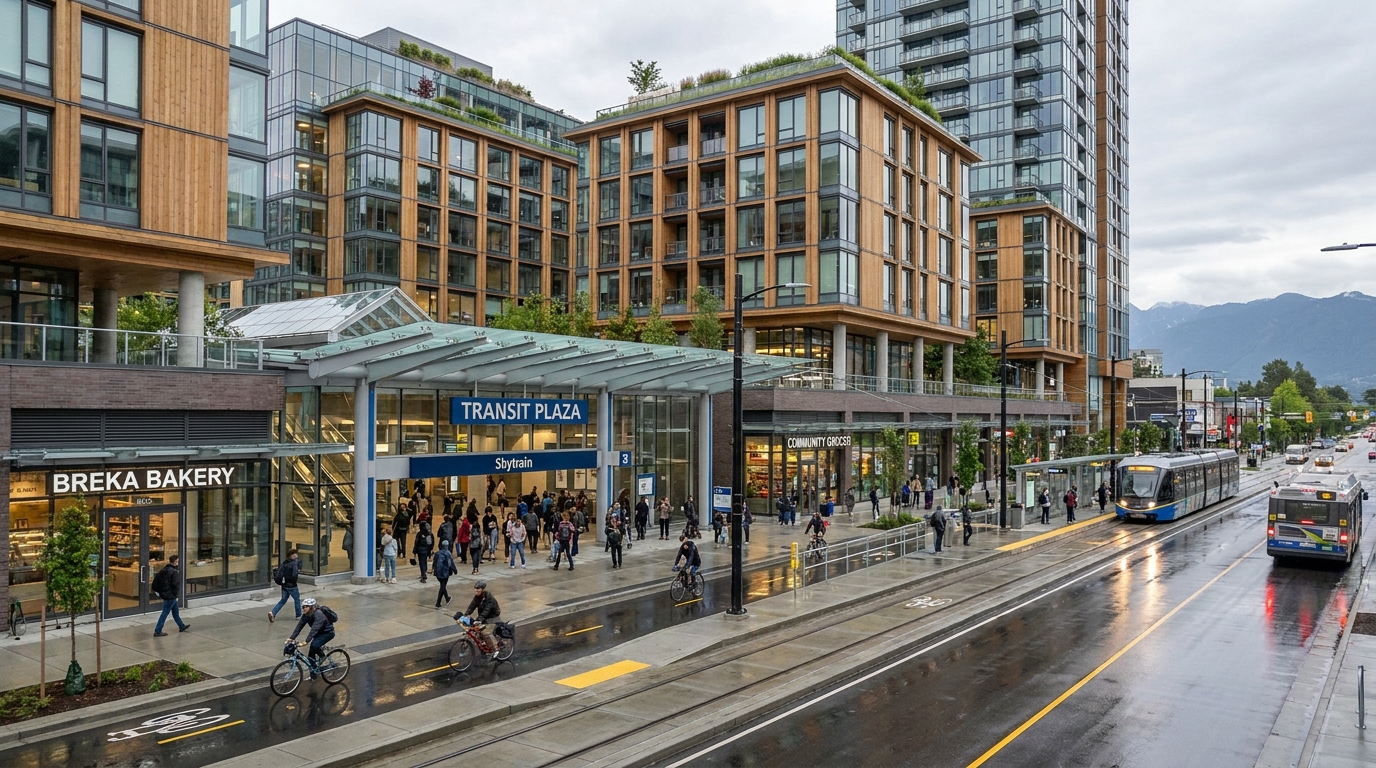
Transit-oriented development, often shortened to TOD, has been discussed in planning circles for years. What is changing now is its scale and urgency. In the past, TOD could be treated as a desirable planning concept around a few major stations. Today, it is becoming a central strategy for addressing housing supply, infrastructure efficiency, and urban sustainability. The difference is significant. A design idea can be optional. A growth strategy cannot be.
Transit-oriented development works best when housing, employment, services, and public spaces are concentrated near frequent transit. That pattern supports ridership, reduces car dependence, and makes better use of expensive infrastructure. It also improves the viability of local retail and public amenities because more residents are within easy walking distance. In a high cost environment, this matters enormously. Every dollar invested in transit performs better when paired with supportive land use, and every unit of housing performs better when residents can access the city without depending on a private vehicle for every trip.
Canada is already moving in this direction through policy. British Columbia’s Transit-Oriented Areas framework requires 31 municipalities to designate TOD areas, illustrating a direct integration of provincial housing and transit objectives. Toronto and Vancouver are also using transit-oriented community and transit-friendly housing policies to shape growth around stations and corridors. These examples point to a larger policy model in which mobility investment and land use reform are tied together rather than managed as separate agendas.
Still, there is an important misconception to address. Housing near transit does not automatically become affordable. In many markets, transit investment can increase land values substantially. Without inclusionary policies, rental protections, public land strategies, and affordable housing delivery tools, the benefits of accessibility may be accompanied by displacement pressures. That does not weaken the case for TOD. It strengthens the case for doing it strategically. Mobility-led growth must be paired with governance tools that preserve access for a broad range of households.
What Effective TOD Requires
Successful transit-oriented development is not just about building taller buildings near stations. It depends on a coordinated set of ingredients that turn proximity into real mobility benefits. These include frequent transit service, walkable street design, safe cycling access, clear station-area planning, and zoning that allows enough residential and mixed-use intensity to support a complete neighborhood. If one piece is missing, the outcome often underperforms.
It also requires timing and sequencing. Cities that wait too long to align zoning, infrastructure, and development approvals around major transit investments often lose the opportunity to shape growth before speculation and fragmented projects take over. A proactive station-area strategy gives municipalities a chance to set expectations early around public realm, affordability, density, access, and community services. For developers, that clarity can reduce uncertainty and improve project feasibility. For residents, it can create a more coherent path from infrastructure announcement to neighborhood transformation.
Zero-Emission Transit and the Decarbonization Imperative
No serious discussion of sustainable city transit can ignore emissions. Transportation is one of the country’s largest emitting sectors, which means urban mobility strategy has to be part of any credible climate response. This is where zero-emission transit becomes essential. The continued funding of zero-emission buses and transit planning projects shows that governments understand the importance of reducing the carbon intensity of public fleets while modernizing service.
Electric buses and other zero-emission technologies offer a compelling opportunity, especially on busy urban routes where vehicle turnover is high and local air quality improvements are meaningful. They can reduce operating emissions, support quieter streets, and align public mobility investments with broader environmental goals. But the strategic lens matters. Fleet electrification should be seen as one layer of mobility transformation, not the full solution. If a city electrifies buses but continues to expand low-density land patterns that make frequent service difficult, the climate and accessibility benefits will be limited.
True decarbonization comes from combining clean technology with mode shift and compact urban form. In other words, cities need more people to use efficient shared modes for more trips, and they need more homes and services located where those trips are practical. That is why transit planning and housing planning cannot be separated. A low-emission bus serving a well-planned corridor with housing, employment, and walkable amenities is far more powerful than the same bus serving fragmented sprawl.
There is also a resilience dimension here. Decarbonized mobility systems can be integrated with broader infrastructure adaptation strategies, including energy reliability, street tree canopy, stormwater management, and heat mitigation in station areas. Sustainable transit is not just a vehicle choice. It is part of the larger question of how cities will function in a changing climate while continuing to grow.
Why Bus Priority and Network Redesign Deserve More Attention
One of the enduring misconceptions in urban mobility is that only major rail projects can materially improve transit outcomes. Rail certainly has a major role, particularly where demand, corridor structure, and land use justify large capital investment. But many cities can deliver meaningful gains faster and more affordably through bus priority, network redesign, and service optimization. These are not second-tier tools. In many corridors, they are the highest value interventions available.
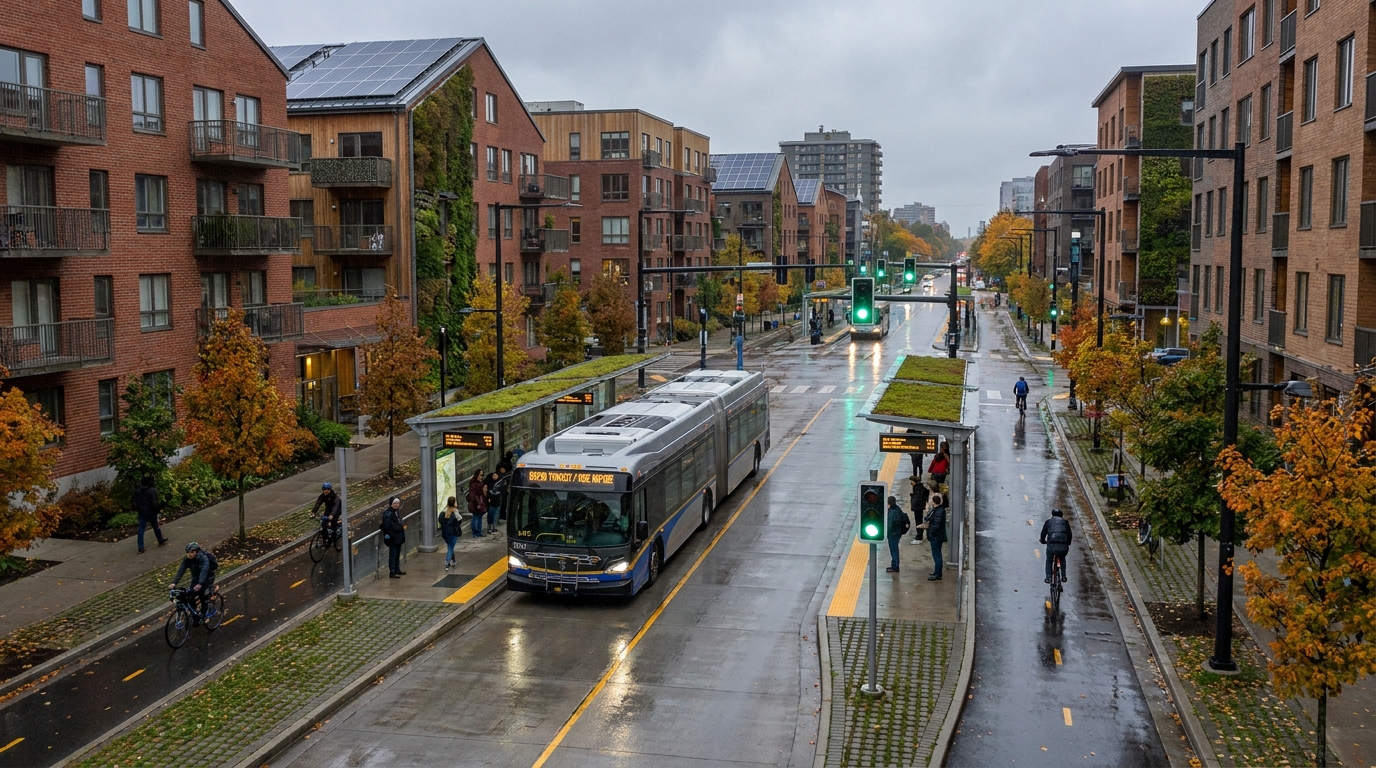
Bus rapid transit, transit signal priority, queue jump lanes, dedicated lanes, stop consolidation, and redesigned routes can all improve speed and reliability without waiting for decade-long project timelines. Reliability matters because riders experience transit through trust. If service is frequent but unpredictable, its usefulness drops sharply. A bus network that arrives when expected and connects cleanly to other modes can change travel behavior quickly, particularly in growing neighborhoods where demand is already strong but service quality is inconsistent.
Network redesign is equally important because many transit systems still reflect historical travel patterns that no longer dominate. As urban form evolves, routes need to be reassessed against current accessibility needs, cross-town demand, and emerging growth centers. A city that continues to operate a network designed for yesterday’s economy will struggle to support tomorrow’s development. Data-driven ridership analytics and accessibility metrics are becoming more central to this process, allowing agencies to allocate service based on real travel behavior and social need rather than inherited assumptions.
For decision makers, the lesson is clear. Sustainable mobility does not always begin with megaprojects. Often, it begins with disciplined corridor planning, street reallocation, and operational reforms that make the existing network work better. Those improvements can also create stronger foundations for future capital investments by building ridership and shaping land use confidence in advance.
Micromobility and the First-Mile, Last-Mile Opportunity
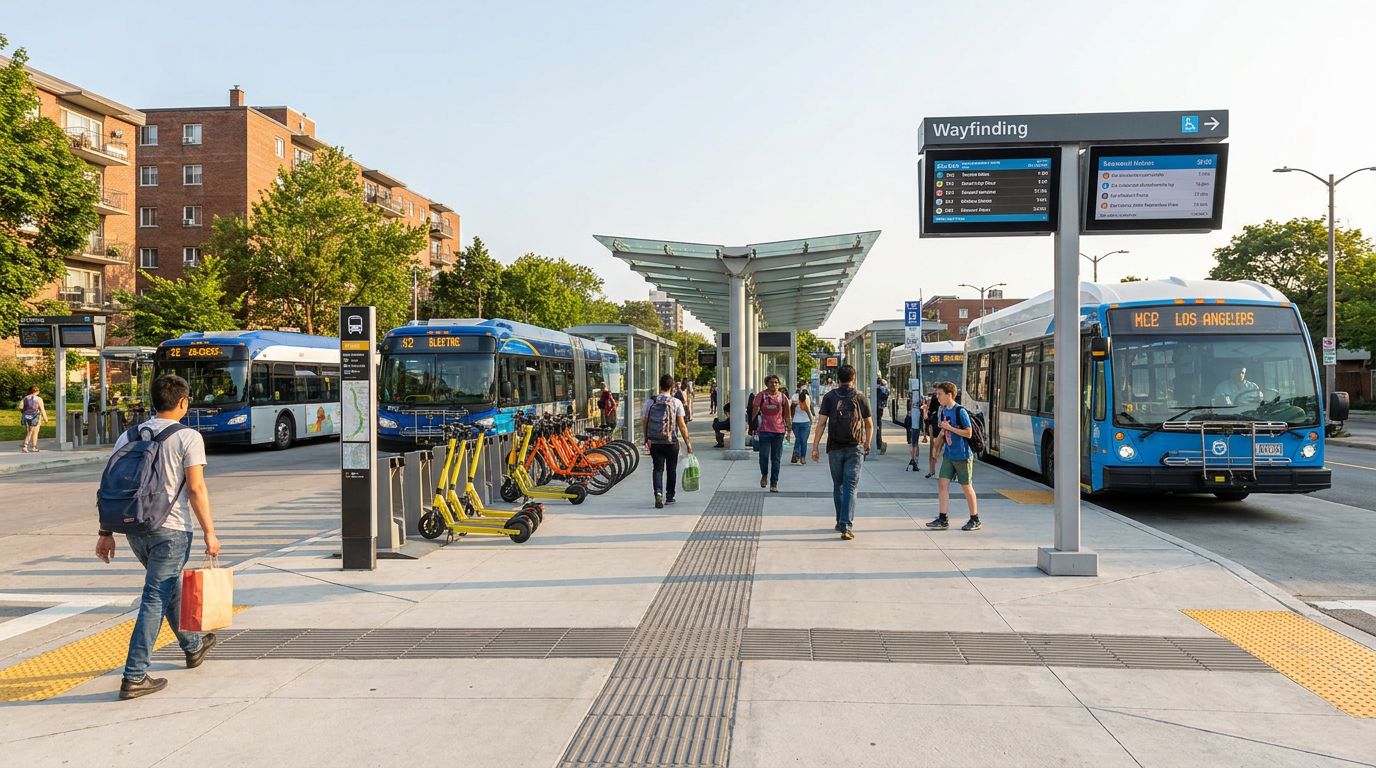
Urban mobility systems are becoming multimodal by necessity. Residents do not experience transportation as a set of isolated agencies or technologies. They experience a trip. That trip may involve walking to a bus stop, riding a train, using a shared bike for the final stretch, and returning home along a protected cycling corridor. The quality of the overall system depends on how well these pieces connect.
This is where micromobility has become strategically relevant. Shared micromobility in the United States and Canada reached 157 million trips in 2023, according to NACTO, which demonstrates that bikes and scooters are no longer fringe experiments. In the right urban contexts, they are increasingly part of the first-mile and last-mile ecosystem. They can expand the effective catchment area of transit stations, improve short local trips, and reduce pressure on car use for errands and connections that are too far to walk comfortably but too short to justify driving.
Of course, micromobility only works well when the public realm supports it. Protected cycling infrastructure, safe intersections, predictable curb management, secure parking, and clear operating rules are all necessary. Without them, shared systems can create friction rather than convenience. The strategic opportunity lies in treating micromobility as infrastructure-supported mobility rather than a private tech layer dropped onto streets that were not designed for it.
For housing and development strategy, this matters because station-area performance is not just about the station itself. It is about the radius of practical access around it. If more residents can safely and quickly reach transit without driving, a city can support higher density with less parking demand and better land efficiency. That can improve project economics, reduce construction costs tied to structured parking, and create a more human-scaled urban environment.
Mobility, Housing Supply, and the Economics of Land
At the heart of urban mobility strategy is a land question. Transit changes land economics because it changes accessibility, and accessibility is one of the most powerful drivers of urban value. When high-quality mobility infrastructure is delivered, some sites become more viable for redevelopment, some corridors become more attractive for mixed-use intensification, and some neighborhoods become more connected to employment and services than they were before. These changes are not side effects. They are core outcomes.
This is why transit funding is increasingly being tied to housing supply and land-use reform. Governments are recognizing that mobility investments should generate public value beyond ridership alone. If a major transit corridor is built but surrounding zoning prevents meaningful housing growth, the city captures only a fraction of the possible benefit. The infrastructure still matters, but its long term productivity is constrained. By contrast, if policy allows more homes, more mixed-use space, and more complete communities around transit, the return on public investment becomes much broader.
That said, land value uplift must be managed carefully. Rising accessibility can improve feasibility and stimulate development, but it can also price out lower income residents and smaller local businesses if protections are absent. A sophisticated strategy therefore balances growth with inclusion. This can involve affordable housing requirements, public land partnerships, rental replacement policies, density bonusing, land value capture mechanisms, and targeted community benefits. The goal is not to suppress growth. It is to ensure that growth near transit remains socially durable.
From a city-building perspective, the most successful mobility investments are those that create a pipeline of livable, serviceable, and financially realistic housing opportunities. They help shift growth into places where infrastructure can support it and where daily life can be less car dependent. In an era of constrained housing supply, this is not a secondary benefit of mobility planning. It is one of its most important strategic functions.
Key Principles for Linking Mobility and Housing
- Plan transit and land use together from the start. Corridor investment should be matched with zoning, servicing strategy, and station-area frameworks before growth pressure accelerates.
- Focus on complete communities, not isolated density. Housing performs better near transit when schools, childcare, retail, healthcare, and public space are also integrated.
- Protect affordability as accessibility rises. Stronger transit can increase land values, so inclusion tools are needed to preserve socioeconomic diversity.
- Reduce dependence on parking-led design. Better mobility options can support lower parking ratios and more efficient land use, improving development feasibility.
- Measure outcomes through accessibility. The real test is not only whether new units are built, but whether residents can reach opportunity more easily and affordably.
Designing Multimodal Corridors for Long-Term Urban Growth
The future of mobility is not a single mode. It is a corridor approach that integrates transit priority, cycling, walking, freight movement, curb activity, and adjacent development. Multimodal corridor planning reflects the reality that streets are some of the most valuable and contested public assets in the city. They are not just conduits for vehicles. They are places where mobility, commerce, utilities, public life, and safety all intersect.
When corridors are planned strategically, they can become the framework for sustainable intensification. A street with reliable transit, protected cycling lanes, generous sidewalks, street trees, managed loading zones, and clear redevelopment potential is far more than a transport route. It becomes an urban growth spine. Housing can cluster along it, businesses can benefit from increased foot traffic, and public investment can be concentrated where it has the greatest cumulative effect.
Complete streets principles are especially relevant here. Streets that safely serve walkers, cyclists, transit users, drivers, seniors, and people with disabilities are better aligned with modern urban needs than single-purpose road expansions. They also support equity because not every household has the same mobility options. A resilient city is one where daily access does not depend entirely on car ownership.
Freight and curb management must also be included in this conversation. As e-commerce and urban delivery demands grow, curb space is becoming more strategically important. Without active management, curb conflict can undermine bus operations, cycling safety, and pedestrian comfort. The next generation of mobility planning will need to treat curb allocation as seriously as lane allocation. In dense urban environments, that level of operational detail can determine whether a corridor functions smoothly or poorly.
Governance, Data, and the Need for Better Decision Frameworks
Urban mobility systems are only as effective as the governance structures behind them. One of the consistent challenges in city building is that transportation, housing, infrastructure, and land-use decisions are often spread across multiple agencies and levels of government. When objectives are misaligned, projects slow down, funding is diluted, and outcomes become fragmented. The future of sustainable city transit depends not only on technical solutions but also on better institutional coordination.
Data is playing a larger role in this shift. Ridership analytics, accessibility mapping, service equity measures, and land-use forecasting are becoming central to investment decisions. This is a positive development because it moves the discussion beyond anecdotes and mode preferences. A city should be able to identify which corridors have the strongest unmet demand, which neighborhoods are most disconnected from jobs and services, where service improvements would deliver the greatest social return, and how mobility infrastructure is influencing development activity over time.
At the same time, data should inform but not replace strategy. Good planning still requires judgment about long term growth, resilience, and public value. Some investments are justified not only by current numbers but by the future urban structure they make possible. This is particularly true in emerging growth areas where mobility infrastructure can shape land use outcomes before patterns harden. The strongest decision frameworks combine present evidence with future-oriented planning.
Public trust also matters. Residents are more likely to support mobility transformation when they understand how it connects to broader goals such as housing, affordability, safety, air quality, and local economic vitality. Framing transit projects solely in technical transport terms can narrow public understanding. Framing them as city-building investments creates a stronger case for action and a more durable coalition behind it.
Common Misconceptions That Still Hold Cities Back
Despite substantial progress, several misconceptions still limit the effectiveness of urban mobility strategy. The first is the idea that transit investment is only about commuting. In reality, modern systems support access to jobs, education, healthcare, childcare, and everyday services throughout the day. A transit network that serves only the traditional office commute is misaligned with how cities actually function.
The second misconception is that higher density automatically produces better mobility outcomes. Density matters, but it is not sufficient by itself. Without frequent service, safe walking conditions, cycling access, and coordinated land use, density can simply add more congestion and pressure to underperforming infrastructure. The quality of urban form matters as much as the quantity.
A third misconception is that electrifying vehicles alone will solve sustainable mobility. Cleaner vehicles are essential, but emissions, congestion, equity, and land consumption are also shaped by mode choice and spatial structure. If every trip still requires long-distance car travel, even an electrified fleet will not solve many of the broader urban problems cities are trying to address.
Another persistent misunderstanding is that micromobility is a niche add-on and that only large capital projects deserve serious attention. In practice, micromobility, bus priority, fare integration, curb management, and service redesign can deliver significant benefits quickly and at lower cost. Cities need the discipline to pursue these practical gains alongside major infrastructure ambition. Sustainable mobility is built through systems thinking, not a single silver bullet.
A Strategic Agenda for the Next Generation of Sustainable City Transit
If cities want mobility systems that genuinely support sustainable growth, several strategic priorities should guide the next decade. The first is to align transportation funding with land-use outcomes. Public investment should reinforce places where housing, jobs, and services can grow together around strong mobility infrastructure. The second is to prioritize reliability and accessibility over symbolic expansion alone. A smaller set of well-performing improvements can sometimes outperform a larger portfolio of disconnected projects.
The third priority is to make multimodal integration the default. Walking, cycling, buses, rail, shared mobility, and curb access need to be planned as one ecosystem rather than separate silos. The fourth is to accelerate fleet decarbonization while recognizing that mode shift and urban form remain essential to climate performance. The fifth is to treat affordability and inclusion as structural parts of transit-oriented growth, not afterthoughts added once land values have already escalated.
Cities should also embrace phased implementation. Not every transformation requires waiting for a full buildout or ideal funding package. Tactical bus lanes, interim cycling facilities, pilot curb programs, station-area zoning reforms, and fare integration measures can all create momentum while larger capital plans advance. That incremental approach is not a compromise. In many cases, it is the most practical path to durable change.
Finally, leadership matters. The future of urban mobility systems will be shaped by whether governments, agencies, and development actors can move beyond fragmented decision making and operate from a shared urban vision. The stakes are high because mobility influences not just how people travel, but how they live, where they can afford to live, how communities connect, and whether growth strengthens or weakens the city as a whole.
Conclusion: Mobility as the Framework for Better Urban Living
The future of urban mobility systems is ultimately about more than transportation efficiency. It is about creating cities that can grow without becoming less affordable, less connected, less healthy, or less resilient. In that sense, mobility is one of the most important levers in modern urban development. It shapes land value, housing feasibility, emissions performance, and daily quality of life in ways that no serious city can afford to ignore.
The evidence is already clear. Transit ridership is recovering, but the nature of demand is changing. Housing policy is increasingly being tied to transit policy. Zero-emission fleet transition is accelerating. Provincial and municipal governments are linking station-area growth to supply objectives. Micromobility is maturing into a meaningful connector mode. Corridor planning is becoming multimodal. Data-driven service design is gaining importance. These are not isolated trends. Together, they point to a broader transformation in how cities understand mobility.
For planners, developers, and public leaders, the path forward is strategic integration. Transit must connect to housing. Housing must connect to infrastructure. Infrastructure must connect to climate goals. Climate goals must connect to equity and accessibility. When these pieces are aligned, mobility systems can do far more than move people. They can underpin a more productive, inclusive, and sustainable urban future.
That is the real opportunity ahead. The cities that succeed will not be the ones that simply add new transit lines or buy cleaner vehicles in isolation. They will be the ones that use mobility as a framework for shaping complete communities, unlocking housing in the right places, and building urban regions that work better over the long term. Sustainable city transit is not just the future of transportation. It is the future of city building itself.


No Comment! Be the first one.