



Construction has always depended on equipment, but for decades the industry treated machines primarily as physical assets rather than information assets. An excavator was measured by its horsepower, rental rate, and hours on the meter. A loader was tracked by where it was sent and whether it was available the next morning. Today that view is changing quickly. Equipment monitoring technology is turning machines into continuous sources of operational intelligence, and that shift is reshaping how contractors manage productivity, budgets, safety, and schedules.
Table Of Content
- What Equipment Monitoring Technology Really Includes
- Why Data Analytics Is the Real Breakthrough
- Closing the Utilization Gap on Modern Jobsites
- Predictive Maintenance and Condition-Based Service
- Safety Gains Beyond Compliance
- Why Mixed-Fleet Integration Is Now Essential
- The Canadian Productivity Context
- From Asset Tracking to Project-Level Intelligence
- What Contractors Need to Get Right
- The Future of Equipment Monitoring in Construction
At its core, equipment monitoring combines telematics, GPS, engine diagnostics, fuel tracking, maintenance data, and in some cases video or sensor inputs to create a live picture of machine activity. Contractors can see where equipment is, how much it is working, how long it is idling, when it is consuming excess fuel, and whether a component is showing signs of failure. What used to require clipboards, radio calls, and scattered spreadsheets can now be viewed in a central dashboard. The practical value is not just visibility. The real transformation comes when that data is analyzed and used to improve decisions. In short, equipment monitoring is the use of telematics and connected sensors to convert machine activity into real-time operational data that contractors can act on.
This matters because construction remains a data-rich but often under-measured environment. McKinsey has described the industry as one where sensors and wireless technologies can connect machinery to a central platform for equipment monitoring and repair, yet many firms still struggle to turn raw signals into coordinated action. In North America, and especially in Canada, the timing is significant. Construction productivity pressures, housing supply constraints, and continued capital investment in machinery and equipment are making every unit of labor and every machine hour more important.
The conversation is no longer about whether telematics exists. Most contractors have heard of it, many have invested in some version of it, and major equipment manufacturers already provide connected-machine capabilities. The real question is whether construction firms can operationalize the data. A 2026 Teletrac Navman study summarized by For Construction Pros found that 74% of operators cited data accessibility as the biggest barrier to improving utilization, while equipment can sit idle up to 50% of the time. Even more revealing, only 28% of fleets reported having a fully implemented digital tracking system despite broader investment in digital tools. That gap is where the next wave of construction intelligence will be won or lost.
Equipment monitoring is therefore not just a fleet management feature. It is becoming a strategic layer in project management itself. The contractors that use it well are not simply tracking iron in the field. They are using analytics to right-size fleets, reduce downtime, improve dispatch, support safer operations, sharpen estimates, and forecast equipment demand on future jobs. In a business where margins are tight and delays can compound quickly, these advantages are material.
What Equipment Monitoring Technology Really Includes
A common misconception is that equipment monitoring is basically GPS tracking. Location is part of the picture, but it is only the beginning. Modern platforms can track equipment location, fuel burn, idle and working hours, diagnostic codes, incident reports, and maintenance schedules from a central database. That level of visibility changes how supervisors and fleet managers understand a worksite. Instead of guessing whether an underperforming machine is a scheduling issue, an operator issue, or a maintenance issue, they can start with data.
Telematics is the backbone of most systems. A telematics device or embedded OEM module captures machine signals and transmits them through cellular or satellite networks to a software platform. These signals often include engine hours, fault codes, ignition status, geofencing activity, run time, and fuel usage. Depending on the machine and provider, contractors may also get information about load patterns, hydraulic behavior, battery condition, or emissions system alerts. When integrated with maintenance software, telematics can also trigger service planning and work orders.
What makes this especially powerful in construction is that machine data can be linked to project data. An excavator is no longer only a unit in a fleet register. It can be tied to a job cost code, a schedule milestone, a rental agreement, an operator, and a maintenance history. Once that connection is made, decisions become more intelligent. A project manager can compare actual equipment utilization against the estimate, while a fleet manager can identify whether a rented compactor is underused enough to return early or heavily used enough to justify a purchase.
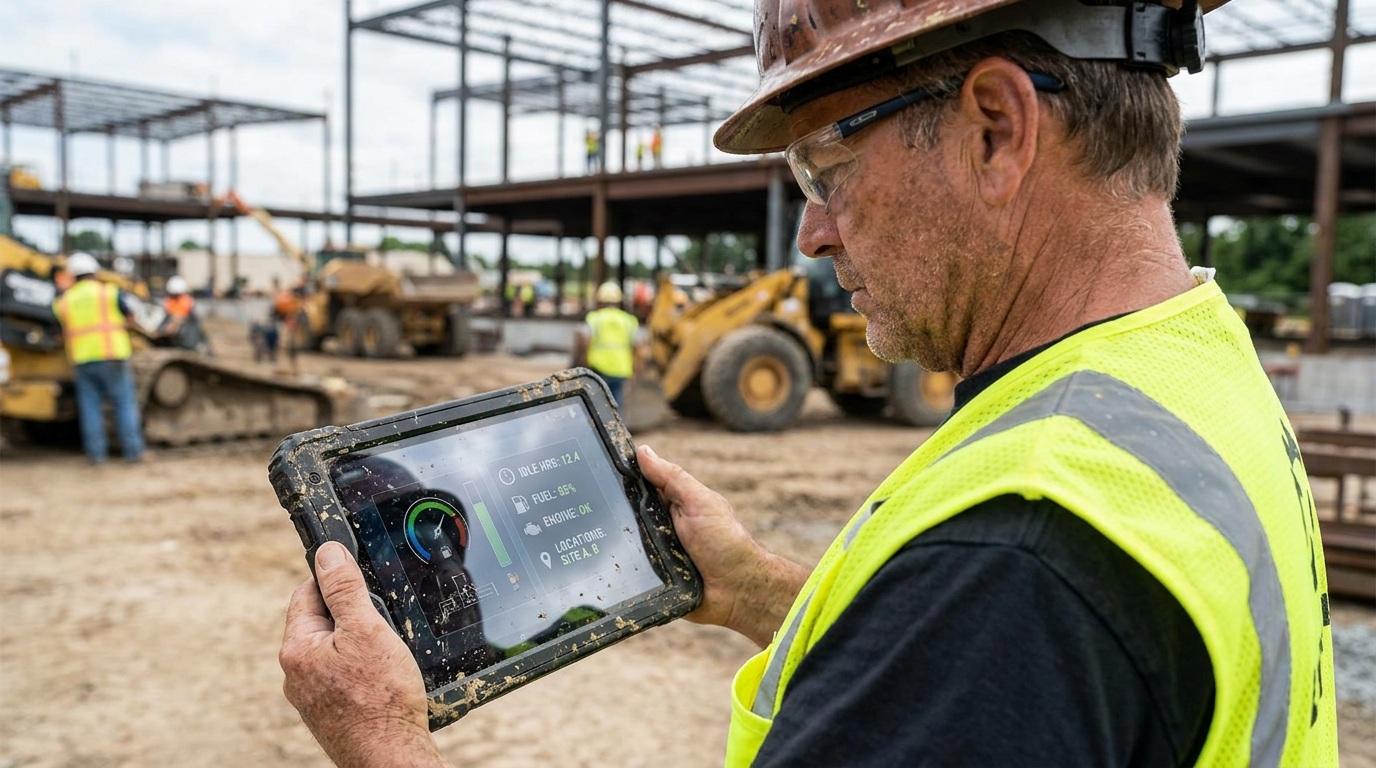
That is why equipment monitoring should be understood as part of the broader construction intelligence stack. It intersects with IoT sensors, preventive maintenance workflows, business intelligence dashboards, enterprise asset management systems, and increasingly AI-assisted forecasting. The machine is generating the signal, but the real business value comes from the intelligence layer built around it. Firms that recognize this tend to move faster from passive tracking to active optimization.
There is also a behavioral dimension. Once crews and managers know machine activity is visible, accountability improves. Idle time gets questioned. Unauthorized use becomes easier to identify. Preventive maintenance can no longer be delayed indefinitely without documentation. This does not mean monitoring should become a surveillance exercise. The best implementations use visibility to support better planning and smoother operations rather than to punish people for isolated events.
Why Data Analytics Is the Real Breakthrough
Construction companies have never lacked data entirely. They have lacked coherent, timely, and decision-ready data. Equipment monitoring changes that by creating a continuous stream of machine-level information, but analytics is the step that turns information into action. Knowing a dozer idled for three hours yesterday is interesting. Understanding that the fleet averages 38% idle time on utility trenching jobs, that certain crews idle more during handoff periods, and that this pattern is adding measurable fuel cost and schedule drag is useful.
Analytics helps answer high-value operational questions. Which machines are chronically underutilized across the company. Which projects are over-rented relative to actual usage. Which sites consume unusually high fuel per working hour. Which fault codes tend to precede costly failures. Which operators regularly work assets beyond optimal maintenance windows. These are not abstract management questions. They directly affect margin, project delivery, and capital allocation.
For many firms, utilization analysis is the first major win. Construction equipment is expensive to buy, expensive to rent, and expensive to move. If a contractor can identify underused assets, they can avoid unnecessary rentals, redeploy owned machines, or dispose of equipment that no longer earns its keep. If they can identify overused assets, they can reduce strain on key machines and prevent breakdowns that disrupt field operations. Fleet analytics also improves future bidding because historical usage patterns reveal what equipment was truly needed rather than what was assumed to be needed.
Fuel analysis is another often overlooked advantage. Fuel costs are volatile, and excess idle time quietly erodes profitability. Monitoring systems can expose machines that burn fuel without producing corresponding work hours. Sometimes the cause is operator habit. Sometimes it is poor dispatch. Sometimes the machine is simply oversized for the task. Without data, those causes blur together. With analytics, each one can be isolated and addressed.
The strategic shift is simple: equipment monitoring is no longer just about locating assets. It is about understanding how asset behavior influences cost, schedule, risk, and productivity across the whole project.
Advanced dashboards make this analysis usable for non-specialists. A fleet manager may want machine-level diagnostics, while a project executive may prefer a simple utilization and downtime summary by job. A superintendent may need alerts when idle thresholds are exceeded or when a fault code threatens tomorrow’s work plan. Good systems translate raw machine streams into role-specific views. That is where analytics becomes operational rather than merely technical.
AI is beginning to deepen this value. Pattern recognition models can flag abnormal fuel behavior, forecast service intervals based on actual usage rather than generic calendar schedules, and estimate likely demand for specific equipment classes on upcoming work. These capabilities are not magic, and they are only as reliable as the underlying data, but they point toward a future in which machine intelligence contributes directly to forecasting and resource planning. For contractors, that means less guesswork and more control.
Closing the Utilization Gap on Modern Jobsites
One of the strongest arguments for equipment monitoring is the simple scale of wasted utilization in construction. If equipment can sit idle up to 50% of the time, as the Teletrac Navman study suggests, then a large share of fleet cost is not creating productive output. Idle machines still incur ownership costs, transport costs, depreciation, insurance exposure, and often fuel consumption. In a high-volume operation, small inefficiencies repeated across dozens or hundreds of assets become a major financial drag.
Idle time does not always mean mismanagement. Construction is inherently variable. Crews wait for inspections, materials, access, weather windows, and sequence handoffs. Certain equipment must remain nearby for short bursts of activity even if it is inactive for part of the shift. The goal is not to eliminate all idle time. The goal is to distinguish necessary idle time from preventable idle time. Data makes that distinction more precise.
For example, if telematics shows a skid steer repeatedly idling for long periods between short bursts of movement on one site, managers can investigate whether the equipment assignment is too broad, whether the task sequence is fragmented, or whether the machine should be shared with another crew. If a generator runs overnight outside approved operating windows, geofencing and usage alerts can reveal unauthorized or unnecessary operation. If multiple compactors are deployed to a site but only one shows consistent work hours, the fleet is probably oversized for the actual production requirement.
Utilization analysis also improves dispatch and logistics. Contractors with multiple active jobs often struggle to know where equipment should go next, especially when they operate mixed ownership and rental models. A centralized monitoring platform helps identify which machine is nearest, which is due for service, which has enough available hours to support another shift, and which can be reassigned without creating a downstream shortage. That kind of visibility reduces scramble-based decisions and lowers transport waste.
The result is a more disciplined relationship between fleet size and workload. Instead of buying more equipment to compensate for uncertainty, firms can first use analytics to understand whether current assets are being used effectively. That is a meaningful strategic shift. In a capital-intensive sector, avoiding even a few unnecessary purchases can improve cash flow and return on assets significantly.
Predictive Maintenance and Condition-Based Service
Maintenance is where equipment monitoring often delivers some of its fastest and most measurable returns. Traditional maintenance models in construction rely on fixed intervals, operator reports, and reactive repairs. These methods are familiar, but they are blunt. A machine may be serviced too early, wasting labor and parts, or too late, causing a costly failure in the middle of a critical production window. Monitoring technology offers a more precise middle path.
By collecting engine diagnostics, fault codes, fluid indicators, temperature readings, and run-time patterns, connected systems can support condition-based maintenance. Instead of asking whether a machine has reached a generic service threshold, managers can ask whether its actual behavior suggests rising risk. Repeated overheating alerts, abnormal idle-to-work ratios, or recurring fault codes can signal an issue before it becomes a breakdown. Predictive maintenance does not guarantee failure prevention, but it reduces risk by surfacing early warning signals.
This matters because downtime in construction is rarely contained to one machine. If a key excavator goes down during a foundation sequence, trucks may wait, labor crews may stall, and follow-on activities may slip. The cost of disruption is often greater than the repair bill itself. Monitoring systems reduce this vulnerability by helping maintenance teams intervene earlier and schedule service windows more intelligently.
There is also a lifecycle cost advantage. Telematics-supported maintenance records create a more accurate history of each asset. Managers can see how often a machine needed repair, which components failed most often, how hard it was used, and what its total operating profile looked like across projects. That information improves replacement timing, resale decisions, and future procurement strategy. Over time, contractors can compare not only purchase prices but true ownership performance across machine classes and brands.
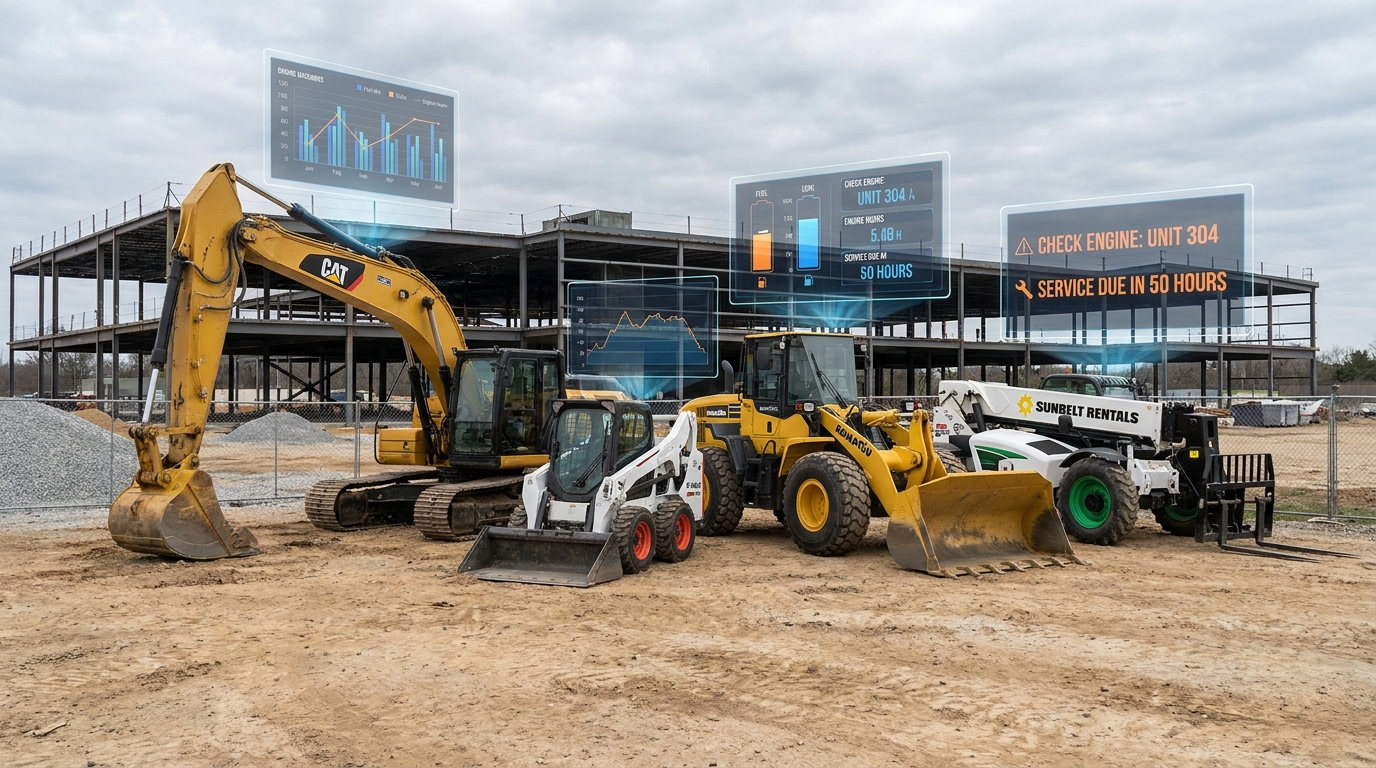
For firms managing rental assets, this can be just as valuable. Monitoring clarifies whether rental equipment is being operated within expected patterns, whether it is idle enough to return sooner, and whether recurring issues stem from the machine, the operator, or the work conditions. In rental-heavy environments, these insights protect margin because they tighten the link between asset cost and actual field value.
OSHA guidance on equipment condition emphasizes inspection, maintenance, repair history, and mechanical integrity as core controls for hazard reduction. Monitoring technology supports these practices by improving the completeness and timeliness of equipment records. A digital log of service events, alerts, and repairs is not just operationally useful. It can also strengthen compliance posture and documentation quality when incidents, audits, or claims occur.
Safety Gains Beyond Compliance
Construction safety has traditionally focused on training, PPE, site controls, and inspections. Those remain essential, but equipment monitoring adds a new dimension by making machine condition and machine behavior more observable. A fault that once stayed hidden until an operator reported a problem can now trigger an alert. Excessive speeds, harsh events, after-hours use, or unsafe zone entries can be captured and reviewed with much greater clarity than before.
One of the more important developments is video telematics. Traditional telematics can tell managers that a harsh braking event happened, that a machine entered a restricted area, or that an incident alert was triggered. Video adds context. It can show whether the event was caused by congestion, operator distraction, poor site layout, ground conditions, or another vehicle. That difference matters because corrective action should address root cause, not just the event itself.
Video telematics is increasingly valuable for near-miss analysis, claims support, and safety coaching. Instead of relying solely on memory or fragmented witness reports, supervisors can review actual event footage alongside machine data. This supports a more accurate and less emotional investigation process. It also creates better feedback loops for site planning. If repeated close calls occur at the same haul route crossing, the problem may be traffic design rather than individual operator behavior.
Monitoring also helps control unauthorized use and after-hours risk. Geofencing can alert managers when equipment leaves approved boundaries or operates outside scheduled windows. Engine and ignition records can reveal whether a machine was started unexpectedly. For high-value or safety-sensitive equipment, this adds a meaningful layer of asset protection and jobsite control.
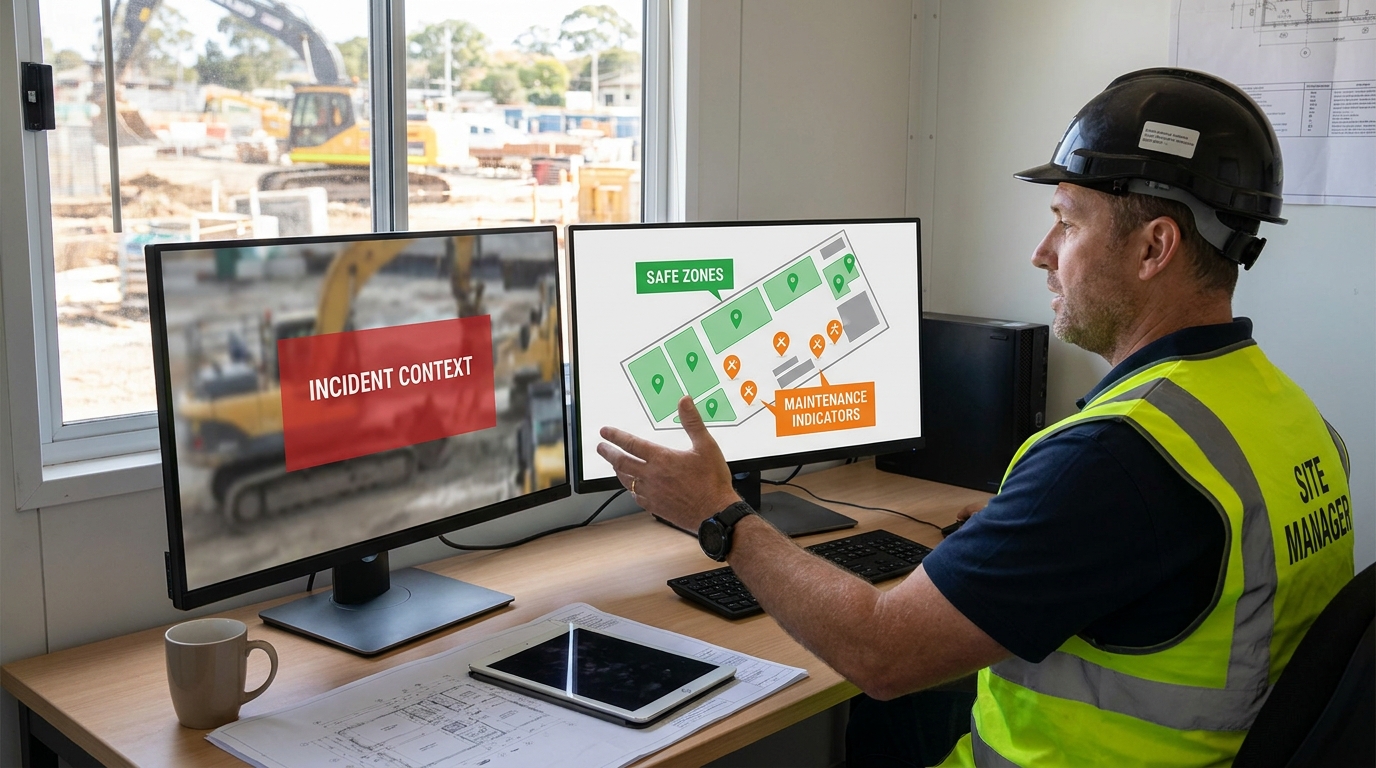
It is worth noting that the best safety outcomes come when monitoring is integrated into a broader safety culture. Data should support coaching, process improvement, and hazard reduction rather than simply creating more reports. When crews understand that monitoring helps prevent incidents, improve machine reliability, and document site conditions fairly, adoption tends to be stronger. In that sense, technology works best when paired with trust and clear operating policies.
Why Mixed-Fleet Integration Is Now Essential
Many contractors do not operate a single-brand fleet. They own machines from multiple OEMs, bring in rental assets for peak workloads, and sometimes use subcontractor equipment within shared workflows. That reality creates one of the biggest practical barriers to effective monitoring: fragmented data. If each manufacturer has its own portal, each rental source has its own reporting method, and each project team keeps separate logs, fleet visibility remains incomplete even when telematics devices are present.
This is why interoperability matters so much. The AEMP API, formalized as ISO 15143-3, was designed to standardize the communication of mobile machinery status data across telematics providers and third-party software. In simple terms, it helps equipment data from different brands speak a more common language. For contractors, that is a major step toward unified analytics.
Standardization enables better benchmarking. A company can compare utilization, fuel efficiency, or maintenance patterns across its whole fleet rather than within isolated OEM dashboards. It can feed multiple machine streams into a central BI platform, connect them to cost codes, and create enterprise-level views of asset performance. This is especially important for larger firms and rental-heavy contractors, but smaller firms benefit too because it reduces administrative friction.
Without integration, more data can actually make operations harder. Managers may have to log into multiple systems, export inconsistent reports, and manually reconcile machine identities. That slows response times and discourages regular use. It also undermines confidence in the numbers. If utilization reports vary by source, project teams may stop trusting them altogether. Interoperability is therefore not a technical luxury. It is a prerequisite for scaling equipment intelligence.
The broader lesson is clear. Contractors do not need more disconnected dashboards. They need an operating model in which equipment data, maintenance records, rental information, and project planning can work together. Standards like AEMP and ISO 15143-3 are important because they support exactly that convergence.
The Canadian Productivity Context
The case for equipment monitoring is especially strong in Canada. The country continues to face housing supply pressure, productivity constraints, labor shortages in some trades, and high costs tied to logistics, weather, and project complexity. At the same time, Statistics Canada data shows continued investment in machinery, equipment, and construction-related capital. When the asset base is significant, the quality of asset management becomes economically important.
CMHC has argued that improving housing construction productivity requires smarter tools, better skills, and stronger investment in equipment and methods. Equipment monitoring fits naturally into that framework. It does not solve productivity challenges on its own, but it addresses a part of the problem that is often overlooked: whether high-value machines are being deployed, maintained, and coordinated with enough precision to support faster and more reliable delivery.
This matters beyond large civil projects. Residential and light commercial builders can benefit as well, particularly when equipment is rented frequently or moved across multiple sites. If a builder understands exactly how often lifts, compactors, mini excavators, and generators are used, they can tighten scheduling, reduce unnecessary rental days, and improve trade coordination. In a market where financing costs and timing pressures are significant, even modest efficiency gains matter.
Canadian contractors also work across varied geographies and conditions, from dense urban infill to remote resource-adjacent projects. Monitoring technology helps bridge that complexity by enabling centralized oversight across dispersed operations. A head office fleet manager can see machine status on remote jobs, while local teams can receive alerts and service recommendations without waiting for manual reports to flow upstream. That connectivity is increasingly valuable as construction operations become more distributed and time-sensitive.
From Asset Tracking to Project-Level Intelligence
The most advanced contractors are moving beyond asset tracking toward project-level intelligence. This means equipment data is no longer reviewed in isolation. It is linked to production rates, cost performance, schedule adherence, labor allocation, and risk indicators. When that happens, monitoring technology starts influencing not just fleet decisions but project strategy itself.
Consider estimating and bidding. Historical fleet data can reveal how many productive hours a specific class of machine actually delivered on comparable jobs, how much idle time was typical under certain site constraints, and what maintenance disruptions occurred. Estimators can use that history to build more realistic assumptions into bids. Over time, this improves pricing accuracy and reduces the gap between planned and actual equipment cost.
Scheduling also benefits. If utilization data shows that certain machine classes become bottlenecks during critical path phases, planners can adjust sequencing or secure backup capacity earlier. If maintenance trends suggest a high risk window for a key asset, teams can schedule service before entering a major production push. These are examples of machine data informing schedule resilience rather than merely documenting work after the fact.
Risk management improves as well. Equipment event history, video telematics, and maintenance logs can strengthen claims documentation and post-incident analysis. A contractor can show where a machine was, when it was operating, what condition it was in, and what event sequence occurred. In disputes over delays, damage, or unsafe conditions, that record can be materially useful.
In this model, equipment monitoring becomes one input into a larger digital feedback loop. The fleet informs the project, and the project informs the fleet. That is what makes the technology transformative. It is not just a more sophisticated odometer. It is an intelligence system for understanding how machines shape project outcomes.
What Contractors Need to Get Right
Despite the promise, not every monitoring rollout succeeds. One reason is that firms focus heavily on device installation and not enough on workflow design. More data does not automatically improve performance. If alerts go nowhere, dashboards are not reviewed, and no one owns utilization decisions, the system becomes expensive background noise. Implementation succeeds when firms define what decisions the data should improve and who is responsible for acting on it.
A practical starting framework often includes a few high-value use cases:
- Utilization management to identify underused or overused assets
- Idle reduction to lower fuel waste and improve productivity
- Maintenance planning to reduce unplanned downtime
- Safety monitoring to review incidents, unauthorized use, and machine condition
- Rental optimization to match external equipment cost with actual site need
It is also important to define data standards early. Machine naming conventions, project tagging, service categories, and operator or crew associations should be consistent if the company wants reliable reporting. This sounds mundane, but standardization is often the difference between analytics that scale and analytics that collapse into manual clean-up. The same is true for mixed-fleet integration. If the data is fragmented, the operational value will be fragmented too.
Training is another often underestimated factor. Project teams need to understand not only how to read dashboards but why the data matters to their daily work. A superintendent is more likely to use utilization reports if they help solve real scheduling friction. A mechanic is more likely to trust alerts if they align with actual service outcomes. Adoption improves when the system proves useful in field conditions, not just in executive presentations.
- Start with a small number of metrics that directly affect cost, schedule, or safety.
- Integrate machine data into regular operating reviews rather than treating it as a side report.
- Use benchmarks over time, because a single week of data rarely tells the full story.
- Combine quantitative signals with field context, especially when analyzing safety or operator behavior.
- Review whether insights lead to action, because unused dashboards do not create value.
The firms that win with equipment monitoring are usually not the ones with the most sensors. They are the ones with the clearest operating discipline around the data. Their edge comes from turning visibility into repeatable decisions.
The Future of Equipment Monitoring in Construction
Over the next several years, equipment monitoring will likely become more predictive, more integrated, and more closely tied to enterprise planning. AI models will improve anomaly detection and maintenance forecasting. Video and machine data will merge more tightly to support incident analysis and autonomous or semi-autonomous workflows. Digital twins and project simulation tools may increasingly ingest real-world equipment behavior to update schedule assumptions dynamically.
At the same time, the basics will remain decisive. Contractors still need accurate data capture, interoperable systems, and clear accountability for action. The technology stack can become sophisticated very quickly, but the business goal is still straightforward: use equipment more effectively to deliver projects with less waste, lower risk, and better performance.
That is why this shift is so important. Construction is under constant pressure to build faster, safer, and with tighter margins. Equipment represents one of the industry’s largest controllable cost and productivity levers. Monitoring technology gives contractors a way to manage that lever with much greater precision than before. The machine becomes visible not just as a cost center, but as a measurable contributor to project success.
In practical terms, the revolution is already happening. Telematics platforms can track location, fuel burn, idle hours, working hours, diagnostics, incident reports, and maintenance schedules in real time. Standards such as AEMP and ISO 15143-3 are making mixed-fleet data more usable. Video telematics is adding context to safety events. Analytics tools are helping contractors forecast utilization and maintenance needs more accurately. What remains is execution.
For construction leaders, the opportunity is clear. Treat equipment monitoring as a strategic intelligence capability rather than a narrow tracking tool. Connect machine data to project decisions. Focus on utilization, maintenance, safety, and interoperability. Build workflows around action, not just observation. Contractors that do this will not simply know more about their machines. They will manage projects more intelligently because of them.



No Comment! Be the first one.