



Types of Concrete: Which One Is Right for Your Project?
Concrete looks simple from the outside, but it is one of the most engineered materials on a construction site. People often talk about it as if it were a single product, the same way they would talk about paint or lumber. In practice, concrete is a family of mix designs, and each one is built around a different set of performance goals. A driveway, a basement wall, a warehouse floor, a bridge deck, and a permeable parking area may all be made with concrete, but they should not all be made with the same concrete.
Table Of Content
- Why concrete selection matters more than most people think
- The basic building blocks that shape concrete performance
- Normal strength concrete: the standard choice for everyday work
- Air entrained concrete: essential for cold climates and exterior durability
- High strength concrete: when the structure needs more load carrying capacity
- Lightweight concrete: reducing dead load without giving up structural use
- High density concrete: a specialty material for special demands
- Pervious concrete: built to let water through
- Self consolidating concrete: when flow and placement quality matter
- Fiber reinforced concrete: better crack control in the right applications
- Mass concrete and low heat mixes: controlling temperature in large pours
- Sustainable concrete choices: lower carbon does not have to mean lower performance
- How to choose the right concrete for your project
- Common mistakes people make when selecting concrete
- Final thoughts: choose for the real job, not the generic idea of concrete
The main types of concrete include normal strength concrete for everyday slabs and footings, air-entrained concrete for exterior surfaces exposed to freeze-thaw cycles, high-strength concrete rated at 8,000 psi or more for heavily loaded structural members, and lightweight concrete made with low-density aggregate to reduce dead load. Other specialized types include high-density concrete for radiation shielding and mass applications, pervious concrete designed to let stormwater pass through its connected voids, self-consolidating concrete (SCC) that flows into congested formwork without vibration, fiber-reinforced concrete for improved crack control, and mass concrete engineered to manage heat buildup in large pours. Each type is a distinct mix design built around specific strength, durability, weight, or placement requirements, so the right choice depends on the project’s exposure conditions, structural loads, and how the concrete will be placed and cured.
That matters because the wrong mix can create problems that are expensive and hard to fix. You can end up with cracking from shrinkage, scaling from freeze thaw cycles, poor finishing, weak early strength, moisture intrusion, or a slab that simply does not fit the demands of the site. On the other hand, the right concrete can improve service life, reduce maintenance, make placement easier, and in many cases lower environmental impact over the life of the structure.
At its core, concrete is made from cement paste and aggregates. The cement, water, sand, and coarse aggregate work together to form the hardened mass, and cement itself usually makes up only about 10 to 15 percent of a typical mix by volume. That point is worth remembering because one of the most common misconceptions is that cement and concrete are the same thing. They are not. Cement is one ingredient in concrete, and good concrete performance depends on the whole mix, not just one component.
In North America, concrete mixes are typically specified and tested using standards from organizations such as ASTM, ACI, and CSA. Those standards matter on real projects because they give designers, contractors, and suppliers a common language for strength, durability, workability, curing, and exposure conditions. If you are a homeowner or small builder, you do not need to memorize those standards, but it helps to understand the thinking behind them. The concrete chosen for your project should match the exposure, the load, the placement method, and the expected service life.
This guide breaks down the main types of concrete in practical terms. We will look at what each type is, where it works best, what problems it solves, and what tradeoffs come with it. The goal is not to turn you into a mix designer. The goal is to help you ask better questions and avoid the common mistake of choosing concrete based only on price or a vague idea that all concrete is basically the same.
Why concrete selection matters more than most people think
When people think about concrete, they usually focus on strength. Strength does matter, and compressive strength is commonly measured at 28 days. A benchmark around 3,000 psi is common in many everyday applications, while high strength concrete is typically considered 8,000 psi or greater. But strength is only one part of the picture. A slab can reach the specified strength and still perform poorly if it has the wrong air content, too much water, poor curing, or the wrong resistance to the environment it is exposed to.
Durability often matters more than headline strength numbers, especially in exterior work. A patio in a cold climate may fail faster from freeze thaw damage and deicing salts than from a lack of compressive strength. A foundation in sulfate rich soil may need a mix designed for chemical resistance. A commercial floor may need a harder wearing surface and tighter shrinkage control. A stormwater management area may need concrete that intentionally allows water to pass through it. These are very different demands, and they call for different concrete decisions.
Workability and placement also affect what type of concrete makes sense. Some projects have simple open forms and easy access for vibration and finishing. Others have dense reinforcement, narrow formwork, or awkward pump lines. In those cases, a concrete that flows well under its own weight can save labor and reduce placement defects. That is why you cannot judge a mix by strength alone. The same goes for weight, thermal mass, permeability, and sustainability goals.
The best concrete is not the strongest concrete on paper. It is the mix that fits the actual exposure, installation method, and service life of the project.
One more thing to keep in mind is that concrete continues to gain strength over time. Most strength development happens in the first few weeks after placement, but the final result depends heavily on curing, temperature, and moisture control. A good mix can still underperform if it is placed badly or allowed to dry out too quickly. In other words, concrete choice and concrete handling are tied together. You need both parts right.
The basic building blocks that shape concrete performance
Before looking at the major types, it helps to understand what changes from one mix to another. The first variable is the water to cementitious material ratio. In plain terms, that means how much water is used relative to the cement and other cementitious materials in the mix. Too much water can make concrete easier to place in the short term, but it usually reduces strength and durability in the long term. That is why a higher slump does not automatically mean better concrete. It may simply mean someone added too much water.
The second variable is aggregate. The size, grading, and density of aggregate affect strength, finishability, unit weight, and special performance needs. Normal density concrete uses conventional aggregates. Lightweight concrete uses low density aggregates. High density concrete uses heavy aggregates for specialty uses such as radiation shielding or mass applications. Aggregate choice changes how the concrete behaves in both fresh and hardened states.
The third variable is admixtures and supplementary cementitious materials, often called SCMs. These include materials such as fly ash, slag cement, silica fume, and newer lower carbon options such as calcined clay and blended cements. They can improve durability, lower permeability, reduce heat of hydration, control setting, and lower embodied carbon. Portland limestone cement, known as PLC or Type IL, is now widely used in the United States and can reduce the carbon footprint of some mixes by up to about 10 percent compared with traditional portland cement.
Air entraining admixtures are another major piece of the puzzle, especially in cold climates. They create tiny, evenly distributed air voids that help concrete survive freeze thaw cycles. Those small voids give water room to expand when it freezes, reducing internal stress. For exterior slabs, pavements, and other exposed concrete in cold regions, air entrainment is often essential rather than optional.
Normal strength concrete: the standard choice for everyday work
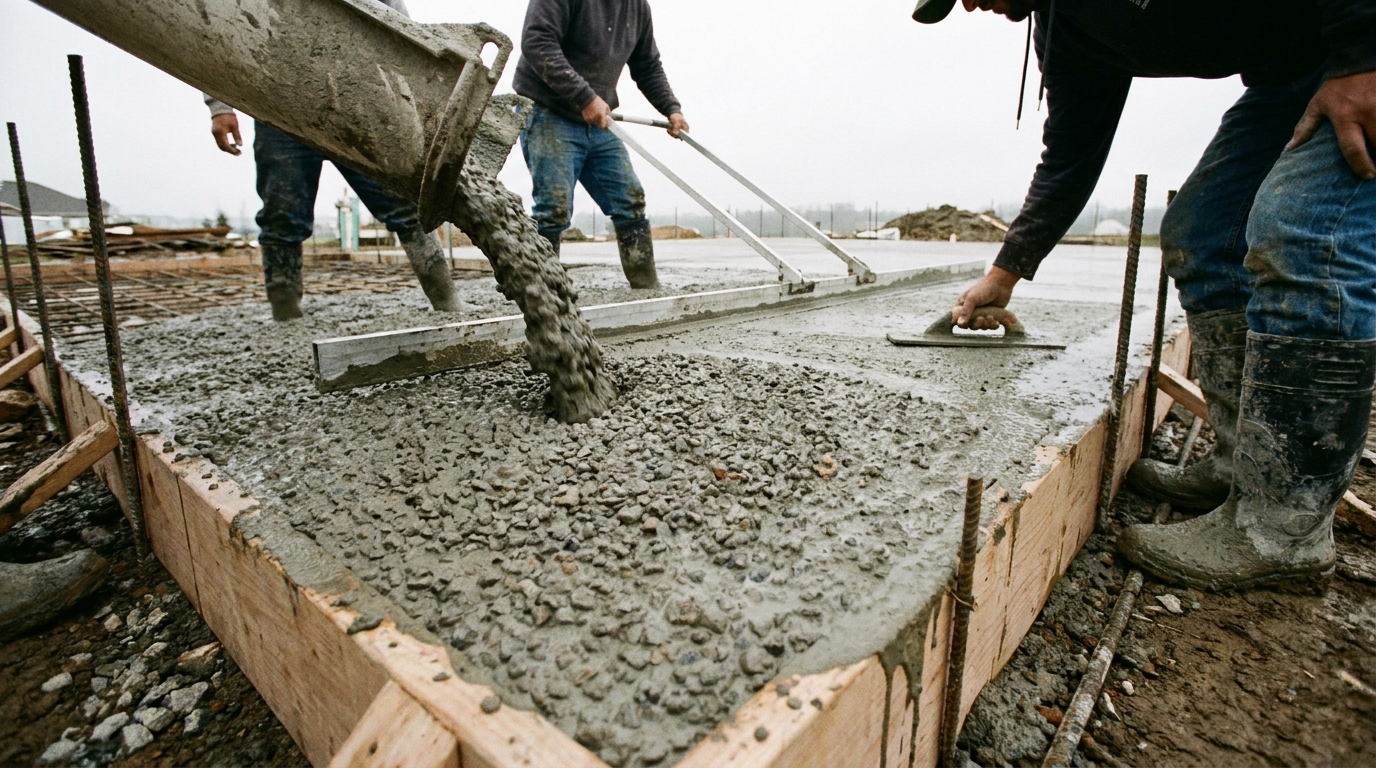
Normal strength concrete is what many people picture first. It is the everyday mix used in sidewalks, patios, driveways, slabs, footings, and many general construction applications. The exact strength can vary, but a common range is around 2,500 to 4,000 psi depending on the project. This type is usually the default choice when the loading conditions are straightforward and there are no unusual durability or placement challenges.
The main advantage of normal strength concrete is that it is familiar, widely available, and cost effective for common work. Contractors know how it behaves, ready mix suppliers produce it routinely, and finishers are comfortable with it when the weather and timing are managed properly. If the project conditions are ordinary and the design is simple, there is no reason to overcomplicate things with a specialty mix.
That said, normal strength does not mean no specification is needed. A driveway in a mild climate may do fine with a standard exterior mix, but the same driveway in a northern climate may need air entrainment and better curing control to hold up against winter exposure. A garage slab may need stronger surface performance than a simple garden path. Even within standard concrete, details still matter.
This is where homeowners often make a costly mistake. They ask for concrete without discussing where it will be used, what weather it will face, and how it will be cured. The result may be a mix that was technically delivered as ordered but not actually suited to the job. If you are doing routine residential work, normal strength concrete is often right, but it still needs to be the right version of normal strength concrete.
Air entrained concrete: essential for cold climates and exterior durability
Air entrained concrete is one of the most important categories for exterior work in regions with freezing temperatures. This is not concrete with visible air pockets or poor consolidation. It is concrete made with a controlled system of microscopic air voids. Those voids help the hardened concrete survive freeze thaw cycles by giving water space to expand as it freezes.
In much of Canada and the northern United States, air entrainment is a key consideration for sidewalks, driveways, exterior slabs, curbs, pavements, and exposed structural concrete. Without it, surface scaling, cracking, and early deterioration become much more likely, especially when deicing salts are involved. Many concrete failures blamed on bad finishing or bad luck are really durability problems tied to the wrong air content or weak curing practices.
The benefit is clear, but there is still a practical balance to strike. Air entrainment is designed for durability, not for every possible interior application. You do not add it blindly to every mix without considering the use case. The contractor and supplier should know the exposure conditions and specify the air content accordingly. It is one of those details that seems small until you see what happens when it is missing.
If your project is outdoors in a cold climate, ask directly whether the mix is designed for freeze thaw exposure. Do not assume that all exterior concrete automatically is. It should also be placed, finished, and cured correctly, because even a durable mix can be damaged by poor site practices. Air entrainment is not a cure all, but for the right project it is one of the smartest choices you can make.
High strength concrete: when the structure needs more load carrying capacity
High strength concrete is used when a project demands greater compressive strength than standard mixes can provide. In broad terms, concrete at 8,000 psi or more falls into this category. It is common in high rise construction, heavily loaded columns, long span structures, parking facilities, certain foundations, and infrastructure work where reducing member size or increasing capacity matters.
The main value of high strength concrete is structural efficiency. When engineers can use a stronger mix, they may be able to design smaller columns or more slender elements while still carrying the required load. That can free up space in buildings and improve overall design flexibility. In some cases, high strength concrete also comes with lower permeability and better long term durability, especially when it uses optimized cementitious systems and low water content.
But there are tradeoffs. High strength mixes can be less forgiving during placement and finishing, and they may have different curing needs than standard concrete. They also tend to cost more. If the structure does not actually require that extra performance, specifying a very high strength mix can be a waste of money and may create unnecessary handling challenges. Stronger is not automatically better if the strength is not doing useful work.
This is where practical thinking matters. If you are building a residential walkway, high strength concrete is probably not the answer. If you are building a heavily loaded structural element where dimensions and capacity matter, it might be exactly right. Match the strength to the job, not to the sales pitch.
Lightweight concrete: reducing dead load without giving up structural use
Lightweight concrete is made with low density aggregate instead of conventional stone. Its main purpose is to reduce the weight of the structure. That can be useful in floor systems, roof decks, precast elements, bridge work, and renovation projects where existing framing or foundations can only carry so much added load. Lighter concrete can also improve handling and in some cases contribute to thermal performance.
One of the biggest misconceptions about lightweight concrete is that it must be weak. That is not always true. Structural lightweight concrete can be engineered for structural use, and in the right design it performs very well. The key is that the mix has to be designed, tested, and specified for the actual loads and service conditions. You do not get structural performance by simply swapping in lightweight aggregate and hoping for the best.
There are tradeoffs to understand. Lightweight concrete can behave differently in terms of pumping, finishing, moisture movement, and shrinkage. The crew needs to know what they are placing. The designer also needs to account for the specific material properties rather than assuming it behaves exactly like normal density concrete in every respect. That is not a flaw. It just means the material has to be used with some discipline.
For renovation and retrofit work, lightweight concrete can be especially valuable. If you need a new topping slab or structural element but want to limit added dead load, it may solve a problem that normal density concrete cannot. This is one of those cases where the right material can open up design options, not just fill a form.
High density concrete: a specialty material for special demands
High density concrete is much less common in everyday residential and commercial work, but it has an important role in specialized construction. It uses heavy aggregates to achieve a greater unit weight than normal concrete. This is often done for radiation shielding in medical or industrial facilities, for certain counterweight applications, or for projects where mass itself is part of the performance requirement.
This is not the kind of concrete most homeowners or small builders will specify, but it is still worth understanding because it shows how far concrete can be tailored. In this case, the target is not just strength or durability. The target is density and the performance that comes with it. Once again, concrete is best thought of as an engineered family of materials rather than one generic product.
Because high density concrete is specialized, it usually requires more coordination with engineers, suppliers, and installers. Aggregate sourcing, placement logistics, and quality control all become more important. If your project has a shielding or mass requirement, standard concrete is usually not a substitute. This is a case where the specification exists for a clear reason and should not be watered down in the name of convenience.
Pervious concrete: built to let water through
Pervious concrete is almost the opposite of what many people expect concrete to be. Instead of forming a dense, nearly impermeable surface, it is designed with a connected void structure that allows water to pass through it. That makes it useful in permeable pavement systems, where stormwater needs to infiltrate through the surface rather than run off into drains or across the site.
Environmental agencies including the EPA recognize pervious concrete as a green infrastructure option for runoff reduction and water quality management. In the right setting, it can help reduce ponding, ease pressure on storm sewer systems, and support site designs that manage rainfall more naturally. For parking areas, walkways, low traffic pavements, and certain landscape integrated applications, it can be a very practical tool.
It is not, however, a universal replacement for standard pavement. Pervious concrete depends on the underlying soil infiltration rate, subbase design, local climate, expected loads, and long term maintenance. If the pores clog from sediment, performance drops. If the climate or traffic conditions are wrong for the design, the pavement may not be the right fit. This is one of the most misunderstood concrete types because people hear the environmental benefits and assume it belongs everywhere.
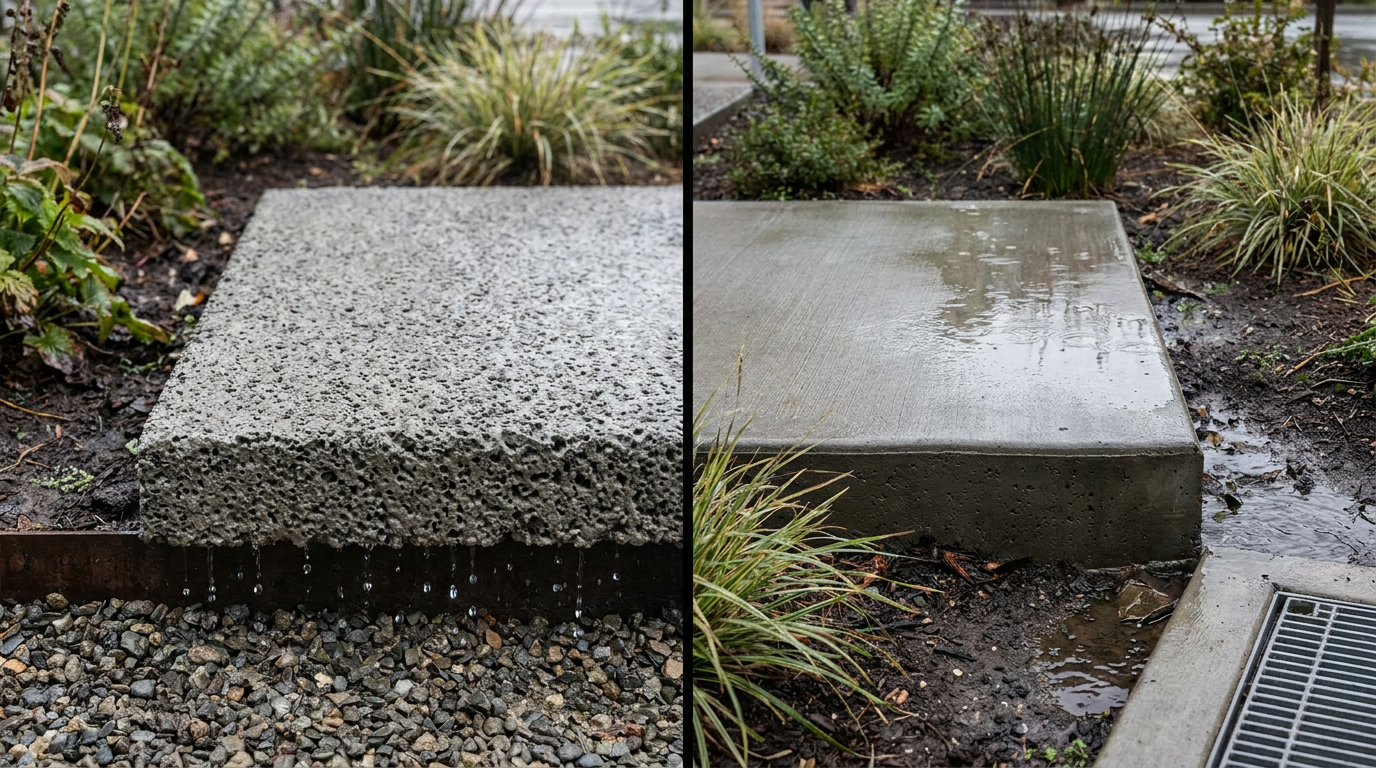
For the right site, pervious concrete solves a real problem that standard concrete does not. For the wrong site, it can create maintenance headaches and unmet expectations. If stormwater management is part of your project goals, ask not just whether pervious concrete is available, but whether the site conditions support it. That is the practical question.
Self consolidating concrete: when flow and placement quality matter
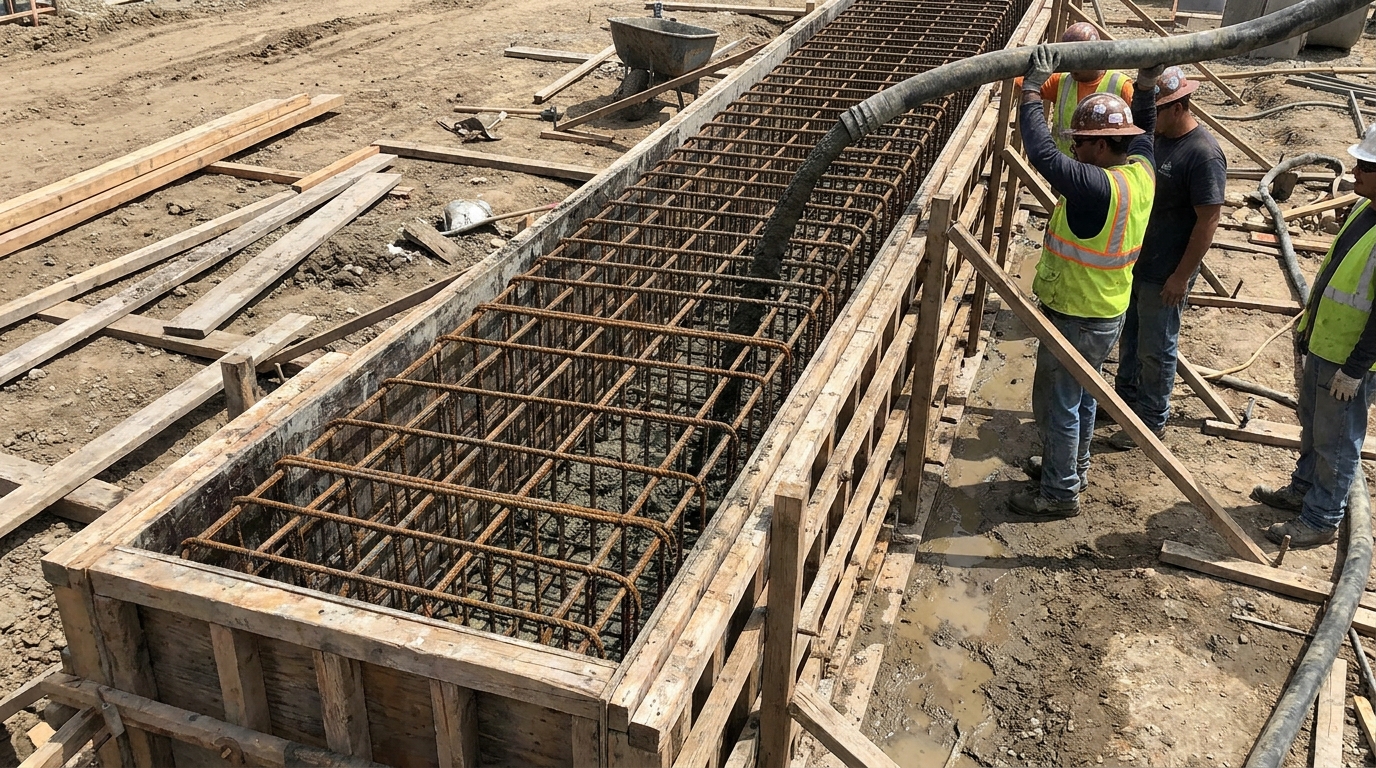
Self consolidating concrete, often called SCC, is designed to flow under its own weight with little or no vibration. This makes it especially useful in congested reinforcement, complex formwork, architectural concrete, precast production, and hard to reach structural placements. Instead of relying heavily on mechanical vibration to eliminate voids, the concrete is proportioned to move and fill forms smoothly while staying stable.
The advantages are straightforward. SCC can reduce labor, improve surface quality, help fill intricate formwork, and lower the risk of honeycombing around dense reinforcement. It can also improve consistency in precast settings where repeated form filling and finish quality are major concerns. On some jobs, the labor savings alone can justify the mix choice.
Like every specialty concrete, SCC needs proper control. It is not just regular concrete with extra water, and treating it that way is asking for trouble. Its performance comes from mix design, admixture control, and testing for flow characteristics and stability. If those pieces are ignored, the result can be segregation, poor surface quality, or inconsistent hardened performance.
For complex structural work, SCC is often one of the smartest choices available. If you have tight reinforcement or formwork that would make conventional consolidation difficult, this mix can solve a placement problem before it turns into a defect. It is a good example of how concrete technology can improve workmanship rather than replace it.
Fiber reinforced concrete: better crack control in the right applications
Fiber reinforced concrete includes small fibers distributed through the mix to help control cracking and improve certain aspects of toughness and post crack behavior. The fibers may be steel, synthetic, glass, or other materials depending on the application. This type of concrete is often used in slabs, industrial floors, overlays, shotcrete, precast products, and some structural or semi structural applications where crack control is a priority.
It is important to understand what fibers do and do not do. In many applications, fibers help reduce plastic shrinkage cracking and can improve resistance to minor cracking, impact, or abrasion. They may supplement or in some cases reduce certain forms of traditional reinforcement, depending on the design. But they are not a magic replacement for all reinforcing steel, and they do not cancel out the need for joints, curing, or sound design.
For homeowners, fiber reinforcement often comes up in garage slabs, driveways, and patio work. It can add value, but it should be discussed in context. What problem is it solving, and how does it fit with the rest of the slab design? Used correctly, it is a helpful tool. Used as a sales shortcut without proper explanation, it can create false confidence.
Mass concrete and low heat mixes: controlling temperature in large pours
Mass concrete is used where the size of the placement creates a risk of excessive temperature rise from cement hydration. In very large foundations, thick walls, mat slabs, dams, and other heavy sections, the heat generated inside the concrete can become a performance issue. If the interior stays much hotter than the surface, thermal cracking can develop as the material cools and contracts at different rates.
The solution is usually not a different aggregate alone but a mix and placement strategy built around heat control. That may involve using supplementary cementitious materials, lower heat cement options, reduced cement content, staged pours, cooling measures, or careful temperature monitoring. This is a good example of why concrete selection is more complex than just ordering a stronger mix.
Most homeowners will never need true mass concrete, but the principle still matters on smaller jobs. Large footings, thick walls, and hot weather placements can all benefit from thinking about heat, curing, and shrinkage. Concrete that gets too hot, dries too fast, or cools unevenly can crack whether the project is huge or modest. Good concrete work is often about controlling the process, not just selecting the bag or truck.
Sustainable concrete choices: lower carbon does not have to mean lower performance
Modern concrete decisions are increasingly shaped by sustainability as well as performance. That does not mean sacrificing durability or structural reliability. In many cases, the best lower carbon strategies actually improve long term service life. Since maintenance, repairs, and replacement all carry environmental cost, a durable mix can be a sustainability win as much as a technical one.
One of the biggest shifts in North American construction is the growing use of portland limestone cement, or PLC Type IL. This cement can reduce carbon footprint compared with traditional portland cement in some general construction mixes while still fitting standard construction practice. Blended cements and SCMs such as slag cement, fly ash, silica fume, and newer materials are also being used more widely to lower clinker content, improve durability, and optimize lifecycle performance.
This is another area where simple assumptions can be misleading. More cement does not always mean better concrete. Sometimes a better optimized mix with SCMs delivers lower permeability, better sulfate resistance, lower heat of hydration, and reduced embodied carbon. The right question is not whether a mix sounds greener. The right question is whether it is designed for performance over the full life of the structure.
If sustainability is part of your project goals, talk about service life, local material availability, cement type, and maintenance expectations. A lower carbon mix that fails early is not a good outcome. A durable, well designed mix with thoughtful cementitious materials often is.
How to choose the right concrete for your project
The best way to choose concrete is to start with conditions, not assumptions. Ask what the concrete has to carry, what weather and moisture it will face, how it will be placed, how quickly it needs to gain strength, and how long it needs to last. Think about whether weight matters, whether water infiltration is a goal or a problem, and whether aesthetics or surface finish are critical. Once those questions are answered, the mix type usually becomes much clearer.
For a standard interior slab or basic footing, normal strength concrete may be all you need. For exterior slabs in cold climates, air entrained concrete is often the correct default. For heavily loaded structural members, high strength concrete may be justified. For weight sensitive structures or retrofits, lightweight concrete can make sense. For stormwater management surfaces, pervious concrete may be the right call. For complex reinforced forms, SCC can improve quality and reduce labor.
It also helps to think in terms of risk. What is the consequence of getting the mix wrong? On a garden shed pad, the risk may be modest. On a foundation, suspended slab, or commercial pavement, the risk is much higher. The more costly the failure, the less sense it makes to choose concrete based only on the cheapest initial quote.
- Define the exposure conditions, especially freeze thaw, deicing salts, moisture, and chemical exposure.
- Confirm the structural demand, including load requirements and any need for reduced member size or lower dead load.
- Consider placement conditions such as pump distance, congestion of reinforcement, finishing needs, and access for vibration.
- Discuss curing expectations, scheduling, and weather because a good mix still depends on good handling.
- Ask about cement type, SCMs, and lifecycle durability if sustainability is part of the project goals.
If you are working with a contractor, ready mix supplier, architect, or engineer, bring these questions to the conversation early. It is much easier to choose well before the truck arrives than to solve performance problems after the slab is down.
Common mistakes people make when selecting concrete
The most common mistake is confusing cement with concrete and assuming that more cement must mean better performance. In reality, mix optimization matters more than brute force. A well proportioned concrete with the right admixtures and supplementary materials can outperform a richer but less balanced mix. Good concrete is engineered, not guessed at.
The second big mistake is adding water at the site to improve workability without understanding the consequences. Too much water can reduce strength, increase shrinkage, and hurt durability. If workability is a concern, it should be solved with proper mix design, admixtures, and delivery control rather than casual water addition. This is one of the fastest ways to turn decent concrete into poor concrete.
Another common error is choosing concrete by strength alone. People focus on the 28 day psi number and ignore air entrainment, permeability, sulfate exposure, shrinkage control, and curing. A slab can hit the target strength and still fail early if the durability side was ignored. That is especially true for exterior flatwork in cold climates.
Finally, people often underestimate curing. Concrete continues to gain strength over time, and moisture and temperature control in the first days and weeks matter a great deal. Good curing can make an average mix perform much better. Bad curing can ruin a good one. If there is one practical lesson to remember, it is that concrete quality is about the full system from mix design to placement to curing.
Final thoughts: choose for the real job, not the generic idea of concrete
Concrete is one of the most useful building materials we have because it can be adapted to so many different needs. That flexibility is a strength, but it also means there is no one size fits all answer. The right concrete for a driveway is not automatically the right concrete for a basement wall, suspended slab, parking surface, or reinforced structural column. Every project should start with the actual demands of the job.
If you remember nothing else, remember this. Concrete selection should be based on exposure, durability, placement method, weight, structural demand, and long term performance, not just initial cost or whatever mix someone happens to order most often. A practical concrete decision is usually not the flashiest one. It is the one that does the work reliably for years with the fewest problems.
Homeowners, renovators, and professionals all benefit from asking better questions up front. Is this for exterior use in freeze thaw conditions? Does it need air entrainment? Is lower weight important? Will water management drive the design? Is the reinforcement too congested for conventional placement? Are lower carbon options available without compromising service life? Those questions lead to better concrete and better buildings.
Concrete is behind more of the built world than most people notice. Foundations, slabs, walls, sidewalks, garages, bridges, ramps, retaining structures, and pavements all depend on it. When the mix is matched to the job and the work is done properly, it is one of the most dependable materials on site. That is the real goal, not just pouring something hard into a form, but building with a material that is chosen with purpose.



No Comment! Be the first one.