



Interior design has always lived in the delicate space between imagination and reality. A beautiful room begins as a feeling long before it becomes a specification sheet, a furniture order, or a construction timeline. What is changing now is the speed and sophistication with which that feeling can be visualized. AI-generated design is opening a new chapter in interior aesthetics, one where elegant ideas can be explored more freely, tested more quickly, and translated more accessibly for people who may never have worked with a designer before.
Table Of Content
- Why AI-generated design is arriving at exactly the right time
- From specialist service to collaborative experience
- What AI actually does well in interior design
- Mood boards and atmosphere building
- Color and material testing
- Style translation across rooms
- The new aesthetics of AI: polished, personal, and emotionally rich
- Effortless sophistication for real homes, not fantasy rooms
- Why designers still matter, perhaps more than ever
- The risks we should speak about honestly
- How to use AI-generated design well
- What this means for the future of the industry
- Elegance, technology, and the return of personal style
AI-generated design refers to the use of artificial intelligence tools that help people visualize interior concepts, such as mood boards, color and material combinations, and style directions, before committing to any renovation work. Rather than replacing designers, it functions as a collaborative visualization tool: a person describes a feeling or reference, and the AI generates visual options that can then be refined by taste, budget, and real-world constraints like floor plans and lighting. At its best, the technology does not aim to replace taste or craftsmanship — it becomes a tool for discovering interior combinations that feel personal, layered, and distinctly one’s own, rather than generic or templated.
For years, polished interiors were often associated with specialist knowledge, generous budgets, and long consultation processes. Today, artificial intelligence is helping shift that equation. Homeowners can generate mood directions in minutes, renters can experiment with color stories before buying anything, and professionals can communicate design concepts with far greater clarity. The technology does not eliminate taste, instinct, or craftsmanship. Instead, at its best, it becomes a graceful assistant that helps bring personal style into sharper focus.
This shift is especially relevant across Canada and North America, where people are investing in the homes they already have. Renovation demand remains strong, affordability pressures continue to shape housing decisions, and many households are prioritizing practical improvement over relocation. In that context, AI-generated interior design feels less like a futuristic novelty and more like a useful design companion. It supports better planning, more confident experimentation, and a more refined result within the limits of real budgets and real floor plans.
There is also an important emotional dimension to this moment. The most compelling interiors today are not merely perfect. They are personal, warm, and story-driven. They hold references, memories, and texture. They suggest a life rather than a showroom. AI-generated design becomes most exciting precisely when it serves this more human vision of home, offering not a generic template but a way to discover combinations that feel nuanced, expressive, and distinctly one’s own.
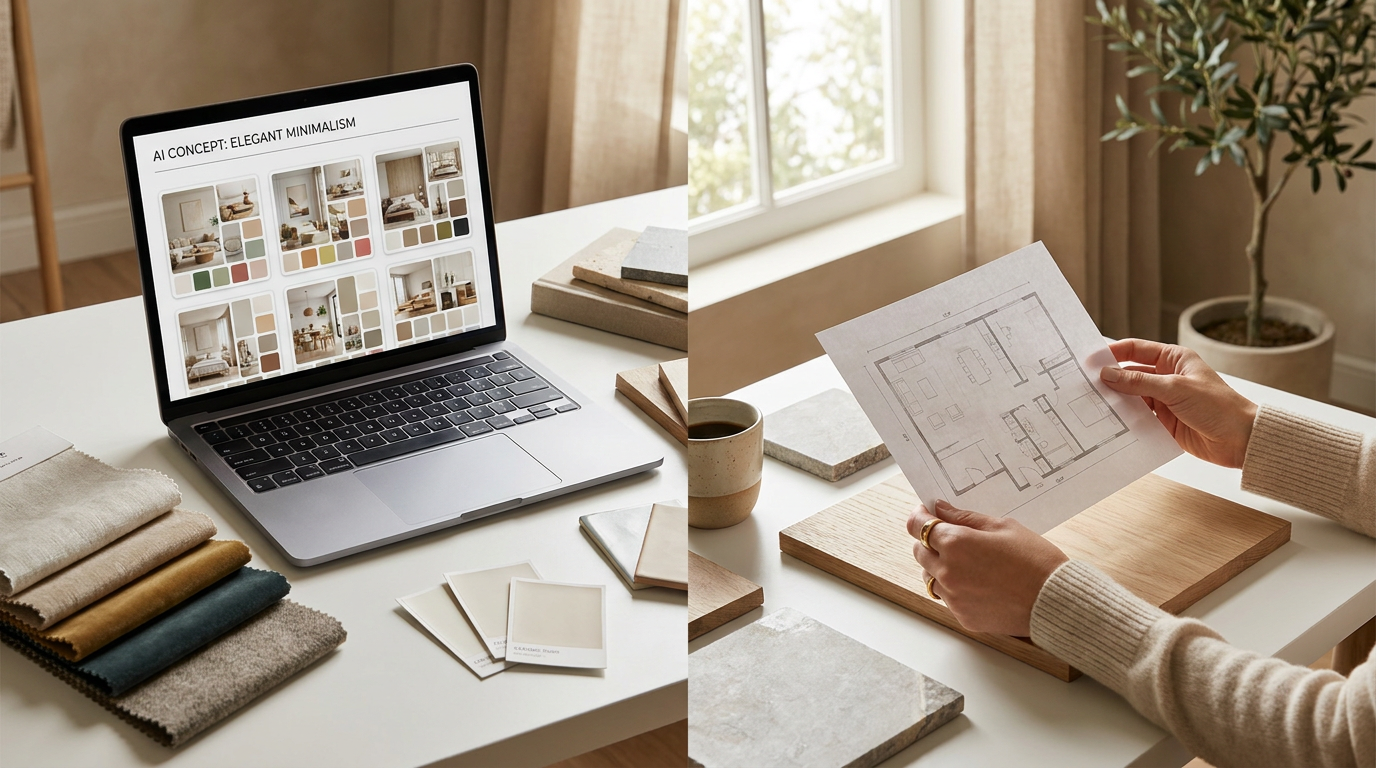
Why AI-generated design is arriving at exactly the right time
The rise of AI in interiors is not happening in isolation. It is arriving at a moment when the design industry is already in motion, adapting to digital workflows, changing consumer expectations, and a housing environment that demands flexibility. Statistics Canada reported that the country’s specialized design services industry reached nearly $4.7 billion in operating revenue in 2024, with interior design services accounting for 45.3 percent of total sales. The same outlook noted that digital design tools, web-based services, and the integration of artificial intelligence are expected to shape the sector in meaningful ways.
Those figures matter because they tell a wider story about access. Interior design is no longer confined to one traditional format. Clients now expect visual clarity, speed, remote collaboration, and responsive planning. AI fits naturally into this evolution. It can help generate style directions, provide visual alternatives, support virtual staging, and speed up the concept phase without requiring an immediate full-scale commitment. For many people, that lower barrier to entry is the difference between feeling intimidated by design and feeling invited into it.
The broader housing landscape reinforces this relevance. CMHC reported that Canada’s housing starts increased by 6 percent in 2025, driven in part by record rental apartment construction. At the same time, the federal Housing Design Catalogue was introduced to help communities create smarter, more accessible, and adaptable homes more quickly. These are not abstract policy details. They point to the practical reality that more people are living in compact spaces, rental settings, missing-middle housing types, and homes that require flexibility over spectacle.
AI-generated design responds elegantly to these conditions. It can help someone understand how a small entryway might feel more open, how a rental kitchen might be refreshed without structural work, or how an accessible layout can still feel deeply stylish. When space is limited and budgets matter, visualization becomes more valuable. Good design is often about avoiding costly mistakes, and AI can help narrow possibilities before money is spent on furniture, finishes, or labor.
AI in interior design is most powerful not when it takes over the creative process, but when it gives more people the confidence to participate in it.
From specialist service to collaborative experience
One of the most beautiful shifts in AI-generated design is the way it transforms interior planning into a dialogue. Traditionally, many clients struggled to interpret drawings, imagine materials in context, or understand how a written concept would look in their actual home. AI-generated visuals create a gentler bridge. They allow people to react to images, refine preferences, and articulate what they are drawn to with more precision.
This matters because taste is often easier to feel than to describe. A homeowner may know they want a room to feel calmer, richer, softer, or more architectural, yet not have the vocabulary to explain exactly what that means. AI can translate those emotional instincts into visual studies. It can propose a room with warmer oak tones, another with a more cinematic interplay of shadow and contrast, and another with sculptural minimalism. The user can then respond not in technical language, but in honest human terms: this feels too cold, this feels too formal, this feels like home.
Professionals benefit from this collaborative loop as well. Designers can use AI to generate fast concept directions, test alternative palettes, or help clients compare approaches without producing full custom renderings for every possibility. That accelerates communication while preserving the designer’s role as curator, editor, and problem solver. It also creates a more transparent process, one in which design decisions become easier to discuss because they are easier to see.
MIT research on generative design and human-centered systems supports this view. The most meaningful use of AI is not autonomous authorship but intelligent collaboration. Human intuition, context, and judgment remain essential. In interiors, this principle is especially important because a room must do more than look lovely on screen. It must support daily life, respond to circulation, respect maintenance realities, and endure changing needs over time.
What AI actually does well in interior design
AI-generated design is often misunderstood as a magical machine for finished rooms. In reality, its greatest strength lies in concepting, exploration, and translation. It is extraordinarily useful at helping people generate possibilities that can then be refined by taste and practicality. This is where the technology becomes both sophisticated and accessible. It does not ask users to know everything in advance. It helps them discover what they want to know.
Mood boards and atmosphere building
Perhaps the most intuitive use of AI is mood-board generation. Rather than collecting dozens of disconnected references, users can create a coherent visual atmosphere around a few guiding ideas. They might begin with phrases such as soft minimalism, cinematic warmth, stone textures, or nostalgic Parisian apartment with contemporary restraint. Within moments, they can see how these ingredients interact. The value lies not just in inspiration but in clarification. Preferences begin to reveal themselves with surprising speed.
This is where elegance becomes more democratic. A room that once felt difficult to define can be distilled into an atmosphere of layered neutrals, gentle contrast, tactile textiles, and sculptural lighting. For someone without formal training, this process can be transformative. It reduces the anxiety of starting from a blank page and replaces it with a curated field of options that feel attainable and visually coherent.
Color and material testing
Color decisions can feel deceptively small until they are painted across every wall. The same is true of stone, wood finish, hardware, or upholstery. AI tools can quickly simulate these variations, allowing users to compare options before committing. A kitchen can be tested in a pale putty tone, a warmer mushroom hue, or a saturated olive with far less cost than making physical changes. A living room can be explored with brushed brass accents, dark bronze details, or lighter natural oak to understand how the mood shifts.
Adobe’s room-makeover guidance reflects this highly practical use case. Its tools position generative editing as a way to restyle interiors while preserving the original layout, composition, and user intent. This distinction is crucial. It allows the room to remain rooted in reality. Instead of fantasy spaces that bear no relation to the actual home, the user sees how style changes might sit within the proportions and architecture they already have.
Style translation across rooms
One of the subtler challenges in interior design is consistency. A home should not feel repetitive, but it should feel related. AI can help translate a style language from one room to another. If a bedroom has a serene palette, curved forms, and linen textures, the adjacent office can be visualized in a way that echoes that spirit without becoming identical. This creates a home that feels considered as a whole, rather than assembled room by room with no shared identity.
For households renovating in phases, this is especially useful. Many people cannot redesign an entire home at once. AI-assisted style translation helps maintain coherence over time, ensuring that each future update still belongs to the same visual narrative.
The new aesthetics of AI: polished, personal, and emotionally rich
A common fear around AI-generated design is that it will make interiors feel generic. That concern is understandable, especially when early design imagery often leaned toward exaggerated perfection. Yet current design culture is moving in almost the opposite direction. The most admired interiors are becoming more layered, more intimate, and more expressive. They are less interested in anonymous luxury and more interested in narrative.
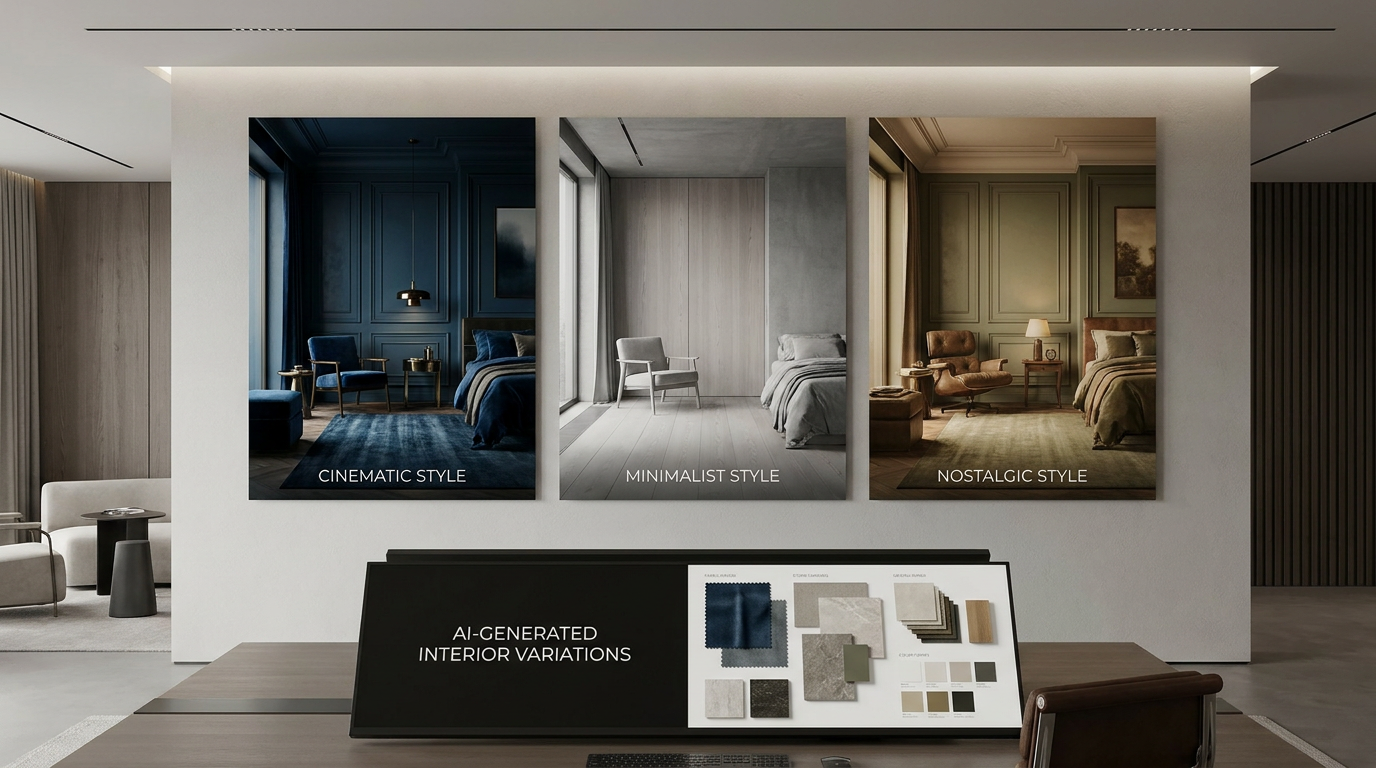
Research from Adobe on 2025 and 2026 creative trends suggests growing interest in aesthetics such as minimalism, cinematic styling, glassmorphism, nostalgic references, and polished lifestyle-driven visuals. These are not shallow internet categories. They reflect a deeper appetite for rooms that communicate atmosphere. A cinematic interior uses light and shadow deliberately. A nostalgic space invites memory and softness. A minimalist room today is less sterile than before, often enriched with tactile detail and emotional warmth.
AI can support these aesthetics with remarkable agility. A user can test how a dining room feels with a more cinematic mood, perhaps through deeper wall color, reflective surfaces, and dramatic pendant lighting. They can explore nostalgia through patterned upholstery, vintage silhouettes, and muted sepia-toned palettes. They can compare this with a lighter interpretation rooted in contemporary calm. None of this needs to become literal or costume-like. The point is to study atmosphere, then refine it through selective real-world decisions.
What emerges is a more personalized home. Rather than following a single dominant trend, people can sample influences and blend them. A room might combine disciplined French elegance with Mediterranean earthiness, contemporary joinery with vintage ceramics, or restrained minimal forms with deeply tactile materials. AI becomes a tool for composing these combinations, making style feel more exploratory and less prescriptive.
Effortless sophistication for real homes, not fantasy rooms
Perhaps the greatest promise of AI-generated interior design is that it makes sophistication feel less intimidating. Sophistication is often misunderstood as complexity, expense, or visual performance. In truth, the most graceful interiors often feel effortless because they are resolved. Their materials speak to one another. Their colors are balanced. Their furnishings have proportion and rhythm. Their atmosphere is calm because choices have been edited with care.
AI can help ordinary users approach this level of polish. It can suggest restraint where there is visual clutter. It can reveal that a room needs fewer decorative objects and better lighting rather than more furniture. It can show how a heavy palette may be softened with linen, plaster, pale wood, and reflective glass. It can clarify where architectural emphasis should go and where silence in a room is more elegant than excess.
This is particularly valuable in compact homes and rental apartments. Small spaces do not have room for trial and error. Every object must justify itself, and every finish carries more visual weight. AI-assisted design allows for elegant planning in advance. A renter can test removable wallpaper against paint tones, compare open shelving with closed storage visually, or see whether a round dining table improves flow more than a rectangular one. These are subtle decisions, yet they shape the daily experience of a home profoundly.
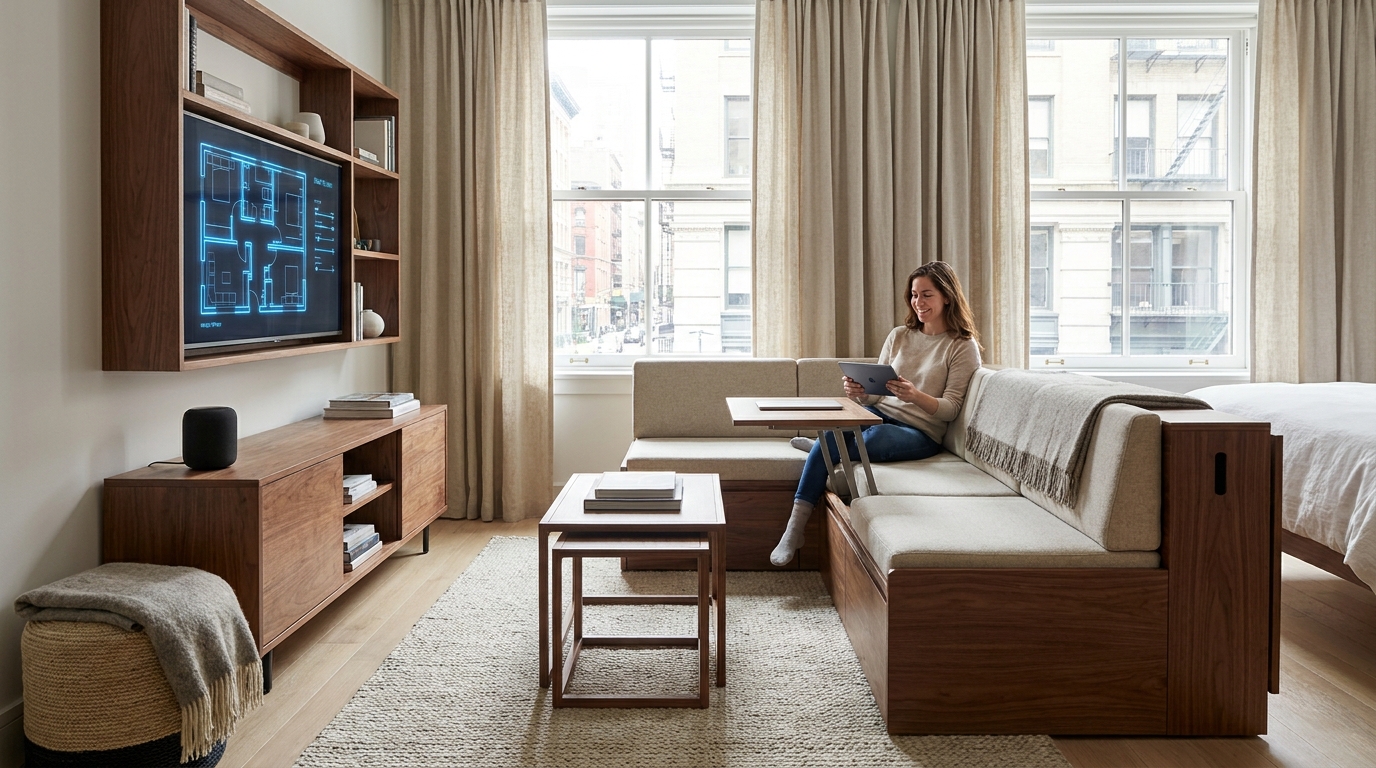
The same principle applies to accessible and adaptable design. Practical features do not need to diminish beauty. Wider circulation paths, better lighting contrast, smoother transitions, ergonomic storage, and flexible furniture can all be integrated into interiors that feel refined. In many cases, AI can help visualize these solutions quickly and sympathetically, making inclusive design easier for clients to embrace not as compromise but as thoughtful living.
Why designers still matter, perhaps more than ever
As AI tools become more capable, it is natural to ask whether interior designers are at risk of being replaced. The more nuanced answer is that the role is evolving rather than disappearing. If anything, the flood of generated imagery can make professional discernment even more valuable. Beautiful pictures are not the same as good design. A skilled designer understands proportion, sourcing, material performance, contractor coordination, and the lived reality of a room beyond the rendering.
AI may produce twenty seductive variations of a kitchen, but it does not automatically know which stone etches too easily for a busy family, which pendant height impedes sightlines, or which millwork detail will strain the budget. It may suggest a wonderful banquette without accounting for heating vents, or a dramatic archway where structure will not permit one. This is why AI should be understood as an assistant in the design-to-render workflow, not the final authority.
For professionals, this can be liberating. Time that might once have gone into repetitive early visualization can be redirected toward deeper strategy. Designers can spend more energy on refinement, client education, and custom problem solving. They can test more options faster, communicate more clearly, and still bring the irreplaceable quality of judgment that separates decoration from design. In this sense, AI does not erode authorship. It sharpens the value of human authorship by making the editorial hand more visible.
The future of interior aesthetics belongs neither to algorithms nor to nostalgia alone. It belongs to thoughtful collaboration, where technology expands possibility and human taste gives it soul.
The risks we should speak about honestly
Any intelligent discussion of AI-generated design must also acknowledge its limitations. The first is visual seduction. AI images can be so compelling that they create unrealistic expectations. A room may appear larger, brighter, or more materially refined than is feasible in reality. Surfaces may be impossible to source, lighting may be physically implausible, and proportions may quietly drift away from buildable truth. If users confuse inspiration with documentation, disappointment follows.
NIST has warned that synthetic content can undermine trust and be misused. In the context of interiors, that means generated images should be disclosed clearly and reviewed critically. Homeowners deserve to know whether they are looking at a conceptual visualization, a digitally altered photo, or a production-ready specification drawing. These are not interchangeable categories. Clarity protects both trust and good decision-making.
There are also ethical and legal questions around authorship and copyright. When a model is prompted to imitate a recognizable designer, studio, or visual language too closely, questions arise about originality and creative ownership. Legal scholarship is still evolving in this area, and the design industry will need thoughtful standards. Inspiration has always circulated in design, but AI can compress and replicate aesthetic signals at scale. Responsible use requires both restraint and attribution awareness.
Finally, there is the risk of overdesign. Because AI can generate endless variations, users may mistake novelty for necessity. A room does not become better simply because it is more visually dramatic. Sometimes the strongest design decision is to stop. To keep the original floor. To preserve the old wood. To choose fewer materials, quieter colors, and one well-made chair instead of several decorative gestures. AI should expand imagination, not encourage visual noise.
How to use AI-generated design well
The most satisfying outcomes tend to come from a structured approach. AI is a remarkable creative partner when it is guided with intention and grounded in reality. Whether one is a homeowner, renter, or design professional, the process becomes more useful when aesthetic exploration is paired with practical constraints from the beginning.
- Start with the room you actually have. Use real dimensions, photographs, architectural details, and lighting conditions wherever possible. The closer the input is to reality, the more meaningful the output becomes.
- Define the feeling before the furniture. Words such as serene, cinematic, warm, airy, tailored, nostalgic, or tactile can establish direction more effectively than brand names alone.
- Add constraints early. Include budget range, rental limitations, maintenance needs, accessibility priorities, and existing pieces you want to keep. Good design gains clarity from boundaries.
- Generate options, then edit ruthlessly. Compare several directions and identify recurring elements you genuinely love. Sophistication often appears in the patterns of your choices.
- Validate everything important. Before purchasing or building, confirm dimensions, code requirements, materials, durability, and installation details with qualified professionals.
This process makes AI less about spectacle and more about discernment. It can be surprisingly revealing. People often discover that what they truly want is not what they first described. A request for luxury may turn out to mean calm. A wish for modernity may actually point toward simplicity with vintage warmth. A desire for minimalism may soften into edited abundance once color and texture are explored. AI helps surface these truths with speed, but refinement still depends on reflection.
What this means for the future of the industry
As AI-generated design becomes more common, the interior design industry is likely to become more hybrid, more visual, and more participatory. Consumers will arrive at consultations with stronger preferences and clearer references. Designers will increasingly work across digital concepting, virtual presentation, and real-world specification with greater fluidity. Firms that embrace AI thoughtfully may be able to offer more responsive services at different price points, broadening access without diluting quality.
This may be especially important in North America, where the housing conversation increasingly centers on adaptation. People are renovating instead of moving, improving rentals instead of owning large homes, and seeking spaces that can support remote work, multigenerational living, and changing mobility needs. AI-assisted workflows are well suited to this environment because they help users make decisions earlier and with fewer expensive reversals. They also support remote collaboration, which matters for regional clients, small firms, and web-based design services.
The future may also bring stronger integration between AI design tools and other systems such as digital twins, material databases, e-commerce, and renovation planning platforms. One can imagine a workflow in which a user explores a style concept, checks dimensions against a digital room model, compares sourcing options, and then moves into budgeting and procurement. Even then, the best version of this future remains human-centered. Efficiency is valuable, but only if it serves better living.
Elegance, technology, and the return of personal style
There is something poetic about the fact that a technological leap is helping restore individuality rather than erase it. For a time, digital culture often seemed to flatten taste into trend cycles and endlessly repeated rooms. Yet AI-generated design, when used with care, can actually reverse that. It allows people to test ideas privately, refine their preferences, and build interiors that feel more aligned with their habits, memories, and visual instincts.
In this sense, the future of interior aesthetics is not about machine perfection. It is about a more intelligent path to authenticity. A person can begin with a few words, an old photograph, a favorite fabric, or the mood of a film scene and arrive at a room concept that feels unexpectedly precise. The process becomes lighter, faster, and more generous. It invites experimentation without punishing mistakes. It makes elegance feel less distant.
That may be the most important contribution of all. AI-generated design lowers the barrier to refinement. It does not guarantee beauty, but it makes the pursuit of beauty more open. It offers homeowners and professionals a way to explore polished, personal interiors with greater confidence and less waste. In a world where our homes are asked to do so much, that is no small thing. It is practical, yes, but it is also artistic.
The rooms of the future will still need proportion, feeling, craftsmanship, and restraint. They will still need the touch of the human eye. What AI brings is a new kind of fluency, one that helps more people imagine what is possible before the first chair is placed or the first wall is painted. If we use it wisely, the result will not be colder homes. It will be homes that are more expressive, more considered, and perhaps more effortlessly beautiful than ever before.


No Comment! Be the first one.