


Public-private partnerships, often called PPPs, are formal arrangements in which government agencies and private companies share the funding, risk, and delivery of urban infrastructure and housing projects. In growing cities across Canada and North America, PPPs have moved from the margins of infrastructure policy to the center of modern urban development strategy, because the pressure on cities is no longer limited to building more homes. Cities must also deliver the transit, water systems, wastewater capacity, stormwater management, roads, parks, and community infrastructure that make those homes possible. In a PPP, municipalities contribute land, planning approvals, and infrastructure priorities to unlock development, while private partners bring capital, technical expertise, construction management, and lifecycle discipline that many governments cannot easily assemble on their own. Housing is increasingly understood not just as a real estate challenge, but as a systems challenge that partnerships are built to solve.
Table Of Content
- Why PPPs Matter More in Today’s Urban Economy
- Housing Shortages Are Also Infrastructure Shortages
- How PPPs Actually Create Value in Urban Development
- Key Urban Development Advantages of PPPs
- Toronto and the Emerging Canadian Model
- Transit-Oriented Development and the Power of Coordinated Growth
- The Affordability Question Cannot Be an Afterthought
- Conditions That Strengthen Affordable Housing Outcomes in PPPs
- The Risks and Criticisms Are Real
- Governance Is the Difference Between Success and Failure
- Where PPPs Are Heading Next
- What City Leaders and Developers Should Take From This
- Conclusion: Partnerships as a Tool for Better City-Building
This is where PPPs become strategically important for city-building. At their best, they align public objectives with private delivery capacity toward the same outcomes: staging infrastructure, reducing delivery risk, and tying project execution to broader goals such as affordability, density, and transit access. That alignment is what allows municipalities to move projects from concept to construction on a realistic timetable.
That does not mean every PPP succeeds, or that partnerships automatically make projects cheaper. They do not. Poorly designed partnerships can become expensive, politically contentious, or disconnected from public needs. But when governance is strong and outcomes are clear, PPPs can become one of the most practical tools available for building complete communities in a period of rapid urban growth and persistent housing shortages.
In Canada, this shift is now visible at the federal, provincial, and municipal levels. National housing and infrastructure policy increasingly link new housing supply to enabling infrastructure such as water, wastewater, stormwater, solid waste, transit, and active transportation. The strategic question is no longer whether cities need partnerships. The real question is how to structure them so they create public value while also making projects financeable and deliverable in the real world.
This matters especially in metropolitan regions where land values are high, approval timelines are long, and infrastructure bottlenecks determine whether housing can move from concept to construction. In these conditions, PPPs are not simply procurement tools. They are city-building instruments. Used intelligently, they can help governments align land use policy, infrastructure finance, and development feasibility into a more coordinated growth model.
The most important urban development insight of the last several years is simple: cities do not solve housing shortages by zoning alone. They solve them by combining land, infrastructure, finance, governance, and delivery capacity in a coherent system.
Why PPPs Matter More in Today’s Urban Economy
Urban development has become more complex than at any point in recent memory. Construction costs have risen sharply, interest rates have reshaped pro formas, and municipalities face major pressure to expand services while maintaining fiscal discipline. At the same time, population growth in many Canadian cities has intensified the need for new housing across multiple income levels. These pressures expose a structural truth. Even where land is available and policy supports density, projects can stall if enabling infrastructure is missing or if public budgets cannot move quickly enough.
That is why PPPs are gaining attention in development economics. They help bridge the gap between public ambition and market execution. A growing city may know it needs a transit-oriented district, a mixed-income community on public land, or major utility upgrades to support new homes. But delivering those outcomes requires sequencing, capital, procurement discipline, and risk-sharing. Partnerships can bring these elements together in a way that neither sector can easily achieve alone.
Recent federal policy reflects this evolution clearly. Housing, Infrastructure and Communities Canada now explicitly links housing production to infrastructure readiness. This is a major policy shift because it reframes the housing shortage as partly an infrastructure constraint. If water, wastewater, stormwater, solid waste, and mobility systems are inadequate, then housing approvals alone do not create homes. They create potential supply that cannot be realized on schedule.
The Canada Infrastructure Bank has also leaned into this logic through its Infrastructure for Housing Initiative. The purpose is not simply to lend money for abstract capital works. It is to reduce development risk, improve project viability, and accelerate new housing construction. That is an important distinction. It shows how infrastructure finance can be aimed directly at unlocking housing outcomes rather than functioning as a separate silo of government activity.
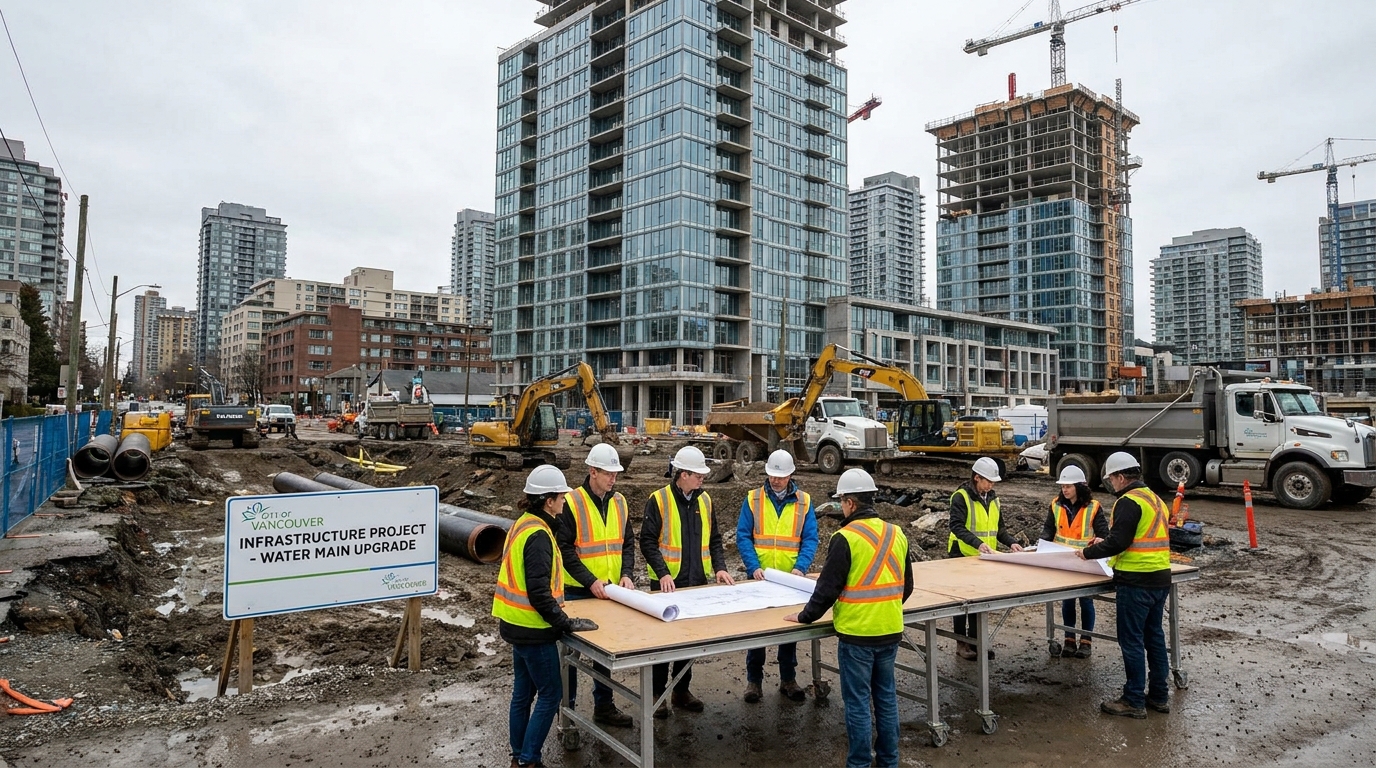
In practical terms, this means PPPs are increasingly relevant not just for highways, bridges, or hospitals, but for urban districts, housing-enabling utilities, community-serving facilities, and land redevelopment strategies. That broader application matters because the next generation of city growth will happen through integrated urban systems, not isolated projects. The winners will be cities that can coordinate infrastructure and development timing with discipline and clarity.
Housing Shortages Are Also Infrastructure Shortages
One of the biggest misconceptions in the housing debate is that supply problems begin and end with private developers or planning approvals. In reality, many housing shortages are driven by a lack of serviced land and inadequate supporting infrastructure. A municipality may permit significant density, but if sewer capacity is constrained, stormwater systems are outdated, or transit investment is delayed, the site remains underbuilt. In that sense, infrastructure is not a background issue. It is a direct determinant of whether housing can proceed.
This is why public-private partnerships are becoming more strategic in growth planning. They create a mechanism to coordinate the often fragmented responsibilities that shape housing outcomes. The public sector may control zoning, rights of way, utility planning, and public land. The private sector may control construction capacity, equity, market knowledge, and execution. Institutional lenders may provide long-term capital. A well-designed PPP aligns these moving parts around delivery rather than leaving each actor to operate in sequence.
Federal and provincial initiatives in Canada reinforce this direction. The Canada Housing Infrastructure Fund supports communities by enabling densification and the construction of new homes through investments in systems that are often the real bottlenecks. These are not glamorous assets, but they are essential. Without water, wastewater, stormwater, and waste management upgrades, many ambitious housing targets remain theoretical.
From a strategic standpoint, this changes how urban leaders should think about land value. Land is not valuable simply because it is located in a growing city. It becomes exponentially more valuable when infrastructure, approvals, access, and a credible delivery pathway are in place. PPPs can be a way to create that pathway. They can turn underused land into productive urban districts by linking capital works with development rights, public objectives, and phased delivery.
How PPPs Actually Create Value in Urban Development
To understand the role of PPPs, it helps to move beyond slogans and look at how value is created. First, partnerships can improve project feasibility. When public entities contribute land, streamline approvals, reduce fees, or provide access to low-cost financing, they can materially change the economics of a project. This is particularly important in a market where high borrowing costs and construction inflation have made many otherwise sensible housing projects difficult to launch.
Second, PPPs can reduce delivery risk. Major urban development projects often fail not because demand is absent, but because timing risk is too high. Infrastructure arrives late, procurement stalls, community opposition intensifies, or cost overruns erode project viability. A structured partnership can assign risks to the parties best able to manage them, creating a more stable framework for execution. This is one of the reasons governments continue to rely on partnership models in large capital programs.
Third, PPPs can support lifecycle thinking. In conventional development models, the pressure is often to deliver quickly and move on. In a stronger partnership structure, long-term operations, maintenance, and performance can be built into the agreement. This matters in urban development because the quality of the built environment depends not only on opening day delivery, but on how assets perform over decades. Streets, public spaces, utilities, community facilities, and mixed-use environments all require stewardship.
Fourth, PPPs can help align infrastructure with land use in ways that create broader economic value. A transit station surrounded by fragmented low-density land can remain underleveraged for years. But if public agencies, transit authorities, and private development partners coordinate around a shared district plan, the same area can become a mixed-use node with homes, jobs, amenities, and better ridership. This is where city-building strategy and project finance begin to intersect directly.
Key Urban Development Advantages of PPPs
- They connect housing goals to enabling infrastructure, which is often the missing link in supply delivery.
- They allow public land to be used more strategically, including long-term leasing models that preserve public influence.
- They improve delivery coordination across planning, finance, construction, and operations.
- They can attract institutional and private capital into projects that serve public growth objectives.
- They support phased district-scale development rather than one-off site-by-site solutions.
These benefits are real, but they depend entirely on structure. A PPP only creates public value if the contract, financing model, and accountability framework are designed around public outcomes rather than vague partnership language.
Toronto and the Emerging Canadian Model
One of the clearest recent examples of this direction is the 2025 partnership between the Government of Canada and the City of Toronto. The significance of this arrangement lies not only in the financing itself, but in the broader logic behind it. Low-cost federal financing was tied to municipal relief on development charges, fees, and property taxes in order to help build more homes faster. In essence, multiple layers of government used partnership tools to improve project viability and accelerate delivery.
This is a notable evolution in Canadian housing policy. For years, much of the housing discussion focused on interest rates, zoning, or private development capacity in isolation. The Toronto model points to something more integrated. It acknowledges that municipal fee structures, financing costs, and public policy incentives all shape whether housing can proceed at scale. By intervening on those fronts together, the partnership aimed to reduce friction across the development chain.
The significance extends beyond one city. Large metropolitan areas across North America face similar conditions: expensive land, infrastructure deficits, fiscal pressure on municipalities, and the need for more housing near transit. In that context, Toronto represents a framework that others will study closely. The lesson is not that every city should copy one agreement exactly. The lesson is that urban development works better when governments coordinate their tools rather than acting in policy silos.
Ontario’s long-term infrastructure reporting also underscores the importance of close public-private collaboration. The province has extensive experience with P3 delivery, and Infrastructure Ontario has reported dozens of substantially completed projects under its program. While much of this legacy comes from hospitals, transit, and public facilities, the strategic takeaway is relevant to housing and urban growth as well. Partnership models are most effective when governments define outcomes clearly and manage procurement and contract performance rigorously.

Transit-Oriented Development and the Power of Coordinated Growth
Transit-oriented development is one of the strongest use cases for modern PPPs. Transit stations create a concentration of public value. They are expensive to build, hard to relocate, and capable of supporting significant density if surrounding land use is planned effectively. Yet many transit corridors remain underdeveloped because the public and private sectors do not align timing, land strategy, and infrastructure investment well enough.
In a strong partnership model, transit can become the backbone of a district-level development strategy. The public sector can establish the transit investment, planning framework, and community standards. Private partners can deliver housing, retail, office space, and public realm improvements in phases. Financing structures can reflect the value created by transit access, allowing growth to help support the broader economics of the district. This is where related concepts such as land value capture, lifecycle costing, and mixed-use planning become highly relevant.
For growing cities, the implications are significant. Transit-oriented PPPs can support higher density without repeating low-efficiency suburban growth patterns. They can reduce transportation emissions, improve access to jobs, and concentrate growth where infrastructure can be used more efficiently. From a development economics standpoint, this improves both urban productivity and service efficiency. The city gets more value from each dollar invested in mobility and public utilities.
However, transit-oriented development only fulfills its promise if housing is included meaningfully. Too often, major station area plans generate premium land values without delivering enough homes, especially homes affordable to a broad range of households. This is where partnership terms matter. Governments must use their leverage to secure outcomes such as mixed-income housing, community benefits, and public realm quality. Otherwise, the urban value created by public investment is captured too narrowly.
The Affordability Question Cannot Be an Afterthought
Any serious discussion of PPPs in urban development must confront affordability directly. Partnerships can accelerate growth, but growth alone does not guarantee affordability. In many high-demand cities, purely market-driven delivery tends to produce homes at price points that exclude many households. If PPPs are structured only to maximize development yield or land sale revenue, they may increase supply without meaningfully improving access.
This is why Canadian housing policy has placed growing attention on public land strategies and affordability-linked programs. CMHC’s Federal Lands Initiative demonstrates a different philosophy from the old disposition model in which public land was simply sold to the highest bidder. Instead, public land can be leveraged collaboratively with private and non-profit partners to deliver housing that serves broader social objectives. This is a more mature use of public assets because it values long-term community outcomes rather than one-time revenue maximization.
The OECD has also identified major Canadian housing measures, including the Affordable Housing Fund, the Canada Housing Infrastructure Fund, and the Public Lands for Home Plan, as part of a broader affordability strategy. This broader package matters because it shows that PPPs work best as part of a policy ecosystem. They are not substitutes for subsidy, planning reform, or public accountability. They are mechanisms that can help implement those goals more effectively when combined with them.
One of the most promising directions is public land leasing rather than outright sale. Leasing can preserve long-term public influence over affordability, land use, and stewardship while still enabling private or non-profit development. This model can be especially powerful in transit-rich or institutionally anchored locations where public agencies, universities, hospitals, or governments control valuable sites. In such cases, the land itself becomes a strategic tool for shaping equitable growth.
Conditions That Strengthen Affordable Housing Outcomes in PPPs
- Clear affordability requirements embedded in agreements from the beginning rather than added later.
- Long-term covenants or lease structures that preserve affordability over time.
- Use of public land to lower development cost instead of maximizing immediate sale revenue.
- Integration of infrastructure funding with housing delivery targets.
- Strong monitoring so performance is measured against public objectives, not only construction milestones.
The Risks and Criticisms Are Real
It is important to be clear-eyed about the limitations of PPPs. They are not magic. They do not automatically lower costs, and they do not resolve weak policy design. If a city has unclear growth priorities, poor procurement discipline, or unrealistic assumptions about market absorption, a partnership model can magnify those weaknesses rather than solve them. The success of a PPP depends heavily on contract quality, institutional capacity, and a realistic understanding of where risk truly belongs.
One common misconception is that PPPs always save public money. In reality, private capital often costs more than sovereign borrowing. The rationale for using a partnership is usually not that financing is inherently cheaper, but that risk transfer, delivery certainty, innovation, and lifecycle performance may justify the model under the right circumstances. That requires serious value for money analysis. Without it, partnerships can become politically appealing labels attached to weak economics.
Another challenge is alignment. Public agencies may prioritize affordability, resilience, and long-term stewardship. Private partners may focus on returns, timing, and market flexibility. These priorities are not incompatible, but they must be negotiated honestly. If a municipality assumes the market will absorb public-interest conditions without affecting feasibility, projects may stall. If a developer assumes public agencies will relax standards once procurement is complete, trust can erode quickly. A durable PPP must account for these tensions upfront.
Political risk is also significant. Urban development unfolds over years, often across election cycles. Governments change, market conditions shift, and community expectations evolve. A rigid contract can become obsolete, but an overly vague one can invite disputes. The best partnerships create enough structure to protect public value while maintaining enough adaptability to respond to changing economic conditions.
PPPs should be judged neither as ideological victories nor as ideological threats. They should be judged as delivery frameworks. The question is whether they achieve public goals better than the alternatives available.
Governance Is the Difference Between Success and Failure
If there is one lesson repeated across North American PPP experience, it is that governance matters more than branding. The strongest partnerships begin with clear public objectives. Governments need to know whether they are trying to maximize housing starts, preserve affordability, unlock infrastructure, intensify around transit, regenerate public land, or achieve some combination of these goals. Without that clarity, procurement becomes confused and negotiations drift.
Risk allocation is central. Risks should be assigned to the party best equipped to manage them. Construction risk may sit partly with private delivery teams. Planning and political risk may remain largely public. Market absorption risk may need to be shared depending on the project type. Attempting to transfer every risk to the private sector usually leads to higher costs or unworkable bids. Retaining every risk publicly defeats much of the purpose of the model. Strategic balance is essential.
Contract management also matters after financial close. Many governments focus heavily on deal structuring and not enough on implementation capacity. Yet urban development partnerships evolve over long timelines and multiple phases. Performance monitoring, milestone enforcement, public reporting, and issue resolution all require skilled oversight. Strong public institutions are not less important in PPPs. They are more important.
Community trust is another governance issue. Large urban projects affect neighborhoods directly, and residents often worry that partnerships prioritize investors over communities. The answer is not to avoid partnerships, but to improve transparency and embed clear community benefits. Public reporting on affordability commitments, open-space delivery, infrastructure upgrades, and design standards can help build legitimacy. So can early engagement that treats local stakeholders as participants rather than obstacles.

Where PPPs Are Heading Next
The next phase of PPPs in urban development will likely look broader and more ecosystem-based than the older generation of one-off megaprojects. We are already seeing movement toward portfolio approaches in which multiple sites, infrastructure systems, or development phases are coordinated under shared housing and growth objectives. This is a smarter model for urban regions because city-building rarely occurs through isolated assets. It occurs through interconnected networks of land, infrastructure, institutions, and capital.
There is also growing potential for more diverse partnership participants. Municipalities and developers will remain central, but universities, hospitals, transit agencies, Indigenous communities, pension funds, and non-profit housing providers are likely to play larger roles. The Canada Infrastructure Bank’s work in housing-enabling and Indigenous community infrastructure reflects this trend toward broader partnership design. In a complex urban economy, more durable outcomes often emerge when multiple long-term stakeholders are at the table.
Innovation in construction may also become more relevant. Modular and prefabricated approaches can pair well with partnership-based delivery when governments want to accelerate timelines and create repeatable housing solutions across multiple sites. This is particularly useful when a city or region is trying to move from project-by-project decision-making toward a more scalable housing production model. Partnerships can provide the procurement and financing framework that allows such innovations to be deployed more consistently.
At the same time, no partnership model will eliminate the need for broader reform. Zoning modernization, permitting efficiency, infrastructure planning, subsidy programs, and public land strategy all remain necessary. PPPs are complements, not replacements. Their strategic value comes from integration. When they are layered onto coherent policy and realistic market understanding, they can significantly improve delivery. When used as substitutes for policy discipline, they disappoint.
What City Leaders and Developers Should Take From This
For public leaders, the first takeaway is that housing strategy must include infrastructure strategy. Cities need to know where growth should occur, what infrastructure is required to support it, and how capital and delivery responsibility will be organized. The era of separating land use ambition from infrastructure reality is over. If municipalities want more homes, they must create service-ready pathways to build them.
For developers and investors, the takeaway is that the most attractive urban opportunities increasingly sit within partnership frameworks rather than outside them. Projects tied to transit, public land, utility upgrades, or affordability programs may offer stronger long-term prospects than purely speculative site plays because they are linked to broader public commitments and district-scale growth. That does not remove complexity, but it can create more durable value.
For communities, the takeaway is more nuanced. PPPs should not be accepted uncritically, but neither should they be dismissed reflexively. The real issue is design. Partnerships can either reinforce exclusionary growth patterns or help produce more inclusive, connected, and resilient neighborhoods. The difference lies in whether the public sector enters negotiations with a strong vision, credible leverage, and a commitment to accountability.
For policy makers, the message is strategic. The housing shortage will not be solved by one instrument. It requires a portfolio approach that combines public land strategy, infrastructure funding, zoning reform, affordability programs, and effective delivery models. PPPs belong in that portfolio because they create a practical bridge between policy intention and construction reality.
Conclusion: Partnerships as a Tool for Better City-Building
Modern urban development demands more than isolated projects and short-term thinking. It requires coordinated systems that connect land, finance, infrastructure, and public purpose. Public-private partnerships have become more important because they offer a framework for that coordination. In fast-growing cities, they can help unlock housing supply, accelerate infrastructure, support transit-oriented growth, and turn public assets into long-term community value.
But success is not automatic. PPPs work best when governments know what they want, understand the economics of delivery, and protect the public interest with disciplined governance. They are most effective when they are tied to specific outcomes such as serviced land, affordable housing, complete communities, and resilient infrastructure. When those conditions are present, partnerships can do more than build projects. They can help shape the future form and function of a city.
That is the strategic importance of PPPs in this era. They are not simply contracts between sectors. They are instruments for aligning growth with capacity, ambition with feasibility, and housing targets with the infrastructure that makes those targets real. As Canadian cities continue to grow and intensify, the places that succeed will be the ones that treat partnerships not as shortcuts, but as serious tools for disciplined, inclusive, long-term city-building.



No Comment! Be the first one.