



Transform Your Space: A DIY Guide to Smart Lighting Solutions
There are few design elements as transformative as light. Furniture defines function, textiles soften a room, and color establishes character, yet lighting is what gives all of these choices their emotional presence. It can make a modest room feel composed and luxurious, turn a practical kitchen into an inviting gathering place, and elevate a quiet bedroom into a sanctuary. In today’s homes, smart lighting offers something especially compelling because it merges refined atmosphere with practical intelligence.
Table Of Content
- Why Smart Lighting Matters in Modern Home Design
- Understanding Layered Lighting Before You Buy Anything
- Start With a Lighting Plan, Not a Shopping Cart
- A Simple Room Assessment Framework
- Choosing the Right Smart Lighting Products
- What to Check Before You Buy
- The Beauty of Tunable White Light
- How to Install Smart Lighting as a DIY Project
- Basic DIY Installation Sequence for a Smart Dimmer
- Where Smart Lighting Makes the Biggest Impact
- Creating Scenes That Feel Personal and Polished
- Useful Smart Lighting Scenes to Start With
- Common Smart Lighting Mistakes to Avoid
- Design Tips for Making Smart Lighting Look Expensive
- Maintenance, Updates, and Long Term Success
- The Future of Smart Lighting at Home
- Conclusion: Light as Atmosphere, Light as Craft
For many homeowners, smart lighting still sounds like a gadget category, something associated with color changing bulbs and voice commands rather than beautiful interiors. In reality, the most successful smart lighting plans are less about novelty and more about elegance, comfort, and control. The true value lies in creating scenes that flatter your home throughout the day, supporting how you cook, read, entertain, and relax while also reducing waste and improving efficiency. When chosen carefully, smart lighting recedes into the design language of a room and lets the space itself become the focus.
That balance between artistry and utility is what makes this such a rewarding DIY project. According to the U.S. Department of Energy, lighting accounts for about 15% of an average home’s electricity use, and modern LEDs can use up to 90% less energy and last up to 25 times longer than incandescent bulbs. At the same time, Natural Resources Canada describes residential lighting design as both artistic and scientific, emphasizing a layered approach that combines ambient, task, accent, and decorative light. Together, these ideas create a beautiful premise for the modern home: choose efficient lighting first, then use smart controls to shape mood, texture, and daily life.
This guide will walk you through the process of planning, selecting, installing, and customizing a smart lighting system with taste and confidence. You do not need to begin with a whole house automation package or an expensive renovation. You simply need a clear sense of how you want your home to feel and a willingness to approach lighting as one of the most expressive materials in the room.
Why Smart Lighting Matters in Modern Home Design
Smart lighting has become increasingly relevant because the market has matured. Efficient LED technology is now mainstream across North America, and recent policy shifts have reinforced that reality. In Canada, ENERGY STAR certification for most new lighting products ended on December 31, 2024, reflecting the fact that efficient lighting has largely become standard rather than exceptional. In the United States, stricter efficiency standards for general service lamps have pushed the market toward highly efficient products, which means homeowners are now choosing less between efficient and inefficient bulbs and more between different levels of design quality, compatibility, control, and aesthetic flexibility.
That shift is important because it changes the conversation. If efficiency is increasingly expected, then the more interesting design question becomes how light behaves in your space. This is where smart lighting excels. Instead of simply turning a fixture on or off, you can adjust brightness, tune color temperature, automate routines, coordinate multiple sources of light, and create scenes that suit the architecture of your home. A room can be bright and crisp in the morning, softly luminous in the afternoon, and warm and intimate in the evening without requiring different fixtures for every moment.
Smart controls also support a more intuitive relationship with the home. Occupancy sensors, daylight sensors, timers, and dimmers can reduce energy use while making life easier. Better Buildings case material linked to smart LED systems has shown lighting energy savings in the range of 50% to 90% in retrofit contexts that used sensing and dimming strategies. For a homeowner, this does not simply mean lower bills. It means the hallway glows gently when needed, the kitchen adjusts to available daylight, and the living room settles into a refined evening setting without harsh overhead glare.
Smart lighting works best when it is treated as a design tool first and a technology layer second. The goal is not to make your home feel more digital. The goal is to make it feel more responsive, graceful, and beautifully lit.
Understanding Layered Lighting Before You Buy Anything
One of the most useful concepts in lighting design is layering. A room illuminated by a single ceiling fixture often feels flat because every surface receives the same visual treatment. Layered lighting introduces depth by giving different jobs to different sources of light. This approach is central to professional residential lighting plans and is equally valuable in DIY work because it helps you make better product decisions from the beginning.
Ambient lighting is your overall background illumination. It helps the room function safely and comfortably and typically comes from ceiling fixtures, recessed lights, cove lighting, or wall sconces. In a smart lighting scheme, ambient light is often dimmable and scheduled to shift in intensity depending on the time of day. This creates a room that feels alive rather than mechanically bright.
Task lighting is more focused and supports specific activities. It includes reading lamps, under cabinet lighting, vanity lights, desk lamps, and pendant lights over work surfaces. Smart task lighting is especially helpful because you can set brighter scenes for concentration and softer settings for relaxation. In kitchens, offices, and bathrooms, the right task light often matters more than simply increasing overall brightness.
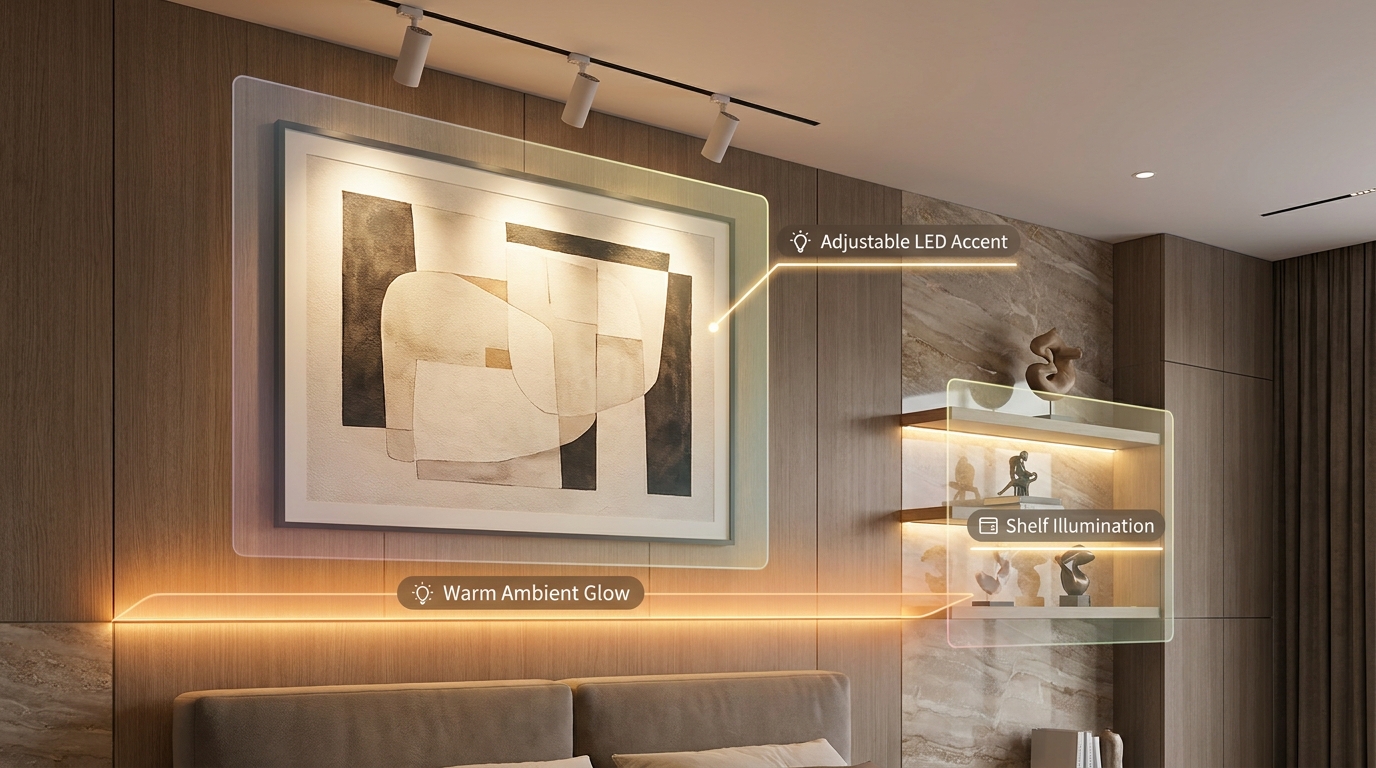
Accent lighting draws attention to something worth noticing. It might highlight artwork, shelving, a textured wall, a fireplace surround, or beautiful joinery. LEDs are particularly well suited to this role because they offer excellent control, longevity, and compact form. When paired with smart controls, accent lighting can become dynamic and expressive, quietly changing with the room’s mood without ever feeling theatrical.
Decorative lighting contributes personality and visual identity. Think of a sculptural pendant, a glass table lamp, or a brass sconce whose beauty matters even when the light is off. Smart bulbs can be placed within decorative fixtures to preserve the fixture’s character while adding flexibility to the atmosphere it creates. In this way, technology can serve style rather than competing with it.
Start With a Lighting Plan, Not a Shopping Cart
The temptation with any smart home upgrade is to start by browsing products. A more elegant approach is to begin with a room by room assessment. Walk through your home during the morning, late afternoon, and evening. Notice which rooms feel dim, which feel overlit, where glare appears, and where your existing lighting fails to support the way you actually live. Pay close attention to mood as well as function because a technically bright room can still feel visually uncomfortable.
As you evaluate each room, ask a few simple questions. What activities happen here most often. Which surfaces or features deserve emphasis. Is there enough light for practical tasks. Does the room need warmth, crispness, or flexibility depending on the hour. These questions reveal whether you need a brighter bulb, a dimmer switch, a tunable white lamp, an accent strip, or a more comprehensive combination of all four.
It is also wise to consider circulation and rhythm between rooms. Smart lighting is especially effective when spaces feel visually connected. If your entry is dramatically cool and bright while your living room is dim and amber, the transition may feel abrupt unless that contrast is intentional. Interoperability matters here because homeowners increasingly want systems that work across bulbs, switches, sensors, and apps. Standards based ecosystems and compatible platforms make it easier to build scenes that behave consistently throughout the home.
A Simple Room Assessment Framework
- Identify the room’s main purpose such as cooking, reading, entertaining, dressing, resting, or circulation.
- List existing light sources including ceiling fixtures, lamps, sconces, strips, and natural daylight.
- Note what feels missing such as softness, focus, brightness, warmth, or drama.
- Decide what should be smart whether bulbs, plugs, dimmers, sensors, or a combination.
- Create one ideal scene for morning, one for everyday use, and one for evening ambiance.
This planning stage may seem modest, but it saves money and produces far more harmonious results. Rather than scattering disconnected smart products through the house, you begin composing a lighting experience with intention.
Choosing the Right Smart Lighting Products
Once your plan is clear, product selection becomes much easier. The first distinction to understand is the difference between smart bulbs, smart switches or dimmers, and smart plugs or controllers. Each option has a place, and the most elegant homes often use a combination rather than relying on one category alone.
Smart bulbs are the easiest entry point. They work well in table lamps, floor lamps, bedside fixtures, and decorative pendants where you want individualized control or tunable white settings. They are especially useful when you cannot or prefer not to alter wiring. However, not every bulb fits every fixture. You need to verify base type, brightness, color temperature range, enclosed fixture suitability, and whether the bulb is intended for damp or wet locations if used in bathrooms or exterior areas.
Smart switches and dimmers are often the more sophisticated long term solution. They allow you to control existing hardwired fixtures at the wall, which preserves the familiar behavior people expect in a home. This matters aesthetically and practically because guests should not need a tutorial to turn on a hallway light. A well selected smart dimmer brings convenience without visual clutter and often integrates more gracefully with daily routines than a house full of individually controlled bulbs.
Smart plugs are excellent for portable lamps and seasonal lighting. They are simple to install, require no rewiring, and can help turn a beautiful decorative lamp into part of a broader scene. If your living room already has lovely table lamps and sconces, a smart plug or bulb may be all you need to create layered evening ambiance with almost no renovation effort.
What to Check Before You Buy
- Compatibility with your ecosystem so all devices can work together through one app or interoperable platform.
- Dimming compatibility because not all LEDs work well with all dimmers.
- Color temperature options if you want tunable white light for day to night changes.
- Lumen output rather than wattage, since brightness should match the room’s purpose.
- Safety certification from recognized bodies such as UL or other accredited certification marks relevant to your market.
- Fixture suitability for enclosed, damp, wet, or outdoor applications.
Safety should never be treated as a minor detail in a DIY lighting project. UL Solutions is a major North American lighting certification body, and certified products offer reassurance that fixtures, controls, and electrical components have been tested to recognized standards. In practical terms, this means you should check packaging and specifications carefully before installation, particularly when combining LEDs, dimmers, drivers, and smart control hardware.
The Beauty of Tunable White Light
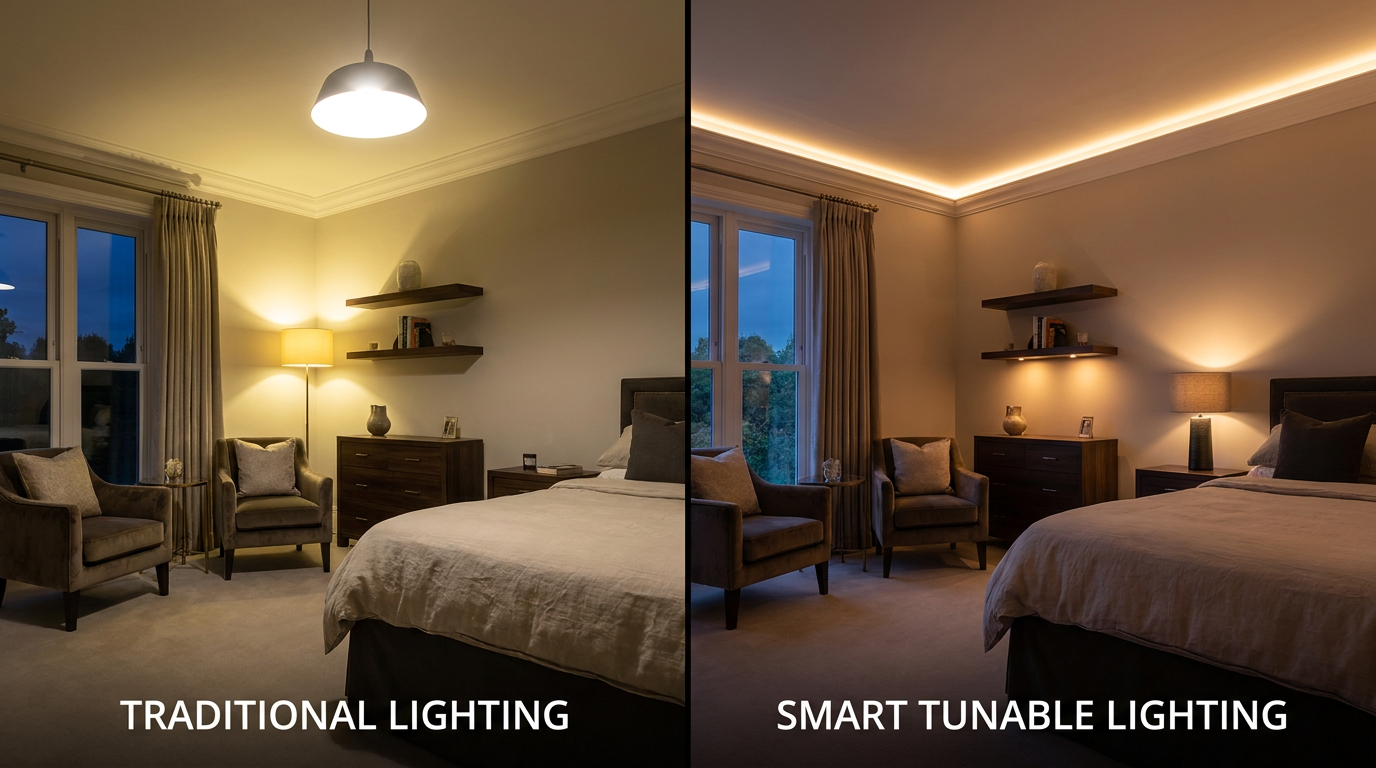
If there is one smart lighting feature that most gracefully bridges technology and interior design, it is tunable white. Unlike dramatic color changing effects, tunable white focuses on subtle shifts between cooler and warmer whites. This is profoundly useful because our perception of comfort changes throughout the day. Morning often benefits from a cleaner, brighter light that feels energizing, while evening is far more flattering in warmer tones that soften contrasts and invite calm.
In design terms, color temperature affects how materials are perceived. Warm light enriches wood, linen, brass, terracotta, and cream painted walls. Cooler light can make white kitchens feel crisp and efficient while improving clarity for grooming, cooking, and work. The ideal home usually does not commit to one color temperature everywhere. Instead, it allows rooms to evolve according to purpose and time.
This flexibility is especially helpful in open plan spaces. A kitchen may require brighter, cooler task lighting over counters in the morning while the adjoining dining area glows more warmly by evening. With a coordinated smart system, these subtle distinctions can happen seamlessly. The result feels polished and intuitive rather than obviously automated.
How to Install Smart Lighting as a DIY Project
Many smart lighting upgrades are remarkably approachable, particularly when they involve bulbs, plugs, portable lamps, or adhesive LED strips. These can often be completed in an afternoon and make a visible difference immediately. Installation becomes more advanced when you move into hardwired switches, dimmers, or new fixtures. At that point, careful preparation matters enormously, and if local code or comfort level requires it, there is no loss of elegance in involving a licensed electrician for part of the work.
For bulb based upgrades, begin by identifying where simple replacement will bring the most value. Bedside lamps, living room lamps, dining pendants, and entry fixtures are often excellent starting points because they define atmosphere. Install the bulbs, connect them to the manufacturer’s app or your preferred smart home platform, name each device clearly, and test dimming and scheduling before building more complex scenes. This first phase lets you learn what level of brightness and warmth feels right in your own home.
For smart plugs, the process is similarly straightforward. Plug the device into the outlet, connect it to your network, and attach the lamp or decorative light source. Use this method to control lamps that already contribute visual charm to the room. It is one of the easiest ways to make an interior feel considered because lighting can begin behaving in unison without changing the room’s visible design language.
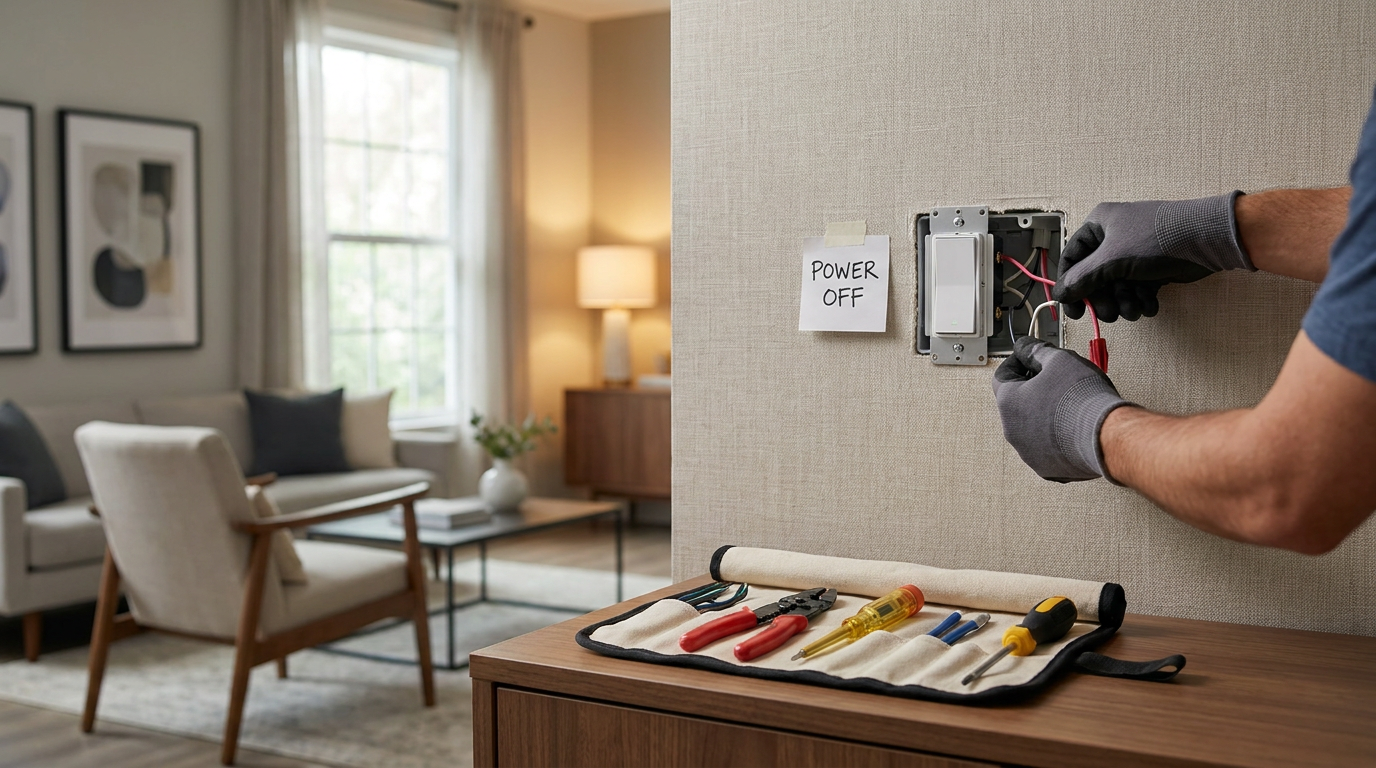
Smart dimmers and switches require more attention. Always turn off power at the breaker before working on any wiring and confirm that the circuit is not live. Review the product instructions carefully because some smart switches require a neutral wire, while others are designed for specific load types. Verify that your existing fixture and bulbs are compatible with the dimmer, as mismatch can cause flicker, reduced dimming range, or premature failure.
Basic DIY Installation Sequence for a Smart Dimmer
- Turn off the breaker and test to confirm power is off.
- Remove the faceplate and old switch carefully, documenting existing wire positions with a photo.
- Read the manufacturer diagram and identify line, load, ground, and neutral if required.
- Connect the new smart dimmer using the supplied connectors and approved methods.
- Secure the device and reinstall the faceplate ensuring no wires are pinched.
- Restore power and complete app pairing, firmware updates, and dimming calibration if available.
If at any point wiring seems inconsistent, aluminum, damaged, or unclear, pause the project. Good design is always supported by safe execution. A beautiful room should never rest on uncertain electrical work.
Where Smart Lighting Makes the Biggest Impact
Not every room needs the same level of sophistication. The most effective smart lighting upgrades usually begin where lifestyle and atmosphere overlap. In the living room, focus on dimmable layers. Replace harsh overhead dependence with a combination of lamps, accent lighting on shelves or artwork, and a soft ambient source. Build an evening scene that leaves the room luminous without flattening it.
In the kitchen, task lighting is paramount. Under cabinet LED lighting, pendant dimming, and daylight responsive brightness can dramatically improve both function and visual comfort. Because kitchens often connect to dining or family areas, this is also an excellent place to use scenes that transition from practical daytime brightness to a warmer setting for dinner and conversation.
The bedroom benefits tremendously from tunable white and low level scene control. Gentle wake up routines, warm bedside reading settings, and dimmed pathways for late evening movement all contribute to a more restful environment. The room should feel composed and cocooning rather than overly bright. Smart lighting helps achieve that with very little visual intrusion.
In the bathroom, clarity matters, but so does softness. Vanity lighting needs to support grooming accurately, ideally with good color rendering, while evening scenes should be calmer and less stark. Motion activated night lighting can be especially elegant here because it improves comfort without the shock of full brightness during nighttime use.
The entry and hallway are often overlooked, yet they benefit beautifully from automation. Timed illumination, occupancy sensing, and subtle dimming create a sense of welcome the moment someone arrives home. These transitional spaces may not demand decorative complexity, but they shape the first impression of the entire house.
Creating Scenes That Feel Personal and Polished
The true refinement of smart lighting appears when you begin creating scenes. A scene is a preset combination of brightness, color temperature, and selected fixtures for a specific mood or function. This is where the home begins to feel curated rather than merely equipped with connected devices. Instead of thinking in terms of individual switches, you begin thinking in terms of lived moments.
A morning scene might raise kitchen and bathroom lights to a clear, energizing brightness while leaving the living room softer. A work from home scene can strengthen task lighting in an office and reduce glare in adjacent areas. An entertaining scene may illuminate artwork, dim overheads, brighten the dining pendant slightly, and leave side lamps glowing warmly around the room. An evening unwind scene usually benefits from low ambient light, warm temperatures, and gentle accents that define form without overstimulation.
Try naming scenes in a way that reflects experience rather than technology. Names like Breakfast, Reading, Guests, Gallery, Quiet Evening, or Night Path are more intuitive than terms such as Preset 1 or Warm Mode. This keeps the system human, which is exactly what refined design should do. The home responds more beautifully when the language around it is tied to living rather than circuitry.
Useful Smart Lighting Scenes to Start With
- Morning Rise with brighter, cooler light in active zones.
- Daylight Balance with moderate output that complements natural light.
- Entertain with layered dimming and highlighted focal points.
- Reading with stronger task light and softened ambient glow.
- Evening Calm with warm dimmed lighting and minimal glare.
- Night Path with low illumination in circulation areas only.
Common Smart Lighting Mistakes to Avoid
One of the most common misconceptions is that smart lighting automatically saves energy in every case. The truth is more nuanced. Savings depend on what you are replacing and how the controls are used. If you are moving from incandescent bulbs to LEDs and using dimmers and sensors thoughtfully, the benefits can be substantial. If you install always connected devices but leave them at excessive brightness or ignore scheduling, the results may be less impressive than expected.
Another mistake is assuming smart lighting is only about color changing bulbs. For most interiors, the more meaningful gains come from dimming, tunable white, layered lighting, occupancy sensing, and thoughtful placement. The aim is not to make your ceiling purple. It is to make your home flattering and flexible.
Compatibility errors are also extremely common. Not every bulb works with every dimmer, and not every fixture is appropriate for every LED lamp. Enclosed fixtures, outdoor conditions, and moisture rated environments all require specific products. Interoperability across bulbs, switches, hubs, and apps deserves careful attention as well because a fragmented system quickly becomes frustrating.
Finally, avoid overlighting. Higher brightness is not always better. Good lighting depends on the right lumen output, beam spread, placement, color rendering, and temperature. Rooms with thoughtful contrast and varied layers almost always feel more luxurious than rooms flooded with uniform brightness.
Design Tips for Making Smart Lighting Look Expensive
Luxury in lighting is rarely about intensity. It is about control, restraint, and nuance. If you want smart lighting to feel elevated, begin by reducing reliance on a single central fixture. Even if a room has a statement pendant or ceiling light, pair it with other sources at different heights. This creates a visual landscape rather than a single field of brightness.
Use warm dimming or tunable white settings in the evening to flatter skin tones and soften surfaces. Highlight one or two architectural or decorative features in each room rather than trying to illuminate everything equally. Shelving, art, drapery folds, a textured wall, or an elegant console can become a gentle focal point with carefully directed light.
Think about shadows as part of the composition. A room feels sophisticated when light reveals texture and creates rhythm. Lamps with fabric shades, concealed LED strips under millwork, and narrow beam accents on objects can all add richness. Smart controls simply allow you to adjust this composition with greater precision throughout the day.
It is also wise to hide technology where possible. Choose sleek switches, avoid visible cords when practical, and place sensors discreetly. The best smart lighting is often almost invisible as technology. What remains visible is atmosphere.
Maintenance, Updates, and Long Term Success
Once installed, smart lighting still benefits from occasional care. Update firmware when manufacturers release improvements, especially for security, reliability, and compatibility. Revisit your scenes every few months because your needs may change seasonally or as furniture layouts evolve. A lighting plan should feel alive, not frozen.
Keep fixtures clean because dust and residue can dull even the best lighting design. In kitchens and bathrooms, this matters particularly because buildup can affect both brightness and visual clarity. If a bulb or device begins flickering, investigate promptly rather than ignoring it. The cause may be a compatibility issue, a failing component, or a fixture condition that deserves attention.
As your system grows, document it. Save product names, installation dates, app credentials, and pairing instructions in one accessible place. This is especially useful if you move, remodel, or add devices later. A thoughtful record keeps the system elegant behind the scenes as well as in appearance.
The Future of Smart Lighting at Home
One of the most exciting aspects of smart lighting is that it continues to evolve toward greater simplicity. Interoperability and standards based systems are becoming more important as homeowners expect bulbs, switches, sensors, and software to cooperate more gracefully. This matters not only for convenience but also for design consistency. A scene that behaves predictably across multiple rooms feels far more luxurious than a system that requires constant troubleshooting.
At the same time, the visual direction of lighting is becoming quieter and more architectural. Instead of obvious novelty, there is increasing interest in tunable white systems, discreet controls, circadian inspired schedules, and integrations that support energy management without disturbing the atmosphere of the room. In this sense, smart lighting is maturing into what good design has always aimed to be: helpful, beautiful, and almost effortlessly integrated into daily life.
Conclusion: Light as Atmosphere, Light as Craft
To transform a home with smart lighting is not simply to add convenience. It is to shape experience with greater intention. The right system can make mornings easier, evenings softer, art more expressive, kitchens more workable, and ordinary routines more graceful. It can also reduce waste and support a more efficient home, especially when paired with modern LEDs, dimming, sensors, and thoughtful scheduling.
What makes this project so satisfying is its dual nature. It is practical enough to begin with a single lamp or dimmer, yet artistic enough to influence the entire feeling of a home. You do not need to chase complexity to achieve beauty. Start with one room, layer the light carefully, verify safety and compatibility, and let each improvement teach you what your space wants to become.
In the end, the finest interiors are not only seen. They are felt. Smart lighting, when approached with sensitivity, allows that feeling to deepen. It gives the home a quieter intelligence and a more luminous soul.


No Comment! Be the first one.