



For many homeowners, energy use lives in the background. Lights turn on, the refrigerator hums, the heating or cooling system cycles as needed, and then a utility bill arrives at the end of the month with a total that can feel frustratingly vague. You know you used electricity, but not always how you used it, which appliances were responsible, or what changes would make a meaningful difference. That uncertainty is exactly why smart energy monitoring has become so useful.
Table Of Content
- What smart energy monitoring actually means
- Why homeowners are paying more attention to energy monitoring
- How smart energy monitoring works
- What are the main types of smart energy monitoring systems?
- Utility smart meters
- Plug-in appliance monitors
- Whole-home monitors
- Circuit-level monitoring and smart panels
- What smart monitoring can reveal in a real home
- Smart monitoring and lower energy bills
- How monitoring supports sustainability without making life complicated
- The growing role of time-of-use pricing, electrification, and resilience
- Common misconceptions that are worth clearing up
- How to choose the right smart energy monitoring system for your home
- Questions to ask before you buy
- Practical ways to use the data once you have it
- A measured approach to a smarter home
Smart energy monitoring is the practice of measuring and visualizing how electricity is used in a home so you can identify waste, adjust habits, and make more informed upgrade decisions. It can be as simple as a utility smart meter paired with an app that shows overall usage trends, or as advanced as a circuit-level monitoring system that reveals what a heat pump, dryer, EV charger, or basement freezer is consuming throughout the day. The U.S. Department of Energy notes that a smart meter can help homeowners see their home energy use, identify savings opportunities, and in some cases remotely control thermostats or appliances. The Department of Energy also reports that average U.S. household electricity consumption is about 1,000 kWh per month, meaning most homes have real opportunity to save once that usage becomes visible instead of hidden inside a single monthly total.
For homeowners who care about lowering bills, improving comfort, or making more sustainable choices without overcomplicating daily life, smart monitoring is a practical starting point. It does not require perfection, and it is not just for people with solar panels or high-tech homes. It is simply a better way to see what your home is already doing, so you can make decisions with confidence rather than guesswork.
Smart energy monitoring does not save money on its own. The savings come from the choices it makes possible, from adjusting thermostat settings to replacing an inefficient appliance or shifting energy use to cheaper hours.
What smart energy monitoring actually means
The phrase can sound more technical than it needs to. At its core, smart energy monitoring means tracking electricity use in a way that is easy to understand. Instead of waiting for a monthly utility statement, you can see energy use closer to real time, view patterns across days or seasons, and connect spikes in consumption to specific devices or systems in your home. That visibility transforms energy from an abstract cost into something measurable and manageable.
There are several levels of monitoring, and they each answer slightly different questions. A utility smart meter generally tells you how much electricity your home uses overall. A plug-in electricity monitor can measure the energy use of a single appliance, such as a dehumidifier or space heater. A whole-home monitor can show your total household demand in real time, and some systems go further by estimating or directly measuring usage by circuit. The right option depends on what kind of insight you want and how detailed you need the picture to be.
For most households, the real value is not in collecting more data for its own sake. It is in translating that data into action. You may discover that your home has a surprisingly high overnight baseline, which points to always-on loads. You may notice that summer cooling use is much higher than expected, suggesting an HVAC tune-up or air sealing project. You may realize that an old freezer in the garage costs more to run than it is worth keeping. These are practical discoveries that can change spending and comfort in a tangible way.
Why homeowners are paying more attention to energy monitoring
There are a few reasons smart monitoring is gaining momentum. First, utility costs have become a larger concern for many households. Even when rates remain relatively stable, homes are adding more devices, from larger televisions and multiple refrigerators to electric vehicles and home office equipment. Second, weather extremes can put more pressure on heating and cooling systems, which often represent some of the biggest energy loads in a home. Third, more homeowners are considering electrification upgrades such as heat pumps, battery storage, or rooftop solar, and those decisions are easier to make when you understand your existing usage profile.
In both the United States and Canada, residential energy use is significant enough to justify closer attention. Natural Resources Canada maintains detailed household energy-use databases and regional tables because climate, housing type, and energy sources vary considerably across provinces and metropolitan areas. A home in Vancouver will not have the same energy patterns as a home in Calgary or Minneapolis, and smart monitoring helps bring those regional realities down to the household level.
There is also a growing awareness that efficiency should come before bigger investments. The Department of Energy recommends reducing home loads first because that lowers monthly bills and can reduce the size and cost of renewable systems later. In other words, if you are thinking about solar panels, battery backup, or an EV charger, monitoring is a useful first step because it helps you understand what your home actually needs.
How smart energy monitoring works
Although the tools vary, most smart energy monitoring systems follow the same basic process. First, they measure electricity use at one or more points. Second, they convert that measurement into readable information such as watts, kilowatt-hours, daily patterns, or estimated cost. Third, they present the information in a dashboard, app, or utility portal so the homeowner can review trends and respond.
Electricity can be measured at different levels. Utility smart meters usually record total household electricity use and send that information to the utility. Plug-in monitors measure one device at a time by sitting between the appliance and the outlet. Whole-home systems are often installed at the electrical panel and use sensors to track overall demand. Circuit-level systems go a step further by watching specific circuits, which can make it possible to identify the energy used by large loads such as an electric water heater, oven, dryer, air conditioner, or EV charger.
The Department of Energy notes that electricity usage monitors can estimate the cost of running a device if you enter your utility rate, while whole-house monitoring systems provide more detailed data and can measure 240-volt appliances. That difference is important because many of the biggest energy users in a home, including electric dryers, heat pumps, ranges, and water heaters, run on 240-volt circuits and are not easy to assess with a simple plug-in monitor.
The best systems turn this information into patterns you can act on. For example, a dashboard may show that your home has a stable background load even when no one is home. That could point to networking equipment, a second fridge, cable boxes, aquarium pumps, or a collection of small electronics that never really shut off. A more advanced system may send an alert when a major appliance begins drawing more power than usual, which can help you spot maintenance issues before they become expensive failures.
What are the main types of smart energy monitoring systems?
Utility smart meters
A smart meter is often the first layer of monitoring a homeowner encounters. Installed by the utility, it records whole-home electricity use and can transmit data automatically rather than relying on manual meter readings. Depending on your utility, you may be able to log into an online portal or app to review daily or hourly usage trends, compare one billing period to another, and sometimes receive alerts or energy-saving suggestions.
Smart meters are useful, but they are also limited. They typically show total usage rather than a breakdown by device or circuit. If your usage rose sharply last month, the meter can tell you that it happened, but not necessarily whether the cause was a failing dehumidifier, a cold snap that drove heating demand, or teenagers home for summer break running extra electronics. That is why a smart meter should be seen as a helpful baseline rather than a complete diagnostic tool.
Still, it is worth using the data if your utility provides it. The Department of Energy explains that smart meters can help homeowners see home energy use, identify savings, and in some cases remotely adjust thermostats or turn appliances off. For many households, that level of visibility alone is enough to reveal useful patterns, especially when paired with a careful look at billing cycles and weather changes.
Plug-in appliance monitors
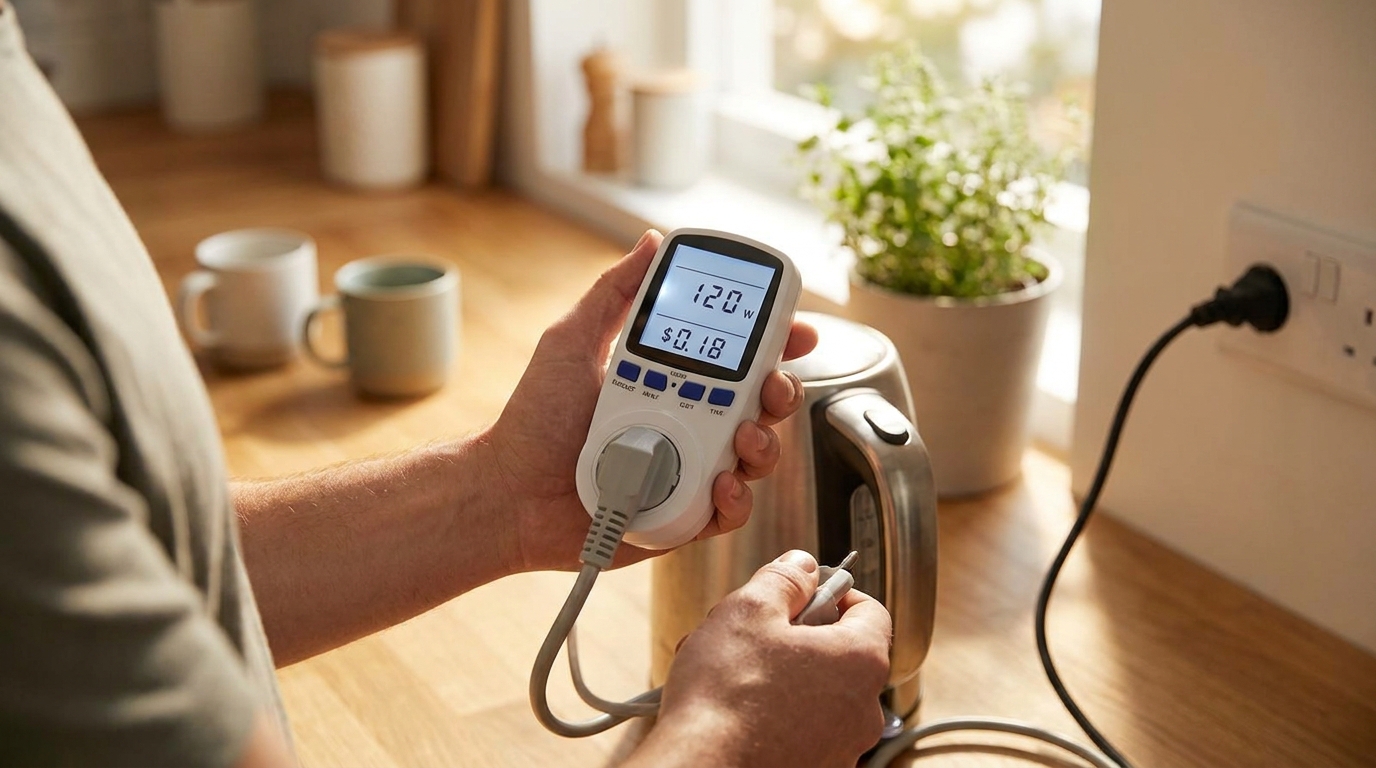
Plug-in monitors are simple, affordable, and surprisingly helpful. You plug the monitor into an outlet, then plug the appliance into the monitor. The device measures the electricity being used and may display watts, operating time, and estimated cost. This is one of the easiest ways to answer questions such as how much a portable heater costs to run, whether an old chest freezer is worth keeping, or how much power your entertainment setup draws when it appears to be off.
These tools work best for standard plug-in devices. They are less useful for built-in appliances or large 240-volt equipment, but they can still reveal a lot. They are especially good for identifying so-called vampire loads or always-on loads, meaning devices that consume power continuously even when they are not actively being used. Individually, those draws may look small. Across a full year and an entire home, they can add up.
For homeowners who are curious but not ready to invest in a whole-home system, this is often the easiest starting point. It makes energy visible in a very direct way. You plug in a device, you see the number, and suddenly a vague sense of waste becomes concrete enough to evaluate.
Whole-home monitors
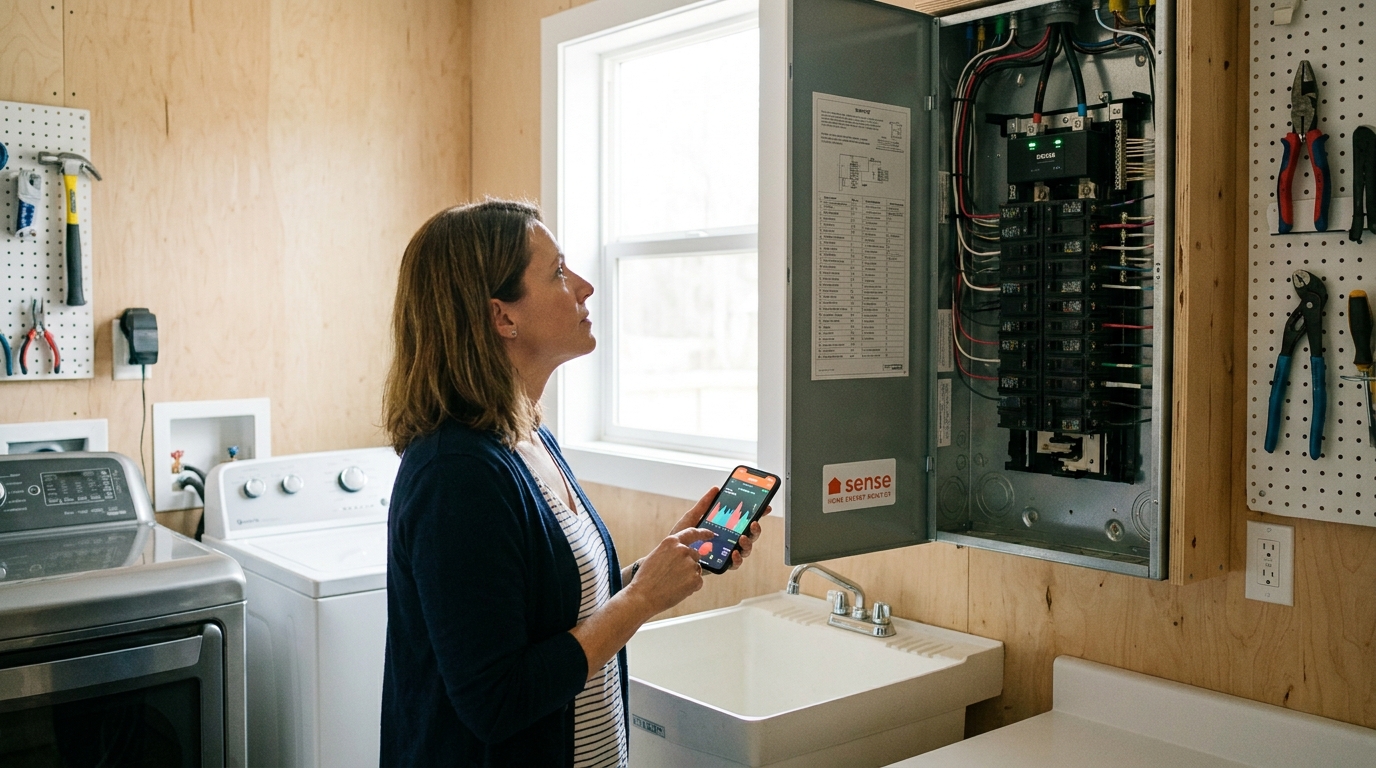
Whole-home energy monitors usually connect at the electrical panel and measure the total power entering the home. Many provide live readings, historical charts, and app-based insights. Some systems use software to estimate which appliances are operating based on their electrical signatures, while others simply show the rise and fall of overall household demand.
This kind of monitoring is valuable for seeing the rhythm of a home. You can watch what happens when the air conditioner starts, when the oven preheats, or when several loads overlap during a busy evening. It is especially useful for households trying to reduce peak demand, understand seasonal changes, or respond to time-of-use utility pricing. If you know your highest usage tends to occur between 5 p.m. and 8 p.m., you can begin shifting laundry, dishwashing, or EV charging to lower-cost hours.
Whole-home systems occupy a helpful middle ground. They are more informative than a basic smart meter but usually less complex than a fully circuit-level setup. For many homeowners, that balance is enough.
Circuit-level monitoring and smart panels
Circuit-level monitoring is where smart energy systems become especially powerful. Instead of only showing total household usage, these systems track energy by circuit, which means you can see what your water heater, heat pump, range, dryer, or home office circuits are doing over time. In some homes, that level of detail comes from add-on sensors in the electrical panel. In others, it is built into a newer smart electrical panel or broader home energy management system.
The Department of Energy has highlighted smart electrical panel based home energy management systems as a way to reduce utility bills, cut emissions, and improve resilience during outages, while enabling circuit-level monitoring and analytics. This is increasingly relevant as households adopt EV chargers, batteries, solar, and electric heating systems. Once a home has multiple large electric loads, it becomes much more useful to know not just how much electricity is being used, but when and where.
These systems can also support automation. In some cases, they can help homeowners shed nonessential loads during an outage, manage backup power more intelligently, or shift flexible loads to lower-cost periods. That is a meaningful step beyond observation. It turns monitoring into active energy management.
What smart monitoring can reveal in a real home
The most compelling reason to use smart monitoring is that it shows you things your bill cannot. A monthly total compresses countless daily decisions into one number. Monitoring opens that number back up. It shows when energy use rises, what may be driving it, and whether a change made a real difference.
One of the first patterns many homeowners notice is the always-on load. This is the baseline electricity your home uses even when no one is actively doing anything. It may include internet equipment, standby power for electronics, an older fridge in the garage, radon fans, sump pumps, security systems, or chargers left plugged in. Some of these loads are necessary. Others are simply leftovers of convenience that have quietly become permanent expenses.
Monitoring is also very useful for heating and cooling analysis. HVAC often represents one of the largest energy uses in a house, especially in regions with cold winters or hot summers. The Department of Energy says energy efficiency can save as much as 10 percent a year on heating and cooling bills simply by setting back the thermostat 7 to 10 degrees Fahrenheit, or roughly 10 percent to 15 percent, for 8 hours a day. A monitor can show whether thermostat changes are actually reducing consumption in your specific home, rather than relying on general assumptions.
Lighting offers another example. The Department of Energy states that lighting accounts for around 15 percent of an average home’s electricity use, and estimates that the average household saves about $225 per year by switching to LEDs. Smart monitoring can help validate those savings. It may not isolate every light bulb unless you have circuit-level visibility, but it can still show lower evening demand after a lighting upgrade, particularly in homes that still use older incandescent or halogen fixtures.
Appliance performance is another area where monitoring helps. A refrigerator that cycles too often, a dehumidifier running constantly in a damp basement, or a water heater with heavy standby losses can all become visible in usage patterns. Homeowners often assume these devices are working normally because they have not failed outright. Monitoring helps identify the quieter kinds of inefficiency that raise bills month after month.
Smart monitoring and lower energy bills
It is important to be honest here. Buying a monitor does not automatically lower your utility bill. Data alone does not save money. The savings come from using the information to make better choices. That may sound obvious, but it is also reassuring because it means the goal is not to become obsessed with numbers. The goal is to identify your biggest opportunities and respond in sensible ways.
Often, the first savings are behavioral. You may shift laundry to off-peak hours, lower a thermostat overnight, reduce unnecessary lighting, or stop using a second old refrigerator. Those are relatively easy adjustments. They may not feel dramatic, but when they address a recurring daily load, they can add up steadily over a year.
The next layer of savings comes from targeted upgrades. Monitoring can help you prioritize what matters most. Instead of replacing appliances based on age alone, you can focus on the ones using the most energy. Instead of assuming your insulation is the problem, you can first see whether your cooling spikes correspond to hot afternoons, poor shading, or excessive simultaneous appliance use. Monitoring does not replace a home energy audit, but it makes the audit more informed and often more effective.
That is why the Department of Energy recommends understanding your bill and using tools such as electricity usage monitors or whole-house monitoring systems to estimate which devices cost the most to run. If you know where the major costs are coming from, you are far less likely to spend time and money on improvements with limited impact.
How monitoring supports sustainability without making life complicated
For homeowners who want to reduce environmental impact, smart monitoring offers a grounded approach. It does not begin with guilt or grand gestures. It begins with awareness. When you lower unnecessary electricity use, you reduce demand on the grid and cut associated emissions. The environmental benefit is real, but it arrives through practical steps that often improve household finances at the same time.
This is one reason monitoring feels so approachable. It helps people start where they are. You do not need to renovate your entire house. You do not need solar on day one. You do not even need to be particularly technical. You only need enough information to see what is happening in your own home and decide what feels worth changing.
Monitoring is also helpful because it reinforces the principle that efficiency comes first. The Department of Energy emphasizes using energy efficiency before renewable energy because lowering home loads can reduce both utility bills and the size and cost of future renewable systems. If you are planning to install solar panels or a home battery, reducing waste first usually leads to a more balanced and cost-effective system.
The growing role of time-of-use pricing, electrification, and resilience
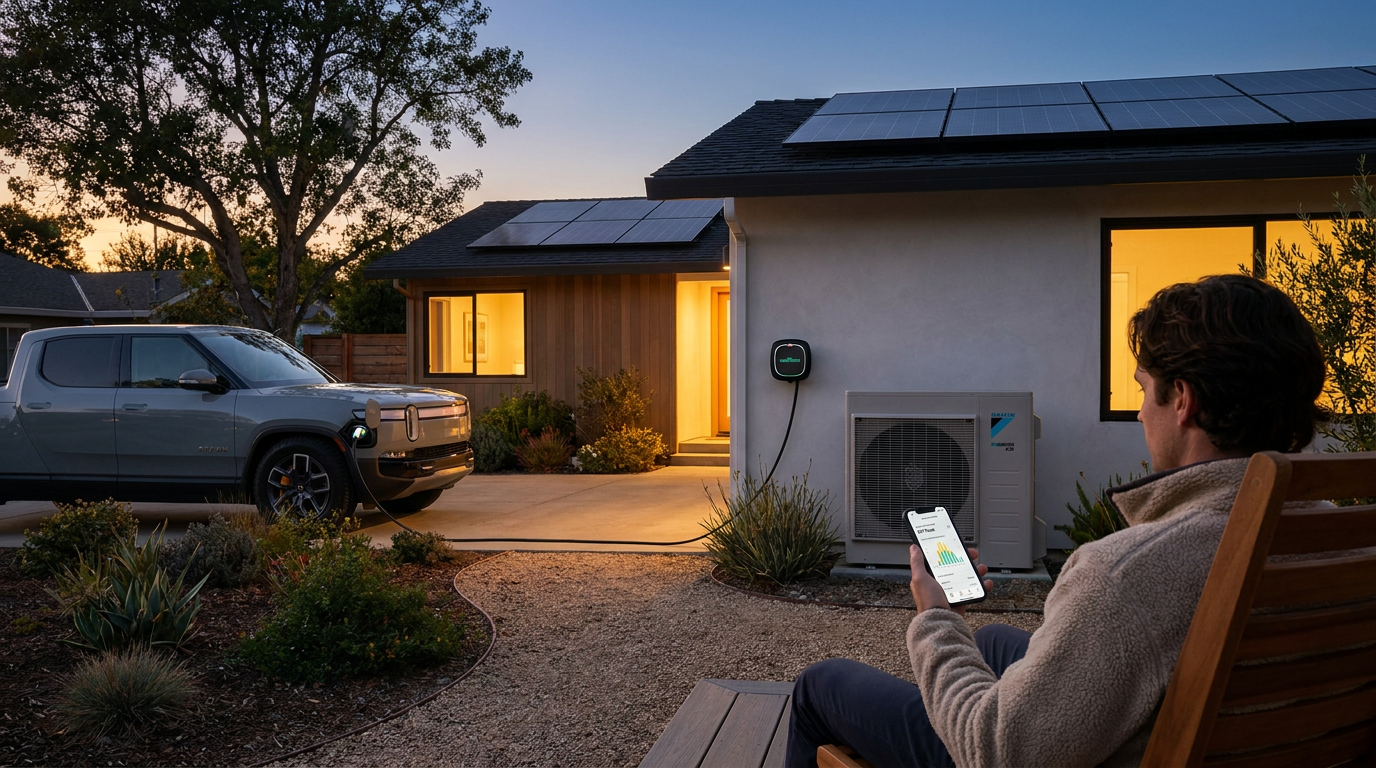
Energy monitoring becomes even more valuable as homes become more electric. Heat pumps, induction cooking, electric water heating, EV charging, battery storage, and rooftop solar can all improve household efficiency and reduce fossil fuel dependence, but they also make energy flows more dynamic. A homeowner may suddenly care not just about monthly consumption, but about what happens at 6 p.m., what happens during a grid outage, and how to coordinate multiple large electric loads without driving up costs.
This is where time-of-use pricing enters the conversation. In many areas, electricity costs more during peak periods and less during off-peak hours. A whole-home or circuit-level monitor can help you see whether major loads are clustering in the expensive part of the day. If they are, shifting EV charging to overnight hours or delaying the dishwasher until later in the evening can produce savings without reducing comfort.
The Department of Energy’s work on smart electrical panels also points to resilience benefits during extreme weather events. That is an important shift. Home energy technology is no longer just about efficiency in the narrow sense. It is also about adaptability. If a home has backup power from a battery or generator, circuit-level monitoring can help manage which loads stay on. If an outage is likely, a homeowner can understand which circuits matter most and how to extend available power.
For families investing in electrification, monitoring creates a clearer path forward. It can confirm whether a panel upgrade is necessary, reveal how often the EV charger overlaps with electric heating, and show whether a future battery would mainly offset evening peaks or support backup needs. These are expensive decisions, and better data makes them easier to stage thoughtfully rather than reactively.
Common misconceptions that are worth clearing up
One of the biggest misconceptions is that smart monitoring is only useful for highly efficient homes or for people with solar panels. In reality, it can be even more valuable in an average home with high bills, aging appliances, or inconsistent heating and cooling performance. Homes with obvious inefficiencies often have the most to gain because there is more waste to uncover.
Another common misconception is that a utility smart meter and a home energy monitor are the same thing. They are not. A smart meter generally provides utility-side whole-home usage data. A home energy monitor may offer more frequent readings, more detailed analysis, and sometimes circuit or appliance-level insight. Both can be useful, but they answer different questions.
There is also a tendency to assume that more data automatically means better outcomes. That is not always true. If a system produces pages of charts that no one in the household will ever review, it may not be especially helpful. Often, a simpler dashboard with understandable trends, alerts, and cost estimates is more effective than a technically sophisticated interface that feels overwhelming.
Finally, it is important not to overinterpret short-term results. A lower bill one month may have more to do with weather, occupancy, or travel than with a permanent improvement. Monitoring is most useful when you look for patterns over time. It helps you separate one-off fluctuations from lasting changes.
How to choose the right smart energy monitoring system for your home
The best system is the one that matches your goals, your comfort level, and your home’s electrical setup. You do not need the most advanced option to get value. You need the one that answers the questions you actually have.
If your main goal is simply to understand whether your household usage is generally rising or falling, start with your utility smart meter portal if one is available. Many homeowners overlook this free or low-cost source of information. It can show total usage trends and may be enough to identify broad seasonal patterns.
If you want to know what individual appliances cost to run, a plug-in monitor is a sensible next step. It is affordable, easy to use, and ideal for testing suspect devices one at a time. This approach works particularly well if you are worried about an old freezer, portable AC unit, space heater, or entertainment cluster.
If your household has high bills and you want a clearer picture of overall consumption, a whole-home monitor is often worth considering. It gives you immediate feedback and can reveal the timing of major loads. This is especially useful if you are on time-of-use pricing or trying to understand why certain days are much more expensive than others.
If you are planning major electrification projects, have a large house with several 240-volt loads, or want more active energy management, circuit-level monitoring or a smart panel may be the most future-ready choice. It tends to cost more and may require professional installation, but it can provide insight that simpler systems cannot.
Questions to ask before you buy
-
Do you want to track whole-home usage, individual appliances, or specific circuits such as HVAC, water heating, and EV charging?
-
Does your utility offer an app or portal already, and if so, what level of detail does it provide?
-
Are you on a time-of-use rate, or might you be in the future?
-
Are you planning upgrades such as a heat pump, solar, battery storage, or an electric vehicle charger within the next few years?
-
Do you prefer a simple app with alerts and cost estimates, or are you comfortable reviewing more detailed charts and analytics?
-
Will the system require professional installation, and is it compatible with your electrical panel and household wiring?
Practical ways to use the data once you have it
The most effective approach is to focus on the biggest patterns first. Start by looking at your baseline usage overnight or when the house is empty. If that number seems high, investigate always-on devices. Then look for major peaks. What is happening during those times, and are there any loads you can reduce, delay, or replace?
Next, test one change at a time. Adjust the thermostat schedule for a week. Replace a set of frequently used bulbs with LEDs. Stop using an old secondary fridge for a month. Compare the before and after data as carefully as possible while accounting for weather and occupancy. This kind of small experiment is far more reliable than making several changes at once and trying to guess which one mattered.
If you are considering an appliance replacement, use monitoring to build confidence in the decision. For example, if a dehumidifier or freezer is drawing far more energy than expected, you can compare its operating cost with the cost of a newer efficient model. Similarly, if your cooling demand is consistently high, monitoring can help justify sealing ductwork, improving insulation, or upgrading HVAC equipment.
Pairing smart monitoring with a home energy assessment can be especially effective. The Department of Energy notes that a home energy assessment or even a DIY audit can be paired with smart home energy management systems to monitor and control consumption. In practice, that means you are not relying on one source of information alone. You are combining data with a professional or structured look at the building itself.
A measured approach to a smarter home
Smart energy monitoring is useful precisely because it is not flashy. It does not ask homeowners to overhaul everything at once. It simply makes household energy use visible. And once waste is visible, the path forward tends to become clearer. You can decide what is worth changing now, what can wait, and where future investments will have the greatest return.
For some households, the biggest win will be catching a few hidden loads and improving thermostat habits. For others, it will be understanding whether a heat pump, EV charger, or solar installation fits the home’s real demand profile. In every case, the value comes from turning a monthly bill into practical insight.
If you have ever felt that your energy costs were too high but were not sure where to begin, smart monitoring is one of the most approachable starting points available. It respects both sustainability and practicality. It does not require you to be an expert. It only asks you to pay attention, use the information well, and let your home tell you what it needs.
That is what makes smart energy monitoring so effective. It is not about chasing perfect efficiency or filling your home with gadgets. It is about understanding the systems you already live with, reducing unnecessary waste, and making future decisions from a steadier, more informed place. For homeowners trying to lower bills and lighten environmental impact in a realistic way, that is a very good place to start.



No Comment! Be the first one.