



Cities have always been shaped by the tools available to them. Rail lines redefined metropolitan form, highways reorganized land value, and digital connectivity changed how people work, shop, and move. Artificial intelligence now represents the next major urban tool, but its value will depend less on novelty and more on how effectively it is embedded into long-term city building. An AI-driven city is not simply a place with sensors, apps, and automated systems. It is a city that uses intelligence, data, and predictive insight to make better decisions about growth, infrastructure, housing, mobility, sustainability, and public service delivery.
Table Of Content
- Why AI-Driven Cities Need a Planning Framework Before a Technology Framework
- The Urban Systems AI Must Support
- Data as Urban Infrastructure
- Land Use, Housing Supply, and AI-Assisted Growth Management
- Mobility, Access, and the Human Experience of Intelligent Cities
- Energy, Utilities, and Climate Resilience
- Governance, Trust, and Public Legitimacy
- Community Engagement in the Age of Intelligent Planning
- Institutional Capacity and the Need for Cross-Sector Alignment
- From Pilot Projects to Long-Term Urban Strategy
- What Future Urban Leaders Must Prioritize Now
- Conclusion: Intelligence Must Serve a Larger Urban Vision
That distinction matters because cities are not software products. They are complex physical environments shaped by policy, public trust, budget constraints, political cycles, infrastructure limitations, and competing social priorities. If artificial intelligence is introduced as a layer of technology without a broader development strategy, it risks becoming expensive decoration or, worse, a force that amplifies inequity and fragmentation. If it is approached strategically, however, AI can help cities become more responsive, efficient, resilient, and inclusive over the long term.
The future of AI-driven cities therefore depends on foundations. Those foundations include data governance, digital infrastructure, land use coordination, utility modernization, institutional capacity, regulatory alignment, and meaningful community engagement. They also include a clear civic vision that answers a simple but essential question: what kind of city are we trying to build? Technology can accelerate outcomes, but it cannot define them. That work still belongs to planners, public leaders, developers, infrastructure providers, and communities.
This is where strategic urban development becomes critical. The conversation about AI in cities often focuses on isolated applications such as smart traffic lights, predictive maintenance, autonomous transit, or intelligent energy systems. Those tools are useful, but they only create lasting value when they are connected to a coherent growth model. AI should support housing supply where demand is rising, guide infrastructure investment where capacity is strained, improve service delivery where residents are underserved, and strengthen environmental resilience where climate risks are intensifying. In other words, the role of AI is to help cities make better long-range choices, not merely faster short-term ones.
For cities facing population growth, affordability pressure, aging infrastructure, and climate adaptation needs, that strategic lens is no longer optional. It is central to future competitiveness and livability. The cities that succeed in the next generation will be those that treat AI as an operating system for smarter urban development while remaining grounded in human needs, public accountability, and place-based planning.
Why AI-Driven Cities Need a Planning Framework Before a Technology Framework
One of the most common mistakes in urban innovation is starting with the tool instead of the problem. A city procures a platform, installs a sensor network, launches a dashboard, or pilots a new automation technology before establishing how the investment connects to broader land use, infrastructure, and social goals. That approach can generate headlines, but it rarely produces durable city-building value. The stronger approach is to begin with planning outcomes and use AI selectively to achieve them.
For example, if a municipality is struggling with housing shortages, long approval timelines, and infrastructure coordination, the strategic question is not whether AI should be adopted in the abstract. The real question is how AI can support faster scenario testing, better site selection, infrastructure sequencing, and more informed approvals without undermining transparency. Similarly, if congestion is increasing, the city must first define the mobility outcome it wants, whether that means faster bus service, safer active transportation routes, more efficient freight movement, or reduced peak demand. AI then becomes a means of implementing the chosen strategy.
This planning-first framework is especially important because cities operate across long time horizons. Roads, sewers, substations, transit corridors, and neighborhoods are built to last decades. The wrong decision can lock in inefficiency for a generation. AI can help cities analyze those choices more effectively, but it can also create dependency on systems that are poorly aligned with civic priorities if governance is weak. Strategic planning ensures that technology adoption is tied to physical development patterns, public value, and long-term flexibility.
The smartest city is not the one with the most technology. It is the one that uses intelligence to make better long-term decisions about land, infrastructure, and people.
A mature AI urban strategy should therefore be built around a planning framework with several core questions. What growth pressures are shaping the city? Where are infrastructure bottlenecks limiting development? Which communities are currently underserved? What environmental and climate risks must be addressed? How will technology improve accountability rather than obscure it? These questions anchor AI in real urban priorities and prevent innovation from drifting into a disconnected side project.
The Urban Systems AI Must Support
AI-driven cities are often discussed as if they are singular entities, but cities are actually collections of interconnected systems. Land use, transportation, energy, water, housing, public health, emergency services, waste management, and environmental management all influence one another. A strategic AI framework recognizes that value emerges not from optimizing one system in isolation, but from understanding how systems interact across geography and time.
Consider housing growth. New residential development depends on more than zoning entitlement. It requires transportation access, school capacity, utility servicing, flood management, public space, and often job accessibility. AI can assist with forecasting demand, identifying infrastructure constraints, modeling development feasibility, and sequencing capital investment. Yet if those tools are not integrated across departments, a city can still approve growth where systems are not ready to support it. AI only becomes transformative when it helps align multiple layers of decision making.
The same principle applies to transportation. Adaptive traffic management may improve vehicle flow, but a city focused solely on car movement could undermine transit priority, pedestrian safety, or climate goals. AI should therefore support a larger mobility strategy that balances mode share, accessibility, safety, emissions reduction, and economic productivity. In practice, this means feeding multiple objectives into urban models rather than using a single metric as the measure of success.
Urban sustainability also depends on system integration. Buildings consume energy, stormwater affects transportation corridors, tree canopy influences heat exposure, and land use density shapes emissions patterns. AI can help cities understand these interactions at a scale and speed that traditional methods often cannot. It can identify where retrofits will have the greatest impact, where cooling infrastructure is most urgent, where distributed energy resources should be prioritized, and where urban form is driving unnecessary infrastructure costs.

Data as Urban Infrastructure
If roads, pipes, and power grids are the physical foundations of city growth, data is becoming a parallel form of infrastructure. AI systems depend on reliable, timely, interoperable data to generate insight and support decision making. Without that base, even the most sophisticated algorithms will produce limited or distorted results. For this reason, municipalities planning for AI-driven urban development need to think of data architecture as a strategic public asset.
That starts with data quality. Many cities still operate with fragmented systems, inconsistent standards, outdated records, and departmental silos. Planning data may not align with utility data. Building permit records may not integrate smoothly with transportation models. Real-time sensor feeds may exist but remain disconnected from policy workflows. The result is an urban intelligence gap in which decision makers have plenty of information but limited operational clarity.
Closing that gap requires investment in structured data governance. Cities need common standards, clear stewardship responsibilities, interoperable platforms, and protocols for privacy and security. They also need to decide what should be collected, how often it should be updated, and how it will be used in policy and development decisions. A strong data strategy is not glamorous, but it is the foundation that enables AI to perform responsibly and effectively.
There is also a land value dimension to this issue. Better data can improve certainty in development markets by clarifying constraints, servicing capacity, approvals pathways, and future capital priorities. That can reduce risk, speed decision cycles, and support more rational investment in housing and mixed-use growth. In fast-changing urban regions, clarity is itself an economic asset. Developers, infrastructure agencies, and municipalities all benefit when the intelligence behind urban growth is stronger and more transparent.
At the same time, cities must be careful not to treat data extraction as progress in itself. More information is not automatically better if communities do not understand how it is being used or if it reinforces unequal surveillance across neighborhoods. Data must serve public value. That means cities need governance models that define ownership, consent, access, accountability, and redress. AI-driven cities will earn trust not by collecting the most data, but by using it responsibly and visibly in service of better outcomes.
Land Use, Housing Supply, and AI-Assisted Growth Management
Perhaps the most important long-term test for AI-driven cities is whether they help address the structural challenge of housing supply. Many urban regions are experiencing rising demand, constrained land, lengthy approvals, infrastructure shortfalls, and policy friction. These pressures are not caused by a lack of technology, but better intelligence can help cities navigate them with greater speed and precision. AI has the potential to improve growth management by supporting scenario planning, policy analysis, land suitability assessment, and infrastructure coordination.
For planners, one of the most valuable applications is predictive land use analysis. AI can synthesize parcel characteristics, zoning permissions, market signals, servicing capacity, transit access, environmental constraints, and demographic trends to identify where growth can be accommodated most effectively. This does not replace planning judgment. Instead, it allows public and private actors to see patterns, tradeoffs, and timing issues more clearly. That is especially useful in regions where every major housing decision has implications for affordability, mobility, and infrastructure cost.
AI can also support development approvals by reducing repetitive administrative tasks, flagging inconsistencies, and helping staff model policy impacts more quickly. In theory, that can shorten timelines and improve predictability. But implementation matters. If municipalities automate processes without clear rules and public transparency, they risk creating systems that feel opaque to applicants and residents alike. The opportunity is not simply to digitize the status quo, but to redesign approvals around clarity, consistency, and evidence-based decision making.
Long-term housing strategy also depends on infrastructure timing. A site may appear suitable for growth on paper but remain effectively frozen if water, wastewater, power, or transportation upgrades are not sequenced properly. AI can help align capital planning with development pipelines by forecasting service demand and identifying where bottlenecks will emerge. For fast-growing cities, this is critical. Housing targets mean little if the infrastructure delivery model cannot support them.
There is another strategic advantage here. AI-assisted growth management can help cities shift from reactive to proactive planning. Instead of waiting for pressure to appear project by project, municipalities can identify where intensification should be encouraged, where public investment should be accelerated, and where policy reform is needed before constraints become acute. That kind of foresight is exactly what future urban development requires.
Mobility, Access, and the Human Experience of Intelligent Cities
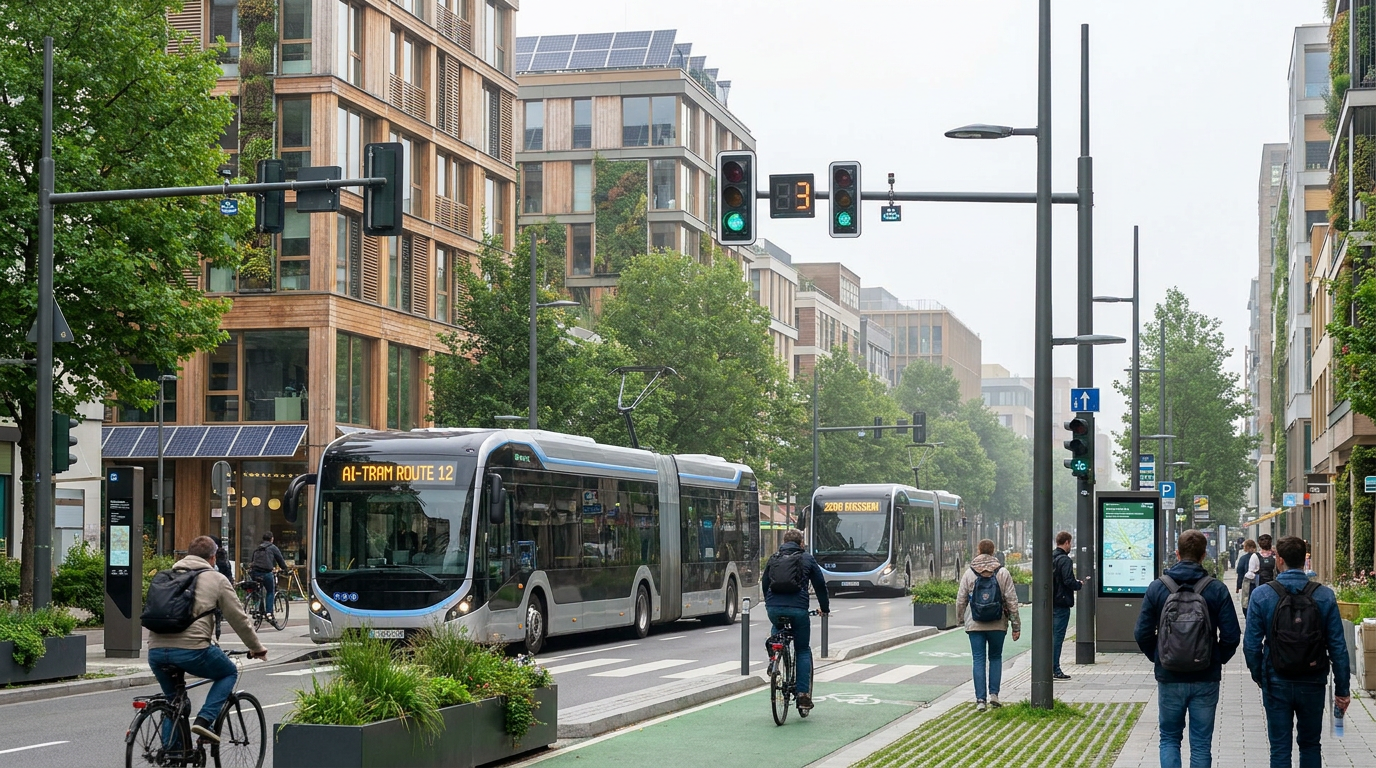
Transportation is one of the most visible areas where AI can influence urban life. Real-time traffic management, predictive transit scheduling, curbside optimization, dynamic pricing, fleet electrification, and route planning all offer operational benefits. Yet the strategic question is larger than traffic efficiency. Mobility systems shape access to jobs, housing, education, healthcare, and public space. In that sense, transportation is not only a technical system but also a social and economic one.
AI-driven mobility should therefore be measured by how well it improves access, not just movement. A city where buses arrive more reliably, intersections are safer, and services adjust dynamically to neighborhood needs is materially different from a city that simply moves vehicles faster through major corridors. The former supports opportunity and quality of life. The latter may produce narrower benefits while entrenching existing inequities.
For suburbanizing and intensifying regions, AI can be especially valuable in coordinating multimodal networks. Transit ridership patterns can be analyzed in relation to land use changes. Micro-mobility systems can be linked to station access. Freight flows can be timed to reduce conflicts with peak commuter demand. Emergency response routes can be optimized during severe weather or infrastructure disruptions. These are not isolated gains. They influence productivity, emissions, public safety, and development attractiveness.
Still, technology should remain nearly invisible in the best urban environments. Residents do not need to feel that they are living inside a machine. They need streets that are safer, transit that is more dependable, and neighborhoods that are easier to navigate. The goal of AI in mobility is to improve the lived experience of the city while preserving the human scale of public life.
Energy, Utilities, and Climate Resilience
No discussion of AI-driven cities is complete without addressing utilities and environmental resilience. Urban growth depends on systems that most residents rarely see directly, including electricity distribution, water networks, wastewater treatment, stormwater management, district energy, and waste recovery. As cities intensify and climate risks increase, these systems face pressure from both demand and volatility. AI can help operators manage complexity, but the real value lies in making infrastructure more adaptive, efficient, and resilient over time.
On the energy side, AI can support demand forecasting, distributed generation integration, building performance optimization, and outage response. As electrification accelerates through electric vehicles, heat pumps, and cleaner building systems, grid planning becomes more complicated. Cities and utilities will need better intelligence to understand where loads are rising, where capacity upgrades are needed, and how local generation and storage can reduce stress on the system. These are development questions as much as technical ones because energy capacity increasingly influences what can be built, where, and how quickly.
Water and stormwater systems are equally important. More intense rainfall, aging assets, and urban hardscaping create flood risks that can damage property, disrupt mobility, and constrain development potential. AI can improve monitoring, predict system stress, and support targeted intervention. When integrated with land use planning, this can guide where growth should be limited, where green infrastructure should be prioritized, and where capital upgrades can unlock new capacity safely.
Climate resilience also requires better urban environmental intelligence. Heat vulnerability, air quality exposure, ecological fragmentation, and wildfire smoke events are increasingly relevant in many regions. AI can map risk with more precision and help target responses such as cooling corridors, tree planting, retrofits, public health interventions, and emergency preparedness. But cities must remember that resilience is not a dashboard output. It is a physical and social condition shaped by planning decisions, investment discipline, and community capacity.
The strongest AI-driven cities will use technology to reinforce sustainable development rather than compensate for weak urban form. Compact growth patterns, transit-oriented development, high-performance buildings, and well-maintained public infrastructure remain essential. AI can sharpen those strategies and make them more adaptive, but it cannot substitute for them.
Governance, Trust, and Public Legitimacy
Every conversation about AI in urban development eventually arrives at governance, and rightly so. Cities are public institutions with legal obligations, democratic accountability, and a duty to balance efficiency with fairness. If AI systems influence planning decisions, service allocation, inspections, emergency response, or enforcement priorities, residents need confidence that those systems are transparent, lawful, and reviewable. Without that legitimacy, even useful technology can face resistance.
Governance begins with clarity of purpose. Municipalities should define where AI is being used, what decisions it informs, what data it relies on, and what human oversight exists. They should also establish rules for procurement, testing, auditing, privacy protection, cybersecurity, and bias mitigation. These are not technical side notes. They are central to whether AI can be trusted in a civic setting.
Bias is a particularly important issue in urban contexts because cities contain long histories of uneven investment, exclusionary policy, and infrastructure disparity. If AI models are trained on biased historical patterns, they can replicate or even intensify those outcomes. A predictive model that identifies where violations occur, where transit demand is strongest, or where investment is most productive may simply reinforce patterns created by past neglect or unequal access. That is why governance cannot be separated from social policy and planning ethics.
Public legitimacy also depends on explainability. Residents do not need to understand every technical detail, but they should be able to understand the logic of systems that affect their neighborhoods and opportunities. If AI is helping shape development approvals, prioritize capital upgrades, or manage public services, cities should communicate the principles clearly and provide channels for challenge and review. Trust grows when systems are visible, accountable, and open to scrutiny.
In city building, legitimacy is infrastructure. Without it, even well-designed systems can fail to scale or endure.
Community Engagement in the Age of Intelligent Planning
Strategic urban development has always depended on public engagement, but AI raises the stakes. If cities use advanced analytics to understand growth, predict behavior, or target interventions, they must also deepen their commitment to community participation. The challenge is not merely to inform residents after decisions are largely shaped. It is to involve them early enough that local knowledge and lived experience influence how intelligence is used in the first place.
Community engagement is especially important because data alone does not capture the full meaning of place. An algorithm may identify an underused parcel near transit as an ideal site for intensification, but residents may understand the social function of that site in ways the model cannot see. A system may optimize service deployment based on measured demand, yet overlook barriers faced by residents who are underrepresented in digital data streams. Human context remains essential.
Done well, AI can actually improve engagement. Interactive visualizations, scenario tools, and accessible simulations can help communities understand the implications of different planning choices more clearly than static reports often do. Residents can compare tradeoffs related to density, mobility, public space, school capacity, environmental impact, and infrastructure cost. That creates the possibility of a more informed civic conversation. But the technology must be designed to empower people, not overwhelm them.
There is also an inclusion challenge. Not all residents have equal digital access, technical literacy, or trust in institutions. Cities must avoid creating engagement models that privilege already-connected voices while excluding others. Multilingual outreach, in-person forums, analog participation options, and partnerships with local organizations remain vital. AI should enhance the reach and quality of engagement, not narrow it.
Ultimately, community engagement in AI-driven cities is about co-authorship. Residents should not feel that the future of their neighborhood is being generated somewhere behind a screen. They should feel that technology is helping make the planning process more informed, more transparent, and more responsive to collective priorities.
Institutional Capacity and the Need for Cross-Sector Alignment
One of the less visible but most decisive factors in AI-driven urban development is institutional capacity. Technology does not implement itself. Cities need staff who understand planning, infrastructure, procurement, analytics, privacy, public communication, and change management. They also need operating structures that allow departments to work together rather than protect separate data silos and mandates. Without that capacity, even strong tools can underperform.
This is particularly relevant because urban development decisions cut across public and private boundaries. Municipal governments control zoning and many approvals. Utility providers manage servicing networks. Transit agencies shape accessibility. Developers assess feasibility and build projects. Technology firms offer platforms and analytics. Community organizations surface local priorities and risks. If these actors are not aligned around common objectives, AI adoption can become fragmented and inefficient.
A practical strategy is to treat AI urban deployment as a cross-sector governance project rather than a software rollout. Cities should create integrated leadership structures that connect planning, engineering, housing, transportation, IT, legal, and communications functions. They should establish shared performance metrics tied to real outcomes such as housing delivery, permit timelines, transit reliability, energy efficiency, resilience, and service equity. This moves AI from experimentation into institutional practice.
Capacity building also means knowing when not to automate. Some decisions benefit from stronger data support while still requiring intensive professional judgment or political deliberation. Others can be streamlined safely through well-designed digital workflows. The maturity of an AI-driven city is reflected in its discernment. Not every urban problem should be handed to an algorithm, and not every legacy process deserves to remain untouched.

From Pilot Projects to Long-Term Urban Strategy
Many cities begin their AI journey with pilot projects, and that is understandable. Small-scale experiments reduce risk, build familiarity, and demonstrate value. But there is a danger in becoming trapped in perpetual piloting. A city can accumulate a portfolio of disconnected smart initiatives without ever establishing a durable operating model for growth and governance. To build real value, municipalities need a pathway from experimentation to long-term strategy.
That pathway starts by evaluating pilots against strategic outcomes, not just technical performance. Did the project improve decision quality, reduce service gaps, support housing delivery, increase resilience, or strengthen public trust? Could it scale across departments or geographies? What governance and infrastructure changes would be needed for broader deployment? These questions help separate meaningful innovations from short-lived demonstrations.
Cities should also develop phased road maps. In the near term, the focus may be on data integration, digital service modernization, and high-value operational use cases. In the medium term, AI can be more deeply embedded into planning, infrastructure sequencing, and resource allocation. Over the long term, mature cities may operate with integrated urban intelligence systems that support dynamic decision making across multiple networks while maintaining strong public oversight.
Importantly, long-term strategy should be tied to capital planning. AI is most powerful when it influences where cities spend money, how they sequence infrastructure, and how they shape development patterns. If it remains detached from budgeting and asset management, it will struggle to affect the physical form and functioning of the city. Strategic integration means linking intelligence to investment.
What Future Urban Leaders Must Prioritize Now
The next decade will be decisive for cities navigating growth, affordability, decarbonization, infrastructure renewal, and technological disruption. AI can help address each of these pressures, but only if leaders act with clarity and discipline. The cities that create long-term advantage will not be those that chase every new platform. They will be the ones that make focused investments in systems, governance, and public trust.
Several priorities stand out. Cities need integrated data foundations that support planning, approvals, utilities, and service delivery. They need land use strategies that connect AI to housing supply and infrastructure readiness. They need governance frameworks that protect privacy, reduce bias, and preserve accountability. They need public engagement models that make intelligent planning more understandable and participatory. And they need institutions capable of managing cross-sector complexity over time.
- Start with urban outcomes such as housing, mobility, resilience, and service equity rather than technology procurement.
- Build data infrastructure that is interoperable, secure, and aligned with public value.
- Connect AI to physical development through land use, utilities, transportation, and capital planning.
- Design for trust with transparent governance, oversight, and community participation.
- Scale deliberately by moving from pilots to integrated long-term operating models.
These priorities are not abstract. They determine whether AI strengthens the civic fabric or fragments it. They also influence land value, development certainty, investment efficiency, and quality of life. In high-growth regions especially, the question is not whether intelligence will shape urban development. It already is. The question is whether that intelligence will be governed strategically enough to produce better cities.
Conclusion: Intelligence Must Serve a Larger Urban Vision
The promise of AI-driven cities is real, but it is often misunderstood. The real opportunity is not to make cities feel futuristic. It is to make them work better. Better for residents seeking housing they can afford. Better for workers trying to move efficiently across the region. Better for municipalities managing aging infrastructure under fiscal pressure. Better for communities facing heat, flooding, and environmental risk. Better for long-term investment decisions that will shape urban form for generations.
That kind of progress requires more than digital tools. It requires strategic intent. Cities must know what they value, what they want to grow, what they need to protect, and where they are willing to reform old systems. AI can accelerate insight, improve coordination, and reveal patterns that were previously hard to see. But it cannot replace civic judgment, public legitimacy, or the discipline of good planning.
In the end, the foundations of an AI-driven city look remarkably familiar. Strong infrastructure. Clear governance. Housing capacity. Efficient mobility. Environmental resilience. Informed communities. Institutional competence. What changes is the level of intelligence cities can bring to those tasks. If urban leaders keep that perspective, artificial intelligence can become a powerful ally in building cities that are not only smarter, but also more livable, equitable, and prepared for the future.


No Comment! Be the first one.