



The global housing crisis has moved far beyond the boundaries of a conventional real estate discussion. It is now one of the defining urban development challenges of our time, shaping how cities grow, how economies perform, and how communities either prosper or fragment. Housing affects where people can live, how far they commute, how much of their income they can retain, and whether they can participate fully in education, employment, and civic life. When housing fails, cities become less productive, less inclusive, and less resilient.
Table Of Content
- The Housing Crisis Is Global, Structural, and Intensifying
- What Is Driving the Global Housing Crisis?
- Supply Has Failed to Keep Up With Need
- Land Use Regulation Often Constrains Growth
- Higher Costs and Financing Constraints Are Slowing Delivery
- Demographic and Economic Shifts Are Reshaping Demand
- Why the Housing Crisis Matters for Urban Development
- Misconceptions That Hold Back Better Policy
- What Successful Housing Strategies Have in Common
- Canada’s Evolving Approach Offers Useful Lessons
- Innovative Approaches Gaining Momentum Worldwide
- Transit Oriented Development
- Missing Middle and Gentle Density
- Modular and Industrialized Construction
- Public Land, Land Banking, and Community Stewardship
- The Role of Non Market and Mixed Income Housing
- Climate Resilience and Housing Affordability Must Be Pursued Together
- A Practical Framework for Moving Forward
- Five Strategic Priorities for Policymakers and City Builders
- The Path Forward Is About Systems Change
That is why the housing conversation must be reframed. This is not simply about prices rising too quickly or rents becoming harder to manage, though both are real and urgent symptoms. At a deeper level, the crisis reflects structural weaknesses in land use systems, infrastructure planning, public finance, housing delivery, and political decision making. It exposes a persistent mismatch between where growth is occurring and where homes are permitted, financed, and built.
UN-Habitat has made the scale of the challenge unmistakably clear. Up to 3.4 billion people globally lack secure, safe, and adequate housing, while more than 1 billion people live in informal settlements and slums. The global housing deficit increased from 251 million units in 2010 to 288 million in 2023, and the world is estimated to need about 96,000 new affordable and accessible homes every day by 2030. Those numbers place housing at the center of development policy, not at the margins.
For policymakers, developers, and the public, the key question is no longer whether there is a housing crisis. The question is how to respond strategically. The most effective path forward will not come from one ideology, one subsidy, or one housing type. It will come from a coordinated approach that expands supply, reforms regulation, uses land more intelligently, protects affordability over time, and aligns housing with infrastructure, transit, and climate resilience.
Housing is not only shelter. It is economic infrastructure, social infrastructure, and civic infrastructure. Cities that treat it as such are better positioned to grow sustainably.
The Housing Crisis Is Global, Structural, and Intensifying
Across regions, housing stress presents itself differently, but the underlying pattern is consistent. In some places, the crisis takes the form of informal settlements, overcrowding, and basic inadequacy. In others, it appears as soaring rents, exclusionary homeownership costs, homelessness, or the displacement of middle income households from high opportunity neighborhoods. These outcomes differ in appearance, yet they are connected by the same core problem: cities are not producing enough of the right housing in the right places at the right price points.
The urban development lens matters because housing shortages are not isolated from the broader systems that shape city growth. Housing is tied to labor markets, transportation networks, utility capacity, environmental performance, and public service delivery. If a metropolitan region adds jobs faster than homes, workers must either pay more, accept lower quality housing, or move farther away. If transit investment is not matched by zoning reform and residential intensification, public infrastructure underperforms while affordability worsens.
UN-Habitat also estimates that financing needs for adequate and affordable housing amount to roughly USD 3 to 4 trillion annually through 2030, excluding maintenance and upgrades. That figure underscores another important point. The crisis is not only about approvals and construction capacity. It is also about capital allocation, risk sharing, and whether financial systems support long term affordability rather than simply reward scarcity and asset inflation.
Many countries are now confronting the same reality at once. Population growth, migration, urbanization, construction cost escalation, labor shortages, and higher borrowing costs are all colliding with outdated planning frameworks. The result is a housing system that reacts too slowly to demand and often produces homes that are misaligned with household incomes, family structures, and mobility patterns.
What Is Driving the Global Housing Crisis?
Supply Has Failed to Keep Up With Need
The most direct cause of housing unaffordability is persistent undersupply. In many cities, homebuilding has lagged population growth for years or even decades. This gap does not emerge overnight. It develops through low density zoning in high demand areas, lengthy approvals, land assembly challenges, neighborhood opposition, fragmented governance, and infrastructure shortfalls that limit where growth can occur. By the time prices signal shortage, the system is already years behind.
Canada offers a clear example of this problem. CMHC estimates that restoring affordability to 2019 levels would require approximately 430,000 to 480,000 new housing units annually over the next decade, roughly double the current pace. That is not a marginal adjustment. It is a signal that affordability deterioration has been cumulative and structural. It also illustrates how difficult it is to recover once supply deficits become embedded in the urban system.
Shortages are also about composition, not just totals. A city can add units and still fail to address housing need if most new supply is concentrated in a narrow segment of the market. Luxury units, investor oriented product, or housing in auto dependent peripheral locations may not meaningfully improve affordability for lower and middle income households. What matters is whether cities are enabling a broad spectrum of housing, including rental, family sized units, supportive housing, social housing, missing middle formats, and transit oriented density.

Land Use Regulation Often Constrains Growth
Land policy sits at the heart of the housing crisis. In many urban areas, large portions of residential land are restricted to detached housing even where demand, infrastructure, and transit access would support greater intensity. This artificially limits the supply of buildable opportunities and inflates land values for the few sites where multifamily development is permitted. The result is a city that grows by exception instead of by plan.
Lengthy approvals further compound the problem. Time is a cost in development, and uncertainty is a cost multiplier. Projects delayed by years become more vulnerable to inflation, financing risk, and changing market conditions. Smaller builders are often pushed out first because they cannot absorb prolonged entitlement timelines. That reduces competition and limits the diversity of projects delivered.
Exclusionary planning practices also shape who gets access to opportunity. When high amenity neighborhoods near transit, jobs, and strong schools permit little new housing, access to those places becomes rationed by income. This is one of the clearest ways housing policy influences inequality. The map of housing permissions often becomes a map of economic exclusion.
Higher Costs and Financing Constraints Are Slowing Delivery
Even where there is political support for new housing, delivery has become more difficult. Rising interest rates have increased borrowing costs for both homebuyers and builders. CMHC reports that higher interest rates have slowed housing starts in Canada while rental demand has remained elevated, keeping vacancies tight in many markets. This creates a difficult cycle: affordability worsens as projects become harder to finance, even though the need for supply becomes more urgent.
Construction costs have also risen sharply in many regions due to materials inflation, supply chain disruptions, skilled labor shortages, and stricter performance requirements. None of these issues are reasons to lower standards around safety or resilience. They are reminders that productivity in housing delivery must improve. If every project is custom built through slow and fragmented processes, cities will continue to struggle to produce enough homes at scale.
Capital is also unevenly distributed. It often flows most easily to products with the clearest return profile, which may not include deeply affordable rental, supportive housing, or non-market projects. Without public financing tools, land contributions, tax incentives, guarantees, and mission driven ownership models, the homes that are most needed can remain the hardest to build.
Demographic and Economic Shifts Are Reshaping Demand
The demand side of the equation is changing quickly. Urban migration, immigration, smaller household sizes, aging populations, and delayed homeownership are all influencing the kinds of housing cities need. In many metropolitan areas, demand for rental housing has increased significantly, yet policy frameworks remain better aligned with ownership models developed in an earlier era. This disconnect is especially visible in cities where vacancy rates are persistently low and renters face intense competition for limited supply.
At the same time, housing costs are consuming a growing share of household income. OECD analysis for Canada found housing related spending absorbed 19.3 percent of median disposable income in 2022. That pressure is not limited to the poorest households. It increasingly affects essential workers, young families, newcomers, and even moderate income professionals. A society cannot remain economically dynamic if a widening share of its workforce is priced out of stable housing near jobs and services.
Why the Housing Crisis Matters for Urban Development
Housing shortages produce consequences far beyond the housing sector itself. They alter urban form, increase infrastructure inefficiency, and weaken social cohesion. When workers are forced to live farther from employment centers, commute distances rise, congestion worsens, and household transportation costs increase. That in turn makes transit harder to operate efficiently because land use and mobility are no longer aligned.
Unaffordable housing can also undermine regional competitiveness. Employers depend on access to labor, and labor depends on access to housing. If a city becomes too expensive for nurses, teachers, tradespeople, service workers, and early career professionals, business growth slows and public services become harder to sustain. The housing crisis is therefore not only a social issue. It is an economic development issue with direct implications for productivity and investment.
There are also public health implications. Overcrowding, unstable tenure, substandard conditions, and long commutes can all contribute to stress, illness, and reduced educational attainment. The World Bank and UN-Habitat have both emphasized that housing is deeply connected to employment, health, education, and resilience. Good housing supports human capability. Poor housing erodes it over time.
Then there is the issue of climate adaptation. Housing located far from transit and services tends to increase emissions through car dependency. Housing built without attention to heat resilience, energy performance, and flood risk can expose households to greater environmental harm and higher utility costs. In a warming world, housing policy and climate policy cannot be separated. They must be designed together.
Misconceptions That Hold Back Better Policy
One of the greatest obstacles to progress is the persistence of simplified narratives. The first misconception is that the housing crisis is only about homelessness. Homelessness is the sharpest and most visible manifestation of failure, but millions of households experience housing insecurity while remaining employed and housed in a technical sense. They may be overcrowded, cost burdened, precariously rented, or living in poor quality units that undermine health and stability.
A second misconception is that building more housing automatically solves affordability in every context. Supply expansion is essential, but it is not enough on its own. Location, tenure, income targeting, and long term affordability protections matter. A city that produces only expensive units in disconnected locations may add inventory without addressing the needs of lower and middle income households.
A third misconception is that any single policy can solve the crisis. Rent regulation can protect existing tenants, but it does not create new homes by itself. Demand side subsidies can help households access housing, but they may inflate prices if supply remains constrained. Market delivery is important, but luxury production alone will not reliably meet the needs of vulnerable populations. The crisis is too complex for one tool. Effective systems rely on a portfolio of coordinated interventions.
What Successful Housing Strategies Have in Common
International experience suggests that the strongest housing systems share a common strategic logic. They treat land as a public policy question, approvals as a delivery challenge, affordability as a long term stewardship issue, and housing mix as a city building priority. They do not rely exclusively on market production or exclusively on public subsidy. Instead, they build frameworks where public and private actors can each play defined roles.
UN-Habitat’s guidance on affordable land and housing in Europe and North America points to several mechanisms that consistently appear in more effective jurisdictions. These include inclusionary zoning, land banking, community land trusts, better use of public land, and mixed income development. What these approaches have in common is that they intervene upstream. Rather than trying to repair affordability only after land values have escalated, they shape the conditions of delivery from the beginning.
Successful systems also move with speed and predictability. Developers, non-profit providers, and public agencies all respond better when the rules are clear, entitlement risk is lower, and financing pathways are aligned with policy objectives. Fast approvals do not mean weak planning. They mean competent planning that establishes expectations in advance and reduces avoidable delays.
Canada’s Evolving Approach Offers Useful Lessons
Canada’s housing challenge is often discussed through the lens of affordability, but it is equally a governance and delivery issue. CMHC reports that the National Housing Strategy is a 10 year plus federal plan exceeding $115 billion, complemented by Canada’s Housing Plan and programs such as the Housing Accelerator Fund, Apartment Construction Loan Program, Federal Lands Initiative, and Rapid Housing Initiative. Collectively, these tools reflect an important shift in thinking. Governments are no longer treating housing solely as a local planning matter. They are using financing, incentives, and public land to influence supply and affordability outcomes more directly.
The Housing Accelerator Fund is particularly notable because it recognizes how much delay and scarcity originate at the municipal level. By linking federal support to local reforms such as faster approvals, zoning modernization, and density near transit, the program attempts to change the operating environment for housing delivery. This is an example of strategic alignment across orders of government, which is essential in countries where land use authority is dispersed.
The Apartment Construction Loan Program addresses another critical issue: purpose built rental often requires different capital structures than condominium development. If cities want more stable rental supply, they need financing tools that reflect rental economics. That principle applies globally. Housing systems produce what they finance, and if financing disproportionately favors certain product types, the market will follow.
The Rapid Housing Initiative and supportive housing programs highlight a further lesson. Emergency needs require emergency tools. Not every part of the crisis can wait for long cycle planning reform. Some households need immediate intervention through acquisition, adaptive reuse, modular delivery, or direct public development. The strategic challenge is to pair those near term responses with deeper structural reforms so that emergency measures do not become the entire policy agenda.
Innovative Approaches Gaining Momentum Worldwide
Transit Oriented Development
One of the most powerful strategies available to growing cities is to align housing with transit. Transit oriented development allows more people to live near jobs, education, and services while reducing dependence on private vehicles. It improves the financial performance of transit systems, lowers household transportation costs, and supports more efficient infrastructure use. When done well, it also creates walkable, mixed use neighborhoods that are more adaptable over time.
However, transit oriented development is not simply about placing towers beside stations. It is about planning complete communities with varied housing types, public realm quality, and affordability measures. If new transit corridors only generate high end product, they may reinforce exclusion instead of broadening access. The best examples combine density with inclusionary housing, public amenities, and mechanisms that preserve affordability over the long term.
Missing Middle and Gentle Density
Many cities suffer from a polarized housing landscape in which detached homes dominate low rise neighborhoods while high rise towers are concentrated on a limited set of corridors. Missing middle housing can help bridge that gap. Duplexes, fourplexes, townhouses, laneway homes, courtyard apartments, and small multiplexes offer relatively moderate density that can fit established neighborhoods while expanding choice.
This form of housing matters strategically because it uses urban land more efficiently without requiring every site to become a major redevelopment. It can also support intergenerational living, aging in place, and a wider range of price points. In cities where large areas remain locked into low density zoning, missing middle reform can unlock significant supply over time while distributing growth more equitably.
Modular and Industrialized Construction
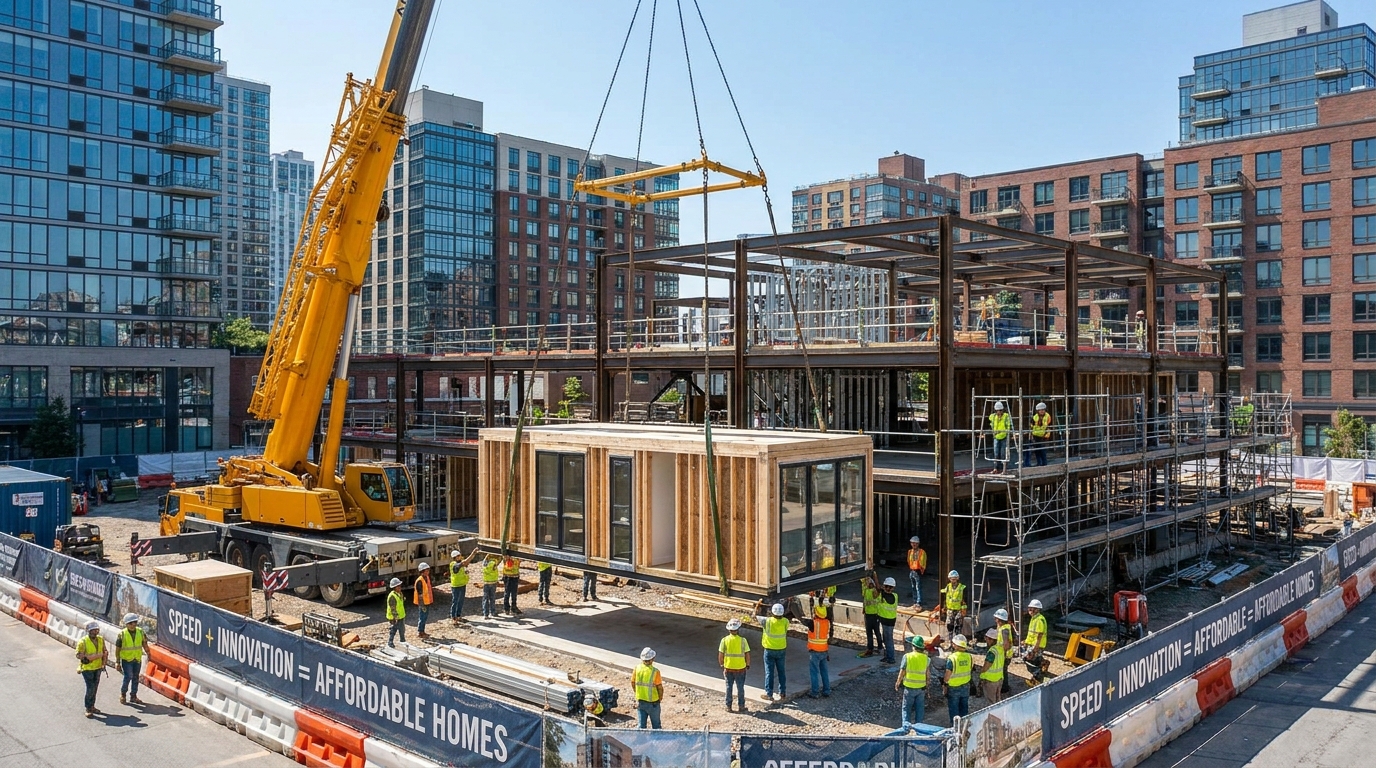
CMHC’s innovation work has pointed to modular housing, 3D printed components, and passive house design as promising tools to improve speed, labor productivity, and energy performance. Industrialized construction is not a universal solution, but it can help address one of the industry’s most persistent weaknesses: fragmented and slow delivery. By shifting more work into controlled manufacturing environments, builders can reduce weather delays, improve quality control, and compress project timelines.
For supportive housing, student housing, workforce housing, and other repeatable typologies, modular methods may be particularly effective. They are most powerful when paired with standardized approvals, predictable procurement, and public sector willingness to support demonstration and scale. Innovation in construction should be judged not by novelty alone, but by whether it improves delivery at the volume and price points cities actually need.
Public Land, Land Banking, and Community Stewardship
Land is often the single largest input in housing cost, especially in high demand urban regions. That is why public land strategies are so important. When governments identify underused sites near transit, employment, and services, they can shape outcomes that the market may not deliver independently. Public land can support mixed income housing, non-profit housing, supportive housing, and family oriented rental in locations that would otherwise be financially inaccessible.
Land banking extends this logic by allowing public or mission driven actors to acquire sites in advance of development pressure. This can preserve future options and reduce speculative escalation. Community land trusts provide another long term mechanism by separating land ownership from building occupancy, helping preserve affordability across generations rather than only at the point of initial delivery.
The Role of Non Market and Mixed Income Housing
A serious housing strategy cannot rely solely on market rate production. Some households will never be adequately served by market dynamics alone, particularly those with very low incomes, complex needs, or insecure employment. Non market housing, including social housing, co operative housing, supportive housing, and deeply affordable rental, is not a side program. It is a core component of a complete housing system.
Mixed income development offers a practical way to integrate affordability within broader urban growth. It can support social inclusion, reduce concentration of poverty, and create more resilient neighborhood economics. But mixed income models must be carefully designed. Affordability terms need to be meaningful, lasting, and responsive to local income realities. Short affordability periods or shallow discounts may satisfy targets on paper while failing to deliver lasting access.
This is where inclusionary zoning can play a constructive role, particularly in strong markets. By requiring or incentivizing affordable units within new development, cities can capture a portion of land value uplift for public benefit. Yet inclusionary policy works best when calibrated to local economics and paired with other enabling tools such as density, fee relief, or expedited approvals. Good policy design matters because the goal is to increase delivery, not suppress it.
Climate Resilience and Housing Affordability Must Be Pursued Together
A false tradeoff often appears in housing debates: the idea that cities must choose between affordability and sustainability. In reality, the two objectives are increasingly intertwined. Energy efficient buildings reduce utility burdens. Compact urban form reduces transportation costs and emissions. Heat resilient design protects vulnerable residents during extreme weather. Well located infill housing reduces the pressure to sprawl into environmentally sensitive areas or distant greenfield locations that create long term infrastructure liabilities.
The stronger strategic view is that climate resilient housing is part of affordability, especially over the life cycle of a building. A cheap home in a flood prone or transit poor location can become expensive in every way that matters. Cities should therefore align housing targets with energy performance, district infrastructure planning, cooling strategies, and adaptation investments. Long term affordability depends not only on upfront rent or mortgage cost, but on operating cost, mobility cost, and exposure to climate risk.
A Practical Framework for Moving Forward
If governments and development partners want durable progress, they need a framework that operates across time horizons. Short term measures should focus on emergency shelter expansion, homelessness reduction, rental assistance where needed, eviction prevention, acquisition of existing buildings at risk, and rapid delivery of supportive housing. These interventions protect people from immediate harm and stabilize the most vulnerable households.
Medium term action should prioritize zoning reform, approvals modernization, rental finance tools, public land activation, and infrastructure coordination. This is where much of the hidden friction in housing systems can be reduced. Cities need predictable entitlement pathways for transit oriented density, missing middle housing, and rental development. They also need data systems that track approvals, starts, completions, vacancies, and affordability outcomes with greater transparency.
Long term strategy must go deeper still. It should address the underlying political economy of land, the stewardship of non market housing, the integration of housing and climate planning, and the institutional capacity required to deliver at scale. Housing policy needs continuity beyond election cycles. Developers, non-profits, lenders, and communities all make better decisions when they can rely on stable rules and credible long term direction.
Five Strategic Priorities for Policymakers and City Builders
-
Legalize more housing in high opportunity areas. This includes missing middle formats, mid rise housing on transit corridors, and multifamily development near jobs and services. The objective is not growth for its own sake, but access to opportunity and better use of existing infrastructure.
-
Reduce approval times and increase certainty. Faster, clearer processes can lower project risk and support both private and non-profit delivery. Predictability is one of the most underappreciated affordability tools in the housing system.
-
Expand non market and supportive housing. A complete housing system requires dedicated pathways for households whose needs cannot be met through market delivery alone. This is essential for inclusion, public health, and homelessness prevention.
-
Use public land and public finance strategically. Public assets should be leveraged where they can create long term affordability, not simply disposed of for short term revenue. Housing policy becomes more effective when land, financing, and planning work together.
-
Align housing growth with transit and climate resilience. The right homes in the right places can improve affordability, reduce emissions, and strengthen urban productivity at the same time. These goals are mutually reinforcing when planned coherently.
The Path Forward Is About Systems Change
The global housing crisis did not emerge because cities forgot how to build. It emerged because too many urban systems became misaligned with the realities of contemporary growth. Demand accelerated while permissions remained constrained. Land values rose while public capture mechanisms stayed weak. Financing favored some forms of housing while leaving others chronically underserved. Communities needed complete neighborhoods while planning remained fragmented across silos.
The encouraging news is that this is a solvable problem, but only if it is addressed at the scale and seriousness it deserves. There are already strong examples of governments using accelerators, public land, rental financing, inclusionary policies, and non market delivery to change outcomes. There are also emerging innovations in modular construction, passive house design, adaptive reuse, and data driven approvals. The challenge now is to move from isolated initiatives to integrated systems.
For the public, the essential insight is that housing policy is city policy. It shapes whether growth is inclusive or exclusionary, whether climate goals are realistic or rhetorical, and whether prosperity is broadly shared or spatially concentrated. For policymakers, the implication is that incrementalism is no longer enough. The scale of need requires reforms that are structurally meaningful, politically durable, and operationally credible.
For developers and urban leaders, there is a strategic opportunity in this moment. The future of housing will belong to jurisdictions that can combine speed with quality, density with livability, and affordability with long term resilience. Building more matters. Building better matters just as much. The true solution to the housing crisis is not merely more units, but a better urban development model that allows cities to grow in ways that are equitable, productive, and sustainable for decades to come.



No Comment! Be the first one.