



The phrase AI-driven cities used to sound distant, abstract, and a little theatrical. It often belonged to concept videos full of glowing roads, silent vehicles, and buildings that seemed to think for themselves. By 2026, the real story looks different. AI is not arriving as an all-powerful urban brain. It is being threaded into very specific parts of city life, where it can improve routing, forecasting, maintenance, energy use, accessibility, and service delivery if it is governed well and measured carefully.
Table Of Content
- From Smart City Vision to Operational Urban Systems
- Urban Mobility Will Be the Most Visible Change
- Why Accessibility Makes Mobility a Priority
- Public Services Will Become More Predictive and Personalized
- Infrastructure Maintenance Will Quietly Improve Daily Life
- Sustainability Gains Are Real, but So Are AI’s Resource Costs
- Digital Twins and the Rise of the Urban Intelligence Layer
- Governance Will Decide Whether Cities Gain Trust or Lose It
- Cybersecurity and Privacy Are Not Optional Conditions
- What Residents Will Actually Notice by 2026
- Common Misconceptions About AI-Driven Cities
- What the Best AI-Driven Cities Will Do Next
- The 2026 Outlook: Smarter Cities, Narrower Claims, Higher Standards
- Key Signals to Watch in 2026
- Final Takeaway
That distinction matters because the most credible transformation in urban living is not a total reinvention of the city. It is a steady shift from manual, reactive systems to more adaptive, data-assisted ones. Traffic signals can respond to real conditions instead of fixed schedules. Transit agencies can anticipate vehicle failures before they disrupt service. Municipal departments can target inspections more intelligently. Residents can receive more useful public information in real time, and in more accessible formats. These are not glamorous changes on the surface, but they affect daily life in immediate ways.
There is also a larger structural reason this topic matters now. Cities are under pressure from housing costs, climate risk, aging infrastructure, service backlogs, and growing expectations from residents who want faster, clearer, and more equitable public services. AI is attractive because it promises to help municipal governments do more with limited resources. Yet the cities most likely to benefit are not the ones that deploy the most software. They are the ones that combine technology with standards, procurement discipline, public accountability, cybersecurity, and inclusive design.
In Canada and across North America, the strongest near-term impacts by 2026 are expected in transportation, accessibility, infrastructure maintenance, energy management, and public-service delivery. This aligns with how Transport Canada, Statistics Canada, the OECD, and NIST frame current smart-city development. The shift is practical. AI is becoming an intelligence layer on top of urban systems, not a substitute for human decision-making. The cities that get this right will likely feel more navigable, more responsive, and more sustainable. The cities that get it wrong may simply become more complex, less transparent, and harder for some residents to use.
From Smart City Vision to Operational Urban Systems
For more than a decade, cities have experimented with sensors, connected street furniture, mobility apps, and digital dashboards. Many of those early efforts were fragmented. One department ran a pilot for parking. Another tested air-quality sensors. Another considered connected transit shelters. The result was often a patchwork of technology that looked innovative but did not fundamentally change how the city operated. By 2026, the emphasis is shifting from experimentation to integration.
This is one reason Canada’s broader innovation history around cities matters. The federal Smart Cities Challenge was backed by $300 million over 11 years and designed to help communities use innovation, data, and connected technology to improve residents’ lives. That framing now feels especially relevant because municipalities have moved beyond asking whether they should use digital tools at all. They are asking where AI delivers measurable value, how to govern it, and which systems are mature enough to scale responsibly.
International policy also supports this practical direction. The OECD increasingly describes smart cities as places that use digital technologies to improve well-being, inclusion, sustainability, and public services. That wording is important because it moves the conversation away from technology for its own sake. AI is useful only when it improves outcomes people can actually feel, such as shorter wait times, safer infrastructure, cleaner air, easier navigation, and better access to services.
NIST’s work is equally instructive because it emphasizes standards, reproducible evaluation, cybersecurity, and measurement science. In other words, a city cannot simply claim it is smarter because it bought a platform. It needs a way to test whether a forecasting model really improves bus reliability, whether an inspection algorithm reduces risk, and whether a digital service works equally well for different groups of residents. By 2026, that evaluation mindset is likely to be one of the defining features of serious AI-driven cities.
Urban Mobility Will Be the Most Visible Change
If one area will make AI-driven cities feel different in daily life, it is transportation. Mobility is where data volumes are large, operational decisions are constant, and small improvements can affect millions of trips. In 2025, Canada’s urban transit agencies provided 1.55 billion passenger trips. That scale makes transit one of the clearest environments for AI optimization. A tiny gain in scheduling, dispatching, maintenance, or disruption management can ripple across an enormous number of journeys.
Transport Canada’s reporting points directly to autonomous, connected, and automated systems, smart transportation systems, and accessibility-enhancing innovation as relevant trends. The immediate 2026 transformation is not a city full of fully autonomous vehicles. It is more likely to be a city where buses are dispatched more intelligently, traffic lights are timed dynamically, curb space is managed with more precision, and service alerts are more personalized and timely. AI helps because urban mobility is a forecasting problem at heart. Cities need to estimate demand, predict disruption, and respond in near real time.
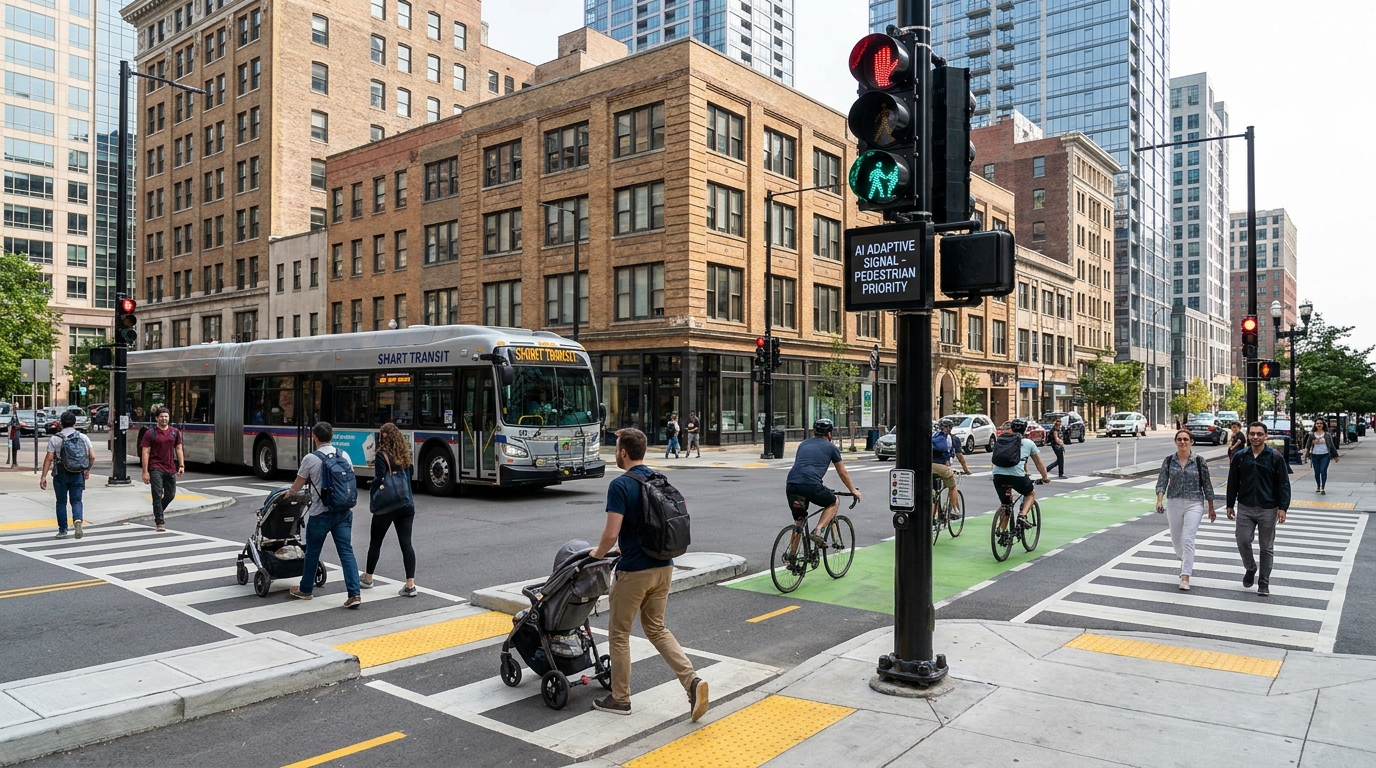
Consider traffic signal timing. Traditional systems often run on fixed sequences calibrated from old traffic studies or limited historical assumptions. AI-assisted traffic management can use current traffic flow, pedestrian demand, transit priority signals, weather patterns, and event data to adjust intersections more responsively. That can reduce idle time, smooth congestion, and improve travel time reliability for drivers and transit vehicles alike. For residents, the result is not dramatic in cinematic terms, but it is deeply practical. Commutes become less erratic, buses bunch less often, and streets can be managed with more nuance.
The same principle applies to public transit. An AI-enabled operations system can detect recurring delay patterns, identify route segments that are sensitive to weather or construction, and suggest dispatch adjustments before delays escalate. It can also improve communication with riders by translating raw operational data into useful alerts. A rider does not need to know that a signal priority system failed or that a bus operator shortage changed fleet allocation. They need to know whether the next vehicle will arrive, whether another route is faster, and whether the system can still accommodate their trip.
Why Accessibility Makes Mobility a Priority
Accessibility may be the most compelling reason AI in urban transportation matters. Statistics Canada’s 2025 accessibility data show a striking gap: 48.9% of persons with disabilities reported that their transportation needs were met, while 47.3% reported unmet transportation needs. That is not a marginal issue. It suggests that nearly half of residents in this group still encounter significant barriers moving through the city.
AI can help close that gap, but only if cities design for inclusion from the beginning. Accessible urban mobility is not just about adding a chatbot to a transit app. It includes better wayfinding, more reliable elevator outage alerts, paratransit scheduling that reflects actual rider needs, multilingual trip support for newcomers, real-time disruption messaging in multiple formats, and routing that accounts for curb cuts, incline, weather exposure, and transfer complexity. For older adults and residents with disabilities, the quality of this information can determine whether a trip feels possible at all.
There is another important layer here. Statistics Canada’s 2025 transit-access release found that 96.5% of the population in census metropolitan and census agglomeration areas lived within the modeled transit coverage area, while 83.3% of Canada’s total population did. Coverage does not equal usability. A stop may exist nearby, but if service is inconsistent, boarding information is unclear, the transfer path is inaccessible, or disruption alerts are missing, the formal presence of transit does not translate into functional access. AI’s real value is in improving the reliability and usability of existing systems, not simply expanding the amount of data around them.
Still, accessibility gains are not automatic. If a city assumes every rider owns a smartphone, can read a dense map interface, and is comfortable sharing personal data, it will exclude many residents. The strongest 2026 models will pair digital services with non-digital alternatives, such as voice lines, station displays, human support, and accessible physical design. AI can improve the intelligence of the network, but it cannot compensate for poor inclusion choices.
Public Services Will Become More Predictive and Personalized
Beyond mobility, AI-driven cities will increasingly change how residents interact with public services. Historically, many municipal services have been reactive. A resident reports a missed waste pickup, a pothole, a broken streetlight, or a drainage problem, and the city responds when staff capacity allows. AI creates the possibility of shifting some of those services toward prediction, prioritization, and more targeted intervention.
Waste collection is a good example. Instead of using static collection schedules across neighborhoods with very different demand patterns, cities can use route optimization and fill-level forecasting to dispatch resources more efficiently. That can reduce fuel use, labor inefficiencies, and overflowing bins. For residents, the visible impact is cleaner public space and fewer service inconsistencies. For municipal budgets, it can mean fewer wasted vehicle hours and better use of equipment.
Emergency response is another area where AI can assist without replacing professional judgment. Predictive models can identify locations with repeated collision risk, flooding vulnerability, or infrastructure failure patterns. Dispatch systems can improve how calls are triaged and routed. Weather-linked forecasting can help cities stage equipment before storms rather than after damage is already widespread. None of this removes the need for human expertise. It simply gives emergency teams a better information base from which to act.
Resident-facing services may also become more navigable. Many people struggle to understand which department handles a specific issue, how to apply for a permit, or where to find updates on a case. AI-assisted digital interfaces can make city services easier to search, translate, and personalize. A resident may be guided to the right form more quickly, receive clearer status updates, or get information in a language and format that is easier to use. These improvements sound modest, but together they can materially reduce friction between citizens and municipal systems.

Infrastructure Maintenance Will Quietly Improve Daily Life
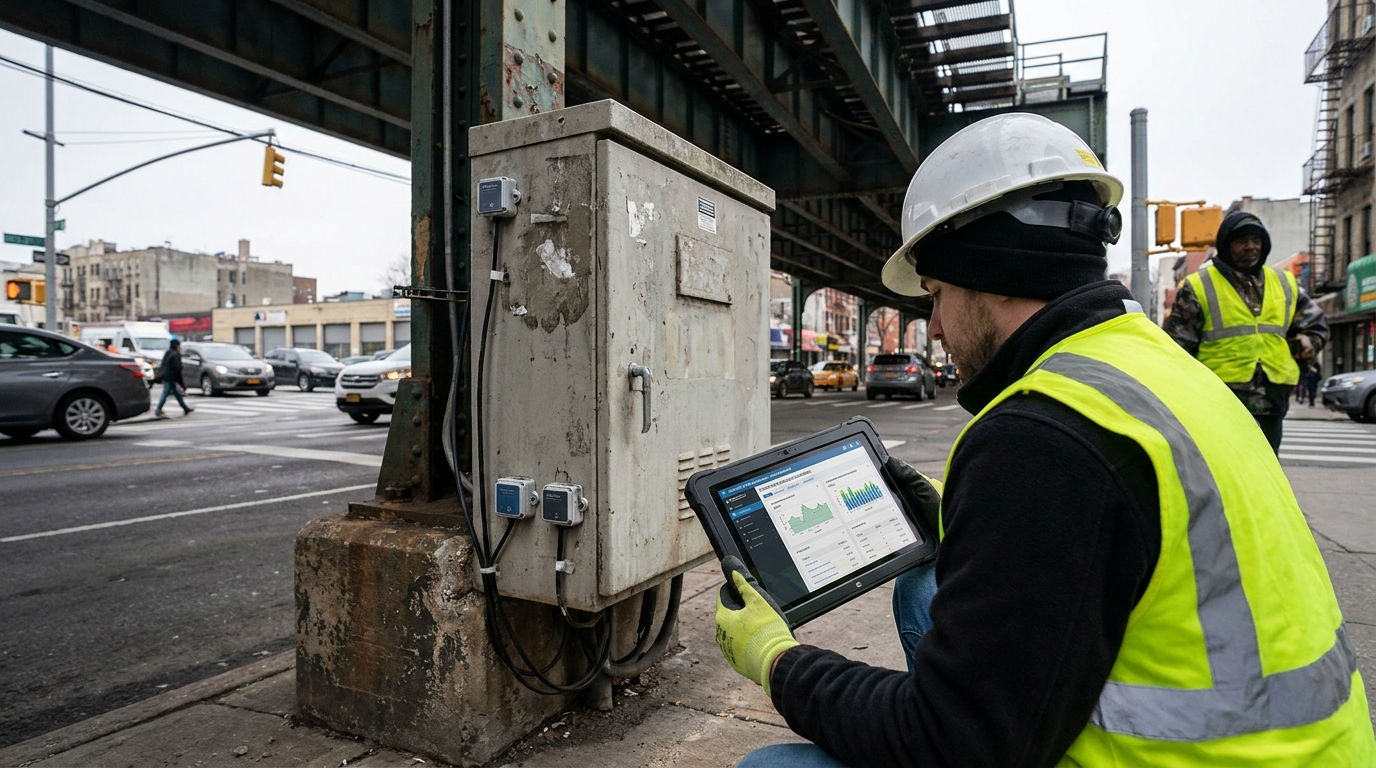
One of the least visible but most valuable transformations in AI-driven cities will happen in infrastructure maintenance. Roads, bridges, water systems, transit fleets, streetlights, and public buildings are expensive to inspect and repair. Many municipal systems are old, budget constrained, and maintained on schedules that are either too late or too blunt. AI can help cities move toward predictive maintenance, where assets are monitored continuously or scored by risk so that interventions happen before failure becomes disruptive or dangerous.
For transit agencies, predictive maintenance can identify wear patterns in vehicles, tracks, signals, or station equipment before breakdowns occur. This matters because reliability is often decided by small failures that cascade. A door issue, an overheated component, or a signal fault can create delays across a network. If AI helps maintenance teams focus on assets most likely to fail, it improves rider experience while also making better use of limited capital and labor.
The same logic applies to roads and utilities. AI models can combine inspection records, sensor data, weather history, traffic loads, and previous repair patterns to estimate which assets need attention first. This is especially useful when cities face large maintenance backlogs. Instead of treating every pothole or pipe segment with equal urgency, they can prioritize where failure would cause the greatest safety risk, disruption, or long-term cost.
For residents, this may show up as fewer unexpected closures, faster repairs, safer structures, and less emergency digging. The benefit is not just convenience. Better maintenance strategy can extend asset life and reduce resource waste. That makes predictive maintenance one of the clearest examples of AI improving both service quality and sustainability at the same time.
Sustainability Gains Are Real, but So Are AI’s Resource Costs
Much of the appeal around AI-driven cities is tied to sustainability. Cities consume large amounts of energy and produce significant emissions and waste. The OECD has repeatedly emphasized that urban systems such as transport, buildings, utilities, and waste management are central to sustainability outcomes. If AI improves traffic flow, transit reliability, building efficiency, and utility operations, the environmental gains can be meaningful because cities operate at large scale.
Smarter traffic management can reduce idling and stop-and-go congestion. Better transit reliability can encourage mode shift away from private vehicles. AI-assisted building controls can adjust heating, cooling, and lighting more precisely. Utilities can use forecasting to reduce losses, better match supply and demand, and identify leaks or anomalies earlier. These are all plausible and increasingly practical benefits for 2026.
But there is a tension that serious coverage of this topic cannot ignore. Canadian federal reporting has linked AI and digital infrastructure with rising energy and water demand, especially through data centers. That means AI is not inherently sustainable. It can lower emissions in one part of the city while increasing electricity and water consumption in another. If municipalities promote AI solely as a green solution without accounting for its operational footprint, they risk oversimplifying the tradeoff.
The most responsible urban strategy is to think in systems. If a city deploys AI for transit optimization, building operations, and service delivery, it should also ask where the computing workloads run, how efficient those facilities are, what procurement standards apply, and whether environmental gains are being measured net of digital infrastructure costs. By 2026, the best-performing cities will likely be those that pair urban AI deployment with disciplined energy planning and transparent reporting.
Digital Twins and the Rise of the Urban Intelligence Layer
One concept gaining traction is the digital twin, a virtual representation of physical urban systems that can be used for simulation, monitoring, and planning. In practice, this can mean a city uses integrated data from roads, utilities, buildings, weather feeds, and transit operations to model how a neighborhood or network behaves under different conditions. AI adds forecasting and anomaly detection to that picture, helping officials test scenarios before implementing costly changes.
For example, a city might simulate how a new bus lane changes intersection delay, pedestrian crossing time, and nearby curb demand. It could estimate how heat waves affect electricity use across districts or how stormwater infrastructure performs during intense rainfall. These models are not crystal balls, and they are only as useful as the data and assumptions behind them. Still, by 2026, digital twins are likely to become a more practical part of urban operations, especially where agencies want a stronger evidence base for infrastructure decisions.
This is why it is useful to think of AI as an urban intelligence layer. It sits above physical assets and service networks, helping cities interpret patterns, test scenarios, and allocate resources more precisely. It does not replace infrastructure. It makes infrastructure more legible.
Governance Will Decide Whether Cities Gain Trust or Lose It
Technology alone will not determine whether AI-driven cities improve urban life. Governance will. This is becoming much clearer in North America, where municipal and federal institutions are paying closer attention to responsible use, accountability, and security. Toronto’s 2026 economic implementation update notes that the city has formalized AI governance to support responsible use of AI. That matters because local governments are beginning to acknowledge that city systems cannot simply absorb AI tools without rules about how they are selected, tested, monitored, and explained.
Governance is not a side issue. It shapes whether residents trust the systems affecting their movements, service access, and data. If an AI model influences transit scheduling, service eligibility, infrastructure inspection priority, or public communication, people need to know the goals of the system and the safeguards around it. They also need channels for review when automated recommendations produce poor results. A city that cannot explain its tools will struggle to maintain legitimacy, even if those tools are technically impressive.
NIST’s emphasis on standards and evaluation points toward a practical path. Cities need clear metrics before and after deployment. They need procurement frameworks that require vendor transparency. They need testing environments where models can be stress-checked for error, drift, and unequal impact. They need records of who is accountable when a tool fails. AI in the public sector is not just a software purchase. It is an operational and ethical commitment.
There is also a workforce dimension. Municipal staff need training not only to operate AI-assisted systems but to question them. A healthy AI-driven city is one where planners, engineers, operations staff, and service managers can interpret model outputs critically rather than treating them as objective truth. Human judgment remains central, especially in settings where tradeoffs involve safety, equity, and public money.
The most realistic future for AI-driven cities is not autonomous government. It is human-governed systems using AI to make narrow urban decisions faster, more measurable, and more responsive.
Cybersecurity and Privacy Are Not Optional Conditions
As cities become more connected, the attack surface expands. Sensors, cameras, control systems, digital service portals, and cloud-based analytics all create dependencies that can be exploited if they are poorly secured. Canada’s national-security guidance on smart cities warns that smart-city systems can be compromised and that data collection itself creates security considerations. This is not theoretical. A failure in a connected urban system can disrupt transport, expose sensitive information, or undermine trust in public infrastructure.
Privacy concerns are equally significant. AI systems often work best when they have more data, but public institutions cannot assume that more collection is always justified. If a city monitors movement patterns, transit usage, service requests, or accessibility needs, it must be clear about why the data is collected, how long it is retained, who can access it, and how risks are minimized. Residents should not have to trade basic privacy for usable public services.
These issues matter especially in accessibility contexts. A city may want to personalize services for seniors or residents with disabilities, but personalization can involve sensitive data. If safeguards are weak, a tool designed to increase inclusion can create new forms of vulnerability. The challenge for 2026 is to build systems that are helpful without becoming invasive. That often means collecting only what is necessary, anonymizing wherever possible, and preserving non-digital alternatives for those who prefer them.
The cities best positioned to lead will treat cybersecurity and privacy as infrastructure requirements, not as compliance boxes. If AI becomes part of traffic management, utility control, transit operations, and citizen services, then digital resilience becomes as fundamental as physical resilience.
What Residents Will Actually Notice by 2026
The most meaningful urban changes are often not the most dramatic. Residents are unlikely to wake up in 2026 and feel that they now live in a science fiction city. What they may notice instead is that parts of urban life feel less wasteful and less uncertain. Their commute may become more reliable. Service updates may arrive sooner and in clearer language. Broken infrastructure may be fixed before it becomes dangerous. Public buildings may use energy more efficiently without sacrificing comfort.
Parents may notice school-zone traffic moving more safely at peak times. Older adults may find it easier to book accessible transport or receive route information in formats they can actually use. Transit riders may experience fewer unexplained delays because maintenance teams intervened earlier. City residents may see fewer overflowing waste bins or prolonged streetlight outages because operations teams can prioritize better.
Some of the most important changes will happen behind the scenes. Better demand forecasting can improve budget allocation. Better infrastructure data can reduce emergency repair costs. Better operations analytics can reveal where services consistently fail vulnerable communities. AI does not need to be visible to be transformative. In fact, the strongest urban systems are often the ones residents barely think about because they function more reliably.
At the same time, residents may become more aware of city technology through questions about surveillance, data sharing, and fairness. Public trust will depend on whether cities communicate clearly about what is being used, why it is being used, and how outcomes are assessed. An invisible intelligence layer is only beneficial if it remains accountable to the public it serves.
Common Misconceptions About AI-Driven Cities
One of the biggest misconceptions is that AI-driven cities are equivalent to fully autonomous cities. They are not. Urban governance still depends on human institutions, political choices, budgets, regulation, and public input. AI assists with routing, forecasting, monitoring, and maintenance, but it does not replace the role of planners, operators, engineers, or elected officials. Any city claiming otherwise is likely overselling what current systems can do.
Another misconception is that smart-city technology automatically improves equity. It does not. A beautifully designed mobility app means little if some residents lack smartphones, language access, data plans, digital literacy, or confidence using such tools. A model trained on incomplete or biased data can misread demand or underserve the very groups it claims to help. Equity requires inclusive design, representative data, and constant feedback from affected communities.
A third misconception is that AI is automatically sustainable. The gains from reduced congestion, better building controls, and smarter utilities can be real, but they do not erase the energy and water demands of digital infrastructure. Sustainability needs to be measured honestly across the full system. A city cannot claim environmental progress simply because it has more software.
Finally, there is a tendency to believe that more data naturally leads to better decisions. In practice, data without governance can create confusion, overconfidence, and procurement waste. Better outcomes depend on standards, accountability, outcome measurement, and the ability to stop or redesign systems that do not perform as promised.
What the Best AI-Driven Cities Will Do Next
By 2026, the leading cities will likely share a few core habits. First, they will focus on specific, high-value use cases rather than broad AI branding. Transportation, maintenance, accessibility, building operations, and service routing are practical domains because success can be measured. Second, they will build governance into deployment from the start instead of treating it as an afterthought. Third, they will evaluate systems with clear performance indicators and publish results where possible.
They will also invest in interoperability and open standards. Cities rarely operate through a single platform. Transit, utilities, roads, emergency services, and planning departments all have different systems and vendors. If those systems cannot share data responsibly, the promise of integrated urban intelligence weakens quickly. Interoperability is not glamorous, but it is often what separates durable infrastructure from isolated pilot projects.
Another marker of strong implementation will be community involvement. Cities that test accessibility features with residents, publish plain-language explanations of AI use, and maintain offline service channels will build more resilient and inclusive systems. Public-sector AI works best when it is iterative. It should learn not only from data but from real users who can identify where the model’s assumptions break down.
Finally, the best cities will remain humble about what AI can and cannot solve. No algorithm can substitute for affordable housing policy, good land-use planning, or long-term capital investment. AI can improve the intelligence of operations, but it cannot eliminate hard political tradeoffs. The cities that benefit most will be the ones that understand AI as a capability enhancer within a broader urban strategy.
The 2026 Outlook: Smarter Cities, Narrower Claims, Higher Standards
The most believable forecast for 2026 is not that AI will reinvent the city all at once. It is that AI will become embedded in targeted urban functions where the value case is strongest and the outcomes are measurable. Transportation will lead because the scale is huge and the data is rich. Accessibility will become a more central test of whether urban technology serves everyone. Infrastructure maintenance will become more predictive. Public services will become easier to navigate. Energy and utility systems will become more adaptive, even as cities confront the environmental cost of the digital infrastructure supporting them.
What changes the character of urban living is not that AI becomes everywhere, but that urban systems become more responsive in ways people can feel. The resident experience of the city is shaped by thousands of small interactions: how long a bus takes, whether an elevator works, whether a crossing feels safe, whether a permit process is clear, whether a service outage is communicated honestly. AI can improve those moments by helping cities allocate attention with greater precision.
Still, the winners in this transition will not be the cities with the loudest technology messaging. They will be the cities that adopt tighter rules, stronger governance, better measurement, and more inclusive design. In that sense, the future of AI-driven cities is less about machine autonomy and more about institutional maturity. The intelligence layer matters, but the public system around it matters more.
That is why 2026 looks like an inflection point. The conversation is moving past hype and into operations. Cities are no longer just asking what AI could do. They are asking what it should do, where it delivers measurable benefit, and how to deploy it without compromising trust, access, or sustainability. For urban residents, that is good news. The most transformative cities of the near future are likely to be the ones that feel not futuristic, but simply better run.
Key Signals to Watch in 2026
-
Transit reliability metrics will reveal whether AI is improving dispatch, scheduling, and maintenance in measurable ways across large systems.
-
Accessibility outcomes will matter more than app launches, especially for residents with disabilities, older adults, and newcomers navigating city services.
-
Formal AI governance frameworks at the municipal level will become a stronger indicator of readiness than isolated pilot announcements.
-
Energy and water reporting tied to digital infrastructure will show whether cities are addressing AI’s environmental footprint honestly.
-
Cybersecurity posture and procurement discipline will increasingly determine whether AI systems can scale safely across critical urban functions.
Final Takeaway
AI-driven cities by 2026 will not be defined by spectacle. They will be defined by whether they help people move more easily, access services more fairly, and live in urban environments that are more efficient without becoming less accountable. Canada’s current research and policy signals point to a future where transportation, accessibility, infrastructure maintenance, and sustainability sit at the center of this shift. The opportunity is real, but so are the constraints.
If there is one principle worth keeping in view, it is this: the success of AI in cities will depend less on the intelligence of the tools than on the intelligence of the institutions using them. That is the real urban transformation to watch in 2026.


No Comment! Be the first one.