


Smart housing developments are often discussed as if they begin and end with app-controlled lighting, keyless entry, or a smart speaker on a kitchen counter. That framing is too narrow and, for developers, not especially useful. The real strategic value of smart housing lies in how technology can improve building performance, support operational efficiency, enhance resident experience, reduce environmental impact, and protect long term asset value. In a market shaped by housing demand, affordability pressures, climate targets, and rising operating costs, smart integration has become a serious development consideration rather than a lifestyle add-on.
Table Of Content
- Why smart housing is becoming a core development strategy
- What smart housing really means in development terms
- The clearest benefits for developers
- Lower operating costs and better lifecycle performance
- Improved leasing, absorption, and market differentiation
- Stronger environmental performance and compliance readiness
- Higher resilience and reduced operational risk
- Common misconceptions that lead projects off course
- The most valuable technologies to consider
- Building automation and centralized controls
- Smart thermostats and HVAC optimization
- Submetering and utility analytics
- Predictive maintenance and fault detection
- Leak detection and water management
- EV charging with load management
- Access control, security, and digital services
- How developers should approach implementation
- Start with outcomes, not products
- Integrate smart planning early in the design process
- Design for interoperability and vendor neutrality
- Commission, train, and operationalize
- Address cybersecurity from the beginning
- Smart housing and property value
- Examples of strategic application in modern housing projects
- A practical framework for developers
- The future of smart housing developments
- Conclusion
Across Canada and North America, developers are under pressure to deliver housing that performs better over time. Buyers, renters, lenders, municipalities, and operating partners all expect more from new projects. Energy use, emissions, building resilience, maintenance efficiency, and digital readiness now influence how projects are approved, marketed, leased, operated, and valued. In that environment, the strongest smart housing strategy is not about chasing novelty. It is about connecting technology to measurable outcomes that matter through the full life cycle of the asset.
That distinction matters because many projects still misunderstand what makes a building truly smart. A connected building is not automatically an intelligent building. Devices alone do not create value if systems cannot communicate, if data cannot be used, or if operations teams cannot maintain and optimize what has been installed. The smartest housing developments are grounded in fundamentals first, then layered with technology that is interoperable, scalable, secure, and practical to operate.
For developers, this creates a major opportunity. Residential and commercial buildings and their associated electricity use account for 18 percent of Canada’s greenhouse gas emissions, according to Natural Resources Canada. That means housing is not only a shelter product. It is also a major platform for emissions reduction, cost control, and energy innovation. Developers who integrate smart systems well can position projects to meet stricter performance expectations while also improving market appeal and long term returns.
This guide explores how smart technology should be approached in modern housing developments, what benefits are most credible, where implementation often goes wrong, and what practical steps developers can take to build projects that are efficient, resilient, and future-ready. The goal is not to present smart housing as a gimmick. It is to treat it as a disciplined development strategy.
Why smart housing is becoming a core development strategy
The housing industry is entering a period where performance transparency matters more than ever. Utility costs remain volatile, climate policy is tightening, and residents increasingly expect comfort, convenience, and reliability without excessive monthly costs. At the same time, municipalities are paying more attention to energy benchmarking, emissions reduction, and infrastructure efficiency. That makes building intelligence more valuable because it creates visibility into how an asset actually performs.
Natural Resources Canada notes that ENERGY STAR Portfolio Manager is used to track the energy use of 30,500 buildings in Canada, representing 380 million square metres of floor area as of December 2022. That scale matters because it shows how deeply measurement and benchmarking are becoming part of the real estate environment. In practical terms, data is moving from optional to expected. Developers that create assets with better monitoring, better controls, and better performance records will be in a stronger position as transparency requirements continue to grow.
There is also a grid and infrastructure dimension to this shift. The International Energy Agency has identified buildings as a core sector for efficiency progress, with electrification and flexibility becoming increasingly important. As heating systems electrify and electric vehicle adoption increases, buildings will need to manage loads more intelligently. Smart housing, when designed properly, becomes part of a broader energy ecosystem rather than a passive consumer of power.
This is why smart housing should be understood at a community and systems level. A development with demand-response capability, submetering, smart HVAC controls, and EV load management is not simply offering convenience. It is reducing stress on infrastructure, helping residents control costs, and improving the ability of the property to adapt over time. That has strategic value for owners, operators, and municipalities alike.
Importantly, technology does not replace good urban development fundamentals. Strong site planning, durable construction, envelope quality, ventilation, orientation, and access to infrastructure remain foundational. But when those basics are in place, smart systems can significantly increase the performance and resilience of the finished product.
What smart housing really means in development terms
In the development context, smart housing refers to residential projects that use integrated digital systems to improve how the building operates and how residents experience the space. That can include in-suite technologies like smart thermostats and leak sensors, but it also includes central systems such as building automation platforms, access control, energy analytics, submetering, predictive maintenance tools, indoor air quality monitoring, and EV charging management.
The key word is integrated. A project becomes meaningfully smart when systems work together, produce usable information, and support better decisions. A dozen disconnected apps or devices can create complexity without delivering value. By contrast, a coordinated platform that allows property managers to monitor water usage, identify HVAC inefficiencies, track common area energy use, respond to leaks early, and manage resident access can materially improve operations.
There is also an important distinction between resident-facing features and infrastructure-facing features. Resident-facing systems improve convenience, comfort, and perception. Examples include app-based entry, package management, lighting scenes, and unit-level climate control. Infrastructure-facing systems improve the financial and environmental performance of the asset. Examples include submeters, occupancy-based common area controls, fault detection, demand response capability, and equipment monitoring. The strongest projects align both levels so that the resident benefit and the building benefit reinforce each other.
Developers should also think about smart housing at multiple scales. In a single-family context, the technology conversation may focus more on home energy management and security. In a multifamily or mixed-use context, the priority often shifts toward common systems, lifecycle maintenance, operating efficiency, and scalable resident services. The larger the project, the more important interoperability and operational simplicity become.
The clearest benefits for developers
Lower operating costs and better lifecycle performance
The most credible economic case for smart housing starts with operations. Smart controls can reduce waste in heating, cooling, lighting, and water systems. Submetering can improve accountability and reveal inefficiencies. Leak detection can prevent expensive damage. Predictive maintenance can help operators address issues before they become emergencies. These are not abstract benefits. They affect net operating income, reserve planning, and the day to day stability of the asset.
Natural Resources Canada reports that building recommissioning can yield 5 percent to 15 percent energy savings with a typical payback of less than three years in most cases, and sometimes up to 30 percent. That is a useful reminder that technology alone is not the entire story. Systems need to be commissioned, calibrated, and actively managed. But it also highlights the upside available when building systems are observable and optimizable. If a property has the digital infrastructure to monitor and tune performance, it can continue improving after occupancy rather than locking in inefficiencies.
For developers who retain ownership, this matters immediately. For developers who sell, it still matters because operating performance affects purchaser confidence, condominium governance outcomes, and the long term reputation of the product. Buildings that are easier to run and less prone to expensive failures hold value more effectively over time.
Improved leasing, absorption, and market differentiation
In competitive urban markets, tenants and buyers increasingly compare more than square footage and finishes. They want a building that feels current, secure, comfortable, and efficient to live in. Smart features can support that positioning, especially when they are practical rather than flashy. Residents appreciate being able to control temperature more precisely, receive maintenance updates digitally, access secure package systems, and live in a building that appears well managed.
What developers should understand is that the strongest market differentiation often comes from combining convenience with lower monthly costs. A building that offers better comfort and potentially lower utility expenses can compete more effectively than a building that simply offers entertainment-oriented gadgets. In an affordability-conscious environment, cost predictability is part of the value proposition.
This can be especially relevant in multifamily rental, student housing, seniors housing, and mixed-use communities where resident turnover, service responsiveness, and operational consistency strongly influence reputation. Smart systems can improve all three when they are integrated into management workflows.
Stronger environmental performance and compliance readiness
Developers increasingly need to align projects with climate policies, green building expectations, and investor scrutiny around environmental performance. Smart systems help by making energy use visible and controllable. They also support electrification, ventilation optimization, and flexible load management, all of which are becoming more important as codes and market expectations evolve.
Natural Resources Canada’s ENERGY STAR Multifamily High-Rise Pilot Program in Ontario recognizes new multifamily buildings designed to be at least 15 percent more energy efficient than the provincial energy code. That tells us two things. First, policy and market institutions are already rewarding measurable above-code performance. Second, developers that build with energy intelligence are better positioned to capture these kinds of distinctions and the market confidence that comes with them.
Smart technology also supports emissions strategy in a more dynamic way. It helps operators see whether a building is truly performing as designed. That matters because many projects meet design intent on paper but underperform in reality. A smart building can close that gap if data is being reviewed and acted upon.
Higher resilience and reduced operational risk
One of the most underappreciated benefits of smart housing is risk reduction. Water leaks, equipment failures, poor ventilation, and unmanaged electrical loads can all create major operational problems. Connected monitoring allows teams to identify issues early and respond before costs escalate. In larger developments, early detection can prevent resident disruption, insurance claims, and reputational damage.
Resilience also includes the ability to adapt to changing infrastructure conditions. Buildings with smart load management and grid-aware systems are better prepared for a future where electricity demand patterns matter more. Natural Resources Canada’s smart-grid materials show active research and deployment work related to smart grid integration in Canada. For housing developments, that points directly to future relevance in demand response, managed EV charging, and grid-interactive building operations.
Common misconceptions that lead projects off course
One of the biggest misconceptions is that smart housing is mainly about luxury automation. That view causes teams to focus on visible gadgetry rather than durable performance. In reality, some of the best returns come from relatively unglamorous systems such as submetering, leak detection, controls optimization, and equipment monitoring. These tools may not appear on a glossy sales brochure with the same effect as voice control or app-based lighting, but they often matter more to long term operating success.
Another misconception is that connected technology automatically lowers emissions or utility costs. It does not. Systems must be commissioned, configured correctly, and actively managed. A poorly set up smart thermostat or a building automation system that nobody reviews will not deliver strategic value. Technology is only as effective as the operational discipline behind it.
There is also a tendency to confuse quantity with intelligence. A building can be filled with sensors and still perform poorly if data is fragmented and teams cannot act on it. Developers should prioritize interoperability, reporting clarity, and maintainability over sheer device count. A cleaner, more coherent digital architecture is often more valuable than a crowded one.
Finally, smart features do not compensate for weak passive design. If the building envelope is poor, the ventilation strategy is flawed, or solar gain is unmanaged, digital controls can only do so much. Good development still starts with strong design fundamentals and durable construction quality.
The most valuable technologies to consider
Building automation and centralized controls
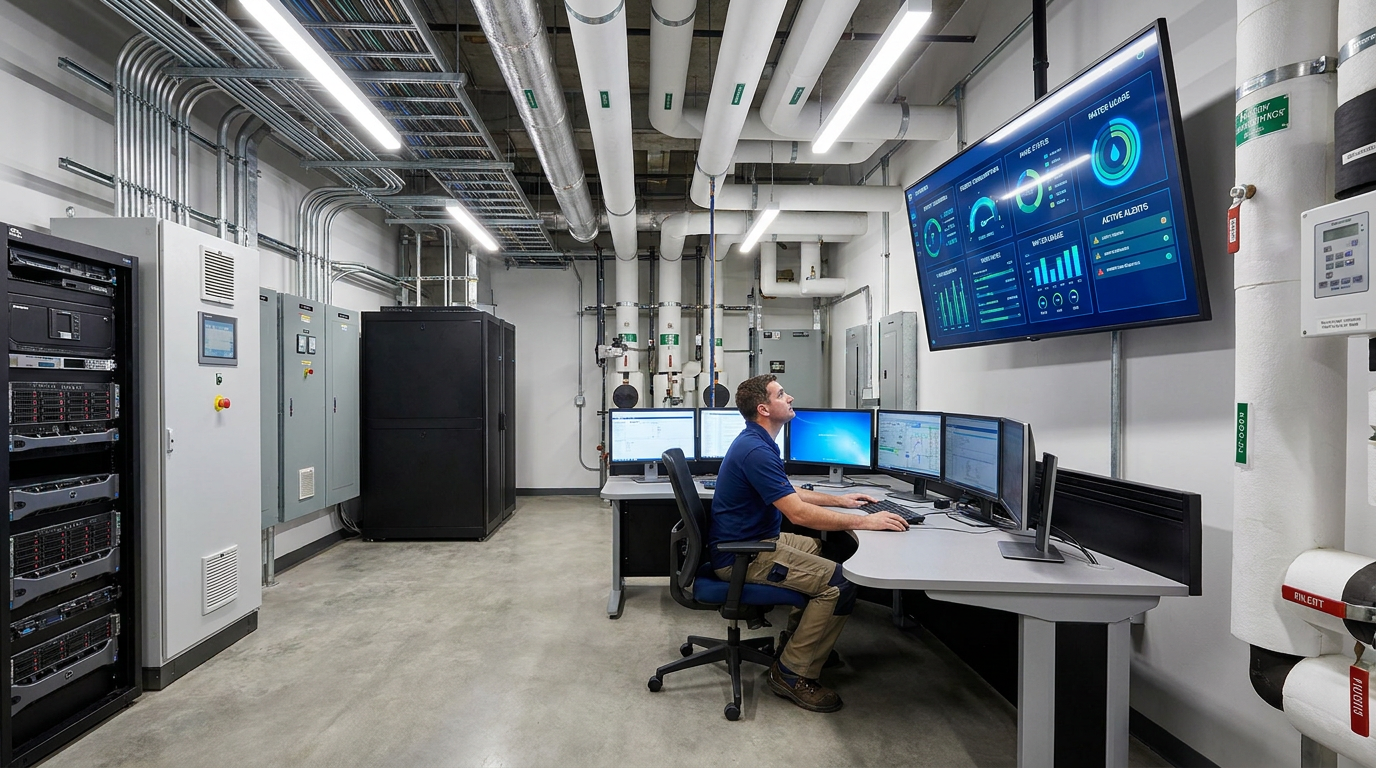
For multifamily and mixed-use projects, a building automation system can serve as the operational backbone. It allows teams to monitor HVAC, ventilation, common area lighting, and other core systems through a centralized interface. This visibility supports faster troubleshooting, better scheduling, and more consistent performance across the property. It can also create a historical record of how equipment is behaving, which is essential for optimization over time.
The value of centralized control increases with building complexity. In a larger development, disconnected mechanical systems create inefficiencies that are difficult to identify. A well-planned automation approach gives operators a clearer picture of where energy is being used and where interventions are needed. For developers, that can translate into lower service burden and a stronger operating story for ownership teams.
Smart thermostats and HVAC optimization
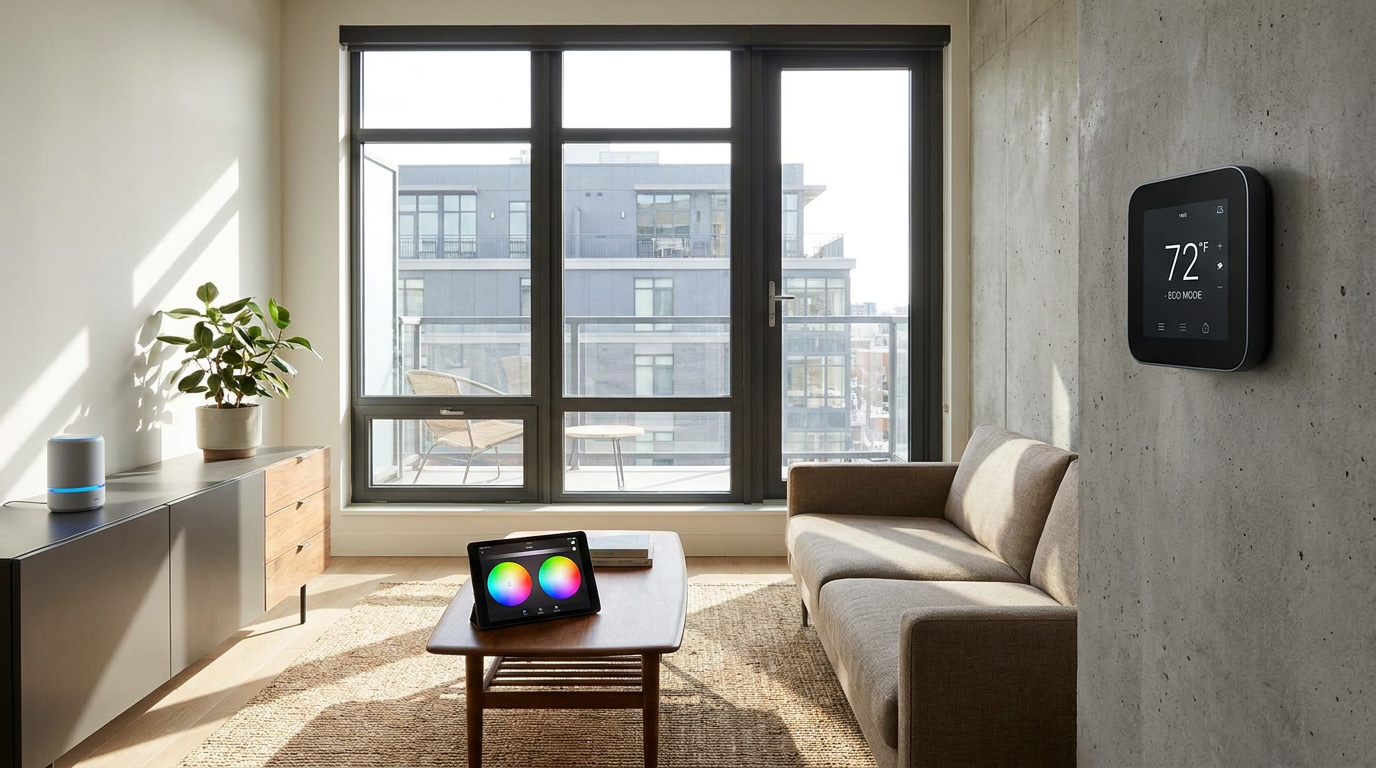
Heating and cooling are major drivers of resident comfort and energy use. Smart thermostats offer more precise control, scheduling, and monitoring than conventional systems. Natural Resources Canada’s ENERGY STAR Canada 2023 annual report notes that smart thermostats are among the product categories contributing to national energy savings. For developers, this supports the case for integrating thermostatic intelligence where it aligns with the mechanical design of the project.
That said, smart thermostats work best as part of a broader HVAC strategy. If ventilation balancing is weak or the envelope underperforms, thermostats alone will not solve comfort issues. Their real strength is in helping an already sound system operate more efficiently and responsively. In rental and condominium settings, they can also improve resident satisfaction by giving occupants better control over their environment.
Submetering and utility analytics
Submetering is often one of the most practical smart investments in multifamily development. It helps allocate utility costs more transparently, encourages efficient consumption, and provides owners with better visibility into building performance. It can also reveal anomalies that suggest leaks, equipment issues, or unusual consumption patterns. In a world where operating costs matter deeply to both owners and residents, better information creates a real advantage.
Utility analytics build on that foundation by turning raw consumption data into actionable insight. Developers should think beyond the hardware installation and ask how data will be reviewed, reported, and used after occupancy. A development that collects information but lacks a process for acting on it has not fully captured the benefit.
Predictive maintenance and fault detection
Traditional maintenance is often reactive. Something breaks, a complaint is filed, and the team responds. Smart housing aims to shift that model by using sensors and system data to identify equipment stress, performance drift, or failure risk in advance. Predictive maintenance can be especially useful for pumps, ventilation systems, boilers, heat pumps, and other major components where breakdowns are disruptive and costly.
For developers planning larger portfolios, this becomes even more valuable. Standardized equipment monitoring across multiple properties can improve maintenance planning, procurement efficiency, and service consistency. It also supports a more professional operating model, which in turn can strengthen institutional confidence in the asset class.
Leak detection and water management
Water damage remains one of the most common and expensive issues in residential buildings. Smart leak detection sensors can provide early alerts in suites, riser rooms, mechanical spaces, and high-risk areas such as under sinks or near laundry equipment. In some configurations, systems can trigger automatic shutoff to prevent wider damage. For developers, this is a straightforward example of how a relatively modest technology can protect the building and reduce future claims.
Water intelligence can also extend to broader consumption analysis. Monitoring irrigation, common area use, and unusual flow patterns can help operators reduce waste. In regions where municipalities are increasingly focused on infrastructure efficiency, these capabilities support a more responsible development profile.
EV charging with load management
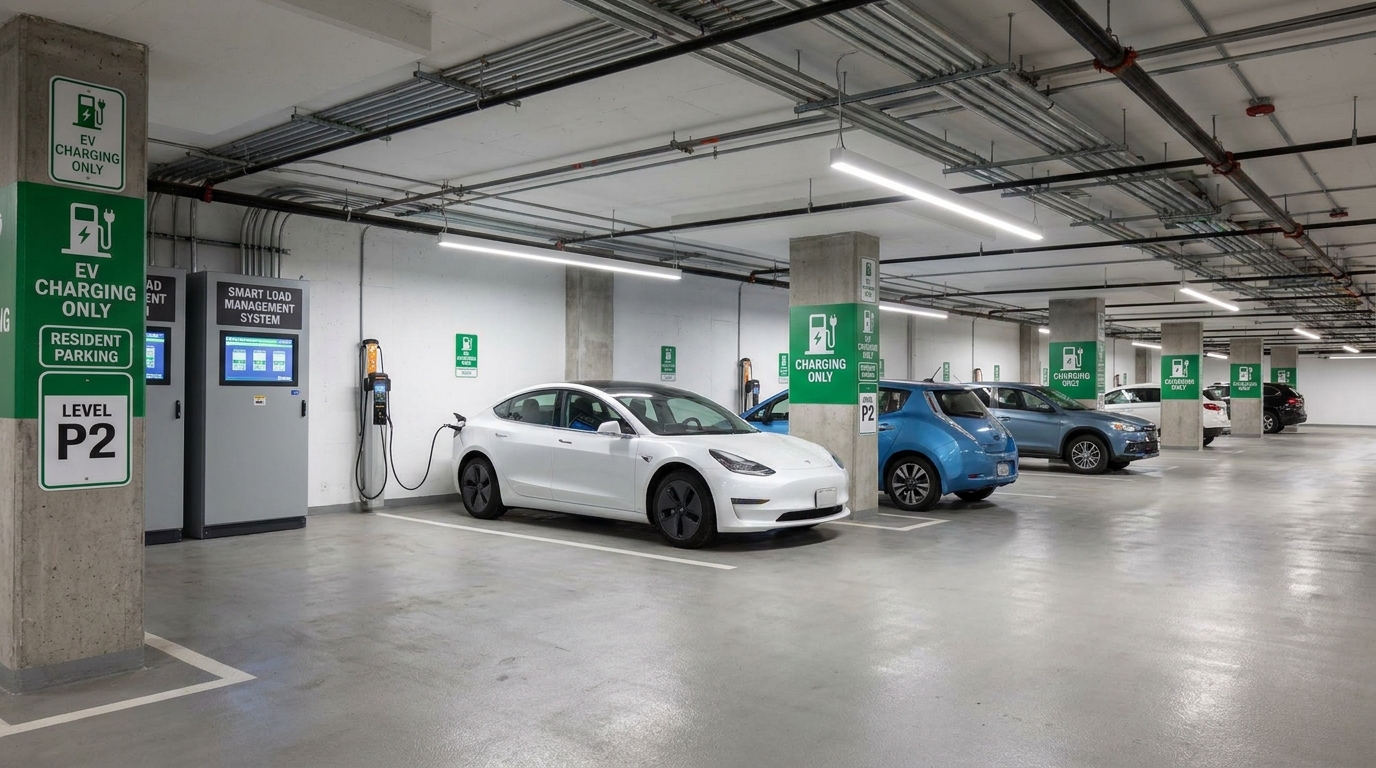
Electric vehicle readiness is quickly shifting from optional amenity to baseline expectation in many new developments. The challenge is not simply providing chargers. It is doing so in a way that does not create avoidable electrical capacity costs or future retrofit complexity. Smart load management allows multiple chargers to share available power intelligently, reducing infrastructure strain and helping projects scale charging access over time.
This is where smart housing intersects directly with future mobility. Residents want confidence that their building can support vehicle electrification. Municipalities and utilities want that support to be managed responsibly. Developers who plan EV infrastructure early, with flexible control systems and expansion capacity, can avoid expensive redesign later while strengthening market appeal today.
Access control, security, and digital services
Resident experience still matters, and access systems are often one of the most visible examples of smart integration. Secure mobile entry, visitor management, parcel systems, and remote access control can make a building feel more convenient and professionally managed. These systems can also reduce friction for staff and improve response times when issues arise.
Still, convenience should not come at the cost of security or maintainability. Developers should pay close attention to who owns the data, how credentials are managed, how systems perform during outages, and whether the platform can evolve without forcing a costly full replacement. Digital services should strengthen trust, not introduce avoidable risk.
How developers should approach implementation
Start with outcomes, not products
The first question is not which devices to install. It is what the project needs to achieve. Is the primary goal lower energy intensity, stronger rental positioning, reduced maintenance calls, EV readiness, or better ESG performance? Different priorities lead to different technology stacks. Starting with outcomes keeps the process strategic and prevents teams from being distracted by features that do not materially improve the project.
Developers should define success in measurable terms wherever possible. That might include targets for energy use intensity, common area operating cost reduction, resident utility transparency, water leak response time, or EV charging capacity. Clear objectives improve design coordination and make procurement decisions more disciplined.
Integrate smart planning early in the design process
Technology integration becomes far more expensive when it is treated as an afterthought. The right time to plan digital infrastructure is during early design, when electrical capacity, communications pathways, riser space, equipment locations, and controls architecture can still be coordinated efficiently. Developers should bring mechanical, electrical, architecture, IT, and operations perspectives together early enough to avoid fragmented decisions.
In many projects, the biggest failures occur not because the technology itself is weak but because no one clearly defined system ownership at the design stage. A fragmented consultant and vendor environment can leave critical gaps in interoperability, dashboard reporting, and maintenance responsibility. Early integration helps close those gaps before they become operational problems.
Design for interoperability and vendor neutrality
Developers should resist solutions that lock the building into a closed ecosystem with limited flexibility. Smart technologies evolve quickly, and properties may need to swap vendors, add capabilities, or connect new platforms over time. Open protocols and vendor-neutral architectures make that easier. They also reduce the risk that a building becomes digitally obsolete long before the physical asset reaches maturity.
Interoperability should be evaluated in practical terms. Can the access control platform communicate with the resident app. Can utility data feed into a unified dashboard. Can EV charging management connect with overall building power strategy. These details matter because value is created through coordination, not just installation.
Commission, train, and operationalize
Technology only delivers if the handoff to operations is taken seriously. Commissioning is essential, and training is just as important. Property teams need to understand how to use dashboards, interpret alerts, escalate issues, and adjust settings responsibly. Without that capability, a smart building can quickly become a dumb one with expensive hardware.
Developers should budget not only for installation but also for testing, documentation, and post-occupancy optimization. This is where many projects underinvest. Yet the research is clear that recommissioning and optimization can produce meaningful savings. A project that plans for ongoing refinement is far more likely to achieve its promised outcomes.
Address cybersecurity from the beginning
As more building systems become connected, cybersecurity becomes a basic development issue. Access control, cameras, thermostats, charging systems, and automation networks all create potential points of vulnerability. A smart building strategy should include network segmentation, secure credential practices, vendor assessment, update protocols, and clarity around data governance. The goal is to make digital convenience compatible with resident trust and operational continuity.
Cybersecurity should not be delegated entirely to a late-stage vendor conversation. It needs to be part of project governance from the outset, especially in larger multifamily and mixed-use assets where many systems intersect. The more connected the building, the more important disciplined digital stewardship becomes.
Smart housing and property value
Developers often ask whether smart technology directly increases property value. The honest answer is that value is rarely created by technology in isolation. It is created when technology improves the income profile, marketability, resilience, and future readiness of the asset. Lower operating costs, stronger occupancy, reduced maintenance surprises, better energy performance, and better resident retention all support valuation more credibly than novelty features alone.
There is also a liquidity dimension to consider. As lenders, institutional buyers, and sophisticated investors pay more attention to building performance data, assets with stronger digital infrastructure may become easier to underwrite and benchmark. A project that can demonstrate how it manages energy, supports electrification, and controls operational risk has a more compelling story in an increasingly performance-conscious market.
For condominium projects, smart integration can also influence reputational value. Buildings that are easier to operate and better able to manage utilities and maintenance tend to create healthier owner experiences over time. That can have downstream effects on resale confidence and brand trust in the developer’s broader portfolio.
Smart housing creates the most value when it is treated as infrastructure for performance, not decoration for marketing.
Examples of strategic application in modern housing projects
In a purpose-built rental development, a developer might prioritize suite-level smart thermostats, water leak sensors, common area occupancy controls, centralized mechanical monitoring, and a resident app tied to access and service requests. The objective would be to reduce service calls, improve retention, and keep utilities under tighter control. The resident experience improves, but the larger gain comes from smoother operations and better cost predictability.
In a condominium project, the strategy might emphasize submetering, indoor air quality monitoring, secure package systems, smart parking access, and EV charging infrastructure with load management. Here, the technology supports a marketable ownership experience while also reducing future retrofit pressure on the building corporation. If the systems are well commissioned and documented, the property enters its operational life with stronger governance tools.
In a mixed-use urban development, smart integration can extend further into district-scale concerns. Retail energy loads, residential HVAC, parking, common area lighting, and mobility infrastructure can all be coordinated through a broader control strategy. This is where the concept of the development as a micro-ecosystem becomes especially useful. The site performs better not because every device is advanced, but because systems are planned to work together.
A practical framework for developers
For teams deciding where to begin, a disciplined framework can help. The following sequence is often more effective than selecting products too early in the process.
- Define the operating and market objectives. Clarify whether the development is aiming to reduce utility intensity, strengthen leasing appeal, improve resilience, support electrification, or all of the above.
- Identify the highest-value systems. Focus on HVAC controls, submetering, leak detection, building automation, EV load management, and resident access before lower-impact novelty features.
- Coordinate design inputs early. Align architecture, electrical, mechanical, IT, and operations requirements before procurement decisions are fixed.
- Prioritize open and maintainable platforms. Reduce lock-in risk and support future adaptation through interoperable systems.
- Budget for commissioning and training. Assume that optimization after occupancy is part of the investment, not an optional extra.
- Set up performance reporting. Decide who reviews energy, maintenance, water, and system alert data and how often decisions will be made from it.
This framework keeps the smart housing conversation grounded in feasibility rather than hype. It also helps ensure that technology choices remain aligned with the realities of operations, resident expectations, and long term ownership.
The future of smart housing developments
The next phase of housing innovation will likely be less about isolated consumer gadgets and more about integrated building intelligence. Electrification, grid flexibility, climate adaptation, and data transparency are reshaping what high-performing housing looks like. Buildings will increasingly need to manage power loads, support EV adoption, optimize indoor conditions, and provide clearer evidence of how they perform over time.
Developers who prepare for that future now will have an advantage. They will be able to deliver projects that align more easily with public policy, infrastructure constraints, and resident demand for efficient living. They will also be better positioned to respond to new disclosure rules, utility pressures, and operating expectations without costly retrofits.
There is a broader city-building dimension here as well. Housing developments are not isolated products. They are pieces of an urban system. When they use technology to consume less energy, manage loads more intelligently, and improve livability, they reduce strain on infrastructure and support more resilient communities. That is where the smart housing conversation becomes more meaningful. It moves beyond convenience and starts contributing to better urban performance.
Conclusion
Integrating technology into housing developments is no longer a matter of adding a premium feature package and calling the project innovative. For developers, the opportunity is larger and more strategic than that. Smart housing works best when it strengthens the fundamentals of building performance, operating efficiency, resident comfort, resilience, and long term value.
The most successful smart developments are not the ones with the most devices. They are the ones with the clearest purpose, the strongest systems integration, and the most disciplined operational follow-through. They treat data as a management tool, not a marketing slogan. They recognize that interoperability, commissioning, cybersecurity, and maintainability matter just as much as the hardware itself.
As housing markets continue to evolve, the projects that stand out will be those that combine sound design, efficient infrastructure, and practical intelligence. Smart housing, approached thoughtfully, gives developers a way to build for that future. It can lower costs, improve outcomes, and create homes that are better aligned with the environmental, economic, and urban realities ahead. That is not a trend. It is a more mature model of development.



No Comment! Be the first one.