



Utility infrastructure rarely gets the public attention given to skyline defining towers, new transit stations, or major housing announcements. Yet beneath every successful urban project sits a far more decisive layer of city building: the systems that deliver water, manage wastewater, control stormwater, power homes, connect broadband, support mobility, and sustain daily life at scale. These systems are not simply technical requirements to be addressed after planning approvals are issued. They are strategic assets that shape where growth can happen, how quickly housing can be delivered, and whether that growth remains fiscally and environmentally sustainable over the long term.
Table Of Content
- Why Utility Infrastructure Has Become a Strategic Urban Issue
- The Link Between Utility Capacity and Housing Supply
- Growth Management Starts with Servicing Strategy
- From reactive servicing to proactive sequencing
- Compact Growth, Densification, and the Economics of Infrastructure
- Climate Resilience Is Now Core Infrastructure Planning
- The growing role of green infrastructure
- Electricity, Electrification, and the New Capacity Challenge
- Broadband as Essential Urban Infrastructure
- Integrated Planning Is Replacing Siloed Decision Making
- Common Misconceptions That Distort Better Infrastructure Decisions
- What Strong Utility Planning Looks Like in Practice
- Key elements of a strategic utility framework
- The Future of Urban Growth Will Be Decided Below Ground and Across Networks
In Canada, this reality is becoming harder to ignore. Population growth remains concentrated in major urban regions at the same time that many municipal systems are aging, climate risks are increasing, and electrification is reshaping infrastructure demand. Statistics Canada has reported that large urban areas in Canada covered more than 11,000 square kilometres of inland area in 2020, up 2.4 percent from 2010. That expansion is not just a land story. It is an infrastructure story, because every additional area brought into the urban footprint requires some combination of pipes, roads, substations, drainage capacity, broadband access, and long term maintenance commitments.
The strategic implication is clear. Utility infrastructure is no longer just the hidden backbone of development. It is a primary lever of growth management. It influences land value, project timing, housing affordability, public finances, climate resilience, and the quality of life residents experience after a development is built. For municipalities, developers, and policymakers, the central question is no longer whether utilities are important. The real question is whether cities are planning them early enough, broadly enough, and intelligently enough to support the urban future they say they want.

Why Utility Infrastructure Has Become a Strategic Urban Issue
For decades, utility infrastructure was often treated as a background engineering function. Land would be designated for growth, projects would move through planning approvals, and servicing would follow through standard capital delivery processes. That model is far less effective in today’s environment. Rapid population growth, constrained municipal finances, aging assets, and climate related disruptions have created a more complex reality in which infrastructure limitations can stall or reshape entire development pipelines.
Housing delivery provides one of the clearest examples. According to CMHC, Canada recorded 245,120 housing starts in 2024, including 227,697 in centres with populations above 10,000. Even with this scale of activity, construction remains regionally uneven. Some markets continue to struggle not because demand is absent, but because service capacity, land readiness, and infrastructure timing do not align with the need for new homes. In practical terms, a city can approve housing on paper while still lacking the water, wastewater, electricity, or transportation capacity needed to support timely delivery.
This is why utility planning has moved from an operational concern to a strategic planning issue. Infrastructure influences the actual realization of housing supply. It determines whether growth can be directed toward transit supportive areas, whether intensification is feasible in mature neighbourhoods, and whether fringe expansion will impose excessive long term costs on public budgets. When utility systems are aligned with growth plans, cities can unlock land, sequence development more effectively, and make better use of public investment. When they are not aligned, approvals become aspirational rather than actionable.
The misconception that utility infrastructure is merely technical is especially problematic. In reality, it sits at the intersection of land use, finance, resilience, and equity. Decisions about where to extend sewer trunks or increase power capacity affect which communities attract investment, how quickly housing can be built, and who bears the long term cost of servicing dispersed growth. Infrastructure is therefore not just about engineering performance. It is about urban form, economic competitiveness, and the long term structure of the city itself.
The Link Between Utility Capacity and Housing Supply
One of the most important shifts in urban development thinking is the recognition that housing enabling infrastructure is a supply issue in its own right. Public discussion often focuses on zoning, approvals, or interest rates, all of which matter. But even when a site is entitled and market demand exists, a project may still be delayed by insufficient water pressure, wastewater treatment limits, constrained feeder lines, inadequate stormwater outlets, or the absence of broadband and transportation connections.
This reality has direct implications for how cities pursue housing targets. Ambitious growth objectives require equally credible servicing strategies. It is not enough to ask how many units a municipality wants to approve over the next decade. The more strategic question is whether utility networks can absorb that growth in the right locations and within the necessary timeframes. If not, then the city faces a mismatch between policy ambition and implementation capacity.
Statistics Canada’s 2024 housing analysis reinforces this point by showing that while higher density housing is gaining share, low density expansion still carries higher infrastructure costs and greater environmental implications than compact growth. This matters because the cheapest land to acquire is not always the cheapest land to serve. Extending pipes, roads, stormwater systems, hydro capacity, and service routes to the urban fringe can create substantial upfront capital costs as well as long term operating burdens. In contrast, intensifying already serviced areas often delivers better infrastructure efficiency, even if redevelopment is more complex at the project level.
For developers, this creates a very practical lens on feasibility. Servicing constraints can alter timelines, increase soft costs, trigger off site capital contributions, and affect whether a project proceeds at all. For municipalities, it underscores the need to connect development pipelines with infrastructure planning. If the city knows where applications are concentrated, where capacity is limited, and where strategic upgrades can unlock significant housing, it can prioritize capital in a way that supports both growth and fiscal discipline.
In modern city building, the question is not simply how much housing a municipality can approve. The deeper question is how much housing its utility networks can support reliably, affordably, and resiliently over decades.
Growth Management Starts with Servicing Strategy
Strategic utility planning is increasingly inseparable from growth management. Municipalities are recognizing that infrastructure should not merely react to development pressure. It should guide development toward locations where service delivery is efficient, sustainable, and aligned with broader city building objectives. This is particularly relevant in large Canadian cities where development demand is intense, public resources are limited, and political pressure for housing is high.
Toronto offers a useful example of this direction. Its development pipeline work emphasizes long range planning to manage growth, infrastructure, and service delivery together. That is significant because it reflects a larger institutional shift. The city is not looking at buildings in isolation. It is examining how proposed growth interacts with the systems needed to support it. Winnipeg’s 2024 Infrastructure Plan similarly uses a 10 year capital outlook tied to broader planning documents, reinforcing the idea that growth and servicing must be coordinated over time rather than managed through fragmented decisions.
A strong servicing strategy usually asks a sequence of strategic questions. Where is growth expected to concentrate over the next 10, 20, or 30 years. What parts of the network already have spare capacity. Which upgrades will unlock the highest housing yield or the strongest community benefit. What timing dependencies exist between development phases and utility expansion. And how should these investments be funded without undermining affordability or municipal fiscal stability.
These questions matter because utility infrastructure has a long life cycle and a large financial footprint. Once installed, pipes, pumping stations, substations, and corridors shape growth patterns for generations. Poorly timed expansion can induce costly sprawl or lock in service obligations that strain future budgets. Thoughtful investment, by contrast, can reinforce complete communities, support transit oriented development, and make intensification more practical and more attractive.
From reactive servicing to proactive sequencing
The traditional approach to servicing often focused on responding to individual development proposals. That can work in slow growth environments, but it becomes inefficient when urban expansion accelerates. A proactive sequencing model is more effective. In this approach, municipalities map out where growth should occur first, what utility investments are needed to support each phase, and how funding tools can be structured to deliver capacity in advance of bottlenecks.
This is where strategic planning creates real value. By sequencing infrastructure with growth, cities reduce uncertainty for developers, protect public finances, and create a clearer path from approval to construction. It also helps avoid situations where a municipality approves large amounts of housing in locations that cannot be serviced for years, generating frustration in the market and weakening public trust in planning outcomes.
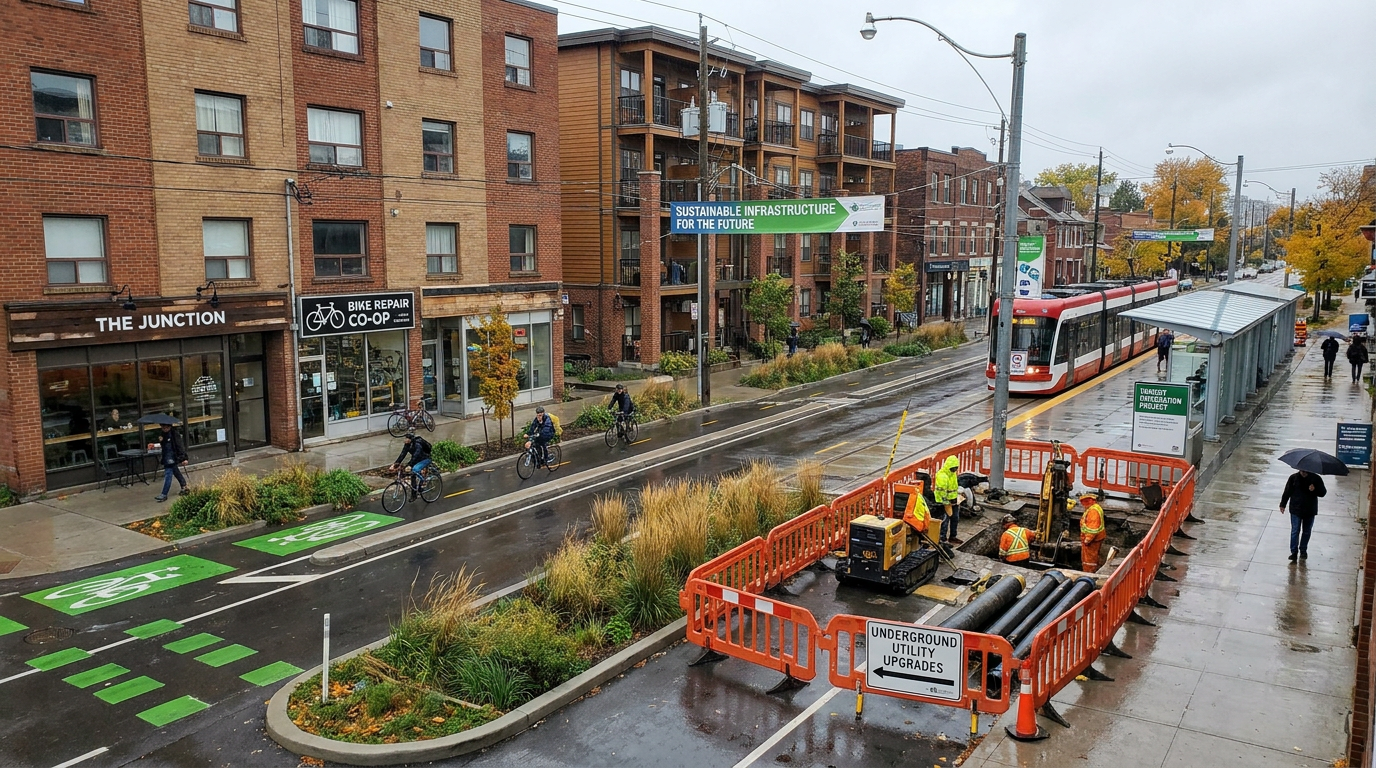
Compact Growth, Densification, and the Economics of Infrastructure
Much of the urban growth debate is framed around housing choice, affordability, and neighbourhood change. Those are important issues, but the infrastructure dimension deserves equal attention. Density is not just a planning preference. In many cases, it is an infrastructure efficiency strategy. Compact growth generally allows cities to serve more households with shorter networks, lower per unit expansion costs, and more efficient use of treatment plants, corridors, and public services.
This does not mean every dense project is simple or inexpensive. Intensification in mature areas can require complex tie ins, utility relocation, and asset upgrades. However, from a long term systems perspective, compact urban form usually places less strain on municipal finances than continuous outward expansion. Low density sprawl increases the length of roads, water mains, sewers, and distribution lines that must be built and maintained for each household served. Over time, this can create a widening infrastructure deficit as municipalities inherit more assets than they can sustainably renew.
Statistics Canada’s findings on the higher infrastructure costs and environmental implications of low density expansion are therefore highly relevant to development strategy. They remind us that land use choices carry embedded infrastructure consequences. A new subdivision may look cost effective at the parcel level, but once the full cost of servicing, maintenance, replacement, and climate risk is accounted for, the long term public burden can be significantly higher than more compact alternatives.
For decision makers, this argues for a more disciplined view of growth. Cities should evaluate development not only through the lens of immediate approvals or short term tax assessment gains, but through lifecycle cost. Where can housing be added using existing or efficiently upgraded systems. Which forms of expansion create unsustainable servicing obligations. And how can intensification be paired with utility investments that increase both capacity and community quality. These are strategic questions, not just technical ones.
Climate Resilience Is Now Core Infrastructure Planning
One of the most significant changes in the Canadian planning environment is the formal elevation of climate resilience from an optional enhancement to a core infrastructure requirement. Canada’s National Adaptation Strategy states that all infrastructure systems should be climate resilient and that climate change must be embedded in planning, design, operation, and lifecycle decisions. The federal Adaptation Action Plan goes further by emphasizing resilience criteria, updated climate data, future design standards, and modernized guidance for infrastructure investments.
For utility systems, this policy direction is especially important. Water, wastewater, stormwater, electricity, and transportation networks are all vulnerable to climate stress. More intense rainfall can overwhelm sewer systems and stormwater outlets. Heat can strain electricity demand and degrade equipment performance. Freeze thaw cycles can shorten asset life. Wildfire smoke can affect operations and public health. Flooding can knock out critical facilities and isolate communities. These are no longer rare edge cases. They are design conditions that must be assumed in long range planning.
The strategic implication is that cities cannot separate growth planning from climate planning. If a municipality is expanding housing supply in an area with flood risk, limited drainage redundancy, or vulnerable electrical infrastructure, then its development strategy is incomplete. Likewise, if it is upgrading a utility system without considering future rainfall intensity, electrification load, or emergency continuity, it may be embedding tomorrow’s failure into today’s investment.
Climate resilience also changes the financial logic of infrastructure. Resilient systems often require higher upfront investment, but they can reduce lifecycle costs by avoiding service disruptions, emergency repairs, asset damage, and public safety impacts. In a constrained fiscal environment, this kind of investment discipline is not a luxury. It is prudent long term asset management.
The growing role of green infrastructure
North American planning practice increasingly recognizes that resilience is not achieved solely through larger pipes and harder systems. Green infrastructure is gaining traction as a complementary strategy for stormwater management, urban cooling, and watershed health. U.S. EPA guidance on integrated planning and sustainable water infrastructure highlights the value of coordinating stormwater, land use, water systems, and capital budgeting rather than addressing each challenge in isolation.
This integrated approach matters in Canada as well. Bioswales, permeable surfaces, urban tree systems, retention areas, and distributed stormwater solutions can reduce runoff pressure, improve neighbourhood amenity, and enhance resilience at lower long term cost in some contexts. For new housing developments, the lesson is straightforward. Utility planning should not begin and end with underground servicing diagrams. It should also consider how site design, landscape systems, and public realm infrastructure can improve overall system performance.
Electricity, Electrification, and the New Capacity Challenge
Electricity planning is becoming one of the most consequential utility issues in urban development. Housing growth alone raises demand, but the challenge does not stop there. Electrification of space heating, hot water systems, transportation, and building operations is adding new layers of load. Heat pumps, electric vehicle charging, battery storage, and smart building technologies all depend on reliable grid capacity and modern distribution infrastructure. As cities pursue lower carbon growth, electricity moves closer to the centre of development feasibility.
This shift has several planning implications. First, grid capacity must be considered earlier in the development process. A project with strong market fundamentals may still face delay if local substations, feeders, or interconnections cannot support new demand. Second, electrical planning must become more geographically coordinated with land use decisions. Areas targeted for major intensification, mixed use nodes, and transit oriented development may require substantial grid reinforcement before projected growth can be accommodated at scale.
Third, resilience and redundancy matter more than ever. As cities rely more heavily on electricity for heating and mobility, service disruptions become more disruptive to everyday life and public safety. Strategic planning must therefore consider not just peak demand, but continuity, backup capacity, distributed energy opportunities, and the adaptability of future networks. In some communities, district energy or distributed resources may play a growing role in reducing pressure on conventional systems while improving efficiency and resilience.
The broader lesson is that electrification cannot be treated as a separate sustainability agenda disconnected from housing and infrastructure planning. It is part of the same urban systems challenge. If municipalities want more homes, more efficient buildings, and lower emissions, then electricity planning must be embedded in growth strategy from the start.

Broadband as Essential Urban Infrastructure
Broadband is now widely understood as a foundational utility rather than a secondary amenity. Modern households depend on connectivity for work, education, healthcare access, municipal services, and daily economic participation. New housing developments that lack high quality digital infrastructure are increasingly at a disadvantage, not only in market appeal but in long term community functionality.
Federal evaluations in Canada have emphasized the importance of mapping backbone infrastructure and identifying access gaps, underscoring that broadband planning has become a serious public policy issue. For urban development, this means digital connectivity should be integrated into the same strategic discussions as water, power, and transportation. It is especially relevant in mixed use districts, employment areas, and communities designed around remote work flexibility or smart city applications.
The planning implication is broader than technology. Broadband capacity influences economic productivity, social inclusion, and neighbourhood resilience. A community with strong digital infrastructure is better positioned to support home based work, local entrepreneurship, virtual services, and adaptive public systems. In a development context, that makes broadband part of the value proposition of place making, not simply a utility trench item to be addressed late in construction.
For municipalities, broadband also illustrates the need for multi utility coordination. Road reconstruction, transit expansion, and new subdivision servicing often create opportunities to install conduits or improve connectivity at lower cost if planned together. When infrastructure systems are coordinated, cities can reduce disruption, improve delivery efficiency, and future proof growing communities more effectively.
Integrated Planning Is Replacing Siloed Decision Making
One of the strongest emerging trends in infrastructure development is the move away from siloed planning. Water teams can no longer plan independently from stormwater teams. Transportation cannot be disconnected from land use. Electricity upgrades cannot be detached from housing forecasts. Broadband cannot be left outside capital coordination. Urban growth now depends on how these systems interact, because bottlenecks in one network can undermine the performance of the others.
Integrated planning creates several advantages. It improves capital prioritization by identifying investments that unlock multiple benefits at once. It supports more accurate growth forecasting because land use scenarios are tested against service realities. It reduces duplication by aligning corridor work and construction timing. And it creates better resilience because systems are assessed as an interdependent whole rather than a collection of isolated assets.
This approach also changes the role of municipal leadership. Strategic infrastructure planning requires stronger coordination between planning departments, engineering divisions, finance teams, utilities, transit agencies, and development stakeholders. It requires better data, clearer capital frameworks, and more explicit links between policy objectives and implementation tools. In short, it requires governance capacity, not just engineering capacity.
For the development industry, integrated planning can reduce uncertainty. Developers benefit when municipalities can provide clearer answers on servicing capacity, timing, cost sharing expectations, and long range infrastructure priorities. A city that understands its utility constraints and opportunities is better positioned to attract investment, accelerate housing delivery, and negotiate growth from a position of strength.
Common Misconceptions That Distort Better Infrastructure Decisions
Several misconceptions continue to weaken public and policy discussions about utility infrastructure. The first is the belief that utilities are simply technical matters best left to engineers after land use decisions are made. In reality, infrastructure planning is inseparable from urban economics, climate adaptation, fiscal sustainability, and housing delivery. By the time a utility issue appears as a technical constraint, the strategic opportunity to shape growth may already have been missed.
The second misconception is that development at the urban edge is always cheaper. Land may be less expensive upfront, but servicing can be far more costly once the full network implications are included. Pipes must travel farther. Roads become more extensive. Transit becomes harder to support efficiently. Maintenance obligations increase over time. The apparent savings of fringe growth often look very different when viewed through a lifecycle infrastructure lens.
The third misconception is that more housing approvals automatically translate into more housing supply. This is one of the most common planning misunderstandings. If water, sewer, power, stormwater, transit, or broadband capacity is constrained, approvals can sit in the pipeline for years without reaching completion. Housing targets and servicing capacity must therefore be planned together rather than treated as separate policy tracks.
The fourth misconception is that climate resilience is optional or secondary. Current federal policy direction in Canada makes clear that resilience is central to infrastructure planning and investment. This is not a decorative sustainability layer added after the fact. It is part of core risk management and asset stewardship. Finally, there is the misconception that utilities can still be planned one asset at a time. The reality is that modern urban growth requires cross sector planning because infrastructure systems are interconnected in both cost and performance.
What Strong Utility Planning Looks Like in Practice
Effective utility infrastructure planning begins with a realistic growth forecast. Municipalities need to understand not just how many people are coming, but where growth is likely to occur, what forms of housing will dominate, and how those patterns will affect service demand. This means linking demographic projections, land use plans, development pipelines, and utility models in a disciplined and regularly updated planning process.
It also requires a serious commitment to lifecycle asset management. Building new capacity without a long term renewal strategy creates future liabilities. Strong planning therefore considers the full life of infrastructure, from capital delivery to maintenance, replacement, resilience upgrades, and operational costs. This is essential for protecting municipal financial health and avoiding the accumulation of assets that cannot be sustained over time.
Another defining feature is phased servicing. Rather than assuming all infrastructure must be delivered at once, cities can sequence upgrades to align with actual growth patterns. This allows capital to be targeted more precisely while still creating a clear path for development. It also helps municipalities negotiate from a position of evidence when determining where cost sharing, development charges, or other funding tools are most appropriate.
Finally, strong planning is transparent. It gives the market, residents, and decision makers a clear understanding of where capacity exists, where constraints are emerging, and what investments are needed to support the next generation of housing. In an era of housing pressure and public scrutiny, transparency around servicing is not just good administration. It is part of building trust in the city’s growth strategy.
Key elements of a strategic utility framework
- Integrated forecasting that aligns population growth, housing pipelines, utility demand, and land use policy.
- Capacity mapping to identify where existing infrastructure can absorb growth and where upgrades are required.
- Phased capital planning that sequences investments to unlock housing in priority areas.
- Climate risk analysis embedded into planning, design standards, and lifecycle decisions.
- Cross sector coordination among planning, engineering, finance, transportation, utilities, and development stakeholders.
- Lifecycle financial discipline so expansion decisions reflect not only construction costs but long term operating and renewal obligations.
The Future of Urban Growth Will Be Decided Below Ground and Across Networks
Urban development is often discussed in terms of visible outcomes: more housing, better neighbourhoods, stronger transit, cleaner energy, and greater affordability. But those outcomes depend on a less visible set of decisions about utility infrastructure. The future of sustainable urban growth will be determined not only by what cities approve, but by what their underlying systems can support with reliability and resilience.
That is why utility infrastructure should be understood as a strategic lever of urban transformation. It determines whether growth is compact or sprawling, whether approvals become completions, whether public finances remain manageable, and whether communities can withstand the shocks of a changing climate. In a high growth country like Canada, these choices are becoming more consequential with each passing year.
The cities that succeed will be the ones that think of infrastructure not as a reactive expense, but as a long horizon investment in urban capacity. They will align housing targets with servicing plans, use capital budgets to unlock complete communities, embed resilience into every major decision, and coordinate utilities as part of a single growth system. They will recognize that water, wastewater, power, broadband, roads, transit, and stormwater are not isolated technical domains. Together, they are the operating platform of city building.
Unlocking the future of urban development means unlocking the networks that make growth possible. The municipalities, planners, utilities, and developers that understand this will be better positioned to deliver housing faster, build more resilient communities, and shape cities that remain livable and competitive for decades to come.



No Comment! Be the first one.