



There was a time when energy-efficient lighting was discussed in purely practical terms. It belonged to the language of utility bills, environmental awareness, and technical upgrades rather than the sensual world of interiors. Today, that divide has quietly dissolved. The most sophisticated homes increasingly rely on lighting that is not only beautiful and atmospheric, but also deeply efficient, measured, and considerate of the resources it consumes.
Table Of Content
- The New Standard of Beauty and Efficiency
- Why Energy-Efficient Lighting Belongs in Thoughtful Interiors
- Understanding the Language of Beautiful Light
- Layered Lighting: The Secret to Both Luxury and Efficiency
- Ambient Light as a Foundation
- Task Light for Precision and Comfort
- Accent Light for Drama and Identity
- Choosing the Right LEDs for Different Rooms
- Living Rooms and Reception Spaces
- Kitchens and Dining Areas
- Bedrooms and Dressing Areas
- Bathrooms
- Home Offices and Study Corners
- Controls, Sensors, and Smart Lighting as Design Tools
- How to Read Product Quality Beyond Marketing
- Daylighting and the Dialogue Between Natural and Artificial Light
- Common Misconceptions That Deserve Retirement
- A Room-by-Room Approach to an Elegant Lighting Upgrade
- What the Future of Residential Lighting Looks Like
- Conclusion: The Most Graceful Light Is Thoughtful Light
- Quick Reference: What to Prioritize When Choosing Energy-Efficient Lighting
This shift matters because lighting shapes far more than visibility. It softens architecture, reveals texture, guides movement, and gives emotional identity to a room. A well-lit home feels composed and welcoming, while a poorly lit one can seem flat or uneasy no matter how beautiful the furnishings may be. When energy-efficient lighting is chosen thoughtfully, it allows a home to feel layered, intimate, and polished while also reducing waste, maintenance, and unnecessary electricity use.
Energy-efficient lighting refers to fixtures and bulbs, most commonly LEDs, that produce the same or better brightness and color quality while consuming significantly less electricity than traditional incandescent lighting. That balance between elegance and responsibility is especially relevant now. Natural Resources Canada notes that household lighting accounts for 3.5% of the energy used in the average Canadian home, a modest share that still represents a meaningful opportunity to lower energy demand without sacrificing comfort or style. On a larger scale, the International Energy Agency estimates that lighting accounted for about 8% of global electricity demand in 2024, or roughly 2,200 TWh, a reminder that small choices made room by room contribute to a much larger environmental picture. In practice, this means LEDs, smart controls, and thoughtful layering rather than a single bright overhead fixture.
For homeowners, the good news is that the modern lighting landscape is more graceful than ever. LEDs now come in warm tones, sculptural forms, delicate decorative bulbs, and highly refined integrated fixtures. Smart controls have matured into intuitive systems that support scene setting, dimming, occupancy sensing, and daylight responsiveness. What once felt clinical can now feel luxurious. Energy efficiency is no longer the compromise. In many cases, it is the very thing that makes a lighting scheme more versatile, longer lasting, and more refined.
This guide explores how to use energy-efficient lighting as a design asset rather than a mere replacement strategy. From understanding brightness and color quality to layering light across different rooms, the goal is to show how a sustainable choice can also be the most elegant one in the house.
Elegant lighting today is not about excess. It is about precision, warmth, and intention. The most sustainable rooms are often the most beautifully lit because every source of light has a purpose.
The New Standard of Beauty and Efficiency
Across North America, LED lighting has moved decisively from niche upgrade to mainstream expectation. The U.S. Energy Information Administration reported that 47% of U.S. households used LEDs for most or all indoor lighting in 2020, and adoption has continued to expand as performance has improved and prices have become more accessible. What this means in design terms is significant. Homeowners are no longer simply swapping one bulb for another. They are beginning to treat lighting as a complete system composed of mood, function, and energy intelligence.
The U.S. Department of Energy describes LEDs as today’s most energy-efficient and rapidly developing lighting technology. That endorsement is not only about reduced electricity use. It is also about longevity, thermal performance, and design flexibility. LED bulbs last substantially longer than incandescent bulbs, which reduces replacement frequency and maintenance. In practical terms, this means fewer ladders brought out for high ceilings, fewer burned-out decorative lamps in difficult corners, and a more stable visual environment across the life of a home.
Style has advanced just as quickly as technology. Contemporary LEDs can mimic the familiar glow of traditional bulbs, support fine dimming, and provide decorative silhouettes that feel perfectly at home in classic, transitional, or modern interiors. They appear in alabaster pendants, fluted sconces, discreet recessed trims, slim picture lights, and hidden linear profiles that seem to dissolve into architecture. Efficiency, once visible as a compromise, now lives quietly beneath the surface of beautiful design.
For the homeowner who values both atmosphere and sustainability, this is a profoundly attractive proposition. The same lighting scheme that creates intimacy in a dining room or sculptural softness along a corridor can also reduce electricity use over time. Premium visual results no longer demand wasteful operation. In fact, the most accomplished lighting plans often rely on efficient technology precisely because it allows greater control and finer calibration.
Why Energy-Efficient Lighting Belongs in Thoughtful Interiors
When discussing lighting in design, it is tempting to focus only on fixtures. Yet the truest role of light is atmospheric. It defines how color is perceived, how stone or wood appears after sunset, and how a room feels when one enters it at the end of the day. Energy-efficient lighting supports this atmospheric work beautifully because it can be tuned with more nuance than older technologies often allowed.
Modern LED systems can be selected based on brightness, beam spread, dimmability, color temperature, and color rendering. This matters because the emotional quality of a room is built from those details. A warm and dimmable lamp in a sitting room can encourage calm conversation. A higher-output task light in a kitchen can make food preparation easier and safer. A narrow accent beam can draw attention to art, shelving, or an architectural niche without flooding the whole room with unnecessary brightness.
There is also a financial elegance to energy efficiency. Higher upfront cost does not necessarily mean higher lifetime cost. Because quality LEDs use less electricity and last much longer, they often offset their purchase price over time through lower energy use and fewer replacements. This makes them particularly appealing in spaces where lights are used daily for long periods, such as kitchens, bathrooms, living rooms, and exterior entries.
ENERGY STAR certification adds another layer of confidence for homeowners seeking quality as well as efficiency. ENERGY STAR-certified LEDs are tested for thermal management and performance through rated life, helping to distinguish well-made products from options that may look similar on the shelf but perform less gracefully over time. In interior design, durability is part of luxury. A beautiful fixture or bulb should not only look refined on installation day. It should continue to perform with consistency, color stability, and comfort for years.
Understanding the Language of Beautiful Light
Before choosing fixtures and bulbs, it helps to understand the vocabulary that defines lighting quality. One of the most common misconceptions is that wattage indicates brightness. In older incandescent systems, consumers often relied on wattage as a shorthand, but with LEDs, lumens are the more relevant measure. Lumens tell you how much light a bulb emits. This simple shift in thinking allows homeowners to compare products based on actual performance rather than energy consumption alone.
Color temperature, measured in Kelvin, is equally important. Warm light often falls around 2700K to 3000K and tends to feel intimate, flattering, and residential. Neutral light can move slightly cooler and may be useful in task-oriented spaces where clarity is important. The key point is that efficient lighting does not have to look cold. One of the enduring myths around LEDs is that they are inherently harsh or blue. In reality, modern products are available in warm tones that can feel every bit as inviting as traditional incandescent light, sometimes more so because they are easier to control and layer.
Color rendering index, commonly called CRI, measures how accurately a light source reveals colors compared with natural light. In a home where materials matter, whether linen, walnut, marble, paint, or skin tone, good color rendering is essential. Designers increasingly specify high-CRI LEDs because they allow interiors to appear richer and more truthful. A creamy wall can otherwise turn dull, a timber surface may lose depth, and textiles can feel lifeless under poor-quality illumination.
Dimming is another element that should not be overlooked. A dimmable source offers emotional flexibility. It allows one room to serve several purposes across the day, from practical morning routines to quieter evening rituals. In design terms, dimming introduces softness, proportion, and control. In energy terms, it also helps reduce unnecessary use when full brightness is not required.
Layered Lighting: The Secret to Both Luxury and Efficiency
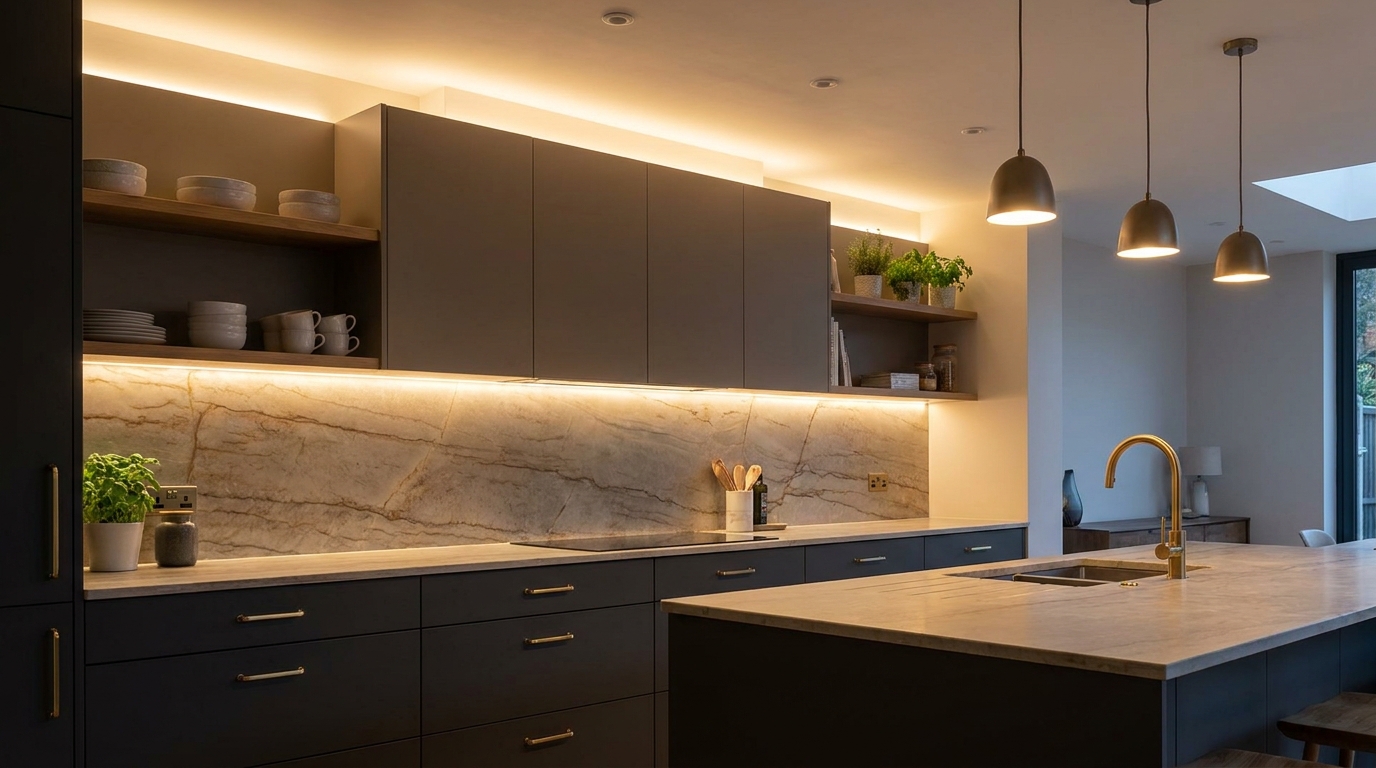
One of the most transformative principles in residential lighting is layering. Rather than relying on a single central fixture to do everything, layered lighting combines several types of illumination so that each performs a distinct role. This creates visual richness while reducing the tendency to over-light a room. It is, in many ways, the design principle that best unites sophistication and sustainability.
The three classic layers are ambient lighting, task lighting, and accent lighting. Ambient lighting provides overall illumination and establishes the room’s base atmosphere. Task lighting supports specific activities such as reading, cooking, grooming, or working. Accent lighting introduces drama and depth by highlighting art, shelving, architectural details, or textured surfaces. When these layers are balanced properly, a room feels complete and dimensional rather than uniformly bright.
Layering is efficient because it lets you use only the light you need. In a living room, for instance, the ambient layer might be a dimmed ceiling fixture or concealed cove lighting. Task light may come from a reading lamp beside a chair. Accent light could graze a stone wall or illuminate a painting. Instead of flooding the entire room with high output at all times, each source can be used selectively. The result is lower energy use, more comfort, and far greater beauty.
Architecturally, layered lighting also flatters space. It creates shadow, contrast, and softness, which are essential to a refined interior. Rooms with a single bright overhead source often feel exposed and unfinished. Rooms with several calibrated sources feel intimate, composed, and visually expensive. This is true in minimalist homes, traditional homes, and everything in between.
Ambient Light as a Foundation
Ambient lighting should be generous but never aggressive. It forms the visual background of a room and should allow people to move comfortably without erasing depth. Recessed LEDs, concealed cove lighting, flush mounts, and certain pendants can all serve this role depending on the architecture. In elegant spaces, the most successful ambient light often feels almost invisible. One notices the atmosphere rather than the source.
Warm-to-neutral color temperatures tend to work best for residential ambient lighting because they create calm and continuity. They also pair well with natural materials such as wood, plaster, stone, and brushed metals. If the room receives good daylight, ambient LED lighting can be calibrated to complement rather than compete with it, preserving the room’s natural rhythm from morning through evening.
Task Light for Precision and Comfort
Task lighting is where efficiency becomes especially practical. Focused light in work areas means the entire room does not need to be brightly illuminated for one specific activity. Under-cabinet LEDs in a kitchen, adjustable reading lamps in a library corner, and mirror lighting in a bathroom all exemplify this approach. The placement should reduce shadow and strain while remaining visually integrated with the room.
Beautiful task lighting does not have to feel utilitarian. Some of the loveliest examples come in the form of finely detailed sconces, slim articulated lamps, and minimalist linear profiles tucked discreetly into joinery. The effect is clean, intentional, and reassuringly modern without feeling sterile.
Accent Light for Drama and Identity
Accent lighting is often what transforms a house into a memorable interior. It directs the eye, creates hierarchy, and gives emotional focus to the room. Picture lights above artwork, LED strips inside shelving, wall washers along textured plaster, and toe-kick lighting under cabinetry all contribute to a more nuanced visual experience. Because accent lighting is targeted, it can often achieve strong effect with modest energy use.
In design, accent light is a form of editing. It tells the eye what matters. It can make a corridor feel gallery-like, a fireplace feel ceremonial, or a dressing area feel quietly luxurious. Used sparingly and intelligently, it is one of the most powerful tools in the lighting vocabulary.
Choosing the Right LEDs for Different Rooms
Every room has its own tempo, and energy-efficient lighting should respond to that character rather than apply a uniform formula. The goal is not simply to install LEDs everywhere, but to select the right LED products for each function, mood, and architectural condition. This is where design intelligence makes all the difference.
Living Rooms and Reception Spaces
In living rooms, comfort and flexibility are paramount. These spaces often host conversation, reading, television viewing, and moments of retreat, sometimes all within the same day. Warm dimmable LEDs are ideal here because they allow the light level to shift with changing needs. A sculptural pendant may provide presence, while table lamps, floor lamps, and subtle accent lighting create a softer layered setting.
High-CRI bulbs are particularly valuable in living areas where artwork, textiles, and skin tones should appear flattering. If shelving or architectural niches are present, integrated LED strips can create depth without clutter. The most successful schemes avoid overreliance on recessed ceiling downlights and instead compose a more graceful balance of sources.
Kitchens and Dining Areas
The kitchen is one of the clearest examples of how efficient lighting can be both practical and elegant. This room benefits from several layers working together. Ambient ceiling light establishes visibility, under-cabinet lighting supports preparation, and decorative pendants over an island or table introduce personality. Because kitchens are often used for long periods, the energy savings from efficient fixtures can be especially meaningful over time.
Dining areas call for a slightly different mood. Here, the visual center is often the table, and lighting should flatter faces, food, and materials. A dimmable pendant with warm LED illumination can make an ordinary meal feel ceremonial. If the dining area is open to the kitchen, controls become essential so the atmosphere can shift from bright functionality to evening softness.
Bedrooms and Dressing Areas
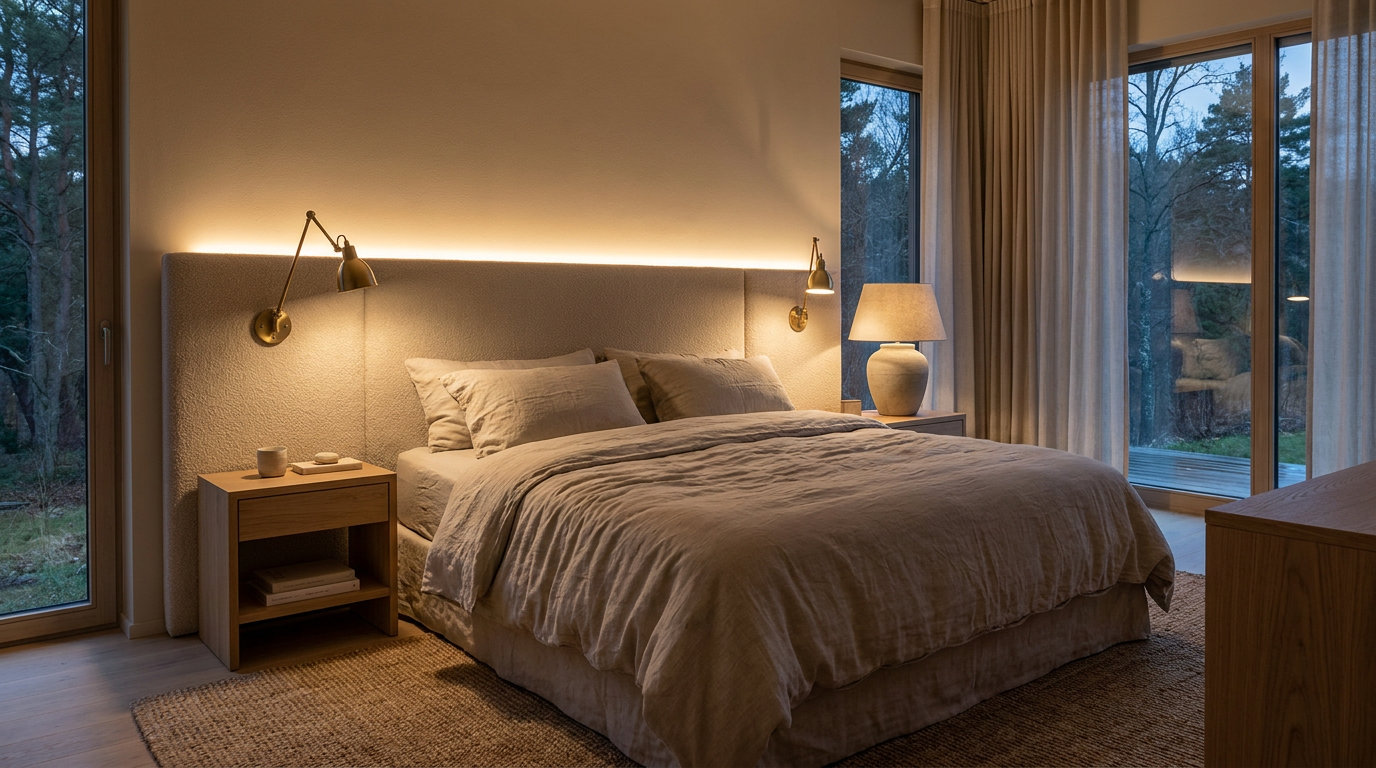
Bedrooms ask for restraint. The lighting should support rest rather than constant stimulation. Warm LEDs, bedside sconces, low-glare lamps, and concealed cove lighting are all effective choices. Layering is important here because no one wants to rely solely on a bright overhead source at night. Gentle wall lighting and dimmable reading lights allow the room to feel restorative.
Dressing areas and closets benefit from accurate color rendering so clothing appears true. Integrated LED strips inside joinery can be remarkably elegant, especially when activated by occupancy sensors that illuminate only when needed. This small detail feels luxurious while also preventing lights from being left on unnecessarily.
Bathrooms
Bathrooms require balance between clarity and softness. Mirror lighting should minimize shadow on the face, which often makes vertical sconces or integrated mirror lighting more flattering than a single overhead fixture. Warm-to-neutral LEDs with strong color rendering help skin tones look natural. For general ambiance, ceiling light can be paired with dimmable secondary sources so the room can shift from morning brightness to spa-like calm in the evening.
Because bathrooms are high-use spaces, durable efficient fixtures are especially worthwhile. Moisture-rated LEDs and quality drivers matter here, not only for safety but also for long-term performance. Refinement in the bathroom often lies in these hidden technical decisions.
Home Offices and Study Corners
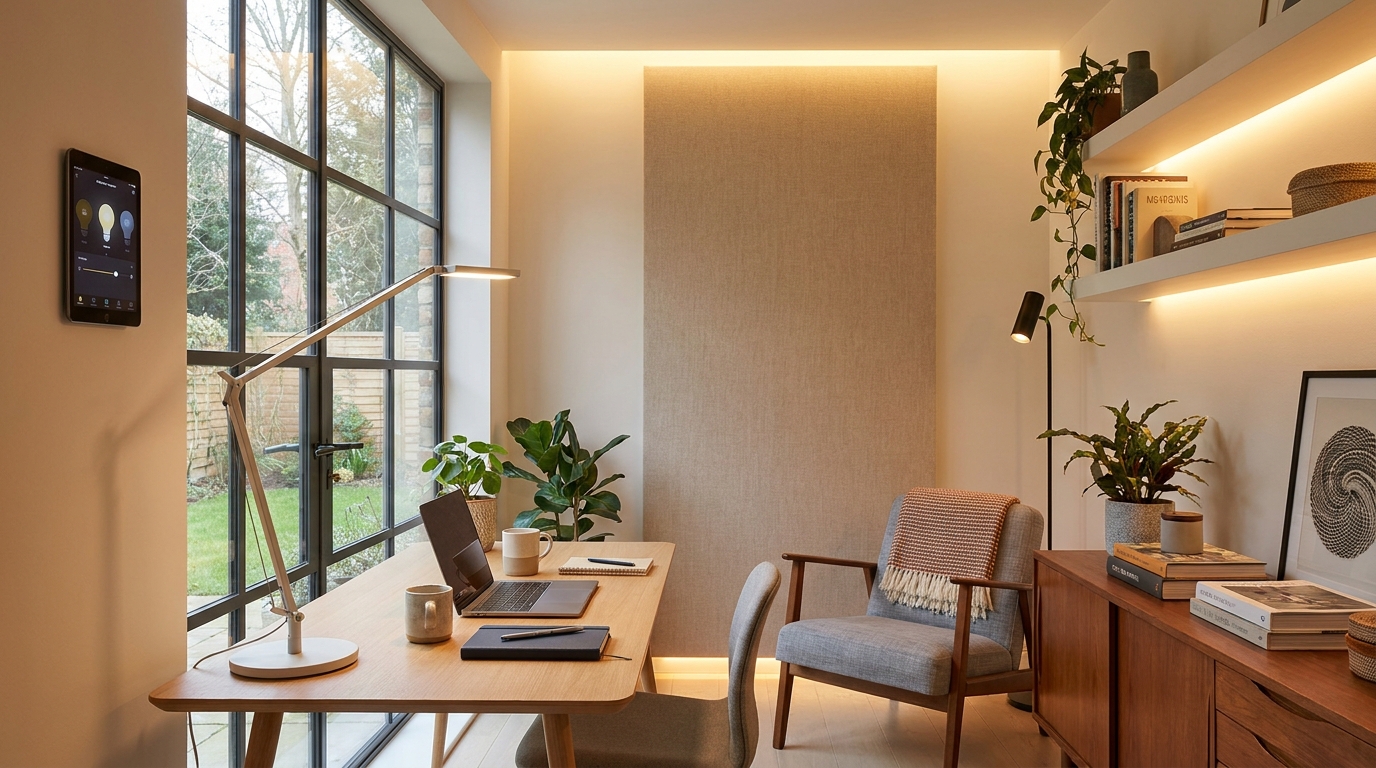
Workspaces require visual clarity and comfort over extended periods. A good LED task lamp with adjustable direction is one of the smartest upgrades for a home office. Paired with ambient room light and access to daylight, it creates a productive environment without over-illuminating the entire space. In multi-use rooms, this becomes especially useful because light can be directed where it is needed rather than spread indiscriminately.
Smart controls can also be particularly effective in offices. Scheduling and scene settings make it easy to transition from daytime work mode to evening calm. The result is a room that supports concentration without feeling clinical or detached from the rest of the home.
Controls, Sensors, and Smart Lighting as Design Tools
One of the most overlooked truths about energy-efficient lighting is that efficiency is not only about the bulb itself. Controls, placement, and operating habits play a major role in determining how much energy is actually used. Natural Resources Canada recommends controls such as timers, motion sensors, and photocells to reduce unnecessary lighting use. The International Energy Agency likewise highlights smarter controls as central to the next wave of lighting efficiency.
In practical terms, this means a beautiful home can also be an intelligent one. Occupancy sensors are ideal for closets, pantries, laundry rooms, mudrooms, and secondary bathrooms where lights are often forgotten. Timers can support exterior lighting schedules. Daylight-responsive systems can dim artificial lighting when natural light is sufficient, preserving both atmosphere and energy.
Smart home integration expands these possibilities further. Connected lighting now allows homeowners to create scenes for entertaining, quiet evenings, cooking, reading, or waking up gradually in the morning. Instead of moving from switch to switch, one can orchestrate a room’s mood with precision. This level of control is not merely technological flourish. It helps prevent waste, encourages better habits, and makes layered lighting easier to enjoy fully.
There is an aesthetic benefit as well. Smart controls support subtlety. They allow a cove light to glow gently while pendants remain dimmed, or permit hallway lighting to lower automatically late at night. This fluidity creates a home that feels responsive and calm. Sustainability, in this context, becomes inseparable from comfort and grace.
How to Read Product Quality Beyond Marketing
Not all LEDs are equal, and this is where careful selection matters. A product may claim energy efficiency while failing to deliver pleasing light, smooth dimming, or long-term consistency. For homeowners seeking both beauty and reliability, product specifications deserve attention. The most useful starting points include lumens, color temperature, CRI, dimmability, rated life, and certification.
ENERGY STAR certification is valuable because it signals that products have met established performance criteria. This can include aspects such as thermal management, longevity, and color quality through rated life. Since LEDs are expected to last for years, these qualities are not minor technicalities. They shape the daily visual experience of a room.
It is also wise to consider fixture and bulb compatibility. A dimmable LED should be paired with a compatible dimmer, and integrated fixtures should come from reputable manufacturers with clear performance data. Poor dimming, flicker, and color inconsistency can undermine even the most elegant interior. When in doubt, it is usually worth choosing fewer, better lighting elements rather than filling a home with inexpensive products that compromise comfort.
Quality in lighting is often felt rather than announced. It appears in the softness of shadow, the steadiness of illumination, and the way materials seem to come alive after dark. These are subtle pleasures, but they are the very essence of an elevated home.
Daylighting and the Dialogue Between Natural and Artificial Light
No discussion of sustainable lighting is complete without daylight. The most elegant homes do not treat artificial light as a replacement for natural light, but as its companion. During the day, thoughtful window treatments, reflective surfaces, and strategic furniture placement can help natural light travel more generously through the home. This reduces reliance on artificial light while enhancing well-being and visual ease.
Artificial lighting should then pick up where daylight leaves off. In rooms with generous windows, lower output and selective task lighting may be sufficient during much of the day. In deeper or north-facing rooms, layering and warmer tones can compensate gently without creating abrupt contrast. A home feels most harmonious when its lighting responds to the rhythm of daylight rather than ignoring it.
Photocells and smart controls make this relationship more refined by adjusting output based on available daylight. This is not only efficient but deeply elegant, because it allows the interior to remain balanced and calm as outdoor light changes. The room is neither overlit at noon nor underlit at dusk. It simply adapts.
Common Misconceptions That Deserve Retirement
Many homeowners still carry outdated assumptions about energy-efficient lighting, often based on early products that lacked warmth or finesse. One of the most persistent misconceptions is that LEDs are always cold or harsh. In truth, modern LEDs are available in a wide range of warm color temperatures and decorative formats suitable for every kind of residential interior, from rustic to highly contemporary.
Another misconception is that efficiency is only about bulbs. In reality, fixtures, dimmers, occupancy sensors, daylighting, and placement all affect the total energy picture. A poorly planned room with efficient bulbs can still waste energy and feel uncomfortable. A carefully layered room with quality controls will usually perform much better both visually and environmentally.
Homeowners also sometimes assume that higher upfront price means indulgence rather than value. Yet when one considers lifespan, maintenance, and lower electricity use, many LED solutions become economically compelling over time. This is especially true in frequently used areas. The long view often reveals that beauty and prudence are not in conflict at all.
Finally, it is important to retire the habit of choosing bulbs by wattage. The Department of Energy advises selecting bulbs based on brightness and intended use rather than wattage alone. Once one begins thinking in lumens, color quality, and function, the process becomes much more intuitive and much more rewarding.
A Room-by-Room Approach to an Elegant Lighting Upgrade
For homeowners wondering where to begin, the most effective strategy is often gradual rather than dramatic. Start with the rooms that are used most often and where the lighting quality most affects daily life. Kitchens, living rooms, bedrooms, and bathrooms are excellent priorities. Replace poor-quality or outdated bulbs with warm, dimmable, high-CRI LEDs. Then assess whether the room needs better layering rather than simply more brightness.
Next, consider controls. Add dimmers where mood matters, occupancy sensors where lights are commonly left on, and timers for exterior or transitional spaces. If the home is already using smart devices, lighting is one of the most satisfying systems to integrate because the visual and energy benefits are immediate. Scene setting, especially in open-plan areas, can transform how spaces are experienced.
Then turn to accent opportunities. Could shelving benefit from discreet illumination? Would under-cabinet task lighting improve both usefulness and beauty in the kitchen? Could a hallway become more welcoming with wall washing or a sequence of sconces? These are not extravagant gestures. They are precise ones, and precision is often what distinguishes an ordinary interior from a memorable one.
Finally, edit. Too many fixtures can be as detrimental as too few. A refined lighting scheme is composed, not crowded. Each source should contribute to function, atmosphere, or emphasis. If it does none of those things, it may not belong. Energy-efficient design is, at its heart, an art of intention.
What the Future of Residential Lighting Looks Like
The future of home lighting is not simply brighter or cheaper. It is more intelligent, more adaptive, and more aligned with the experience of living beautifully. The International Energy Agency points to a growing emphasis on smarter controls, improved product design, circularity, and higher performance. For homeowners, this suggests a future in which lighting systems are not only efficient in operation, but also better designed across their full lifecycle.
We are also seeing greater interest in human-centered lighting and circadian awareness, where brightness and color can shift to support alertness by day and calm by evening. While not every home requires advanced programming, the broader movement reinforces an important idea. Lighting is no longer an afterthought. It is part of wellness, sustainability, and architectural identity all at once.
As LEDs continue to evolve, they are likely to become even more discreet, more customizable, and more seamlessly integrated into furniture, millwork, and building fabric. This opens beautiful possibilities for interiors that feel softly illuminated rather than mechanically lit. The emotional effect is subtle yet profound. Light becomes part of the architecture itself.
Conclusion: The Most Graceful Light Is Thoughtful Light
Energy-efficient lighting is one of the rare home upgrades that touches aesthetics, sustainability, comfort, and long-term value all at once. It offers measurable environmental gains, yes, but its deeper gift is experiential. It allows rooms to glow with more nuance, supports everyday rituals with greater ease, and reduces waste in a way that feels effortless rather than sacrificial.
In the contemporary home, elegance is increasingly defined by intelligence and restraint. A beautifully designed space is not one that consumes carelessly, but one that uses materials, systems, and light with discernment. LEDs, high-quality controls, and layered planning make this possible. They allow us to create homes that are atmospheric and expressive while still mindful of the energy they draw from the world around them.
Perhaps that is the real luxury now. Not abundance without purpose, but beauty with awareness. Not brightness for its own sake, but illumination tuned to life. When lighting is chosen with both artistry and responsibility, the result is a home that feels more serene, more enduring, and unmistakably more elegant.
Quick Reference: What to Prioritize When Choosing Energy-Efficient Lighting
- Choose LEDs first for the best combination of efficiency, longevity, and design flexibility in residential spaces.
- Shop by lumens, not wattage, so brightness matches the needs of the room and the activity.
- Select warm or warm-neutral color temperatures for most living spaces to maintain a welcoming residential atmosphere.
- Look for high CRI if you want materials, artwork, and skin tones to appear rich and natural.
- Use dimmable products and compatible dimmers to add flexibility, comfort, and lower evening energy use.
- Layer ambient, task, and accent lighting instead of relying on one overly bright source.
- Add controls such as timers, occupancy sensors, and daylight-responsive systems to reduce unnecessary use.
- Prefer certified quality such as ENERGY STAR products when possible for greater confidence in long-term performance.
When these principles come together, sustainable lighting stops feeling like a technical category and begins to feel like what it truly is: a design language of warmth, discipline, and quiet sophistication.



No Comment! Be the first one.