



Energy Storage Systems: A Guide for Homeowners and Builders
Energy storage systems have become one of the most practical upgrades in modern residential construction and renovation. A few years ago, many people thought of home batteries as specialty equipment for off grid cabins or high end custom homes. That picture has changed. Today, battery energy storage systems are showing up in suburban new builds, deep energy retrofits, solar projects, and homes where owners simply want better control over outages, electric bills, and future energy costs.
Table Of Content
- What Is an Energy Storage System?
- How Does Home Battery Storage Work in Real Life?
- Power and Energy Are Not the Same Thing
- Why Is Energy Storage Becoming More Common in Homes?
- What Are the Main Benefits of Energy Storage for Homeowners?
- Why New Builds and Major Renovations Have an Advantage
- Choosing the Right System Starts With the Right Questions
- A Practical Sizing Framework
- What Do Energy Storage Systems Cost?
- Safety, Codes, and Why Installer Quality Matters
- What Are the Most Common Misconceptions About Energy Storage?
- How Storage Fits With Solar, Heat Pumps, and EV Charging
- What Builders Should Consider During Design and Construction
- A Simple Decision Process for Homeowners
- Future Trends Homeowners and Builders Should Watch
- Final Takeaway
The change is not just anecdotal. The International Energy Agency reported that global battery storage deployment reached 108 GW of new capacity in 2025, which was 40 percent higher than in 2024. That is a strong sign that storage is scaling quickly across the electricity sector. At the homeowner level, that larger trend matters because technologies usually get more familiar, more standardized, and more usable as adoption grows. For builders, it means batteries are no longer a fringe add on. They are becoming part of the wider conversation around solar, electrification, backup power, and resilient building design.
This article looks at energy storage systems from a practical point of view. It explains what these systems do, how they work in real homes, when they make sense for new construction and renovations, and what mistakes to avoid. The goal is simple: give homeowners and builders a grounded understanding of where battery storage adds real value and where expectations need to be realistic.
Home battery storage works best when it is treated as part of the whole house electrical strategy, not as a gadget added at the end of the job.
What Is an Energy Storage System?
In residential use, an energy storage system usually means a battery energy storage system, often shortened to BESS. In simple terms, it stores electricity so you can use it later instead of the moment it is generated or purchased from the grid. If a home has solar panels, the battery can capture excess daytime production and hold it for evening use. If the utility has time of use pricing, the battery may charge when rates are lower and discharge when rates are higher. If the grid goes down, the battery can power selected loads or in some cases most of the home for a limited period.
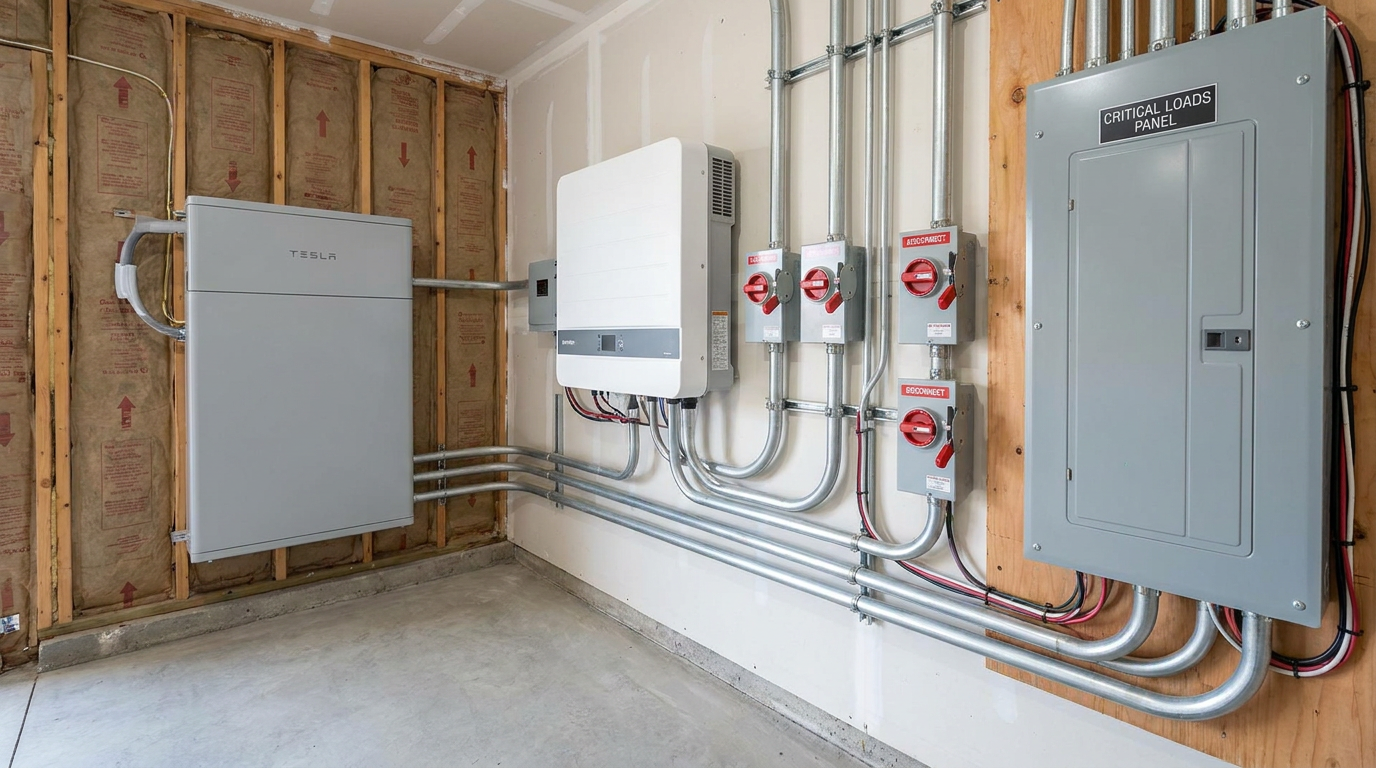
That sounds straightforward, but the system is more than just a battery box on the wall. A residential storage setup usually includes the battery modules, an inverter, a battery management system, disconnects, metering, protective equipment, and the electrical connections that tie it into the home and often the solar system. NRCan’s clean technology tax guidance in Canada explicitly defines electrical energy storage equipment broadly enough to include not just storage batteries, but also the inverter, battery management system, temperature control, transformer, meter, and branch electrical connection. That is a useful reminder that a functioning storage system is an integrated assembly, not a single product.
For most homeowners, the easiest way to think about storage is as a controllable reserve of electricity. It can improve resilience, increase use of onsite solar generation, and give the house more flexibility in how it interacts with the grid. It does not create electricity on its own. It stores power that came from solar, the grid, or in some cases another source. That distinction matters because buyers sometimes assume a battery alone will keep delivering power indefinitely. It will not. It only has what was previously stored.
How Does Home Battery Storage Work in Real Life?
The practical value of energy storage becomes clearer when you look at everyday operation. On a sunny day, a house with solar panels may produce more electricity than it needs around midday. Without a battery, that extra power usually goes to the grid if the utility allows it under a net metering or similar billing arrangement. With a battery, some of that surplus can be stored for later use. The home then draws on that stored energy during the evening, overnight, or whenever rates are high.
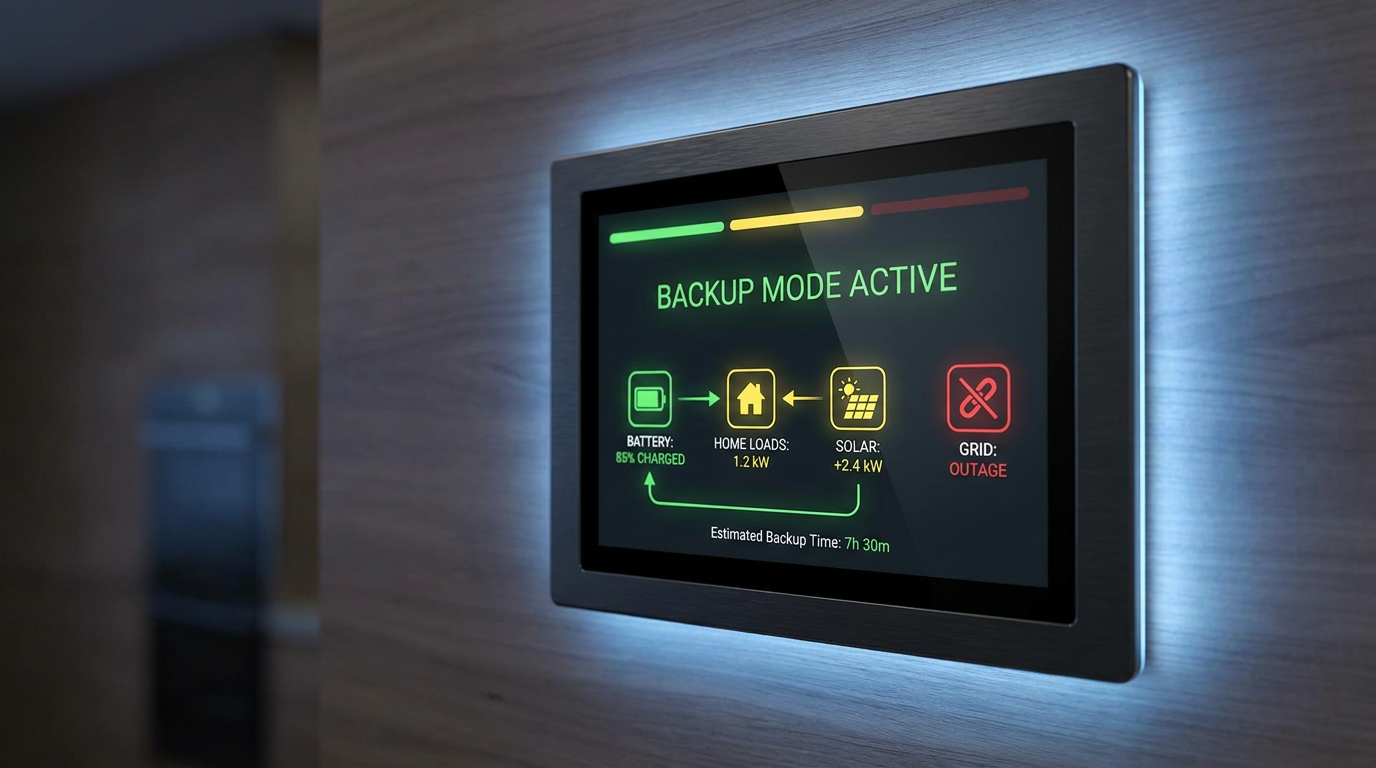
Storage is also important during outages. The U.S. Department of Energy notes that solar plus storage can automatically island during grid outages and continue powering loads without fuel deliveries. The phrase automatically island means the system disconnects from the grid for safety and keeps serving designated circuits from the battery and possibly from solar if conditions allow. That is one of the clearest real world benefits compared with a standard grid tied solar setup, which typically shuts down during outages unless paired with battery controls designed for backup operation.
In practice, most homeowners do not back up every circuit in the house. They back up the circuits that matter most. That often includes refrigeration, some lighting, internet equipment, a sump pump, garage door opener, selected receptacles, and maybe parts of the HVAC system. In all electric homes, backup strategy needs more careful planning because heating equipment, electric water heaters, induction cooking, and central air conditioning can demand a lot of power. That is why system design has to start with actual loads, not just marketing claims about battery capacity.
Power and Energy Are Not the Same Thing
One of the most common misunderstandings is the difference between power and energy. Battery capacity is usually described in kilowatt hours, or kWh. That tells you how much electricity the battery can store. Power output is usually described in kilowatts, or kW. That tells you how much electricity the system can deliver at one time. Both matter.
A simple example helps. Imagine a battery with 10 kWh of storage and a 5 kW continuous output. That may sound substantial, and in many homes it is useful. But if the house tries to run a large electric range, a central air conditioner, and an electric dryer all at once, the system may not be able to supply enough power at that moment even though it still has energy in reserve. On the other hand, if the home is only running a fridge, lights, internet, and a blower motor, the same battery may last many hours because both power demand and total energy use are lower.
For homeowners comparing products, this is where a lot of confusion starts. Bigger capacity does not automatically mean better backup. If the inverter and battery cannot start or support your actual loads, the extra stored energy does not solve the problem. Good designers look at startup loads, continuous loads, desired backup duration, and whether there will be load shedding or a critical loads subpanel. Those details determine whether the system will feel dependable in a real outage.
Why Is Energy Storage Becoming More Common in Homes?
Residential storage is not growing for just one reason. It sits at the intersection of several changes in home energy use. More homes are adding solar. More homeowners are buying electric vehicles. More builders are installing heat pumps and moving away from combustion appliances. Utilities in some regions are using time of use pricing or other tariff structures that reward shifting consumption away from expensive periods. At the same time, outage concerns have become more prominent because of storms, wildfire related shutoffs, grid stress, and the simple reality that many households now depend heavily on internet connectivity and home office equipment.
That combination makes storage more attractive than it was when homes used less electricity and fewer loads were essential. In North America, residential storage is increasingly tied to resilience, electrification, and self consumption rather than only emergency backup. A battery can help a house operate more smoothly as an electrified system. It can reduce the mismatch between when solar produces power and when the house actually needs it. It can also soften the impact of utility pricing that penalizes consumption during peak hours.
There is also a broader market confidence effect. Ontario announced in 2025 that it broke ground on what it described as Canada’s largest battery storage project. Utility scale projects like that do not mean a home battery is the same as a grid battery, but they do show that storage is now mainstream electrical infrastructure. When a technology is being deployed from house scale to grid scale, it becomes easier for homeowners and builders to treat it as a serious planning item rather than a novelty.
What Are the Main Benefits of Energy Storage for Homeowners?
The biggest practical benefit for many homeowners is resilience. If your area sees frequent outages, or if your home contains equipment that cannot tolerate interruption, a battery can protect your daily routine in a way that feels immediate and concrete. Refrigeration stays on. The internet stays live. Medical devices, pumps, lighting, and charging circuits can continue working. Unlike a fuel powered generator, a battery does not need onsite combustion or fuel deliveries. For households that want quieter backup with less maintenance, that is a real advantage.
The second major benefit is better use of solar power. Without storage, a lot of midday solar generation may be exported when the house is lightly occupied and then bought back later when the family returns home and electricity use climbs. A battery improves self consumption by saving some of that generation for later. Depending on the utility tariff and billing arrangement, that can improve project economics, though the exact value varies a lot by location.
The third benefit is bill management under time based rates. If the utility charges more during peak periods, the battery can help avoid buying expensive electricity at the worst times. This is often called peak shaving or time shifting. It can be financially useful, but it is not universal. In some places, favorable net metering or low rate differences reduce the economic benefit of a battery. That is why buyers should be cautious about promises that a battery always pays for itself quickly.
A fourth benefit is readiness for a more electrified house. If you are adding a heat pump, electric water heating, EV charging, or all of the above, storage can become part of a broader strategy for managing loads. It does not replace service upgrade planning or efficiency work, but it can support a home that is relying on electricity for more of its comfort and transportation needs.
Why New Builds and Major Renovations Have an Advantage
Battery storage can be added later, but it is usually easier and more cost effective to plan for it during design or major renovation. New construction gives the project team a chance to coordinate battery location, conduit runs, wall space, ventilation requirements, inverter placement, service equipment, solar readiness, and critical loads planning before finishes are complete. That reduces rework and often produces a cleaner, safer installation.
NRCan’s solar planning guidance is useful here because it lays out battery ready and battery installed pathways for net zero ready and solar equipped homes. That approach matters. A house does not have to install batteries on day one to benefit from smart planning. Builders can make a home battery ready by reserving space, sizing electrical equipment thoughtfully, roughing in pathways, and coordinating future solar and storage decisions with HVAC and EV charging plans. For homeowners who are watching budgets, that can be a practical middle path.
Renovations create a similar opportunity, especially when the electrical service is being upgraded, the roof is being replaced, or the home is undergoing broader energy improvements. If walls are open and the panel is already being touched, it makes sense to ask whether the house should be prepared for solar plus storage. Too many retrofits happen in silos, with the electrical work, mechanical upgrades, and envelope improvements treated as separate projects. Battery integration works better when those decisions are coordinated.

Choosing the Right System Starts With the Right Questions
The first question is not which brand to buy. It is what problem the system is meant to solve. Some homeowners want outage protection for a handful of critical loads. Others want to maximize solar self consumption. Some care mostly about utility bill management under time of use rates. A few want whole home backup. Those are different design briefs, and they lead to different system sizes, configurations, and budgets.
The second question is what loads really matter. This is where a load schedule becomes useful. List the essential circuits, estimate their power demand, and think honestly about what needs to run simultaneously during an outage. Most houses can reduce battery size significantly if they avoid trying to back up large resistance loads or every convenience load in the house. Refrigeration, lighting, communication equipment, and selective receptacles often deliver most of the resilience value without the cost of full house backup.
The third question is how long backup needs to last. A short outage strategy may be very different from a design intended to ride through multi day disruptions. A battery that works well for evening peak shifting and occasional interruptions may not be enough if the goal is extended outage coverage in winter, especially if the house relies on electric heating. In those cases, solar production, load management, and possibly supplemental backup sources all need to be evaluated together.
The fourth question is how the home interacts with the utility. Ontario’s net metering program, for example, allows eligible customers to offset electricity consumed with renewable generation, but the province makes clear that project approval and utility connection steps should come before equipment is purchased or installed. That is a practical warning worth repeating. Homeowners should understand the local rules first. Utility approval, export permissions, interconnection requirements, and metering arrangements can affect both design and economics.
A Practical Sizing Framework
A sensible way to think about sizing is to work through four layers. Start with critical loads, because they define the minimum useful backup system. Then consider duration, meaning how many hours those loads should be supported. Next examine charging sources, such as solar, the grid, or both. Finally look at future electrification, because the system should not be obsolete the moment an EV charger or heat pump is added.
In many homes, the critical loads approach leads to the best value. Instead of paying for a battery large enough to carry every load at once, the design focuses on the things that preserve safety, comfort, and function. A larger system may still be justified, but the decision should be based on a real load profile. It should not be based on the assumption that more capacity is always more practical. Plenty of homeowners would benefit more from a right sized battery plus efficiency upgrades than from the biggest battery their budget can stretch to.
What Do Energy Storage Systems Cost?
Battery storage economics are highly case specific. A system that makes financial sense in one market may look much weaker in another. The key variables include utility rates, time of use pricing, demand charges where applicable, net metering rules, outage frequency, solar system size, installation complexity, and available incentives or tax treatment. That is why simple payback claims should be treated carefully.
In Canada, the policy environment has become more supportive. NRCan notes that batteries can be added to eligible new or existing solar PV systems under the Canada Greener Homes Initiative, and the program also includes resiliency measures where batteries are paired with other retrofits. For builders and larger scale projects, NRCan’s tax guidance now treats electrical energy storage equipment as a defined class for clean technology tax purposes. In the United States, qualified projects placed in service after 2024 can benefit from clean electricity tax credit structures, depending on project specifics. Those policy signals do not eliminate cost, but they do show that storage is being recognized as a legitimate part of clean energy investment.
Even with incentives, the most durable financial case often combines several benefits rather than relying on one. A homeowner might save some money by shifting energy use, get more value from solar generation, avoid food spoilage or work disruption during outages, and postpone or reduce other backup spending. That total value can justify storage even when the battery is not a quick payback item on electricity savings alone. The right question is not always, Will this battery pay for itself fast? Sometimes the better question is, What combination of resilience, bill control, and future readiness is worth paying for in this house?
Safety, Codes, and Why Installer Quality Matters
This is the part of the conversation that should never be rushed. Home batteries are electrical equipment with significant stored energy, and they must be installed in compliance with applicable codes and manufacturer requirements. Location, clearances, protection, ventilation needs where relevant, fire separation, and access all matter. A battery is not a decorative appliance. It is part of the building’s electrical infrastructure.
In Canada, CSA is developing a residential behind the meter battery installation and commissioning technical specification, which shows how much attention the field is getting. NRCan also notes that some recent Canadian Electrical Code changes may prohibit battery installations inside dwellings in certain cases, making local code authority confirmation essential. In the United States, key safety references include NFPA 855 and UL 9540A and UL 9540B, which address installation, fire behavior, and thermal runaway testing. UL’s current guidance emphasizes that residential systems require specific evaluation of fire propagation and installation conditions.
For homeowners, the practical takeaway is simple. Do not assume the system can go anywhere you have free wall space. Do not buy equipment before confirming utility and code requirements. Do not treat installer selection as a minor detail. Ask whether the contractor has direct experience with residential storage, what products they are certified to install, how they handle commissioning, and how service support works after the job is complete. Good workmanship matters just as much here as it does with roofing, plumbing, or structural framing.
A well designed battery system should look boring in the best sense of the word. It should be orderly, compliant, labeled clearly, and installed by people who understand both the equipment and the local code environment.
What Are the Most Common Misconceptions About Energy Storage?
One common misconception is that batteries are only useful for off grid homes. In reality, many grid tied homes use storage for backup power, self consumption, and peak shifting. Another misconception is that batteries always save money. They can save money, but economics depend heavily on tariff design, incentives, and how the home actually uses electricity. A battery in a favorable rate environment may perform very differently from the same battery in a region with low power prices and generous net metering.
A third misconception is that larger capacity automatically means better backup. As discussed earlier, power output and load management matter just as much as stored energy. A fourth misconception is that batteries can be installed anywhere indoors without special rules. They cannot. Code, fire safety, and installation requirements can be strict and can vary by province, state, municipality, and product type.
Another important misconception is that energy storage replaces efficiency work. It does not. Official guidance in both Canada and the United States consistently points homeowners toward envelope improvements, air sealing, insulation, better windows where appropriate, and HVAC efficiency before or alongside renewable energy and storage investments. A drafty house with oversized electrical loads will often need a bigger and more expensive battery to do the same job as an efficient house. Efficiency first is still sound advice.
How Storage Fits With Solar, Heat Pumps, and EV Charging
The strongest use case for residential battery storage often appears when it is paired with other electrical upgrades. Solar plus storage is the most obvious combination. Solar gives the home a source of onsite generation, and the battery helps capture more of that value. Without solar, a battery can still provide backup and rate management, but the economics and resilience profile may be different. With solar, especially in a well designed system, the battery becomes more than an outage tool. It becomes part of daily energy management.
Heat pumps also change the picture. They can be efficient, but they still place meaningful electrical demand on the house, particularly in colder weather or in homes that have not improved the building envelope. Builders designing all electric homes should think carefully about whether battery storage is intended to support heating loads during outages, and if so, for how long. In some cases, the best strategy is to focus battery backup on circulation, controls, and a limited comfort zone rather than trying to maintain full normal operation across the entire house.
Electric vehicle charging is another factor. A home with an EV often has more flexibility needs and a stronger case for integrated electrical planning. There is also growing interest in bidirectional EV charging, where a parked electric vehicle can serve as mobile storage for the house. That is not yet a universal residential standard, but it is a trend worth watching. In time, many homeowners may think of stationary batteries and vehicle batteries as complementary assets rather than separate conversations.
What Builders Should Consider During Design and Construction
From a builder’s standpoint, the smartest projects deal with storage early. The first consideration is equipment location. The battery and inverter need an approved, practical place with service access, proper clearances, and coordination with the rest of the electrical layout. The second consideration is the service and panel strategy. If the house may get solar, EV charging, and a battery, then panel capacity, bus ratings, and circuit organization should reflect that from the start.
The third consideration is future adaptability. Even if a client is not installing a battery on day one, the house can be made battery ready with conduit pathways, reserved wall space, panel organization, and planning for a critical loads subpanel. That kind of foresight is usually inexpensive during construction and much more disruptive later. It also gives the homeowner a cleaner upgrade path when budget, incentives, or utility conditions become favorable.
The fourth consideration is coordination across trades. Electrical, HVAC, solar, framing, and architectural decisions affect one another. If the battery is being added to support a net zero ready or highly electrified home, then the storage discussion belongs in the same room as the decisions about heat pumps, ventilation, EV charging, and load calculations. Builders who treat these as isolated scopes often create unnecessary conflicts or missed opportunities.
A Simple Decision Process for Homeowners
If you are considering home energy storage, a structured decision process helps. Start by defining your priority: backup power, solar self consumption, bill management, future electrification, or some mix of those. Then gather one year of utility bills and note any time of use structure, demand charges, or outage history. After that, list the loads you actually want backed up and estimate how long you want them to run in an outage.
Next, check local program rules, utility requirements, and any incentive pathways before shopping aggressively. In Ontario and many other jurisdictions, approval and interconnection steps matter and should come before equipment purchase. Once those basics are clear, get proposals from qualified installers that show not just battery capacity but also power output, backup loads, expected operating mode, monitoring features, warranty terms, and any assumptions behind projected savings.
Finally, compare the storage option against other uses of the same budget. Sometimes the right answer is a battery now. Sometimes it is solar first and battery later. Sometimes the best first move is air sealing, a panel upgrade, or reducing major loads through better equipment. A good contractor or consultant should be willing to talk through those tradeoffs honestly.
Future Trends Homeowners and Builders Should Watch
The residential market is still evolving, and a few trends are worth attention. One is the shift toward longer duration storage in the broader electricity system. Most homes still use shorter duration lithium ion systems, but the general push for longer duration flexibility will influence how people think about resilience and grid support over time. Another trend is stronger residential specific safety testing and guidance, including continued attention to standards such as UL 9540B and developing CSA specifications.
Bidirectional EV charging is another important development. If automakers, utilities, and equipment standards align, the family vehicle could become a meaningful backup and load management asset. That would not eliminate the need for stationary batteries in every case, but it could reshape residential energy planning. There is also growing interest in demand response and microgrid style coordination, where homes with batteries interact more actively with utility programs or community energy systems.
The broader point is that storage is moving from optional backup toward an enabling technology for electrification, solar integration, and grid resilience. Homeowners do not need to chase every new feature, but they should understand that battery readiness is becoming part of sensible long term planning. Builders, especially those working on high performance or all electric homes, should expect more clients to ask about it.
Final Takeaway
Energy storage systems are not magic boxes, and they are not right for every house in the same way. Their value depends on how the home uses electricity, how often outages happen, how utility rates are structured, what equipment the home needs to support, and whether the battery is being integrated thoughtfully with solar and other upgrades. When those factors line up, storage can be a very practical investment in resilience, energy control, and future readiness.
For new builds and major renovations, the best time to deal with storage is before the walls are closed and the electrical plan is locked in. For existing homes, the best approach is to define the goal clearly, understand loads honestly, verify code and utility requirements early, and choose an installer with proven experience. In both cases, battery storage works best as part of a whole house strategy that respects the basics of efficiency, safety, and good design.
The technology is moving quickly, but the core advice stays steady. Start with the house. Know your loads. Improve efficiency where it makes sense. Plan the electrical system as a system. Then, if storage fits the job, it can be one of the most useful upgrades you make.



No Comment! Be the first one.