

Where Toronto’s Detached Market Is Starting to Send Investable Signals
The Greater Toronto Area’s detached housing market is no longer uniformly quiet. For investors, that does not mean the rebound is broad or risk-free. It means select pockets are beginning to show the first signs of renewed buyer depth, price resilience, and liquidity.
According to reporting by INsauga on Re/Max Canada’s 2026 Hot Pocket Communities report, detached housing sales rose year over year in 61 per cent of the 83 markets reviewed across the GTA, Greater Vancouver and the Fraser Valley in the first half of 2026. Price growth, however, appeared in only five markets, four of them in the GTA.
That split matters. Rising sales without broad price growth usually suggests buyers are returning, but still negotiating from a position of caution. For investors, transaction volume is often the earlier signal. Price appreciation tends to follow only when inventory tightens, financing conditions improve, and confidence becomes more durable.
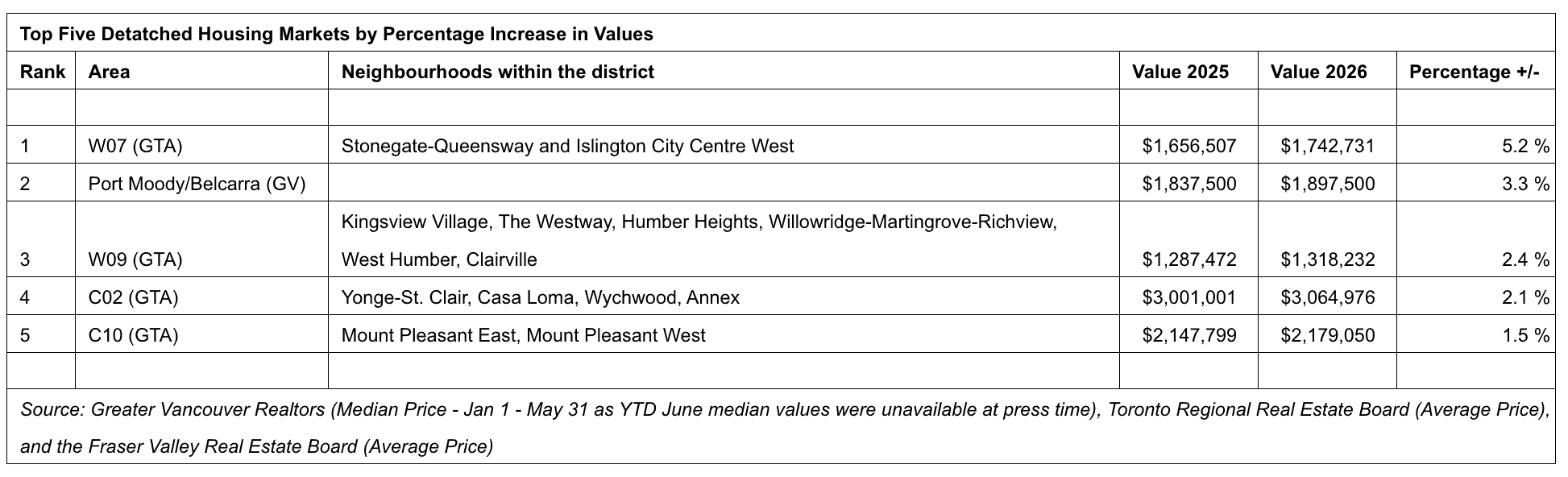
The strongest price move came in Stonegate-Queensway and Islington City Centre West, where detached values rose 5.2 per cent, from $1,656,507 in 2025 to $1,742,731 this year. This is a meaningful signal because these west Toronto markets combine established housing stock, access to transit and employment nodes, and limited detached supply.
Other gains were more modest but still notable. Kingsview Village, The Westway, Humber Heights, Willowridge-Martingrove-Richview, West Humber and Clairville moved from $1,287,472 to $1,318,232. Yonge-St. Clair, Casa Loma, Wychwood and the Annex increased from $3,001,001 to $3,064,976. Mount Pleasant East and West rose from $2,147,799 to $2,179,050.
These are not speculative fringe markets. They are mature neighbourhoods where detached homes are scarce and replacement value is high. That makes price support more likely when demand returns, but it also limits yield for conventional rental investors unless there is a redevelopment, multi-unit conversion, or long-term land assembly thesis.
Volume is returning before pricing, and that is exactly where disciplined investors should pay attention.
The sales data is equally important. Willowdale West, Newtonbrook West, Westminster-Branson and Lansing-West saw detached sales rise from 80 to 122. Newtonbrook East and Willowdale East rose from 78 to 102. Aurora increased from 153 to 200, while St. Andrews-Windfields moved from 56 to 71.
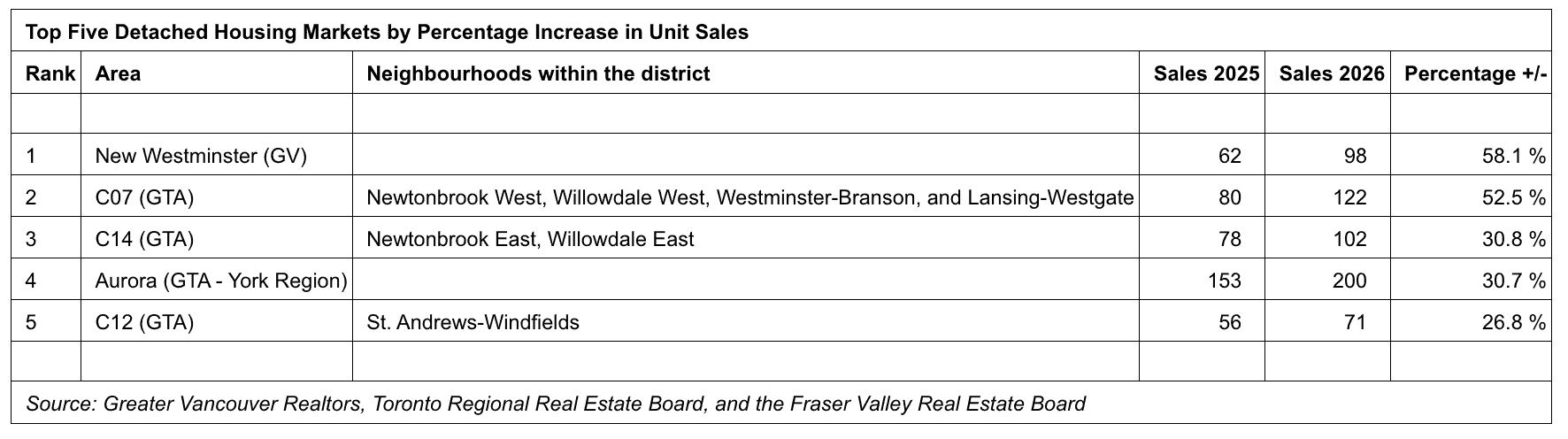
For capital allocators, these figures point to liquidity corridors rather than blanket appreciation. Areas with rising sales but flat prices may offer better entry points than markets already posting gains. The buyer pool is active, yet valuations may not have fully repriced. That is where negotiation, property condition, and financing discipline can still create an edge.
Affordability remains the constraint. Durham markets including Ajax, Clarington, Brock, Oshawa and Scugog remain below $1 million for detached homes. Georgina was cited at $849,256. Brampton averaged $1,029,973, while some Scarborough pockets remain below $900,000, and Malvern Rouge was identified below $600,000.
The risk is that investors mistake activity for recovery. Re/Max Canada’s Don Kottick cautioned that affordability, confidence and potential shadow inventory remain unresolved. That is the correct read. Higher sales are constructive, but they do not erase carrying-cost pressure, mortgage renewal risk, or the possibility of more listings entering the market.
The practical takeaway is to watch markets where sales are rising before prices accelerate. In this cycle, the best opportunities are unlikely to come from chasing the hottest headline number. They will come from identifying neighbourhoods with returning liquidity, durable end-user demand, and enough pricing softness to buy well.
Source: INsauga