



Real estate is one of the most important markets in everyday life, yet many property transactions still rely on systems that feel slower and more fragmented than buyers and sellers expect. A home purchase can involve brokers, lenders, lawyers, title professionals, registrars, insurers, and government records, all working across different databases and document standards. That complexity creates delays, extra cost, and opportunities for error. It also explains why blockchain has become one of the most discussed technologies in modern PropTech.
Table Of Content
- What blockchain means in a property transaction
- Why property transactions need improvement
- How blockchain can make transactions faster
- How blockchain can reduce fraud in real estate
- Record-keeping is where blockchain may matter most
- Blockchain does not replace land registries or property law
- North American pilots and practical experimentation
- Tokenization is related, but it is not the same thing
- What blockchain can and cannot do
- Where the biggest near-term gains are likely to appear
- A realistic future for blockchain property systems
- Conclusion
- Frequently asked questions about blockchain in real estate
- Is blockchain the same as cryptocurrency in property transactions?
- Can blockchain replace land registries in Canada?
- Does blockchain eliminate real estate fraud?
- What is the biggest practical benefit of blockchain in property today?
- Is tokenization the same as putting a deed on the blockchain?
Blockchain is revolutionizing property transactions by giving buyers, lenders, lawyers, title professionals, and registrars a shared, tamper-evident digital record that everyone can view and trust at the same time. Instead of each party keeping its own isolated paperwork, a blockchain-based system logs identity checks, contract milestones, mortgage conditions, and document signatures in one synchronized, time-stamped sequence. That shared record speeds up closings by cutting out repetitive verification, reduces fraud by making unauthorized changes to ownership or contract data easier to detect, and improves long-term record-keeping by creating a single, auditable history instead of scattered files across institutions. It is not a replacement for land registries, lawyers, or property law—legal title still depends on statutes and recognized registration processes. Its real value is as a trust layer underneath the existing system, making real estate transactions faster, more transparent, and harder to manipulate.
The most useful way to understand blockchain in real estate is not as a dramatic replacement for every land registry or legal process. A more realistic view is that it can strengthen how transaction data, ownership history, and contract workflows are recorded and checked. That pragmatic framing matters because in Canada and the United States, legal title still depends on established laws, registrars, and recognized transfer processes. Technology can improve the system, but it does not erase the legal backbone behind property ownership.
That balance between innovation and legal reality is exactly why blockchain deserves attention. Research and policy discussions in Canada and North America consistently point to the same issues in real estate: long processing times, high transaction costs, fragmented records, and ongoing fraud risk. Blockchain is attractive because it directly addresses these frictions through shared visibility, stronger audit trails, and harder-to-alter records. When used well, it can make transactions faster, more transparent, and easier to trust.
This article explains how blockchain is revolutionizing property transactions in practical terms. It will look at what blockchain actually does in real estate, why it can reduce fraud and improve record-keeping, where current pilots are focused, and what newcomers should understand before assuming it is a complete solution. The short version is that blockchain is not magic, but it is becoming an important intelligence layer in housing transactions.

What blockchain means in a property transaction
At its core, blockchain is a distributed ledger. That means a record can be shared across approved participants, with updates logged in sequence and designed to be very difficult to alter without leaving a trace. In a property setting, that shared ledger can be used to record transaction steps, ownership history, contract milestones, mortgage data, document signatures, and verification events. Instead of each party holding its own isolated version of the truth, blockchain aims to create a more synchronized record environment.
This matters because real estate transactions are full of repetitive verification. A buyer may provide identity documents to several parties. A lender may request records that a lawyer or broker has already seen. A title professional may need to confirm details from separate databases that do not easily speak to one another. Much of the friction in a closing does not come from the property itself. It comes from data moving slowly across disconnected systems.
Canadian Mortgage and Housing Corporation has described blockchain as a technology that could help record property transactions, track ownership, and manage contracts securely and transparently. It has also highlighted broader benefits such as improved data quality, faster issuance processes, lower cost, and reduced fraud. That language is important because it focuses on real operational gains rather than futuristic slogans. Newcomers should think of blockchain as a better record and coordination layer, not as a speculative add-on.
Another helpful point is that blockchain is not the same as cryptocurrency. A real estate platform can use blockchain-style infrastructure for secure record-keeping without exposing buyers to speculative digital coins. The business value comes from verifiable records, shared access, timestamps, and auditability. Those features can exist in permissioned systems designed for lenders, title companies, registries, and legal professionals.
In practical terms, a blockchain-supported property workflow might show exactly when a title search was completed, when identities were verified, when mortgage conditions were met, when documents were signed, and when ownership records were updated. Each authorized participant can view the same chronology. That reduces disputes about version control and lowers the need for phone calls and email chains just to confirm what happened and when.
Why property transactions need improvement
Real estate remains one of the most paperwork-heavy industries despite years of digital modernization. Even when documents are electronic, they often move through fragmented channels that still require manual checking and re-entry. Academic reviews repeatedly identify the same structural problems: high transaction costs, lengthy processing times, limited transparency, liquidity constraints, and fraud risk. Those are not minor inconveniences. They affect affordability, efficiency, and confidence in the market.
Consider a typical residential transaction. There are purchase agreements, financing conditions, identity checks, title searches, insurance confirmations, closing statements, registration submissions, and post-closing notices. Every step has a reason, but every extra handoff also creates a chance for delay or inconsistency. If one party uses outdated information or if a document is not properly reconciled, the process can slow down fast. That is why the industry spends so much time on verification rather than decision-making.
CMHC has also pointed to fragmentation in the housing finance ecosystem, including multiple intermediaries and the absence of a trusted shared source of data. This is a crucial insight. Many delays exist not because anyone is acting improperly, but because too many institutions are maintaining separate records with limited interoperability. A technology that improves synchronization can therefore create value even without changing the legal structure of ownership.
For buyers and sellers, this fragmentation often shows up as uncertainty. People ask whether the lawyer has the latest mortgage instructions, whether the title issue was resolved, whether funds have been released, or whether registration has actually gone through. A shared ledger cannot remove the underlying legal work, but it can create much better visibility around status and documentation. That alone can reduce stress and speed up coordination.
In that sense, blockchain addresses a very old real estate problem using a very modern tool. Property has always depended on trust, but trust has often been maintained through slow layers of documentation and manual review. Blockchain offers a way to preserve trust with stronger digital evidence and cleaner information flow.
How blockchain can make transactions faster
Speed is one of the clearest practical benefits of blockchain in property transactions. Many closings are delayed not by major legal disputes, but by routine coordination issues. Documents need to be located, compared, re-sent, confirmed, and approved by multiple parties. When a blockchain-based workflow creates one synchronized record of transaction events, a large amount of that repetitive checking can be reduced.
Imagine a purchase where the buyer’s identity verification, financing approval milestones, contract updates, and title review events are securely logged in a shared system. The lender does not need to guess whether a document is current. The lawyer does not need to rely on several email attachments with slightly different timestamps. The title professional can see a clearer audit trail of what has already been validated. This does not eliminate professional oversight, but it does reduce friction.
CMHC has specifically noted that blockchain could support faster issuance processes and lower costs. In housing finance, this is especially relevant for mortgage origination, securitization, servicing, and title-related workflows. These areas are known for heavy documentation and repeated verification. Blockchain can help by reducing duplication and creating reliable audit trails that are easier to review than scattered records across isolated systems.
Smart contracts are often part of this conversation, although they are sometimes misunderstood. In simple terms, a smart contract is a digital rule set that executes predefined actions when conditions are met. In real estate, that could mean triggering a next-step notification when financing is approved or logging the completion of a contract milestone once all required signatures are in place. The practical benefit is workflow automation, not a robot replacing legal judgment.
Faster transactions also produce secondary benefits. Buyers get more certainty, sellers face fewer costly delays, lenders can process files more efficiently, and professionals spend less time chasing administrative details. When transaction infrastructure improves, the market becomes more responsive overall. That is one reason blockchain is being discussed as part of a broader effort to modernize property systems.
How blockchain can reduce fraud in real estate
Fraud prevention is one of the strongest reasons blockchain has gained attention in property transactions. Real estate fraud can be devastating because it involves large asset values and can affect legal ownership itself. Canada.ca warns that real estate fraud can lead to a loss of home ownership and emphasizes the importance of land title searches. That warning reflects a real need for stronger verification, cleaner records, and better tools for spotting unusual changes.
Blockchain helps here because it creates records that are easier to audit and harder to alter secretly. If ownership-related data, contract updates, or title-adjacent events are logged in a tamper-evident sequence, unauthorized manipulation becomes more visible. Instead of quietly changing a record in a siloed system, a fraudulent change would be more likely to leave a detectable trail. That does not make fraud impossible, but it can make concealment much harder.
Researchers and practitioners often connect blockchain to reducing risks such as deed fraud, document tampering, and certain collusive behaviors. A shared ledger can improve confidence that all authorized parties are working from the same verified history. It can also support more robust chain-of-custody tracking for sensitive documents. In a market where timing, signatures, and ownership history matter, stronger auditability is a major advantage.
Still, it is important to avoid overstating the technology. Blockchain is not fraud-proof. If inaccurate or fraudulent information is entered into the system at the start, the ledger can preserve that bad data very effectively. This is often summarized as the classic data problem: bad inputs still create bad outputs. That is why identity verification, governance, legal review, and registrar oversight remain essential.
The best anti-fraud use of blockchain is therefore not blind automation. It is controlled transparency. When blockchain is combined with proper identity checks, KYC and AML compliance, legal validation, and trusted institutional participation, it can significantly improve record integrity. In property, fraud reduction depends on strong systems and strong rules working together.

Record-keeping is where blockchain may matter most
If there is one area where blockchain can have immediate practical value, it is record-keeping. Property transactions generate a long chain of documents, approvals, searches, amendments, and confirmations. In many systems today, each institution stores part of the story. That makes it difficult to build a single, trusted view of what happened across the life of a property or transaction.
Blockchain can improve this by creating a shared, chronological record that multiple approved participants can rely on. Instead of asking each party for separate copies of records, a platform can provide an integrated audit trail showing who updated what, when it happened, and whether the change has been validated. That does not only help with current transactions. It can also improve later servicing, refinancing, dispute resolution, and compliance review.
CMHC’s research on the housing finance ecosystem emphasizes exactly this issue. Fragmented systems, many third parties, and no trusted shared source of data create operational drag. Blockchain is attractive because it can synchronize records across participants and reduce reconciliation work. In practical terms, that means fewer duplicate checks, fewer mismatched versions, and less time spent proving that a document is the latest one.
This record-keeping advantage extends beyond title and ownership. Mortgage servicing, securitization processes, document verification, and secondary market operations can all benefit from cleaner audit trails. Real estate is not only about the sale itself. It is also about the full life cycle of financing and administration that follows. A more trustworthy data layer can therefore have effects long after closing day.
For newcomers, this is the most grounded way to think about blockchain in property. It is a tool for creating better evidence, better continuity, and better transparency in systems that still rely too heavily on fragmented records. The future may not look like every deed living on a public chain. It may look like many institutions quietly using blockchain-style infrastructure to make records more reliable.
Blockchain does not replace land registries or property law
One of the biggest misconceptions in this space is the idea that blockchain can simply replace land registries overnight. In reality, legal title depends on law, not just software. In Canada, provincial legislation governs land registration and transfers. British Columbia’s Land Title Act, for example, remains the legal framework that determines how registration and transfer rules operate. That means any blockchain solution has to fit within existing statutory systems rather than ignore them.
This legal reality is not a weakness. It is a design constraint, and a useful one. Property ownership is too important to be defined only by whichever platform happens to store a digital record. Courts, registrars, statutes, and recognized legal processes still determine enforceable title. Blockchain can support those systems by improving data integrity and workflow efficiency, but it does not independently create legal ownership where legislation says otherwise.
This is why most credible North American use cases are pilots, workflow tools, title-adjacent systems, and policy experiments rather than complete registry replacements. The strongest value today lies in making current systems work better. That includes reducing duplication among professionals, creating better document histories, and helping institutions reconcile records with greater confidence. In other words, blockchain is more likely to enhance the legal system than bypass it.
For readers new to the topic, this point is essential because it prevents the most common misunderstanding. A blockchain record may be technologically sophisticated, but property transfer still depends on recognized registration procedures. If a province or state requires submission through a legal registrar, that requirement remains in force. Good PropTech succeeds when it respects legal architecture and improves the user experience around it.
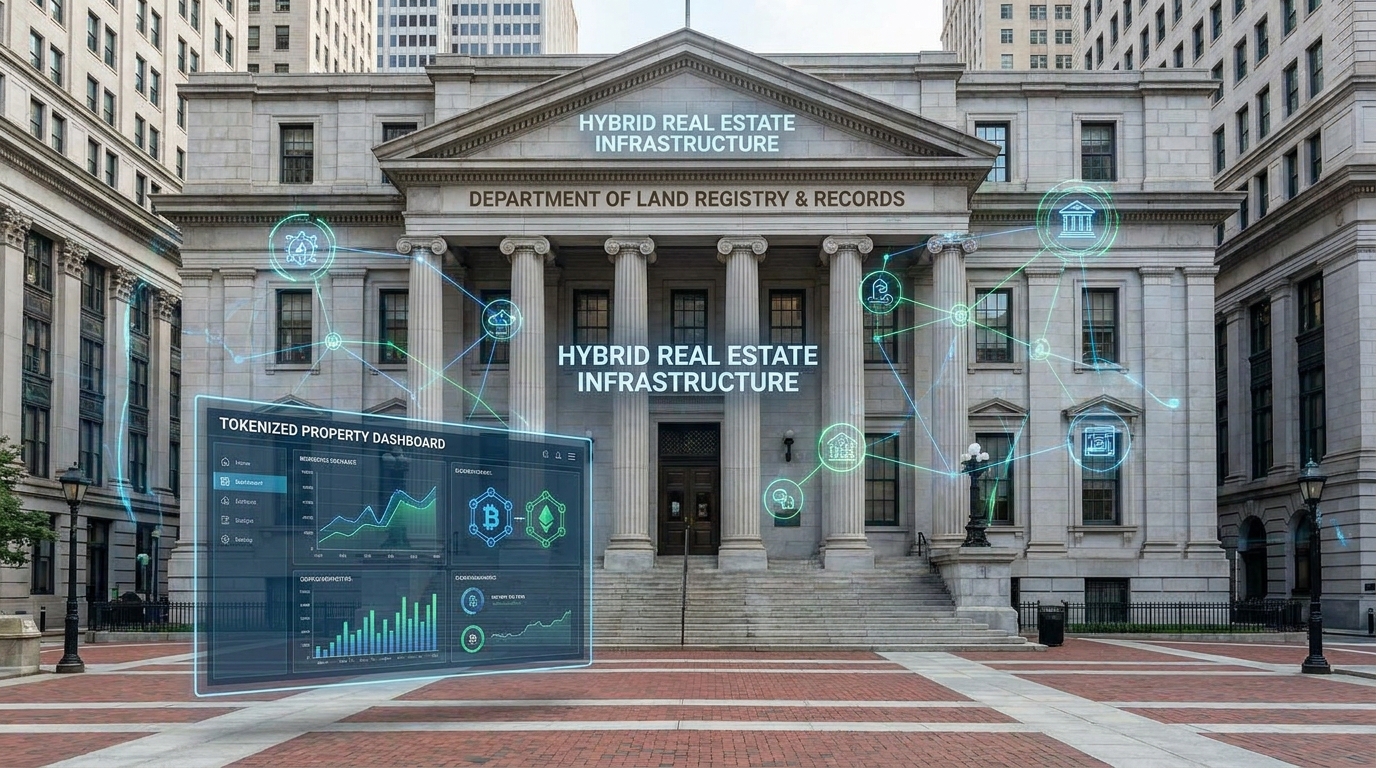
That is why the future probably belongs to hybrid systems. These are systems where registries, lenders, legal professionals, and transaction platforms use blockchain-style infrastructure for secure data sharing while legal title remains anchored in law. Hybrid design may sound less dramatic than disruption headlines, but it is far more realistic and far more useful.
North American pilots and practical experimentation
Real estate blockchain adoption in North America has been cautious, but that does not mean it has been inactive. Government discussions, research papers, and policy reports have referenced pilot initiatives related to land records, title management, and transaction workflows. One of the better-known examples in policy discussions is the earlier Cook County, Illinois, pilot work often cited in public-sector materials and Congressional Research Service reporting. These initiatives are valuable because they test where blockchain adds operational clarity and where legal or technical constraints remain.
The significance of pilots is often misunderstood. A pilot is not evidence that the entire system has changed. It is evidence that institutions see enough potential to experiment in controlled conditions. In real estate, that is exactly the right approach. Property systems involve public records, legal rights, consumer protection, lender risk, and government process. Careful testing is more credible than rushing toward full replacement without standards.
Canada has also shown public-sector interest in blockchain for secure digital recordkeeping in housing and finance workflows. The emphasis has generally been on transparency, secure contract management, and improved data quality rather than on making conventional registries obsolete. This reflects a mature understanding of where the near-term value actually is. Most transaction pain comes from friction across institutions, not from a complete absence of technology.
These experiments also help expose a critical implementation lesson: integration is usually harder than invention. A blockchain platform may work well in isolation, but its value depends on how well it connects with lenders, title systems, legal documentation, compliance requirements, and government databases. Interoperability and data standards often determine success more than the ledger technology itself.
That is why adoption has been uneven. The technical case can be persuasive, but institutions still need shared standards, governance rules, legal comfort, and a clear return on investment. The result is a market that is moving forward, though in a measured way. For a sector as foundational as housing, that gradual path is often a sign of seriousness rather than hesitation.
Tokenization is related, but it is not the same thing
Another topic that often appears alongside blockchain property systems is tokenization. Tokenization refers to digitally representing an asset, a share of value, or an ownership-related interest on blockchain infrastructure. In real estate, this can enable ideas such as fractional ownership, easier transfer of economic interests, and potentially improved liquidity in markets that are traditionally hard to access. It is one of the most discussed emerging trends in real-world assets.
However, tokenization should not be confused with recording legal title on a blockchain. They are related, but they solve different problems. A token might represent an investment interest tied to a property, or rights within a structure that holds real estate, without replacing the legal title record in a provincial or state system. This distinction matters because many headlines blur the boundary and leave readers with the wrong impression.
There is genuine potential here. Real estate has historically been illiquid, expensive to access, and difficult to divide into smaller positions. Tokenization can, in theory, make participation more flexible and broaden access to property-linked investments. Academic and industry discussions increasingly point to this possibility as part of the broader real-world-asset infrastructure trend.
But tokenization also introduces serious legal and compliance questions. Securities law, custody standards, investor protection, disclosure requirements, governance, and platform risk all come into play. That means tokenized real estate is not simply a technical upgrade. It is a regulated financial design challenge. Anyone exploring it needs to understand both the opportunity and the legal complexity.
For newcomers, the clean takeaway is this: blockchain for transaction records and blockchain for tokenized property interests are adjacent concepts, not interchangeable ones. One is mainly about secure documentation and workflow integrity. The other is about digitally representing value or ownership-related rights. Both matter, but they should be evaluated on their own terms.
What blockchain can and cannot do
Educational clarity matters in PropTech because overselling a technology usually delays adoption instead of accelerating it. Blockchain can create trusted digital records, synchronize data across institutions, support better audit trails, and reduce some forms of fraud and administrative delay. It is especially useful where many participants need a shared view of transaction history or document status. These are meaningful advantages in real estate, where trust and timing are central.
At the same time, blockchain cannot solve weak governance, poor data quality, or unclear legal authority by itself. If a transaction process has inconsistent standards, a ledger will not automatically fix them. If identity checks are weak, a blockchain can still preserve an inaccurate entry. If laws require registrar approval for a transfer, a digital record alone does not bypass that legal step.
This is one reason the best current framing is practical rather than ideological. Blockchain is not a replacement for lawyers, due diligence, notaries where required, or land registries. It is not a guarantee of instant closings. It is not a universal cure for real estate complexity. What it can do is reduce friction in multi-party workflows and create more dependable records around the legal process.
A useful way to summarize the distinction is through a simple comparison:
- What blockchain does well: timestamping, audit trails, shared visibility, workflow coordination, tamper-evident recordkeeping, and data synchronization.
- What blockchain does not do alone: validate identity in the real world, create legal title outside statutory systems, eliminate human error at input, or remove compliance obligations.
Readers who understand this split will be far better equipped to judge blockchain claims in property. The strongest solutions are the ones that combine technical rigor with legal realism.
Where the biggest near-term gains are likely to appear
The most meaningful blockchain progress in property is likely to happen behind the scenes before it becomes obvious to the average homebuyer. That may sound underwhelming, but it is actually where the highest operational value sits. Mortgage origination, title workflows, servicing records, document verification, and audit trails are all areas where institutions can gain efficiency without forcing consumers to learn an entirely new system.
Data standardization is particularly important here. If lenders, registries, legal professionals, and service providers use different formats and verification rules, automation remains limited. Blockchain works best when participants agree on how records are created, shared, and validated. That is why interoperability has become such a central theme in housing finance research and PropTech development.
Another likely area of growth is identity-linked transaction controls. Because fraud prevention depends on reliable onboarding, blockchain systems may increasingly connect with digital identity tools, KYC procedures, and secure authorization workflows. This could make it easier to prove that the right people signed the right documents at the right time. Again, the value comes from combining technologies, not from blockchain working alone.
Institutional finance may also adopt blockchain infrastructure faster than consumer-facing property transfer. Large-scale mortgage and securitization ecosystems generate enormous amounts of documentation and reporting. Where there is repeated need for synchronized, auditable data, blockchain can make economic sense. Consumers may never see the underlying ledger, but they may feel the benefit through fewer delays and cleaner processes.
Over time, these back-end improvements could support more visible changes in the market. Better records can enable faster refinancing, smoother cross-institution servicing, more reliable title-adjacent histories, and eventually more mature tokenization frameworks. In that sense, blockchain’s first victory in real estate may not be a headline-grabbing digital deed. It may be a quieter but much more consequential reduction in friction.
A realistic future for blockchain property systems
The future of blockchain in real estate will probably be hybrid, regulated, and infrastructure-focused. That may be less dramatic than early promises of fully decentralized land markets, but it aligns far better with how property law and financial systems actually work. Legal title will continue to depend on provincial and state law. Registrars and recognized registration procedures will remain central. The innovation will happen in how information moves around those systems and how securely that information can be trusted.
CMHC’s analysis points toward a future where blockchain improves transparency, data quality, contract management, and transaction coordination in the housing ecosystem. Academic literature supports that direction by identifying the structural inefficiencies blockchain can address. Government guidance on real estate fraud highlights why stronger record integrity matters. When these signals are put together, a coherent picture emerges: blockchain is most valuable as a practical layer of trust in an industry that still spends too much time reconciling scattered records.
That does not mean widespread adoption is guaranteed. Institutions still have to align on standards, justify implementation costs, train users, and work within regulatory boundaries. Some use cases will stall. Others will succeed quietly and become standard infrastructure before the public notices. This is common in mature industries. The technologies that matter most often become invisible once they work properly.
For buyers, sellers, investors, and professionals, the key educational takeaway is straightforward. Blockchain can make property transactions faster, more transparent, easier to audit, and harder to manipulate when it is integrated with legal recognition, identity controls, and high-quality data standards. It is not a shortcut around due diligence, and it is not a substitute for property law. It is an enabling system for better real estate operations.
In that sense, blockchain is not revolutionizing property transactions by tearing the system down. It is doing so by improving the trust architecture underneath it. In real estate, that is where meaningful change usually starts.
Conclusion
Property transactions have long been slowed by fragmented records, manual verification, and the need to coordinate trust across many different participants. Blockchain offers a compelling response because it can create shared, tamper-evident records that improve transparency, reduce duplication, and strengthen audit trails. The practical benefits are clear: faster workflows, lower administrative friction, better record-keeping, and a stronger foundation for fraud reduction.
Just as importantly, blockchain works best when it is treated realistically. It does not replace land title law, and it does not make professional oversight unnecessary. The legal system still defines ownership, while identity checks, governance, and due diligence remain essential safeguards. The strongest future model is therefore a hybrid one, where blockchain supports the transaction ecosystem while legal title stays grounded in established statutory frameworks.
For anyone new to blockchain property systems, the message is encouraging. You do not need to believe in hype to see the value. If real estate can share trusted data more efficiently, track records more clearly, and make important changes easier to audit, the entire transaction process becomes more resilient. That is the real revolution, and it is already taking shape.
Key takeaway: Blockchain is most useful in real estate when it improves verification, transparency, and record-sharing across existing legal systems rather than trying to replace them outright.
Frequently asked questions about blockchain in real estate
Is blockchain the same as cryptocurrency in property transactions?
No. Blockchain is the underlying record-keeping and verification technology. Cryptocurrency is one possible use case, but property platforms can use blockchain without relying on speculative digital coins.
Can blockchain replace land registries in Canada?
Not on its own. Legal title in Canada still depends on provincial legislation and recognized registration processes. Blockchain can support better records and workflows, but it must operate within existing legal frameworks.
Does blockchain eliminate real estate fraud?
No. It can reduce some fraud risks by making records easier to audit and harder to alter secretly, but it does not prevent bad data from being entered in the first place. Identity verification, legal review, and governance still matter.
What is the biggest practical benefit of blockchain in property today?
Better record-keeping and workflow coordination. The strongest near-term gains are likely to come from synchronized records, cleaner audit trails, less duplication, and faster verification across lenders, lawyers, title professionals, and registries.
Is tokenization the same as putting a deed on the blockchain?
No. Tokenization is about digitally representing value or ownership-related interests, often for investment purposes. Recording legal title is a separate issue governed by property law and registration systems.



No Comment! Be the first one.