



Occupancy tracking has moved from a niche building feature to a core intelligence layer in modern property operations. For years, many owners and managers treated buildings as static assets, with fixed schedules, fixed assumptions, and broad rules applied across every room and floor. That model now looks inefficient. In both residential and commercial settings, the more useful question is not how much space exists, but how that space is actually used throughout the day.
Table Of Content
- Why occupancy tracking matters more now
- What occupancy tracking actually measures
- Space efficiency in commercial properties
- Meeting rooms, desks, and hybrid work patterns
- Cleaning, maintenance, and service delivery
- Occupancy tracking in residential properties
- Comfort as a form of efficiency
- How occupancy data improves building systems
- From raw signals to useful decisions
- Privacy, trust, and the difference between insight and surveillance
- Common misconceptions that limit results
- What good implementation looks like
- The future of occupancy tracking in smart property data
- Final thoughts
Occupancy tracking is the use of sensors, booking systems, and movement data to measure in real time how a property’s spaces are actually used, rather than how they were designed to be used. Instead of relying on occasional audits, manual observations, or rough seat counts, smart properties can collect real time signals about presence, density, vacancy, and movement patterns. Those signals then inform practical decisions about lighting, HVAC operation, cleaning schedules, room allocation, and layout planning. The result is better space efficiency, lower operational waste, and a more responsive experience for the people inside the property.
The market is clearly moving in this direction. JLL’s 2026 benchmark found utilization tracking participation increased from 5% to 26% in a single year, while CBRE reported office utilization rising to 53% in 2026, up from 38% in 2024 and 35% in 2023. Those numbers matter because they reflect more than curiosity. They show that owners, occupiers, and operators increasingly see occupancy data as essential for understanding how buildings perform under hybrid work, shifting tenant expectations, and tighter efficiency targets.
At its best, occupancy tracking is not a surveillance tool. It is a decision tool. Privacy conscious systems can use anonymous sensing, count based analytics, booking data, infrared detection, or aggregated movement patterns instead of personally identifiable monitoring. That distinction matters because the long term value of occupancy tracking depends on trust. The smartest properties are not simply measuring people. They are aligning space, systems, and services with real demand.
Key insight: Occupancy tracking creates value when it connects space usage data to operational action. Counting people alone changes very little. Using occupancy insights to improve room availability, energy control, comfort, and service delivery is what makes the technology worthwhile.
In this article, I will focus on the practical applications of occupancy tracking in both commercial and residential properties. The central theme is simple: when buildings understand where people are, how often spaces are used, and when demand rises or falls, they can operate with much greater precision. That precision improves both cost efficiency and occupant experience, which is exactly why occupancy tracking is becoming a foundational part of smart property data.
Why occupancy tracking matters more now
The renewed interest in occupancy tracking is tied closely to how space use has become more variable. In offices, hybrid work has disrupted the old assumptions that desks, meeting rooms, and collaboration zones would be used in predictable ways from Monday to Friday. JLL’s 2024 global occupancy planning research found that 87% of organizations were operating a hybrid program, which helps explain why utilization, occupancy and vacancy, and density data have become central planning metrics. A floor plan that looked efficient on paper can quickly prove wasteful when real usage patterns show concentrated demand on some days and large areas sitting empty on others.
This same logic applies beyond offices. In retail environments, occupancy changes throughout the day and week can affect staffing, climate control, and customer flow. In multi family properties, amenity spaces such as gyms, lounges, and co working rooms often appear popular in theory but are unevenly used in practice. In homes, spare rooms, basements, and open plan areas are frequently heated, cooled, and lit even when no one is using them. Occupancy tracking gives property stakeholders a factual baseline for seeing these mismatches clearly.
There is also a broader operational reason for its rise. NIST notes that more than 80% of a building’s lifecycle energy use is associated with operation rather than construction. That means performance gains often come less from the shell of the building and more from how intelligently it runs over time. Occupancy data becomes especially valuable in this context because it helps connect systems to real patterns of use rather than generic schedules.
For many property teams, that shift feels practical rather than futuristic. They are not asking whether smart technology sounds impressive. They are asking whether a building can stop conditioning empty zones, whether conference rooms can be allocated more fairly, whether cleaning crews can be routed based on actual use, and whether occupants can find the right kind of space when they need it. Occupancy tracking answers those questions with evidence instead of guesswork.
What occupancy tracking actually measures
One of the most common misconceptions is that occupancy tracking simply counts how many people are in a building. In reality, modern systems can measure a range of occupancy related signals. Depending on the technology stack, they may detect room level presence, zone level density, movement trends, dwell time, vacancy duration, entry and exit patterns, desk usage, or meeting room utilization. When this data is combined with booking systems, environmental sensors, and operational schedules, it becomes much more powerful.
For example, a conference room may appear busy if it is often booked, but occupancy tracking can reveal that many reservations end in no shows, partial attendance, or short meetings that could have used a smaller room. A shared residential lounge may look underused in anecdotal feedback, but sensor data may show strong evening demand concentrated on certain days. A home office may be occupied regularly enough to justify room specific temperature settings rather than relying on a whole home schedule.
Different sensing approaches suit different properties. Passive infrared sensors can identify presence in rooms. Door counters can estimate foot traffic. Desk and seat sensors can show workstation use. Wi Fi based analytics can provide broad movement or occupancy trends. Camera based systems can be configured for anonymous counting without facial identification. Booking platforms and access control records can add context, while environmental sensors can help correlate occupancy with temperature, air quality, and lighting conditions.
The practical point is that occupancy tracking works best when it is designed around a clear operational goal. A commercial office trying to optimize meeting room turnover does not need the same setup as a condo tower trying to manage amenity demand, or a single family smart home trying to reduce wasted lighting and HVAC use. The quality of the outcome depends less on the number of sensors installed and more on how well the data model fits the use case.
Space efficiency in commercial properties
Commercial real estate is where occupancy tracking often shows its value fastest because the cost of underused space is easy to understand. An organization can lease thousands of square feet that remain lightly used, maintain meeting rooms that are booked but empty, or cool and ventilate entire zones based on outdated schedules. Occupancy analytics expose these inefficiencies in a way that static floor plans cannot.
One major application is workplace planning. As office attendance becomes more uneven, property teams can compare design intent with actual use. They can see whether staff gather in collaboration areas more than focus zones, whether assigned desks are consistently empty, whether quiet rooms are scarce, or whether a floor has become oversized relative to real attendance. Instead of resizing space based on assumptions, they can make decisions based on repeated occupancy patterns.
CBRE’s reported rise in office utilization to 53% in 2026 suggests that more organizations are not only bringing people back into offices but also paying closer attention to how those offices perform. That performance is not just about high attendance. It is about fit. A workplace can be busy and still function poorly if the right spaces are unavailable at the right times. Occupancy tracking helps identify whether demand is concentrated in boardrooms, small huddle rooms, touchdown areas, cafeteria zones, or informal lounge settings.
This matters directly to cost. If a company learns that two floors are persistently underused, it may be able to consolidate and reduce leased area. If a landlord sees that a tenant amenity floor has low weekday usage but high event driven evening demand, the space can be reprogrammed instead of expanded. If occupancy patterns show that certain rooms are consistently mis-sized, furniture, partitions, and booking rules can be adjusted to improve throughput rather than adding more square footage.
Meeting rooms, desks, and hybrid work patterns
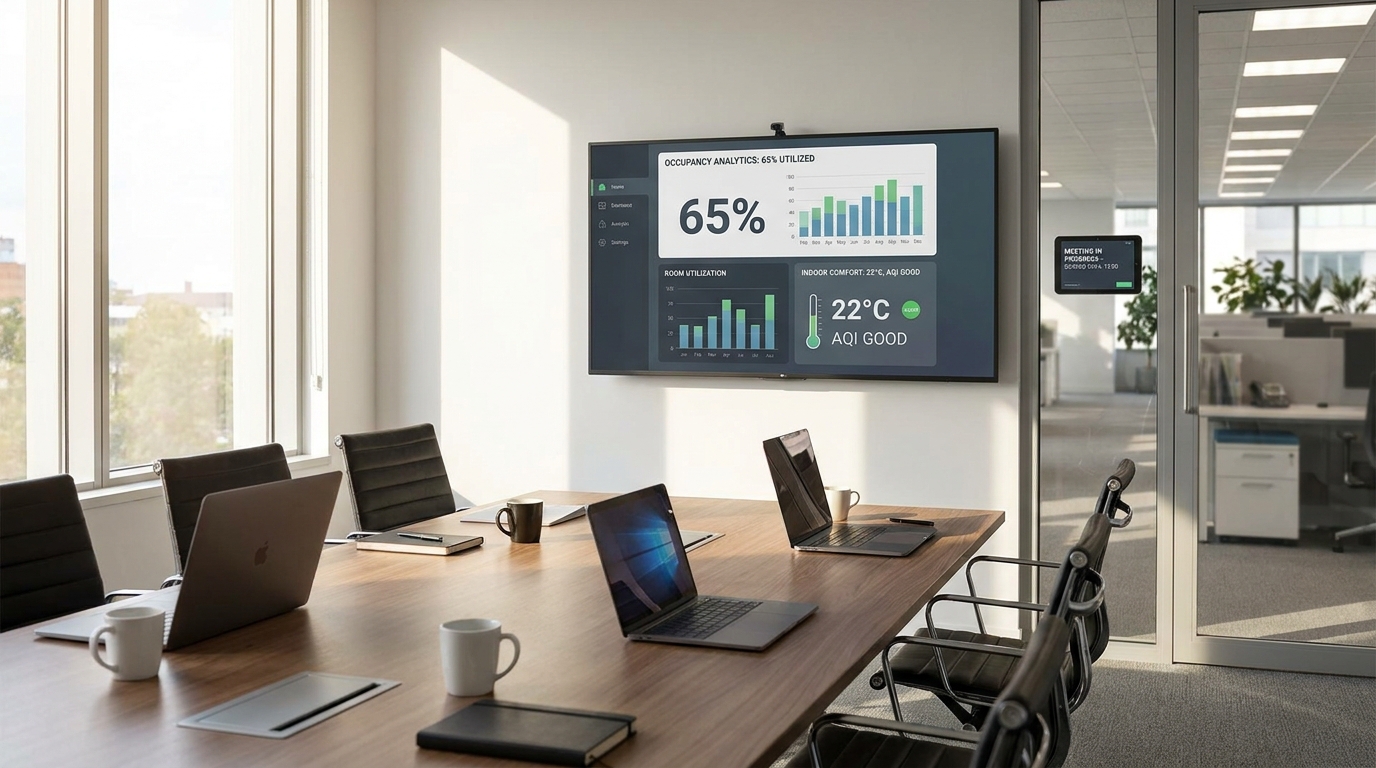
Meeting room management is one of the clearest examples of occupancy tracking in action. Many offices have experienced the same frustration: calendars show every room booked, yet staff walk through the floor and see empty or half empty spaces. Occupancy sensors can detect no show bookings, meetings that finish early, and rooms where actual attendance is far below capacity. That insight can feed into auto release rules, rebooking logic, and redesign decisions.
Desk usage is similarly revealing. Organizations that adopted hybrid work often reduced assigned seating, but not all hot desking systems work equally well. Occupancy analytics can show whether neighborhoods become overcrowded on peak days, whether certain teams gravitate to the same zones, and whether premium desks are monopolized while others are ignored. These are small operational details, but they shape daily experience significantly.
Importantly, better space efficiency does not mean squeezing more people into less room at all costs. The most effective strategies balance density with comfort and usability. Occupancy tracking can help organizations understand whether a perceived shortage is real or simply a distribution problem. Often, the issue is not total space but the mismatch between the type of space provided and the way people want to work.
Cleaning, maintenance, and service delivery
Another practical use of occupancy data is operational routing. Instead of cleaning every room to the same schedule regardless of use, facilities teams can prioritize areas that were heavily occupied and defer those that remained vacant. This improves labor allocation without lowering standards. In large commercial properties, even small changes in service routing can create meaningful savings over time.
Maintenance can also become more intelligent. High traffic zones typically experience faster wear, greater demand on fixtures, and more complaints when issues arise. Occupancy patterns help managers identify where preventive work should be scheduled first. If one washroom bank serves a heavily used collaboration area while another remains lightly used, the maintenance strategy should reflect that difference.
The same principle applies to hospitality, retail, healthcare adjacent spaces, and public sector buildings. A building that knows where demand is concentrated can align staffing, cleaning, and support services far more precisely. This is what I mean by occupancy data as an operational layer. It allows managers to shift from treating all space equally to managing according to actual usage.
Occupancy tracking in residential properties
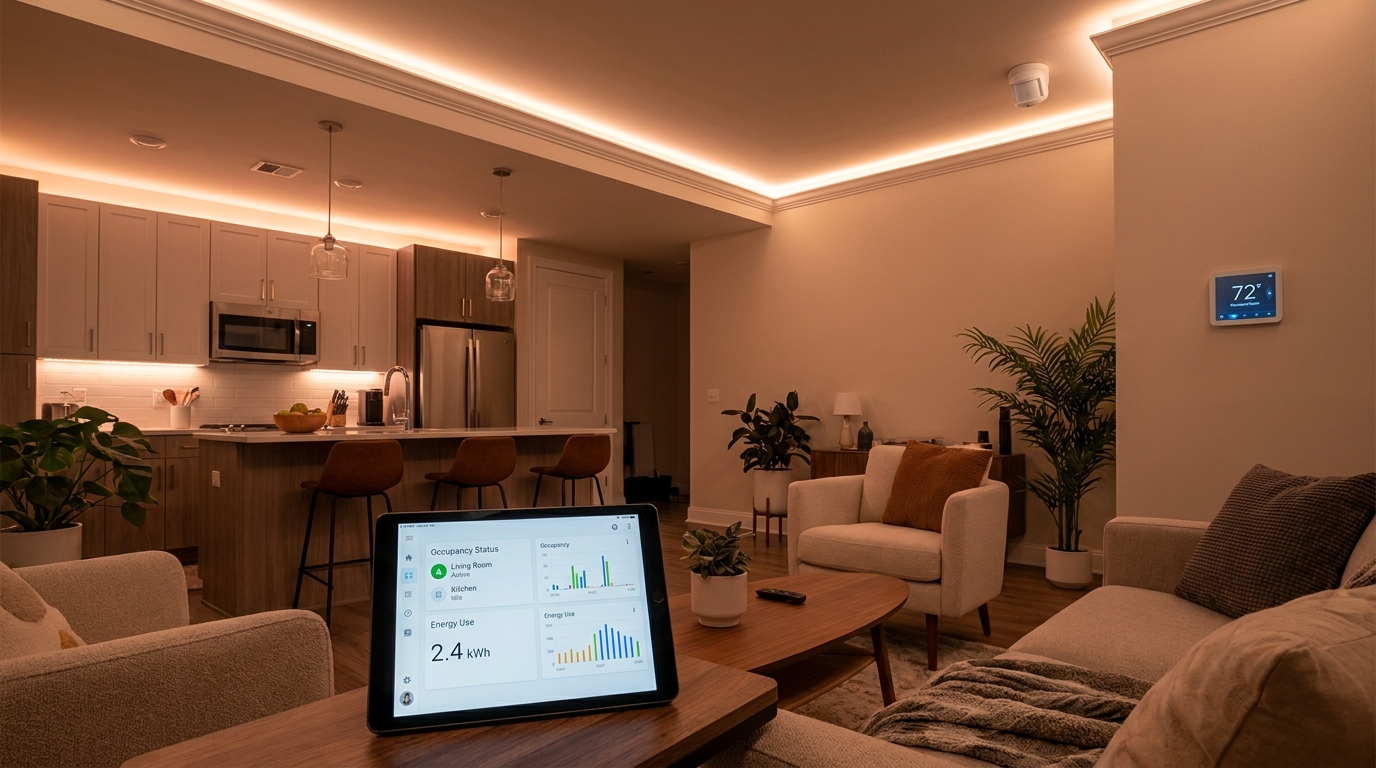
In residential environments, occupancy tracking is usually less about corporate optimization and more about comfort, convenience, and efficiency. Yet the underlying logic is similar. Homes and multi unit residential properties often waste energy and underperform because systems respond to fixed schedules rather than to how people actually live. Occupancy tracking helps close that gap.
Natural Resources Canada and the U.S. Department of Energy both recommend occupancy or motion sensors for lighting control, especially in intermittently used spaces such as corridors, utility areas, and rooms that are not continuously occupied. That is a straightforward example, but residential applications now go further. Occupancy aware systems can support room by room climate control, security routines, appliance automation, and occupancy based scene settings that align the home environment with daily patterns.
Consider a common household pattern. A family may spend weekday mornings in the kitchen and entry areas, afternoons with the house mostly empty, and evenings concentrated in the living room and bedrooms. Without occupancy awareness, heating, cooling, and lighting schedules often continue across underused spaces simply because the system lacks better information. With occupancy inputs, the property can reduce energy waste while improving comfort where people are actually present.
In apartment buildings and condo communities, occupancy tracking also helps shared space management. Fitness rooms, parcel areas, lounges, study rooms, and co working spaces can all benefit from utilization monitoring. Managers can see when demand peaks, whether capacity is appropriate, and whether resident complaints about crowding or underuse reflect reality. That evidence supports better scheduling, layout changes, and capital planning.
Comfort as a form of efficiency
It is easy to think of occupancy tracking purely in terms of savings, but comfort is just as important. A smart home that only cuts energy use without responding well to occupant needs will not feel smart for long. The value comes from making the space more adaptive. If a room is occupied, temperature, ventilation, and lighting can respond more appropriately. If a room is vacant, the property does not need to continue operating as if someone were there.
That balance matters in bedrooms, nurseries, home offices, media rooms, and guest spaces where conditions vary widely across the week. Occupancy tracking can also support elder care and accessibility use cases when implemented carefully, such as detecting prolonged inactivity or abnormal movement patterns through privacy respectful sensing. In those situations, efficiency and safety begin to overlap.
For residential users, the best systems feel almost invisible. Lights turn off when a space is unused. Climate settings shift gently based on occupancy routines. Security settings arm when the home is empty. Notifications arrive only when something unusual happens. This kind of automation works because occupancy becomes a contextual signal inside a broader smart property ecosystem.
How occupancy data improves building systems
The strongest return on occupancy tracking often comes when the data feeds directly into building systems. DOE describes sensors and controls as a path from reactive control to optimized whole building control, and that framing is important. Data alone does not create savings. Savings happen when occupancy signals trigger smarter decisions in HVAC, ventilation, lighting, and equipment operation.
HVAC is an obvious example. Heating and cooling are among the largest operational loads in most properties, and many systems still run according to generic schedules. Occupancy tracking allows more targeted conditioning by zone, floor, or room. If a meeting wing is empty until noon, it does not need the same conditioning profile as a busy lobby or a densely occupied open office. If a guest room in a home or residential property is unoccupied for days, it can remain within a setback range without sacrificing overall comfort.
Ventilation is another area where occupancy data matters. ASHRAE guidance explicitly discusses occupancy sensors as inputs for reducing or shutting off ventilation in unoccupied zones under appropriate conditions. In practice, many systems modulate airflow or ventilation rates rather than simply shutting everything down. That distinction is important because good occupancy based control is about precision, not blunt on and off behavior.
Lighting is often the fastest win. DOE lighting guidance explains that motion and occupancy sensors can automatically turn lights off when they are not needed, and this remains one of the simplest forms of smart property efficiency. Hallways, washrooms, storage spaces, conference rooms, utility rooms, and parking areas are all classic candidates. Yet advanced implementations can also tune lighting scenes based on occupancy density, time of day, and daylight availability.
Plug loads, elevators, escalators, and even digital signage can also be optimized with occupancy context. In large portfolios, these incremental improvements add up. DOE’s Smart Energy Analytics Campaign analyzed data from 96 U.S. organizations across 518 million square feet and nearly 6,000 buildings, reinforcing the scale at which analytics supported operational savings. Occupancy data becomes more valuable when it is integrated into that wider performance stack.
From raw signals to useful decisions
A property does not become smarter just because it has sensors. This is one of the most important realities in the occupancy tracking conversation. More devices do not automatically produce better outcomes. Poor placement, weak calibration, fragmented dashboards, and unclear workflows can all turn a promising system into a source of bad data or ignored alerts.
The better model is to think in layers. First comes data capture through sensors, booking systems, access logs, or network signals. Second comes interpretation through analytics, rules, and benchmarking. Third comes action, which may include adjusting HVAC schedules, reassigning rooms, changing cleaning frequency, updating design standards, or informing leasing strategy. The value appears at the point where data changes decisions consistently.
That is why occupancy tracking increasingly sits alongside building automation systems, fault detection and diagnostics, building energy modeling, digital twins, and smart dashboards. Occupancy schedules, lighting loads, thermostat behavior, and room demand all influence building performance models. When these inputs are current rather than assumed, the system becomes much more useful for forecasting and optimization.
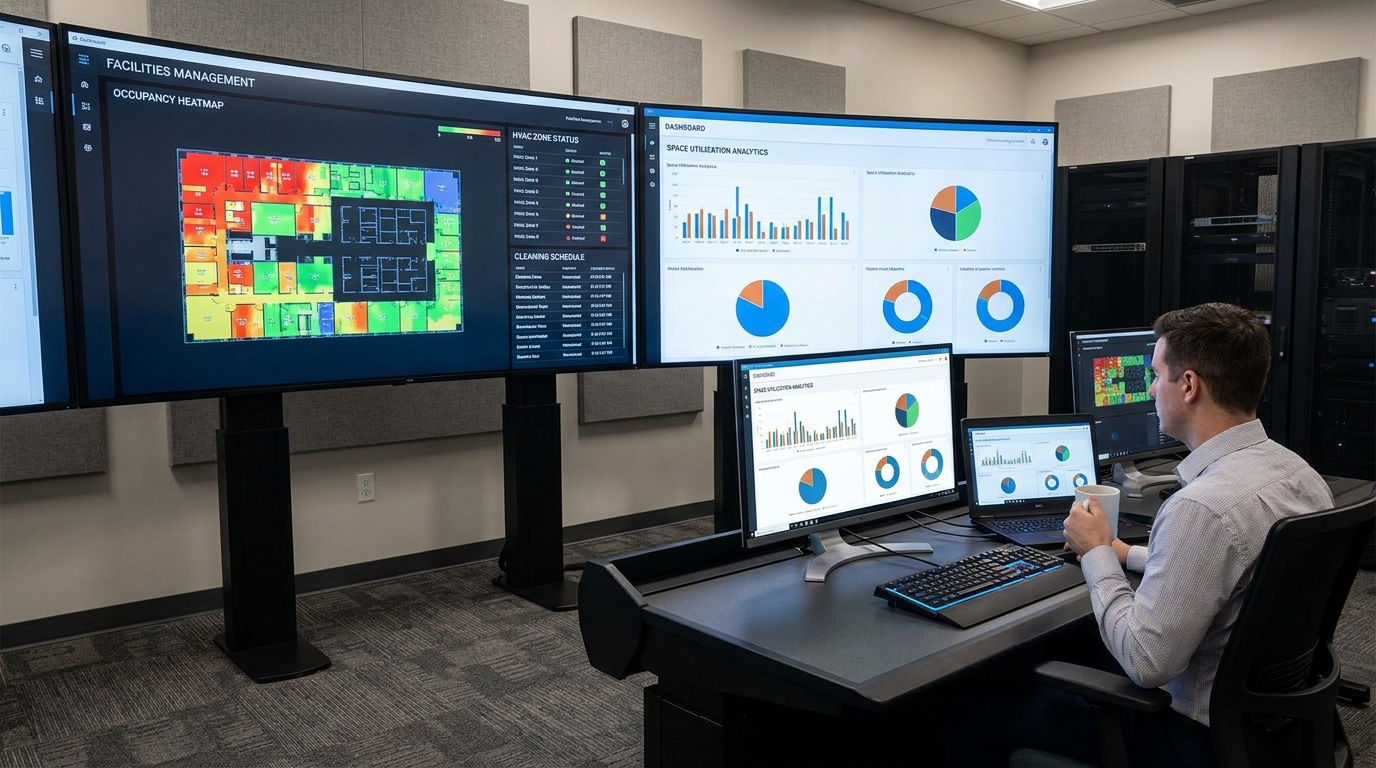
For operators, the dashboard matters almost as much as the sensor. If property managers cannot quickly see which areas are overused, underused, or drifting outside target comfort conditions, the data remains theoretical. Effective dashboards translate occupancy into simple questions. Which rooms are often booked and empty? Which floor has low average utilization? Which amenity needs reconfiguration? Which HVAC zones are conditioning mostly vacant space? This is where smart property data becomes operational intelligence.
Privacy, trust, and the difference between insight and surveillance
Occupancy tracking often raises immediate privacy concerns, and those concerns are legitimate. People want to know what is being measured, why it is being measured, and whether the system identifies them personally. The success of any implementation depends on answering those questions clearly. In many cases, the best approach is privacy by design from the start.
That means choosing sensing methods that gather the minimum information needed for the operational goal. A room availability system may only need anonymous presence detection. A cleaning optimization workflow may only need aggregate counts by zone. A home lighting automation setup may only need motion based triggers. The more tightly the data collection method aligns with the real use case, the easier it is to maintain trust.
Transparency also matters. Occupants should understand the difference between anonymous occupancy analytics and invasive surveillance assumptions. Property teams should document what data is collected, how long it is retained, who can access it, and what decisions it influences. In commercial settings, this often requires collaboration between facilities, workplace strategy, IT, legal, and HR. In residential environments, it means giving residents or homeowners clarity and control.
There is a practical upside to privacy conscious design beyond compliance. Trust improves data quality. When occupants understand that the goal is better comfort, room availability, and efficient operations rather than personal monitoring, adoption tends to be smoother. In a market where occupant experience increasingly influences retention and reputation, trust is not just ethical. It is strategic.
Common misconceptions that limit results
Several misconceptions continue to slow effective occupancy tracking programs. The first is that occupancy tracking is only about counting people. In reality, the strongest use cases usually involve planning, environmental control, cleaning, maintenance, and service optimization. Counting is just the start.
The second misconception is that occupancy tracking always requires invasive surveillance. Many systems rely on anonymous or aggregated sensing methods, including motion sensors, infrared detection, booking data, or count based analytics. Choosing the right technology architecture matters far more than assuming every deployment uses the same approach.
The third misconception is that occupancy data alone will solve space inefficiency. It will not. Space performance improves when teams act on the insight. That may mean changing booking policies, reconfiguring layouts, updating cleaning schedules, retraining staff, or integrating occupancy inputs with HVAC logic. Data without governance rarely produces lasting change.
The fourth misconception is that occupancy based HVAC control always means shutting systems off completely. In practice, standards and engineering details matter. Many implementations modulate airflow, adjust setpoints, or reduce ventilation in unoccupied zones where appropriate rather than applying crude all or nothing control. Precision is what protects both comfort and efficiency.
What good implementation looks like
Properties that get strong results from occupancy tracking usually follow a disciplined implementation path. They start with a clear objective, such as improving meeting room availability, reducing wasted conditioning in vacant zones, or understanding amenity demand. They then choose a sensing method that fits that objective without collecting unnecessary data. Finally, they connect the insights to workflows that teams can actually execute.
In practical terms, a strong rollout often includes several steps:
- Define the decision to improve. Start with a real operational problem, not a vague desire for more data.
- Establish baseline conditions. Measure current utilization, energy use, booking behavior, complaints, or service frequency before changes are made.
- Select privacy conscious sensing. Match the technology to the use case and avoid collecting more detail than necessary.
- Integrate with existing systems. Connect occupancy signals to booking platforms, building automation, work order systems, or resident apps where useful.
- Validate the data. Test sensor placement, calibrate thresholds, and compare outputs against reality.
- Create action rules. Decide how occupancy insights will change cleaning, scheduling, room release, HVAC control, or planning reviews.
- Review results consistently. Track whether utilization, comfort, responsiveness, and efficiency actually improve over time.
This process sounds straightforward, but it is where many projects succeed or fail. The Government of Canada’s smart buildings program, for example, emphasizes baseline data to determine whether efficiency is improving. That principle applies at every scale. Without a baseline and a review loop, occupancy tracking can become another dashboard that looks interesting but does not drive better outcomes.
The future of occupancy tracking in smart property data
Occupancy tracking is increasingly becoming part of a larger intelligence environment rather than a standalone feature. AI driven analytics, predictive maintenance systems, digital twins, and portfolio dashboards are all making occupancy data more actionable. Instead of only describing what happened yesterday, these systems can begin to forecast where demand will rise, where comfort issues may emerge, and where space can be reallocated more effectively.
In commercial real estate, that may mean predicting peak office attendance days and preparing rooms, ventilation, and support services in advance. In mixed use properties, it may mean understanding how resident, visitor, and staff flows interact across different zones. In homes, it may mean more adaptive automation that learns occupancy rhythms without requiring constant manual programming.
North America is likely to remain one of the leading regions in this space because of strong retrofit activity, workplace transformation, public sector modernization, and growing demand for smarter building operations. As adoption expands, the differentiator will not be whether a property has occupancy data at all. It will be whether the property can use that data responsibly, clearly, and productively.
The long term opportunity is significant because occupancy sits at the intersection of two high value goals: space efficiency and occupant experience. Too often, these goals are treated as if they compete with each other. In reality, the best occupancy tracking strategies support both. They reduce waste in empty spaces while making occupied spaces more available, more comfortable, and better aligned with actual needs.
Final thoughts
Occupancy tracking is most useful when it helps a building respond like a living system rather than operate like a fixed machine. Whether the property is a downtown office, a multi unit residential building, a retail environment, or a single family smart home, the principle is the same. Better visibility into how spaces are used allows owners and operators to manage them with more precision.
That precision can show up in many forms: fewer ghost bookings, more efficient meeting room turnover, reduced lighting waste, smarter ventilation, better comfort in occupied zones, improved cleaning routes, and stronger decisions about how much space is really needed. These are not abstract benefits. They affect budgets, sustainability outcomes, and the daily experience of everyone who enters the property.
For practical readers, the key takeaway is simple. Occupancy tracking should not be treated as a gadget or a surveillance layer. It should be treated as an operational signal that helps properties fit themselves to reality. When paired with analytics, privacy conscious design, and clear action rules, it becomes one of the most effective tools available for maximizing space efficiency in smart properties.
In a market where every square foot needs to justify itself, that is a meaningful advantage. The properties that perform best in the coming years will not just be connected. They will be aware of how they are used, capable of adapting, and disciplined enough to turn occupancy insight into better decisions every day.



No Comment! Be the first one.