


Public spaces often seem simple on the surface. A park, a small plaza, a tree lined sidewalk, a trail between neighbourhoods, or a community garden may look like everyday amenities that quietly sit in the background of daily life. In reality, these places do much more than fill empty land or add greenery to a map. They shape how people move, meet, rest, play, and feel in their communities. When designed well, sustainable public spaces become part of the social and environmental foundation of a neighbourhood.
Table Of Content
- What Sustainable Public Spaces Really Are
- Why Sustainable Public Spaces Matter More Than Ever
- The Evidence Shows Progress, but Also Gaps
- Community Involvement Is Not Symbolic. It Is Essential.
- How Sustainable Public Spaces Support Community Health
- Public Space as Climate Infrastructure
- What Makes a Public Space Truly Inclusive
- How to Get Involved in Creating Better Public Spaces
- Practical Ways Residents Can Participate
- How to Advocate Effectively Without Burning Out
- What to Look for in a Strong Local Public Space Project
- The Future of Sustainable Public Spaces Is Local
Sustainable public spaces are parks, plazas, trails, gardens, and streetscapes designed to remain useful, accessible, and environmentally resilient over time, not just visually appealing. They matter because they function as health, social, and climate infrastructure: nearby green space encourages daily physical activity, reduces stress, strengthens neighbourhood ties, and helps manage heat and stormwater as the climate changes. In Canada, 91 percent of households now live within a 10 minute trip of a park or greenspace, and 85 percent of households near one visit it within a year, evidence that proximity translates into real, everyday use. Getting involved does not require a planning background. It starts with observing how a space is actually used, attending local consultations, and advocating for features like shade, seating, and accessible paths that make a space work for everyone.
Across Canada and North America, the conversation around public space has become more thoughtful and more urgent. Public health agencies, urban planners, and sustainability leaders increasingly describe green public spaces as part of essential community infrastructure. That shift matters because it recognizes that shared outdoor places are tied to physical activity, mental well being, social connection, safety, climate resilience, and equity. These are not abstract ideals. They influence the quality of ordinary life, from whether a child has a safe place to play to whether an older adult can walk comfortably in summer heat.
What makes this topic especially meaningful is that residents are not passive observers in the process. Sustainable public spaces tend to work best when local people help shape them. Communities understand their own needs in ways that outside designers or decision makers may not fully see at first. Parents notice where shade is missing. Seniors know which routes feel inaccessible. Young people know whether a plaza feels inviting or ignored. Local businesses understand how foot traffic changes the rhythm of a street. In that sense, community involvement is not an extra step. It is a practical ingredient in creating places that truly function.
This article looks at why sustainable public spaces matter, how they support healthier and more resilient communities, and what readers can do to get involved. Whether you want to improve a nearby park, advocate for safer walking routes, support a community garden, or simply understand how local placemaking works, there are realistic ways to participate. Sustainable public space is not only the work of planners and municipalities. It is also built, protected, and improved through everyday civic action.
What Sustainable Public Spaces Really Are
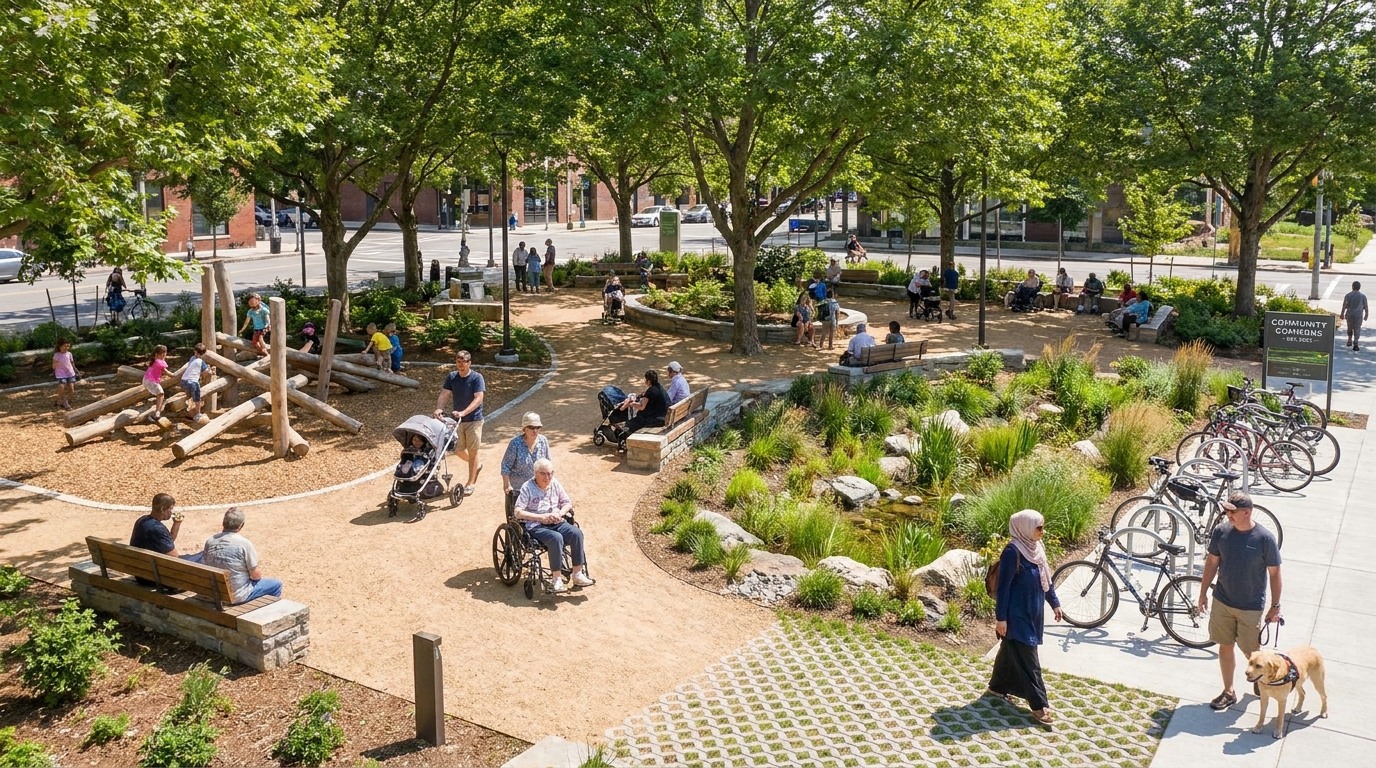
One of the most common misunderstandings about sustainable public spaces is that they are only large parks. Parks are certainly part of the story, but they are only one category within a much wider landscape. Sustainable public spaces can include plazas, schoolyards, greenways, trails, community gardens, waterfront promenades, tree lined sidewalks, protected cycling corridors, pocket parks, redesigned streets, and even small seating areas that invite people to stop and spend time outdoors. In dense communities, these smaller spaces can be just as important as larger signature parks.
The word sustainable also deserves a more practical definition. It does not simply mean adding grass, trees, or a few eco friendly materials. A sustainable public space is one that performs well over time for both people and the environment. It should support regular use, be accessible to a wide range of residents, withstand changing climate conditions, and be maintainable within realistic budgets and local capacity. In many cases, it also helps manage stormwater, cool overheated streets, improve biodiversity, and reduce the environmental burden of hard urban surfaces.
UN Habitat describes public space as a crucial component of sustainable cities and communities because it supports ecosystem services, health and well being, social inclusion, and economic exchange. That is a helpful framework because it reminds us that public space is not separate from city life. It is one of the systems that makes city life possible and more humane. A shaded square where neighbours gather, a safe sidewalk that connects homes to shops, or a community garden that strengthens local stewardship can all be examples of sustainable public space when they are thoughtfully planned and cared for.
There is also a scale dimension worth noticing. Some public spaces serve a city wide function, while others are hyper local and woven into the everyday patterns of one block or one district. Often, the most beloved and well used spaces are not the grandest. They are the places that feel close, useful, welcoming, and comfortable. A small space with seating, trees, and visibility can change daily life more than a larger park that feels difficult to reach or poorly maintained. Sustainability in public space is therefore about fit as much as it is about size.
Why Sustainable Public Spaces Matter More Than Ever
The case for investing in sustainable public spaces is stronger than it may first appear. At a basic level, public spaces influence how easy it is for people to be active. When neighbourhoods include attractive and safe outdoor places, walking, cycling, play, and informal recreation become more natural parts of daily life. Public health guidance in Canada has long linked the built environment to physical activity and community well being. The design of streets, parks, and green routes affects whether people feel invited to move through their surroundings rather than remain disconnected from them.
The health benefits extend beyond exercise. The Centers for Disease Control and Prevention notes that people with safe access to parks and green spaces tend to be more physically active, but also that parks can support stress reduction, stronger social connection, and urban heat island mitigation. That is an important reminder that public spaces are not only about recreation. They can help regulate temperature, soften noise, improve comfort, and create room for human interaction that many modern neighbourhoods otherwise lack. In a time when loneliness, heat stress, and sedentary lifestyles are rising concerns, this combination of benefits is especially valuable.
Canadian public health resources similarly point out that outdoor green spaces help people share experiences, engage socially, build connections, and participate in recreational activities that strengthen community belonging. This social role is easy to underestimate. A bench under a tree, a play area next to a walking loop, or a plaza that hosts seasonal events can create repeated low pressure interactions between neighbours. Those interactions are often how trust forms in a community. Sustainable public spaces make room for familiarity, and familiarity can become belonging.
They also matter because they help cities and towns adapt to a changing climate. Trees can lower surface and air temperatures. Rain gardens, permeable paving, wetlands, and naturalized landscapes can help manage stormwater. Urban forests and connected green corridors can support biodiversity while improving comfort for residents. Canada’s climate adaptation policy increasingly recognizes living natural infrastructure as part of resilience planning, which means public spaces are now being understood as environmental assets as well as civic amenities. A good public space may now be expected to cool, absorb, connect, shelter, and support, all at once.
Well designed public spaces are not decorative extras. They are health infrastructure, social infrastructure, and climate infrastructure working together in visible everyday form.
The Evidence Shows Progress, but Also Gaps
Canada has made meaningful progress in proximity to parks and greenspace. Statistics Canada reported that 91 percent of Canadian households lived within a 10 minute trip of a park or public greenspace in 2021, up from 87 percent in 2017. Another Statistics Canada indicator found that about 75 percent of the population lives within 1 kilometre of a neighbourhood park, with even higher proximity in large metropolitan areas. Those numbers are encouraging because they suggest many households can reach green space without a long journey.
Use rates are also high. Statistics Canada reported that 85 percent of Canadian households that lived near a park or greenspace visited it in the previous year. This tells us something important. When green spaces are nearby, people often do use them. Access is not a trivial detail. It strongly shapes whether a public space becomes part of daily life or remains an occasional destination. In planning terms, proximity planning and walkable neighbourhood design remain essential if communities want these spaces to be broadly used rather than unevenly enjoyed.
At the same time, access on paper does not always equal access in practice. A park may be within a ten minute trip, but if the route feels unsafe, the crossings are difficult, the paths are inaccessible, the site lacks shade, or the space feels unwelcoming to certain groups, then the practical value of that proximity declines. This is where equity becomes central. Not everyone experiences a nearby park in the same way. A caregiver with a stroller, a wheelchair user, a teenager looking for social space, an older adult seeking rest areas, or a newcomer family hoping for culturally inclusive programming may all encounter different barriers.
There is also a measurement challenge. Statistics Canada’s urban ecosystem work notes that urban greenness includes both publicly and privately owned green space, and that measuring green space consistently in cities is complex. This matters because broad greenness metrics can sometimes hide local deficiencies. A neighbourhood may look green overall while still lacking usable public gathering space, tree canopy on sidewalks, or safe access to recreation. As cities use ecosystem accounting and urban greenness metrics more often, the goal should be not only more data, but better decisions based on how people actually experience space on the ground.
Community Involvement Is Not Symbolic. It Is Essential.
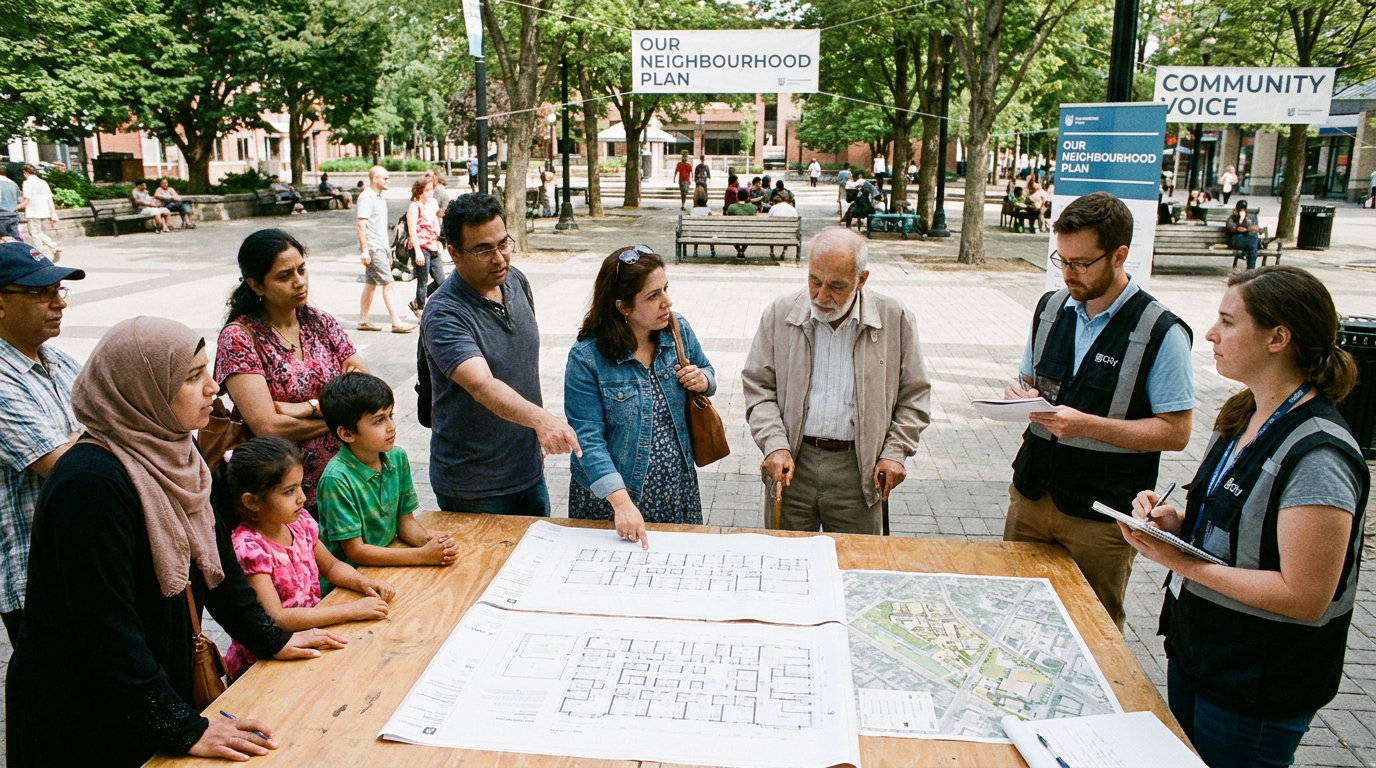
A persistent misconception is that community engagement in public space projects is mostly symbolic. People are invited to a meeting, leave comments, and then the real decisions happen elsewhere. While token engagement certainly exists, that is not the standard communities should accept. The best placemaking practice starts from a different assumption: local residents are experts in how a place functions day to day. Project for Public Spaces has repeatedly emphasized that successful public spaces are rooted in participation, collaboration, and local leadership. This perspective is practical because it leads to better outcomes.
Residents often see patterns that formal plans miss. They know where flooding happens after a storm, where people naturally gather, which areas feel unsafe after dark, and which amenities are missing for children, teens, or seniors. They notice if a path is technically present but not comfortable to use. They understand whether a space serves one group well while quietly excluding another. This kind of knowledge is not secondary. It is highly valuable design intelligence that can prevent expensive mistakes and improve long term use.
Community involvement also increases stewardship. When people feel they had a real voice in shaping a space, they are more likely to care for it, defend it, and use it regularly. That does not mean responsibility should be downloaded from municipalities onto volunteers. Public maintenance and public investment remain essential. But there is a meaningful difference between a space that residents feel was imposed on them and one they feel reflects their own needs and identity. The latter tends to develop a stronger culture of care.
Perhaps most importantly, community participation can make public space more inclusive. Public spaces often fail not because they were underfunded alone, but because they were too narrowly imagined. A place with no seating may exclude older adults. A beautiful lawn with no shade may be unpleasant in summer heat. A playground without accessible routes may leave some families out entirely. A plaza with no programming may remain empty despite being visually appealing. Engagement can surface these issues early and create spaces that are not simply greener, but genuinely more usable.
How Sustainable Public Spaces Support Community Health
When people talk about healthy communities, the conversation often turns quickly to healthcare systems, housing, or nutrition. Those issues matter deeply, but the physical environment also plays a quiet and powerful role. Public spaces can influence health not through a single dramatic intervention, but through repeated daily opportunities. A pleasant walking route encourages movement. A nearby greenspace offers stress relief after work. A shaded bench supports rest and comfort. A public square makes chance social interactions more likely. Over time, these small experiences add up.
Physical activity is one of the clearest benefits. People are more likely to walk or cycle when routes feel safe, connected, and appealing. Families are more likely to spend time outdoors when parks include basic features such as seating, shade, washrooms, play opportunities, and visible paths. Children benefit from places to move freely, explore, and interact with others outside structured settings. Older adults benefit from level surfaces, rest areas, and nearby destinations that make routine walking easier. Good design can quietly widen participation across age groups.
Mental well being is equally important. Time in green environments is often associated with reduced stress, improved mood, and a greater sense of restoration. Even small doses of nature in daily life can matter, particularly in dense urban settings. Sustainable public spaces can provide that contact in ways that are affordable and accessible. Unlike private wellness services, public spaces offer benefits that do not depend on individual purchasing power. That makes them especially meaningful as shared civic resources.
There is also a social health dimension. Communities with active public spaces often feel more legible and more connected. People see one another. Children play near adults. Informal conversations happen. Local events have somewhere to unfold. These interactions can help reduce isolation and build the thin but important threads of social trust that make neighbourhoods feel safer and more supportive. In this sense, a sustainable public space is not simply a place to pass through. It is a place where community becomes visible.
Public Space as Climate Infrastructure
As climate pressures intensify, sustainable public spaces are taking on a new level of importance. They are increasingly expected to perform as climate infrastructure, not just recreational amenities. This is a significant shift in how cities think about streets, parks, plazas, and waterfronts. Trees are no longer only appreciated for beauty. They are also tools for cooling. Wetlands and bioswales are not just landscape accents. They are part of flood and stormwater management. Connected green corridors are not only pleasant routes. They can support biodiversity and resilience across the urban fabric.
Canada’s adaptation approach recognizes that living natural infrastructure such as urban forests and wetlands can build resilience while also delivering added benefits such as carbon storage and health gains. This layered value is one reason sustainable public spaces deserve serious attention from communities and local leaders. A shaded street with permeable surfaces and planting beds can improve comfort, reduce runoff, and invite more walking at the same time. A naturalized park can absorb rainfall, create habitat, and support recreation without forcing tradeoffs between ecological and social goals.
Funding trends are helping move this work forward. Programs connected to the Green Municipal Fund and other municipal and federal support channels continue to back local sustainability and climate adaptation projects across Canada. That does not guarantee every neighbourhood gets what it needs, but it does mean there is growing policy recognition that public space can be part of the climate solution. Residents who advocate for green public improvements are therefore aligning with a broader direction in planning and funding, not pushing against it.
For communities, this creates an opportunity. It means local advocacy can be framed in ways that resonate with multiple priorities at once. A request for more trees and shade is not only about comfort. It can also be about heat mitigation and public health. A call for naturalized landscaping may also support biodiversity and stormwater management. A safer walking route to a park can be framed as an equity issue, a transportation issue, and a climate issue together. In many cases, the strongest public space arguments are the ones that connect these concerns rather than treating them separately.
What Makes a Public Space Truly Inclusive
It is easy to assume that adding greenery automatically produces a better public outcome. In practice, inclusion depends on many finer details. A sustainable public space should be usable by a broad range of people, not just visually pleasant in photographs or concept renderings. Accessibility, safety, comfort, cultural relevance, maintenance quality, and ease of access all shape whether a place actually serves the public. A green space can still be underused if it feels unsafe, disconnected, or indifferent to local needs.
Accessibility should be understood broadly. That includes physical access through smooth paths, ramps, curb cuts, and seating, but also sensory clarity, legibility, and enough comfort for people with varying mobility or stamina. Shade matters for older adults, children, and anyone sensitive to heat. Washrooms matter for many families and longer visits. Lighting matters for perceived safety. Sightlines matter for caregivers. Wayfinding matters for newcomers and visitors. These elements are not decorative details. They often determine whether a space becomes truly public in practice.
Cultural inclusion matters as well. Public spaces should reflect who lives nearby, not only abstract planning ideals. That might mean community gardens with culturally meaningful planting, gathering spaces designed for multigenerational use, public art that reflects local histories, or programming that welcomes diverse users at different times of day. A plaza that looks polished but never feels socially inviting may not fulfill its purpose. A simpler space with the right mix of amenities, identity, and everyday use may do far more for community well being.
Maintenance is another often overlooked equity issue. A poorly maintained space communicates neglect, and neglect changes who feels welcome. Broken seating, litter, dead plantings, inaccessible paths, and unclear upkeep can quickly reduce the benefits of even a well designed space. Sustainable public spaces need maintenance plans that are realistic and durable. Stewardship from residents can help, but public agencies also need to commit to ongoing care so that quality does not decline unevenly across neighbourhoods.
How to Get Involved in Creating Better Public Spaces
For many readers, the most important question is not whether sustainable public spaces matter, but how to participate in making them better. The encouraging news is that involvement does not require professional planning credentials. It begins with observation, relationship building, and a willingness to show up consistently. Small actions can become surprisingly influential when they are thoughtful and sustained.
A good first step is to understand your local context. Walk your neighbourhood and pay attention to how public spaces are actually used. Notice where people linger, where they avoid, where heat feels intense, where crossings feel unsafe, and which amenities are missing. Look at who is present and who seems absent. A park that attracts dog walkers but few children, or a plaza with seating but no shade, is already telling a story. Careful observation helps turn vague dissatisfaction into useful, specific input.
The next step is to learn how local decisions are made. Most municipalities have planning processes, parks departments, transportation consultations, budget meetings, or public engagement portals. These may not always be easy to navigate, but they are often where ideas begin to enter official channels. If a city is updating a park plan, transportation strategy, climate adaptation plan, or neighbourhood design framework, that is an important opening. Sustainable public space improvements are frequently connected to these broader planning processes rather than handled in isolation.
It can also be helpful to connect with others rather than acting alone. Neighbour associations, school groups, environmental organizations, accessibility advocates, cycling groups, community garden networks, and local business improvement groups may already be working on related concerns. Coalition building can strengthen a case because it shows that a proposal serves multiple interests. A request for trees and benches may gain more traction when supported by parents, seniors, local merchants, and climate advocates together. Shared goals often carry further than isolated complaints.
Practical Ways Residents Can Participate
There are many realistic points of entry for local involvement, and not all of them require a large time commitment. The key is to choose one or two forms of participation you can sustain. Public space change often happens gradually, so consistency matters more than intensity.
- Attend public consultations and open houses. If your municipality is gathering feedback on parks, streets, climate adaptation, or neighbourhood design, participate early. Ask practical questions about shade, seating, accessibility, safety, tree canopy, stormwater features, and maintenance.
- Respond to surveys with specific observations. Instead of saying a space needs improvement, explain what is missing. Mention route safety, washrooms, poor drainage, lack of gathering areas, or inaccessible surfaces.
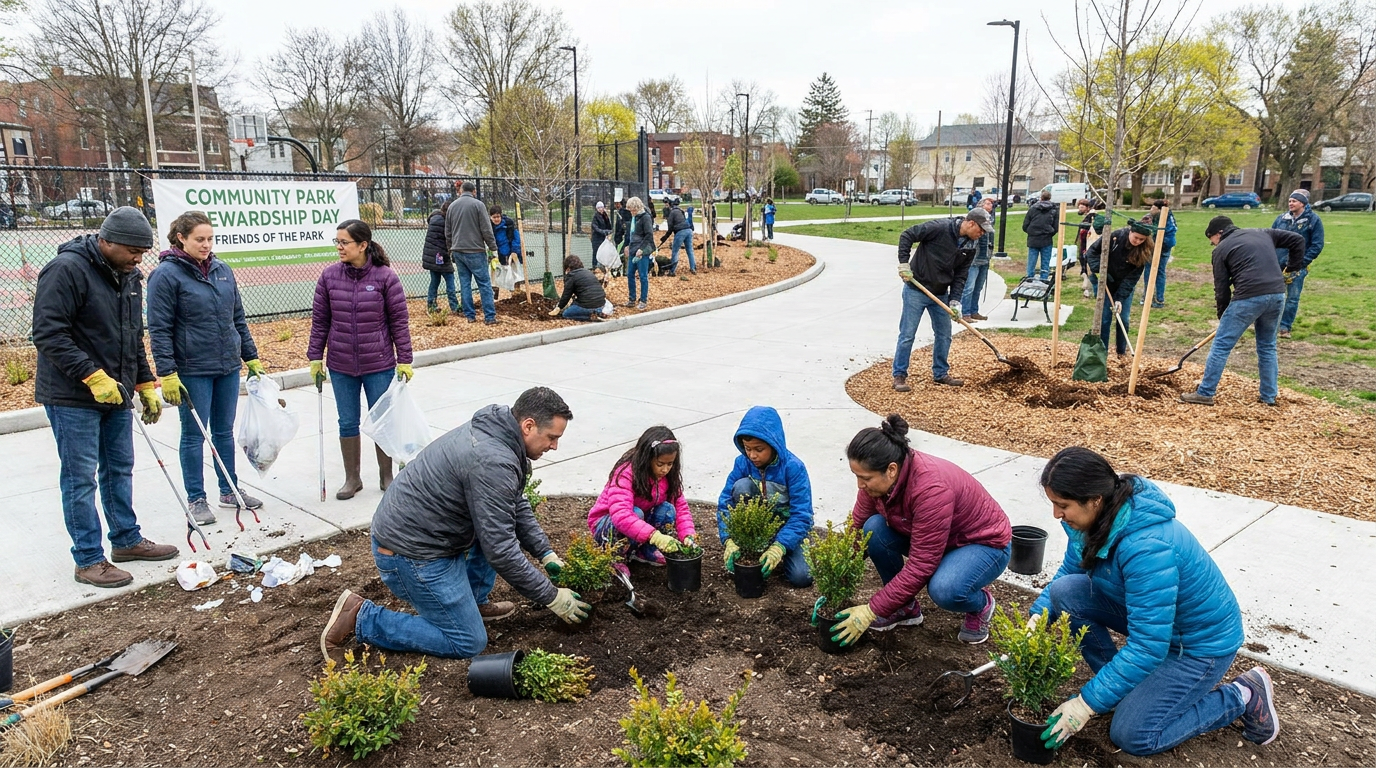
- Join or organize stewardship efforts. Park cleanups, planting days, pollinator garden projects, and community garden work can build local momentum while improving the space directly.
- Document existing conditions. Photos, short notes, and simple counts of use at different times of day can make community feedback more persuasive and grounded.
- Advocate for inclusive design. Encourage municipalities to include seating, shade, play features, accessible paths, bike parking, naturalized areas, and programming that supports regular use by different age groups.
- Support local funding and policy initiatives. Pay attention to municipal budgets, parks levies, climate resilience investments, and neighbourhood plans that affect public space quality.
- Build partnerships with schools and community groups. Shared programming and stewardship can make spaces feel active, safer, and more cared for over time.
These actions may seem modest, but they can shape real outcomes. Community input often helps identify needs before construction begins, which is far easier and less expensive than correcting problems later. In many places, residents have influenced where shade structures are added, how paths are routed, whether accessible features are included, and what kind of programming makes a space active rather than empty. Participation works best when it is specific, constructive, and connected to long term follow through.
How to Advocate Effectively Without Burning Out
Civic involvement can be rewarding, but it can also feel slow. Public projects move through budgets, approvals, competing priorities, and changing political attention. For that reason, effective advocacy needs patience as much as passion. It helps to frame requests in ways that align with public goals already recognized by municipalities. If you can connect your ideas to health, accessibility, climate adaptation, walkability, and equity, they are more likely to be understood as practical priorities rather than optional extras.
Specificity is useful here too. Asking for a better park is too broad to guide action. Asking for more shade trees near the playground, level paths that support mobility devices, safer crossings to the entrance, and regular maintenance of washrooms and seating gives decision makers something clearer to evaluate. When possible, tie those requests to observable local conditions. Mention where pavement overheats, where ponding occurs after storms, or where benches are consistently occupied because seating is limited. Useful advocacy is grounded, calm, and evidence informed.
It is also wise to celebrate small wins. A single bench, a community notice board, a pilot street closure, a few additional trees, or a temporary seating area can all be meaningful steps. Public space improvements are often iterative. Demonstration projects and temporary installations can show what works before permanent capital investments are made. Residents who remain engaged through these stages often have the best chance of helping shape stronger long term outcomes.
Finally, pace yourself. Sustainable change usually comes from collective effort over time, not from one perfect petition or one high attendance meeting. Choose forms of involvement that feel realistic for your life. You may be someone who attends consultations regularly, or someone who joins a seasonal cleanup, or someone who contributes thoughtful written feedback when plans are released. All of these roles matter. Public space stewardship benefits from many kinds of participation, including quiet and consistent forms.
What to Look for in a Strong Local Public Space Project
When evaluating a proposed project, it helps to know what good public space planning tends to include. A strong proposal usually begins with clear community need, not only visual appeal. It pays attention to who will use the space and how it connects to surrounding streets, transit, housing, schools, and local businesses. It considers comfort through shade, seating, and safety. It addresses accessibility from the outset rather than as an afterthought. It also includes a realistic plan for maintenance and long term management.
Environmentally, strong projects often use layered strategies. That may include native or climate appropriate planting, tree canopy expansion, permeable surfaces, rain gardens, habitat support, and materials selected for durability and lower impact. Socially, they often support a mix of passive and active use so that different people can enjoy the space in different ways. Economically, successful spaces can strengthen nearby local activity by increasing foot traffic and making streets more inviting, while still remaining fundamentally public and accessible.
Another sign of a strong project is whether it feels rooted in local identity. Generic design can be attractive, but places become memorable and loved when they reflect the culture, routines, and needs of the people nearby. A waterfront promenade should not feel interchangeable with a suburban plaza, and a neighbourhood park should not ignore the age profile or cultural diversity of the community around it. Public spaces gain resilience when they are socially meaningful, not just technically competent.
Most of all, a good project remains open to learning. Public spaces change over time as neighbourhoods evolve. What works for one decade may need adjustment in the next. Flexible design, ongoing evaluation, and continued dialogue with residents are signs that a project is likely to stay useful. Sustainable public space is not a one time achievement. It is an ongoing civic relationship between place, people, and stewardship.
The Future of Sustainable Public Spaces Is Local
There is growing momentum behind the idea that public spaces are central to sustainable communities. UN Habitat frames public space as a core ingredient of sustainable cities and communities, and notes that well functioning cities devote substantial surface area to public space even though many places fall short of that ambition. In Canada, data, policy, and funding trends all point toward a broader understanding of parks, streetscapes, and green spaces as part of health and climate infrastructure. This is an encouraging direction, but the future of these spaces will still be shaped locally.
That local dimension is where readers have genuine influence. The most successful sustainable public spaces are rarely created by design alone. They are shaped through listening, observation, practical feedback, stewardship, and repeated community involvement over time. They succeed because residents help define what comfort, safety, inclusion, and belonging actually look like in their own neighbourhoods. A sustainable public space is not just built for a community. It is built with one.
If there is a reassuring lesson in all of this, it is that meaningful participation does not require perfection. You do not need to have every policy answer or a professional planning background to contribute something useful. You simply need to notice, care, and engage in ways that are constructive and consistent. The bench that gets added, the safer path that gets redesigned, the shade trees that get planted, or the local stewardship group that takes root all begin with people deciding that shared spaces are worth improving.
Public spaces tell us what a community values. When they are sustainable, inclusive, and cared for, they communicate that health, dignity, and resilience belong in everyday life, not only in special destinations or private settings. That is why they matter, and why getting involved is so worthwhile. The greener, safer, and more welcoming public spaces we want are rarely out of reach. More often, they are waiting for enough people to help imagine them clearly and support them patiently into being.

No Comment! Be the first one.