



Cities are where the future is being negotiated in real time. They are where housing demand rises fastest, where infrastructure is tested hardest, and where the effects of climate change become deeply personal through heat waves, flooding, traffic congestion, poor air quality, and rising energy costs. At the same time, cities are where innovation tends to happen first. That is why the idea of the smart eco-city has gained so much attention. It offers a practical way to think about urban growth that is efficient, resilient, and environmentally responsible without losing sight of what residents actually need from daily life.
Table Of Content
- Why Smart Eco-Cities Matter More Than Ever
- What Makes a City Both Smart and Sustainable
- The Built Environment Is the Biggest Lever
- Why Net-Zero Buildings Are Not Enough on Their Own
- Mobility, Land Use, and the 15-Minute City
- How Data, AI, and Digital Twins Can Help Cities Perform Better
- Nature-Based Solutions Are Part of the Smart City Future
- Equity, Affordability, and the Human Side of Smart Cities
- Governance: The Difference Between a Good Idea and a Good City
- Common Misconceptions About Smart Eco-Cities
- What Smart Eco-Cities Could Look Like in Everyday Life
- A Practical Model for the Future
- Key Elements That Define a Strong Smart Eco-City Strategy
- Final Thoughts
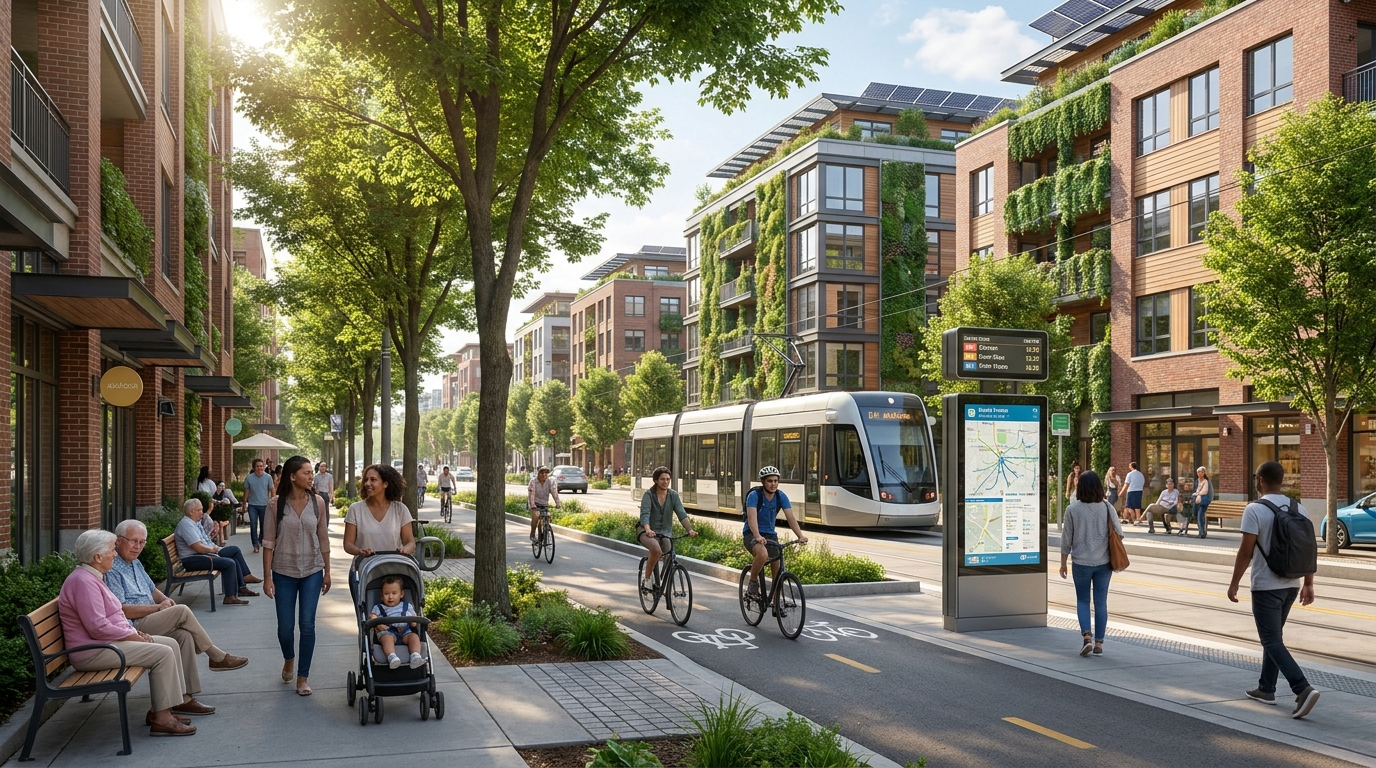
The most useful definition of a smart eco-city is not a place filled with gadgets. A smart eco-city is a city that uses technology carefully and deliberately to support a lower carbon, healthier, and more convenient urban environment, combining tools such as district energy systems, building automation, green roofs, transit-oriented development, flood-ready landscapes, and digital demand-management systems with compact, resilient urban design. In other words, technology is the tool, not the destination. That distinction matters because the word smart can easily drift toward flashy systems that look modern but do not fundamentally improve sustainability or quality of life. A credible smart eco-city is measured by outcomes such as cleaner air, lower building emissions, easier mobility, better access to services, and stronger resilience to climate stress — succeeding when residents experience it as comfortable, affordable, connected, and healthy, not merely as technologically advanced.
This conversation is especially relevant now. UN-Habitat notes that more than 55 percent of the world’s population already lives in cities, and that figure is projected to climb to roughly 68 to 70 percent by 2050. The International Energy Agency estimates that cities are responsible for around two-thirds of global energy use and more than 70 percent of global carbon emissions. In Canada, urban life is already the norm rather than the exception. Statistics Canada reported that 74.8 percent of Canadians lived in a census metropolitan area as of July 1, 2024. When so much of modern life is concentrated in cities, urban design becomes one of the most important climate and quality-of-life decisions we make.
The encouraging part is that smart eco-cities are not just theoretical. The pieces described above already exist in many places today. The challenge is not whether the tools exist. It is whether cities can integrate them in a way that is equitable, elegant, and grounded in everyday needs. The best smart eco-cities do exactly that. They make sustainability feel less like sacrifice and more like good urban living.
A smart eco-city succeeds when residents experience it as comfortable, affordable, connected, and healthy, not merely as technologically advanced.
Why Smart Eco-Cities Matter More Than Ever
Urban growth creates both urgency and opportunity. As cities expand, they lock in patterns of transport, housing, energy use, and infrastructure for decades. A low-density pattern built around long commutes and high-energy buildings can be expensive to maintain and difficult to decarbonize later. A compact, well-connected pattern with efficient buildings, reliable transit, and integrated green infrastructure can lower emissions while making everyday life easier. This is why urban planning decisions are so powerful. They do not just shape skylines. They shape household costs, public health, and environmental performance over generations.
There is also a strong economic case for getting this right. The IEA points out that cities account for around 80 percent of global GDP, which means urban systems are not only major emitters but also major engines of investment and productivity. When cities reduce waste, improve transport efficiency, and modernize energy systems, the benefits are not abstract. They show up in lower utility bills, reduced infrastructure strain, better business conditions, and stronger local resilience. A smart eco-city is not only a climate strategy. It is also an economic and public health strategy.
In North America, the timing is significant because several pressures are converging at once. Housing demand is rising, much of the building stock is aging, climate impacts are becoming more visible, and governments are pushing toward cleaner buildings and infrastructure. Canada’s federal green buildings strategy makes clear that the country needs to accelerate the retrofit of approximately 10 million buildings and build millions of new net-zero buildings in the coming decades. That scale of change invites a broader question. Rather than upgrading one building at a time in isolation, how can cities evolve as integrated systems where buildings, transit, energy, public space, and data work together more effectively?
That systems view is the heart of the smart eco-city concept. It recognizes that a building connected to clean transit, a resilient grid, shaded streets, and mixed-use neighbourhoods performs differently than the same building standing alone in a car-dependent area. Sustainability at the city level is not only about isolated efficiencies. It is about the quality of the relationships between urban systems.
What Makes a City Both Smart and Sustainable
The phrase smart city has been used so broadly that it can sometimes lose meaning. In its best form, it refers to the thoughtful use of data, connectivity, and responsive infrastructure to improve public services and urban performance. In its weakest form, it can describe little more than a collection of disconnected pilot projects. That is why it helps to define a smart eco-city by a few core principles. It should be low carbon, resource efficient, resilient to climate risk, inclusive across income groups, and designed around human well-being rather than technological novelty.
International frameworks support this broader view. UN-Habitat has emphasized people-centered smart cities, meaning digital innovation should create genuine opportunities for residents rather than simply deploying frontier technology for its own sake. The International Telecommunication Union’s smart sustainable cities framework evaluates cities across economy, environment, and society or culture. That multidimensional approach is useful because it reminds us that good urban performance is never one-dimensional. A city can have advanced digital tools and still fail if housing becomes unaffordable, transit remains inaccessible, or public trust erodes because of poor governance.
When we look at successful examples, a pattern emerges. Smart eco-cities use technology to reduce friction and waste in urban life. Sensors can detect water leaks before they become major losses. Adaptive street lighting can save energy while improving safety. Building controls can respond to occupancy and weather conditions to reduce energy use without sacrificing comfort. Transit data can help align service frequency with real demand. Digital twins can allow planners to model energy flows, traffic patterns, flood risks, and development scenarios before investing in expensive infrastructure. These are practical improvements with measurable outcomes.
But the sustainability side matters just as much as the digital side. A truly smart eco-city also prioritizes compact land use, walkability, mixed-income housing, electrified mobility, clean power, durable materials, urban trees, biodiversity, and circular-economy thinking. It asks how neighbourhoods can meet more daily needs locally, how infrastructure can be used more efficiently, and how public space can support social connection as well as environmental performance. Without these deeper design choices, technology alone cannot make a city sustainable.
The Built Environment Is the Biggest Lever
If there is one place where smart eco-cities can create long-term impact, it is the built environment. Buildings use significant amounts of energy, shape neighbourhood form, and influence how people travel and interact with their surroundings. Because buildings often last for many decades, every new project and every major retrofit has consequences that extend far into the future. That is why building strategy is not a side issue in smart eco-city planning. It is central.
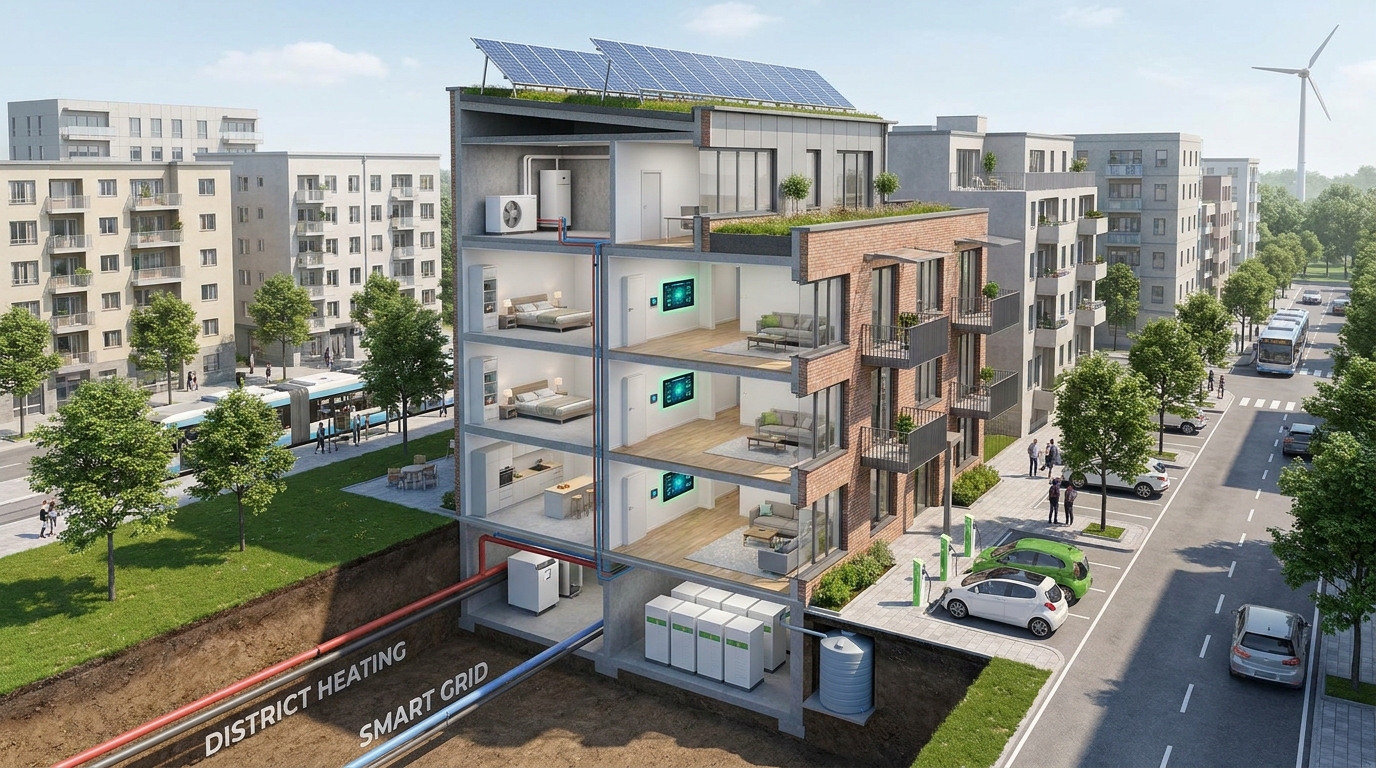
In Canada and across North America, this is becoming a policy priority. Governments are moving toward net-zero-ready codes, electrification, and deep retrofits because building emissions remain a major challenge. Yet the smart eco-city approach goes beyond simply improving insulation or replacing equipment. It looks at how buildings function as part of a neighbourhood-scale system. For example, a highly efficient building that is close to transit, integrated with district energy, equipped with smart controls, and located in a walkable mixed-use area can reduce emissions far more effectively than a similar building in a remote car-dependent setting.
District energy is one of the clearest illustrations of this integrated thinking. Instead of each building producing heating and cooling independently, district systems serve multiple buildings from a shared network. This can improve efficiency, simplify maintenance, and create opportunities to use lower-carbon sources such as waste heat, geoexchange, or centralized heat pumps. As electricity grids become cleaner and heating needs shift away from fossil fuels, district-scale systems can become a valuable part of urban decarbonization.
Smart building controls also play an important role. Modern systems can optimize temperature, ventilation, lighting, and equipment use in response to occupancy patterns, utility signals, and weather conditions. Residents experience this as comfort and convenience, while operators see lower energy waste and more reliable performance. The key is that intelligence should remain mostly invisible to the user. Good systems support better living without requiring constant effort or technical expertise from the people who live there.
Material choices matter too. Sustainable cities are not only powered differently. They are also built differently. Lower-impact materials, longer-lasting assemblies, adaptive reuse, and circular construction practices can reduce embodied carbon and construction waste. Smart eco-city thinking encourages cities to ask not only how a building performs in operation, but also how it was made, how long it will last, and what happens at the end of its life cycle.
Why Net-Zero Buildings Are Not Enough on Their Own
There is a common misconception that if enough buildings become net-zero, the city itself will automatically become sustainable. In reality, citywide performance depends on much more than individual buildings. Urban form, transport choices, public infrastructure, land use, water systems, and access to nature all shape environmental outcomes. A city made of efficient buildings can still produce high emissions if residents depend on long car commutes, if stormwater overwhelms hard surfaces, or if public services remain fragmented and inequitable.
This is why smart eco-cities focus on district and city scale coordination. A building may generate clean power on site, but it also benefits from a smart grid that can balance demand and support electrification. A retrofit may improve indoor comfort, but it becomes more valuable when paired with tree canopy expansion that reduces urban heat and with transit improvements that lower transportation emissions. Sustainability becomes stronger when systems reinforce one another.
Mobility, Land Use, and the 15-Minute City
Transportation is one of the clearest examples of how technology and sustainability need to work together. A city can deploy mobility apps, connected traffic systems, and real-time transit screens, but if most daily trips still require driving long distances, the environmental gains will remain limited. Smart eco-cities begin with a more fundamental question. How can urban form reduce the need for unnecessary travel in the first place?
This is where ideas like the 15-minute city and transit-oriented development become so useful. The goal is not to restrict movement. It is to make daily needs easier to reach by foot, bike, or transit. When homes, schools, shops, parks, healthcare, and community services are located closer together, residents gain time, convenience, and flexibility. Compact, mixed-use neighbourhoods can also support local business vitality, improve street life, and reduce emissions from transport.
Technology strengthens this model when it helps public transit become more reliable and responsive. Real-time data can improve route planning, service coordination, maintenance scheduling, and passenger information. Integrated fare systems can make transfers smoother. Shared mobility options can help solve the first- and last-kilometre problem around transit hubs. Smart traffic management can give buses and trams priority where it genuinely improves mobility outcomes. Used well, these tools make sustainable transportation feel not just virtuous but practical.
Walkability also deserves attention in this conversation. A smart eco-city is not defined only by software and networks. It is also defined by the simple physical experience of moving through space. Wide sidewalks, weather protection, street trees, safe crossings, active frontages, and accessible public spaces all influence whether people feel comfortable choosing low-carbon ways to get around. These are not decorative features. They are part of the city’s performance system.
Low-carbon mobility includes electrification as well, but electrifying vehicles should complement compact planning rather than replace it. Electric buses, electric fleets, and charging infrastructure are important advances. Still, a city that reduces trip distances and increases alternatives to driving will usually achieve better environmental and social outcomes than one that merely swaps internal combustion engines for electric ones while keeping the same spread-out pattern.
How Data, AI, and Digital Twins Can Help Cities Perform Better
Much of the recent excitement around smart eco-cities comes from new digital capabilities. AI-enabled urban operations, digital twins, and real-time analytics are creating better ways to understand how cities function and where inefficiencies exist. These tools are especially promising because cities are complex systems. Energy demand shifts by hour and season. Transport patterns change with housing growth and remote work. Climate risks evolve over time. Traditional planning methods can miss these interactions or capture them too slowly.
A digital twin is essentially a dynamic digital model of part of a city or infrastructure system. It can combine physical data, sensor feeds, geographic information, and predictive analytics to simulate conditions and test scenarios. For planners and operators, this can be extremely valuable. They can evaluate how a new development may affect traffic and energy demand, identify heat-vulnerable zones, optimize district energy operations, or assess how floodwater might move through a neighbourhood during an extreme storm. The result is often better decision-making before money is spent or before disruption occurs.
AI can support urban systems in similarly practical ways. It can help forecast electricity demand, detect anomalies in water systems, optimize waste collection routes, manage transit scheduling, and improve maintenance planning for aging infrastructure. In a warming climate, these capabilities matter even more. The IEA has pointed to the increasing importance of cities and grids on a heating planet, where cooling demand, electrification, and resilience pressures all interact. Smarter urban operations can help cities handle these pressures more efficiently.
Still, caution is necessary. A city is not improved simply because it has more data. Data must be tied to clear public goals, transparent governance, and meaningful accountability. If digital systems become opaque, intrusive, or biased, they can undermine trust. That is why the most thoughtful smart eco-city strategies pair innovation with strong data governance, privacy protections, and resident engagement. The real promise of urban technology lies in better stewardship, not more surveillance.
Nature-Based Solutions Are Part of the Smart City Future
One of the most encouraging shifts in recent years is the recognition that urban technology and urban nature are not opposites. In fact, some of the strongest smart eco-city models combine digital insight with natural systems. This matters because climate resilience increasingly depends on how well cities manage heat, water, air quality, and biodiversity. Concrete and data alone are not enough.
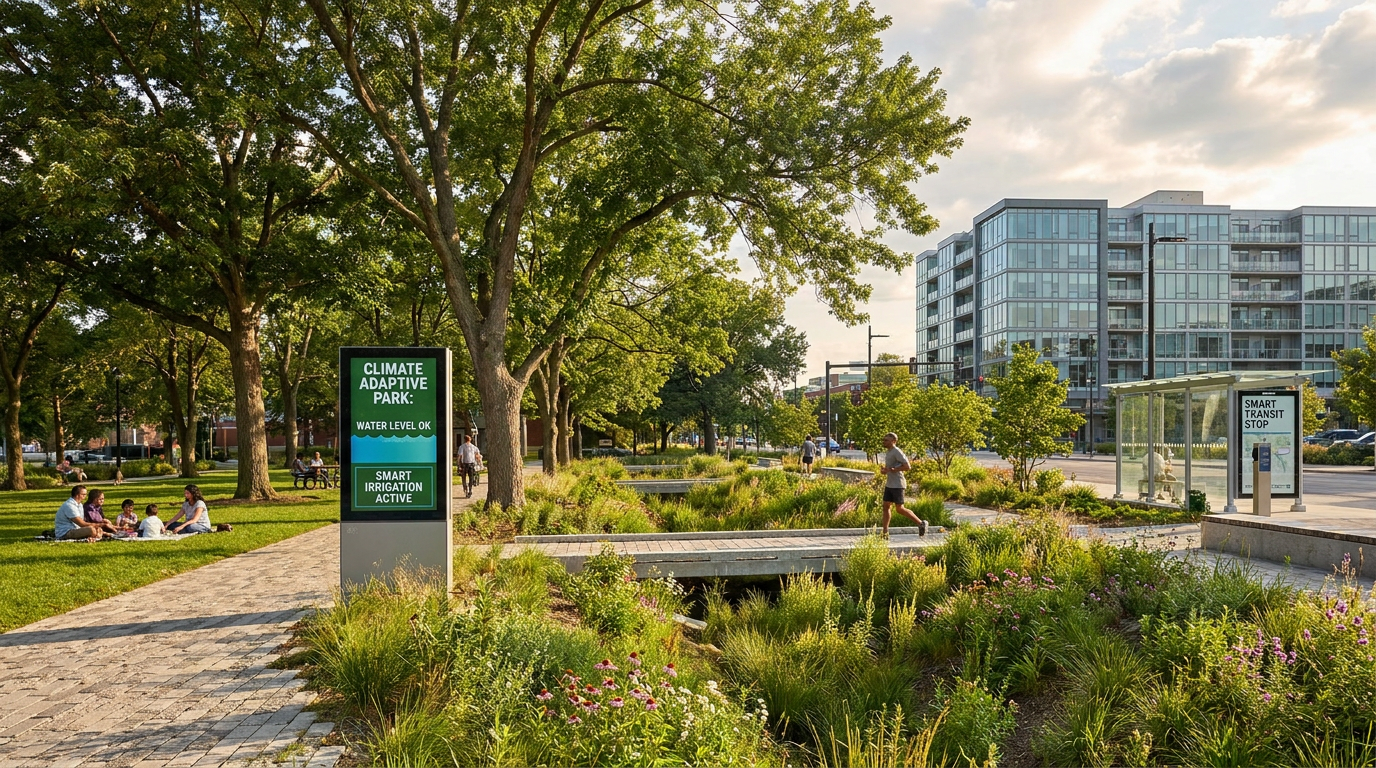
Nature-based solutions include street trees, green roofs, wetlands, rain gardens, bioswales, permeable surfaces, urban forests, and restored waterways. These features can cool neighbourhoods, absorb stormwater, support habitat, reduce the urban heat island effect, and improve public well-being. They also make cities feel more humane. Residents often experience sustainability most directly through the comfort of shade, the relief of cleaner air, and the beauty of well-designed public landscapes.
Smart monitoring can make these systems even more effective. Sensors can track soil moisture, water levels, and surface temperatures. Satellite and GIS data can identify areas with too little canopy coverage or high flood risk. Maintenance teams can respond more precisely, reducing waste and improving performance. In this way, technology supports ecological infrastructure rather than replacing it.
This integrated approach is especially relevant for cities facing flood risk, wildfire smoke, and extreme summer heat. Resilience is no longer a separate concern from sustainability. It is part of it. A smart eco-city that lowers emissions but fails to protect residents during climate stress is incomplete. Equally, a city that builds resilient green infrastructure while improving daily quality of life is investing in both near-term comfort and long-term stability.
Equity, Affordability, and the Human Side of Smart Cities
Any serious discussion of smart eco-cities has to address equity. This is not an optional add-on. Recent urban research has shown that sustainability gains can be unevenly distributed, and that well-intentioned policies can produce trade-offs around segregation, affordability, and procedural justice. A greener city is not necessarily a fairer one unless inclusion is built into the process and the outcomes.
For residents, the questions are concrete. Who gets access to efficient housing and lower utility bills. Which neighbourhoods receive reliable transit and cleaner air. Who benefits from tree canopy and high-quality parks. Which households can participate in digital services easily, and which are left behind because of cost, accessibility barriers, language, or lack of connectivity. A smart eco-city should be judged by how broadly it spreads its benefits, not only by how advanced its systems appear on paper.
Affordability is central here. Sustainability features can increase long-term value, but if they are introduced in ways that drive displacement or concentrate benefits in already advantaged areas, trust erodes quickly. Cities need policies that connect environmental improvements with housing access, tenant protections, and inclusive community development. Mixed-income housing near transit, retrofit support for affordable housing providers, and equitable investment in underserved neighbourhoods are all part of the solution.
Digital inclusion matters too. As more city services move online, residents need reliable access to devices, internet service, accessible interfaces, and clear support. If smart systems assume a level of digital access that not everyone has, they risk widening the divide they claim to solve. Good design is inclusive by default. It recognizes diverse needs and makes participation easy rather than technical.
The smartest city is not the one with the most sensors. It is the one that distributes safety, comfort, clean air, mobility, and opportunity more fairly.
Governance: The Difference Between a Good Idea and a Good City
Governance is often the least visible part of a smart eco-city, yet it may be the most important. Technology can improve urban systems, but governance determines whose problems get prioritized, how success is measured, and whether residents trust the process. Without strong governance, even well-funded smart initiatives can become fragmented, underused, or disconnected from local needs.
The Government of Canada’s Smart Cities Challenge framed smart cities in terms of meaningful outcomes for residents, including mobility, health, safety, housing, and well-being. That is a useful standard because it shifts attention away from devices and toward lived experience. Cities should ask whether a proposed technology will reduce emissions, improve resilience, save public money, or expand access in measurable ways. If it will not, then it may not be worth pursuing.
Transparent metrics can help. Rather than focusing solely on traffic speed or app adoption, cities can track building energy intensity, transit accessibility, tree canopy distribution, flood exposure, housing affordability, indoor air quality in public buildings, and energy burden across income groups. These indicators align much more closely with the idea of a smart eco-city than a narrow focus on technological deployment.
Resident participation also matters. People understand local conditions in ways data sometimes cannot capture. They know where intersections feel unsafe, where flooding recurs, where transit connections fail, and where public spaces feel unwelcoming. Engaging residents early and seriously leads to better design and stronger legitimacy. In the long run, that may be one of the smartest investments any city can make.
Common Misconceptions About Smart Eco-Cities
Because the topic combines sustainability and technology, misconceptions are common. One is the belief that all smart cities are inherently sustainable. They are not. Adding sensors, dashboards, or connected devices does not reduce emissions unless the underlying urban system changes. If technology is layered onto inefficient buildings, car-dependent sprawl, or inequitable service patterns, the city may become more data-rich without becoming meaningfully greener.
Another misconception is that sustainability begins and ends with energy. Energy is a major issue, but it is only one part of urban performance. Land use, transport, housing, water, waste, biodiversity, and public health all matter. A city with efficient buildings but poor transit and little green space is still missing key ingredients of sustainable living. Smart eco-cities work because they recognize these interdependencies rather than isolating them.
A third misconception is that more technology always produces a better city. High-tech urban systems can create new problems if they increase surveillance, reduce privacy, or exclude residents who cannot easily participate. A city should never become less humane in the name of becoming more efficient. Technology should recede into the background and support trust, accessibility, and comfort.
Finally, there is the idea that low-density developments can remain equally sustainable as compact urban neighbourhoods as long as the buildings are greener. In practice, compact mixed-use development often performs better because it shortens trips, supports transit, reduces infrastructure duplication, and preserves more land. Density on its own is not enough, but well-designed urban density can be one of the most powerful sustainability tools available.
What Smart Eco-Cities Could Look Like in Everyday Life
For many people, the phrase smart eco-city can still sound abstract. It helps to imagine the concept in daily terms. Picture a neighbourhood where most errands can be done within a short walk, where transit arrival times are accurate, and where streets feel safe for children and older adults. Apartment buildings and offices are comfortable in winter and summer because their systems adjust efficiently in real time. Energy comes from cleaner sources, and district systems reduce waste behind the scenes. Parks are designed to manage stormwater and cool the area during hot weather.
Now imagine that these systems are coordinated rather than isolated. When electricity demand spikes, buildings respond intelligently. When heavy rain is forecast, water systems and green infrastructure are prepared. When wildfire smoke affects air quality, public buildings can serve as reliable clean-air spaces. When a new development is proposed, planners can model its impact on transport, energy, and public space before approving it. Residents may not think of these functions as smart infrastructure day to day, but they experience the results as reliability and ease.
This is the deeper promise of smart eco-cities. They can make sustainability feel normal rather than exceptional. They can fold environmental performance into the routines of housing, commuting, recreation, and community life. That kind of integration is often more durable than messaging alone because it aligns personal benefit with public benefit.
A Practical Model for the Future
Smart eco-cities are not a silver bullet, and they are not a single design formula that every municipality can copy. Climate, geography, housing needs, infrastructure age, and political context all vary. Still, the underlying lesson is consistent. Cities function best when technology is used to support compact, inclusive, low-carbon urban systems rather than to distract from deeper structural choices.
That means prioritizing efficient buildings, transit-oriented development, green infrastructure, resilient public space, clean energy integration, and equitable access to services. It means using AI, sensors, and digital twins where they genuinely improve stewardship, operations, and planning. It means treating residents not as passive users of a platform, but as participants in shaping neighbourhoods that reflect shared goals. And it means recognizing that sustainability is not a niche preference. It is increasingly the practical foundation of long-term urban livability.
For Canada and North America, this is a particularly important moment. Urban populations are high, infrastructure renewal is urgent, and climate adaptation can no longer be deferred. The choices made now around housing, buildings, streets, and public systems will shape emissions and quality of life for decades. Smart eco-cities offer a useful framework because they insist on balance. They show that modern cities can be technologically capable without becoming impersonal, and environmentally ambitious without becoming unrealistic.
Perhaps most importantly, they remind us that the future of sustainable living is not only about consuming less. It is about designing better. Better buildings, better systems, better public spaces, and better coordination between the many parts of urban life. When done well, a smart eco-city does not ask residents to choose between convenience and conscience. It quietly brings those values together in the places people call home.
Key Elements That Define a Strong Smart Eco-City Strategy
- People-centered planning that measures success through health, affordability, accessibility, comfort, and environmental performance.
- Compact mixed-use development that shortens trips and supports walkability, transit, and local services.
- High-performance buildings with deep retrofits, electrification, smart controls, and durable low-impact materials.
- District-scale infrastructure such as district energy, smart grids, and coordinated water and waste systems.
- Low-carbon mobility supported by transit-oriented development, safe cycling, complete streets, and electrified transport.
- Nature-based resilience including trees, permeable landscapes, green roofs, and flood-ready public spaces.
- Responsible digital governance with transparency, privacy safeguards, and inclusive access to digital services.
- Equity-focused investment so benefits reach diverse neighbourhoods and income groups rather than concentrating in a few areas.
Final Thoughts
The future city that many people want is not simply smarter or greener in isolation. It is both, and in a way that feels grounded, fair, and livable. Smart eco-cities represent that possibility. They use modern tools to reduce waste, cut emissions, improve resilience, and support everyday comfort, while keeping environmental values rooted in practical design. For communities navigating growth and change, that balance may be one of the most valuable planning ideas we have.
If cities are where the greatest pressures converge, they are also where the best solutions can scale. Thoughtful urban density, cleaner buildings, better transit, responsive infrastructure, and greener public spaces are no longer separate ambitions. They are parts of the same story. The smart eco-city is simply the version of that story in which technology serves people, sustainability shapes the system, and quality of life improves as a result.



No Comment! Be the first one.