



Brick finishes have a rare quality in interior design. They can feel grounded, storied, and tactile, yet they can also appear restrained, architectural, and quietly modern. Few materials move so effortlessly between these visual worlds. In one room, brick suggests history, warmth, and age old character. In another, it becomes a clean backdrop for sculptural furniture, pale timber, steel detailing, and contemporary light.
Table Of Content
- Why Brick Finishes Continue to Captivate
- The Dual Nature of Brick: Rustic Soul and Modern Precision
- Understanding Brick Finishes in Modern Homes
- The Performance Story Behind the Beauty
- Designing with Brick in Different Interior Styles
- Brick in Rustic and Heritage Inspired Interiors
- Brick in Modern and Minimal Interiors
- Brick in Transitional Spaces
- How Color, Joint Profile, and Surface Treatment Change the Look
- Where Brick Finishes Work Best Inside the Home
- Brick and Material Layering
- The Sustainable Appeal of Reclaimed Brick
- Common Misconceptions About Brick Finishes
- Planning a Brick Finish Thoughtfully
- Maintenance, Care, and Longevity
- Brick as a Timeless Design Language
That duality is precisely what makes brick so compelling today. As interiors continue to shift toward richer texture, earthy palettes, and layered materials, brick finishes feel more relevant than ever. They answer a growing desire for surfaces that look honest and substantial, while also offering a versatile visual language that can be adapted to lofts, family homes, apartments, renovations, and new builds alike. Brick is no longer confined to industrial aesthetics or farmhouse nostalgia. It belongs just as naturally in calm minimalist homes as it does in heritage inspired spaces.
For homeowners considering a renovation or a finish upgrade, brick offers more than appearance alone. It is associated with durability, fire performance, acoustic mass, and long term presence. Yet it is equally important to understand that most interior brick looks in modern homes are not structural masonry walls. They are often brick veneer or thin brick systems applied with careful detailing. When chosen and installed thoughtfully, brick finishes can enrich a room visually and technically, creating spaces that feel both beautiful and enduring.
This article explores brick as both a rustic texture and a sleek modern design element. It looks at the aesthetic possibilities, the practical realities, the common misconceptions, and the design strategies that help brick feel elevated rather than expected. Whether you are drawn to reclaimed red clay, a pale limewashed wall, or a refined gray thin brick installation, brick can become a deeply expressive part of your interior story.
Why Brick Finishes Continue to Captivate
There is something instinctively reassuring about brick. Its rhythm, depth, and imperfect surface speak to permanence in a way that flat painted drywall rarely can. Even when used as a finish rather than a structural wall, brick introduces a feeling of substance. It catches light across its uneven face, reveals subtle shifts in tone, and develops atmosphere through shadow. This is why a brick wall can animate a room even before any furniture is placed within it.
Part of brick’s timeless appeal comes from the fact that it is neither overly polished nor visually chaotic. It sits in a graceful middle ground. It has texture, but it is organized. It has variation, but it is coherent. It carries memory and patina, yet it can still support a contemporary composition. In design terms, that balance is immensely valuable because it allows brick to harmonize with many styles without overwhelming them.
Today’s interiors are embracing tactile richness once again. Designers and homeowners are leaning into mineral colors, natural fibers, lime based finishes, stone, wood grain, and surfaces that feel lived in rather than sterile. Within this context, brick finishes feel current rather than dated. They offer a material response to modern life, bringing a sense of depth and grounding to spaces that might otherwise feel too smooth or anonymous.
Brick is best understood not as a single look, but as a design language. Through color, mortar, format, finish, and context, it can read as rustic, urban, classic, minimal, or quietly luxurious.
The Dual Nature of Brick: Rustic Soul and Modern Precision
Brick is often associated with rustic interiors because it naturally evokes age, craft, and material honesty. Reclaimed brick in warm red and brown tones can make a kitchen feel welcoming, a fireplace feel authentic, or a hallway feel richly layered. Irregular edges, weathered faces, and softened mortar lines contribute to a mood that is deeply human. In homes that seek comfort and character, brick can become the anchor that keeps a room from feeling generic.
Yet brick can be transformed completely by the way it is finished and framed. When laid in a refined stack or traditional running bond with flush joints, when chosen in charcoal, taupe, buff, or pale gray, or when softened with whitewash or limewash, brick takes on an altogether different personality. It becomes quieter, flatter in tone, and more architectural in effect. The same essential material that once suggested warehouse lofts or country houses can suddenly feel tailored enough for a minimalist living room.
This ability to shift identities is what makes brick finishes such a useful tool in contemporary interiors. Homeowners are no longer forced to choose between an old world material and a modern home. Brick can be the bridge between the two. It can warm clean lines, soften steel and glass, and bring tactility to restrained color schemes. Equally, it can modernize traditional spaces when paired with streamlined cabinetry, sculptural lighting, and less ornate furnishings.
The beauty of brick lies in nuance. A wall of deeply textured reclaimed brick with thick, recessed mortar joints tells one story. A smooth thin brick installation in pale gray with neat joints tells another. Both are brick finishes, yet the emotional result is dramatically different. Understanding that range opens the door to more imaginative, more personal interiors.
Understanding Brick Finishes in Modern Homes
One of the most useful misconceptions to correct is that all interior brick is structural. In many North American homes, the brick you see indoors is not a load bearing masonry wall. It may be a veneer, a thin brick system, or an applied finish designed to create the visual richness of brick without requiring the depth and weight of full masonry construction. This distinction matters because it influences installation methods, substrate requirements, performance expectations, and maintenance.
Brick veneer is commonly used as a finish system, and industry guidance emphasizes that it must be detailed correctly. The Brick Industry Association notes that brick veneer walls are drainage type systems. In practical terms, that means some water penetration is expected, and flashing and drainage details are essential to proper long term performance. This technical reality may seem far removed from aesthetics, but it is central to preserving beauty. A beautiful brick wall that is poorly detailed is never truly a successful design feature.
Thin brick has become especially important for interiors because it offers flexibility in renovations and retrofit projects. It can provide the appearance of traditional brick with a slimmer profile and lighter system weight, making it suitable for feature walls, kitchen applications, fireplaces, and selected commercial style installations in homes. This makes brick far more accessible than many people imagine. It is not reserved only for older loft buildings or heavy masonry construction.
For Canadian homeowners, compliance minded planning is essential. Fire and building code requirements vary depending on the assembly, location, and product used, especially in renovations. National code frameworks and product evaluation pathways matter. The elegant part of good design is not simply choosing the right surface, but choosing a system that performs responsibly within the realities of the building.
The Performance Story Behind the Beauty
While brick finishes are often chosen for visual reasons, their technical associations add to their enduring appeal. According to the Brick Industry Association, a nominal 4 inch brick wythe can provide 1 hour of fire resistance, and certain brick veneer assemblies with wood stud backing can achieve 2 hour fire ratings when assembled properly. These are not decorative trivialities. They help explain why brick remains such a respected material across residential and commercial applications.
Brick’s mass also contributes to acoustics and thermal moderation. A room with masonry elements often feels quieter and more settled because mass can help temper sound transmission. In open plan living spaces, home offices, and urban residences, this quality can be especially desirable. Thermal moderation is another benefit often associated with brick, though it is important to be precise. Actual thermal performance depends on the entire wall assembly, including insulation, backing, glazing, and detailing. Brick contributes, but it does not work in isolation.
These performance characteristics support the emotional experience of brick as much as the practical one. A wall that visually feels solid and enduring often also behaves in ways that support comfort and safety. That coherence between appearance and performance is part of what makes brick so satisfying. It is not merely pretending to be substantial. Even as a finish system, it participates in a broader architectural logic.
Still, homeowners should resist assuming that all brick installations perform the same way. Performance varies by product, substrate, cavity design, moisture management strategy, and assembly type. A thoughtful designer or contractor will never reduce brick to a universal claim. Instead, they will ask the more useful question: what kind of brick finish is appropriate for this room, this wall, and this building?
Designing with Brick in Different Interior Styles
Brick in Rustic and Heritage Inspired Interiors
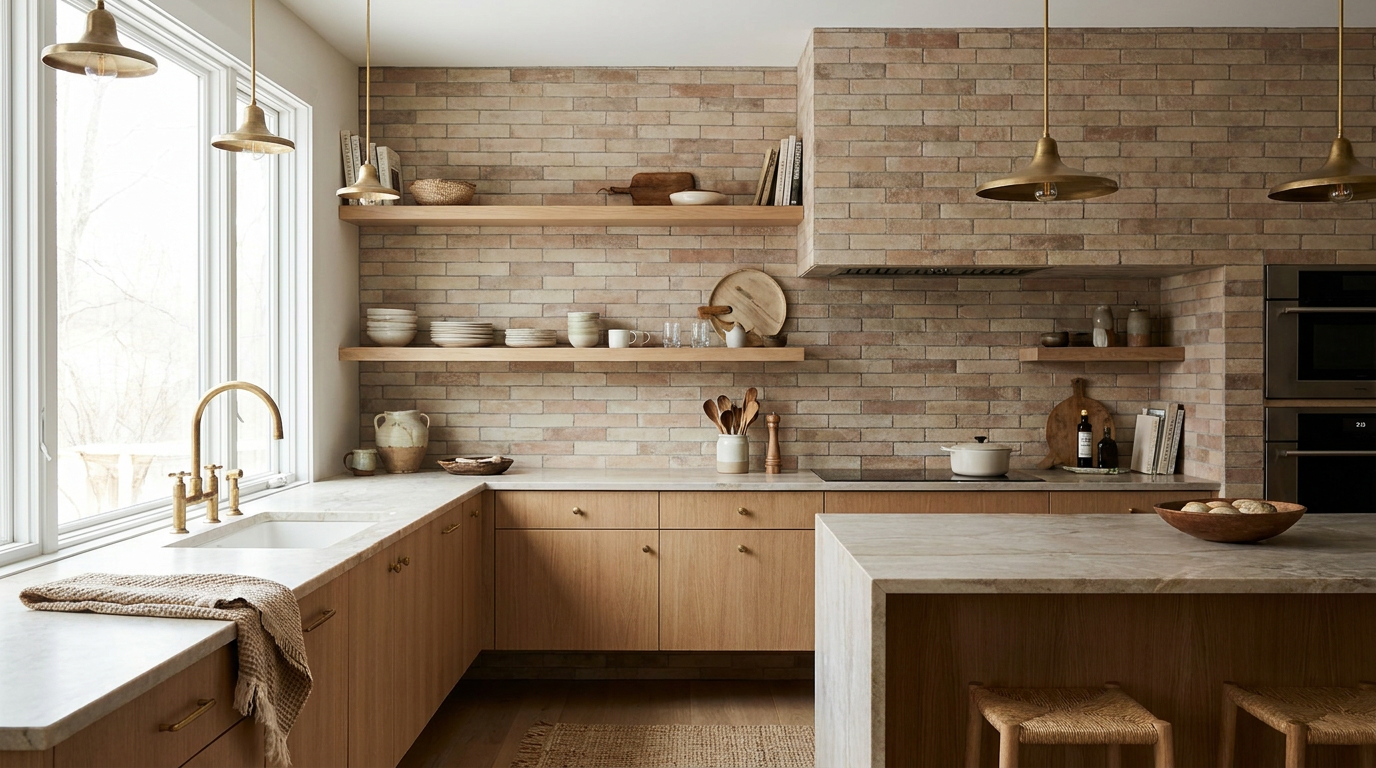
In heritage inspired rooms, brick often works best when it is allowed to keep some of its natural irregularity. Reclaimed brick is particularly evocative because it carries variation in color, softened corners, and a lived in surface that new materials often struggle to imitate. In a kitchen, this can translate into a backdrop that makes simple wooden shelves, unlacquered brass, and ceramic pottery feel intentional rather than staged. In a living room, brick around a fireplace or on a single feature wall can establish an atmosphere of comfort without resorting to excessive decoration. Kingsgate brought this same warm, red-brick craftsmanship to life in a recent custom build — see 49 Rumsey Rd in Toronto, where a warm red brick facade sets the tone for an interior that balances traditional detailing with modern comfort.
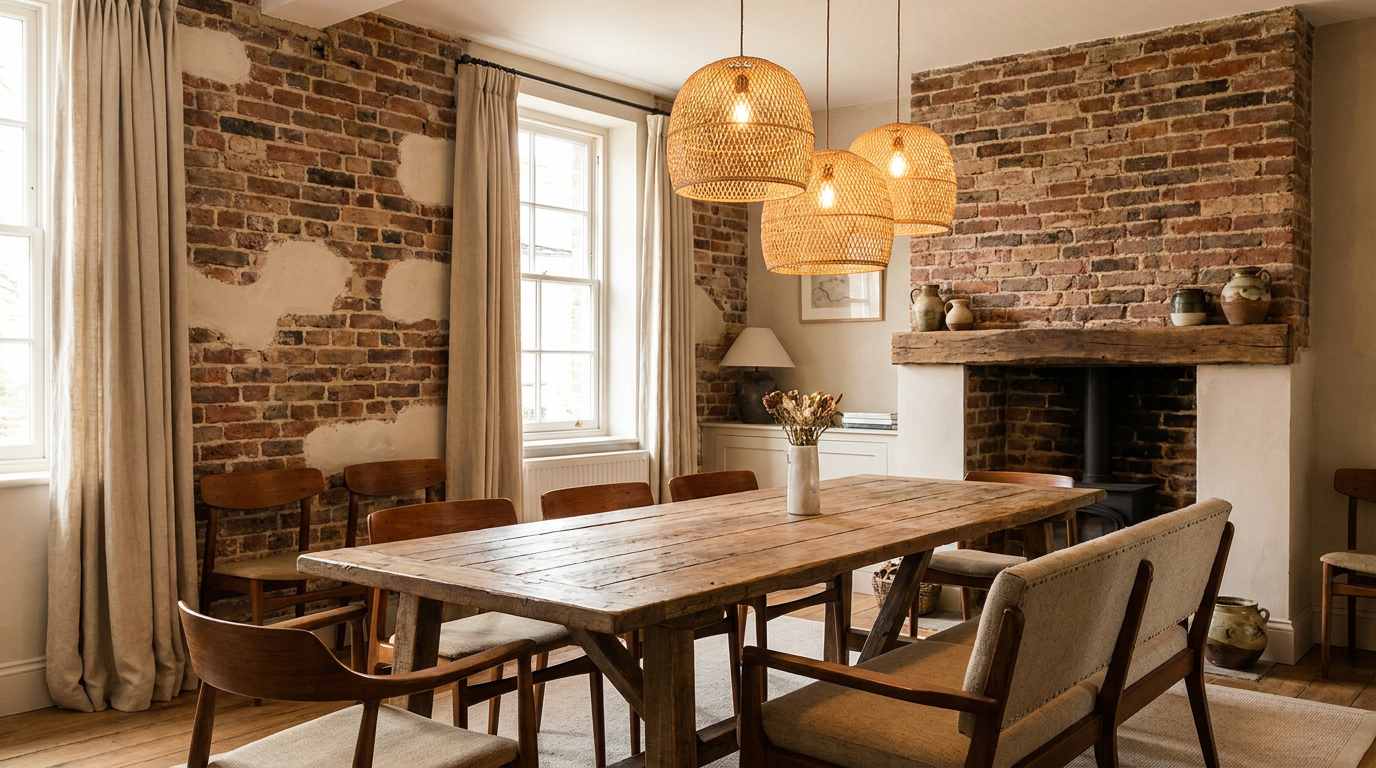
Mortar plays a significant role in the final effect. A softer, more visible joint can reinforce the sense of age and craft. So can tonal variation between brick and mortar rather than a sharp contrast. When paired with wide plank timber, natural linen, aged leather, and muted paint colors, brick becomes part of a layered composition that feels collected over time. It can be especially effective in homes where new additions need to converse gently with older architectural references.
Rustic use of brick does not need to feel heavy. The most refined rooms balance the weight of masonry with light, softness, and air. Creamy plaster ceilings, sheer curtains, warm oak, and thoughtful lighting can stop brick from becoming visually dense. The goal is not to create a themed room, but to allow the material’s history and warmth to enrich the space with quiet confidence.
Brick in Modern and Minimal Interiors
Modern interiors often benefit from one surface that disrupts perfect smoothness. Brick can provide that interruption with remarkable elegance. In a minimalist home, a pale or monochrome brick finish creates texture without clutter. Gray, whitewashed, buff, and taupe brick tones work particularly well here because they maintain a calm palette while adding visual depth. Flush mortar joints and thinner brick profiles can make the installation feel clean and contemporary.
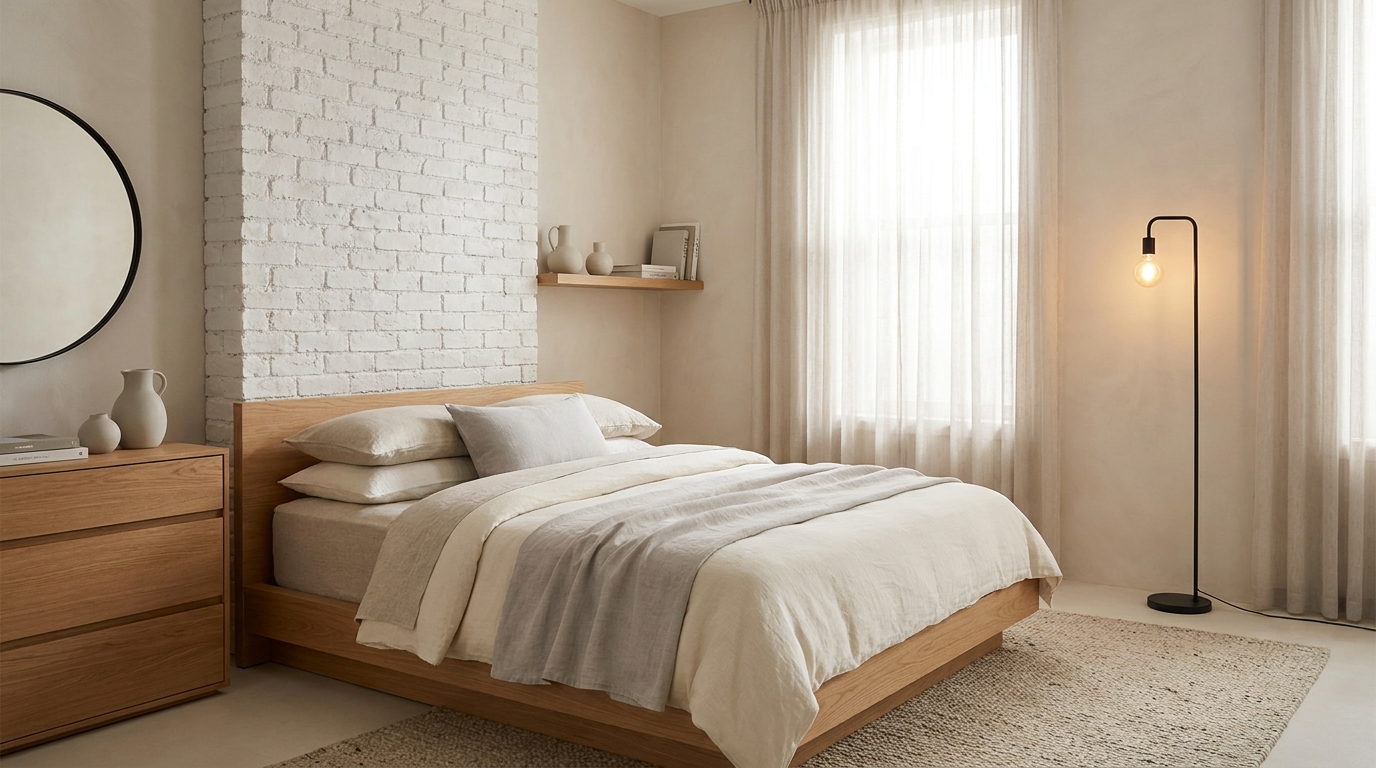
Whitewashed and limewashed brick are especially sophisticated options because they soften the visual busyness of traditional brick while allowing the material’s relief and rhythm to remain visible. The result is not flat like paint, but atmospheric. Light moves gently across the surface, revealing the masonry beneath in a way that feels nuanced and architectural. This is often ideal in bedrooms, serene living rooms, and Scandinavian influenced interiors where restraint matters.
Brick also pairs beautifully with modern materials. Against black steel, it feels sharper. Against oak, it feels warmer. Against plaster, it feels more textural. Against glass, it feels more grounded. This interplay is where modern brick interiors become truly compelling. The brick does not dominate. Instead, it participates in a carefully choreographed contrast of hard and soft, matte and reflective, old and new.
Brick in Transitional Spaces
For many homeowners, the most livable interiors are neither strictly rustic nor purely minimal. They exist in the elegant middle ground often called transitional design. Brick is almost perfectly suited to this territory. A softly toned brick wall in a dining area or entry can connect classic detailing with contemporary furniture. It introduces familiarity without becoming sentimental and texture without becoming rough.
Transitional spaces often rely on balance, and brick can provide it. If a room contains traditional millwork, a brick finish can stop it from feeling too formal. If a room contains sleek cabinetry and modern lighting, brick can stop it from feeling too cold. Because the material carries both heritage and simplicity, it can mediate between visual languages that might otherwise clash.
This makes brick particularly useful in renovations where original architecture and new interventions need to coexist gracefully. It can absorb difference. It can help an updated kitchen sit comfortably within an older envelope. It can also help a new addition feel rooted rather than detached. In this sense, brick is not only a finish but a connector.
How Color, Joint Profile, and Surface Treatment Change the Look
Brick’s versatility depends greatly on detail. Color is perhaps the most immediate variable. Traditional red and brown clay tones create warmth and familiarity. Buff and sand tones feel lighter and sunnier. Gray and charcoal move the material toward an urban, architectural mood. White and off white applications reduce contrast and make brick feel airy and contemporary. Each palette alters the emotional temperature of the room.
Mortar and joint profile are equally influential. Recessed joints can heighten shadow and emphasize each brick individually, often making the wall feel more textured and dramatic. Flush joints tend to create a flatter, more unified appearance that suits modern interiors. Mortar color can either sharpen the pattern or dissolve it. A contrasting mortar highlights geometry. A tonal mortar softens it and allows the surface to read more as a whole.
Surface treatment adds another layer of possibility. Painted brick creates a bold, consistent finish, though it changes the material’s original expression and should be approached with care. Whitewash allows some of the underlying color to show through, offering softness without total concealment. Limewash has a particularly beautiful mineral quality, producing an aged, breathable appearance that feels both old and current. Each treatment should be selected not simply for trend appeal but for how it supports the room’s broader palette and mood.
To understand these variables more clearly, it helps to think of brick finishes as a set of design decisions rather than a single material choice:
- Brick color shapes warmth, depth, and period association.
- Joint profile influences shadow, texture, and visual crispness.
- Mortar color determines whether the wall reads as graphic or subdued.
- Surface treatment can preserve, soften, modernize, or dramatize the masonry.
- Surrounding materials decide whether brick feels rustic, refined, industrial, or serene.
Where Brick Finishes Work Best Inside the Home
Brick can be effective throughout the home, but its impact is strongest where it can act as an architectural anchor. Living rooms are a natural choice, especially behind a fireplace, media wall, or long seating arrangement. Here, brick creates a sense of permanence and scale. In open plan spaces, it can visually stabilize the room, giving the eye a textured point of focus amid larger expanses of drywall and glazing.
Kitchens are another ideal setting. A brick backsplash or feature wall introduces warmth into a room often dominated by hard, reflective finishes. When paired with stone counters, timber cabinetry, or metal shelving, brick enriches the material dialogue. It can also make a newly renovated kitchen feel less clinical and more connected to the life of the home.
Dining areas benefit from brick because the material creates intimacy. Candlelight, pendant light, or evening shadows all interact beautifully with its uneven surface. In entryways, brick can establish immediate character and signal the tone of the house from the first moment. Bedrooms may seem less obvious, yet pale or whitewashed brick can be remarkably soothing, adding texture without visual excess.
Bathrooms can also use brick successfully, though with greater technical care because moisture exposure is higher. In these spaces, the romance of the material must be matched by appropriate detailing, ventilation, and finish compatibility. This is a recurring theme with brick. It rewards beauty, but it also expects respect.
Brick and Material Layering
One reason brick remains so relevant is that it performs beautifully within layered interiors. Current design directions continue to favor homes that feel assembled from a range of tactile surfaces rather than a single dominant finish. Brick belongs naturally in this environment. It pairs with plaster for softness, with wood for warmth, with steel for clarity, and with stone for gravitas.
When designing around brick, contrast should be deliberate. If the brick is rough and warm, consider smoother adjacent finishes that allow it to breathe. If the brick is pale and understated, consider adding deeper wood or dark metal accents to sharpen its presence. The relationship between materials is what elevates the room. Brick should not be seen in isolation, but as part of a carefully balanced composition.
Textiles matter here as well. Linen, wool, boucle, cotton, and leather all react differently to the visual weight of brick. Soft fabrics can temper its hardness and create welcome comfort. Sculptural lighting can highlight the relief of the surface. Art can either stand out beautifully against brick or disappear into it, depending on color and scale. These decisions are what transform a brick wall from a simple finish into an atmospheric backdrop.
The Sustainable Appeal of Reclaimed Brick
Brick’s endurance is not only aesthetic. It also carries a meaningful sustainability story, especially when reclaimed materials are used thoughtfully. The U.S. EPA identifies brick as one of the materials commonly recovered in demolition streams, and strategies such as reuse, salvage, and deconstruction are increasingly important within circular design thinking. For homeowners who want beauty with environmental consideration, reclaimed brick presents an appealing option.
Reclaimed brick often offers more character than new product because it comes with irregularities, patina, and tonal complexity developed over time. These visual marks are not flaws. They are part of the material’s biography. In an era when many homeowners are seeking authenticity, reclaimed brick answers that desire elegantly. It brings a sense of narrative into the home while reducing demand for newly manufactured material in some applications.
That said, sustainable design is not simply about choosing old brick and declaring the work done. Reuse still requires evaluation, suitability, and proper installation. Not every salvaged material is right for every interior condition. The most successful sustainable projects treat reclaimed brick as a resource that must be integrated intelligently, with attention to structural compatibility, moisture behavior, and finish goals.
Timeless interiors often succeed because they allow materials to age with grace. Reclaimed brick does exactly that, carrying forward both memory and substance into contemporary life.
Common Misconceptions About Brick Finishes
Brick has a long history, but it is surrounded by surprisingly persistent myths. One of the most common is that brick interior finishes are always structural. In fact, many contemporary applications use veneer or thin brick systems rather than load bearing masonry. This expands design possibilities and makes brick more practical for many renovations.
Another misconception is that brick is maintenance free. Brick is durable, but durability does not mean neglect. The type of installation, the finish treatment, the sealants used, and the condition of joints all affect upkeep. Historic masonry requires one kind of care, while a newer thin brick wall may require another. Homeowners should think of brick as low drama rather than no maintenance.
There is also a belief that brick automatically causes dampness. More accurately, moisture problems usually arise from poor detailing, trapped water, inappropriate coatings, or assemblies that were not designed to manage water properly. Brick industry guidance stresses that correct flashing and drainage matter because water penetration is expected in certain wall systems. The issue is not brick itself but whether the assembly has been designed intelligently.
Finally, some people assume brick only belongs in rustic or industrial homes. This is perhaps the easiest myth to dismiss once one sees the breadth of contemporary brick applications. Whitewashed bedroom walls, thin brick kitchen backsplashes, monochrome living room features, and limewashed dining spaces all demonstrate how adaptable the material can be. Brick is not bound to a single aesthetic period. It is a medium of interpretation.
Planning a Brick Finish Thoughtfully
If you are considering brick in your own home, begin with intention rather than imitation. Ask what the room needs emotionally and visually. Does it need warmth, texture, and age? Or does it need restraint, subtle pattern, and architectural depth? Once that is clear, the right type of brick finish becomes easier to identify. A reclaimed wall may be beautiful, but not every room needs its intensity. A pale thin brick might be the more graceful answer.
It is also wise to think in terms of assemblies rather than surfaces. Especially in kitchens, bathrooms, basements, exterior facing walls, fireplaces, or renovation projects, installation details matter deeply. Moisture management, substrate preparation, transitions, and code considerations should be resolved early. In Canada and across North America, compliance is not a bureaucratic afterthought. It is part of what protects the longevity of the design.
Lighting should be considered from the beginning as well. Brick changes dramatically in different conditions. Morning light may emphasize every nuance. Evening light may flatten or enrich it depending on color and fixture direction. Test samples whenever possible. View them under natural and artificial light. A finish that appears beautifully soft in one setting may feel too dark or too busy in another.
The following sequence can help homeowners make better decisions:
- Define the mood you want the room to convey.
- Decide whether the brick should be a focal point or a supporting texture.
- Choose between reclaimed brick, veneer, thin brick, or another suitable finish system.
- Refine color, mortar, joint profile, and any wash or coating.
- Coordinate adjacent materials such as wood, stone, plaster, metal, and textiles.
- Confirm installation details, code requirements, and moisture strategy with qualified professionals.
Maintenance, Care, and Longevity
Brick’s lasting appeal is closely tied to the fact that it wears well, but that does not mean every finish should be treated the same way. Interior brick generally benefits from gentle maintenance. Dust can collect in textured surfaces and mortar joints, so periodic light cleaning is often sufficient. Harsh chemicals and unsuitable coatings should be avoided unless specifically recommended for the product and condition.
Painted, whitewashed, or limewashed brick may age differently from untreated masonry. Some homeowners appreciate this evolution, while others prefer a more controlled appearance. Understanding how the finish will wear over time is part of choosing wisely at the start. In heritage properties, special care should be taken before sealing or altering old masonry, as certain treatments can trap moisture or compromise the wall’s behavior.
Long term beauty comes from compatibility. The right finish on the right substrate, detailed correctly, will generally outperform a more dramatic but poorly considered choice. This is one reason brick has remained beloved for centuries. It rewards patience, craft, and realism. It does not need to shout to endure.
Brick as a Timeless Design Language
Perhaps the most elegant way to think about brick finishes is as a vocabulary of atmosphere. Through color, scale, wash, pattern, and pairing, brick can say many things. It can speak of heritage and softness. It can suggest urban edge or Mediterranean calm. It can feel artisanal, monastic, contemporary, or quietly luxurious. The material itself remains grounded, but its expression is wonderfully flexible.
For homeowners, this is liberating. Choosing brick does not lock a home into one aesthetic identity. Instead, it provides a textured foundation upon which many different stories can be built. A rustic kitchen can evolve toward a more modern look over time simply by changing lighting, hardware, stools, and wall color around the brick. A sleek living room can become warmer and more layered without needing to replace the masonry itself. Brick is adaptive because it contains both memory and neutrality.
As trends continue to favor authenticity, tactility, and layered natural materials, brick finishes stand out as a meaningful design choice rather than a passing gesture. They offer visual pleasure, architectural depth, and real performance associations when specified responsibly. More than that, they invite a room to feel inhabited in the richest sense of the word. Brick gives space a pulse.
In the end, the beauty of brick lies not only in how it looks, but in how it holds contrasts so gracefully. It is earthy yet refined, historic yet current, rugged yet sophisticated. That is why brick continues to enchant designers and homeowners alike. It does not ask us to choose between comfort and elegance, or between tradition and modernity. It offers both, in a single enduring surface.


No Comment! Be the first one.