



Procurement can sound like a technical term reserved for government tenders, corporate contracts, or supply chain specialists. In practice, it is much simpler than that. Procurement is just the process of deciding what to buy, who to buy it from, and how those choices affect cost, quality, performance, and waste over time. When sustainability enters that process, the goal is not to make every decision perfect. The goal is to make purchasing more thoughtful, more durable, and more aligned with the kind of future we actually want to support.
Table Of Content
- What sustainable procurement really means
- Why sustainable procurement matters for waste reduction
- Why this topic is becoming more important now
- Common misconceptions that make sustainable procurement feel harder than it is
- A practical framework for making better purchasing decisions
- Step 1: Ask whether the purchase is necessary
- Step 2: Prioritize high-impact categories
- Step 3: Compare options using life-cycle value
- Step 4: Look for credible certifications and standards
- Step 5: Pay attention to packaging and delivery
- Step 6: Ask suppliers for environmental information
- Step 7: Consider end-of-life before you buy
- How sustainable procurement works in everyday categories
- Office supplies and paper products
- Furniture and interiors
- Electronics and ICT
- Cleaning and facility supplies
- Construction and renovation materials
- Creating a sustainable procurement checklist you can actually use
- How organizations can implement sustainable procurement without overwhelming staff
- The role of certifications, policies, and shared procurement tools
- How to start at your own pace
- Final thoughts: better choices over time
Sustainable procurement means buying goods and services in a way that considers environmental, social, and economic impacts across the full life cycle. That includes how raw materials are extracted, how products are made, how they are packaged and transported, how long they last, how much energy or maintenance they require, and what happens when they reach the end of their useful life. It shifts the question from What is cheapest today? to What offers the best value and lowest impact over time?
This shift matters more than it may seem at first glance. In OECD countries, public procurement accounts for about 12.7% to 13% of GDP in recent years, which makes purchasing a major lever for influencing markets and reducing environmental harm. When buyers ask for lower waste, better packaging, recycled content, cleaner materials, or supplier transparency, suppliers respond. The same principle applies at every scale. Whether you are managing a federal contract, sourcing office furniture for a small business, buying renovation materials, or choosing products for your home, procurement decisions help shape what gets produced and what gets thrown away.
The encouraging part is that sustainable procurement does not require an all-at-once overhaul. In fact, the most practical approach is often the most effective one. Start where the waste is highest, use trusted standards to reduce guesswork, and improve one category at a time. Better choices made consistently tend to matter more than ambitious plans that are too complicated to sustain.
Sustainable procurement works best when it feels achievable. It is less about chasing perfection and more about creating better purchasing habits over time.
For Canadian readers, this approach is already reflected in federal guidance. Canada’s green procurement framework emphasizes evaluating goods and services over their full life cycle alongside price, availability, quality, and performance. That is a useful reminder that sustainability does not replace practicality. It broadens practicality. A purchase that creates excess waste, fails early, or carries hidden disposal and energy costs is often less practical in the long run, even if the sticker price is low.
This article offers a grounded guide to understanding sustainable procurement in a way that feels accessible. We will look at what it means, why it matters for waste reduction, how to apply it step by step, and how to avoid some of the most common misconceptions. If you are new to the idea, you do not need to transform every purchasing decision overnight. You simply need a framework that helps you make the next decision a little better than the last one.
What sustainable procurement really means
At its core, sustainable procurement is a decision-making method. Rather than treating a product as an isolated object with a price tag, it treats that product as part of a larger system. A chair is not only a chair. It is wood, metal, foam, adhesives, packaging, shipping, durability, maintenance, repairability, and eventual disposal. A computer is not only a computer. It is mined materials, manufacturing emissions, electricity use, battery longevity, upgrade potential, and e-waste risk. Looking at the full picture helps buyers avoid choices that appear economical in the short term but create larger costs or waste later.
This is where concepts like life-cycle assessment and life-cycle costing become useful. Life-cycle assessment looks at environmental impacts across extraction, manufacturing, distribution, use, and end-of-life. Life-cycle costing looks at the total cost of ownership rather than purchase price alone. That might include maintenance, energy use, replacement frequency, consumables, transportation, and disposal. UNEP and other sustainability bodies emphasize these tools because they help procurement move beyond surface-level claims and toward long-term value.
It is also important to understand what sustainable procurement is not. It is not simply buying the first product with a green label on it. It is not limited to governments or multinational companies. It is not a moral test that requires every product to be perfectly sustainable before it is worth buying. It is a practical framework for making better trade-offs in a world where every purchase has some impact.
That balanced framing matters because sustainability can feel abstract or intimidating when it is presented as a complete lifestyle or organizational transformation. Procurement is actually one of the more approachable places to start because it is so concrete. There is a product in front of you. There is a budget. There are alternatives. And there are a few better questions you can ask before saying yes.

Why sustainable procurement matters for waste reduction
When people think about waste reduction, they often think first about recycling bins, composting programs, or plastic bans. Those efforts matter, but procurement sits even further upstream. It influences what enters a space in the first place, how much packaging arrives with it, how long the product will last, and whether it can be reused, repaired, or recovered later. In many cases, the lowest-waste product is not the one with the best recycling symbol. It is the one you do not need to replace quickly and the one that creates the least excess material from the beginning.
Guidance from the U.S. Environmental Protection Agency and Canadian public sector resources emphasizes this life-cycle perspective. Waste is not only what goes into a landfill at the end. Waste can also be embedded in extraction, inefficient manufacturing, over-packaging, single-use accessories, poor durability, and products designed for disposal rather than recovery. Procurement can reduce waste by asking better questions at the start of the process instead of trying to manage waste only after it appears.
For example, if an office buys breakroom supplies in individually wrapped formats for convenience, the packaging stream grows immediately. If that same office shifts toward bulk purchasing, durable dispensers, refillable containers, and concentrated cleaning products, the waste profile changes before disposal even enters the conversation. If a renovation project specifies materials that are durable, repairable, and easier to separate for future reuse or recycling, it reduces waste years down the road. These are procurement decisions as much as they are environmental ones.
Sustainable procurement also supports a more circular economy. Circular thinking asks how materials can stay in use longer through reuse, remanufacture, refurbishment, repair, and recycling. Procurement is where many of those possibilities become real. Buyers can ask for remanufactured furniture, refurbished electronics, products with recycled content, returnable packaging, replaceable parts, and supplier take-back programs. Each of those choices lowers demand for virgin materials and reduces the amount of waste generated across the system.
In this sense, sustainable procurement is not just about buying greener things. It is about buying less waste. That distinction is both practical and powerful because it helps buyers focus on what truly changes outcomes rather than what simply looks environmentally friendly on the surface.
Why this topic is becoming more important now
Sustainable procurement has become more visible in recent years because climate goals, resource constraints, and waste challenges are converging. Organizations are under pressure to reduce emissions and material use while also showing clearer evidence of how decisions are made. Procurement is where those expectations turn into day-to-day action. Rather than making broad sustainability commitments with no operational path, organizations can build sustainability into supplier requirements, product specifications, and contract terms.
In Canada, federal green procurement guidance has evolved to focus on high-impact categories such as concrete, steel, information and communications technology, plastics, and supplier disclosure. Those priorities reflect a larger trend. The market is paying more attention to embodied carbon, which is the emissions associated with producing materials before they are even used. That is especially relevant in construction, infrastructure, furnishings, and manufactured goods. Choosing lower-carbon materials can reduce environmental impact significantly long before operational energy use is considered.
Supplier emissions disclosure is another major development. For federal procurements over $25 million, Canada’s Standard on the Disclosure of Greenhouse Gas Emissions and the Setting of Reduction Targets requires major suppliers to disclose emissions and set reduction targets. While that threshold applies to major contracts, the underlying idea has broad relevance. Buyers increasingly want to understand whether suppliers are measuring their impacts, setting goals, and improving practices over time. Transparency is becoming part of value.
There is also growing momentum around shared procurement tools that make sustainable purchasing easier by default. Canada reported 1,244 green standing offers and supply arrangements as of March 2025. These kinds of pre-qualified procurement instruments matter because they reduce the burden on individual buyers. Instead of researching every specification from scratch, buyers can use systems that already include sustainability criteria. This is one of the clearest signs that sustainable procurement is moving from niche practice to practical standard.
For smaller organizations and households, this trend is good news. As standards become more common, better options become easier to find. Sustainable procurement becomes less about advanced expertise and more about knowing which questions and certifications to look for.
Common misconceptions that make sustainable procurement feel harder than it is
One of the biggest barriers to sustainable procurement is not cost or complexity. It is the belief that it has to be perfect to be worthwhile. That belief often shows up in a few familiar misconceptions, and each of them can make progress feel more difficult than it needs to be.
The first misconception is that sustainable procurement means buying the cheapest eco-labeled product. Labels can be helpful, but they are only one piece of the picture. A product with a certification may still come with excessive packaging, short service life, or poor repairability. Sustainable procurement asks a broader question about the product’s overall value and impact. Certification is a tool, not a substitute for judgment.
The second misconception is that green procurement is only for governments or large companies with dedicated teams. In reality, the same principles scale very easily. A household deciding between a disposable and refillable cleaning system is making a procurement decision. A nonprofit choosing energy-efficient equipment is doing the same. A small business deciding whether to replace furniture or buy remanufactured pieces is already applying procurement logic, even if it never uses the word.
The third misconception is that recyclable automatically means sustainable. Recyclability can help, but it is not the full story. Durability, recycled content, repairability, modular design, packaging reduction, and supplier take-back options may matter just as much or more. A sturdy product used for years often outperforms a flimsy recyclable one that needs to be replaced repeatedly.
The fourth misconception is that sustainable choices always cost more. Sometimes they do have a higher upfront price, but that does not mean they cost more overall. Lower energy use, reduced maintenance, longer lifespan, fewer replacements, and lower disposal costs can offset the difference. The most useful comparison is rarely purchase price alone. It is the total cost and impact over the life of the product or service.
Finally, there is the misconception that if you cannot fix every category, it is not worth starting. This is perhaps the most limiting idea of all. Sustainable procurement is inherently incremental. One checklist, one contract, one policy update, or one product category can create real progress. Starting small is not a compromise. It is often the smartest strategy.
A practical framework for making better purchasing decisions
If sustainable procurement feels broad, a simple framework can make it manageable. The goal is not to build a perfect system immediately. The goal is to create a repeatable set of questions that helps you buy more carefully and generate less waste over time. Whether you are buying for a household, office, organization, or project, the same basic sequence applies.
Step 1: Ask whether the purchase is necessary
The most sustainable product is often the one that does not need to be purchased at all. Before comparing brands or specifications, ask whether the need is real, whether existing inventory can be used more effectively, or whether the item can be shared, rented, repaired, or upgraded. This first question is often overlooked because procurement processes tend to begin after the decision to buy has already been made. Taking a moment to pause can prevent unnecessary spending and waste before the process even starts.
In workplaces, this may mean checking storage before ordering more supplies, extending furniture life through reupholstery, or consolidating equipment across teams. In households, it may mean borrowing a tool, repairing a small appliance, or postponing a purchase until you know it will genuinely be useful. Waste prevention begins with restraint, not deprivation.
Step 2: Prioritize high-impact categories
Not every purchase deserves the same level of scrutiny. If you are trying to build a practical system, focus first on categories that create the most waste, emissions, or replacement cycles. In many settings, those categories include electronics, furniture, building materials, paper products, cleaning supplies, food service items, and packaging-heavy consumables. For construction and renovation, concrete, steel, wood products, insulation, finishes, and fixtures often have outsized impact.
Starting with high-impact categories makes sustainable procurement feel more efficient. Instead of scattering your attention across every minor purchase, you can direct energy where it matters most. A single improvement in a major category often does more than dozens of tiny improvements elsewhere.
Step 3: Compare options using life-cycle value
Once a purchase is necessary, compare options based on how they perform over time. This includes durability, maintenance requirements, energy use, replacement frequency, and end-of-life handling. A lower-priced item that fails quickly or generates more waste may be less economical than a sturdier one that lasts significantly longer. Looking at life-cycle value helps buyers avoid false savings.
This is also where service models can become attractive. In some cases, leasing, take-back programs, refill systems, or managed service contracts reduce waste and improve maintenance. The right choice depends on the category, but the broader principle is the same. Assess the full pattern of use, not only the point of purchase.
Step 4: Look for credible certifications and standards
Trusted certifications can simplify the process by offering some assurance that a product meets recognized criteria. Canadian guidance often points buyers toward labels and standards such as FSC, PEFC, and SFI for responsibly managed wood and paper products, along with UL ECOLOGO, Cradle to Cradle, and Green Seal for a range of environmental attributes. These do not eliminate the need for judgment, but they provide a strong starting point when comparing options.
When evaluating labels, it helps to favor certifications that are independent, transparent, and well-established. Marketing language like natural, green, or eco-friendly can be vague. Standards with clear criteria are more useful because they reduce the risk of greenwashing and make procurement decisions more defensible.
Step 5: Pay attention to packaging and delivery
Packaging is one of the clearest places where procurement affects waste. Ask whether products are available in bulk, concentrated, refillable, or returnable formats. Consider whether deliveries can be consolidated to reduce packaging and transport emissions. If you are sourcing repeatedly from the same vendor, even small packaging improvements can add up quickly.
Some suppliers are now able to offer reusable shipping containers, reduced void fill, recycled-content packaging, or take-back systems for pallets and transit materials. These details may seem secondary, but in aggregate they often make a visible difference in both waste volume and operational tidiness.
Step 6: Ask suppliers for environmental information
You do not need to demand perfect data from every vendor, but supplier transparency is becoming increasingly valuable. A reasonable starting point is to ask what recycled content is included, what certifications apply, how packaging is handled, whether end-of-life take-back exists, and what steps the supplier is taking to reduce emissions or waste. For larger purchases, environmental product declarations, carbon data, or basic sustainability policies can be useful points of comparison.
Suppliers do not need to have every answer immediately for the conversation to be worthwhile. Simply asking these questions sends a market signal. It tells vendors that environmental performance matters and encourages them to improve the information they make available.
Step 7: Consider end-of-life before you buy
One of the most practical procurement habits is to think about disposal before a product arrives. Can it be repaired, refurbished, donated, disassembled, recycled, or returned to the supplier? Are there hazardous materials that create handling issues later? Is the design modular enough to replace parts rather than discard the whole item?
Thinking ahead in this way often changes which product appears most attractive. End-of-life is not a distant technical issue. It is part of the real cost and waste profile of the purchase.
How sustainable procurement works in everyday categories
Sustainable procurement becomes much easier when it is translated into familiar categories. The concept may sound strategic, but its value shows up in ordinary decisions that people and organizations make every day.
Office supplies and paper products
Paper, notebooks, pens, toner, and shipping materials may seem small individually, but they are purchased frequently and can generate steady streams of waste. A practical approach is to choose recycled-content paper, FSC-certified paper products, refillable pens and markers where appropriate, remanufactured toner cartridges, and packaging materials that are reusable or recyclable. It also helps to reduce demand itself by printing less, standardizing products, and avoiding duplicate inventory.
These choices are rarely disruptive. In many offices, they simply require a default setting change rather than a major behavior shift. That is often the sweet spot for sustainable procurement. Good systems make better choices easier without making daily work harder.
Furniture and interiors
Furniture is a strong category for sustainable procurement because service life varies dramatically. Durable construction, replaceable components, low-emission finishes, recycled content, and take-back programs all matter. Remanufactured or refurbished furniture can be especially effective because it keeps materials in circulation and often provides strong value.
Before replacing furniture, it is also worth considering reconfiguration, repair, refinishing, or reupholstery. Many perfectly functional pieces are discarded for aesthetic or layout reasons that can be addressed more creatively. Procurement that supports adaptation rather than disposal often reduces both waste and spending.
Electronics and ICT
Electronics are a high-impact category because they involve resource-intensive manufacturing and can become e-waste quickly. Sustainable procurement here includes buying equipment with strong energy performance, longer support windows, upgrade potential, repairability, and take-back or recycling programs. Refurbished devices can make sense for many use cases, especially where top-tier performance is unnecessary.
It also helps to look beyond the device itself. Chargers, accessories, peripherals, and packaging can create significant waste over time. Standardizing equipment and avoiding unnecessary accessory duplication are simple but effective procurement choices.
Cleaning and facility supplies
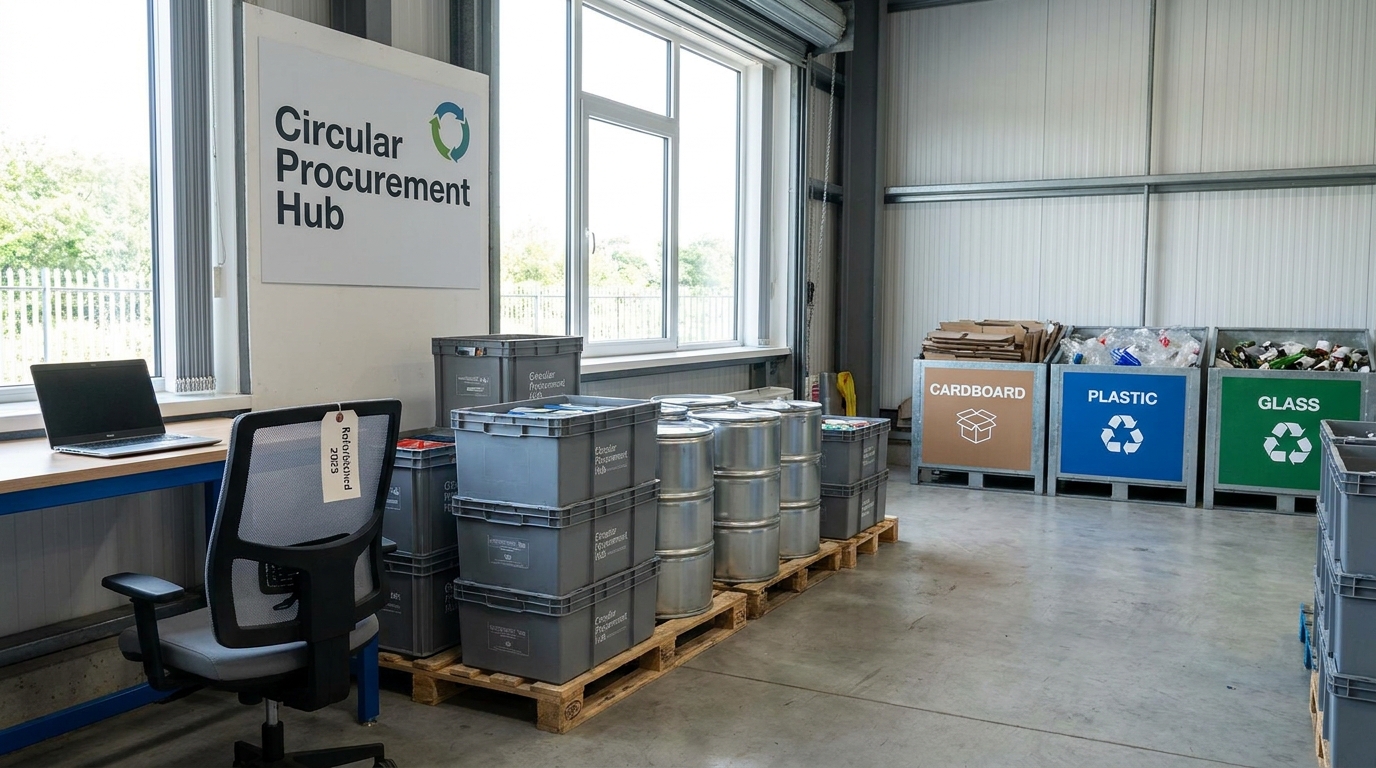
This category offers some of the most accessible opportunities for waste reduction. Concentrated products, refill systems, durable dispensers, and reduced-plastic packaging can all lower waste without compromising function. It is also helpful to look for recognized certifications that assess environmental and health attributes, especially in products used frequently in indoor environments.
Because these items are purchased repeatedly, small specification changes can create large cumulative benefits. This is a useful reminder that sustainable procurement is often less about dramatic innovation and more about consistent, quieter improvements.
Construction and renovation materials
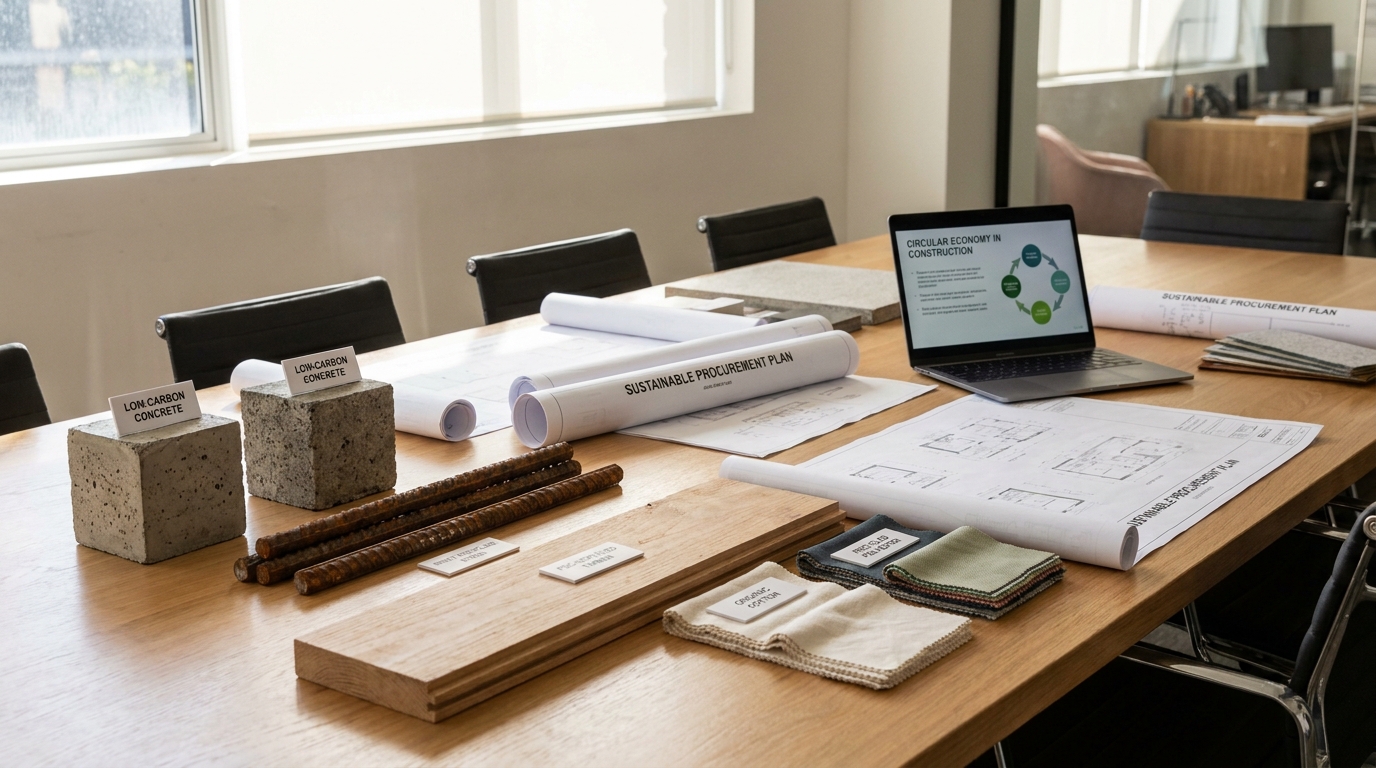
For building projects, procurement decisions shape waste and carbon impacts at a much larger scale. Material choices such as lower-carbon concrete mixes, recycled steel content, FSC-certified wood, modular systems, durable finishes, and locally appropriate materials can reduce embodied carbon and improve long-term performance. Waste planning also matters. Ordering efficiently, selecting standard dimensions, minimizing excess packaging, and planning for offcut recovery can reduce construction waste substantially.
This category also illustrates why upfront price alone can be misleading. Durable materials with lower maintenance needs and longer replacement cycles often support better long-term value, particularly in housing and commercial spaces meant to perform for decades.
Creating a sustainable procurement checklist you can actually use
If you want a practical place to begin, a short checklist is often more effective than a long policy document. The best checklists are simple enough to use regularly and flexible enough to apply across categories. They help create consistency without making every purchase feel bureaucratic.
A useful sustainable procurement checklist might include the following questions:
- Is this purchase necessary? Can we reduce, share, repair, or reuse instead?
- Is this a high-impact category? If yes, can we spend more time comparing alternatives?
- What is the expected lifespan? Is the product durable, maintainable, and repairable?
- What trusted certifications apply? Are there recognized standards for this category?
- How much packaging is involved? Can we choose bulk, refillable, returnable, or reduced-packaging options?
- What materials are used? Is there recycled content or lower-impact sourcing?
- What does end-of-life look like? Can it be reused, refurbished, recycled, or returned?
- Can the supplier provide environmental information? Even basic transparency can improve decisions.
- What is the life-cycle cost? How do energy use, maintenance, and replacement affect long-term value?
This kind of checklist is useful precisely because it does not ask for perfection. It creates a structure for asking better questions, which is usually where meaningful improvement begins.
How organizations can implement sustainable procurement without overwhelming staff
For organizations, the challenge is often less about intention and more about implementation. Staff may support sustainability in principle but feel pressed for time, uncertain about criteria, or concerned about disrupting established purchasing processes. A practical rollout acknowledges those realities rather than ignoring them.
One effective approach is to begin with one or two categories where both impact and feasibility are high. Office paper, cleaning supplies, breakroom products, electronics, or furniture are common starting points. Set a few clear criteria, identify preferred suppliers or approved product lists, and make those options easy to find. When sustainable choices become the default, staff do not have to reinvent the process every time.
It also helps to define success realistically. Instead of requiring every purchase to meet every possible criterion, organizations can track a few meaningful indicators such as percentage of spend in approved categories, reduction in single-use items, increased recycled content, or number of suppliers providing environmental data. The goal is improvement, not administrative perfection.
Training should be simple, practical, and connected to the actual decisions staff make. People do not need abstract sustainability theory to choose better products. They need examples, trusted labels, basic checklists, and permission to ask suppliers the right questions. Calm clarity tends to work better than pressure.
The role of certifications, policies, and shared procurement tools
One reason sustainable procurement is becoming more accessible is that buyers no longer have to build every criterion from scratch. Policies, standards, and shared procurement tools now provide a stronger foundation. In Canada, green standing offers and supply arrangements show how sustainability can be embedded into procurement systems so that buyers have easier access to vetted options. That kind of infrastructure matters because it lowers the expertise barrier and saves time.
For individuals and small organizations, the equivalent may be simpler but still meaningful. It could be a house rule to favor refillable cleaning products, FSC-certified paper, remanufactured furniture, or electronics with repair support. It could be a preferred vendor list based on packaging reduction and supplier transparency. Small systems are still systems, and they help sustainable procurement become routine rather than occasional.
Policies are most effective when they remain practical. A policy that no one can interpret or follow tends to create friction rather than improvement. A policy that names a few trusted certifications, highlights key product categories, and emphasizes life-cycle value is much more likely to guide better outcomes.
How to start at your own pace
If this topic feels new, the most important thing to remember is that sustainable procurement is scalable. You do not need a full sustainability department, an advanced carbon model, or a procurement law background to begin. You can start with one purchase category this month and another later. You can decide that from now on you will compare durability before price in one area where replacements happen often. You can ask one supplier for packaging reduction options. Each of those steps counts.
A calm, practical pace is often the best one because it leaves room to learn what works. Some categories will offer obvious improvements quickly. Others will take more time because information is limited or alternatives are still emerging. That is normal. Sustainable procurement is not a static checklist you complete once. It is an evolving practice of making better-informed choices as better options become available.
There is also no shame in trade-offs. A product may meet one sustainability goal but not another. A budget may limit what is possible in the short term. A supplier may be strong on durability but still weak on packaging. What matters is the direction of travel. Progress tends to come from asking better questions consistently, not from pretending every answer is simple.
Final thoughts: better choices over time
Sustainable procurement is one of the most practical ways to connect environmental goals with everyday decisions. It turns broad concerns about waste, emissions, and resource use into specific actions at the point of purchase. It helps households, businesses, nonprofits, and public institutions buy with more foresight and less waste. And importantly, it does so without requiring perfection or dramatic disruption.
The most useful way to think about sustainable procurement is as a habit of better choices over time. Start by asking whether the purchase is necessary. Focus on categories where the impact is meaningful. Look for credible standards. Compare life-cycle value, not just purchase price. Consider packaging, supplier transparency, and end-of-life before you buy. These steps are modest, but they are powerful because they work in the real world.
In a culture that often encourages speed, convenience, and replacement, sustainable procurement offers something steadier. It invites us to choose products and services with a little more care, a little more context, and a little more long-term thinking. That is not about doing everything at once. It is about building a purchasing practice that is practical, elegant, and lighter on the systems that support us.
And that is what makes sustainable procurement so worthwhile. It meets people where they are, gives them a realistic place to start, and turns ordinary buying decisions into lasting progress.



No Comment! Be the first one.