

China’s Twin Crash Is a Warning Shot for Real Estate Investors Everywhere
When a government stakes its entire economic pivot on a single asset class, the fallout from a crash becomes everyone’s problem. That is precisely what is unfolding in China right now, where a collapsing AI-driven stock rally is colliding with an already battered property sector, and the combination is forcing a hard look at what happens when household wealth sits concentrated in one place.
For context, real estate still accounts for roughly 70 percent of household wealth in China. That number alone should give pause to any investor who believes diversification is optional. Beijing’s plan was to shift savers away from property and into equities, using a stock-market boom to help fund an AI buildout and quietly de-emphasize a housing market that had already turned deflationary. Instead, China’s tech-heavy STAR 50 index has fallen 44 percent from its summer peak, and October data showed property investment sinking nearly 22 percent. Two pillars of wealth are weakening at the same time, and that is rarely a coincidence when one was meant to replace the other.
There is a lesson here that extends well beyond Shanghai. Investors who treat real estate and equities as interchangeable stores of value, rather than genuinely uncorrelated holdings, can find themselves exposed on both fronts during a single downturn. According to Yardeni Research, retail investors in China still largely treat the stock market as a casino rather than a retirement vehicle, a trust problem that has lingered since the 2015 crash and the 2020 tech crackdown. That kind of fragile sentiment makes capital skittish, and skittish capital tends to flee property and securities at the same time rather than rotating sensibly between them.
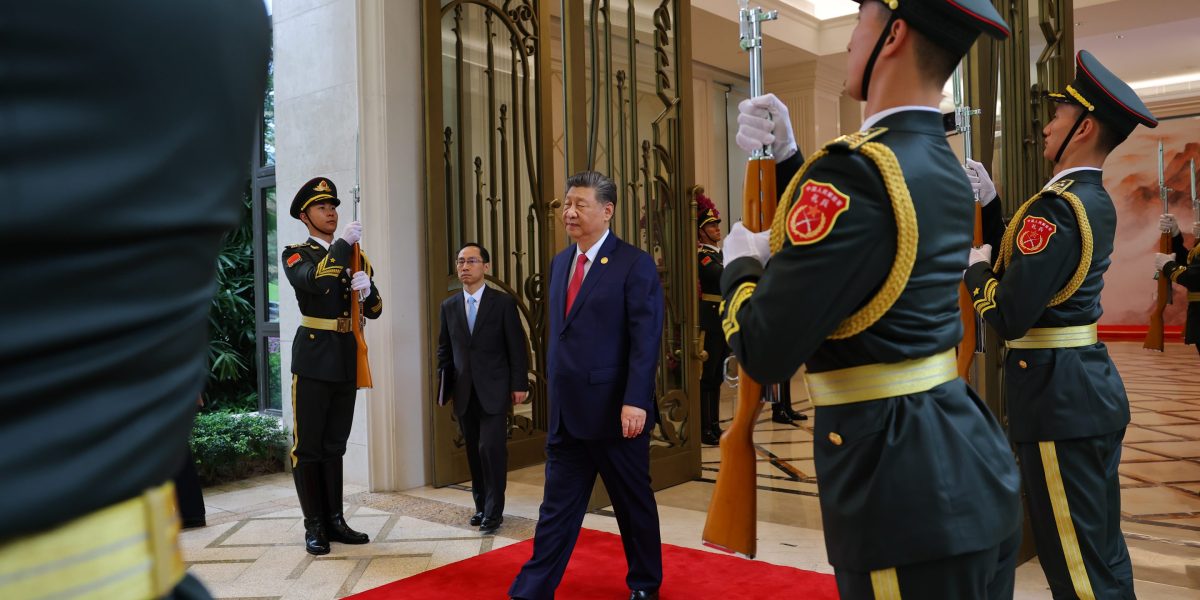
A bursting AI bubble would not merely erase wealth. It would weaken Beijing’s attempt to replace a broken property model with a stock-market-led one.
For investors watching from outside China, the opportunity is not to speculate on when Beijing’s markets stabilize, but to take the structural lesson seriously. Real estate remains one of the most durable wealth-building tools available precisely because it can be evaluated on fundamentals like location, rental demand, and long term supply, rather than on sentiment swings tied to a single sector’s fortunes. China’s experience shows what happens when policymakers try to manufacture a second asset bubble to paper over the first one. New export reliance, tariff pressure, and tightening technology controls on chip access only add to the uncertainty, and uncertainty is exactly what disciplined real estate investors are trained to price around rather than chase.
The takeaway for anyone building a portfolio is straightforward. Concentration risk does not disappear just because the asset class changes from property to equities. Genuine diversification, steady underwriting, and a clear eyed view of timing remain the strongest defenses against exactly the kind of twin collapse now playing out in China.