



Understanding Institutional Funding for Real Estate Investments
In today’s evolving real estate landscape, institutional funding has emerged as a pivotal force, reshaping how investments are financed and managed. This comprehensive guide aims to demystify institutional funding, exploring its potential impact on investment strategies and long-term financial goals. By contrasting it with traditional financing options, we will provide valuable insights for both novice and experienced investors navigating this complex arena.
Table Of Content
What is Institutional Funding?
Institutional funding encompasses a variety of capital sources, including life insurance companies, pension funds, institutional credit funds, and sovereign wealth entities, all of which are increasingly participating in the real estate finance sector. It also involves government-backed securitization programs, contributing to a robust funding ecosystem. As of 2024, commercial real estate (CRE) mortgage borrowing and lending in the United States surged to approximately $498 billion, marking a significant 16% increase from the previous year. The various stakeholders involved in institutional funding operating as a network provide diversified financial channels, proving advantageous for real estate investors.
The changing dynamics of the financial landscape highlight a necessity for institutional funding, as it offers both depth and stability as comparable to traditional methods. With institutions maintaining significant capital reserves, they facilitate larger transactions and offer more competitive terms, shifting the focus away from conventional bank lending. This shift stems from the emergence of a substantial “wall of capital” and the maturity of debt cycles influencing lending behaviors.
How Institutional Funding Differs from Traditional Financing
The most notable difference between institutional funding and traditional financing lies in the sources of capital and their respective operational models. Traditional financing typically relies on banks and local lenders, often resulting in more stringent regulations and limited lending thresholds. Institutional funding, conversely, taps into a broader pool of capital resources enabling a more agile response to market shifts.
For example, in Q4 2024, banks accounted for 43% of non-agency loan closings, while life insurance companies contributed 33%, illustrating a diversified lending environment. The role of alternative lenders, including private debt funds, also climbed to 23%. This diversity allows institutional funding to cover a wider range of investment types—from core properties to value-add opportunities—leading to tailored financing solutions that resonate with the immediate needs of real estate investors.
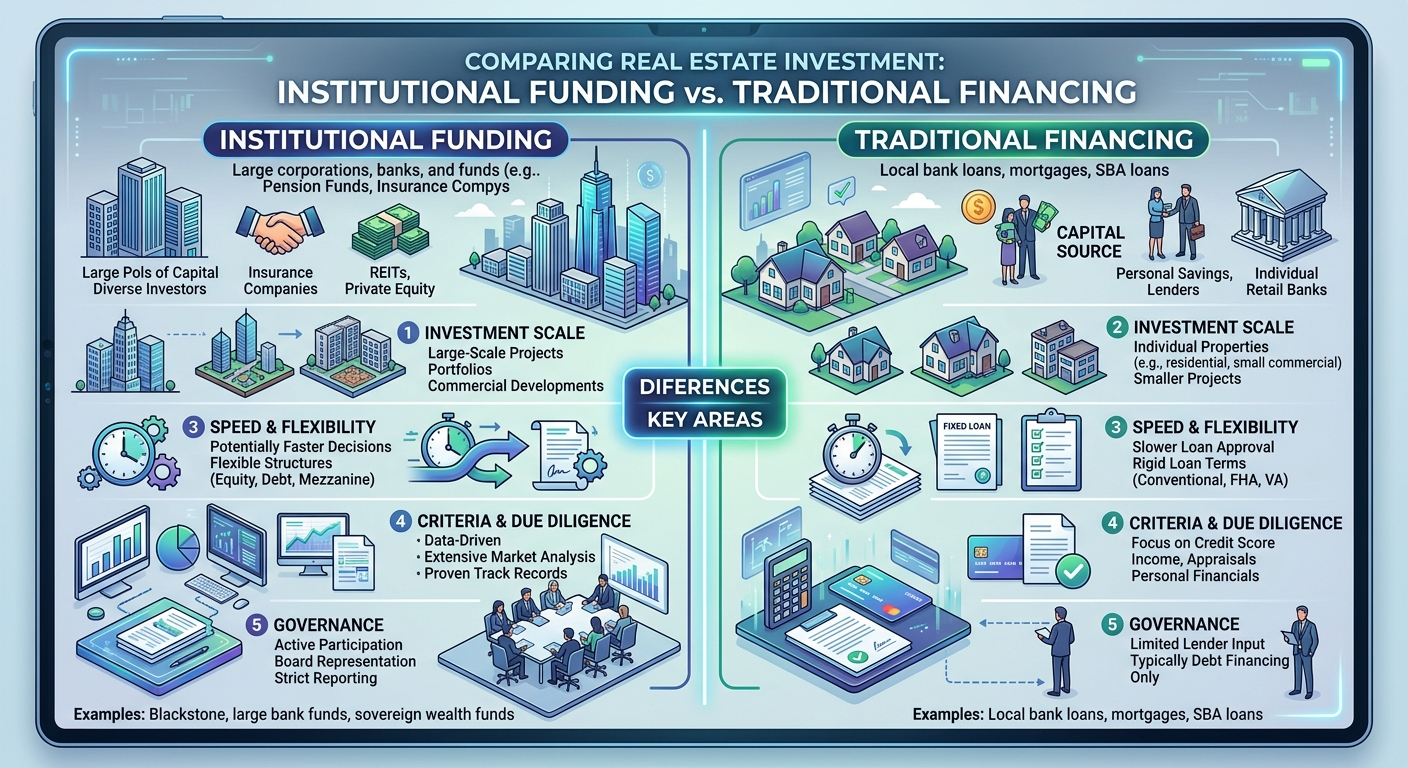
While institutional funding boasts several advantages, it also presents challenges. For investors, the complexity and intricacies of institutional structures may pose significant barriers to entry, particularly for those unfamiliar with sophisticated financial models and the nuances of risk assessment. However, the benefits often outweigh these challenges, provided investors are willing to navigate the learning curve.
Advantages and Challenges of Institutional Funding
Advantages
One of the primary advantages of institutional funding is the greater capital availability and liquidity it offers to investors. In a competitive market characterized by structural imbalance, the infusion of institutional capital provides essential support, allowing developers and investors to pursue projects that would otherwise be unattainable. Additionally, institutional investors tend to have a long-term perspective, aligning their capital with projects that promise sustained growth and stability, which is particularly relevant in the context of real estate.
Equally significant is the flexibility inherent in institutional funding. For example, institutions often provide a range of financial products—such as senior secured debt, mezzanine debt, preferred equity, and private credit—that enable borrowers to choose the most suitable mix to optimize risk and leverage. This multifaceted approach also accommodates various property types—from core assets in established markets to transitional properties requiring repositioning.
Challenges
Despite its notable advantages, institutional funding is not without challenges. For many investors, securing institutional funding necessitates a robust track record and established credibility. While the depth of capital provided may lead to favorable terms, these institutions typically demand strong deal structures and reliable sponsors. Consequently, emerging or less seasoned investors might find access to these funding sources limited.
Moreover, the potential for increased regulatory scrutiny on institutional lending, especially in light of ongoing market fluctuations, can complicate the funding landscape. Institutions must adapt to compliance requirements, which may, in turn, affect the availability of financing for certain projects. Investors must remain cognizant of these evolving regulations, ensuring their strategies align with institutional requirements.
Conclusion: Leveraging Institutional Funding for Growth
Institutional funding is redefining the framework within which real estate investments are undertaken. By understanding the nuances of this financing model, investors can unlock new opportunities and position themselves for sustained growth within the market. As builders and developers increasingly turn to institutional capital, realizing the evolving landscape becomes paramount.
Approximately 957 billion in CRE mortgage maturities is projected for 2025, necessitating a blended approach combining traditional bank facilities with institutional funding. The integration of various financing sources enhances investor liquidity and mitigates risks associated with interest rate volatility and economic uncertainty. While the road toward institutional funding may demand a certain level of expertise, those who embrace its complexities stand to benefit significantly from the generational wealth creation it offers.
As we navigate a future shaped by heightened competition and evolving markets, the importance of aligning investment strategies with institutional funding will continue to grow. Opportunity exists for those able to leverage the dynamics of this funding environment, poised to enhance their portfolios and ultimately drive long-term financial success in the world of real estate investments.




No Comment! Be the first one.