55 Old Broad Street Signals Where Prime Office Development Still Works
The restart of 55 Old Broad Street is more than another City of London office project moving out of pause mode. It is a signal about where capital still has confidence, what kind of commercial space can clear feasibility, and how transit-rich central land is being repositioned for the next cycle of urban growth.
As reported by Construction Enquirer, Skanska is set to begin work on the 23-storey scheme, with completion targeted for 2029. The project will deliver roughly 270,000 sq ft of high-quality office space, retail at ground level, and public realm improvements. AshbyCapital is now taking the scheme forward, while Landsec remains involved as development manager.
That ownership and delivery structure matters. In the current market, stalled schemes do not restart casually. Higher financing costs, construction inflation, occupier selectivity, and uncertainty around office demand have forced developers to separate marginal sites from genuinely strategic ones. A project beside Liverpool Street Station sits in a different category. It benefits from heavy rail, Underground, and Elizabeth line access, which turns location into a resilience factor rather than a branding line.
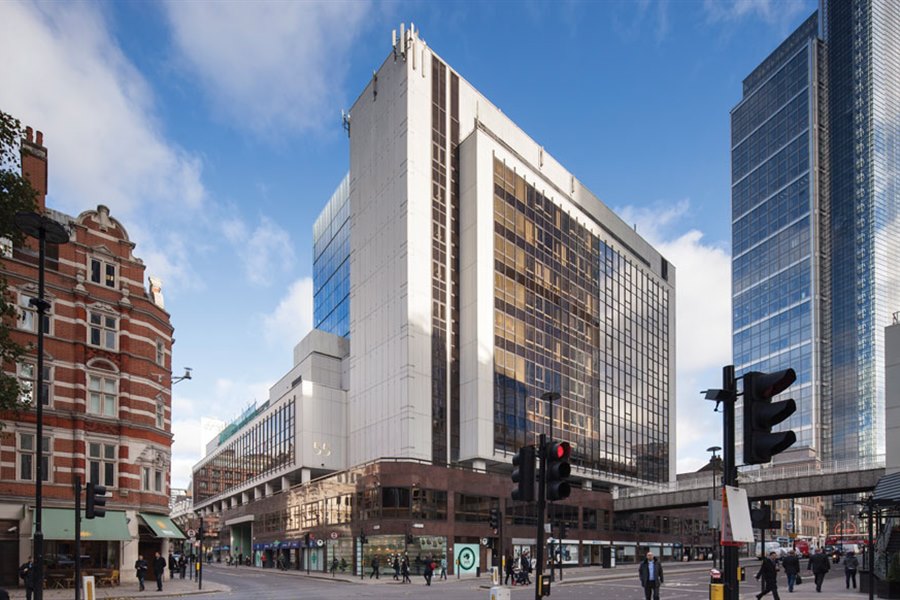
The development also reflects the continued bifurcation of the office market. Demand has not disappeared. It has narrowed. Occupiers are cutting weak space and competing for buildings with strong environmental performance, amenity, connectivity, and operational efficiency. That favours new or deeply upgraded assets in prime nodes, while older secondary buildings face rising obsolescence risk.
Skanska’s scope reinforces that point. The contractor is not only delivering the core build, but also mechanical, electrical and public health systems, plus Cat A office fit-out works. In a market where sustainability, energy performance, and building systems directly affect leasing velocity and valuation, MEP is no longer back-of-house detail. It is central to the investment thesis.
Prime urban land is only prime when infrastructure, occupier demand, policy support, and capital timing align.
The heritage component is equally important. The scheme includes refurbishment of the Grade II-listed Bishopsgate Victorian Bath House and the adjacent five-storey building at 65 Old Broad Street. This is the model increasingly shaping central-city development: intensification without erasing the urban fabric. For planners, that offers a way to support density while maintaining street-level identity. For developers, it adds complexity, but also creates differentiated value.
The housing lesson is indirect but relevant. Central employment districts still influence residential demand across the wider region. When major office investment concentrates around transit, it strengthens the case for housing intensification along connected corridors. Jobs, commuting patterns, and land values do not move separately. A renewed office node at Liverpool Street will continue to support demand pressure in surrounding and connected residential markets.
For developers and investors, the key takeaway is discipline. The next cycle will not reward generic density or speculative ambition alone. It will reward sites where access, policy, sustainability, placemaking, and capital structure converge. 55 Old Broad Street is moving because it sits at that intersection. That is what the market should be watching.
Source: Construction Enquirer