Australia’s Data Centre Boom Is Becoming a Property Intelligence Test
Australia’s data centre expansion is not just a technology story. It is a land-use signal. According to reporting from Elite Agent, the country now has at least 162 operational data centres and another 90 projects in development, while residential building approvals fell 5.7 per cent in May. Two infrastructure cycles are moving in opposite directions: digital capacity is accelerating, while housing delivery remains constrained.
For property intelligence teams, the useful insight is not simply that data centres are growing. It is that they are reshaping how institutional capital prices land, power, planning risk, and long-term occupancy. The asset class has moved beyond industrial property and into its own category, driven by cloud computing, AI workloads, data sovereignty rules, and demand for low-latency connectivity.
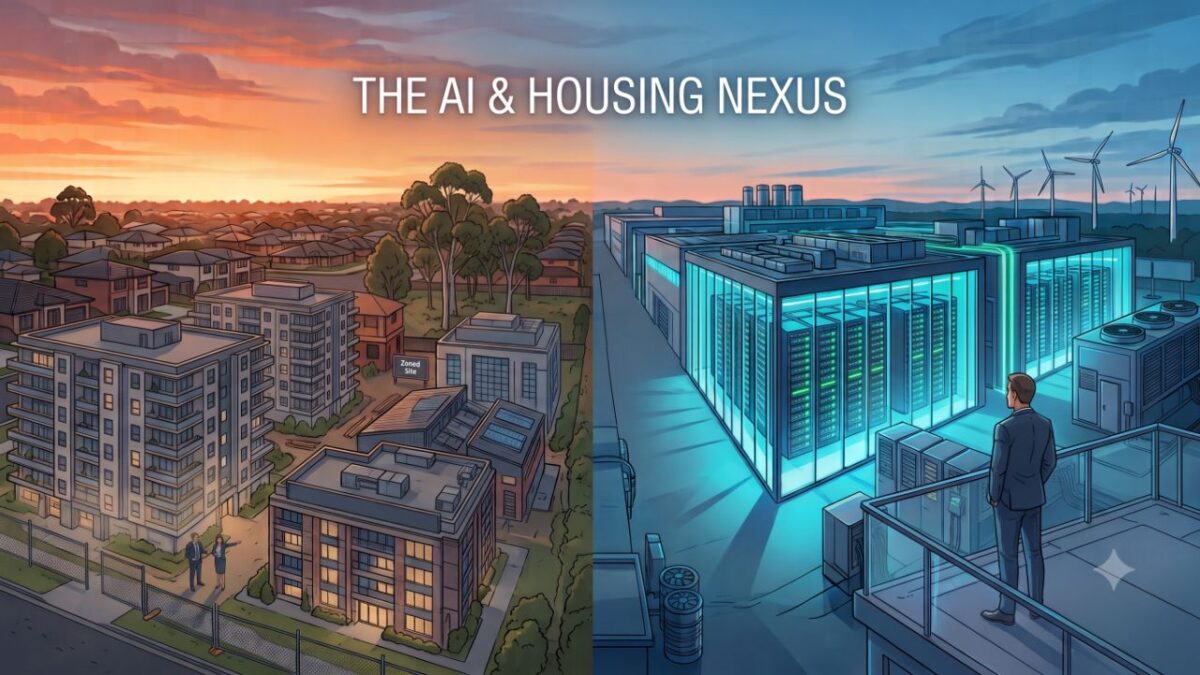
The site-selection model is unusually unforgiving. A viable data centre location needs fibre connectivity, high-voltage power capacity, water access, industrial zoning, and planning tolerance. Cheap land is not enough. In practice, this concentrates demand into narrow corridors such as Macquarie Park, Melbourne industrial precincts, and coastal landing points connected to subsea cables. These are not broad market movements. They are highly specific geospatial filters.
This creates a different kind of property dataset. Traditional industrial analysis looks at rents, vacancies, transport access, and tenant demand. Data centre analysis adds grid capacity, renewable procurement, cooling requirements, latency, cyber-security constraints, and regulatory exposure. The result is a smaller investable universe, but one with unusually durable income. Tenants commonly commit for 10 to 20 years, which helps explain why yields can compress to around 4 per cent.
The next premium industrial site may be defined less by road access and more by megawatts, fibre routes, and the ability to behave as part of the energy system.
The pressure point is energy. Elite Agent cites Australian Energy Market Operator projections that data centre electricity consumption could triple by 2030, broadly equivalent to the power needs of every home in Victoria. That forecast changes the underwriting model. Power is no longer an operating input sitting in the background. It becomes a core development constraint and a political risk variable.

The proposed “triple-lock” obligations described in the source article point to where the market is heading. New projects may need to bring or fund clean supply, pay their share of network connection costs, and reduce demand during peak periods. If implemented strictly, the best data centres will not only consume power. They will operate as flexible grid assets, paired with renewable generation and demand-response capability.
That matters for housing because both sectors compete for planning bandwidth, infrastructure capacity, construction labour, and developable land in high-value corridors. The comparison is not one-for-one, but the divergence is meaningful. Australia is proving it can mobilise capital rapidly for digital infrastructure when revenue certainty is strong and institutional demand is clear. Housing, by contrast, remains exposed to fragmented approvals, weaker feasibility, and slower delivery economics.
The intelligence gap is now site-level transparency. Commercial agents, developers, and councils should be mapping energy capacity, fibre proximity, water constraints, zoning overlays, and renewable connection pathways with the same discipline once reserved for transport and demographics. Edge data centres may also open adaptive reuse opportunities in smaller metro and regional markets, but only where the physical infrastructure supports them.
The signal to track is not just the number of data centres approved. It is the quality of their infrastructure stack. In the AI economy, property value will increasingly be priced by invisible networks: electricity, data, cooling, and regulation. The market participants who can see those layers first will understand the next cycle before it appears in rents or sales evidence.
Source: Elite Agent